Lexicalized Grammar 101
Matthew Stone
Department of Computer Science and Center for Cognitive Science Rutgers, the State University of New Jersey
Piscataway NJ 08854-8019 USA http://www.cs.rutgers.edu/˜mdstone
Abstract
This paper presents a simple and ver-satile tree-rewriting lexicalized grammar formalism, TAGLET, that provides an ef-fective scaffold for introducing advanced topics in a survey course on natural lan-guage processing (NLP). Students who implement a strong competence TAGLET parser and generator simultaneously get experience with central computer science ideas and develop an effective starting point for their own subsequent projects in data-intensive and interactive NLP.
1 Introduction
This paper is particularly addressed to readers at in-stitutions whose resources and organization rule out extensive formal course-work in natural language processing (NLP). This is typical at universities in North America. In such places, NLP teaching must be ambitious but focused; courses must quickly ac-quaint a broad range of students to the essential concepts of the field and sell them on its current research opportunities and challenges. This paper presents one resource that may help. Specifically, I outline a simple and versatile lexicalized formal-ism for natural language syntax, semantics and prag-matics, called TAGLET, and draw on my experi-ence with CS 533 (NLP) at Rutgers to motivate the potential role for TAGLET in a broad NLP class whose emphasis is to introduce topics of current re-search. Notes, assignments and implementations for TAGLET are available on the web.
I begin in Section 2 by describing CS 533— situating the course within the university and outlin-ing its topics, audience and goals. I then describe the specific goals for teaching and implementing gram-mar formalisms within such a course, in Section 3. Section 4 gives an informal overview of TAGLET, and the algorithms, specifications and assignments that fit TAGLET into a broad general NLP class.
In brief, TAGLET is a context-free tree-rewriting formalism, defined by the usual complementation operation and the simplest imaginable modifica-tion operamodifica-tion. By implementing a strong compe-tence TAGLET parser and generator students simul-taneously get experience with central computer sci-ence ideas—data structures, unification, recursion and abstraction—and develop an effective starting point for their own subsequent projects. Two note-worthy directions are the construction of interac-tive applications, where TAGLET’s relainterac-tively scal-able and reversible processing lets students easily explore cutting-edge issues in dialogue semantics and pragmatics, and the development of linguistic specifications, where TAGLET’s ability to lexical-ize tree-bank parses introduces a modern perspec-tive of linguistic intuitions and annotations as pro-grams. Section 5 briefly summarizes the advantages of TAGLET over the many alternative formalisms that are available; an appendix to the paper provides more extensive technical details.
2 CS 533
NLP at Rutgers is taught as part of the graduate ar-tificial intelligence (AI) sequence in the computer science department. As a prerequisite, computer sci-ence students are expected to be familiar with
abilistic and decision-theoretic modeling (including statistical classification, hidden Markov models and Markov decision processes) from the graduate-level AI foundations class. They might take NLP as a pre-liminary to research in dialogue systems or in learn-ing for language and information—or simply to ful-fill the breadth requirement of MS and PhD degrees. Students from a number of other departments fre-quently get involved in natural language research, however, and are also welcome in 533; on average, only about half the students in 533 come from com-puter science. Students from the linguistics depart-ment frequently undertake computational work as a way of exploring practical learnability as a con-straint on universal grammar, or practical reasoning as a constraint on formal semantics and pragmatics. The course also attracts students from Rutgers’s li-brary and information science department, its pri-mary locus for research in information retrieval and human-computer interaction. Ambitious undergrad-uates can also take 533 their senior year; most par-ticipate in the interdisciplinary cognitive science un-dergraduate major. 533 is the only computational course in natural language at Rutgers.
Overall, the course is structured into three mod-ules, each of which represents about fifteen hours of in-class lecture time.
The first module gives a general overview of lan-guage use and dialogue applications. Lectures fol-low (Clark, 1996), but instill the practical method-ology for specifying and constructing knowledge-based systems, in the style of (Brachman et al., 1990), into the treatment of communication. Con-currently, students explore precise descriptions of their intuitions about language and communication through a series of short homework exercises.
The second module focuses on general techniques for linguistic representation and implementation, us-ing TAGLET. With an extended TAGLET project, conveniently implemented in stages, we use basic tree operations to introduce Prolog programming, including data structures, recursion and abstraction much as outlined in (Sterling and Shapiro, 1994); then we write a simple chart parser with incremental interpretation, and a simple communicative-intent generator scaled down after (Stone et al., 2001).
The third module explores the distinctive prob-lems of specific applications in NLP, including
spo-ken dialogue systems, information retrieval and text classification, spelling correction and shallow tag-ging applications, and machine translation. Jurafsky and Martin (2000) is our source-book. Concurrently, students pursue a final project, singly or in cross-disciplinary teams, involving a more substantial and potentially innovative implementation.
In its overall structure, the course seems quite successful. The initial emphasis on clarifying in-tuitions about communication puts students on an even footing, as it highlights important ideas about language use without too much dependence on spe-cialized training in language or computation. By the end of the class, students are able to build on the more specifically computational material to come up with substantial and interesting final projects. In Spring 2002 (the first time this version of 533 was taught), some students looked at utterance interpre-tation, response generation and graphics generation in dialogue interaction; explored statistical methods for word-sense disambiguation, summarization and generation; and quantified the potential impact of NLP techniques on information tasks. Many of these results represented fruitful collaborations between students from different departments.
Naturally, there is always room for improvement, and the course is evolving. My presentation of TAGLET here, for example, represents as much a project for the next run of 533 as a report of this year’s materials; in many respects, TAGLET actu-ally emerged during the semester as a dynamic reac-tion to the requirements and opportunities of a six-week module on general techniques for linguistic representation and implementation.
3 Language and Computation in NLP
emphasis on computational fundamentals; it means that they are building on and reinforcing their ex-pertise in computation in exploring its application to language. Nevertheless, NLP is not compiler con-struction. Programming assignments should always underline a worthwhile linguistic lesson, not indulge in implementation for its own sake.
This perspective suggests a number of desiderata for the grammar formalism for a survey course in NLP.
Tree rewriting. Students need to master recur-sive data-structures and programming. NLP directs our attention to the recursive structures of linguistic syntax. In fact, by adopting a grammar formalism whose primitives operate on these structures as first-class objects, we can introduce a rich set of relatively straightforward operations to implement, and moti-vate them by their role in subsequent programs.
Lexicalization. Students need to distinguish be-tween specification and implementation, and to un-derstand the barriers of abstraction that underlie the distinction. Lexicalized grammars come with a ready notion of abstraction. From the outside, ab-stractly, a lexicalized grammar analyzes each sen-tence as a simple combination of atomic elements from a lexicon of options. Simultaneously, a con-crete implementation can assign complex structures to the atomic elements (elementary trees) and imple-ment complex combinatory operations.
Strong competence implementation. Students need to understand how natural language must and does respond to the practical logic of physical re-alization, like all AI (Agre, 1997). Mechanisms that use grammars face inherent computational problems and natural grammars in particular must respond to these problems: students should undertake imple-mentations which directly realize the operations of the grammar in parsing and generation. But these must be effective programs that students can build on—our time and interest is too scarce for extensive reimplementations.
Simplicity. Where possible, linguistic proposals should translate readily to the formalism. At the same time, students should be able to adapt aspects of the formalism to explore their own judgments and ideas. Where possible, students should get in-tuitive and satisfying results from straightforward algorithms implemented with minimal bookkeeping
and case analysis. At the same time, there is no rea-son why the formalism should not offer opportuni-ties for meaningful optimization.
We cannot expect any formalism to fare perfectly by all these criteria—if any does, it is a deep fact about natural language! Still, it is worth remark-ing just how badly these criteria judge traditional unification-based context-free grammars (CFGs), as presented in say (Pereira and Shieber, 1987). Data-structures are an afterthought in CFGs; CFGs can-not in principle be lexicalized; and, whatever their merits in parsing or recognition, CFGs set up a pos-itively abysmal search space for meaningful genera-tion tasks.
4 TAGLET
TAGLET1 is my response to the objectives mo-tivated in Section 2 and outlined in Section 3. TAGLET represents my way of distilling the essen-tial linguistic and computational insights of lexical-ized tree-adjoining grammar—LTAG (Joshi et al., 1975; Schabes, 1990)—into a form that students can easily realize in end-to-end implementations.
4.1 Overview
Like LTAG, TAGLET analyzes sentences as a com-plex of atomic elements combined by two kinds of operations, complementation and modification. Ab-stractly, complementation combines a head with an argument which is syntactically obligatory and se-mantically dependent on the head. Abstractly, mod-ification combines a head with an adjunct which is syntactically optional and need not involve any spe-cial semantic dependence. Cruspe-cially for generation, in a derivation, modification and complementation operations can apply to a head in any order, often yielding identical structures in surface syntax. This means the generator can provide required material first, then elaborate it, enabling use of grammar in high-level tasks such as the planning of referring ex-pressions or the “aggregation” of related semantic material into a single complex sentence.
Concretely, TAGLET operations are implemented by operations that rewrite trees. Each lexical el-ement is associated with a fragmentary
C
T +
T’ C
⇒
[image:4.612.320.541.72.156.2]T’ C T
Figure 1: Substitution (complementation).
C T
+
T’ C’
C*
⇒
T’ C’
[image:4.612.76.285.186.273.2]C T
Figure 2: Forward sister-adjunction (modification.)
structure tree containing a distinguished word called the anchor. For complementation, TAGLET adopts TAG’s substitution operation; substitution replaces a leaf node in the head tree with the phrase struc-ture tree associated with the complement. See Fig-ure 1. For modification, TAGLET adopts the the sister-adjunction operation defined in (Rambow et al., 1995); sister-adjunction just adds the modifier subtree as a child of an existing node in the head tree—either on the left of the head (forward sister-adjunction) as in Figure 2, or on the right of the head (backward sister-adjunction). I describe TAGLET formally in Appendix A.
TAGLET is equivalent in weak generative power to context-free grammar. That is, any language de-fined by a TAGLET also has a CFG, and any lan-guage defined by a CFG also has a TAGLET. On the other hand context-free languages can have deriva-tions in which all lexical items are arbitrarily far from the root; TAGLET derived structures always have an anchor whose path to the root of the sen-tence has a fixed length given by a grammatical ele-ment. See Appendix B. The restriction seems of lit-tle linguistic significance, since any tree-bank parse induces a unique TAGLET grammar once you la-bel which child of each node is the head, which are complements and which are modifiers. Indeed, since TAGLET thus induces bigram dependency struc-tures from trees, this invites the estimation of proba-bility distributions on TAGLET derivations based on
NP
Chris
S
HHH
NP VP
HH
V
loves NP
NP
Sandy
VP* \
ADVP
madly
Figure 3: Parallel analysis in TAGLET and TAG.
observed bigram dependencies; see (Chiang, 2000). To implement an effective TAGLET generator, you can perform a greedy head-first search of deriva-tions guided by heuristic progress toward achieving communicative goals (Stone et al., 2001). Mean-while, because TAGLET is context-free, you can easily write a CKY-style dynamic programming parser that stores structures recognized for spans of text in a chart, and iteratively combines structures in adjacent spans until the analyses span the entire sentence. (More complexity would be required for multiply-anchored trees, as they induce discontinu-ous constituents.) The simple requirement that op-erations never apply inside complements or modi-fiers, and apply left-to-right within a head, suffices to avoid spurious ambiguity. See Appendix C.
4.2 Examples
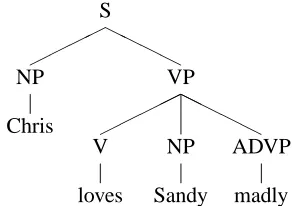
With TAGLET, two kinds of examples are instruc-tive: those where TAGLET can mirror TAG, and those where it cannot. For the first case, consider an analysis of Chris loves Sandy madly by the trees of Figure 3. The final structure is:
S
HHH
H
NP
Chris
VP
H H H H H
V
loves
NP
Sandy
ADVP
madly
[image:4.612.366.514.532.635.2]Q
HH
NP
who
S/NP
NP
Chris
S/NP
HHH
NP VP/NP
HH
V
thinks
S/NP
NP
Sandy
S/NP
HH
NP VP/NP
V
[image:5.612.87.302.74.247.2]likes
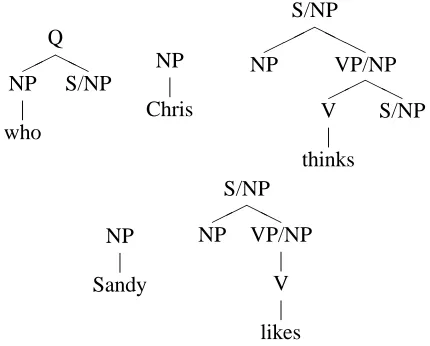
Figure 4: TAGLET requires a gap-threading analy-sis of extraction (or another context-free analyanaly-sis).
Q
HHHH
NP
who
S/NP
HHHH
NP
Chris
VP/NP
HHH
V
thinks
S/NP
HHH
NP
Sandy
VP/NP
V
likes
The use of syntactic features amounts to an in-termediate case. In TAGLET derivations (unlike in TAG) nodes accrete children during the course of a derivation but are never rewritten or split. Thus, we can decorate any TAGLET node with a single set of syntactic features that is preserved throughout the derivation. Consider the trees for he knows below:
NP
NM SG CS X
/he/
S
HHH
H
NP
NM Y CS N
VP
V NM Y
/know/
When these trees combine, we can immediately unify the number Y of the verb with the pronoun’s
singular; we can immediately unify the caseXof the pronoun with the nominative assigned by the verb:
S
H H H H H
NP
NM SG CS N
/he/
VP
V NM SG
/know/
The feature values will be preserved by further steps of derivation.
4.3 Building on TAGLET
Semantics and pragmatics are crucial to NLP. TAGLET lets students explore meaty issues in se-mantics and pragmatics, using the unification-based semantics proposed in (Stone and Doran, 1997). We view constituents as referential, or better, indexical; we link elementary trees with constraints on these indices and conjoin the constraints in the meaning of a compound structure. This example shows how the strategy depends on a rich ontology:
S:e
HHH
H
NP:c
Chris
VP:e
H H H H H
V:e
loves
NP:s
Sandy
ADVP:e
madly chris(c)∧sandy(s)∧love(e,c,s)∧mad(e)
The example also shows how the strategy lets us quickly implement, say, the constraint-satisfaction approaches to reference resolution or the plan-recognition approaches to discourse integration de-scribed in (Stone and Webber, 1998).
4.4 Lectures and Assignments
substitution and modification for parsing and gener-ation; they use these combinatory operations to write a CKY TAGLET parser.
The next two weeks begin with lectures on the lexicon, emphasizing abstraction on the computa-tional side and the idiosyncrasy of lexical syntax and the indexicality of lexical semantics on the linguis-tic side; and continue with lectures on semanlinguis-tics and interpretation. Meanwhile, students add reference resolution to the parser, and implement routines to construct grammars from tree-bank parses.
The final two weeks cover generation as problem-solving, and search through the grammar. Students reuse the grammar and interpretation model they al-ready have to construct a generator.
5 Conclusion
Important as they are, lexicalized grammars can be forbidding. Versions of TAG and combinatory categorial grammars (CCG) (Steedman, 2000), as presented in the literature, require complex book-keeping for effective computation. When I wrote a CCG parser as an undergraduate, it took me a whole semester to get an implemented handle on the metatheory that governs the interaction of (cross-ing) composition or type-raising with spurious am-biguity; I still have never written a TAG parser or a CCG generator. Variants of TAG like TIG (Schabes and Waters, 1995) or D-Tree grammars (Rambow et al., 1995) are motivated by linguistic or formal considerations rather than pedagogical or computa-tional ones. Other formalisms come with linguistic assumptions that are hard to manage. Link gram-mar (Sleator and Temperley, 1993) and other pure dependency formalisms can make it difficult to ex-plore rich hierarchical syntax and the flexibility of modification; HPSG (Pollard and Sag, 1994) comes with a commitment to its complex, rather bewilder-ing regime for formalizbewilder-ing lbewilder-inguistic information as feature structures. Of course, you probably could refine any of these theories to a simple core—and would get something very like TAGLET.
I strongly believe that this distillation is worth the trouble, because lexicalization ties grammar for-malisms so closely to the motivations for studying language in the first place. For linguistics, this phi-losophy invites a fine-grained description of
sen-tence syntax, in which researchers document the di-versity of linguistic constructions within and across languages, and at the same time uncover impor-tant generalizations among them. For computation, this philosophy suggests a particularly concrete ap-proach to language processing, in which the infor-mation a system maintains and the decisions it takes ultimately always just concern words. In taking TAGLET as a starting point for teaching implemen-tation in NLP, I aim to expose a broad range of stu-dents to a lexicalized approach to the cognitive sci-ence of human language that respects and integrates both linguistic and computational advantages.
Acknowledgments
Thanks to the students of CS 533 and four anony-mous reviewers for helping to disabuse me of nu-merous preconceptions.
References
Philip E. Agre. 1997. Computation and Human Experi-ence. Cambridge.
Ronald Brachman, Deborah McGuinness, Peter Pa-tel Schneider, Lori Alperin Resnick, and Alexander Borgida. 1990. Living with CLASSIC: when and how to use a KL-ONE-like language. In J. Sowa, editor, Principles of Semantic Networks. Morgan Kaufmann.
David Chiang. 2000. Statistical parsing with an automatically-extracted tree adjoining grammar. In ACL, pages 456–463.
Herbert H. Clark. 1996. Using Language. Cambridge University Press, Cambridge, UK.
John E. Hopcroft, Rajeev Motwani, and Jeffrey D. Ull-man. 2000. Introduction to automata theory, lan-guages and computation. Addison-Wesley, second edition.
Aravind K. Joshi, L. Levy, and M. Takahashi. 1975. Tree adjunct grammars. Journal of the Computer and Sys-tem Sciences, 10:136–163.
Daniel Jurafsky and James H. Martin. 2000. Speech and Language Processing: An introduction to nat-ural language processing, computational linguistics and speech recognition. Prentice-Hall.
Carl Pollard and Ivan A. Sag. 1994. Head-Driven Phrase Structure Grammar. University of Chicago Press, Chicago.
Owen Rambow, K. Vijay-Shanker, and David Weir. 1995. D-Tree grammars. In ACL, pages 151–158.
Yves Schabes and Richard C. Waters. 1995. Tree-insertion grammar: A cubic-time parsable formalism that lexicalizes context-free grammar without chang-ing the trees produced. Computational Linguistics, 21:479–513.
Yves Schabes. 1990. Mathematical and Computational Aspects of Lexicalized Grammars. Ph.D. thesis, Com-puter Science Department, University of Pennsylva-nia.
Daniel Sleator and Davy Temperley. 1993. Parsing English with a link grammar. In Third International Workshop on Parsing Technologies.
Mark Steedman. 2000. The Syntactic Process. MIT.
Leon Sterling and Ehud Shapiro. 1994. The Art of Pro-log. MIT, second edition.
Matthew Stone and Christine Doran. 1997. Sentence planning as description using tree-adjoining grammar. In Proceedings of ACL, pages 198–205.
Matthew Stone and Bonnie Webber. 1998. Textual economy through close coupling of syntax and seman-tics. In Proceedings of International Natural Lan-guage Generation Workshop, pages 178–187.
Matthew Stone, Christine Doran, Bonnie Webber, Tonia Bleam, and Martha Palmer. 2001. Microplanning with communicative intentions: The SPUD system. Under review.
A Definitions
I define TAGLET in terms of primitive trees. The definitions require a set VT of terminal categories, corresponding to our lexical items, and a disjoint set VNof nonterminal categories, corresponding to con-stituent categories. TAGLET uses trees labeled by these categories both as representations of the syn-tactic structure of sentences and as representations of the grammatical properties of words:
• A syntactic tree is a tree whose nodes are each assigned a unique label in VN∪VT, such that only leaf nodes are assigned a label in VT.
• A lexical tree is a syntactic tree in which ex-actly one node, called the anchor, is assigned a label in VT. The path through such a tree from the root to the anchor is called the spine.
A primitive tree is lexical tree in which every leaf is the child of a node on the spine. See Figures 3 and 4. A TAGLET element is a pairhT,Oiconsisting of primitive tree together with the specification of the operation for the tree; the allowable operations are complementation, indicated by α; premodification at a specified category C∈VN, indicated byβ→(C) and postmodification at a specified category C∈VN, indicated byβ←(C).
Formally, then, a TAGLET grammar is a tuple G=hVT,VN,Γi where VT gives the set of termi-nal categories, VN gives the set of nonterminal cat-egories, andΓgives a set of TAGLET elements for VT and VN. Given a TAGLET grammar G, the set of derived trees for G is defined as the smallest set closed under the following operations:
• (Initial) SupposehT,Oi ∈Γ. ThenhT,Oi is a derived tree for G.
• (Substitution) SupposehT,Oiis a derived tree for G where T contains leaf node n with label C∈VN; and supposehT0,αiis a derived tree for G where the root of T0 also has label C. Then hT00,Oiis a derived tree for G where T00is ob-tained from T by identifying node n with the root of T0.
• (Premodification) SupposehT,Oi is a derived tree for G where T contains node n with label C∈VN, and suppose hT0,β→(C)i is a derived tree for G. ThenhT00,Oiis a derived tree for G where T00 is obtained from T by adding T0 as the first child of node n.
• (Postmodification) SupposehT,Oiis a derived tree for G where T contains node n with label C∈VN, and suppose hT0,β←(C)i is a derived tree for G. ThenhT00,Oiis a derived tree for G where T00 is obtained from T by adding T0 as the last child of node n.
B Properties
Each node in a TAGLET derived tree T is first con-tributed by a specific TAGLET element, and so in-directly by a particular anchor. Accordingly, we can construct a lexicalized derivation tree corresponding to T . Nodes in the derivation tree are labeled by the elements used in deriving T . An edge leads from parent E to child E0 if T includes a step of deriva-tion in which E0is substituted or sister-adjoined at a node first contributed by E. To make the derivation unambiguous, we record the address of the node in E at which the operation applies, and we order the edges in the derivation tree in the same order that the corresponding operations are applied in T . For Figure 3, we have:
α2:loves
H H H H H H H H
α1:Chris (0) α3:Sandy (1.1) β←4 :madly (1.1)
Let L be a CFL. Then there is a grammar G for L in Greibach normal form (Hopcroft et al., 2000), where each production has the form
A→xB1...Bn
where x∈VTand Bi∈VN. For each such production, create the TAGLET element which allows comple-mentation with a tree as below:
A
HHH
x B1 Bn
An easy induction transforms any derivation in G to a derivation in this TAGLET grammar, and vice versa. So both generate the same language L.
Conversely, we can build a CFG for a TAGLET by creating nonterminals and productions for each node in a TAGLET elementary structure, taking into ac-count the possibilities for optional premodification and postmodification as well as complementation.
C Parsing
Suppose we make a bottom-up traversal of a TAGLET derivation tree to construct the derived tree. After we finish with each node (and all its chil-dren), we obtain a subtree of the final derived tree.
This subtree represents a complete constituent that must appear as a subsequence of the final sentence. A CKY TAGLET parser just reproduces this hier-archical discovery of constituents, by adding com-pleted constituents for complements and modifiers into an open constituent for a head.
The only trick is to preserve linear order; this means adding each new complement and modifier at a possible “next place”, without skipping past miss-ing complements or slippmiss-ing under existmiss-ing modi-fiers. To do that, we only apply operations that add completed constituents T2 along what is known as
the frontier of the head tree T1, further away from
the head than previously incorporated material. This concept, though complex, is essential in any account of incremental structure-building. To avoid spuri-ous ambiguities, we also require that operations to the left frontier must precede operations to the right frontier. This gives a relationCOMBINE(T1,T2,T3).
The parser analyses a string of length N using a dynamic-programming procedure to enumerate all the analyses that span contiguous substrings, short-est substrings first. We write T ∈(i,j) to indicate that object T spans position i to j. The start of the string is position 0; the end is position N. So we have:
for word w∈(i,i+1), T with anchor w add T ∈(i,i+1)
for k←2 up to N for i←k−2 down to 0
for j←i+1 up to k−1 for T1∈(i,j)and T2∈(j,k)
for T3withCOMBINE(T1,T2,T3)
add T3∈(i,k)