Neural Scoring Function for MST Parser
Jindˇrich Libovick´y
Charles University in PragueMalostransk´e n´amˇest´ı 25, Praha, Czech Republic [email protected]
Abstract
Continuous word representations appeared to be a useful feature in many natural language processing tasks. Using fixed-dimension pre-trained word embeddings allows avoiding sparse bag-of-words representation and to train models with fewer parameters. In this paper, we use fixed pre-trained word embeddings as additional features for a neural scoring function in the MST parser. With the multi-layer architecture of the scoring function we can avoid handcrafting feature conjunctions. The continuous word representations on the input also allow us to reduce the number of lexical features, make the parser more robust to out-of-vocabulary words, and reduce the total number of parameters of the model. Although its accuracy stays below the state of the art, the model size is substantially smaller than with the standard features set. Moreover, it performs well for languages where only a smaller treebank is available and the results promise to be useful in cross-lingual parsing.
Keywords:dependency parsing, MST Parser, word embeddings, Matrix-tree theorem
1.
Introduction
Syntactic parsing is one of the oldest problems studied by Computational Linguistics. Recently, dependency parsing gained big popularity with graph-based (McDonald et al., 2005) and transition-based parsing (Nivre, 2006) being two major paradigms.
In this paper, we work with MST parser – the most of-ten used graph-based approach. We present several exper-iments showing how pre-trained word embeddings could be used instead of explicit categorial (one-hot) lexical fea-tures. Training of the word embeddings is based on lan-guage modeling, so it can be trained on plain text with any further annotation. They can be computed on much bigger data than the treebanks used for training the parser. By having the lexical information in form of embeddings, the model can learn how to deal with words that were not seen in the training part of the treebank (out-of-vocabulary words).
The simple neural scoring function that we propose can be used to avoid handcrafting feature templates for feature conjunctions. We use the Matrix-Tree theorem (Chaiken and Kleitman, 1978) to sum all possible sentence parses to be able to use a gradient learning procedure as proposed by Koo et al. (2007). Using such a scoring function also allows to control the number of parameters of the model. In the next section, we summarize related work. Section 3. describes the model we use for training. In Section 4. we evaluate the model. Section 5. then concludes the work.
2.
Related Work
In the MSTParser by McDonald et al. (2005), parsing is modeled as finding the maximum spanning tree in a weighted oriented complete graph with vertices represent-ing words of the sentence. The purpose of the learnrepresent-ing pro-cedure is therefore to find a function that favors the edges which are actual dependencies in the sentence. The advan-tage of using such a model is that it can naturally produce non-projective parses.
Bansal et al. (2014) tried to use word embeddings to im-prove the MSTParser. First, they used the word embed-dings dimensions as features for a linear model, which did not bring any success. This can be explained by findings of Szegedy et al. (2013) who claimed that in neural mod-els, the information is encoded by properties of the whole vector space induced by the neural network rather than the individual dimensions.
What actually appeared to be a helpful feature for Bansal et al. (2014) was word clustering based on the cosine dis-tance of word embeddings and adding it to the feature vec-tor the same way Brown cluster can be used (Koo et al., 2008). Because the training procedure of the continuous-bag-of-words embeddings they used (Mikolov et al., 2013) could be seen as an implicit factorization of word co-occurrence matrix (Levy and Goldberg, 2014), we can ex-pect the resulting clustering to be very similar to Brown clusters (Brown et al., 1992).
Chen and Manning (2014) used pre-trained word embed-dings and Part-Of-Speech (POS) tag embedembed-dings in a shift-reduce parser and managed to achieve a state-of-the-art per-formance on English without explicitly using lexical fea-tures. This approach has been recently even improved by Weiss et al. (2015) and Dyer et al. (2015).
Using the Matrix-Tree theorem for MST parsing is not novel. Apart from the previously mentioned use (Koo et al., 2007), it was independently introduced by McDonald and Satta (2007) and Smith and Smith (2007).
3.
Model
er-ror back-propagated to the scoring function (LeCun et al., 1998).
3.1.
Scoring Function
We score edges using a function implemented by a neural network with one hidden layer with the ‘tanh’ activation function. The output of the function is computed as a lin-ear combination of the hidden layer outputs without non-linearity. For an edgeeand parametrizationθ, we denote the scoring functionf(e|θ). There are four groups of fea-tures used in our experiments:
• positional information – bucketed edge length, sen-tence length, relative order in the sensen-tence, indication of being first and last in the sentence;
• POS tags of edge words and their linear neighbors;
• word embeddings of edge words and their linear neighbors (fixed; not updateid during the training);
• lemmas of edge words and their neighbors if among 200 most frequent lemmas.
The technical root is assigned embedding of the end-of-sentence token.
3.2.
Cross-Entropy Loss
Assuming all possible parses of a sentence are independent on each other, we can model their probability with a multi-nomial distribution over the set of all possible parses – all oriented trees rooted in the technical root of the sentence. Probability of a treeT in a graph Gcan be expressed as a soft-max function of a tree score defined as a sum of its edge scores:
P(T|G, θ) = exp
P
e∈Tf(e|θ)
Z(G) . (1)
Computing the partition function Z(G)requires summa-tion over all spanning trees which is intractable in the ex-plicit form. Similarly to Koo et al. (2007), we solve this by using the Matrix-Tree theorem (Chaiken and Kleitman, 1978). We define the weighted Laplacian of the graph G
as:
Lij =
−exp{f(e
ij|θ)} i6=j, P
k6=iexp{f(eik|θ)} i=j.
(2)
According to the Matrix-Tree theorem, we omit the row and the column that correspond to the parse root. The determi-nant of such a matrix is equal to the products of the edge scores, summed over all correctly rooted spanning trees in the graph. Because we use exponential of the edge scores in the definition of the Laplacian, we add products of these ex-ponential, which are actually exponentials of the edge score sum as in Equation 1:
Z(G) = det(−L0) = (−1)ndet(L0) = X
T0
expX
e∈T0
f(e|θ) (3)
whereL0 is the weighted Laplacian of the graphG modi-fied by omitting the column and row that correspond to the root of the spanning tree and nis the length of the sen-tence. That negative modified Laplacian is used because
for a graph with even number of vertices, the determinant of the modified Laplacian is the negative sum of the span-ning tree scores.
We use the negative log likelihood of the correct parse tree
T∗ as the loss function. For data setD ={(Gi, Ti∗)}Ni=1, the loss is:
L(D|θ) = − X
(G,T∗)∈D
logP(Ti∗|Gi, θ)
= − X
(G,T∗)∈D X
e∈T∗
f(e|θ)−logZ(G).(4)
Direct computation of the logarithm of a determinant is nu-merically unstable, so we use the sum of logarithms of the diagonal matrix of the QR matrix decomposition.
By differentiating the loss function with respect toθwe get:
− X
(G,T∗)∈D X
e∈T∗
∂f(e|θ)
∂θ −tr
L0−1·∂L 0
∂θ
!
. (5)
MatrixL0is often close from being singular, so the compu-tation of the gradient also suffers with numeric instability. We therefore clip the values of adjacency matrix such that the minimum values in the matrix are at mostexp(20)times smaller than the maximum.
3.3.
Hinge Loss
One drawback of the previously described loss is the as-sumption of all possible parses being independent on each other because we can expect that spanning trees which share many edges are more correlated than those which do not share edges.
MST parsers are usually trained using variants of the Struc-tured Perceptron algorithm (Collins, 2002). Using the Hinge loss is thus analogous to doing the Perceptron up-date in a linear model. Moreover, because we are able to efficiently do the loss augmented inference with respect to the Hamming loss, we can easily express the loss in the maximum-margin form as in the case of the structured SVM (Joachims et al., 2009).
Formally, we want the scoring function to separate the cor-rect spanning treeT∗ from each possible spanning treeT
by at least their Hamming distance (number of edges in which the two trees differ):
Φ(T∗|θ)≥∆(T∗, T) + Φ(T|θ) (6)
where Φ(T|θ) = P
e∈Tf(e|θ). If the conditions hold, they must be satisfied also for the highest possible value of the right side in the inequality (6); it thus suffices to check whether:
Φ(T∗|θ)≥max
T (∆(T
∗, T) + Φ(T|θ)). (7)
If this is not satisfied, we do a weight update proportional to the error. From that, we get the Hinge loss for a single data point(G, T∗)as:
max0,max
T {∆(T
∗, T) + Φ(T|θ)} −Φ(T∗|θ), (8)
input vector input size # parameters Cross Entropy Hinge Loss
distance only 19 190 .297±.017 .133±.010
distance + POS 163 71k .697±.018 .620±.021
distance + vec. 619 191k .657±.020 .622±.020
distance + POS + vec. 763 477k .728±.020 .626±.019 distance + POS + 200 lemmas 1819 1.3M .700±.020 .618±.021 distance + POS + vec. + 200 lemmas 2419 2.3M .727±.021 .622±.020
baseline – left branching 0 .275±.013
MSTParser (McDonald et al., 2005) .844
MSTPerl (Rosa et al., 2012) 13.6M .809
MSTPerl, delexcalized (Rosa et al., 2012) 1.0M .709
[image:3.595.92.500.69.201.2]state-of-the-art (Bohnet et al., 2013) .890
Table 1: The unlabeled attachment score for various configurations of the input vector on the Prague Dependency Treebank. Note that state-of-the art result was achieved using a transition parser.
The loss-augmented inference can be done efficiently by increasing the weight by one for all edges which are not part of the correct solution. In practice, computing the loss-augmented inference is much slower than computing the complex loss function and derivative in the case of the cross-entropy loss.
4.
Experiments
4.1.
Experimental settings
We used the Czech-language Prague Dependency Treebank (B¨ohmov´a et al., 2003) for initial experiments with various feature sets. The training part consists of 68,562 sentences, the test part of 9,270 sentences. We split the test data into 50 parts and report the mean and standard deviation of the unlabeled attachment score (UAS). We experimented with different settings of the feature groups to investigate the role of particular features.
For the multilingual experiments, we used the harmonized multilingual treebank collection HamleDT (Zeman et al., 2014) containing treebanks for 30 languages out of which we selected four with various sizes. We use the Prague-style annotations for the dependencies with the Universal POS tagset (Petrov et al., 2012).
The word embeddings were trained using the continuous bag-of-words model (Mikolov et al., 2013) on corpora cre-ated from Wikipedia for all the languages. All numerical tokens were replaced with zero and tokens appearing less than 10 times were replaced with a special symbol. We used a context window of size 4 and embeddings of dimen-sion 100.
For the scoring function, we use a neural network with a single hidden layer of the size equal to the half of the in-put vector dimension. We also experimented with different numbers of hidden layers and different sizes. While vary-ing these parameters in a reasonable range, the results were unaffected, although the training time increases noticeably while increasing the number of parameters of the model.
4.2.
Results
The results for various inputs are tabulated in Table 1. The big difference between the scores while using only the posi-tional features and the concatenation of posiposi-tional features with word embeddings shows that the embeddings indeed carry a lot of information about the words. On the other
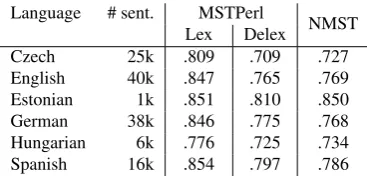
Language # sent. MSTPerl
NMST Lex Delex
Czech 25k .809 .709 .727 English 40k .847 .765 .769 Estonian 1k .851 .810 .850 German 38k .846 .775 .768 Hungarian 6k .776 .725 .734 Spanish 16k .854 .797 .786
Table 2: The unlabeled attachment score for selected treen-banks from HamleDT (Zeman et al., 2014) comparing lex-icalized and delexlex-icalized MSTPerl parser (Rosa, 2015) with our neural scoring function with positions, embed-dings and POS tags on input.
hand, significantly better result are achieved by using the POS tags. Another improvement is brought by combin-ing both the word vectors and the POS tags. Addcombin-ing the lexical features in one-hot representation does not further improve the performance. This confirms that the word em-beddings are more informative than categorial representa-tion of words of similar dimension. In delexicalized pars-ing, we achieved the same UAS score as MST Parser with linear scoring function using a model with much fewer pa-rameters.
When comparing the loss functions, we can see that the cross-entropy loss performs consistently ten percent bet-ter. Probably, the property of having information about the whole set of possible solutions in one continuous variable outweighs the non-realistic assumption of the mutual inde-pendence of parse trees. According to the results of Koo et al. (2007), we can expect that using a different optimiza-tion algorithm, such as exponentiated gradient (Bartlett et al., 2004), may lead to better result, although it assumes the independence as in the case of the cross-entropy loss. The evaluation of experiments with other languages is tabu-lated in Table 2. It shows that the word embeddings trained on bigger data than the treebank are more useful for lan-guages for which only a small treebank is available.
5.
Conclusions
[image:3.595.331.515.252.340.2]delex-icalized parser. This improvement was higher than while using categorial representation of 200 most frequent lem-mas. This result appears to be consistent among various languages.
Our original intuition was that word embeddings should be able to fully replace (and probably even improve upon) cat-egorial lexical features. The fact that it did not appear to be true could suggest that a different vector representation of words could have been used – either more informative pre-trained embedding (Turian et al., 2010; Pennington et al., 2014) or to learn the embeddings during the parser train-ing or ustrain-ing character-based embeddtrain-ings betrain-ing able capture morphological features of out-of-vocabulary words (Ling et al., 2015).
Despite not outperforming the lexicalized parser with hand-crafted features, it works with the substantially smaller model (not counting the table with embeddings).
The models whose only source of lexical information are the word embeddings could be used for cross-lingual pars-ing. The results give a hope that word embeddings could be used to introduce additional lexical information. Automatic word alignment can be used to train a translation function for word embeddings and these translated embeddings then used as lexical information on the input or we can use di-rectly cross-lingual word embeddings (Klementiev et al., 2012).
Acknowledgements
I would like to thank Rudolf Rosa for providing a tutorial for his Perl implementation of MST parser and Terry Koo for sharing with us numerical tricks they have used in their previous work (Koo et al., 2007). I also thank Pavel Pecina and the reviewers for valuable comments.
This research has been supported by the Charles University Grant Agency project No. 5235 and by the SVV project No. 260 224. The work has been using language resources developed, stored and distributed by the LINDAT/CLARIN project of the Ministry of Education, Youth and Sports of the Czech Republic (project No. LM2015071).
References
Bansal, M., Gimpel, K., and Livescu, K. (2014). Tailoring continuous word representations for dependency parsing. InProceedings of the 52nd Annual Meeting of the Asso-ciation for Computational Linguistics (Volume 2: Short Papers), pages 809–815, Baltimore, Maryland, June. As-sociation for Computational Linguistics.
Bartlett, P. L., Collins, M., Taskar, B., and McAllester, D. A. (2004). Exponentiated gradient algorithms for large-margin structured classification. In Advances in Neural Information Processing Systems 17 [Neural In-formation Processing Systems, NIPS 2004, December 13-18, 2004, Vancouver, British Columbia, Canada], pages 113–120.
Bohnet, B., Nivre, J., Boguslavsky, I., Farkas, R., Ginter, F., and Hajiˇc, J. (2013). Joint morphological and syntac-tic analysis for richly inflected languages. Transactions of the Association for Computational Linguistics, 1:415– 428.
Brown, P. F., Desouza, P. V., Mercer, R. L., Pietra, V. J. D., and Lai, J. C. (1992). Class-based n-gram models of natural language. Computational linguistics, 18(4):467– 479.
B¨ohmov´a, A., Hajiˇc, J., Hajiˇcov´a, E., and Hladk´a, B. (2003). The prague dependency treebank. In Anne Abeill´e, editor, Treebanks, volume 20 of Text, Speech and Language Technology, pages 103–127. Springer Netherlands.
Chaiken, S. and Kleitman, D. (1978). Matrix tree the-orems. Journal of Combinatorial Theory, Series A, 24(3):377–381.
Chen, D. and Manning, C. (2014). A fast and accurate de-pendency parser using neural networks. InProceedings of the 2014 Conference on Empirical Methods in Natural Language Processing (EMNLP), pages 740–750, Doha, Qatar, October. Association for Computational Linguis-tics.
Collins, M. (2002). Discriminative training methods for hidden markov models: Theory and experiments with perceptron algorithms. InProceedings of the 2002 Con-ference on Empirical Methods in Natural Language Pro-cessing, pages 1–8. Association for Computational Lin-guistics, July.
Dyer, C., Ballesteros, M., Ling, W., Matthews, A., and Smith, N. A. (2015). Transition-based dependency pars-ing with stack long short-term memory. InProceedings of the 53rd Annual Meeting of the Association for Com-putational Linguistics and the 7th International Joint Conference on Natural Language Processing (Volume 1: Long Papers), pages 334–343, Beijing, China, July. As-sociation for Computational Linguistics.
Joachims, T., Finley, T., and Yu, C.-N. (2009). Cutting-plane training of structural svms. Machine Learning, 77(1):27–59.
Klementiev, A., Titov, I., and Bhattarai, B. (2012). Induc-ing crosslInduc-ingual distributed representations of words. In
COLING 2012, 24th International Conference on Com-putational Linguistics, Proceedings of the Conference: Technical Papers, 8-15 December 2012, Mumbai, India, pages 1459–1474.
Koo, T., Globerson, A., Carreras, X., and Collins, M. (2007). Structured prediction models via the matrix-tree theorem. InProceedings of the 2007 Joint Conference on Empirical Methods in Natural Language Processing and Computational Natural Language Learning (EMNLP-CoNLL), pages 141–150, Prague, Czech Republic, June. Association for Computational Linguistics.
Koo, T., Carreras, X., and Collins, M. (2008). Simple semi-supervised dependency parsing. InProceedings of ACL-08: HLT, pages 595–603, Columbus, Ohio, June. Association for Computational Linguistics.
LeCun, Y., Bottou, L., Bengio, Y., and Haffner, P. (1998). Gradient-based learning applied to document recogni-tion. Proceedings of the IEEE, 86(11):2278–2324. Levy, O. and Goldberg, Y. (2014). Neural word embedding
Ling, W., Dyer, C., Black, A. W., Trancoso, I., Fermandez, R., Amir, S., Marujo, L., and Luis, T. (2015). Finding function in form: Compositional character models for open vocabulary word representation. InProceedings of the 2015 Conference on Empirical Methods in Natural Language Processing, pages 1520–1530, Lisbon, Portu-gal, September. Association for Computational Linguis-tics.
McDonald, R. and Satta, G. (2007). On the complexity of non-projective data-driven dependency parsing. In Pro-ceedings of the Tenth International Conference on Pars-ing Technologies, pages 121–132, Prague, Czech Repub-lic, June. Association for Computational Linguistics. McDonald, R., Pereira, F., Ribarov, K., and Hajiˇc, J.
(2005). Non-projective dependency parsing using span-ning tree algorithms. InIn Proceedings of Human Lan-guage Technology Conference and Conference on Em-pirical Methods in Natural Language Processing, pages 523–530.
Mikolov, T., Sutskever, I., Chen, K., Corrado, G. S., and Dean, J. (2013). Distributed representations of words and phrases and their compositionality. In C.J.C. Burges, et al., editors,Advances in Neural Information Process-ing Systems 26, pages 3111–3119. Curran Associates, Inc.
Nivre, J. (2006). Inductive Dependency Parsing (Text, Speech and Language Technology). Springer-Verlag New York, Inc., Secaucus, NJ, USA.
Pennington, J., Socher, R., and Manning, C. (2014). Glove: Global vectors for word representation. In Pro-ceedings of the 2014 Conference on Empirical Methods in Natural Language Processing (EMNLP), pages 1532– 1543, Doha, Qatar, October. Association for Computa-tional Linguistics.
Petrov, S., Das, D., and McDonald, R. (2012). A universal part-of-speech tagset. InProceedings of the Eight Inter-national Conference on Language Resources and Evalu-ation (LREC’12), Istanbul, Turkey. European Language Resources Association (ELRA).
Rosa, R., Duˇsek, O., Mareˇcek, D., and Popel, M. (2012). Using parallel features in parsing of machine-translated sentences for correction of grammatical errors. In Pro-ceedings of Sixth Workshop on Syntax, Semantics and Structure in Statistical Translation (SSST-6), ACL, pages 39–48, Jeju, Korea. Association for Computational Lin-guistics.
Rosa, R. (2015). Multi-source cross-lingual delexicalized parser transfer: Prague or stanford? InProceedings of the Third International Conference on Dependency Lin-guistics (Depling 2015), pages 281–290, Uppsala, Swe-den. Uppsala University.
Smith, D. A. and Smith, N. A. (2007). Probabilistic mod-els of nonprojective dependency trees. InProceedings of the 2007 Joint Conference on Empirical Methods in Nat-ural Language Processing and Computational NatNat-ural Language Learning (EMNLP-CoNLL), pages 132–140, Prague, Czech Republic, June. Association for Compu-tational Linguistics.
Szegedy, C., Zaremba, W., Sutskever, I., Bruna, J., Erhan,
D., Goodfellow, I. J., and Fergus, R. (2013). Intriguing properties of neural networks. CoRR, abs/1312.6199. Turian, J., Ratinov, L., and Bengio, Y. (2010). Word
rep-resentations: A simple and general method for semi-supervised learning. InProceedings of the 48th Annual Meeting of the Association for Computational Linguis-tics, ACL ’10, pages 384–394, Stroudsburg, PA, USA. Association for Computational Linguistics.
Weiss, D., Alberti, C., Collins, M., and Petrov, S. (2015). Structured training for neural network transition-based parsing. InProceedings of the 53rd Annual Meeting of the Association for Computational Linguistics and the 7th International Joint Conference on Natural Language Processing (Volume 1: Long Papers), pages 323–333, Beijing, China, July. Association for Computational Lin-guistics.