A Constructive View of G P S G
o r
H o w to Make It Work
Stephan BUSEMANN Christa HAUENSCHILD
Technical University of Berlin
Institute for Software and Theoretical Computer Science Project Group KIT
Sekr. FR 5-12 Franklinstr. 28/29 D-1000 Berlin 10
E-mail: busemann@ db0tui 11.bitnet
Abstract
Using the formalism of generalized phrase structure grammar (GF~SG) in an NL system (e.g. for machine translation (MT)) is promising since the modular structure of the formalism is very well suited to meet some particular needs of MT. However, it seems impossible to implement GPSG in its 1985 version straightforwardly. This would involve a vast overgeneration of structures as well as processes to filter out everything but the admissible tree(s). We therefore argue for a constructive version of GPSG where information is gathered in subsequent steps to produce syntactic structures. As a result, we consider it necessary to incorporate procedural aspects into the formalism in order to use it as a linguistic basis for NL parsing and generation. The paper discusses the major implications of such a modified view of GPSG. 1
1 Introduction
Any attempt to build a multi-lingual MT system as in EUROTRA [King, Perschke 1987] must provide for massive modularization in order to avoid developing 9 parsers, 9 generators and 72 transfer components for the 9 languages involved, not to mention the different but redundant formulations of linguistic knowledge embodied in them. The most obvious approach consists in developing one single parser, one single generator, and one single transfer component, the first two being capable of dealing with grammars for different languages and the latter with transfer
1 This work has been developed in the project KFr-FAST (KIT = Kilnstliche Intelligenz und Textverstehen (Artificial Intelligence and Text Understanding); FAST = Functor Argument Structure for Translation), which constitutes the Berlin component of the complementary research project of EuroWa-D. It receives grants by the Federal Minister for Research anti Technology under contract 1013211.
rules for different pairs of languages. Moreover, an MT system must be based on a linguistically justified theory of grammar. This theory has to be implemented in the system, where it determines the construction of a syntactic representation of a sentence during the parsing of some input string as well as during the generation based on the output of the transfer component.
The theory of GPSG (see [Gazdar et al. 1985], henceforth: [GKPS]) has been tested for its usefulness for MT [ttauenschild/Busemann 1988]. It offers the high degree of modul,'u'ity that is required. For instance, an implementation of the GPSG formalism would be able to run with different grammars, and linguistic generalizations would either evolve from the formalism (in the case of universals), or be expressible within the grammars (in the case of language- specific generalizations). We shall distinguish between the formalism and the grammar in the following way; the formalism consists of the Feature Instantiation Principles (FIPs), the formal definition of syntactic features, categories, Feature Co-occurrence Restrictions (FCRs), Immediate Dominance (ID) rules, Linear Precedence (LP) statements, admissible trees, etc. The grammars consist of actual sets of ID rules, LP statements, FCRs, and the lexicon.
However, a closer look at the axiomatic way GPSG has been defined reveals severe problems for an implementation of GPSG. In the next section we shall outline these problems, and in section 3 present our change in perspective towards a GPSG formalism that overcomes these problems. Some consequences of this are discussed in the last section.
2 Problems With the Implementation of GPSG
In this section we want to justify why we had to develop a constructive version of the GPSG formalism although it might seem that the "classical" version of it (as defined in [GKPS]) can be implemented. We want to show that this is only true in theory but not in practice.
What would it really amount to if we tried to implement the axiomatic version of GPSG in a straightforward way? In order to find all admissible trees corresponding to a given sentence, we would have to do the following things for every local tree (i.e. trees of depth 1):
* build every possible extension for every category in an ID rule, which means that every feature that is not specified in the rule may be either absent or specified by any of its values,
. filter out the illegal categories with the aid of the FCRs, . build all the possible projections of ID rules with the
remaining legal categories, thereby creating every possible order of the daughters,
• filter out those combinations of categories that are inadmissible according to the Foot Feature Principle (FFP), Control Agreement Principle (CAP) or Head Feature Convention (HFC),
. filter out those projections that are unacceptable because of some category contradicting a Feature Specification Default (FSD),
° filter out all those projections that contradict any LP statement applicable to the daughters.
After this, the subset of admissible local trees has to be identified which yields the desired complex structures in the
following way: two (locally) admissible trees may be combined into a larger tree iff one of the daughters of one of them is identical with the mother of the other one.
The whole process can be regarded as divided up into three major steps. The first step consists in constructing all the possible projections (possible according to ID rules and FCRs). The second step consists in filtering out local trees that are not admissible according to the restrictions imposed on them by the FIPs, the FSDs and the LP statements. Though these devices are not filters in the Chomskyan sense, 2 they behave in an analogous way by preventing previously generated structures from becoming locally admissible trees. The last step consists in forming complex structures out of locally admissible trees.
In order to show the complexity of such an approach, it is necessary to give a rough idea of what the first step really mnounts to; it yields a combinatorial explosion of the set of categories. Assuming the 25 atomic and the 4 category-valued
2 This was pointed out to us by John Nerbonne (electronic mail).
features defined for file English grammar in [GKPS], a lower bound for the number of categories to be checked by the FCRs is 10 774 [Ristad 1986].
'['he second of the above mentioned steps is riot trivial either, though its problems might be solvable after allo For a purely axiomatic view of the GPSG formalism it may be permissible to neglect the order in which the different filtering components are to be applied, akhough their seem to be some problems with the definitions of the different FIPs with respect to their logical independence of each other. For an effective implementation however, the ordering problem becomes crucial. There are some hints in [GKPS] referring to interdependencies between the different filters, but they are not fully specified. The most problematic case is the order in which the HFC and the CAP have to be applied:
• the HFC seems to presuppose the effects of the CAP (and of the FFP) because it must not force feature specifications that are excluded by the CAP on categories in local trees;
• the CAP presupposes the FlEC in the sense that it is based on semantic types, which are dependent on HEAD features, the distribution of which is in turn governed by the HFC.
One possible way out of this dilemma is suggested in [Shieber 1986], but it is based on the assumption that HEAD features may be split up into two disjoint sets: those HEAD features which are prerequisites for the assignment of semantic types and thus for the applicability of the CAP, and those HEAD features that can safely be applied after the CAP has done its work. However, it is not clear whether such a distribution is possible. Of course, you can always make your ID rules much more informative with respect to feature specifications than is suggested in [GKPS] and thereby guarantee a proper functioning of the FIPs; but that would probably not be in the spirit of GPSG, where the main point is to capture the universal as well as the language-specific generalizations.
There m'e a number of problems with the CAP; we waut to outline just one of them, which has led us to modify this principle. The definition of control in [GKPS] implicitly restricts the functioning of CAP to structures where the functor has no more than one argument (with the exception of those very special cases of control mediators). This cannot be seen from the definition of control [GKPS:88] alone, but may be derived from the interaction of this definition with the conditions on correct type assignment that are imposed on syntactic structures by the principle of functional realization [GKPS, chapter 10]: it follows from beth pm~s of the theoly taken together that a functor can be controlled by its argument only in the case where there is no further argument; otherwise the functor would have to be of a type that differs from what is assumed in the definition of control (intuitively, the type of a functor depends on how many arguments the functor takes).
This diffictllty seems quite hard to cope with; if we assume
rather flat structures (as we do, on independent grounds, in our
German syntax [Preug 1987], see also [Uszkoreit 1984]), then
it is not clear which of the different arguments of a functor is to
control it; in the case of subject-predicate agreement in
German, the subject would have to be marked as the controllc~',
which can b~a:dly be done on the basis of the semantic types
alone (becaose there seems to be no semantic reason to
distinguish ,;ubjects and objects by their semantic type unless
we treat subjects as functors operating on VPs as arguments, which would reverse the conlrol relation between them and
thus cause all sorts of other problems). The only possibility we
can conceive of would be analogous to the concept of
argument order as defined in [GKPS] :in oi~er to obtain
correctly the interpretations of direct attd indirect objects, but
this is a language-particular concept (cf. [GKPS:214], which
would not fit ittto a universal principle.
3 A C o n s t n t c t i v e View of GPS(~,
Aa the previous section shows, the GPSG formalism in
its original version is not suitable for computer
implementation. From a processing point of view, it is an obvious rcqt&ement that the components of GPSG should
only conslru,zt the well-formed categories and trees, i.e. no
garbage should be produced. In order to utilize GPSG for
parsing artd generation in a computer system, a change in
perspective becomes necessary; instead of deciding for all fully
specified categories and all local trees whether they are legal
or admissible respectively, we start from a highly
underspecified local tree that is admitted by an ID rule and
gather information by subsequently applying FCRs and FIPs.
Eventually we sttall have a fully specified local tree that is
admissible b7 definition.
We shall call this view of GPSG constructive since it allows for the construction rather than the selection of a
syntactic structure. In a conslructive version of GPSG, FCRs and F1Ps mainly act as principles of feature transport rather
than of t'c~atu re distribution.
One of d~e most important questions for the constructive
version is ir~ what order the components of GPSG have to be
applied. Since each of them may add further feature
specifications to a category in a local tree, the order of
application ought to depend on what information must be
present for a component to work properly. This can be
determined in general by using a monotonic operation such as
unification for making categories more and more specific.
This has led us to dispense with any assertions about
categories as they are often used in [GKPS]. For instance, the
predicate ~ with the meaning that some feature is undefined
(i.e. it is nn~: contained in the category) is replaced by a feature value, ~, which is subject to unification. W e shall thus say that
a featurefi~', undefined if it is specified as <f, ~>.
Tire predicative character of FCRs is also modified
towards a functional one by including the assignment of values
to features. Formally, an FCR is written catl ~ cat2, where
cat1 and cat2 are categories. An F C R applies to a category C iff C is an extension of cat1. C must unify with cat2,
otherwise C is not legal.
Let us now discuss the role of the FIPs in a constructive
version. We shall start with HFC. In [GKPS], HFC is based oil
the free feature specification sets, which are utilized to prevent
HFC from rejecting local trees because of H E A D features
specified differently at the mother and tile head daughter(s) by virtue of ID rnles, FCRs, the FFP, or file CAP. To generate
these sets would again require all possible projections from an
ID rule to be produced. As was shown in the previous section,
this must lm avoided if a computer implementation is to be
supplied.
From the constructive point of view we suggest that the
effect of using the free feature specification sets can be attained by ensuring that for a local tree, the work of the FCRs, the FFP
and the CAP has been completed before HFC comes into play.
t l F C then assures that the so far unspecified H E A D features at the mother are ktentical with the corresponding H E A D feature
specifications at the head daughter(s) and vice versa thereby
never rejecting a local tree 3. IqFC proceeds as follows; every
head daughter that can unify with its mother with respect to
the set of H E A D features will do so. Typically, IJEAD
includes features for verb form or clause structure. A
constituent is marked as head by a binary feature, head, which is specified in the ID rules, thus replacing the meta-notation H
in IGKPSI, the meaning of which is completely dependent on
its context.
This way HFC is supposed to work in an equally general,
but much simpler, fashion than it was possible with the
definition in [GKPS]. Moreover, IIFC is capable of coping with multiple heads used for the treatment of certain
coordination phenomena; feature specifications are found in
the coordinated head daughters, the H E A D feature in question
has to be undefined at the mother. This parallels the way
multiple heads are treated in [GKPS].
The requirement that the CAP be prior to HFC raises,
however, the problem that the CAP cannot be based on
semantic types anymore because it is HFC which might
provide the major feature specifications necessary to
determine tile type of a constituent. Moreover, to be applicable to local trees with more than one argument (in
those cases where no control mediator is present), the CAP had
to be reformulated, and its place is taken by a purely syntactic mechanism, the Agreement Principle (AP), which is defined ~as follows [Weisweber 1987]; every daughter in a local tree that is ~ marked for agreement must unify with its mother with respect to a subset of features, called AGR. If an AGR feature is undefined, it is ignored by the AP. Any local tree violating the AP is rejected. AGR typically contains features for case, gender, person, or number. A constituent is marked for agreemen t by a binary feature,
agr,
that is specified through FCRs, e.g.{<cas,
hem>} ~{<agr,
+>} and{<vform,
fin>} D{<agr,
+>}. The AP together with HEC provides for subject- verb agreement on the basis of these FCRs. This way of coping with agreement phenomena foregoes with any notion of control. There are no semantic types involved; what agrees with what need not be stated explicitly, it is simply the consequence of the interplay of FCRs, AP, HFC, and theThis approach allows a category to contain feature specifications arising from different agreement relations. An important hypothesis underlying the revised AP is that this will only be necessary if that category contains, by virtue of an ID rule, category-valued features, which can by themselves be specified for
agr.
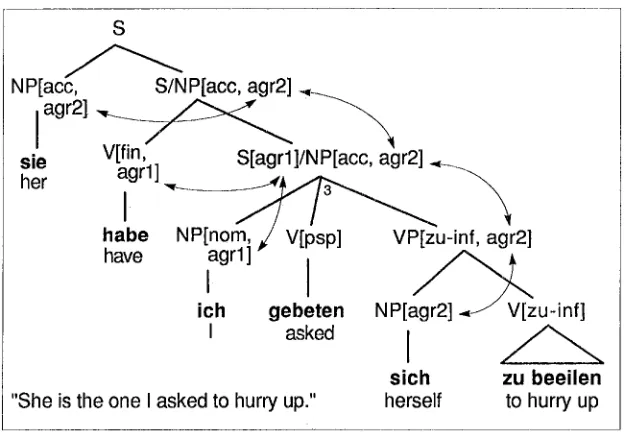
These features are also inspected by the revised AP in order to find members of some agreement relation in a local tree. Figure 1 contains a local tree, (3), with the featureslash
(denoted by 7') specified at the mother as an accusative NP by an ID rule. This expresses the fact that a direct object is missing in local tree (3). The revised AP uses the AGR specifications of theslash
value to establish agreement between the direct object and the reflexive pronoun. The AGR specifications of the S, on the other hand, are used to ensure subject-verb agreement.S
NP[acc,
S/NP[acc, agr2] 4--___
I
sic
t ,j.
S[agrll/NP[acc, agr2] ~,__
her
~ g r l l ~ ~ ~babe
NP[no.m, 4/ V[psp]
VP[zu-inf, agr2]
have
agrl ]
~
~
/
/
3..
i'ch
gebeten
NP[agr2] . , , J V[zu- nf]
I
asked
Isich
zu beeilen
"She is the one I asked to hurry up."
herself
to hurry up
Fig. 1: Establishing Different Agreement Relations
definition of the feature sets AGR and HEAD. Note that the AP does not presuppose HEAD feature specifications and can
thus be prior to HFC.
However, the AP as defined above cannot account for the fact that a category may participate in some agreement relations, but not in others (in 'raising' constructions a direct object may have to agree with a reflexive pronoun, but not with the finite verb). A more sophisticated version of the AP, which is presently being developed, is based on different kinds of
agr
values (e.g. agrl and agr2 instead of +). A direct object, as well as the reflexive, is then specified with
<agr,
agr2> whereas subject and finite verb both have<agr,
agrl>. The revised AP requires categories containing the sameagr
specification to unify with respect to AGR as described above.80
Note that this way of including category-valued features specified in ID rules is independent of which syntactic structures are used to describe a language, rather tile function of category-valued features as indicators of long distance relations is utilized.
The feature
agr
can still be specified by virtue of FCRs, though there seem to be some characteristic exceptions where the value is better provided within the ID rules. For instance, a VP should not always contain<agr,
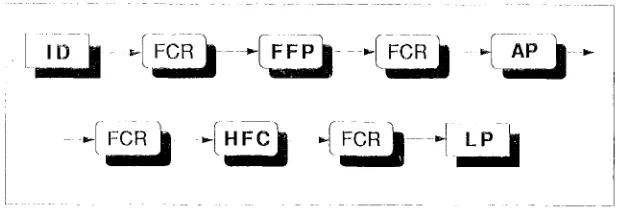
agr2>, as in figure 1, because in the case of 'equi' verbs it would have to agree with the subject. 4 [image:4.612.168.481.261.479.2]Let us conclude tile discussion of the FIPs with the FFP, tile functionir~g of which has by and large been taken over from [GKPSI~ A special treatment is necessary for the wflue ,~. All daughters unify with the mother with respect to a set of FOOT feature, s, provided that the values ale not spe, cified in the ID rules. Daughters that are undefined with respect to some FOOT feature are ignored by the Flq ~ unless the FOOT feature is untlefined at every daughter or at the mother; in that case tile FFP requires all constituents to be undefined with respect to that FOOT feature. If a local tree violates the FFP it is rejected.
The FFP is only dependent on rite ID rules and is thus able to be the first t,'IP to apply. It is in fact prior to the AP since its
point, we shall look at two rather obvious strategies, om which is used in the Berlin GPSG system [Hauensct Busemann 1988] for parsing and the other for generation.
The first one constructs the tree in a bottom-up mar, thereby
reducing
admissible local trees by unifying tl mothers with the daughters of another local tree. The bott( up strategy starts from lexical categories, which are admissi by the lexicon. Each reduction step is followed by application of the FIPs to the newly created local tree. Thus intormation contained in the lexical categories is percolated higher levels of the tree, thereby constraining the set of furtl reduction steps allowed by the grammar. This strategy is us within tile parser in the GPSG system [Weisweber 1987].Fig. 2: Sequence of Application in a Constructional Version of GPSG
results may ~rigger FCRs that specify the
agr
feature. FCRs have to be applied at each step where a feature might have been specified in a local tree, namely after tile FFP, the AP, and the HFC_ LP statements can only be guaranteed to apply 5 properly on fully specified categories. Thus they operate in the last place (cf. figure 2) 6.The next question to be addressed is how complex structures arc built from local trees. Since in the constructional version nothing forces a daughter of one local tree mid tile mother of ~,nother one to have the same set of features specified with the same values, the two categories are not required to be identical, as in [GKPS], rather they must
unify in
order to be combined into a larger tree.
For each of tile two categories involved in the unification, additional features may be specified. This
specification by
construction,
when combined with the application of FCRs and FIPs, makes the results of transporting feature specifications within local trees immediately available to other locN treks. Tile precise way of interaction with FCRs and FIPs depends on the strategy adopted for tree formation. In order to clarify theFor parsing, LP statements work as filters whereas for generation, they constructively order the branches in a local tree [Busemana 1987].
Note that a similar ordering discovered by Shieber [Shieber 1986] results from investigations of underlying assumptions of [GKPS].
The second strategy consists of top-down tree formation With this type of proces s, local trees are
expanded
by unifyin~ their daughters with mothers of other local trees. The top. down strategy starts from a local tree (with mother S, foJ instance), the categories of which have feature specifications by virtue of all ID rule only. FCRs and FlPs cannot be applied during tree expansion because there is too little information available for deciding upon e.g. the value ofagr
(for the same reason, FCRs attd FlPs are not applied to ID rules directly), rather they apply in a bottom-up manner as with the first strategy after the lexical insertion has been completed.The latter strategy is utilized within the generation component [Busemann 1987] in the GPSG system, which has to introduce, for instance, number and case information into the structure that it is about to generate. This takes place in the course of tree expansion by adding relevant feature specifications to categories in the tree (to an NP mother, for instance). This information is usually not available in local trees at a deeper level, especially at local trees with lexical categories. Therefore the lexicon should contain word stems (rather than word forms) and, con'espondingly, categories that are unspecified for e.g. number and case. 7
[image:5.612.154.465.240.347.2]is indeed no requirement that A G R or H E A D features must
have a value in order to unify. W e should like the FIPs to work
properly even if features have not yet received a value. In these
cases, the feature values in question are co-specified, i.e. they will have the same value as soon as one of them is specified. In
our example, number and case specifications are spread over
the sub-structure dominated by the NP as soon as the FIPs
apply to the local tree where they have been introduced.
However, such a delayed specification makes it more difficult
to maintain control over whether a category is still legal and
whether a local tree still complies with the LP statements. For
an elegant solution see [Weisweber 1988], in this volume.
In our present version of GPSG, we use neither metarules
nor FSD. However, the linguist ought to still have the
possibility of expressing elegantly language-particular
generalizations with the aid of metarules. They will be realized
in a preprocessing component in order to avoid having to apply
them during parsing or during generation.
As for FSDs, we adopt the working hypothesis that they are
superfluous if lexical entries are sufficiently specified and free
feature instantiation (in the sense of [GKPS]) is not allowed.
FSDs are needed in the GPSG version of [GKPS] because free
feature instantiation may assign nonsensical values to features,
which would never occur if the structure had been built orderly
on the basis of sufficient lexical information. In the long run it
might be desirable to use the device of FSDs in a
constructional version of GPSG, too; namely, for those cases wbere features have not been specified, thougll the whole
structure has been completed. However, we shall have to avoid
the complexity of FSDs as defined in [GKPS]; a simplified
solution might be analogous to our version of HFC for HFC,
too, is a default device in the final account.
The constructional version of GPSG presented here
constitutes the linguistic basis for parsing and generation of
English and German sentences within the Berlin GPSG system.
The system is fully implemented in Waterloo Core Prolog
using the set of predicates defined by the K I T - C O R E Prolog standard [Bittkau et al. 1987], which makes it possible to run it
with several other Prolog dialects, too (e.g. Symbolics Prolog). At present, it runs on an I B M 4381 under VM/SP, on a
Symbolics 3640 Lisp machine, and on an I B M AT.
4 Conclusion
It has been shown how our constructive version of GPSG
avoids the: problem of combinatorial explosion that would have
arisen if we had tried to implement the GPSG formalism in its axiomatic version [GKPS] in a straightforward way. Our
A stem-form lexicon complemented with lemmatization and inflection procedures is better suited to NL processing anyway, at least if sa'ongly inflecting languages such as German are involved.
change in perspective also leads to an impoitant simplification
of the HFC because it is no longer necessary to build all the projections of an ID rule for the determination of the free
feature specification sets.
The dilemma over the ordering of the CAP and the HFC
has been removed too, which is crucial for any implementation of the formalism. But, for this to be achieved, we had to
sacrifice part of the generality that characterizes the treatment
of control in [GKPS]; ke. although the qnestion of which
constituents have to agree with one another is ~Lot answered ir~
a purely idiosyncratic way by the ID rules (because most of the
cases can be accounted for by FCRs, which are, as it were,
language-specific generalizations), the fact that agreement
depends on functor-argument structures is no longer integrated
iuto the formalism.
This loss, however, is compensated for by the fact that we
can treat agreement in cases which the original CAP could not
account for (as in the case where a functor is cont,oiled by one
of several arguments).
Although we have had to concentrate our presentation on
just a few aspects of the eonsu-uctive view of GPSG, we hope
to have made plausible that our modified formalism is, in
contrast to the original one, suitable for parsing and generation
within an NL processing system.
References
Bittkau, Oliver; Haider, Christi,'m; and Kietz, Jgrg-Uwe (1987), KI'I•CORE- PROLOG Description (Version 1.0), KIT Internal Working Paper No. 17, Fachbereich Informatik, Technische Universitat Berlin.
Busemann, Stephan (1987), Generierung mit GPSG, in K. Morik (ed.), l'rocs. llth German WorL~hop on Artificial Intelligence, Berlin, Springer, 355-364.
Gazdar, Gerald; Klein, Ewan; Pnllum, Geoffrey; and Sag, Ivan (1985),
Generalized Phrase Structure Grammar, Oxford, Blackwell.
Hauensehild, Christa (1986), KIT/NASEV oder die Problematik des Transfers bei der maschinellen (lbersetzung, in I. S. B~ftori and H. J. Weber (eels.),
Neue Ansiitze in maschineller ~lbersetzung. Wissensrepr?isentation und Textbezug, Tiibingen, Niemeyer, 167-185.
Hauen~hild, Christa, and Busemann, Stephan (1988), A Constructive Version of GPSG for Machine Translation, to appear in E. Steiner, P. Schmidt, and C. Zelinsky-Wibbelt (eds.), From Syntax to Semantics -lnsights From Machine Translation, London, Frances Pinter, 1988.
King, Mm'garet, and Perschke, Sergej (1987), EUROTRA, in M. King (ed.),
Machine Translation Today: The State of the Art, Edinburgh, Edinburgh University Press, 373-391.
Preug, Susanne (1987), GPSG-Syntax ffir ein Fragment des Deutschen, KIT Internal Working Paper No. 20, Fachbereich Informatik, Techni.~che UniversitlR Berlin.
Ristad, Eric Sven (1986), Computational Complexity of Current GPSG Theory, in
Procs. 24th Annual Meeting of the ACL, New York, 30-39.
Shieber, Stuart M. (1986), A Simple Reconstruction of GPSG, in Procs. 11th COLING-86, Bonn, 211-215.
Uszkoreit, Hans (1984), Word Order and Constituent Structure in Gerte~an, Ph.D. Dissertation, University of Texas, Austin.
Weisweber, Wilhelm (1987), Ein Dominanz-ChartoParser fiir Generalisiecte Phrasenstrukturgrartm~atiken, KY~' Report 45, Fachbereich Iu~brmalik, Technische Universit/lt Berlin.
Weisweber, Wilhelm (1988), Using Constraints in a Constructive Version of GPSG, in Procs. 12th COLING-88 (this volume), Budapest.