GENERATING COHERENT ARGUMENTATIVE PARAGRAPHS
Michael ElhadadDepartment of Computer Science 450 Computer Science Building
Colmnbia University New York, N.Y. 10027 ELHADAD@ CS .COLUMBIA.EDU
Abstract
We address the problem of generating a coherent paragraph presenting arguments for a conclusion in a text generation system. Existing text planning tech- niques are not appropriate lor this task for two main reasons: they do not explain how arguments can be linked together in a linear presentation order and they do not explain how the rhetorical function of a proposition affects its wording.
We present a mechanism to generate argumentative paragraphs where argumentative relations constrain not only the rhetorical structure of the paragraph, but also the surface form of each proposition. In our approach, a text planner relies on a set of specific argumentative relations to extract information from the knowledge base, to map it to scalar and context dependent evalua- tions and to organize it into chains of arguments. The same information used for planning is also used by the surface realization component to perform lexical choice at all the levels of the clause (connectives, main verb, adverbial adjuncts, adjectives and determiners). The mechanism is implemented in the ADVISOR I1 system using ~ F , an extended functional unification formalism.
I N T R O D U C T I O N : M O T I V A T I O N
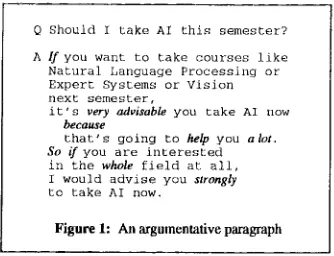
Ceaain types of questions require in response a state- ment of a conclusion and arguments to support it. In our domain, a question-answeting system offering advice to students selecting classes to plan their schedule (McKeown, 1988), should-questions, e.g., should I take AI?, fall into this class. The example shown in Figure I, extracted from a corpus of naturally occurring advising sessions that we have collected, illustrates this point.
The task we consider is that of generating similar argumentative paragraphs presenting an evaluation of a course and its supporting arguments. To produce such paragraphs, a generation system must determine which arguments to include in the paragraph, how to organize them in a structured Immgraph, and how to phrase each piece of the argument. For example in Figure 1, the advisor selects the argument chain that AI provides preparation for all followup courses in the field, that the more the student is interested in AI the more he should take these followup courses and therefore, the more reason he has to take AI. This sequence of argaments forms the structure of the answer.
In terms of wording, note that the conclusion that is
Q S h o u l d I take AI this s e m e s t e r ? A ~ y o u w a n t to take c o u r s e s like N a t u r a l L a n g u a g e P r o c e s s i n g or E x p e r t S ~ s t e m s or V i s i o n n e x t s e m e s t e r ,
it's very advisab~ y o u take AI n o w because
t h a t ' s g o i n g to ~ y o u a l o;. So ~ y o u are i n t e r e s t e d in the whole f i e l d at all, I w o u l d a d v i s e y o u strong~ to take AI now.
Figure 1: An argumentative paragraph
supported affects the choice of expressions at many levels. We have marked in italics words that are selected in part because of the argumentative function of the proposition in which they appear. For example, saying it is very advisable as opposed to it is OK, deciding to add strongly and selecting a lot instead of somewhat are all decisions motivated by the advisor's goal of convincing the student to take AI.
In previous work in text generation, rhetorical schemas (McKeown, 1985) and RST (rhetorical struc- lure theory) (Mann & Thompson, 1987) have been proposed as operational techniques to produce coherent paragraphs. We have found, however, that these tech- niques, in their current forms, are not appropriate to ad- dress the task of generating argumentative paragraphs for two main reasons: first, RST relations are too genetic to perform argument selection and construct coherent ar- gument chains; second, rhetorical relations in both theories do not influence directly linguistic realization and therefore cannot determine wording decisions of the type illustrated in Figure 1.
We present in this paper a mechanism for planning and realizing argumentative t, aragraphs which addresses these two shortcomings. In our approach, specific ar- gumentative relations guide both content planning and iexieal choice within the clause. Content planning is performed using two levels of argumentative relations - evaluation functions and topoi (Anscombre & Ducrot, 1983) to derive content from the underlying knowledge base and organize it into coherent argumentative chains. Surface realization takes advantage of the output of the paragraph stracturer to perform lexical choice at all levels of the clause.
[image:1.432.225.392.115.243.2]In the rest of the paper, we first review previous work in paragraph planning, explaining why existing techaiques cannot be used directly in the case of ar- gumentative paragraphs. We then present our approach, describing file content planner and the surface realization component.
P R E V I O U S W O R K : S C H E M A S A N D R S F In previous work in text generation, two methods have emerged to generate coherent paragraph-long texts: rhetorical schemas and RST (for Rhetorical Structure Theory).
Schemas (McKeown, 1985) encode conventional pat- terns of text StlUCture. A schema is associated with a communicative goal and describes how this goal is con- ventionally satisfied. For example, the constituency schema is used to describe the parts of an object, and the process schema (Paris, 1987) is nsed to describe a com- plex process. A schema describes a sequence of rhetorical predicates where each predicate is either a primitive communicative function, which can be full'died by a single proposition, or rectursively another schema. For example the primitive predicate attributive attributes a property to an object. Each predicate is assigned a semantics in terms of a query to a knowledge base, therefore when the schema is traversed, prepositions are retrieved from the knowledge base as predicates are in- stantiated. The output of a schema traversal is therefore a sequence of propositions labeled by the name of the rhetorical predicate they instantiate.
While schemas label each proposition as the instan- tiation of a predicate, RST attempts to label the relation between propositions. RST (Mann & Thompson, 1987) was t-u'st introduced as a descriptive theory aiming at enmnerating possible rhetodcal relations between dis- course segments. RST relations include elaboration, anti-thesis, evidence and solutionhood. A relation con- nects two text spans, which can be either single proposi- tions or recursively embedded rhetorical relations. One urgument of the relation is marked as its "nucleus'" while the others are the "satellites" and are all optional. RST was made operational as a technique for plan- ning the structure of paragraphs in (Hovy, 1988a) and (Moore & Paris, 1989). The idea is to attach a com- manicative intent with each RST relation and to view the combining of relations into paragraphs as a planning process, decomposing a high-level intention into lower- level goals that eventually can be mapped to single propositions. The communicative goals associated with the leaves of the structure are then used to retrieve the content of each proposition fi'om an underlying knowledge base. By making the intentional structure of a paragraph explicit, this work follows the discourse structure theory advanced in (Grosz & Sidner, 1986). Note also that, since in RST with planning, the structure of paragraphs is dynamically derived, it is possible to view schemas as the compilation of RST configurations with some information abswacted out, as pointed out in (Mann, 1987).
We found that schemas and RST were not ap- propriate for planning and generating argumentative paragraphs because argument selection cannot be easily performed. Among the types of relations enumerated in RST, only two would apply to the analysis of argumen- tative paragraphs: evidence and thesis-antithesis. If these relations were to be composed into a paragraph structure, they would yield a chain of undistinguished evidence links. To determine which propositions can serve as arguments and how to order them, one needs to specify precisely how arguments in the domain combine and relate to a conclusion. An RST type of approacli cannot be used alone to plan the content of an argumen- tative paragraph. Schemas suffer from the same limita- tion.
In place of a generic relation like evidence, we use specific argumentative relations called topoi (Anscombre & Ducrot, 1983), e.g., the more a class is difficult, the less a student wants to take it, to perform content selec- tion. The mechanism is detaiUed later in the paper.
R h e t o r i c a l R e l a t i o n s a n d L e x i c a l C h o i c e While rhettwical schemas or RST have been used to determine the content of the paragraph and the ordering of the ~opositions, they have not been used to determine the surface form of the clause. We have found, however, that in argumentative paragraphs, the rhetorical function of a proposition affects its wording at many levels. Con- sider the following utterances, extracted from our cor- pus:
(1) It requires quite a lot o f prograrmning
(2) It does involve some programming, but nothing outrageous.
Our contention is that either (1) or (2) can be generated from the same content as input, but that the difference between the two forms is determined by the argumentative function of the clause: (1) supports the conclusion that a course should not be taken because it requires a lot of programming, which is time consuming and therefore makes the course difficult. In contrast, (2) supports the conclusion that the level of programming should not affect the decision whether to take the course.
The amount of programming involved in a course can be quantified by considering how many program- ming assignments are required and the number of pro- gramming projects. The question is then, given this in- formation, how to describe this information to a student: what level constitutes some programming, quite a lot o f programming or a not outrageous amount o f programming?
Our position is that the mapping from the objective information that a course requires two programming as- signments to an evaluation that it requires some programming is only partially determined by the content. It is also and over all a rhetorical decision. It is because we want to suppea a certain conclusion that we view and
evaluate an objective quantity as a lot or some. In addition, by looking back at examples (1) and (2), we find that this rhetorical decision also affects the choice of the main verb: the course requires program- ming when the evaluation of the course is negative, while it involves programming when the evaluation is positive. In (Hovy, 1988b), similar issues of lexical choice were also addressed, but different mechanisms were used to perform lexical choice and paragraph or- ganization.
This is an instance of the general problem of expres- sibility discussed in (Meteer, 1990): RST and schemas in their current form do not bridge the gap between rhetori- cal relations and surface realization, and as a con- sequence, surface realization cannot take advantage of the paragraph organization to make decisions.
In earlier work, we have studied the problem of generating certain connectives like but, although, because or since (Elhadad & McKeown, 1990) and of generating adjectives (Elhadad, 1991). In both cases, we have found that argumentative features play an important role in the selection of appropriate wording. The impor- tam point, is that the same argumentative features could be used to constrain both the choice of connectives between the clause and the choice of adjectives within the clause. The particular argumentative features we use are inspired from work by (Anscombre & Ducrot, 1983), (Bruxelles et al, 1989) and (Broxdles & Raccah, 1991). In this paper, we show how these argumentative features can be generated by a paragraph structurer, and therefore serve as a bridge between the rhetorical function of a clause and its surface realization.
O U R A P P R O A C H
In order to explain how lexical choice within the clause can he affected by the rbetorical function of a proposition, we must design a text planner that annotates the propositions with information about their argumen- tative function. In the ADVISOR system, the following activities are performed to produce the answer to a should-type question:
1. An expert-system determines whether tile course should be taken.
2. An evaluation system maps observations about the course from the knowledge base into evaluations that are scalar and context- dependenL
3. The evaluation system finks these evalua- tions into argument chains using argumen- tative relations called topoi. Topoi relations are stored within the propositions as a separate feattme.
4. A paragraph stmcturer selects and or- ganizes argumentative chains into an ar- gumentative strategy.
5. A surface realization component maps the
argumentative strategy into a paragraph, relying on a grammar which is sensitive to the argumentative information stored in the propositions.
An hnportam feature of this approach is that the mapping between information in the knowledge base and the content of the propositions is performed in two stages by two types of argumentative relations: evalua- tion functions and topoi. We distinguish between evaluation, which is the leap from the observation of an objective fact in the knowledge base to a context- dependent scalar evaluation, and argumentative rela- tions, which only operate on scalar evaluations, and not on knowledge-base facts. In contrast, most other text planners simply organize propositions directly retrieved from the knowledge base.
Another important feature is that we do not use generic rhetorical relations like "anti-thesis" or "evidence" but instead specific argumentative relations called topoi. Because topoi are gradual inference rules, our content planner performs a task similar to generating explanations for a rule-based expert system (McKeown & Swartout, 1987). But in addition to determining con- tent, topoi are also used to influence wording: they are added as annotations to the propositions generated by the text planner and are used by the suiface realization com- ponent to perform lexical choice.
In the following sections, we detail how content planning is performed and how the grammar takes ad- vantage of the argumentative information placed in its input to perform lexical choice.
C O N T E N T P L A N N I N G
Our system determines which content can be used to generate an answer in two stages using In'st evaluation functions then topoi.
Evaluation F u n c t i o n s
Evaluation functions are used to map from obser- vations of facts in the knowledge base to context~ dependent evaluations. They are domain specific and rely on the presence of a user-model. An evaluation is the rating of a knowledge-base entity on a scale. In the ADVISOR domain we have identified the relevant scales by examining a corpus of transcripts of advising ses- sions. We looked at all the adjectives modifying a class in these transcripts and classified them into semantic categories. The following classes were thns identified (details on this analysis are provided in (Elhadad, 1991)):
* Goodness • Importance • Level • Difficulty • Workload
• Domain: programming and mathematical Note that all of these categories are scalar and there- fore define a set of dimensions along which a class can he evaluated. The task of the evaluation component is to rank a course on relevant scales. In the current im- plementation, r',mking is binary so a course can be in three possible states with respect to each scale: not ranked (the scale is not ,active in the current context), + (the course is high on the scale) or - (the course is low on the scale). In the current slate of the program, there is no distiaction between degrees (interesting vs. very interesting).
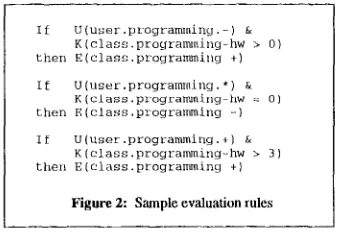
Rmlking is accomplished by using simple rules which determine under which conditiolts objective facts stored iu the knowledge b,ase ean become convincing evidence for an evaluation. Figure 2 shows three evalua- tion rules used in the current system.
If t h e n I[ t h e n If t h e n
U ( u s e r . p r o g r a ~ n i n g . - - ) & K ( c l a ~ s . p r o g r a ~ i n g - h w > O) E ( c l a s e . p r o g r a m m i l i g +) U (user. p r o g r a m l i l i n g . * ) a K (e [ ass. p r o g r a n u n i n g h w :- 0 ) E ( c I as s, p r o g r a m m i n g - ) U ( u s e r . p r o g r a n ~ i n g . ¢ ) & K ( e l a s s . p r o g r a m m i n g - h w > 3) E ( e l a s s . p r o g r a m m i n g +)
Figure 2: Sample evaluation rules
U ( u s e r . p r o g r a m m i n g - ) checks if in the cur- rent slate of the user model the system has evidence that the user dislikes programming.
K ( c l a s s . p r o g r a m m i n g - h w > 0) i s a q u e r y t o t h e knowledge base to determine whether the class has some programming assigmenls. An assertiou of the form E ( c l a s s. p r o g r a m a n i n g + ) is a. positive evaluation of the course Oil tile p r o g r a m m i n g scale. If none of the rules shown in Figure 2 are activated, the p r o g r a m m i n g scale will remain non-activated.
If the first rule is activated, n proposition attributing a number of programming assignments to the class is added to the paragraph being planned. In addition, this content is annotated by an evaluation on the p r o g r a m m i n g scale. Tile output of the evaluation sys- tem is therefore a set of propositions annotated by evaluations along each of the activated scales.
Argumentative Relations: Topoi
Once the course has been evaluated on the activated scales, the evaluation system considers relations between the scales. We use the notion of topoi as defined in (Anscombre & Ducrot, 1983) to describe such relations. Topoi are gradual inference rules of the form " t h e more/less X is P, the more/less Y is Q . " Figure 3 shows sample topoi used in the ADVISOR system.
w o r k l o a d + / d i f f i c u l t y .; w o r k l o a d ~ / t i m e - r e q u i r e d d i f f i c u l t y .I / w o r k l o a d + • d i f f i c u l t y 4 / t i m e r e q u i r e d
d i f [ i c u l t y - , / t a k e
progralltmin9 } / t i m e - l e q u i r e d + i n t e r e s t + / t a k e +
i m p o r t a i ~ c e h / t a k e +
Figure 3: Sample topoi nsed in ADVISOR
Topoi play the role of dletoricM relations ill RST by explaining the relation between two propositions ill it paragraph. But they are different ill that they mc very specific relations ,as opposed to generic relations like "anti-thesis" or " e v i d e n c e " . They can therefore he used to determine the content of the answer and the order in which arguments should be presented.
But the most in~pomant feature of topoi for our puro poses is that they can he related to lexical choice ill a natural way. In (Bruxelles et al, 1989) ,'rod (Bruxelles & Raccah, 1991) it is suggested that lexical items can be defined ht p,'wt by their argumentative potential. For example, it is part of the definition of the verb " t o reo quire" as used in our domain, that its subject is evaluated oil the scale of difficulty. This argumentative connotation explains tile contrast between (3) and (4), ill a context where both are addressed to a student who enjoys progr, unming:
(3) ? At least Al requires prograrmning, so it's easy.
(4) At least AI involves programming, so it's easy.
The same scales are u ~ d both in topoi taxi ill our lexieal description. They therefore serve `as a bridge be- tween the rhetodeal structure of tile p~wagraph and lex- iced choice.
A G R A M M A R S E N S I T I V E T O A R G U M E N T A T I V E C O N S T R A I N T S
The output of the evaluation system is a list of chains of acceptable argamentative derivations supporting tile conclusion that a course should be taken or Blot. Each proposition in the chain is annotated by a featore A O lbr Argumentative Orientation which indicates how it relates to the surrounding propositions. Figure 4 shows a sample proposition using the notation of fmmtional descriptions (FDs) used in fimcfioual unification gram- mars.
This input represents the proposition that AI covers (among others) a set of topics in the area of theory (namely, logic), and the AO feature indicates that this proposition is used as an argument for the conclusion that AI is a difficult course, by virtue of the topos t h e o r e t i c a l + / d i f f i c u l t + (the conclusinn
[image:4.432.224.389.28.141.2] [image:4.432.39.209.179.297.2](cat lex-verb)
(alt v e r b a l - l e x i c o n {:index concept) {{{concept c-contain)
(alt c o n t a i n - l e x (:bk-class ao) (
;; V e r b s a r g u m e n t a t i v e l y m a r k e d [({AO) {(scale s-difficultyl
(carrier c-class)
(carrier { p a r t i c i p a n t s carrier)) (orientation +)
( a o - c o n v e y e d lex-verb))) {participants carrier} c-class) (lex ((ralt ("require" "demand')))))
;; Neutral verbs ((lex ((ralt ('contain"
"involve'))))))))
< < o t h e r concepts>>)))
Figure 5: Fragment of the grammar
((cat relation) (name topics-of) (roles
((class ((cat class) (name AI)}) (topics
(Icat set}
(kind ((cat topic))) (cardinality I} (Intenslon
((cat relation) (name area-of)
(argument (^ roles topic}) (roles I(toplc ((cat topic)))
(area ((name theory)))) (extension
((cat listl
(elements ~(((name logic))))))) (AO
({scope [(cat clause)
(type attributive) (participants
I(carrier {roles class}) lattribute ((cat scale))))}) (scale ((name theoretical){) (orientation +)
(focus
{^ scope participants carrier}) (scalar
{^ scope participants attribute} (conclusion (+ difficult(AI))))))
Figure 4: Input to the grammar
part of the topos is shown in abbreviation). Details on the role of each fields in the AO feature and on the representation of quantification are provided in (EI- hadad, 1992).
Because of this AO specification, the grammar will choose appropriately realization (5) instead of (6):
(5) AI requires a lot of programming
(6) AI involves some programming.
The realization component is implemented in FUF, all extended functional unification grammar formalism which we have implemented (Elhadad, 1990, Elhadad, 1992). In the grammar we use, lexical choice and syn- tactic realization ate interleaved. For example, the choice of the verb is handled by the altemation shown in Figure 5. In this Figme, the notation a l t indicates a disjunction between alternatives; r a l t indicates a ran- dom alternation, and is used to indicate that the grammar does not account for the difference between the alter- natives; the curly braces notation in pairs of the form ( ( g o ) v a l u e ) indicates that the g o feature is not em- bedded in the lexical verb constituent unified with the grammar but rather is a top level feature within the clause.
The fragment shown in Figure 5 specifies how the grammar can map from an input concept e - c o n t a i n to a verb expressing this relation. The grammar for this relation contains two branches: in the first branch, the verbs "require" and "demand" are described as being argumentatively marked on the scale of difficulty. They can therefore be selected to project an evaluation on their subject. Note that the choice between "require" and "demand" is arbitrary, as indicated by the r a l t con- strnct - it is not explained by the grammar. The second branch describes the verbs "contain" and "involve" as neutral verbs, that 60 not add any connotation.
When there is an argumentative connotation, the grammar specifies which participant in the clause is af- fected by the argumentative evaluation (for both verbs in the example, the subject of the verb is the entity that carries the evaluation). Similar lexical descriptions for adjectives are described in (Elhadad, 1991).
The part of the grammar generating the syntactic structure of the clause is inspired both by systemic gram- mars ( (Halliday, 1985) and especially (Fawcett, 1987))
[image:5.432.53.390.37.467.2][or the semantic features of the input and by HPSG (Pol- lard & Sag, 1987) for the overall flow of control. It has been extended to account for the flow of argumentative information from lexical items to constituents and to the clause. For example, inserting an adjective argumen- tatively marked as the describer of a noun group creates an argumentative orientation feature at the level of the noun group which is then percolated to the clause in which the noun group is a participant.
Finally, the clause grammar has been extended with a clause complex constituent which determines connective selection and clause combining (an extension of (McKeown & Elhadad, 1991)). A clause complex is represented as an FD with features d i r e c t i v e and s u b o r d i n a t e (a notion similar to the RST distinction between nucleus and satellite). As discussed in (Ethadad & McKeown, 1990), there are many different connec- lives expressing argumentative relations. For example all of the following connectives can be used to express an evidence relation: because, since, therefore, so, as a consequence, then. The choice offered to the analyst is then: (i) to ignore the differences between such close counectives; (ii) to define a single rhetorical relation for each connective or (iii) to determine the choice of con- nective on other factors than the rhetorical relation alone. We adopt this later approach, and conclude that the out- put of the pat'agmph structurer must not determine the connectives, as is generally done by schema or RST bused planners. Instead we take advantage of how our text planner labels each proposition with information about its rhetorical function to determine which connec- tive is most ,appropriate in combination with the other pragmatic factors discussed in (Elliadad & McKeown, 1990). In this paper, we have also explained how the argumentative features needed to select connectives are
broduced by the content planner.
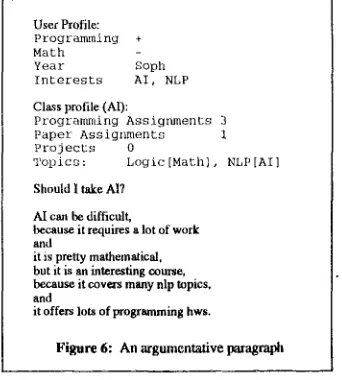
User Profile: P r o g r a m m i n g + M a t h
Y e a r S o p h I n t e r e s t s AI, N L P
Cb.ss profile (AI):
Progranm~ing A s s i g n m e n t s 3 P a p e r AssigIlments 1 P r o j e c t s 0
T o p i c s : Logic [Math] , NLP [AI ]
Should I take AI? AI can be difficult,
because it requires a lot of work and
it is pretty mathematical, but it is an interesting course, because it covca's many nip topics. and
it offers lots of programming hws.
Figure 6: An argumentative paragraph
I m p l e m e n t a t i o n
The content planner is fully implemented. In the surface realization component, the clause grammar is fully implemented with account fi)r argumentative lea- tares in adjectives, verbs and adverbial adjuncts. A 'large portion of the grammar covers the determiner sequence and how the choice of determiners like " m a n y " , " m o s t " , " f e w " etc. has an influence ou tile argunlea- tative orientation of the c l o s e . The grammar for con- nectives is separately implemented but not yet merged with the rest of the grammar.
Tile grammar is quite large: the current version in- cludes 580 disjunctions; it covers simple and complex clauses, interrogation, negation, a complex tense system, relative clauses, control and raising, coordination with some forms of ellipsis. We have extended FUF by adding sophisticated conlrol devices (Elhadad & Robin, 1992), making it possible to ha*vile sucl, -large grammars. In particular, we are able to deal with tile non-kw~al con- straints across constituent boundaries i,nposed by ar- gumentative relations in an efficient way.
Figure 6 shows the type of paragraphs obtained when all the pieces of the surface realization component are put together.
C O N C L U S I O N
We have described a model for planning argumen- tafive paragraphs which can perform content selection and which allows the surface realization component to adapt lexical choice within each clause to the rhetorical function of file clause. The model relies on the fact that the same argumentative relations which can he used as specific rhetorical relations also participate in the lexicld description of verbs, adjectives, adverbs and deter- miners.
O a r model "also distinguishes between two types of argumentative relations: evaluative functions and topoi. Evaluatiun function retch information from the knowledge base and make it scalar and context- dependent, while topoi are purely rhetorical relations that link scMar propositions together according to the ar- gumentative goal of the speaker. This two-stage content retrieval mechanism is in coatrast to most existing plan- ners which assemble facts directly retrieved from the knowledge base, and do not mmsfonn them according to the pragmatic context (goals of the speaker a*al user model). The mec "lmnism is implemented using the FUF text generation system.
Some of the open questions we face are: * Deciding whether to use a connective or not. • Deciding whether propositions can be left
implicit and still be recoverable.
. Combining several independent argumen- tative chains and deciding how to order the arguments in the combined structure. - Acquiring the argumentative lexical descrip-
[image:6.432.42.213.337.527.2]tions we need on a large scale
• Scaling up the text planning mechanism to generate several paragraphs.
In particular, when several independent argumen- tative chains support the same conclusion, argumentative relations alone cannot determine in which order they must be organized. We are currently investigating whether argumentative strategies similar to RST schemas can be combined with our technique. We are also evaluating bow other discourse aspects like topic progression can help in the planning of the paragraph.
Acknowledgments. This work was supported by DARPA under contract N00039-84-C-0165, by NSF Grant IRT-84-51438 and by ONR Grant N00014-89- J-1782. I want to thank Kathy McKeown, Jacques Robin and Frank Z. Smadja for helping me write this paper and Chaya Ochs for helping with the corpus analysis and the implementation of evaluation functions.
R E F E R E N C E S
Anscombre, J.C. and O., Ducrot. (1983). Philosoplu'e et langage. L' argumentation dans la langue. Bruxelles: Pierre Mardaga.
Bruxelles, S. and Raccah P.Y. (1991). Argumentation et Semantique: le parti-pris du lexique. In Acres du Colloque 'Enonciation et parti-pris'. Forthcom- ing.
Bruxelles, S., Careaguo, D. and Founder, C. (1989). Vers ane construction automatique des topoi a par- tir du lexique. CC AI - Journal for the integrated study of Artificial Intelligence cognitive science and applied epistemology, 6(4), 309-328.
Elhadad, M. (1990). Types in Functional Unification Grammars. Proceedings of 28th Meeting of the ACL (ACL'90). Pittsburgh.
Ethadad, M. (1991). Generating Adjectives to Express the Speaker's Argumentative Intent. Proceedings of 9th National Conference on Artificial Intel- ligence (AAAI 91). Anaheim.
Elhadad, Michael. (1992). Using Argumentation to Con- trol Lexical Choice: a Functional Unification- based approach. Doctoral dissertation, Columbia University.
Elhadad, M. and K,R. McKeown, (1990). Generating Connectives. Proceedings of COLING'90 (Volume 3). Helsinki, Finland.
Elhadad, M. & Robin, J. (1992). Controlling Content Realization with Functional Unification Gram- mars. In R. Dale, E. Hovy, D. Roesner and O. Stock (Fxl.), Aspects of Automated Natural Lan- guage Generation. Springer Verlag.
Fawcett, R.P. (1987). The semantics of clause and verb for relational processes in English. In Halliday, M.A.K. & Fawcett, R.P. (T_,d.), New developments
in systemic linguistics. London and New York: Frances Pinter.
Gmsz, B. and Sidaer, C. (1986). Attentions, intentions, and the structure of discourse. Computational Linguistics, 12(3), 175-204.
Halliday, M.A.K. (1985). An Introduction to Func- tional Grammar. London: Edward Arnold.
Hovy, E.H. (June 1988). Planning Coherent Multisen- tential Text. Proceedings of the 26th ACL Conference. Buffalo: ACL.
Hovy, E.H. (1988), Generating natural language under pragmatic constraints. Hillsdale, N.J.: L. Erlbanm Associates. Based on the author's thesis (doctoral--Yale University, 1987).
Mann, W.C. (1987). Text generation: the problem of text structure (Tech. R e p . ISI/RR-87-181). Marina del Rey, CA: ISI.
Mann, W.C. and S.A. Thompson. (1987). Rhetorical Structure Theory: Description and Construction of Text Structures. In Gerard Kempen (Ed.), Natural Language Generation. Martinus Nijhoff,
McKeown, K.1L (1985). Text Generation: Using Dis- course Strategies and Focus Constraints to Generate Natural Language Text, Studies in Natural Language Processing. Cambridge, England: Cambridge University Press.
McKeown, K.R. (1988). Generating Goal Oriented Ex- planations. International Journal of Expert Systems, 1(4). 377-395.
McKeown, K. and M. Ethadad. (1991). A Contrastive Evaluation of Functional Unification Glammar for Surface Language Generators: A Case Study in Choice of Connectives. In Cecile L. Pads, Wil- liam R. Swartout and William C. Mann (Eds.), Natural Language Generation in Artificial Intel- ligence and Computational Linguistics. Kluwer Academic Pubfishers.
McKeown, K.R. & Swartout W.R. (1987). Language generation and explanation. The Annual Review of Computer Science, (2), pp. 401--449.
Meteer, M.W. (1990). The generation gap: the problem of expressibility in text planning. Doctoral disser- tation, University of Massaebnssets at Ahmerst. Also available as BBN technical repoR No. 7347.
Moore, I.D. and C.L. Paris. (June 1989). Planning Text for Advisory Dialogues. Proceeding 27th ACL. Vancouver, BC: ACL.
Pads, C.L. (1987). The Use of Explicit User models in Text Generation: Tailoring to a User's level of expertise. Doctoral dissertation, Columbia University.
Pollard, C. and I.A. Sag. (1987). CSLI Lecture Notes. Vol, 13: Information-based Syntax and Semantics
- Volume 1. Chicago, I1: University of Chicago
Press.