Volume 2007, Article ID 41274,11pages doi:10.1155/2007/41274
Research Article
Multiadaptive Bionic Wavelet Transform: Application to
ECG Denoising and Baseline Wandering Reduction
Omid Sayadi and Mohammad B. Shamsollahi
Biomedical Signal and Image Processing Laboratory (BiSIPL), School of Electrical Engineering, Sharif University of Technology, P.O. Box 11365-9363, Tehran, Iran
Received 7 May 2006; Revised 22 October 2006; Accepted 11 January 2007
Recommended by Maurice Cohen
We present a new modified wavelet transform, called the multiadaptive bionic wavelet transform (MABWT), that can be applied to ECG signals in order to remove noise from them under a wide range of variations for noise. By using the definition of bionic wavelet transform and adaptively determining both the center frequency of each scale together with theT-function, the problem of desired signal decomposition is solved. Applying a new proposed thresholding rule works successfully in denoising the ECG. Moreover by using the multiadaptation scheme, lowpass noisy interference effects on the baseline of ECG will be removed as a direct task. The method was extensively clinically tested with real and simulated ECG signals which showed high performance of noise reduction, comparable to those of wavelet transform (WT). Quantitative evaluation of the proposed algorithm shows that the average SNR improvement of MABWT is 1.82 dB more than the WT-based results, for the best case. Also the procedure has largely proved advantageous over wavelet-based methods for baseline wandering cancellation, including both DC components and baseline drifts.
Copyright © 2007 O. Sayadi and M. B. Shamsollahi. This is an open access article distributed under the Creative Commons Attribution License, which permits unrestricted use, distribution, and reproduction in any medium, provided the original work is properly cited.
1. INTRODUCTION
The heart is a hollow muscular organ which through a co-ordinated muscle contraction generates the force to circulate blood throughout the body. Each beat of our heart is trig-gered by an electrical impulse from special sinus node cells in the atrium. The electrical impulse travels to other parts of the heart and causes the heart to contract. An electrocardio-gram (ECG) records these electrical signals. A normal ECG describes the electrical activity in the heart, and can be de-composed in characteristic components, named the P, Q, R, S, and T waves. Each of these components has its own typi-cal form and behavior and each heart beat traces the familiar morphology labeled by these peaks and troughs as shown in
Figure 1.
When an electrocardiogram is recorded, it would be con-taminated with many kinds of noise [1], such as the follow-ing.
(i) Baseline wandering, which can be modeled by low pass noise.
(ii) 50 or 60 Hz power-line interference.
(iii) Electromyogram (EMG), which is an electric signal caused by the muscle motion during effort test. (iv) Motion artifact, which comes from the variation of
electrode-skin contact impedance produced by elec-trode movement during effort test.
Since ECG is mostly contaminated with noise, extraction of pure cardiological indices from noisy measurements has been one of the major concerns of biomedical signal process-ing and needs reliable signal processprocess-ing techniques to pre-serve the diagnostic information of the recorded signal. For example, the S-T segment in the ECG signal is used for di-agnosing ischemia, myocardial infarction and indicating an imbalance of myocardial oxygen supply. The aim of this pa-per is to remove common noise caused by motion artifact,
0 100 200 300 400 500 600 700 800 −1
−0.5 0 0.5 1 1.5 2 2.5
Samples
A
m
plitude
(mV
)
Q S
P R
T
ST segment
Figure1: A typical human’s ECG signal.
noise, and motion artifacts [2,3]. Statistical techniques such as principal component analysis [4], independent compo-nent analysis [5,6], and neural networks [7] have also been used to extract a noise-free signal from the noisy ECG. Over the past several years, wavelet transform (WT) methods have also received great deal of attention for denoising of signals having multiresolution characteristics such as the electrocar-diogram [8–12].
Besides the above algorithms, baseline wandering re-moval has been addressed in the literature individually. Base-line estimation using cubic spBase-line [13], baseline construction by linearly interpolating between preknown isoelectric levels estimated from PR intervals [14], linear filtering [15], and the use of wavelet packets [16] are major approaches in this field.
Among transform-based methods, bionic wavelet trans-form (BWT), introduced by Yao and Zhang [17], is mainly developed and being optimized by the human biosystem and has showed promising results in speech processing. The term “bionic” goes back to the fact that BWT was origi-nally inspired by a biological mechanism which is related to the human’s biosystem. This idea motivated us to apply the BWT for processing the electrocardiograms. In this pa-per we attempted to apply BWT with new modifications to be properly adjusted for ECG processing, especially for de-noising applications. The new proposed algorithm employs a multiadaptation scheme and leaves the multiadaptive bionic wavelet transform as a novel ECG analyzer.
The paper is organized as follows.Section 2provides the-oretical background on the definition of the bionic wavelet transform. In Section 3 BWT is optimized for ECG sig-nal asig-nalysis with modifying the multiadaptation scheme.
Section 4 focuses on denoising and investigates the multi-adaptive bionic wavelet transform to be applied to ECG for denoising and baseline wandering cancellation. Finally, the simulation results are provided inSection 5followed by dis-cussion and conclusions coming inSection 6.
0 500 1000 1500 2000
−1 −0.5 0 0.5 1 1.5 2 2.5
Samples
Amplitude
(mV
)
(a)
0 500 1000 1500 2000
−1 −0.5 0 0.5 1 1.5 2 2.5
Samples
Amplitude
(mV
)
(b)
0 500 1000 1500 2000
−2 −1.5 −1 −0.5 0 0.5 1 1.5 2 2.5
Samples
Amplitude
(mV
)
(c)
Figure2: (a) Normal ECG, (b) noisy ECG, (c) baseline wandered ECG with its baseline trace.
2. DEFINITION OF BIONIC WAVELET TRANSFORM
The wavelet transform comprises the coefficients of the ex-pansion of the original signal x(t) with respect to a basis
ha,τ(t), each element of which is a dilated and translated
ver-sion of a functionh(t), called the mother wavelet, according to
hτ,a(t)=1
|a|h
t−τ a
. (1)
Depending on the choice of the mother wavelet appro-priately, the basis can be orthogonal or biorthogonal. The wavelet transform coefficients, given by the inner product of
x(t) and the basis functions,
WTx(τ,a)=< x(t), hτ,a(t)>=
1
|a|
x(t)h∗
t−τ a
dt
0 200 400 600 800 1000 1200 1400 1600 −1
0 1 2 3
Samples
Amplitude
(mV)
(a)
0 200 400 600 800 1000 1200 1400 1600 30
20 10
Samples
Sca
le
(b)
0 200 400 600 800 1000 1200 1400 1600 30
20 10
Samples
Sca
le
(c)
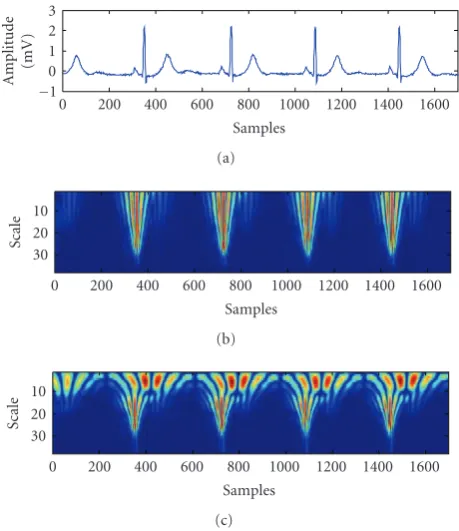
Figure 3: (a) MIT-BIH ECG record number 106, (b) time-frequency representation with WT, (c) the same representation with BWT.
both frequency and time domains, having fine frequency resolution and coarse time resolution at lower frequency, and coarse frequency resolution and fine time resolution at higher frequency. Since this matches the characteristic of most signals, it makes the wavelet transform suitable for time-frequency analysis.
The concept of multiresolution analysis can be extended from the fixed wavelet mother function to the varying in the time spread case. This new approach is known as the adaptive bionic wavelet transform and would be addressed next.
The idea behind the BWT is to replace the constant qual-ity factor of the wavelet transform with a variable adaptive quality factor [17]. To do this, one can make changes in the mother function of the wavelet transform. Satisfying the ad-missible condition for the mother wavelet, the oscillatingh(t) can be represented as
h(t)=h(t) expj2π f0t
, (3)
where f0is the center frequency ofh(t) andh(t) is its
enve-lope function. Using a T-value, the BWT mother function would be stated as follows:
hT(t)=
1
Th
t T
expj2π f0t
. (4)
The BWT is now defined by the following equation [17]:
BWTx(τ,a)=1
|a|
x(t)h∗T
t−τ a
dt
= 1
T|a|
x(t)h∗
t−τ aT
×exp
−j2π f0
t−τ a
dt.
(5)
As can be seen, in contrast to the wavelet transform, both the amplitude and the time spread of BWT mother function depend on theTvalue. For evaluating theTparameter, Yao and Zhang adopted a general nonlinear form based on a pre-viously introduced auditory model. This results in the fol-lowing formula for a function, namely, theT-function:
T(τ+Δτ)= 1−G1 BWTs
BWTs+BWTx(τ,a) −1
×1 +G2∂BWTx(τ,a)/∂t
−1
,
(6)
whereG1,G2, and BWTsare constants, and BWTx(τ,a;h) is
the BWT coefficient at timeτ and scalea, andΔτis the cal-culation step. Clearly, it is theT-function that brings adap-tation to the BWT. For detailed information about how the
T-function is derived and the underlying mechanism, the reader is referred to [18,19].
3. BIONIC WAVELET TRANSFORM OPTIMIZATION
FOR ECG ANALYSIS
According to the definition of BWT, there is a major diff er-ence in resolution of time-frequency span of analyzing win-dows. In fact, in the WT, for a fixed mother function, all the windows in a certain scale along thet-axis are fixed and the window size of the WT varies with the change of analyz-ing frequency. However, both the time and frequency reso-lutions can be different in the BWT even in a certain scale. The adjustment of the BWT resolution in the same scale is controlled byT-function, which is related to the signal in-stantaneous amplitude and its first-order differential [17].
Figure 3shows the time-frequency representation for an ECG signal with both WT and BWT. Notice the smoothing in the BWT representation which is the direct result of windows changes over certain scales.
It only remains to set the BWT parameters efficiently so that it can decompose the signal into finite number of scales and afterwards, determine the most energetic ones, and choose a global or local threshold. In order to optimize the BWT parameters we have used a semioptimal method considering both analytic and morphological aspects of the analyzed signal. As we are considering ECG signal, we should be aware of its variability.
Let f0 be the initial center frequency of the mother
wavelet. In [17] it has a value equal to 15165.4 Hz and as the scale goes higher and higher, the center frequency will de-crease in the following way:
fm= f0
qm, q >1. (7)
For ECG we do not need such high f0, so we optimized
it simply by running the program for different values of f0
and then minimizing the gradient of error variance by com-paring the results—numerically and morphologically—with each other. It has been found that if the center frequency lies in the range of 360 to 500 Hz there would be no much distor-tion on the analyzed ECG. The reason behind this choice lies in the fact that to have no aliasing it is preferred to choose the center frequency of the first scale a value more than ECG sampling frequency. Here we have chosen f0 = 400 which
yields satisfactory results.
Unlike [17], in our methodq is not a global constant, but for each signal and scale of decomposition it takes a fixed value which should obey an adaptation procedure. Besides for everym, that is, in each distinct scale, it is adapted for different time-frequency windows. More explanation on how
q is determined according to every analyzing window is to be given in the next section. Other parameters are exactly the same as what was stated in [20,21] which used BWT for speech enhancement and denoising. These constants are
G1=0.87,G2=45, and BWTs=0.8.
Finally, the calculation step is determined due to the sam-pling frequency. If we let fsbe the sampling frequency, then
the step will beΔτ=1/ fs.
4. APPLICATION TO DENOISING AND BASELINE
WANDERING REDUCTION
For investigating the applications of MABWT to ECG sig-nal, we have restricted our interest on denoising and baseline wandering reduction. In each of the following sections, we have proposed modifications to BWT so as to be optimized for the field of analysis. For baseline wandering elimination, the goal is optimizing BWT by adopting a multiadaptation scheme in which the low passed wandering is automatically removed and there is no need for extra processing on distinct subbands.
4.1. Denoising
After BWT optimization, the denoising technique illustrated inFigure 4is used to reduce the amount of noise contamina-tion in the ECG signal. In implementacontamina-tion, BWT coefficients can be easily calculated based on corresponding WT coeffi -cients by
BWTx(τ,a;T)=K×WTx(τ,a), (8)
whereK is a factor depending onT [18]. Especially, for the real Morlet function h(t) = e−(t/T0)2, which is used as the
Denoised ECG Noisy
ECG WT
BWT coefficients
Kfactor
Thresholding
1/K
Inverse WT
Figure4: Block diagram of the bionic wavelet transform denoising technique.
mother function in our experiments,Kis equal to [21]:
+∞ −∞e−t
2
dt
T/T0 2
+ 1
≈1.7725
T/T0 2
+ 1.
(9)
Here we have used Donoho’s proposed approach for de-noising including two major categories, hard thresholding and soft thresholding [10,22]. Choosing the threshold value can be determined in many ways. Donoho derived the fol-lowing formula based on white Gaussian noise assumption:
thr=σ
2 log2N, (10) where thr is the threshold value,Nis the length of the noisy signal, and σ = AMFS/0.6745, with AMFS denoting the absolute median estimated on the first scale of the bionic wavelet coefficients.
Knowing the fact that it is theT-function (or theK fac-tor, equivalently) which results in the adaptive characteristic of the BWT, it may be a good idea to use the values of the
T-function to come to a new thresholding rule. On the other hand, it is expected for the BWT coefficients to take small val-ues in the higher scales of decomposition with regard to (8), the same as the WT coefficients. Thus it seems to be logic to use the values of the T-function in lower scales of decom-position. Combining the above idea with Donoho’s formula yields the following threshold which is a new modification of (10). LetTfs(i) be the value ofT-function in the first step of
computing. The threshold is formulated as thr= σ
iαiTfs(i)
2 log2N. (11)
In fact a weighted average ofT-function values in the first scale of decomposition with the bionic wavelet transform is added to (10) to get better results. Theαi-weights are chosen
with try and error for the algorithm to have the highest per-formance. But an experimentally right choice is to let theαi
coefficients be a decreasing function.
4.2. Baseline wandering reduction
Among various methods used for baseline wandering reduc-tion, an efficient technique was proposed by Park et al. [23]. They presented a wavelet adaptive filter (WAF) which con-sists of two parts, in the first part the signal is decomposed into seven subbands and in the second part the seventh low-est band subsignal is adaptively filtered. But the method suf-fers from preserving the signal quality, specially in the S-T segment.
Another approach which has utilized the wavelet pack-ets to eliminate the ECG baseline wandering was introduced, which removes the components that are not correlated to ECG and have such characteristics that are somehow added to it [16]. But the method does not fully take the advantage of interbeat correlation of the ECG signal. Hence, baseline drifts that occur occasionally and cannot be considered to be an added source to the ECG would not be removed effi -ciently.
As for the case of BWT, the resolution in the time-frequency domain can be adaptively adjusted not only by the signal frequency but also by the signal instantaneous am-plitude and its first-order differential. Hence, analyzing the ECG signal in the time-frequency plane of BWT not only has a good chance to remove the baseline wanderings but also has promising results preserving the clinical information of the ECG record.
Since the spectrum of the baseline is below the spectrum of the ECG signal, therefore its energy concentration in cor-responding time-scale plane does not change much as the scale is changed in the binary decomposition tree, but the energy of the ECG signal decreases as the scale is changed. Therefore, in the binary tree search we reach a point that the energy of the ECG signal almost vanishes (no details in that scale) but we still have considerable energy for baseline wan-dering.
Using the multiadaptive bionic wavelet transform makes possible the detection and reduction of ECG baseline wan-dering in low frequency subsignals. As we mentioned be-fore the central frequency of each scale is adaptively chosen. For adaptation purpose, we have used the following criteria based on the time-frequency representation of the analyzed signal under the adaptive BWT.
If we suppose that the baseline wandering can be esti-mated by a sinusoidal function (see Figure 2(c)), the fre-quency of the sine function can be approximately estimated using the spectrum of the signal, in which we should seek for a peak. In most cases the second distinguished peak in the Fourier transform of the signal corresponds to the wan-dering frequency. For ECG signals with the baseline wander-ings which cannot be considered as sinusoidal, the fw
esti-mation is obtained from the time-frequency representation of the signal. In this case a frequency exists all over the time which deals with the baseline trace. After determining an es-timation of the baseline wandering frequency,fw, we may use
the thresholding rule of (11) for the three consecutive scales, the one that contains fw, the previous and the next scales. To
evaluate the coefficients of the multiadaptive bionic wavelet transform we need the value ofq. To determine the value of
qwe remember the fact that the mean of the baseline wan-dered ECG and the mean of the baseline corrected ECG have the maximum distance. Thus we use the maximum distance (MD) criteria to verify the optimalqfor which the distance between the MABWT coefficients of original signal and the baseline corrected signal is maximized. We define the MD criteria as
qopt=arg max q
MABWTx(τ,a)
−MABWTx(τ,a) 2
(τ,a)∈m
,
(12)
wherex andxare the original and processed signals,mis the scale number (a =2−m), andmdenotes the analyzing
window of themth scale which is centered at fw. Solving the
above optimization problem, we will haveqfor the next scale. Althoughqis optimally selected, the number of scalesm re-mains to be determined according to theqvalue of the previ-ous scale. In other words, we begin withm=1. For the first scale, that is,m =1, MABWT is computed using an initial value forq. Then (12) gives the optimum value ofqfor the next scale,m = 2. The procedure proceeds iteratively until the center frequency of the analyzing window, which is de-fined according to bothmandq(refer to (7)), goes beyond the desired predefined ECG frequency range.
The step by step multiadaptation together with the adaptedT-function (orK-factor) of BWT can cope with the problem of ECG baseline wandering reduction better than WT. Furthermore as we have an estimation of fw, the
adap-tation can be used only in three successive scales in which the mid-scale has the closest center frequency to fw. So the
implementation is possibly time consuming.
5. SIMULATION RESULTS
To show that MABWT is appropriate for ECG denoising we have used two types of ECG signals, both simulated and real ones. We used the MIT-BIH arrhythmia database [24] as the reference for our real signals, all with sampling frequencies,
fs, equal to 360 Hz. For the simulated ECGs we have used
the dynamical model which was introduced for generation of synthetic ECG cardiac signals [25,26].
The signals were decomposed using MABWT up to 40 scales depending on the different values ofqthat was opti-mally selected using (12). We have used Morlet wavelet as mother wavelet and its support length is chosen as [−4, 4], and 2.5πis chosen as its oscillatory frequency [21]. For sim-ulation, we have chosen f0 = 400 Hz (f0 > fs). In addition
we have considered the simplest case for our new threshold-ing rule, (11). Hence, we have setαi=1/i.
5.1. Denoising
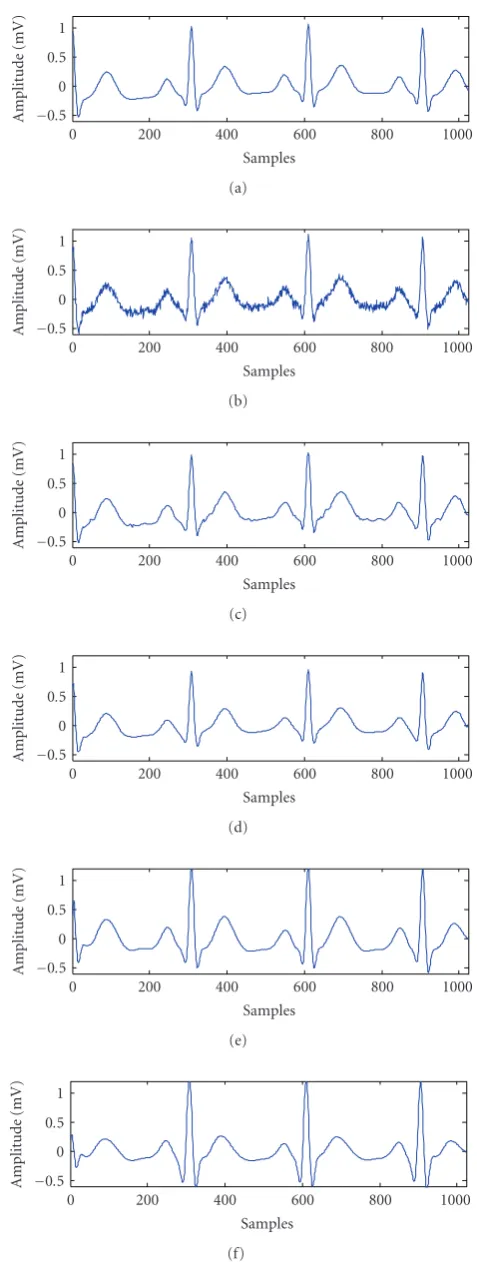
applied the wavelet-based denoising with Daubechies (db4) wavelets to each signal and we have shown the results for both hard and soft thresholdings. Figures 5–7 show some typical results, considering real and simulated ECG signals of two general categories, that is, normal and abnormal ones. One can see that in many cases, hard thresholded signal is much similar to the soft thresholded ECG, which is due to the intrinsic smoothness in BWT.
Simulation results provide supportive evidence to claim that MABWT has some advantages over the traditional WT for ECG denoising. First, it has higher sensitivity so it is more probable for WT to have little single noise samples (speckles) remained. Second, MABWT has a smoothing property with respect to its resolution variation over the time-frequency plane, and this is exactly what we are seeking in many denois-ing techniques. This is particularly true for real ECGs (see
Figure 6). Furthermore, the effect of the adaptation is clearly obvious in the first samples of the reconstructed ECGs with MABWT (refer to Figures5(e)and5(f)). But as the adapta-tion proceeds, the reconstructed signal follows the clean ECG morphology.
Another field of interest for the proposed multiadap-tive method is to denoise and reconstruct abnormal signals.
Figure 7(a)shows an ectopic beat among a normal ECG cy-cle. We have applied the MABWT to the signal and have shown the results corresponding to hard MABWT (HBWT). It is clear that the denoised signal is noise-free but cannot fol-low the ST segment of the ectopic beats, reasonably because any abnormality corresponds to an abrupt change in the sig-nal rhythm and consequently the adaptation needs time to follow this behavior (Figure 7(b)). But fortunately this does not affect the diagnostic features of the ECG signal such as the QT or the ST intervals, and the QRS complex.
Since we have used the adaptation in a limited number of scales, abrupt changes may be tracked not efficiently, but it can be shown that if the adaptation includes all decom-position subbands and also the abnormality can be consid-ered semicyclic, but not necessarily stationary, the MABWT technique would come over the above problem (refer to
Figure 7(c)).
For evaluating the performance of the proposed BWT we have used the SNR improvement measure by the means of the expression:
imp[dB]=SNRoutput−SNRinput
=10 log
ixd(i)−x(i) 2
ixn(i)−x(i)2
, (13)
where x denotes the original ECG,xd is the denoised
sig-nal, andxnrepresents the noisy ECG signal.Figure 8
com-pares the improvement values between WT and MABWT. For evaluation, we have chosen first 4096 samples of the noise free MIT-BIH record number 100 as our reference ECG signal. As mentioned before, both hard and soft threshold-ings have been considered for denoising. One can see that in lower input SNRs, soft MABWT (SBWT) has a better perfor-mance and as the input SNR is increased SBWT remains the best choice with improvements much more than that of WT.
0 200 400 600 800 1000
−0.5 0 0.5 1
Samples
Amplitude
(mV
)
(a)
0 200 400 600 800 1000
−0.5 0 0.5 1
Samples
Amplitude
(mV
)
(b)
0 200 400 600 800 1000
−0.5 0 0.5 1
Samples
Amplitude
(mV
)
(c)
0 200 400 600 800 1000
−0.5 0 0.5 1
Samples
Amplitude
(mV
)
(d)
0 200 400 600 800 1000
−0.5 0 0.5 1
Samples
Amplitude
(mV
)
(e)
0 200 400 600 800 1000
−0.5 0 0.5 1
Samples
Amplitude
(mV
)
(f)
0 500 1000 1500 2000 −1
−0.5 0 0.5 1
Samples
Amplitude
(mV
)
(a)
0 500 1000 1500 2000
−1 −0.5 0 0.5 1
Samples
Amplitude
(mV
)
(b)
0 500 1000 1500 2000
−1 −0.5 0 0.5 1
Samples
Amplitude
(mV
)
(c)
0 500 1000 1500 2000
−1 −0.5 0 0.5 1
Samples
Amplitude
(mV
)
(d)
0 500 1000 1500 2000
−1 −0.5 0 0.5 1
Samples
Amplitude
(mV
)
(e)
0 500 1000 1500 2000
−1 −0.5 0 0.5 1
Samples
Amplitude
(mV
)
(f)
Figure 6: Typical results of different methods for the MIT-BIH record 117 with an input SNR of 4 dB. (a) Clean ECG, (b) noisy in-put signal, (c) WT (hard), (d) WT (soft), (e) MABWT (hard), and (f) MABWT (soft).
0 500 1000 1500 2000 2500 3000 3500 4000 −1.5
−1 −0.5 0 0.5 1 1.5 2 2.5 3
Samples
Amplitude
(mV
)
(a)
0 500 1000 1500 2000 2500 3000 3500 4000 −1.5
−1 −0.5 0 0.5 1 1.5 2 2.5 3
Samples
Amplitude
(mV
)
(b)
0 500 1000 1500 2000 2500 3000 3500 4000 −1.5
−1 −0.5 0 0.5 1 1.5 2 2.5 3
Samples
Amplitude
(mV
)
(c)
Figure7: Denoising results of HBWT applied to an ECG (MIT-BIH record 119) with ectopic beats. (a) Clean and noisy ECG, (b) HBWT with 3 levels of adaptation, (c) HBWT with the adaptation applied to all decomposition levels. The surrounding circles indicate the ST segment of the ectopic beats.
Moreover, HBWT acts better than hard WT and for SNRs higher than 8 dB, it passes the soft WT performance.Figure 8
clarifies that for a wide range of input SNRs, the MABWT improvement (hard or/and soft) has a noticeable difference to that of WT, especially outstanding for lower SNRs for which having nearly 2 dB improvement in MABWT is of ma-jor importance.
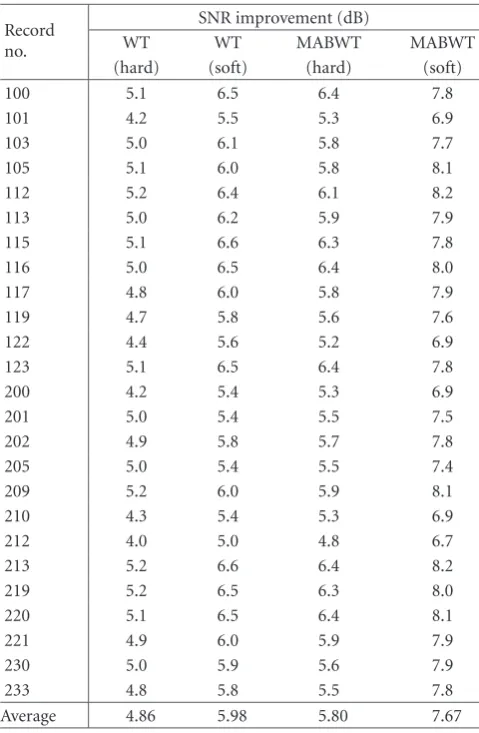
In order to have a comparison between the performance of the proposed method and conventional wavelet-based ECG denoising schemes, WT and the MABWT were tested on the database. The results of the SNR improvement for the input SNR of 5 dB are listed inTable 1.
−10 −5 0 5 10 15 20 −2
−1 0 1 2 3 4 5 6 7 8 9
Input SNR (dB)
Im
pr
o
vemen
t
(dB)
WT soft WT hard
BWT soft BWT hard
Figure8: WT and MABWT filter output SNR improvement ver-sus different input SNRs for the first 4096 samples of the MIT-BIH record number 100.
MABWT always improve the input SNR, MABWT with soft thresholding has the best overall performance with a max-imum SNR improvement of 8.2 dB, while the best result of WT-based approach goes back to 6.6 dB.
5.2. Baseline wandering reduction
We have divided the baseline wanderings into the following two general categories: DC components affecting the base-line not to be at zero level, and basebase-line drift which is a con-sequence of low frequency interferences. For both cases with the appropriate choices for the level of decomposition, that is, number of scalesm, and the center frequency f0,
remov-ing baseline wanderremov-ing would be a direct task. Remember that we have assigned a fixed value to f0, experimentally. On
the other hand there is an interdependency betweenmand
q (7) but with the help of the iterative algorithm discussed inSection 4, there would be only one degree of freedom to determine the accurate values of the mentioned parameters. Again it only remains to findqwith respect to the optimiza-tion problem of (12) form=2 and continue with the com-puted value(s) for the next scale(s). To clarify the eff ective-ness of the proposed technique, we have chosen real ECG signals including two classes of baseline wandering simulta-neously, and we have run the baseline wandering cancellation algorithm with both WT and MABWT. The results are pro-vided in Figures9–11.
Results show that although for the case of wavelet trans-form the denoised signal is somehow free of the baseline interference, but the drifts still exist unless applying a low-pass filtration to the properly selected subband (Figure 9(b)). Moreover, the thresholding not only affects the baseline but
Table1: WT and MABWT denoising performance on the MIT-BIH arrythmia database.
Record no.
SNR improvement (dB)
WT WT MABWT MABWT
(hard) (soft) (hard) (soft)
100 5.1 6.5 6.4 7.8
101 4.2 5.5 5.3 6.9
103 5.0 6.1 5.8 7.7
105 5.1 6.0 5.8 8.1
112 5.2 6.4 6.1 8.2
113 5.0 6.2 5.9 7.9
115 5.1 6.6 6.3 7.8
116 5.0 6.5 6.4 8.0
117 4.8 6.0 5.8 7.9
119 4.7 5.8 5.6 7.6
122 4.4 5.6 5.2 6.9
123 5.1 6.5 6.4 7.8
200 4.2 5.4 5.3 6.9
201 5.0 5.4 5.5 7.5
202 4.9 5.8 5.7 7.8
205 5.0 5.4 5.5 7.4
209 5.2 6.0 5.9 8.1
210 4.3 5.4 5.3 6.9
212 4.0 5.0 4.8 6.7
213 5.2 6.6 6.4 8.2
219 5.2 6.5 6.3 8.0
220 5.1 6.5 6.4 8.1
221 4.9 6.0 5.9 7.9
230 5.0 5.9 5.6 7.9
233 4.8 5.8 5.5 7.8
Average 4.86 5.98 5.80 7.67
also has destructive effects on the signal morphology, espe-cially on the ST segment, which is extremely sensitive to noise and is of great clinical significance (Figure 10(b)). But in the denoised signal with MABWT, baseline wandering is com-pletely removed and also a noise-free version of the signal is obtained without the need for any extra filtering. There are more with the advantages of MABWT over other base-line correction techniques. It is capable of eliminating not only those drifts which could be modeled as additive sources [16], but also the ones that have no correlation with a pure ECG. In addition, the method has no destructive effects on the morphology of the signal and can cope with both normal and abnormal beats, while previously introduced methods have problems with these cases [8].
0 500 1000 1500 2000 2500 3000 3500 4000 −1
0 1 2
Samples
Amplitude
(mV)
(a)
0 500 1000 1500 2000 2500 3000 3500 4000 −1
0 1 2
Samples
Amplitude
(mV)
(b)
0 500 1000 1500 2000 2500 3000 3500 4000 −1
0 1 2
Samples
Amplitude
(mV)
(c)
Figure9: Typical results of different methods for baseline correc-tion in presence of DC components and lowpass interference. (a) MIT-BIH record 203, (b) result of applying WT, (c) result of apply-ing MABWT.
signal has its maximum difference on the QRS complexes and the T waves. In contrast to WT, the processed signal with BWT, when adapted to the signal, follows its morphology, leading the difference to be ignored. Consequently, WT can-not handle precise baseline wander removal, and there is a significant difference in the amplitude of the fiducial points of the signal, compared to the original ECG. Hence, there may be distortions in the locations of the ECG points and interval features.
6. DISCUSSION AND CONCLUSION
We have presented and validated a new multiadaptive version of the bionic wavelet transform and its applications to noise and baseline wandering suppression in electrocardiograms combined with modifications of the traditional threshold-ing rules. The MABWT aims at integratthreshold-ing into the standard BWT a mechanism that adjusts the center frequency of every analyzing scale in a signal-adaptive fashion. Moreover, the value of theT-function, which controls the mother wavelet, is directly influenced on the threshold to come to an appro-priate criterion for the denoising approach which uses the transform coefficients’ information.
To show that BWT improvement is really effective in clin-ical situations, the method has been validated using several ECG recordings with a wide variety of wave morphologies from MIT-BIH arrhythmia database, and also simulated sig-nals. For denoising purpose, using the MABWT
representa-0 200 400 600 800 1000 1200 1400 1600 1800 −0.5
0 0.5 1
Samples
Amplitude
(mV)
(a)
0 200 400 600 800 1000 1200 1400 1600 1800 −0.5
0 0.5 1
Samples
Amplitude
(mV)
(b)
0 200 400 600 800 1000 1200 1400 1600 1800 −0.5
0 0.5 1
Samples
Amplitude
(mV)
(c)
Figure10: Typical results of different methods for baseline wander-ing cancellation in presence of sinusoidal drifts. (a) MIT-BIH record 228, (b) result of applying WT, (c) result of applying MABWT.
0 500 1000 1500 2000 2500 3000 3500 4000 −0.5
0 0.5 1 1.5
Samples
Amplitude
(mV)
(a)
0 500 1000 1500 2000 2500 3000 3500 4000 −0.5
0 0.5 1 1.5
Samples
Amplitude
(mV)
(b)
0 500 1000 1500 2000 2500 3000 3500 4000 −0.5
0 0.5 1 1.5
Samples
Amplitude
(mV)
(c)
1000 2000 3000 4000 5000 6000 7000 8000 −2
−1.5 −1 −0.5 0 0.5 1 1.5
Samples
Amplitude
(mV
)
(a)
1000 2000 3000 4000 5000 6000 7000 8000 −0.6
−0.4 −0.2 0 0.2 0.4 0.6
Samples
Amplitude
(mV
)
(b)
Figure12: Simulated baseline perturbation removal and noise re-duction for an abnormal ECG. (a) MIT-BIH record 207, and the added baseline trace, (b) differences between WT (dashed line) and MABWT (solid line) processed signals and the original ECG.
tion of the ECG signal and with the help of the modified threshold (11) there was an average SNR improvement of 5.80 dB for hard thresholding and 7.67 dB for soft thresh-olding, corresponding to 0.94 dB and 1.69 dB improvement, respectively, compared to the WT-based methods, on the as-sumption of additive white Gaussian noise sources. None of the more complex test cases result in an improvement less than 4.8 dB. The MABWT-based denoising, in contrast to most denosing methods found in the literature, allows taking the advantage of characteristics of adaptive time-scale anal-ysis. Hence, there are advantages with the suggested tech-nique compared to conventional other denoising methods; there are fewer speckles remaining in the denoised signal, and the reconstructed signal follows a smoothing behavior. In contrast to other efficient denoising techniques, abrupt changes that occur in most abnormal cases would not be tracked unless the adaptation includes all subbands. Con-sequently, MABWT is able to outperform other algorithms and the modified threshold selection rule, which uses the in-formation of the transform coefficients in the first scale of decomposition, has a noise reduction ratio well within the acceptable range.
Also, the proposed MABWT algorithm removes baseline wandering, while preserving the clinical information and the morphology of the ECG record. Unlike other baseline correc-tion schemes, it removes the components of all wandering classes that are not correlated to ECG and have such
char-acteristics that are somehow added to it, DC components, and low frequency interfering drifts. Moreover, the proposed algorithm is also capable of improving signal-to-noise ratio while eliminating the baseline wandering.
The superior performance of the proposed technique is a direct result of the multiadaptive scheme, which gives the opportunity to study different types of noise through the in-tuitive modification of BWT parameters. Moreover MABWT can be calculated using WT by adding aK-factor which re-sults in a fast implementation of the proposed algorithm.
Finally, it should be mentioned that the importance of the multiadaptive technique goes beyond the single problem of ECG denoising since it is applicable to every type of data considering a case-dependent optimization. In fact, once the time-frequency features of the data are extracted, the prob-lem obtains an abstract representation on which it is possible to apply whichever experience matured in MABWT.
ACKNOWLEDGMENTS
The authors wish to thank Mr. Reza Sameni for his assistance and deep review of the paper. This work has been supported, financially and intellectually, by the Iran Telecommunication Research Center (ITRC), under Grant no. T/500/15023.
REFERENCES
[1] Z. Frankiewicz and E. Piˆetka, “Komputerowe eliminacja linii izoelektrycznej z sygnau EKG,”Problemy Techniki Medycznej, vol. 16, no. 1, 1985.
[2] N. V. Thakor and Y.-S. Zhu, “Applications of adaptive filtering to ECG analysis: noise cancellation and arrhythmia detection,” IEEE Transactions on Biomedical Engineering, vol. 38, no. 8, pp. 785–794, 1991.
[3] P. Laguna, R. Jane, O. Meste, et al., “Adaptive filter for event-related bioelectric signals using an impulse corevent-related ref-erence input: comparison with signal averaging techniques,” IEEE Transactions on Biomedical Engineering, vol. 39, no. 10, pp. 1032–1044, 1992.
[4] G. B. Moody and R. G. Mark, “QRS morphology represen-tation and noise estimation using the Karhunen-Lo`eve trans-form,” inProceedings of Computers in Cardiology, pp. 269–272, Jerusalem, Israel, September 1989.
[5] A. K. Barros, A. Mansour, and N. Ohnishi, “Removing ar-tifacts from electrocardiographic signals using independent components analysis,”Neurocomputing, vol. 22, no. 1–3, pp. 173–186, 1998.
[6] T. He, G. D. Clifford, and L. Tarassenko, “Application of ICA in removing artefacts from the ECG,” to appear inNeural Pro-cessing Letters.
[7] G. D. Clifford and L. Tarassenko, “One-pass training of op-timal architecture auto-associative neural network for detect-ing ectopic beats,”Electronics Letters, vol. 37, no. 18, pp. 1126– 1127, 2001.
[8] K. Daqrouq, “ECG baseline wander reduction using discrete wavelet transform,”Asian Journal of Information Technology, vol. 4, no. 11, pp. 989–995, 2005.
[10] D. L. Donoho, “De-noising by soft-thresholding,”IEEE Trans-actions on Information Theory, vol. 41, no. 3, pp. 613–627, 1995.
[11] M. Popescu, P. Cristea, and A. Bezerianos, “High resolution ECG filtering using adaptive BSayesian wavelet shrinkage,” in Proceedings of Computers in Cardiology, pp. 401–404, Cleve-land, Ohio, USA, September 1998.
[12] P. M. G. Agante Da Silva and J. P. Marques De S´a, “ECG noise filtering using wavelets with soft-thresholding methods,” inProceedings of Computers in Cardiology, pp. 535–538, Han-nover, Germany, September 1999.
[13] C. R. Meyer and H. N. Keiser, “Electrocardiogram baseline noise estimation and removal using cubic splines and state-space computation techniques,”Computers and Biomedical Re-search, vol. 10, no. 5, pp. 459–470, 1977.
[14] P. W. MacFarlane, J. Peden, J. Lennox, M. P. Watts, and T. D. Lawrie, “The Glasgow system,” in Trends in Computer-Processed Electrocardiograms: Proceedings of the IFIP Work-ing Conference on Trends in Computer-Processed Electrocar-diograms, pp. 143–150, North-Holland, New York, NY, USA, 1977.
[15] J. A. Van Alste and T. S. Schilder, “Removal of base-line wander and power-line interference from the ECG by an efficient FIR filter with a reduced number of taps,”IEEE Transactions on Biomedical Engineering, vol. 32, no. 12, pp. 1052–1060, 1985. [16] B. Mozaffary and M. A. Tinati, “ECG baseline wander
elimina-tion using wavelet packets,”Transactions on Engineering, Com-puting and Technology, vol. 3, pp. 22–24, 2004.
[17] J. Yao and Y. T. Zhang, “Bionic wavelet transform: a new time-frequency method based on an auditory model,”IEEE Trans-actions on Biomedical Engineering, vol. 48, no. 8, pp. 856–863, 2001.
[18] J. Yao and Y. T. Zhang, “Cochlear is an inhomogeneous, active and nonlinear model,” inProceedings of the 1st Joint Meeting of BMES & IEEE/EMBS, p. 1031, Atlanta, Ga, USA, October 1999.
[19] J. Yao and Y. T. Zhang, “From otoacoustic emission modeling to bionic wavelet transform,” inProceedings of the 22nd Annual International Conference of the IEEE Engineering in Medicine and Biology Society, vol. 1, pp. 314–316, Chicago, Ill, USA, July 2000.
[20] J. Yao and Y. T. Zhang, “The application of bionic wavelet transform to speech signal processing in cochlear implants using neural network simulations,” IEEE Transactions on Biomedical Engineering, vol. 49, no. 11, pp. 1299–1309, 2002. [21] X. Yuan, “Auditory model-based bionic wavelet transform for
speech enhancement,” M.S. thesis, Speech and Signal Process-ing Laboratory, Marquette University, Milwaukee, Wis, USA, 2003.
[22] D. L. Donoho and I. M. Johnstone, “Adapting to unknown smoothness via wavelet shrinkage,”Journal of the American Statistical Association, vol. 90, no. 432, pp. 1200–1224, 1995. [23] K. L. Park, K. J. Lee, and H. R. Yoon, “Application of a wavelet
adaptive filter to minimise distortion of the ST-segment,” Medical and Biological Engineering and Computing, vol. 36, no. 5, pp. 581–586, 1998.
[24] “The MIT-BIH Arrhythmia Database,” http://physionet.ph. biu.ac.il/physiobank/database/mitdb/.
[25] P. E. McSharry, G. D. Clifford, L. Tarassenko, and L. A. Smith, “A dynamical model for generating synthetic electrocardio-gram signals,”IEEE Transactions on Biomedical Engineering, vol. 50, no. 3, pp. 289–294, 2003.
[26] P. E. McSharry and G. D. Clifford, “ECGSYN—a realistic ECG waveform generator,” http://www.physionet.org/physiotools/ ecgsyn/.
Omid Sayadiwas born in Shiraz, Iran, in 1983. He majored in biomedical engineer-ing and received the B.S. degree from Sha-hed University of Tehran, Iran, in 2005. He was a Research Scientist with BehsazTeb Co., Tehran, from 2003 to 2005. He is currently an M.S. student of biomedical engineering at the Electrical Engineering Department of Sharif University of Tech-nology, Tehran, Iran, and a member of
Biomedical Signal and Image Processing Laboratory (BiSIPL). His research deals with dynamical models for ECG generation, model-based ECG processing, the application of wavelet concepts, and es-pecially multiadaptive bionic wavelet transform to biomedical sig-nal processing solutions, signature verification, and efficient heart modeling.
Mohammad B. Shamsollahi was born in Qom, Iran, in 1965. He received the B.S. de-gree in electrical engineering from Tehran University, Tehran, Iran, in 1988, and the M.S. degree in electrical engineering, Telecommunications, from the Sharif Uni-versity of Technology, Tehran, Iran, in 1991. He received the Ph.D. degree in electrical engineering, biomedical signal processing, from the University of Rennes 1, Rennes,