Volume 2007, Article ID 92191,14pages doi:10.1155/2007/92191
Research Article
Accurate Methods for Signal Processing of Distorted
Waveforms in Power Systems
A. Bracale,1G. Carpinelli,1R. Langella,2and A. Testa2
1Dipartimento di Ingegneria Elettrica, Universit`a degli Studi di Napoli Federico II, Via Claudio 21, 80100 Napoli (NA), Italy 2Dipartimento di Ingegneria dell’Informazione, Seconda Universit`a degli Studi di Napoli, Via Roma 29, 81031 Aversa (CE), Italy
Received 3 August 2006; Revised 23 December 2006; Accepted 23 December 2006
Recommended by Alexander Mamishev
A primary problem in waveform distortion assessment in power systems is to examine ways to reduce the effects of spectral leakage. In the framework of DFT approaches, line frequency synchronization techniques or algorithms to compensate for desyn-chronization are necessary; alternative approaches such as those based on the Prony and ESPRIT methods are not sensitive to desynchronization, but they often require significant computational burden. In this paper, the signal processing aspects of the problem are considered; different proposals by the same authors regarding DFT-, Prony-, and ESPRIT-based advanced methods are reviewed and compared in terms of their accuracy and computational efforts. The results of several numerical experiments are reported and analysed; some of them are in accordance with IEC Standards, while others use more open scenarios.
Copyright © 2007 A. Bracale et al. This is an open access article distributed under the Creative Commons Attribution License, which permits unrestricted use, distribution, and reproduction in any medium, provided the original work is properly cited.
1. INTRODUCTION
The power quality (PQ) in power systems has recently be-come an important concern for utility, facility, and consult-ing engineers, since electric disturbances can have signifi-cant economic consequences. Several studies have character-ized such PQ disturbances. Because of the widespread use of power electronic converters, the interest in waveform distor-tions has increased, especially because these converters are often the cause of such distortions.
Waveform distortions are usually described as a sum of sine waves, each one with a frequency which is an integer (harmonics) or noninteger (interharmonics) multiple of the power supply (fundamental) frequency.
As commonly known, the waveform distortion assess-ment is characterized by analysis and measureassess-ment diffi cul-ties in the presence of interharmonics. These types of diffi cul-ties are due to the change of waveform periodicity and small interharmonic amplitudes, both of which can contribute to high sensitivity to desynchronization problems.
A method aimed to standardize the harmonic and inter-harmonic measurement has been proposed by the IEC [1,2]. This method utilizes discrete Fourier transform (DFT) per-formed over a rectangular time window (RW) of exactly ten cycles of fundamental frequency for 50 Hz systems or exactly twelve cycles for 60 Hz systems, corresponding to
approxi-mately 200 milliseconds in both cases. Practically speaking, the pre-determined window width fixes the frequency reso-lution at 5 Hz; therefore, the interharmonic components that are between the bins spaced by 5 Hz primarily spill over into adjacent interharmonic bins and minimally spill into har-monic bins. Phase-locked loop (PLL) or other line frequency synchronization techniques should be used to reduce the er-rors in frequency components caused by spectral leakage ef-fects.
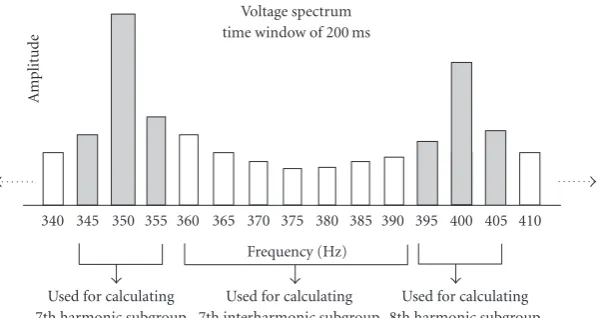
IEC Standards [1,2] also introduce the concept of har-monic and interharhar-monic groups and subgroups, and char-acterize the waveform distortions with the amplitudes of these groupings over time. In particular, subgroups are more commonly applied when harmonics and interharmonics are separately evaluated.Figure 1shows the IEC subgrouping of bins for 7th and 8th harmonic subgroups and for 7th inter-harmonic subgroup. The amplitudeGsg,n(Cisg,n) ofnth har-monic (interharhar-monic) subgroup is defined as the rms value of all its spectral components, as shown inFigure 1.
Voltage spectrum time window of 200 ms
A
m
plitude
340 345 350 355 360 365 370 375 380 385 390 395 400 405 410 Frequency (Hz)
Used for calculating 7th harmonic subgroup
Used for calculating 7th interharmonic subgroup
Used for calculating 8th harmonic subgroup
Figure1: IEC grouping of “bins” for harmonic and interharmonic subgroups.
RW [3]. Another method, in the framework of synchronized processing (SP), uses a self-tuning algorithm, synchronizing the analysed window width to an integer multiple of the ac-tual fundamental period [4]. Finally, a method in the frame-work of desynchronized processing (DP) is based on a double stage algorithm: harmonic components are filtered away be-fore interharmonic evaluation [5–7]. Each of these methods adopts a technique of smoothing the results over aggregation intervals greater than the time window adopted for the anal-ysis [1,2]. The increase in complexity of the computational burden does not always correlate with increased accuracy of the results.
Other authors of this paper have considered and devel-oped alternative advanced methods [8–15]. In particular, the Prony- and ESPRIT-based methods (adaptive Prony method (APM) and adaptive ESPRIT method (AEM)) appear espe-cially suitable for solving desynchronization (and time vari-ation) problems warranting a very high level of accuracy. These methods approximate a sampled waveform as a lin-ear combination of complex conjugate exponentials and are not characterized by a fixed frequency resolution. The com-putational burden of these methods may increase compared to DFT-based methods when high accuracy is required, but the increase is still reasonable, especially when using methods such as AEM.
In this paper, the methods based on the use of the DFT in the IEC framework are summarized. Then, the methods based on Prony and ESPRIT theories are reviewed. Finally, the results of several numerical experiments are reported in order to compare the different methods in terms of accuracy. This paper is an extended and improved version of the paper presented previously at the PES meeting in 2006 [16].
2. DFT-BASED METHODS
In this section, several advanced methods, which use IEC guidelines and the DFT approach, are reviewed.
2.1. Hanning windowing
The amount of spectral leakage interference depends strictly on the characteristics of the time window adopted to weight the signals before the spectral analysis; therefore, an appro-priate choice can reduce the interference.
The IEC Standard [2] refers to the RW, which is consid-ered to be the window characterized by the narrowest main lobe (the best resolution among tones close in frequency), but with the highest and most slowly decaying side lobes (the worst interference caused by a strong tone on a weaker tone not close in frequency). The second type of interaction causes the greatest problems because of the amplitude difference be-tween harmonic tones (which may vary in size by hundredths of a percent up to 100% of the fundamental tone) and inter-harmonic tones of interest (which are only a few thousandths of a percent of the size of the fundamental tone).
Testa et al. [3] have shown how the Hanning window can be utilized instead of the rectangular window. In this case, only minor changes in the IEC procedure are required: one simply multiplies IEC group values by a factor equal to (2/3)1/2. This reduces the leakage errors on the
interhar-monic groups by about one order of quantity as shown in Figure 2. It is worth noting that the errors are reported as a percentage of the amplitude of the close harmonic group and not of the interested interharmonic group, and are therefore very relevant.
2.2. Result interpolation
Result interpolation allows one to estimate amplitude, fre-quency, and phase angle of signal components with great accuracy, starting from the results of a DFT performed at a given frequency resolution (i.e., −5 Hz). This method achieves results similar to those using a higher resolution analysis.
10
1
0.1
0.01
n
th
int
er
har
m
onic
gr
o
u
p
am
p
li
tu
d
e
er
ro
r
(
n
th
har
m
onic
(%))
−1 −0.1 −0.01 0.01 0.1 1
nth harmonic frequency error (Hz)
10
1
0.1
0.01
Rectangular Hanning
Figure2:nth interharmonic group amplitude error versusnth har-monic frequency error: using RW (dotted line) and HW (dashed line).
the negative frequency replica and the other harmonic and interharmonic tones. These three conditions occur with a good approximation if a proper window is used. The authors selected the Hanning window because of its good spectral characteristics and the simplicity of the interpolation formu-las.
A brief review of the frequency domain interpolation technique is summarized below.
A sampled and windowed single tone signal is consid-ered:
s(k)=Asin
2π f kf
S+ϕ
·w(k) withk=0, 1,. . .,L−1
(1)
with Abeing the tone amplitude, f the tone frequency, ϕ the phase angle, fSthe sampling frequency, andwa generic window of lengthTW=L/ fS.
Thus, the signal spectrum evaluated by means of the DFT on L points and neglecting the negative frequency replica equals
S(i)=A·exp(jϕ) 2j ·W
i
L−ν
withi=0, 1,. . .,L−1,
(2)
whereν= f / fSis the tone frequency normalized to the sam-pling frequency.
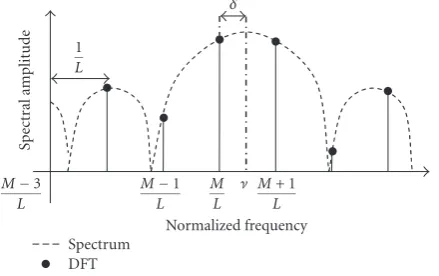
In the presence of a small desynchronization between tone period and sampled time window, none of the DFT components matches the actual tone frequency as shown in Figure 3, whereMis the order of theMth DFT component andδis the normalized frequency deviation from the actual normalized frequency.
Adopting the Hanning window, approximated expres-sions for the interpolated tone amplitudeA, frequencyf, and phase angleϕare
A=πS(M) δ
1−δ2
sin(πδ) , ν=
M L +δ,
ϕ=π
2+∠S(M)−M·π·δ
(3)
Spect
ral
amplitude
1
L
δ
M−3
L M−
1
L ML ν M
+ 1
L
Normalized frequency Spectrum
DFT
Figure3: Example of the spectrum (dashed line) and DFT compo-nents (•) of a signal.
being
|δ| = 2−α 1 +α, α=
S(M)
S
M+ sign(δ) (4)
with sign(δ)=sign(|S(M+ 1)| − |S(M−1)|).
2.3. Desynchronized processing
In the following section, the method proposed in [6]— that constitutes an example of desynchronized processing— is briefly recalled. It is based on harmonic filtering before the interharmonic analysis.
Harmonic filtering
A sampled and windowed time domain signal is considered:
sw(k)=s(k)·w(k) withk=0, 1,. . .,L−1, (5)
wheresis the signal andwthe adopted window. It can be represented by the sum of two contributes, one harmonic and the other interharmonic:
sw(k)=sH(k) +sI(k) ·w(k) withk=0, 1,. . .,L−1. (6)
The evaluation of the amplitudeAHn, of the normalized frequencyνn, and of the phaseϕn, of each harmonic
compo-nent gives
sH(k)= n
AH
n sin2πνnk+ϕn withk=0, 1,. . .,L−1.
(7)
This contribution can be filtered from the original signal, for instance, in the time domain:
sI(k)=s(k)−sH(k) withk=0, 1,. . .,L−1. (8)
and phase angle of the harmonic components to be filtered. This can be accomplished by proper interpolation of the spectrum samples calculated by DFT [6,7], such as that il-lustrated inSection 2.2.
Interharmonic analysis
OncesI(k) has been obtained, an interharmonic analysis can
be performed with reduced harmonic leakage effects. The surviving harmonic leakage is given by
εH(k)=sH(k)−sH(k) withk=0, 1,. . .,L−1. (9)
This is generally different from zero. The lowerεHis equal to the lower leakage effects.
The use of a proper windoww for the interharmonic analysis can reduce the residual harmonic leakage problems:
sI
w(k)=sI(k)·w(k) withk=0, 1,. . .,L−1. (10) The choice of w must be made by considering addi-tional aspects [3], such as interharmonic tone interaction and IEC grouping problems. Here, reference is made only to the HW.
Accuracy and computational burden
The accuracy is related to the filtering accuracy, which de-pends on the interpolation algorithms, the number of sam-ples analysed, and interferences, such as those produced by interharmonic tones close to the harmonics (which need to be estimated and filtered).
With regard to the computational burden, it is important to note that to achieve accuracy of equal or greater level than that of synchronized methods, an exact synchronization is not needed. It is therefore possible to choose a sampling fre-quency fS, independent from the actual supply frequency, but still referring to its rated value. This allows one to acquire a number of samples using the power of two:
f
S= 2
n
10T1r = f1r2n
10 (11)
withT1randf1rbeing the rated values of the system’s funda-mental period and frequency, respectively.
The technique generally implies a doubled number of FFT. It is worth noting that by using the same window for both the first and second stages, harmonic components can be directly filtered in the frequency domain due to the DFT linearity [6].
2.4. Smoothing of the results
In the IEC standards [1,2], it is highly recommended to pro-vide a smoothing of the results obtained during the analyses. Smoothed results are derived from the components obtained in 200 milliseconds analyses as an average over 15 contiguous time windows, updated either every time window (approx-imately every 200 milliseconds) or every 15 time windows (about 3 s each). This procedure may affect the accuracy of the results when the desynchronization effects are remark-able in the 200- milliseconds window.
3. PRONY- AND ESPRIT-BASED METHODS
In this section, Prony and ESPRIT methods are briefly re-called, and then advanced versions of these methods (adap-tive Prony and ESPRIT methods) based on the use of proper time windows are analysed [8–16].
3.1. The Prony method
Let the signal sampled data [x(1) x(2) · · · x(N)] be ap-proximated with the following linear combination of M complex exponentials1[17]:
x(n)=
M
k=1
hkzk(n−1) n=1, 2,. . .,N, (12)
wherehk=Akejψk,zk=e(αk+jωk)Ts,kis the exponential code,
Tsis the sampling time,Ak is the amplitude,ψk is the
ini-tial phase,ωk = 2π fk is the angular velocity, andαk is the damping factor.
The problem is to find damping factors, initial phases, frequencies, and amplitudes solving the following nonlinear problem:
min
N
n=1
x(n)−x(n)2. (13)
The Prony idea consists of first solving the following set of linear equations to find the damping factors and frequen-cies [17]:
M
m=0
a(m)x(n−m)=0, (14)
wheren=M+ 1,M+ 2,. . .,N. The (N−M) relations (14) constitute a linear equation system inMunknowns (i.e., the
a(m) coefficients).
If N = 2M, the system (14) can be solved in closed form since it represents anM-equation system with the same number of unknowns. In practice, the available samples are
N >2M, so an estimation problem has to be solved since the number of (14) are greater than the number of unknownsM (N−M > M). In this case, theMunknown coefficientsa(m) can be obtained by minimizing the total error:
ET = N
n=M+1
M
m=0
a(m)x(n−m). (15)
Once known thea(m) coefficients, the damping factors and the frequencies of each exponential are calculated by means of simple relations.
The amplitudes and phases of each exponential are then calculated by solving a second set of linear equations linking these unknowns to the sampled data.
3.2. The ESPRIT method
The original ESPRIT algorithm [17–19] is based on natu-rally existing shift invariance between the discrete time series, which leads to rotational invariance between the correspond-ing signal subspaces.
The assumed signal model is the following:
x(n)=M
k=1
Ake(kjωkn)+w(n), (16)
wherew(n) represents additive noise. The eigenvectorsUof the autocorrelation matrixRx of the signal define two sub-spacesS1andS2(signal and noise subspaces) by using two
selector matricesΓ1andΓ2:
S1=Γ1U, S2=Γ2U. (17)
The rotational invariance between both subspaces leads to the equation
S1=ΦS2, (18)
where
Φ=
⎡ ⎢ ⎢ ⎢ ⎢ ⎣
ejω1 0 · · · 0
0 ejω2 · · · 0
..
. ... . .. ... 0 0 · · · ejωM
⎤ ⎥ ⎥ ⎥ ⎥
⎦. (19)
The matrixΦcontains all information aboutM compo-nents’ frequencies. Additionally, the TLS (total least-squares) approach assumes that both estimated matricesS1andS2can
contain errors and find the matrixΦby means of minimiza-tion of the Frobenius norm of the error matrix. Amplitudes of the components can be found by properly using the auto-correlation matrixRxof the signal; alternatively, amplitudes and phases (introduced in the signal model) can be found in similar way as with the Prony method by solving a second set of linear equations [20].
3.3. The adaptive Prony and adaptive ESPRIT methods
The basic idea of these methods consists in applying the Prony or ESPRIT methods to a number of “short contigu-ous time windows” inside the signal [11]; the widths of these short time windowsare variable, and this variability ensures the best fitting of the waveform time variations.
To select the most adequateshort contiguous time win-dows, let us initially refer to the adaptive Prony method (APM) and consider the signal x(t) in a time observation periodTobswithLsamples obtained using the sampling
fre-quency fS=1/Ts. The following mean square relative error can be considered:
ε2 curr=
1
L L
k=1
x
tk−xtk2 xtk2
, (20)
wheretk =kTs(k=1, 2, 3,. . .,L) andx(tk) is given by (12).
The mean square relative errorε2
currgives a measure of the
fi-delity of the model considered; in fact, it represents the mean square relative error of the model estimation.
By defining a thresholdεthr2 (acceptable mean square rel-ative error), it is possible to choose in the time observation period ashort time window[ti,tf] (or for fixed sampling fre-quency, a subset of the data segment length can be used) en-suring the satisfactory approximation (ε2
curr≤εthr2 ).
The main steps of the APM algorithm are the following:
(i) select a starting short time window widthTmin;
(ii) apply the Prony method to the samples in the short time window to obtain the model parameters (ampli-tudes, damping factors, frequencies, and initial phases of the Prony exponentials);
(iii) use the exponentials obtained in step (ii) to calculate
ε2
currwith (20);
(iv) compareε2
currwith the thresholdεthr2 and
(a) ifε2
curr≤εthr2 , store the Prony model exponential
parameters and increase the short time window width (and then the subset of the data segment) untilε2
curr ≤ ε2thrandtf ≤ Tobs, and then go to
step (v); (b) ifε2
curris greater than the thresholdε2thr, increase
the short time window width and go to step (vi);
(v) store theshort time spectral components and select a new starting short time window width;
(vi) comparetf withTobs; iftf is less than or equal to the
observation period, go to step (ii); iftf is greater than
Tobs, first calculate and storeshort time spectral
compo-nentsand then stop.
It should be noted that in step (iv)(a), the short time win-dow width is increased until the conditionε2
curr≤ε2thris
sat-isfied; the Prony model parameters remain fixed at the values that satisfy the criterion the first time. In this way, a nonneg-ligible reduction of the computational efforts arises, mainly in the presence of slight time-varying waveforms.
The APM is generally characterized by very good accu-racy in the assessment of waveform distortion in power sys-tems, but its computational burden is certainly greater than the DFT methods; the computational efforts may be worth-while when increased accuracy is required.
Let us consider now the case of the adaptive ESPRIT method (AEM). As for APM, we apply the ESPRIT method to a number of “short contiguous time windows.”
The main steps of the AEM algorithm include the follow-ing:
(i) select a starting short time window widthTmin;
(ii) estimate the autocorrelation matrixRxof the signal us-ing the samples in the short time window;
(iii) calculate the eigenvalues ofRx and then, matricesS1
andS2;
(iv) estimate the matrixΦ;
(vi) calculate the amplitudes and arguments of the expo-nentials in a similar way to the Prony method, for as-signed frequencies (step (v)) and damping factors2;
(vii) use the exponential parameters obtained to calculate
ε2
currwith (20);
(viii) compareε2
currwith the thresholdεthr2 and
(a) ifε2
curr ≤ ε2thr, store the exponential parameters
and increase the short time window width (and then the subset of the data segment) untilε2
curr≤ ε2
thrandtf ≤Tobs, and then go to step (ix);
(b) ifε2
curris greater than the thresholdε2thr, increase
the short time window width and go to step (x);
(ix) store the short time spectral components and select a new starting short time window width;
(x) comparetf withTobs. Iftf is less than or equal to the
observation periodTobs, go to step (ii). Iftf is greater
than Tobs, first calculate and storeshort time spectral
components,and then go to stop.
3.4. Considerations
The Prony- and ESPRIT-based methods have the following features:
(i) the window width is free and only linked to the signal waveform characteristics;
(ii) the adaptive version ensures the best fit of waveform variations by an optimal choice of the time window width;
(iii) window width does not constrain the frequency reso-lution.
The AEM is also characterized by excellent accuracy in the assessment of waveform distortion in power systems; its computational burden is greater than the DFT methods, but generally significantly lower than that required by APM.
In practice, a comprehensive analytical comparison of AEM and APM computational efforts cannot be stated with general validity, since AEM and APM use different models to approximate the waveforms. Because of this, AEM and APM can be characterized not only by a different number ofshort contiguous time windowsin the time observation periodTobs
but also eachshort contiguous time windowmay have a diff er-ent numberMof complex exponentials used to approximate the waveform.
However, some considerations can help demonstrate the reduced computational effort of AEM. These reduced com-putational efforts have been tested using several numerical applications performed on simulated and measured station-ary/nonstationary waveforms, like the examples reported in Section 4.
First, the AEM method generally requires fewershort con-tiguous time windows in the time observation period Tobs
2Since in distortion assessment in power systems, the waveforms can be considered to be the sum of sinusoids, the damping factors value can be constrained to zero.
than APM. This is due to the fact that to better estimate the matrixRxa significant number of samples are necessary. Therefore, enlarging the dimension of the short contiguous time windowsand reducing the number ofshort contiguous time windowsin the time observation periodTobs are often
requirements for AEM.
Moreover, since the APM model does not include the presence of noise, it generally requires a larger numberMof complex exponentials to approximate the waveform in each of theshort contiguous time windows.
Finally, it should be noted that, the DFT-based methods are generally faster than the parametric methods, so that on the basis of our experience the rank of computational burden of the methods, from faster to slower, is
(1) DFT-based methods; (2) adaptive ESPRIT method; (3) adaptive Prony method.
4. NUMERICAL EXPERIMENTS
Several numerical experiments were performed. In consider-ation of space, reference is made only to the results of four case studies.
The examples were performed by utilizing the IEC nor-mal approach (IEC-N) characterised by RW and TW = 200 milliseconds [1,2], the interpolation technique (I-HW) described inSection 2.2applied to the components obtained by DFT on 200 milliseconds using HW, the desynchronised procedure (IEC-DP) described inSection 2.3, and the adap-tive Prony (APM) and adapadap-tive ESPRIT methods (AEM) de-scribed inSection 3.3.
All the data used in the experimental case studies were entered with the maximum allowable precision. The exact number of zeroes after the last significant cipher is not re-ported for the sake of simplicity. The results obtained are al-ways reported in diagrams using two figures for DFT-based and high-resolution methods (APM and AEM). Two diff er-ent scales for errors are used for high-resolution methods: left- side scale for APM and right-side scale for AEM.
The sampling frequency for all the experiments and all the methods used is 5 kHz. The window width used is always
Tw = 200 milliseconds for DFT-based methods. The
win-dow width varies from a minimum of 20 milliseconds (case-studies 1–3) to a maximum of 220 milliseconds (case study 4) for APM and AEM, but all results are presented with ref-erence to 200 milliseconds [11], for ease of comparison of the methods.
It should be noted that the number of samples can af-fect only the computational burden of DFT-based methods, in fact the FFT algorithm is faster when a number of sam-ples that is a power of two is chosen. With reference to APM and AEM methods, the adaptive algorithm selects a variable number of samples (for each short contiguous time window) to fit at best the waveform considered; this number does not affect these methods.
0.5 0 −0.5 −1 −1.5 −2 −2.5 −3 Cisg,1
mag
nitude
er
ror
(%)
70 71 72 73 74 75 76 77 78 79 80 Interharmonic frequency (Hz)
<3.5×10⁻³
IEC-DP IEC-N
(a)
×10−6 1.5
1 0.5 0 −0.5 −1 −1.5
APM
Cisg,1
mag
nitude
er
ror
(%)
70 71 72 73 74 75 76 77 78 79 80 Interharmonic frequency (Hz)
×10−9 4 2 0 −2 −4 −6 −8 −10
AEM
Cisg,1
mag
nitude
er
ror
(%)
APM AEM
(b)
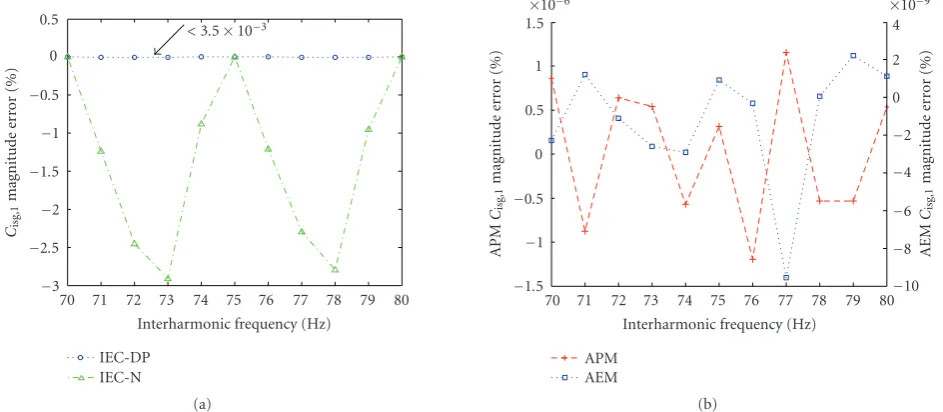
Figure4: Case study 1: interharmonic subgroupCisg,1magnitude error (in %) versus interharmonic frequency: (a) IEC-N (-·-Δ) and IEC-DP (dotted line◦), (b) APM (dotted line +) and AEM (dotted line).
4.1. Case study 1
The signal considered is constituted by a tone of amplitude 1 pu at the fundamental frequency of 50 Hz with an inter-harmonic tone of amplitude 0.001 pu at varying frequencies (ranging from 70 Hz to 80 Hz in increments of 1 Hz). Figures 4(a)and4(b)report the results in terms of magnitude error for the interharmonic subgroupCisg,1versus the frequency of
the interharmonic component in the eleven experiments. The errors of IEC-N reach the value of about−3% un-der the worst conditions, 73 Hz and 78 Hz; the error is null in the experiments characterised by interharmonic frequen-cies of 70 Hz, 75 Hz, and 80 Hz, where the interharmonic is synchronised withTw.
The errors of IEC-DP are not perceptible since they reach the value of about 3.5×10⁻³%. The errors of APM do not
reach 1.5×10⁻⁶%, while the errors of AEM do not reach
1.0×10⁻⁸%.
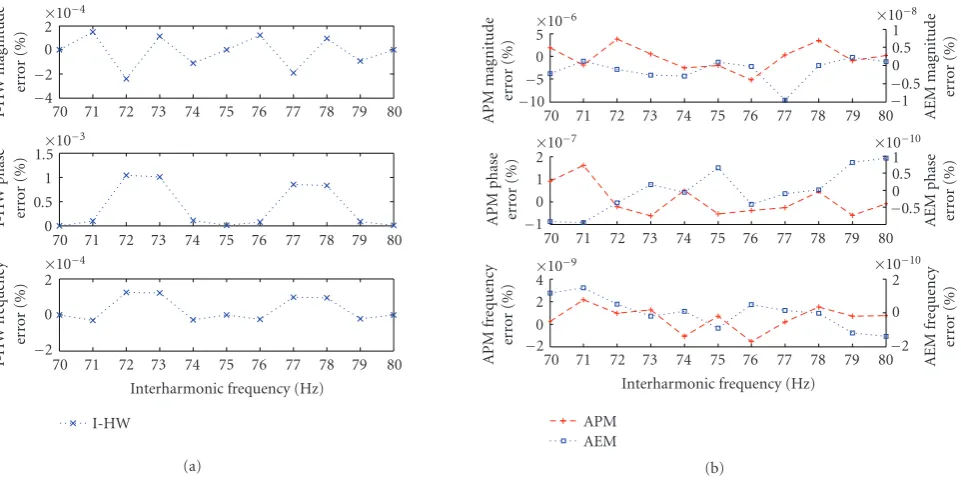
InFigure 5, results obtained by I-HW (Figure 5(a)), and AEP-AEM (Figure 5(b)) are compared. In particular, in-terharmonic component amplitude, phase angle, and fre-quency percentage error versus interharmonic frefre-quency are reported. All methods perform very well.
Figure 6 reports the interharmonic component per-centage error versus interharmonic frequency, smoothing the results over 15 intervals of 200 milliseconds for I-HW (Figure 6(a)) and APM and AEM (Figure 6(b)). Only the amplitude and frequency estimations are reported because smoothing the phase angle results does not make sense. Again, all methods perform very well, with the most bene-fits gained using the I-HW method.
4.2. Case study 2
The case study parameters are the same as in case study 1, except the fundamental tone frequency was changed to
50.02 Hz in order to introduce a further kind of desynchro-nization3; in fact, the window width adopted for the DFT
based methods remains equal to 200 milliseconds. Figures7and8are the equivalent of Figures4and5. Comparing Figures4and7, it is possible to observe that while APM and AEM maintain similar performances, the er-rors of IEC-N reach dramatic values over 200% due to the spectral leakage of RW; IEC-DP, which has been introduced for these kinds of problems, contains errors to a maximum value of 3.5×10⁻³%. Comparing Figures5and8, it is
possi-ble to observe that the performances remain very good with a slight reduction in the accuracy for APM; the behaviour of AEM is very good.
Figure 9reports the fundamental component percentage error versus interharmonic frequency for I-HW (Figure 9(a)) and APM-AEM (Figure 9(b)) in terms of amplitude, phase angle, and frequency. All methods give very good results. Note the results of the Prony- and ESPRIT-based methods with regard to the amplitude and the results of all the meth-ods with regard to frequency. Excellent performances are guaranteed by using AEM, which is characterized by errors that are always lower than 10−11%.
4.3. Case study 3
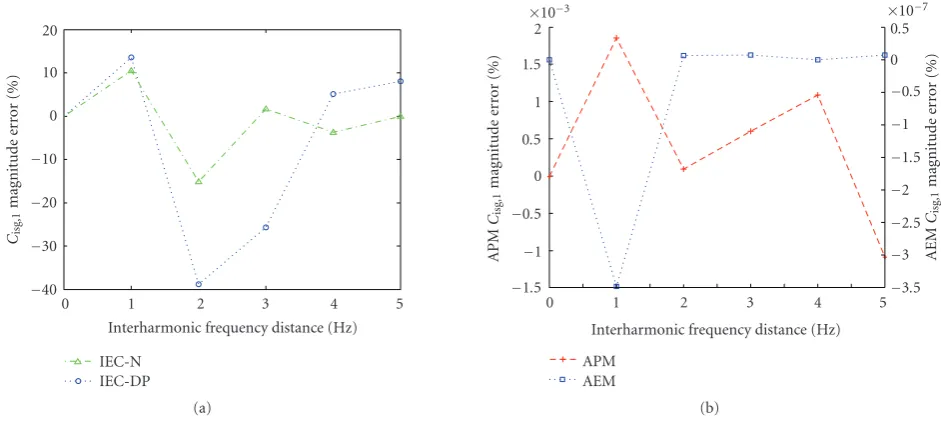
The signal considered is constituted by a tone of amplitude 1 pu at a fundamental frequency of 50 Hz and by a couple of interharmonic tones of amplitude 0.001 pu, located at sym-metrical frequency positions starting from 75 Hz; the first starts at 70 Hz and varies its frequency to 75 Hz by incre-ments of 1 Hz, while the second starts at 80 Hz and varies its frequency to 75 Hz by decrements of 1 Hz. Six experiments were performed.
×10−4 2 0 −2 −4 I-HW mag nitude er ro r (%)
70 71 72 73 74 75 76 77 78 79 80 ×10−3
1.5 1 0.5 0 I-HW phase er ro r (%)
70 71 72 73 74 75 76 77 78 79 80 ×10−4
2 0 −2 I-HW fr equency er ro r (%)
70 71 72 73 74 75 76 77 78 79 80 Interharmonic frequency (Hz)
I-HW
(a)
×10−6 5 0 −5 −10 APM mag nitude er ro r (%)
70 71 72 73 74 75 76 77 78 79 80 ×10−8
1 0.5 0 −0.5 −1 AEM m ag nitude er ro r (%)
×10−7 2 1 0 −1 APM phase er ro r (%)
70 71 72 73 74 75 76 77 78 79 80 ×10−10
1 0.5 0 −0.5
AEM p hase er ro r (%)
×10−9 4 2 0 −2 APM fr equency er ro r (%)
70 71 72 73 74 75 76 77 78 79 80 ×10−10
2 0 −2 AEM fr equency er ro r (%)
Interharmonic frequency (Hz) APM
AEM
(b)
Figure5: Case study 1: interharmonic amplitude, phase angle, and frequency error (in %) versus interharmonic frequency: (a) I-HW (dotted linex), (b) APM (dotted line +) and AEM (dotted line).
×10−9 20 15 10 5 0 −5 I-HW mag nitude er ro r (%)
70 71 72 73 74 75 76 77 78 79 80 ×10−10
2 1.5 1 0.5 0 −0.5 −1 I-HW fr equency er ro r (%)
70 71 72 73 74 75 76 77 78 79 80 Interharmonic frequency (Hz)
I-HW
(a)
×10−7 8 6 4 2 0 −2 −4 APM mag nitude er ro r (%)
70 71 72 73 74 75 76 77 78 79 80 ×10−9
3 2 1 0 −1 −2 −3 AEM m ag nitude er ro r (%)
×10−9 3 2 1 0 −1 APM fr equency er ro r (%)
70 71 72 73 74 75 76 77 78 79 80 ×10−10
1.5 1 0.5 0 −0.5 −1 −1.5
AEM fr equency er ro r (%)
Interharmonic frequency (Hz) APM
AEM
(b)
Figure6: Case study 1: interharmonic amplitude and frequency error (in %) versus interharmonic frequency by smoothing the results over 15 intervals of 200 milliseconds: (a) I-HW (dotted linex), (b) APM (dotted line +) and AEM (dotted line).
Figure 10reports the results in terms of magnitude er-ror for the interharmonic subgroupCisg,1 versus the
abso-lute value of the distance of each interharmonic component from 75 Hz in the six experiments. In this case, IEC-based methods (Figure 10(a)) suffer significantly from the
250 200 150 100 50 0 −50 Cisg,1
mag
nitude
er
ror
(%)
70 71 72 73 74 75 76 77 78 79 80 Interharmonic frequency (Hz)
<3.5×10⁻³
IEC-N IEC-DP
(a)
×10−6 8 6 4 2 0 −2 −4 −6
APM
Cisg,1
mag
nitude
er
ror
(%)
70 71 72 73 74 75 76 77 78 79 80 Interharmonic frequency (Hz)
×10−9 6 4 2 0 −2 −4 −6 −8 −10
AEM
Cisg,1
mag
nitude
er
ror
(%)
APM AEM
(b)
Figure7: Case study 2: interharmonic subgroupCisg,1magnitude error (in %) versus interharmonic frequency: (a) IEC-N (-·-Δ) and IEC-DP (dotted line◦), (b) APM (dotted line +) and AEM (dotted line).
×10−3 10
5 0 −5
I-HW
mag
nitude
er
ro
r
(%)
70 71 72 73 74 75 76 77 78 79 80 ×10−3
5 0 −5 −10
I-HW
phase
er
ro
r
(%)
70 71 72 73 74 75 76 77 78 79 80 ×10−3
2 1 0 −1
I-HW
fr
equency
er
ro
r
(%)
70 71 72 73 74 75 76 77 78 79 80 Interharmonic frequency (Hz)
I-HW
(a)
×10−5 4 2 0 −2
APM
mag
nitude
er
ro
r
(%)
70 71 72 73 74 75 76 77 78 79 80 ×10−8
1 0 −1
AEM
m
ag
nitude
er
ro
r
(%)
×10−7 5 0 −5
APM
phase
er
ro
r
(%)
70 71 72 73 74 75 76 77 78 79 80 ×10−10
2 1 0 −1 AEM
p
hase
er
ro
r
(%)
×10−8 1 0 −1
APM
fr
equency
er
ro
r
(%)
70 71 72 73 74 75 76 77 78 79 80 ×10−10
1 0 −1 −2
AEM
fr
equency
er
ro
r
(%)
Interharmonic frequency (Hz) APM
AEM
(b)
Figure8: Case study 2: interharmonic amplitude, phase angle, and frequency error (in %) versus interharmonic frequency: (a) I-HW (dotted linex), (b) APM (dotted line +) and AEM (dotted line).
other at 75 Hz and synchronized withTw=200 milliseconds. APM and AEM (Figure 10(b)) still give good results, but not as good as in the previous case studies.
Figure 11reports the interharmonic subgroupCisg,1
mag-nitude error (in %) versus the distance of interharmonic tones from 75 Hz obtained by smoothing the results of 15
×10−2 −11
−10
I-HW
mag
n
itude
er
ro
r
(%)
70 71 72 73 74 75 76 77 78 79 80 ×10−4
5 0 −5
I-HW
phase
er
ro
r
(%)
70 71 72 73 74 75 76 77 78 79 80 ×10−4
2 0 −2
I-HW
fr
equency
er
ro
r
(%)
70 71 72 73 74 75 76 77 78 79 80 Interharmonic frequency (Hz)
I-HW
(a)
×10−8 2 0 −2
APM
mag
nitude
er
ro
r
(%)
70 71 72 73 74 75 76 77 78 79 80 ×10−11
2 0 −2 −4
AEM
m
ag
nitude
er
ro
r
(%)
×10−10 5 0 −5
APM
phase
er
ro
r
(%)
70 71 72 73 74 75 76 77 78 79 80 ×10−14
5 0 −5 AEM
p
hase
er
ro
r
(%)
×10−8 2 0 −2
APM
fr
equency
er
ro
r
(%)
70 71 72 73 74 75 76 77 78 79 80 ×10−13
1 0 −1
AEM
fr
equency
er
ro
r
(%)
Interharmonic frequency (Hz) APM
AEM
(b)
Figure9: Case study 2: fundamental component amplitude, phase angle, and frequency error (in %) versus interharmonic frequency: (a) I-HW (dotted linex), (b) APM (dotted line +) and AEM (dotted line).
20 10 0 −10 −20 −30 −40 Cisg,1
mag
nitude
er
ror
(%)
0 1 2 3 4 5
Interharmonic frequency distance (Hz) IEC-N
IEC-DP (a)
×10−3 2 1.5 1 0.5 0 −0.5 −1 −1.5
APM
Cisg,1
mag
nitude
er
ror
(%)
0 1 2 3 4 5
Interharmonic frequency distance (Hz)
×10−7 0.5 0 −0.5 −1 −1.5 −2 −2.5 −3 −3.5
AEM
Cisg,1
mag
nitude
er
ror
(%)
APM AEM
(b)
Figure10: Case study 3: interharmonic subgroupCisg,1magnitude error (in %) versus the distance of interharmonic tones from 75 Hz: (a) IEC-N (-·-Δ) and IEC-DP (dotted line◦), (b) APM (dotted line +) and AEM (dotted line).
4.4. Case study 4
The signal considered is constituted by a 1 pu fifth harmonic tone at a frequency which varies from 249 Hz to 251 Hz by in-crements of 0.5 Hz, giving five different base conditions. Two interharmonic tones of amplitudes 0.1 pu are also present; their frequency position is centred on the fifth harmonic fre-quency and their frefre-quency interdistance is 8, 10, and 12 Hz,
giving three cases for each base condition. Therefore, this sit-uation represents a fifth harmonic tone carrier which suffers from a maximum fundamental frequency desynchronization of 0.2 Hz and whose amplitude is modulated at 4, 5, and 6 Hz, with a modulation amplitude of 0.2 pu.
Figure 12reports the harmonic subgroup Gsg,5
10 8 6 4 2 0 −2 −4 Cisg,1
mag
nitude
er
ror
(%)
0 1 2 3 4 5
Interharmonic frequency distance (Hz)
<3.5×10⁻³
IEC-N IEC-DP
(a)
×10−4 4 2 0 −2 −4 −6 −8 −10 −12
APM
Cisg,1
mag
nitude
er
ror
(%)
0 1 2 3 4 5
Interharmonic frequency distance (Hz)
×10−8 2 1 0 −1 −2 −3 −4 −5 −6 −7 −8
AEM
Cisg,1
mag
nitude
er
ror
(%)
APM AEM
(b)
Figure11: Case study 3: interharmonic subgroupCisg,1magnitude error (in %) versus the distance of interharmonic tones from 75 Hz with smoothed results over 15 intervals of 200 milliseconds: (a) IEC-N (-·-Δ) and IEC-DP (dotted line◦), (b) APM (dotted line +) and AEM (dotted line).
APM (Figure 12(b)), and AEM (Figure 12(c)). IEC-DP suf-fers from the presence of low frequency modulations, behav-ing acceptably for a modulatbehav-ing frequency of 5 Hz; Prony and ESPRIT methods show similar levels of accuracy for the three modulation frequencies.
Figure 13shows harmonic subgroupGsg,5magnitude
er-ror (in %) versus interharmonic frequency, smoothing the results of 15 intervals of 200 milliseconds for the IEC-DP method. The benefits derived from smoothing are evident. The smoothing of APM and AEM results does not change the accuracy of these methods and is therefore not reported. Figure 14reports the interharmonic subgroupCisg,5
mag-nitude versus the carrier frequency for the three modulation frequencies for IEC-DP (Figure 14(a)), APM (Figure 14(b)); the results for AEM are not reported because they are all equal to zero, that is the true magnitude of this subgroup. IEC-DP captures the spectral leakage of the fifth harmonic and of the interharmonics that are in the adjacent harmonic subgroup, giving misleading results; on the contrary, results obtained using the Prony and ESPRIT methods confirm their insensitivity to this phenomenon.
5. CONCLUSIONS
One of the main problems for waveform distortion assess-ment has been considered which examines how to reduce the effects of spectral leakage due to fundamental frequency desychronization and harmonics on interharmonic compo-nents.
The signal processing aspects of the problem have been considered; different proposals regarding both DFT-based
and advanced methods (Prony and ESPRIT) have been re-called and compared to each other. The results of several nu-merical experiments have been reported and analysed.
The main outcomes of the paper are the following:
(i) IEC standards, even if characterized by simplicity, may suffer dramatic inaccuracy problems under con-ditions such as those characterized by fundamental and harmonic desynchronization within the time win-dow widths;
(ii) DFT advanced methods can remarkably reduce the inaccuracies caused by the spectral leakage with-out remarkably increasing computational burden, and therefore could be utilized in industrial applications; (iii) in particular circumstances, which stress the behaviour
of the DFT methods, DFT advanced methods (even if combined with smoothing) may give inaccuracies with very high values for interharmonic subgroups and components;
(iv) adaptive Prony and ESPRIT methods do not seem to suffer at all from the spectral leakage phenomenon even in very critical conditions;
(v) the computational burden of APM and AEM is greater when compared to DFT-based methods when high ac-curacy is required, but this burden is reasonable with respect to the accuracy of the results obtained, espe-cially when using AEM;
8 6 4 2 0 −2 −4 −6 −8
IEC-DP
Gisg,5
mag
nitude
er
ror
(%)
249 249.5 250 250.5 251
Carrier frequency (Hz) Modulation frequency 4 Hz
Modulation frequency 5 Hz
Modulation frequency 6 Hz
(a) ×10−6
3 2 1 0 −1 −2 −3 −4 −5
APM
Gisg,5
mag
nitude
er
ror
(%)
249 249.5 250 250.5 251
Carrier frequency (Hz) Modulation frequency 4 Hz
Modulation frequency 5 Hz Modulation frequency 6 Hz
(b) ×10−11
4 3 2 1 0 −1 −2 −3 −4 −5
AEM
Gisg,5
mag
nitude
er
ror
(%)
249 249.5 250 250.5 251
Carrier frequency (Hz) Modulation frequency 4 Hz
Modulation frequency 5 Hz Modulation frequency 6 Hz
(c)
Figure12: Case study 4: harmonic subgroupGsg,5magnitude error (in %) versus the carrier frequency for three modulation frequen-cies: (a) IEC-DP (dotted line◦), (b) APM (dotted line +) and (c) AEM (dotted line).
8 6 4 2 0 −2 −4 −6 −8
IEC-DP
Gisg,5
mag
nitude
er
ror
(%)
249 249.5 250 250.5 251
Carrier frequency (Hz) Modulation frequency 4 Hz Modulation frequency
5 Hz
Modulation frequency 6 Hz
Figure13: Case study 4: harmonic subgroupGsg,5magnitude error (in %) versus interharmonic frequency, smoothing the results over 15 intervals of 200 milliseconds for the IEC-DP (dotted line◦).
0.15
0.1
0.05
0
−0.05
−0.1
IEC-DP
Cisg,5
mag
nitude
249 249.5 250 250.5 251
Carrier frequency (Hz) Modulation frequency 4 Hz
Modulation frequency 5 Hz
Modulation frequency 6 Hz
(a)
×10−14 4.5
4 3.5 3 2.5 2 1.5 1 0.5 0
APM
Cisg,5
mag
nitude
249 249.5 250 250.5 251
Carrier frequency (Hz)
Modulation frequency 4 Hz
Modulation frequency 5 Hz Modulation
frequency 6 Hz
(b)
ACKNOWLEDGMENT
This work was partly supported by the Italian Ministry for University and Research.
REFERENCES
[1] IEC standard 61000-4-30, “Testing and measurement techni-ques—Power quality measurement methods,” Ed. 2003. [2] IEC standard 61000-4-7, “General guide on harmonics and
interharmonics measurements, for power supply systems and equipment connected thereto,” Ed. 2002.
[3] A. Testa, D. Gallo, and R. Langella, “On the processing of har-monics and interharhar-monics: using hanning window in stan-dard framework,”IEEE Transactions on Power Delivery, vol. 19, no. 1, pp. 28–34, 2004.
[4] D. Gallo, R. Langella, and A. Testa, “A self-tuning harmonic and interharmonic processing technique,”European Transac-tions on Electrical Power, vol. 12, no. 1, pp. 25–31, 2002. [5] D. Gallo, R. Langella, and A. Testa, “Interharmonic analysis
utilising optimised harmonic filtering,” inProceedings of IEEE International Symposium on Diagnostic or Electrical Machines, Power Electronics and Drives (SDEMPED ’01), Gorizia, Italy, September 2001.
[6] D. Gallo, R. Langella, and A. Testa, “Desynchronized process-ing technique for harmonic and interharmonic analysis,”IEEE Transactions on Power Delivery, vol. 19, no. 3, pp. 993–1001, 2004.
[7] P. Langlois and R. Bergeron, “Interharmonic analysis by a fre-quency interpolation method,” inProceedings of the 2nd Inter-national Conference on Power Quality (PQA ’92), Atlanta, Ga, USA, September 1992.
[8] A. Bracale, G. Carpinelli, D. Lauria, Z. Leonowicz, T. Lobos, and J. Rezmer, “On some spectrum estimation methods for analysis of non-stationary signals in power systems—part I: theoretical aspects,” inProceedings of the 11th International Conference on Harmonics and Quality of Power (ICHQP ’04), pp. 266–271, Lake Placid, NY, USA, September 2004. [9] A. Bracale, G. Carpinelli, Z. Leonowicz, T. Lobos, and J.
Rezmer, “Spectrum estimation of non-stationary signals in traction systems,” inProceedings of the International Confer-ence on Power Systems (ICPS ’04), pp. 821–826, Kathmandu, Nepal, November 2004.
[10] A. Bracale, P. Caramia, and G. Carpinelli, “Optimal evalua-tion of waveform distorevalua-tion indices with Prony and rootmusic methods,” to appear inInternational Journal of Power and En-ergy Systems.
[11] A. Bracale, P. Caramia, and G. Carpinelli, “Adaptive Prony Method for Waveform Distortion Detection in Power Sys-tems,” to appear inInternational Journal on Electrical Power and Energy Systems.
[12] Z. Leonowicz, T. Lobos, and J. Rezmer, “Advanced spectrum estimation methods for signal analysis in power electronics,” IEEE Transactions on Industrial Electronics, vol. 50, no. 3, pp. 514–519, 2003.
[13] A. Bracale, D. Proto, and P. Varilone, “Adaptive Prony method for spectrum estimation of non-stationary signals in trac-tion systems,” inProceedings of the International Conference on Computer as a Tool (EUROCON ’05), vol. 2, pp. 1550–1553, Belgrade, Serbia & Montenegro, November 2005.
[14] A. Bracale, G. Carpinelli, and L. Piegari, “Adaptive Prony method for an accurate analysis of AC waveform distortions caused by adjustable speed drives,” inProceedings of the 12th International Conference on Harmonics and Quality of Power (ICHQP ’06), Cascais, Portugal, October 2006.
[15] A. Bracale, G. Carpinelli, Z. Leonowicz, T. Lobos, and J. Rezmer, “Measurement of IEC groups and subgroups using advanced spectrum estimation methods,” inProceedings of the 23rd IEEE Instrumentation and Measurement Technology Con-ference (IMTC ’06), pp. 1015–1020, Sorrento, Italy, April 2006. [16] A. Bracale, G. Carpinelli, R. Langella, and A. Testa, “On some advanced methods for waveform distortion assessment in presence of interharmonics,” inProceedings of IEEE Power En-gineering Society General Meeting, p. 8, Monreal, QC, Canada, June 2006.
[17] S. M. Kay,Modern Spectral Estimation: Theory and Application, Prentice-Hall, Englewood Cliffs, NJ, USA, 1988.
[18] J. Kusuma, “Parametric Frequency Estimation: ESPRIT and MUSIC,” Rice University, http://cnx.rice.edu/content/ m10588/, 2002.
[19] R. Roy and T. Kailath, “ESPRIT - estimation of signal param-eters via rotational invariance techniques,”IEEE Transactions on Acoustics, Speech, and Signal Processing, vol. 37, no. 7, pp. 984–995, 1989.
[20] C. J. Dafis, C. O. Nwankpa, and A. Petropulu, “Analysis of power system transient disturbances using an ESPRIT-based method,” inProceedings of the IEEE Power Engineering Society Summer Meeting, vol. 1, pp. 437–442, Seattle, Wash, USA, July 2000.
A. Bracale was born in Naples, Italy, in 1974. He received his degree in telecommu-nication engineering from the University of Naples “Federico II” (Italy), in 2002 and the Ph.D. degree in electrical energy conver-sion from the Second University of Naples, Aversa, Italy, in 2005. His research inter-est concerns power quality. He is an IEEE Member since 2004.
G. Carpinelliwas born in Naples, Italy, in 1953. He received his degree in electrical engineering from the University of Naples (Italy), in 1978. He is currently Professor in energy electrical systems at University of Naples “Federico II” (Italy). He is Mem-ber of IEEE. His research interest concerns power quality and electrical power system analysis.