Temperature and Light Sensors
a) Thermocouple b) Thermistor
c) Resistance-Temperature Devices (RTDs)
d) Solid State (PN Junction Diode) Thermometry e) Fiber Optic GaAs Bandgap Temperature Sensor
f) Blackbody Radiation and IR Non-contact Thermometry (Pyrometer) g) Thermopile Radiation Detector
h) Optical Instruments: Spectrophotometers i) Snell’s Law and Optical Fiber
j) Light Sources (Incandescent, LED, Laser) k) Photon Detectors
1. CdS Photocell 2. Photodiode 3. Phototransistor 4. Photomultiplier
Thermocouples are manufactured in many different configurations for multitude of applications. Diameters, lengths, sheath material, lead lengths and sensor material are just a few of the variables that go into determining the style of thermocouple when manufactured. The main
determining factors of what type thermocouple needs to be used in a application is temperature, environment,
response time and accuracy. The junction of the
thermocouple can be grounded, ungrounded or exposed. The thermocouple junction may be of many different styles, from tube type to a washer configuration. The lead length may vary depending on the distance of the temperature controller from the thermocouple sensor. The metal that the sensor is constructed of determines the type of thermocouple manufactured.
Applications:
Plastic injection molding machinery Food processing equipment
Engine and turbine exhaust gas Semiconductor processing
Heat treating and metals processing Medical equipment
Use of Thermocouple in Gas Furnace
Honeywell Standing Pilot Valve Body © Honeywell 2006
Furnace Thermocouple
(actual wire junction is sheathed in protective copper tubing)
Standing Pilot Light (small gas flame that is always on --- used to light gas furnace). Thermocouple senses pilot light flame
Role Played by Thermocouple in Gas Furnace
• The thermocouple is the pilot's, well, co-pilot! It
is the electronic device that senses if the pilot
flame is hot enough to sustain burning the gas
fuel from the burner.
• If the thermocouple thinks it's safe, then it keeps
open the main gas valve located in the pilot
assembly.
• If the thermocouple does not sense enough heat
from the pilot flame (such as when the pilot is
Typical
“Standing Pilot” Gas Furnace
The Law of Intermediate Temperatures makes it possible to use the NIST thermocouple polynomials, which relate thermocouple voltage (x) in mV to
temperature (T) in degrees C for each kind of thermocouple, assuming that one junction is held at 0 degrees C, and the other junction is at “T” degrees C.
Example: Here are the empirically obtained coefficients taken directly from the NIST document for the Type J (Iron/Constantan) thermocouple which hold over the temperature range of 0 - 760
degrees Centigrade, where one junction MUSTBE HELD at 0 degrees C using an “Ice Bath”, and the other junction is held at temperature “T”,
mV Find x( ) 5.26785
c0 c1 x c2 x 2 c3 x 3 c4 x 4 c5 x 5 c6 x 6 c7 x 7 100.0
Given
x0
MATHCAD needs and initial guess for the voltage
A. If T = 100 degrees C, use MAPLE to show that the measured voltage is V = 5.2679 mV
T c0 c1 x c2 x 2 c3 x 3 c4 x 4 c5 x 5 c6 x 6 c7 x 7
The temperature T is in degrees Centigrade, and the voltage "x" is in millivolts are related by the following 7th degree polynomial:
c75.099890 1010
c65.344285 108
c53.585153 106
c42.549687 104
c31.036969 102
c22.001204 10 1
c11.978425 101
•
REMEMBER
: to use the NIST polynomials, the reference junction
MUST
be held at 0 degrees C, which corresponds to an easily
laboratory-duplicated standard temperature: the temperature of an ice
bath at its “triple point” (gas/air/liquid).
• But it is not practical to carry an ice bath around in a portable
temperature measuring instrument!
• Instead of an ice bath, the portable instrument has its reference junction
tied to a “thermal mass” (heat sink) with a relatively long thermal time
constant that assumes the average temperature of the surrounding
environment (like a cave assumes the average yearly temperature of its
environment.) Let’s call this thermal mass temperature “Tavg_env”.
• The Law of Intermediate Temperatures allows us to relate the voltage
produced by a thermocouple whose junction temperatures are (Tx,
Tx Tavg_env
Tavg_env 0 Degrees C
(Ice Bath)
Tx 0 Degrees C (Ice Bath)
= Emeas (Actual
measured Voltage) = from NIST coefficients and Tavg_env)Ecal (Calibration Voltage – may be calculated
E_corrected represents the voltage that WOULD HAVE BEEN MEASURED if the thermal block were replaced by the Ice Bath
reference. This is the voltage that must be used (as “x” in millivolts) with the NIST polynomials to find the unknown temperature, Tx (in degrees C)
Practical Thermistors
RTD materials. Pt is the most popular, but also the most
costly, because of its high resistivity, relatively high
melting point, and because it is a “noble metal” (it is not willing to combine with other elements easily, so its resistance remains stable since it is not easily
RTD temperature sensors are used when accurate and repeatable temperature sensing is needed. They are manufactured from
platinum and are available in a 2 or 3 wire configuration. As with thermocouples the RTD sensor is available in a large number of
different configurations.
Applications:
Air conditioning and refrigeration servicing Furnace servicing
Food service processing Medical research
Textile production Plastics processing
Petrochemical processing Microelectronics
National
Fiber Optic
Temperature
Sensor
Measures temperature
inside body without
danger of introducing
electrical currents into
body that could harm
patient, nor can electrical
currents during
defibrillation harm
temperature measuring
electronics at ends the
transmit and receive
fibers.
Opsens’ OTG-A fiber optic temperature sensor offers the highest performances in the industry. The OTG-A sensor uses the well proven technique based on the temperature-dependent bandgap of GaAs crystal as the temperature transduction mechanism. Its small sensing GaAs crystal located at the tip of the optical fiber makes it convenient for tip measurement
applications.
Combined with Opsens’ GaAs signal conditioning technology and with the inherent advantages of fiber optic, the OTG-A delivers unprecedented repeatability and reliability in the most adverse conditions such as high level of EM, RF, MR and microwave field
environments.
The standard operating range of the OTGA is from -40 °C to +250 °C. Higher temperature ranges up to 350 °C are available upon request.
KEY FEATURES
Small and robust design
Good accuracy and outstanding repeatability
EMI/RFI and microwave immune Intrinsically safe
OEM-type and custom version
APPLICATIONS
EM, RF and microwave environments High voltage environments
Nuclear and hazardous environments Microwave assisted chemistry
Sterilization applications In-situ process control
Non-Contact Infrared Thermometer
(Pyrometry)
• Based upon Planck’s Law that relates temperature of a
“blackbody” to the IR radiation that it emits.
• A blackbody is an object that absorbs all incident
radiation, it usually has a rough surface.
• Radiation from any object may be found by multiplying
the blackbody radiation by a “correction factor”, called
the emissivity of the object “
ε”, which varies between 1
(perfect blackbody) and 0 (perfectly reflective object).
• Rough objects (like the human skin) are a very nearly
Inside a silicon radiation thermopile microsensor
Thermocouple junctions are made from Phosphorus (N) Doped and Boron (P) Doped PolySilicon, resulting in a high Seebeck Coefficient. Cold junctions are located under the reflecting areas, which are in contact with the silicon wafer (heatsink), while the Hot junctions are located under the absorbing polyimide material, and are NOT in contact with the silicon wafer, since holes have been etched in the silicon (white areas below).
Hot-cold junction pairs are connected in series in a
2-dimensional array over the active area of the IR
180 degree phase difference if Tobject < To V = K(T4-To4)
OmegaScope Handheld IR Thermometer
Built-In Patented Laser Sighting is Switchable Between Laser Dot or Circle Patterns
•New Series Includes High Performance, General Purpose, Close Focus and High Resolution
Models
•Models Available with Temperature Ranges to 870°C (1600°F)
•Emissivity Adjustable from 0.1 to 1.00 in 0.01 steps
•Backlit LCD Display
•Dual Digital Display Indicates Current with Min, Max, Average, or Difference Temperatures
•°C/°F Selectable
•1 mV/Degree Analog Output Standard
•RS-232 Output Models Include FREE Data Logging Software
•Audible and Visible Alarms
•Integral Tripod Mount
•Type K T/C Input Available
•Temperature Data Storage Available
•Electronic Trigger Lock
•Last Temperature Recall
•All Models Include Built-In Laser Sighting, Display and Lens Protective Bumpers, Wrist Strap, Soft Carrying Case, 4 Long Life Lithium Batteries, and User’s Manual with Emissivity Reference ChartReference Chart
Introduction to Infrared Pyrometry
Why should I use an infrared pyrometer to measure temperature in my application?
Infrared pyrometers allow users to measure temperature in applications where conventional sensors cannot be employed. Specifically, in cases dealing with moving objects (i.e., rollers,
moving machinery, or a conveyer belt), or where non-contact measurements are required because of contamination or hazardous reasons (such as high voltage), where distances are too great, or where the temperatures to be measured are too high for thermocouples or other contact sensors. What should I consider about my application when selecting
an infrared pyrometer?
FIELD OF VIEW--- What is meant by Field of View, and why is it important?
The field of view is the angle of vision at which the instrument operates, and is determined by the optics of the unit. To obtain an accurate temperature reading, the target being measured should completely fill the field of view of the
IRt/c MONITORS TIRE TEMPERATURES FOR RACING PERFORMANCE Tire temperature is of critical concern in automotive racing for two reasons: the tire
temperature directly affects its adhesion and its wear characteristics; and tire temperature patterns provide valuable information on the set-up and performance of the suspension. For example, excessive loading of a tire caused by out-of-tune suspension will cause that tire to become considerably warmer than the others.
The IRt/c is an ideal measuring device for on-board data acquisition, due to its small size, ruggedness, and low cost. It may be connected to standard thermocouple read-out systems. Installation should include connecting the shield to a suitable ground in order to avoid
CONTROLLING WEB ROLLER TEMPERATURE
The IRt/c infrared thermocouples have quickly become the sensors of choice for monitoring and controlling both web and roller temperatures. Tips on accurate roller temperature measurement:
Uncoated Metal or Chrome Rolls – Shiny, uncoated metal rolls are difficult for any infrared sensor to properly sense the true temperature (the sensor will see too many environmental reflections). The solution to the problem is to simply: paint a small black stripe on an unused end of the roller. Aim the IRt/c sensor at the black paint stripe. It will then measure the temperature accurately and reliably regardless of changes in the surface conditions of the rest of the roller.
ASPHALT TEMPERATURE MONITORING
Asphalt properties are particularly sensitive to temperature, and it is important that the asphalt is applied at the correct temperature in order to perform to its specifications. Accordingly,
temperature monitoring is a common requirement, but the thermocouples normally used have severe breakage problems due to the harsh abrasiveness of the material, and must constantly be replaced at high cost and interruption of production.
The IRt/c solves this problem directly, since the temperature is monitored without contact. The normal thermocouple controller can be used – simply calibrate offset if necessary. The OS36-2 and OS36-5 models are recommended due to their built-in air purge, which will keep the lens clean by preventing vapors from condensing on the lens. The OS36-2 can be mounted in the chute to view the asphalt through a small hole, while the OS36-5 can be mounted some
1 Focal Length 1 Focal Length 1 Focal Length 1 Focal Lengt h Any Length Any Length
Convex Lens has a “focal length”, which is the length at which light rays diverging from a point source will be collimated (be made parallel).
Conversely, the focal length may be thought of as the distance at which parallel rays incident on the lens converge to (are focused to) a point.
Blood Oximetry --- Based on the Absorptivities of
Oxygenated Hemoglobin (Hb0
2) and Unoxygenated
(Reduced) Hemoglobin (Hb).
)
log(
)
(
water HgbxI
I
ty
Absorptivi
Isosbestic Wavelength
λ2= 805 nm
Wavelength of maximum Absorptivity
difference λ1= 660 nm
Hb02
Beer’s Law
)
log(
)
(
water bloodI
I
A
Absorbtivity “A” can be measured at different wavelengths, where “I” is the detector output. ) ( ) ( ) ( )
(
2 WLa
2 C0 C WLa
2Cr = 1-Co
805 nm (or 910 nm)
Principles of Pulse Oximetry Technology:
The principle of pulse oximetry is based on the red and infrared light
Pulse oximetry uses a light emitter with red and infrared LEDs that shines through a reasonably translucent site with good blood flow.
Typical adult/pediatric sites are the finger, toe, pinna (top) or lobe of the ear. Infant sites are the foot or palm of the hand and the big toe or
thumb. Opposite the emitter is a photodetector that receives the light that passes through the measuring site.
There are two methods of sending light through the measuring site: transmission and reflectance. In the transmission method, as shown in the figure on the previous page, the emitter and photodetector are
After the transmitted red (R) and infrared (IR) signals pass through the measuring site and are received at the photodetector, the R/IR ratio is
calculated. The R/IR is compared to a "look-up" table (made up of empirical formulas) that convert the ratio to an SpO2 value.
Most manufacturers have their own look-up tables based on calibration curves derived from healthy subjects at various SpO2 levels. Typically a R/IR ratio of 0.5 equates to approximately 100% SpO2, a ratio of 1.0 to approximately 82% SpO2, while a ratio of 2.0 equates to 0% SpO2.
The major change that occurred from the 8-wavelength Hewlett Packard oximeters of the '70s to the oximeters of today was the inclusion of arterial pulsation to differentiate the light absorption in the measuring site due to skin, tissue and venous blood from that of arterial blood.
At the measuring site there are constant light absorbers that are always present. They are skin, tissue, venous blood, and the arterial blood.
If light signals received at the photodetector are looked at 'as a waveform', there should be peaks with each heartbeat and troughs between heartbeats. If the light absorption at the trough (which should include all the constant absorbers) is subtracted from the light absorption at the peak then, in theory, the resultants are the absorption characteristics due to added volume of
blood only; which is arterial.
Light Source Radiant Energy vs. Wavelength
• Tungsten (W) at 3000K has a broad spectral output, at
2000K, output is lower at all wavelengths and the peak output
shifts to longer wavelengths. Note that much of the radiation
from an incandescent (W) lamp is NOT visible, but rather is
infrared.
• LEDs yield a relatively narrow spectral output, with color
determined by the bandgap of the semiconductor. GaAs is
IR LED, GaP is RED LED, GaAsP is green LED.
• Monochromatic outputs from lasers are shown by dashed
Filter Transmission vs. Wavelength
•Crown glass passes a wide range of ultraviolet, visible, and near infrared wavelengths.
•A Corning 5-56 glass filter passes a blue wavelength band.
•A Kodak 87 gelatin filter passes infrared and blocks visible wavelengths
•Germanium (Ge) lenses pass long IR wavelengths that cannot be passed by glass, and thus Ge lenses are useful in IR pyrometers
Detector Sensitivity vs. Wavelength
• Thermal (Thermopile or Pyroelectric detector) has very wide response, using absorbing areas to convert light into heat.
• S4 is a typical phototube response.
• Human eye has relatively narrow response, with colors indicated by VBGYOR.
• CdS photocell has response similar to eye.
Source/Filter/Detector
Combined Wavelength Response
• Indicated curves from (a), (b), and (c ) are multiplied at
each wavelength to yield the overall wavelength
response of the entire system.
Halogen Lamps
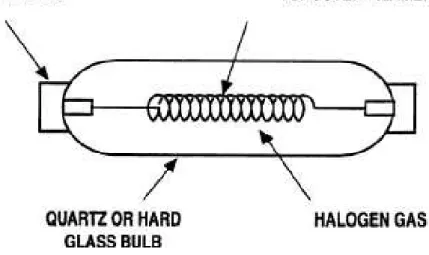
A halogen lamp is a special kind of incandescent lamp. The light output is more consistent than a standard incandescent lamp and the life is longer. Size is smaller because it is
important for the halogen cycle to have a high bulb wall temperature, which requires quartz or hard glass to be used. Better beam control is possible because of the small source size.
Halogen Lamp Construction
Construction of a halogen lamp is similar to a standard incandescent lamp with a few key differences. The light is still produced by a coiled filament of tungsten. The filament is protected by a quartz or hard glass bulb which is deliberately small to ensure the correct bulb wall temperature. The bulb is filled with a halogen gas rather than nitrogen and argon. The halogen gas is either iodine or bromine, or in some cases a mixture of both. The bulb shape is tubular so it is close to the hot filament. Most GE halogen lamps use quartz bulbs because this is a stronger material both mechanically and thermally.
Figure 8.1. Typical
Halogen Bulb Operating Principles
•When a tungsten filament is hot, minute particles of tungsten evaporate - much like steam leaving boiling water.
•With standard incandescent lamps, these particles are deposited on the inside surface of the bulb - just as steam will condense on cold glass. This deposit gradually reduces the transmission of light passing through the bulb as the bulb blackens. This change in light output is called lumen
maintenance.
•However with halogen lamps, the tungsten particles combine with the halogen gas and are prevented from condensing on the bulb, provided the bulb is above 200°C.
•The combined tungsten and halogen remains as a gas which circulates within the bulb, and when it approaches the filament where the temperature is much higher, the combination becomes unstable and reverts to the two separate constituents of tungsten and halogen.
•The tungsten will condense on the coolest local point, usually around the end of the filament. This process is called the halogen cycle.
•
The electric arc in an arc lamp consists of gas,
which is initially
ionized
by a high voltage and
therefore becomes electrically conductive.
•
To start an arc lamp, a very high voltage is pulsed
across the lamp to "ignite" or "strike" the arc
across the gas. This requires an electrical circuit
with an
igniter
and a
ballast
.
•
The ballast is wired in series with the lamp and
performs two functions:
First, when the power is first switched on, the
•
A moment later the starter interrupts the current
flow from the ballast, which has a high
inductance and therefore tries to maintain the
current flow (the ballast opposes any change in
current through it); it cannot, as there is no
longer a 'circuit'.
•
As a result, a high voltage appears across the
ballast momentarily - to which the lamp is
•
When the lamp sustains the arc, the ballast performs
its second function, to limit the current to that needed
to operate the lamp.
•
Lightning
is a similar principle where the atmosphere is
ionized by the high potential difference (voltage)
between earth and storm clouds.
•
The temperature of the arc in an arc lamp can reach
several thousand degrees
Celsius
. The outer glass
envelope can reach 500 degrees Celsius, therefore
before servicing one must ensure the bulb has cooled
sufficiently to handle.
•
Some lamps (mainly fluorescent tubes/energy saving
lamps) can be restruck as soon as they are turned off
(called hot restrike lamp).
•
Often, if these type of lamps are turned off or lose their
In a carbon arc lamp, the electrodes are
carbon rods in free air. To ignite the lamp,
the rods are touched together, thus
allowing a relatively low voltage to strike
the arc. The rods are then slowly drawn
apart, and electric current heats and
maintains an arc across the gap. The tips
of the carbon rods are heated to
•
Fluorescent Lamp Parts
Basically, a fluorescent lamp is made up of five components. See Figure 5.1.
• GLASS TUBE, coated on the inside with fluorescent powders called PHOSPHORS.
• Two ELECTRODES (or cathodes) coated with EMITTER, supported by a glass mount structure, and sealed at the ends of the tube.
• FILLING GAS - usually a low pressure of Argon or Krypton/Argon mixture. • Small amount of MERCURY (less than 20 mg), which vaporises during the
lamp operation.
Fluorescent Lamp Operation
When the circuit is energized, electricity heats the cathodes. See Figure 5.2. The cathodes are coated with material which, when heated, emits electrons. The electrons establish an electric arc between the cathodes at opposite ends of the tube. The
Fluorescent Lamp Circuit Operation
The circuit must contain a ballast (choke or inductor) to limit the current and a starter to provide the pre-heat conditions. Initially the starter switch closes so the two cathodes are connected in series. Current flows and the cathodes heat up emitting electrons. After a short time the starter switch opens so voltage is applied across the tube. If sufficient electrons are available an arc is struck and the starter plays no further part until the next starting operation. If there are insufficient
electrons, the tube will flicker, fail to start, and the starter will repeat the heating of the cathodes. The ballast limits the current to a safe and appropriate level for the power of lamp. Without the ballast, the current would increase to a high level and the lamp would destroy itself.
60 Hz, 120 Vrms Power Line, N is neutral (white)
grounded side of line, and L is the hot
1. The starter (which is simply a timed switch) allows current to flow through the filaments at the ends of the tube for a few seconds, and then it suddenly
breaks the connection..
2. Most starters incorporate a Neon Glow Tube with an internal bimetallic switch, which is normally open. When power is applied, a glow discharge takes place which begins to heat the bimetallic switch inside the glow tube. A second or so later, the bimetallic contacts heat up and bend (due to
different coefficients of expansion of the two metals) and the contacts close thereby permitting current to flow through the starting filaments at each end of the tube. The closing of the switch also shorts out the Neon Glow, and the glow is extinguished, therefore there is no longer any heating of the bimetal, and so after a few seconds, the bimetallic switch contacts once again open. 3. An inductive kick voltage spike (vL = Ldi/dt) is generated at the instant the
contacts are opened, since the ballast (choke) current suddenly falls toward zero as the contacts open.
4. This high voltage pulse is coupled through the capacitor, so it appears across the two ends of the fluorescent tube, thereby ionizing the mercury vapor in the tube, and the tube lights.
The situation before the light
Power switch turned on. 120 VAC power voltage ionizes
Neon in glow tube and the glow tube lights and heats up
the bimetal switch contacts inside the glow tube. As
they heat up, the contacts bend toward bend toward
While the contacts are closed, a large current builds up in the ballast and the tube heater filaments (at both ends of the tube) heat up and vaporize the mercury in the tube.
A few seconds later, the bimetal contacts cool enough to once again separate, and the current though the ballast is suddenly interrupted.
As this happens, a large vL = L*di/dt inductive voltage kick is
1. If the glow bulb starter contacts happen to
open when the 60 Hz is passing through (or
near) a voltage 0 in its 60 Hz cycle, the
inductive kick may not be strong enough to
ionize the mercury vapor in the main tube, and
the main fluorescent tube will not light.
2. However, in this case, the voltage across the
glow tube will be high (since the fluorescent
tube itself is NOT ionized and conducting) and
so the glow tube will once again light and the
whole starting cycle will be automatically be
repeated until an arc is successfully struck in
the fluorescent tube and it lights.!
Note that as Neon glow tube starters age, they get black and eventually stop working and must be replaced (see the old one on the right). A new glow tube starter appears on the left. This one also shows a capacitor connected across the starter to help absorb radio frequency (RF)
Motion detector used in home security. Detects only moving living things at body temperature that
move past the field of view of the two
pyroelectric IR
Side view showing the Fresnel lens focusing the incoming parallel IR light rays onto the surface of the PIR detector
Front view of the Fresnel Lens, which looks like a
circularly symmetric grooved plastic sheet.
Idx
Vdx Load Line
Slope = 1/RL Passes Thru Origin
V d
S l o p e = 1 / R L +
= > P a s s e s T h r o u g O r i g i n
R L L o a d R e s i s t o r
L o a d L i n e E q u a t i o n
-I d = V d / R L
D 1 P H O T O V O L T A I C C E L L
I d
Power Delivered to Load Resistor for 10 mW/cm2 light level:
P
RL= -Vdx*Idx
Note that different load
resistances extract