UWB at SemEval-2016 Task 5: Aspect Based Sentiment Analysis
Tom´aˇs Hercig†‡, Tom´aˇs Brychc´ın‡, Luk´aˇs Svoboda†‡and Michal Konkol†‡ †Department of Computer Science and Engineering, Faculty of Applied Sciences,
University of West Bohemia, Univerzitn´ı 8, 306 14 Plzeˇn, Czech Republic ‡NTIS – New Technologies for the Information Society, Faculty of Applied Sciences,
University of West Bohemia, Technick´a 8, 306 14 Plzeˇn, Czech Republic [email protected] [email protected]
[email protected] [email protected]
Abstract
This paper describes our system used in the Aspect Based Sentiment Analysis (ABSA) task of SemEval 2016. Our system uses Max-imum Entropy classifier for the aspect cate-gory detection and for the sentiment polarity task. Conditional Random Fields (CRF) are used for opinion target extraction. We achieve state-of-the-art results in 9 experiments among the constrained systems and in 2 experiments among the unconstrained systems.
1 Introduction
The goal of Aspect Based Sentiment Analysis (ABSA) is to identify the aspects of a given tar-get entity and estimate the sentiment polarity for each mentioned aspect. In recent years the aspect-based sentiment analysis has undergone rapid devel-opment mainly because of competitive tasks such as SemEval 2014 (Pontiki et al., 2014) and SemEval 2015 (Pontiki et al., 2015). The highest ranking par-ticipants are for SemEval 2014 (Kiritchenko et al., 2014; Brun et al., 2014; Castellucci et al., 2014; Toh and Wang, 2014; Wagner et al., 2014; Brychc´ın et al., 2014) and for SemEval 2015 (Saias, 2015; Toh and Su, 2015a; San Vicente et al., 2015; Zhang and Lan, 2015).
In the current ABSA task - SemEval 2016 task 5 (Pontiki et al., 2016) has attracted 29 participating teams competing in 40 different experiments among 8 languages. The task has three subtasks: Sentence-level (SB1), Text-Sentence-level (SB2) and Out-of-domain ABSA (SB3). The subtasks are further divided into three slots:
• 1) Aspect Category Detection – the category
consists of an entity and attribute (E#A) pair.
• 2) Opinion Target Expression (OTE)
• 3) Sentiment Polarity (positive, negative, neu-tral, and for SB2 conflict)
In phase A we solved slots 1 and 2. In phase B we were given the results for slots 1 and 2 and solved slot 3. We participate in 19 experiments including Chinese, English, French, and Spanish.
2 System Description
Our approach to the ABSA task is based on super-vised Machine Learning. Detailed description for each experiment can be found in Section 2.2 and Section 2.3.
2.1 Features
Our system combines a large number of features to achieve competitive results. In this section we will describe the features in detail.
2.1.1 Semantics Features
We use semantics models to derive word clusters from unlabeled datasets. Similarly to (Toh and Su, 2015b) we use the Amazon product reviews from (Blitzer et al., 2007) and the user reviews from the YelpPhoenix Academic Dataset1to create seman-tic word clusters. Additionally, we use a review Opentabledataset2. In this paper we consider the following semantics models.
1https://www.yelp.com/dataset_challenge 2downloaded fromhttp://opentable.com
Dimension Window Iterations
GloVe 300 10 100
CBOW 300 10 100
LDA – sentence 1000
Table 1:Model settings.
Global Vectors (GloVe) (Pennington et al., 2014) use the ratios of the word–word co-occurrence probabilities to encode the meanings of words.
Continuous Bag-of-Words (CBOW) (Mikolov et al., 2013) is model based on Neural Network Language Model (NNLM) that tries to predict the current word using a small context window around the word.
Latent Dirichlet Allocation (LDA) (Blei et al., 2003) discovers the hidden topics in text. We experiment with 50, 100, 200, 300, 400, and 500 topics.
The settings of theGloVeandCBOWmodels re-flect the results of these methods in their original publications (Pennington et al., 2014; Mikolov et al., 2013). The detailed settings of all these methods are shown in Table 1.
We used the GloVe implementation provided on the official website3, CBOW model uses the Word2Vec4implementation and theLDA implemen-tation comes from the MALLET (McCallum, 2002) software package.
CLUTO software package (Karypis, 2003) is used for words clustering with thek-means algorithm and cosine similarity metric. All vector space models in this paper cluster the word vectors into four different numbers of clusters: 100, 500, 1000, and 5000.
The following features are based on the word clusters created using the semantic models.
Clusters (C) – The occurrence of a cluster at a given position.
Bag of Clusters (BoC) – The occurrence of a clus-ter in the context window.
Cluster Bigrams (CB) – The occurrence of cluster bigram at a given position.
3http://nlp.stanford.edu/projects/glove 4https://code.google.com/p/word2vec
Bag of Cluster Bigrams (BoCB) – The occurrence of cluster bigram in the context window. 2.1.2 Constrained Features
Affixes (A) – Affix (length 2-4 characters) of a word at a given position with a frequency>5. Aspect Category (AC) – extracted aspect category.
We use separately the entity, attribute, and the E#A pair.
Aspect Target (AT) – listed aspect target.
Bag of Words (BoW) – The occurrence of a word in the context window.
Bag of Words filtered by POS (BoW-POS) – The occurrence of a word in the context window fil-tered by POS tags.
Bag of Bigrams (BoB) – The occurrence of a bi-gram in the context window.
Bag of Words around Verb (5V) – Bag of 5 words before verb and a bag of 5 words after verb. Bag of 5 Words at the Beginning of Sentence (5sS)
– Bag of 5 words at the beginning of a sentence. Bag of 5 Words at the End of Sentence (5eS) –
Bag of 5 words at the end of a sentence. Bag of Head Words (BoHW) – bag of extracted
head words from the sentence parse tree. Emoticons (E) We used a list of positive and
neg-ative emoticons (Montejo-R´aez et al., 2012). The feature captures the presence of an emoti-con within the text.
Head Word (HW) – extracted head word from the sentence parse tree.
Character N-gram (ChN) – The occurrence of character n-gram at a given position.
Learned Target Dictionary (LTD) – presence of a word from learned5dictionary of aspect terms. Learned Target Dictionary by Category (LTD-C)
– presence of a word from the learned dictionary5 of aspect terms grouped by category.
N-gram (N) – The occurrence of n-gram in the con-text window.
N-gram Shape (NSh) – The occurrence of word shape n-gram in the context window. We con-sider unigrams with frequency>5 and bigrams, trigrams with frequency>20.
Paragraph Vectors (P2Vec) is an unsupervised method of learning text representation (Le and Mikolov, 2014). Resulting feature vector has a fixed dimension while the input text can be of any length. The model is trained on the One billion word benchmark presented in (Chelba et al., 2013), resulting vectors6 are used as features for a sentence. We use the implementation by ˇReh˚uˇrek and Sojka (2010).
POS N-gram (POS-N) – The occurrence of POS n-gram in the context window.
Punctuation (P) – The occurrence of a question mark, an exclamation mark or at least two dots in the context window.
Skip-bigram (SkB) – Instead of using sequences of adjacent words (n-grams) we used skip-grams (Guthrie et al., 2006; Reyes et al., 2013), which skip over arbitrary gaps. We consider skip-bigrams with 2 to 5 word skips and remove skip-grams with a frequency≤5.
Target Bag of Words (T-BoW) – BoW containing parent, siblings, and children of the target from the sentence parse tree.
TF-IDF (TF-IDF) – Term frequency - inverse doc-ument frequency of a word computed from the training data.
Verb Bag of Tags (V-BoT) – Bag of syntactic de-pendency tags of parent, siblings, and children of the verb from the sentence parse tree.
Verb Bag of Words (V-BoW) – Bag of words for parent, siblings, and children of the verb from the sentence parse tree.
6Vector dimension has been set to 300.
Word Shape (WSh) – we assign words into one of 24 classes7 similar to the function specified in (Bikel et al., 1997).
Words (W) – The occurrence of word at a given po-sition (e.g. previous word).
2.1.3 Unconstrained Features
Dictionary (DL) – presence of a word from dictio-nary extracted from the Annotation Guidelines for Laptops.
Dictionary (DR) – presence of a word from dictio-nary extracted from the Annotation Guidelines for Restaurants.
Enchanted Dictionary (ED) – presence of a word from a dictionary extracted from website8. Group of Words from ED (EDG) – presence of
any word from a group from the ED dictionary. Dictionary of Negative Words (ND) – presence of
any negative word from the negative words list9.
Sentiment (S) – this is a union of features deal-ing with sentiment. It consists of BoG fea-tures where the groups correspond to various sentiment lexicons. We used the following lexicon resources: Affinity lexicon (Nielsen, 2011), Senticon (Cruz et al., 2014), dictionar-ies from (Steinberger et al., 2012), MICRO-WNOP (Cerini et al., 2007), and the list of pos-itive or negative opinion words from (Liu et al., 2005). Additional feature includes the output of Stanford CoreNLP (Manning et al., 2014) v3.6 sentiment analysis package by (Socher et al., 2013).
2.2 Phase A
Sentence-level Category (SB1, slot 1) We use maximum entropy classifier for all classes. Then a thresholdt is used to decide which categories will be assigned by the classifier.
7We use edu.stanford.nlp.process.WordShapeClassifier with
the WORDSHAPECHRIS1 setting.
8http://www.enchantedlearning.com/
wordlist/
9http://dreference.blogspot.cz/2010/05/
Chinese We used identical features for both do-mains (BoB, BoHW, BoW, ChN, N), where ChN ranges from unigram to 4-gram and ChN with fre-quency <20 are removed andN ranges from uni-gram to triuni-gram andChN with frequency<10 are removed. The threshold was set tot=0.1.
Spanish For Spanish we used the following fea-tures: 5V, 5eS, BoB, BoHW, BoW, BoW-POS, ChN, V-BoT, where5V considers only adjective, adverb, and noun,5eSconsiders adjectives and adverbs with frequency>5,ChNranges from unigram to 4-gram andChN with frequency<20 are removed, BoW-POS is used separately for adverbs, nouns, verbs, and a union of adjectives, adverbs, nouns, and verbs, V-BoT is used separately for adverbs, nouns, and a union of adjectives and adverbs while reducing fea-ture space by 50 occurrences. The threshold was set tot=0.2.
English English features employ lemmatization. The threshold was set tot=0.14. Common features
for all experiments in this task are 5V, 5eS, BoB, BoHW, BoW, BoW-POS, P, TF-IDF, V-BoT, where 5V considers only adjective, adverb, and noun, 5eS filters only adjective and adverb,BoW-POScontains adjectives, adverbs, nouns, and verbs,V-BoT filters adjectives and adverbs with frequency>20.
The unconstrained model for the Laptops domain additionally usesBoC, BoCB, DL, ED, P2Vec BoC and BoCB include the GloVe and CBOW models computed on theAmazondataset.
The constrained model for the restaurant domain additionally uses5sS, ChN, LTD, LTD-C, P2Vec 5sS filters only adjective and adverb, ChN in this case means character unigrams with frequency>5. This model also considers separateBoW-POSfeatures for groups for adverbs, nouns and verbs.
The unconstrained model for the restaurant do-main usesBoC, BoCB, DR, LDA, ND, NSh on top of the previously listed features for the constrained model.
BoC and BoCB include the GloVe, CBOW, and LDA models computed on the Yelp dataset and CBOWmodel computed on theOpentabledataset.
Sentence-level Target (SB1, slot 2) Similarly to (Brychc´ın et al., 2014), we have decided to use Con-ditional Random Fields (CRF) (Lafferty et al., 2001)
to solve this subtask. The context for this task is de-fined as a five word window centred at the currently processed word. English features for this subtask employ lemmatization.
The baseline feature set consists ofA, BoB, BoW-POS, HW, LTD, LTD-C, N, POS-N, V-BoT, W, WSh.BoW-POScontains adjectives, adverbs, nouns, verbs, and a union of adverbs and nouns. We con-siderPOS-N with frequency>10. V-BoTincludes adverbs, nouns, and a union of adjectives, adverbs, nouns, and verbs.
In the unconstrained model, we extend this with the semantic featuresC, CB(created using theCBOW model computed on theopentable dataset) and with lexiconsDR, EDG.
Sentence level Category & Target (SB1, slot 1&2) We firstly assign targets as described above and then combine them with the best five candidates for as-pect category10. We also add aspect categories with-out target. This produces too many combinations thus we need to filter the unlikely opinions. We remove the opinions without target in a sentence where the aspect category is already present with a target. When there is only one target and one as-pect category in a sentence we combine them into a single opinion.
Text-level Category (SB2, slot 1) We used the baseline algorithm: the predicted sentence-level tu-ples (SB1, slot 1) are copied to text-level and dupli-cates are removed.
2.3 Phase B
Sentence level Sentiment Polarity (SB1, slot 3) Our sentiment polarity detection is based on the Maximum Entropy classifier, which works very well in many NLP tasks, including document-level senti-ment analysis (Habernal et al., 2014).
Chinese We used identical features for both do-mains (5V, 5eS, 5sS, AC, BoB, BoHW, BoW, BoW-POS, ChN, N, NSh, P, SkB, V-BoT, V-BoW), where 5V considers adjectives and adverbs with frequency >5,5eSand5sScontain adjectives, adverbs, nouns, and verbs, BoW-POS is used separately for adjec-tives and adverbs, ChN ranges from unigram to
5-10We use the same settings and approach as in the
gram andChN with frequency<5 are removed,N ranges from unigram to 5-gram and ChN with fre-quency<2 are removed, V-BoT is used separately for verbs, and a union of adjectives and adverbs, V-BoW is used separately for adjectives, adverbs, verbs, a union of adjectives and adverbs and a union of adjectives, adverbs, nouns, and verbs, while re-ducing feature space by 2 occurrences.
French We employ lemmatization for French. The first constrained model includes the following features: AC, BoB, BoHW, BoW, BoW-POS, ChN, LTD, LTD-C, N, NSh, P, SkB, V-BoT, where BoW-POSis used separately for adjectives, adverbs and a union of adjectives, adverbs, nouns, and verbs,ChN ranges from unigram to 5-gram and ChN with fre-quency ≤ 5 are removed, N ranges from unigram to 5-gram and N with frequency<2 are removed, V-BoT is used separately for verbs, and a union of adjectives and adverbs.
The second constrained model additionally uses 5V, 5eS, 5sS, AT, T-Bow, V-BoW, where 5V consid-ers only adjective and adverb, 5eS, 5sS considers adjective, adverb, noun, and verb, T-BoW is used for adjectives, adverbs, nouns, and verbs, V-BoW is used separately for adjectives, adverbs, verbs, a union of adjectives and adverbs and a union of ad-jectives, adverbs, nouns, and verbs, while reducing feature space by 2 occurrences.
Spanish We employ lemmatization for Spanish. We used the following features: 5V, 5eS, AC, BoB, BoHW, BoW, BoW-POS, E, ChN, LTD, LTD-C, N, NSh, P, SkB, T-Bow, V-BoT, V-BoW, where5V con-siders only adjective and adverb, 5eSconsiders ad-jective, adverb, noun, and verb, BoW-POSis used separately for adjectives, adverbs,ChNranges from unigram to 5-gram andChNwith frequency≤5 are
removed, N ranges from unigram to 5-gram andN with frequency<2 are removed,T-BoW is used for adjectives, adverbs, nouns, and verbs,V-BoTis used separately for verbs, and a union of adjectives and adverbs, V-BoW is used separately for adjectives, adverbs, verbs, a union of adjectives and adverbs and a union of adjectives, adverbs, nouns, and verbs, while reducing feature space by 2 occurrences.
English We use lemmatization in this subtask. Common features for all experiments in this task
are5V, 5eS, 5sS, AC, AT, BoB, BoHW, BoW, BoW-POS, E, ChN, LTD, LTD-C, N, NSh, P, SkB, V-BoT, V-BoW, where5Vconsiders adjectives and adverbs, 5eS, 5sSconsists of adjectives, adverbs, nouns, and verbs, ,BoW-POScontains adjectives and adverbs, N ranges from unigram to 5-gram and N with fre-quency<2 are removed,V-BoT is used separately for verbs, and a union of adjectives and adverbs, V-BoW is used separately for adjectives, adverbs, verbs, a union of adjectives and adverbs and a union of adjectives, adverbs, nouns, and verbs, while re-ducing feature space by 2 occurrences.
The unconstrained model for the Laptops domain additionally usesBoC, BoCB, ED, S BoCandBoCB include theGloVeandCBOWmodels computed on theAmazondataset.
The constrained model for the restaurant domain additionally uses T-Bow, TF-IDF, where T-BoW is used for adjectives, adverbs, nouns, and verbs.
The unconstrained model for the restaurant do-main usesBoC, BoCB, ED, ND, Son top of the pre-viously listed features for the constrained model.
BoC and BoCB include the GloVe and CBOW models computed on the Yelp dataset and CBOW model computed on theOpentabledataset. Text-level Sentiment Polarity (SB2, slot 3) The baseline algorithm traverses the predicted sentence-level tuples of the same category and counts the re-spective polarity labels (positive, negative or neu-tral). Finally, the polarity label with the highest fre-quency is assigned to the text-level category. If there are not any sentence-level tuples of the same cat-egory the polarity label is determined based on all tuples regardless of the category.
Our improved algorithm contains an additional step, that assigns polarity for cases (categories) with more than one sentence-level polarity labels. The resulting polarity is determined by the following al-gorithm:
if(catPolarity == lastPolarity){ assign lastPolarity;
}else if(catPolarity == entPolarity){ assign entPolarity;
}else{
assign CONFLICT; }
where catPolarity is the polarity label with
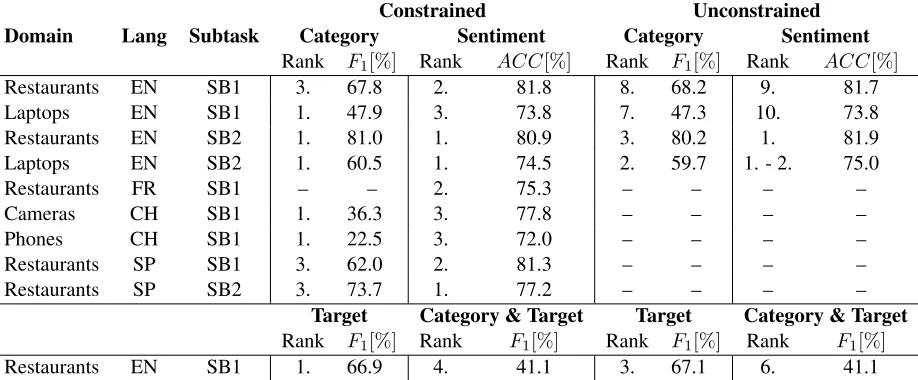
Domain Lang Subtask CategoryConstrainedSentiment CategoryUnconstrainedSentiment
Rank F1[%] Rank ACC[%] Rank F1[%] Rank ACC[%]
Restaurants EN SB1 3. 67.8 2. 81.8 8. 68.2 9. 81.7
Laptops EN SB1 1. 47.9 3. 73.8 7. 47.3 10. 73.8
Restaurants EN SB2 1. 81.0 1. 80.9 3. 80.2 1. 81.9
Laptops EN SB2 1. 60.5 1. 74.5 2. 59.7 1. - 2. 75.0
Restaurants FR SB1 – – 2. 75.3 – – – –
Cameras CH SB1 1. 36.3 3. 77.8 – – – –
Phones CH SB1 1. 22.5 3. 72.0 – – – –
Restaurants SP SB1 3. 62.0 2. 81.3 – – – –
Restaurants SP SB2 3. 73.7 1. 77.2 – – – –
Target Category & Target Target Category & Target
Rank F1[%] Rank F1[%] Rank F1[%] Rank F1[%]
[image:6.612.78.537.61.251.2]Restaurants EN SB1 1. 66.9 4. 41.1 3. 67.1 6. 41.1
Table 2:Achieved ranks and results (in %) by UWB for all submitted systems.
(E#A touple), entPolarity is the polarity label
with the highest frequency for the entity E and
lastPolarityis the last seen polarity label for the
given category. This follows our believe that the last polarity tends to reflect the final sentiment (opinion) toward the aspect category.
2.4 System Settings
For all experiments we use Brainy (Konkol, 2014) machine learning library.
Data preprocessing includes lower-casing and in some cases lemmatization.
We utilize parse trees, lemmatization and POS tags from the Stanford CoreNLP (Manning et al., 2014) v3.6 framework. We chose it because it has support for Chinese, English, French, and Spanish.
3 Results and Discussion
As shown in the Table 2 we achieved very satis-factory results especially for the constrained experi-ments.
In the English sentence level Laptops domain our constrained method was slightly better than the un-constrained one (by 0.6%). We believe this is not a significant deviation.
The baseline algorithm for text-level cate-gory (SB2, slot 1)11 achieves an F
1 score of 96.08% on the Laptops domain and 97.07% on the Restaurants domain for English. When we add the corresponding general class for the
11Using the sentence-level gold test data.
given domain (e.g. RESTAURANT#GENERAL and
LAPTOP#GENERAL) the algorithm achieves an F1
score of 96.87% on the Laptops domain and 99.75% on the Restaurants domain for English.
The baseline algorithm for text-level sentiment polarity (SB2, slot 3)11 achieves an Accuracy of 86.8% on the Laptops domain and 89.6% on the Restaurants domain for English, while the improved algorithm achieves an Accuracy of 94.5% on the Laptops domain and 97.3% on the Restaurants do-main for English.
4 Conclusion
We competed in 19 constrained experiments and won 9 of them. In the other 10 cases we have reached at worst the 4th place. Our unconstrained systems participated in 10 experiments and achieved 5 ranks ranging from the 1st to 3rd place.
In the future we aim to explore the benefits of us-ing neural networks for sentiment analysis.
Acknowledgements
References
Daniel M Bikel, Scott Miller, Richard Schwartz, and Ralph Weischedel. 1997. Nymble: a high-performance learning name-finder. In Proceedings of the fifth conference on Applied natural language processing, pages 194–201. Association for Compu-tational Linguistics.
D. M. Blei, A. Y. Ng, M. I. Jordan, and J. Lafferty. 2003. Latent Dirichlet allocation. Journal of Machine Learning Research, 3:2003.
John Blitzer, Mark Dredze, Fernando Pereira, et al. 2007. Biographies, bollywood, boom-boxes and blenders: Domain adaptation for sentiment classification. In ACL, volume 7, pages 440–447.
Caroline Brun, Diana Nicoleta Popa, and Claude Roux. 2014. XRCE: Hybrid classification for aspect-based sentiment analysis. In Proceedings of the 8th Inter-national Workshop on Semantic Evaluation (SemEval 2014), pages 838–842, Dublin, Ireland, August. Asso-ciation for Computational Linguistics.
Tom´aˇs Brychc´ın, Michal Konkol, and Josef Steinberger. 2014. UWB: Machine learning approach to aspect-based sentiment analysis. In Proceedings of the 8th International Workshop on Semantic Evaluation (Se-mEval 2014), pages 817–822. Association for Compu-tational Linguistics.
Giuseppe Castellucci, Simone Filice, Danilo Croce, and Roberto Basili. 2014. UNITOR: Aspect based senti-ment analysis with structured learning. In Proceed-ings of the 8th International Workshop on Semantic Evaluation (SemEval 2014), pages 761–767, Dublin, Ireland, August. Association for Computational Lin-guistics.
Sabrina Cerini, Valentina Compagnoni, Alice Demontis, Maicol Formentelli, and G Gandini. 2007. Micro-WNOp: A gold standard for the evaluation of auto-matically compiled lexical resources for opinion min-ing. Language resources and linguistic theory: Typol-ogy, second language acquisition, English linguistics, pages 200–210.
Ciprian Chelba, Tomas Mikolov, Mike Schuster, Qi Ge, Thorsten Brants, Phillipp Koehn, and Tony Robin-son. 2013. One billion word benchmark for measur-ing progress in statistical language modelmeasur-ing. arXiv preprint arXiv:1312.3005.
Ferm´ın L Cruz, Jos´e A Troyano, Beatriz Pontes, and F Javier Ortega. 2014. Building layered, multilingual sentiment lexicons at synset and lemma levels.Expert Systems with Applications, 41(13):5984–5994. David Guthrie, Ben Allison, Wei Liu, Louise Guthrie,
and Yorick Wilks. 2006. A closer look at skip-gram modelling. In Proceedings of the 5th international
Conference on Language Resources and Evaluation (LREC-2006), pages 1–4.
Ivan Habernal, Tom´aˇs Pt´aˇcek, and Josef Steinberger. 2014. Supervised sentiment analysis in Czech so-cial media. Information Processing & Management, 50(5):693–707.
G. Karypis. 2003. CLUTO—A clustering toolkit. Svetlana Kiritchenko, Xiaodan Zhu, Colin Cherry, and
Saif Mohammad. 2014. NRC-Canada-2014: Detect-ing aspects and sentiment in customer reviews. In Proceedings of the 8th International Workshop on Se-mantic Evaluation (SemEval 2014), pages 437–442, Dublin, Ireland, August. Association for Computa-tional Linguistics.
Michal Konkol. 2014. Brainy: A machine learning li-brary. In Leszek Rutkowski, Marcin Korytkowski, Rafa Scherer, Ryszard Tadeusiewicz, Lotfi A. Zadeh, and Jacek M. Zurada, editors, Artificial Intelligence and Soft Computing, volume 8468 ofLecture Notes in Computer Science. Springer-Verlag, Berlin.
John Lafferty, Andrew McCallum, and Fernando Pereira. 2001. Conditional random fields: Probabilistic mod-els for segmenting and labeling sequence data. In Proceedings of International Conference on Machine Learning.
Quoc V. Le and Tomas Mikolov. 2014. Distributed representations of sentences and documents. In Pro-ceedings of the 31th International Conference on Ma-chine Learning, ICML 2014, Beijing, China, 21-26 June 2014, pages 1188–1196.
Bing Liu, Minqing Hu, and Junsheng Cheng. 2005. Opinion observer: analyzing and comparing opinions on the web. InProceedings of the 14th international conference on World Wide Web, pages 342–351. ACM. Christopher D. Manning, Mihai Surdeanu, John Bauer, Jenny Finkel, Steven J. Bethard, and David McClosky. 2014. The Stanford CoreNLP natural language pro-cessing toolkit. InAssociation for Computational Lin-guistics (ACL) System Demonstrations, pages 55–60. Andrew Kachites McCallum. 2002. MALLET: A
ma-chine learning for language toolkit.
Tomas Mikolov, Kai Chen, Greg Corrado, and Jeffrey Dean. 2013. Efficient estimation of word representa-tions in vector space. arXiv preprint arXiv:1301.3781. A. Montejo-R´aez, E. Mart´ınez-C´amara, M. T. Mart´ın-Valdivia, and L. A. Ure˜na L´opez. 2012. Random walk weighting over sentiwordnet for sentiment po-larity detection on twitter. InProceedings of the 3rd Workshop in Computational Approaches to Subjectiv-ity and Sentiment Analysis, WASSA ’12, pages 3–10, Stroudsburg, PA, USA. Association for Computational Linguistics.
Proceedings of the ESWC2011 Workshop on ’Making Sense of Microposts’: Big things come in small pack-ages. 93-98.
Jeffrey Pennington, Richard Socher, and Christopher D Manning. 2014. Glove: Global vectors for word rep-resentation. In Proceedings of the 2014 Conference on Empirical Methods in Natural Language Process-ing (EMNLP), pages 1532–1543.
Maria Pontiki, Dimitris Galanis, John Pavlopoulos, Har-ris Papageorgiou, Ion Androutsopoulos, and Suresh Manandhar. 2014. SemEval-2014 Task 4: Aspect based sentiment analysis. In Proceedings of the 8th International Workshop on Semantic Evaluation (Se-mEval 2014), pages 27–35, Dublin, Ireland, August. Association for Computational Linguistics and Dublin City University.
Maria Pontiki, Dimitrios Galanis, Haris Papageorgiou, Suresh Manandhar, and Ion Androutsopoulos. 2015. Semeval-2015 task 12: Aspect based sentiment anal-ysis. In Proceedings of the 9th International Work-shop on Semantic Evaluation (SemEval 2015), Asso-ciation for Computational Linguistics, Denver, Col-orado, pages 486–495.
Maria Pontiki, Dimitrios Galanis, Haris Papageorgiou, Ion Androutsopoulos, Suresh Manandhar, Mohammad AL-Smadi, Mahmoud Al-Ayyoub, Yanyan Zhao, Bing Qin, Orph´ee De Clercq, V´eronique Hoste, Marianna Apidianaki, Xavier Tannier, Natalia Loukachevitch, Evgeny Kotelnikov, Nuria Bel, Salud Mar´ıa Jim´enez-Zafra, and G¨uls¸en Eryi˘git. 2016. SemEval-2016 task 5: Aspect based sentiment analysis. InProceedings of the 10th International Workshop on Semantic Evalua-tion, SemEval ’16, San Diego, California, June. Asso-ciation for Computational Linguistics.
Radim ˇReh˚uˇrek and Petr Sojka. 2010. Software Frame-work for Topic Modelling with Large Corpora. In Proceedings of the LREC 2010 Workshop on New Challenges for NLP Frameworks, pages 45–50, Val-letta, Malta, May. ELRA. http://is.muni.cz/
publication/884893/en.
Antonio Reyes, Paolo Rosso, and Tony Veale. 2013. A multidimensional approach for detecting irony in twit-ter. Language Resources and Evaluation, 47(1):239– 268.
Jos´e Saias. 2015. Sentiue: Target and aspect based sen-timent analysis in semeval-2015 task 12. Association for Computational Linguistics.
Inaki San Vicente, Xabier Saralegi, Rodrigo Agerri, and Donostia-San Sebasti´an. 2015. Elixa: A modular and flexible absa platform. SemEval-2015, page 748. Richard Socher, Alex Perelygin, Jean Y Wu, Jason
Chuang, Christopher D Manning, Andrew Y Ng, and Christopher Potts. 2013. Recursive deep models for semantic compositionality over a sentiment treebank.
In Proceedings of the conference on empirical meth-ods in natural language processing (EMNLP), volume 1631, page 1642. Citeseer.
Josef Steinberger, Mohamed Ebrahim, Maud Ehrmann, Ali Hurriyetoglu, Mijail Kabadjov, Polina Lenkova, Ralf Steinberger, Hristo Tanev, Silvia Vzquez, and Vanni Zavarella. 2012. Creating sentiment dictio-naries via triangulation. Decision Support Systems, 53(4):689 – 694.
Zhiqiang Toh and Jian Su. 2015a. Nlangp: Supervised machine learning system for aspect category classifi-cation and opinion target extraction.
Zhiqiang Toh and Jian Su. 2015b. NLANGP: Supervised Machine Learning System for Aspect Category Clas-sification and Opinion Target Extraction. In Proceed-ings of the 9th International Workshop on Semantic Evaluation (SemEval 2015), pages 496–501, Denver, Colorado, June. Association for Computational Lin-guistics.
Zhiqiang Toh and Wenting Wang. 2014. DLIREC: Aspect term extraction and term polarity classifica-tion system. InProceedings of the 8th International Workshop on Semantic Evaluation (SemEval 2014), pages 235–240, Dublin, Ireland, August. Association for Computational Linguistics.
Joachim Wagner, Piyush Arora, Santiago Cortes, Utsab Barman, Dasha Bogdanova, Jennifer Foster, and Lamia Tounsi. 2014. DCU: Aspect-based polarity classification for SemEval Task 4. InProceedings of the 8th International Workshop on Semantic Evalua-tion (SemEval 2014), pages 223–229, Dublin, Ireland, August. Association for Computational Linguistics. Zhihua Zhang and Man Lan. 2015. Ecnu: