Volume 2006, Article ID 96306, Pages1–12 DOI 10.1155/ASP/2006/96306
Unsupervised Performance Evaluation of Image Segmentation
Sebastien Chabrier, Bruno Emile, Christophe Rosenberger, and Helene Laurent
Laboratoire Vision et Robotique, UPRES EA 2078, ENSI de Bourges, Universit´e d’Orl´eans, 10 boulevard Lahitolle, 18020 Bourges cedex, France
Received 1 March 2005; Revised 5 January 2006; Accepted 21 January 2006
We present in this paper a study of unsupervised evaluation criteria that enable the quantification of the quality of an image segmentation result. These evaluation criteria compute some statistics for each region or class in a segmentation result. Such an evaluation criterion can be useful for different applications: the comparison of segmentation results, the automatic choice of the best fitted parameters of a segmentation method for a given image, or the definition of new segmentation methods by optimization. We first present the state of art of unsupervised evaluation, and then, we compare six unsupervised evaluation criteria. For this comparative study, we use a database composed of 8400 synthetic gray-level images segmented in four different ways. Vinet’s measure (correct classification rate) is used as an objective criterion to compare the behavior of the different criteria. Finally, we present the experimental results on the segmentation evaluation of a few gray-level natural images.
Copyright © 2006 Hindawi Publishing Corporation. All rights reserved.
1. INTRODUCTION
Segmentation is an important stage in image processing since the quality of any ensuing image interpretation depends on it. Several approaches have been put forward in the literature [1,2],. . .. The region approach for image segmentation con-sists in determining the regions containing neighborhood pixels that have similar properties (gray-level, texture,. . .). The contour approach detects the boundaries of these re-gions. We have decided to focus on the first approach, namely the region-based image segmentation, because the corre-sponding segmentation methods give better results in the textured case (the most difficult one). Classification methods can be used afterwards. In this case, a class can be composed of different regions of the segmentation result.
However, it is difficult to evaluate the efficiency and to make an objective comparison of different segmentation methods. This more general problem has been addressed for the evaluation of a segmentation result and the results are available in the literature [3]. There are two main approaches. On the one hand, there are supervised evaluation crite-ria based on the computation of a dissimilarity measure be-tween a segmentation result and a ground truth. These cri-teria are widely used in medical applications [4]. Baddeley’s distance [5], Vinet’s measure [6] (correct classification rate), or Hausdorff’s measure [7] are examples of supervised eval-uation criteria. For the comparison of these criteria, it is pos-sible to use synthetic images whose ground truth is directly available. An alternative solution is to use the segmentation
results manually made by experts on natural images. This strategy is more realistic if we consider the type of images, but the question of the different experts objectivity then arises. This problem can be solved by merging the segmentation re-sults obtained by the different experts [8] and by taking into account their subjectivity.
On the other hand, there are unsupervised evaluation cri-teria that enable the quantification of the quality of a seg-mentation result without any a priori knowledge. These cri-teria generally compute statistical measures such as the gray-level standard deviation or the disparity of each region or class in the segmentation result. Currently, no evaluation cri-terion appears to be satisfactory in all cases. In this paper, we present and test different unsupervised evaluation criteria. They will allow us to compare various segmentation results, to make the choice of the segmentation parameters easier, or to define new segmentation methods by optimizing an eval-uation criterion. A segmentation result is defined by a level of precision. When using a classification method, we believe that the best way to define the level of precision of a segmen-tation result is the number of its classes. We use the unsuper-vised evaluation criteria for the comparison of the segmen-tation results of an image that have the same precision level.
the ground truth is obviously well known and the best eval-uation criterion will be the one that maximizes the similarity of comparison with Vinet’s measure. We then illustrate the ability of these evaluation criteria to compare various seg-mentation results (with the same level of precision) of real images inSection 4. We conclude and give the perspectives of this study inSection 5.
2. UNSUPERVISED EVALUATION
Without any a priori knowledge, most of evaluation crite-ria compute some statistics on each region or class in the segmentation result. The majority of these quality measure-ments are established in agreement with the human percep-tion. There are two main approaches in image segmentation: region segmentation and boundary detection. As we chose
to more specifically consider region-based image segmenta-tion methods, which give better results for textured cases, the corresponding evaluation criteria will be detailed in the next paragraph.
2.1. Evaluation of region segmentation
One of the most intuitive criterion being able to quantify the quality of a segmentation result is the intraregion uni-formity. Weszka and Rosenfeld [9] proposed such a criterion with thresholding that measures the effect of noise to evalu-ate some thresholded images. Based on the same idea of in-traregion uniformity, Levine and Nazif [10] also defined a criterion that calculates the uniformity of a region character-istic based on the variance of this charactercharacter-istic:
LEV 1(IR)=1− 1
Card(I)
NR
k=1
s∈Rk
gI(s)−t∈RkgI(t)
2
maxs∈Rk
gI(s)−mins∈Rk
gI(s)2, (1)
where
(i) IR corresponds to the segmentation result of the im-ageI in a set of regionsR= {R1,. . .,RNR}havingNR
regions,
(ii) Card(I) corresponds to the number of pixels of the im-ageI,
(iii)gI(s) corresponds to the gray-level intensity of the pixel
sof the imageI and can be generalized to any other characteristic (color, texture,. . .).
A standardized uniformity measure was proposed by Sez-gin and Sankur [11]. Based on the same principle, the mea-surement of homogeneity of Cochran [12] gives a confi-dence measure on the homogeneity of a region. However, this method requires a threshold selection that is often arbitrarily
done, limiting thus the proposed method. Another criterion to measure the intraregion uniformity was developed by Pal and Pal [13]. It is based on a thresholding that maximizes the local second-order entropy of regions in the segmentation re-sult. In the case of slightly textured images, these criteria of intraregion uniformity prove to be effective and very simple to use. However, the presence of textures in an image often generates improper results due to the overinfluence of small regions.
Complementary to the intraregion uniformity, Levine and Nazif [10] defined a disparity measurement between two regions to evaluate the dissimilarity of regions in a segmen-tation result. The formula of total interregions disparity is defined as follows:
LEV 2IR=
NR
k=1wRk
NR
j=1/Rj∈W(Rk)
pRk\RjgI¯
Rk−gI¯Rj/gI¯Rk+ ¯gIRj
NR
k=1wRk
, (2)
wherewRkis a weight associated toRkthat can be dependent
of its area, for example, ¯gkis the average of the gray-level of
Rk. ¯gI(Rk) can be generalized to a feature vector computed on the pixels values of the regionRksuch as for LEV 1.pRk\Rj
corresponds to the length of the perimeter of the regionRk
common to the perimeter of the regionRj. This type of cri-terion has the advantage of penalizing the oversegmentation. Note that the intraregion uniformity can be combined with the interregions dissimilarity by using the following for-mula:
ROS 1IR=1 + 1/
C2
NR
NR
i,j=1,i=jgI¯
Ri−gI¯Rj/512−4/2552NR NR
i=1σ2
Ri
whereC2
NR is number of combinations of 2 regions among
NR.
This criterion [14] combines intra and interregions dis-parities. intraregion disparity is computed by the normalized standard deviation of gray levels in each region. The interre-gions disparity computes the dissimilarity of the average gray level of two regions in the segmentation result.
Haralick and Shapiro consider that
(i) the regions must be uniform and homogeneous, (ii) the interior of the regions must be simple without too
many small holes,
(iii) the adjacent regions must present significantly diff er-ent values for the uniform characteristics,
(iv) boundaries should be smoothed and accurate.
The presence of numerous regions in a segmentation result is penalized only by the term NR. In the case of very noisy images, the excess in the number of regions should be pe-nalized. However, the error generated by each small region is close to 0. Consequently, the global criterion is also close to 0, which means that the segmentation result is very good in an erroneous way. Borsotti et al. [15] identified this limitation of Liu and Yang’s evaluation criterion [16] and modified it, so as to more strictly penalize the segmentation results present-ing many small regions as well as heterogeneous ones. These modifications permit to make the criterion more sensitive to small variations of the segmentation result:
BORIR= NR
104×Card(I)
NR
k=1
⎡
⎣ Ek2
1 + logCardRk+
χCardRk
CardRk
2⎤
⎦, (4)
where χ(Card(Rk)) corresponds to the number of regions having the same area Card(Rk),Ekis defined as the sum of the Euclidean distances between the RGB color vector of the pixels ofRk and the color vector attributed to the regionRk
in the segmentation result.
Zeboudj [17] proposed a measure based on the combined principles of maximum interregions disparity and minimal intraregion disparity measured on a pixel neighborhood. One definesc(s,t) = |gI(s)−gI(t)|/(L−1) as the dispar-ity between two pixelssandt, withLbeing the maximum of the gray level. The interior disparityCI(Ri) of the regionRi
is defined as follows:
CIRi= 1
CardRi
s∈Ri
Maxc(s,t), t∈W(s)∩Ri,
(5)
where Card(Ri) corresponds to the area of the regionRiand
W(s) to the neighborhood of the pixels. External disparity
CE(i) of the regionRiis defined as follows:
CERi= 1 pi
s∈Fi
Maxc(s,t), t∈W(s), t /∈Ri, (6)
wherepiis the length of the boundaryFiof the regionRi. Lastly, the disparity of the regionRiis defined by the mea-surementC(Ri)∈[0, 1] expressed as follows:
C(Ri)= ⎧ ⎪ ⎪ ⎪ ⎪ ⎨ ⎪ ⎪ ⎪ ⎪ ⎩
1−CI
Ri
CERi if 0< CI
Ri< CERi,
CERi ifCIRi=0,
0 otherwise.
(7)
Zeboudj’s criterion is defined by
ZEBIR= 1
Card(I)
NR
i=1
CardRi×CRi. (8)
This criterion has the disadvantage of not correctly taking into account strongly textured regions.
Considering the types of regions (textured or uniform) in the segmentation result, Rosenberger presented in [14,18] a criterion that enables to estimate the intraregion homogene-ity and the interregions disparhomogene-ity. This criterion quantifies the quality of a segmentation result as follows:
ROS 2IR=D
IR+ 1−DIR
2 , (9)
whereD(IR) corresponds to the total interregions disparity that quantifies the disparity of each neighbor region of the image I. The total intraregion disparity denoted by D(IR) computes the homogeneity of each region of the image I:
DIR= 1 NR
NR
i=1
CardRi
Card(I)D
Ri, (10)
where D(Ri) is the intraregion disparity of the region Ri.
D(IR) has a similar definition.
Intraregion disparity
The intraregion disparityD(Ri) is computed considering the textured or uniform type of the regionRi. This determina-tion is made according to some statistical computadetermina-tion on the cooccurrence matrix of the gray-level intensity of the pix-els in the regionRi. More details about this computation can be found in [18].
If the region is textured, the standard deviation does not give reliable information on its homogeneity. A more com-plex process based upon texture attributes and clustering evaluation is used instead. A procedure detailed in [18] is fol-lowed to compute the homogeneity of each textured region in the segmentation result.
Briefly stated, a region containing two different primi-tives must have a high intraregion disparity compared to the same region composed of a single primitive. So, a dispersion measure of the Haralick and Shapiro texture attributes deter-mined into each region is computed.
Interregions disparity
The total interregions disparityD(RI) that measures the dis-parity of each region depending on the type of each region (uniform or textured) is defined as follows:
DRI= 1 NR
NR
i=1
CardRi
Card(I)D
Ri, (11)
whereD(Ri) is the interregions disparity of the regionRi. The interclass disparity computes the average dissimilar-ity of a region with its neighbors. The interregions dispardissimilar-ity of two neighboring regions is also computed by taking their types into account.
(A) Regions of the same type
(i) Uniform regions. This parameter is computed as the average of the disparity of a region with its neighbors. The disparity oftwo uniform regions RiandRjis calculated as
DRi,Rj
=gI¯
Ri−gI¯Rj
NGR , (12)
where ¯gI(Ri) is the average gray-level in the re-gionRiand NGR is the number of gray-levels in the region.
(ii) Textured regions. The disparity oftwo textured regionsRiandRjis defined as
DRi,Rj= d
Gi,Gj
Gi+Gj, (13)
where Gi is the average parameters vector de-scribing the regionRi(corresponds to ¯gI(Ri) in the uniform case and to the average value of the Haralick and Shapiro texture attributes other-wise). · corresponds to the quadratic norm. We could have used a more complex distance such as the Bhattacharya distance but we do not want to make some hypothesis on the probabil-ity densprobabil-ity functions.
(B) Regions of different types
The disparity ofregions of different typesis set as the maximal value 1.
Some studies showed the efficiency of this criterion even for segmentation results of textured images [19].
Figure1: Example of an image creation with two textured and three slightly noisy uniform regions.
3. COMPARATIVE STUDY
In this section, we compare different evaluation criteria de-voted to region-based segmentation methods, pointing out their respective aspects of interest and limitations. The goal is then to identify the domain of applicability of each crite-rion.
3.1. Experimental protocol
We present here the image database, the segmentation meth-ods, and the evaluation criteria we have used for the different tests.
Image database
We created a database (BCU) composed of synthetic images to compare the criteria values with a supervised criterion (for synthetic images, the ground truth is of course available). It includes 8400 images with 2 to 15 regions (seeFigure 1). These images are classified in five groups for each number of regions (seeFigure 2):
(i) 100 images composed of 100% textured regions (B0U),
(ii) 100 images composed of 75% textured regions and 25% uniform regions (B25U),
(iii) 100 images composed of 50% textured regions and 50% uniform regions (B50U),
(iv) 100 images composed of 25% textured regions and 75% uniform regions (B75U),
(v) 100 images composed of 100% uniform regions (B100U),
(vi) 100 images composed of 100% textured regions with the same mean gray level for each region (B0UN).
The textures used to create this image database were ran-domly extracted from the Oulu’s University texture database (http://www.outex.oulu.fi).
Segmentation results
(a) (b) (c) Figure2: Example of synthetic images.
K-means method [20] with a number of classes correspond-ing to the number of regions of its ground truth. The second segmentation method is a relaxation [13] of this segmenta-tion result that improves the quality of the result in almost all the cases.
As third segmentation method, we used the EDISON one [21] which uses the “mean shift” algorithm developed by Georgescu and his colleagues (http://www.caip.rutgers.edu/ riul/research/code/EDISON/). In order to keep a similar level of precision (number of classes) between all the segmenta-tion results, we classified this segmentasegmenta-tion result using the LBG algorithm [22]. The fourth segmentation result we con-sider is simply the best one available: the ground truth.
Figure 3 presents an image with 8 regions from the database and the four corresponding segmentation results. As we can see in this figure, these segmentation results have different qualities.
The intrinsic quality of the segmentation results we used for the comparison of evaluation criteria is not so important. Indeed, we are looking for an unsupervised evaluation crite-rion that has a similar behavior to a supervised one used as reference (Vinet’s measure). A similar methodology concern-ing performance measures for video object segmentation can be found in [23].
Evaluation criteria
The tested unsupervised evaluation criteria for the compara-tive study are
(i) the Borsotti criterion (BOR) [15], (ii) the Zeboudj criterion (ZEB) [17],
(iii) the Rosenberger criteria: intra-inter (ROS 1) and adap-tative criterion (ROS 2) [14],
(iv) the Levine and Nazif criteria: intra (LEV 1) and inter (LEV 2) [24].
A good segmentation result maximizes the value of a cri-terion, except for the Borsotti one that has to be minimized. In order to facilitate the understanding of the proposed anal-ysis, we used 1−BOR(IR) as the Borsotti’s value instead of BOR(IR) for each segmentation resultIR.
The Vinet’s measure [6] that is a supervised criterion which corresponds to the correct classification rate is used as reference for the analysis of the synthetic images. In this case, the ground truth is available. This criterion is often used to compare a segmentation resultIRwith a ground truthIRrefin
(a) (b)
(c) (d)
(e)
Figure3: Example of an image with 8 regions and its segmentation results: (a) original image, (b) fuzzy K-means, (c) fuzzy K-means + relaxation, (d) EDISON, (e) ground truth.
the literature. We compute the following superposition table:
TIR,IRref
=cardRi∩Rref
j
, i=1,. . .,NR, j=1,. . .,NRref
, (14)
where card{Ri∩Rref
j }is the number of pixels belonging to
the regionRiin the segmentation resultIRand to the region
Rjin the ground truth.
With this table, we recursively search the matched classes as illustrated in theFigure 4, for example, according to the following method:
(1) we first select into the table the two classes that maxi-mize card(Ri∩Rref
j ),
(2) all the table elements that belong to the row and the column of the mentioned cell are deselected,
(3) while there are elements left, we go back to the first step.
(a) (b) (c)
Figure4: Computation of the Vinet measure: (a) segmentation re-sult, (b) ground truth, (c) maximal overlapping result.
the Vinet measure is computed as follows:
VINIR,IRref
= Card(I)−
CCard
Ri∩Rref
j
Card(I) . (15)
This criterion is often used to compute correct classifica-tion rate of the segmentaclassifica-tion result of a synthetic image.
3.2. Experimental results
In this section, we analyze the previously presented unsuper-vised evaluation criteria. Their quality is evaluated by con-sidering the comparison similarity with the Vinet measure using their values on segmentation results.
Comparative study
We here look for the evaluation criteria having the most sim-ilar behaviors to the Vinet one. In order to achieve this goal, we consider the comparison results of the different segmen-tation results for all the evaluation criteria. As we have four segmentation results of each image, we have 6 possible com-parisons. These 6 possible comparisons of four segmentation results A, B, C, and D areA > B,A > C,A > D,B > C,B > D,
C > D. A comparison result is a value in{0, 1}. If a segmen-tation result has a higher value for the considered evaluation criterion than another one, the comparison value is set to 1 otherwise it is set to 0. In order to define the similarity be-tween each evaluation criterion and the Vinet measure, an absolute difference is measured between the criterion com-parison and the Vinet one. We define the cumulative similar-ity of correct comparison (SCC) as follows:
SCC=
8400
k=1 6
i=1
A(i,k)−B(i,k), (16)
whereA(i,k) is theith comparison result by using the Vinet measure andB(i,k) by an evaluation criterion for the image
k(1< k <8400).
In order to quantify the efficiency of the evaluation cri-teria, we define the similarity rate of correct comparison
Table1: SRCC value of all the criteria with the Vinet measure for different subsets of the image database with a fixed quantity of uni-form and textured regions.
ZEB BOR LEV 1 LEV 2 ROS 1 ROS 2
BC100U 88.45% 65.73% 52.18% 73.72% 65.97% 50.70%
BC75U 67.31% 27.50% 40.80% 69.92% 39.98% 52.89% BC50U 54.51% 19.21% 33.51% 71.83% 32.21% 55.80%
BC25U 38.78% 12.47% 25.71% 72.83% 25.80% 60.80%
BC0U 32.23% 11.10% 20.01% 74.61% 23.46% 64.98% BC0UN 15.12% 11.20% 15.68% 33.62% 32.27% 61.33%
BCU 49.40% 24.53% 31.32% 66.09% 36.62% 57.75%
(SRCC), which represents the absolute similarity of compar-ison with the Vinet measure referenced to the maximal value:
SRCC=
1− SCC
SCCmax
∗100, (17)
where SCCmax=6×8400=33 600 comparison results. We can visualize inTable 1the SRCC value of all the crite-ria with VIN. We can then note that ZEB and LEV 2 have the strongest value of the SRCC in the case of uniform images. In the textured case, LEV 2 is in first position followed by ROS 2 except for the B0UN group. When textured regions have the same mean gray levels, ROS 2 provides better results.
The criteria which obtain the best values of the SRCC in almost all cases are LEV 2, ZEB, and ROS 2. These three crite-ria are complementary if we consider the type of the original images. Indeed, the more the image contains textured (resp., uniform) regions, the more LEV 2 or ROS 2 (resp., ZEB) is efficient.
We illustrate thereafter the behaviors of the different cri-teria on various types of images.
Evaluation of segmentation results
We illustrate in this part, the behavior of these evaluation cri-teria for different types of images. The Vinet measure (cor-rect classification rate), considered as the reference, allows to identify the best segmentation result.
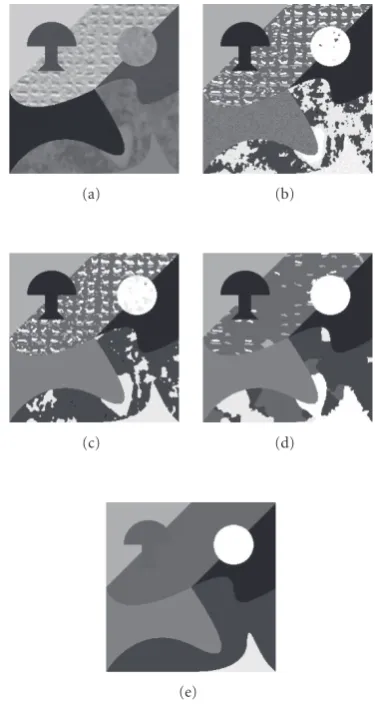
Case of an uniform image.Figure 5presents an original image with only uniform regions and its four segmentation results. In this case, VIN chooses the ground truth as being the best followed by the EDISON result. As shown inTable 2, only ZEB is able to sort these segmentation results like VIN.
Case of a mixed image.Figure 6presents an original im-age with uniform and textured regions from BC50U and its four segmentation results. According toTable 3, LEV 2 and ROS 2 sort correctly the segmentation results except for one comparison.
Table2: Values of the evaluation criteria computed on the segmentation results ofFigure 5.
Segmentation result ZEB BOR LEV 1 LEV 2 ROS 1 ROS 2 VIN
FKM 0.6955 0.9995 0.0756 0.9835 0.5733 0.6551 0.7548
FKM + relaxation 0.7442 0.9996 0.0974 0.9904 0.5671 0.6328 0.9358
EDISON 0.8477 0.9997 0.5219 0.9833 0.5675 0.6628 0.9999
Ground truth 0.8478 0.9997 0.9833 0.5200 0.5675 0.6629 1.0000
(a) (b)
(c) (d)
(e)
Figure5: One uniform image and its four segmentation results: (a) original image, (b) FKM, (c) FKM + relaxation, (d) EDISON, (e) ground truth.
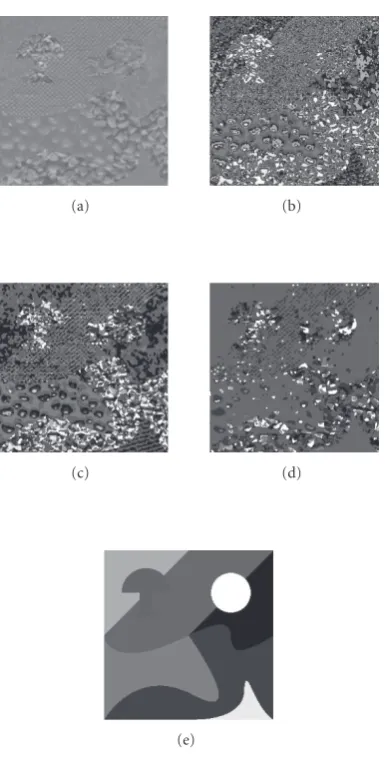
Case of a textured image for regions with the same mean gray level.Figure 8presents an original image with only tex-tured regions with the same mean gray-level from BC0UN and its four segmentation results. According toTable 5, only ROS 2 sorts correctly the segmentation results. We can notice that LEV 2 gives bad results in this case.
As a conclusion of this comparative study, ZEB has to be preferred for uniform images while LEV 2 and ROS 2 are more adapted for mixed and textured ones.
(a) (b)
(c) (d)
(e)
Figure6: One image composed of uniform and textured regions and its four segmentation results: (a) original image, (b) FKM, (c) FKM + relaxation, (d) EDISON, (e) ground truth.
4. APPLICATION TO REAL IMAGES
Table3: Values of the evaluation criteria computed on the segmentation results ofFigure 6.
Segmentation result ZEB BOR LEV 1 LEV 2 ROS 1 ROS 2 VIN
FKM 0.6055 0.9996 0.9786 0.0388 0.5479 0.7069 0.6473
FKM + relaxation 0.4989 0.9994 0.9907 0.0368 0.5477 0.8005 0.6279
EDISON 0.6535 0.9990 0.9697 0.2747 0.5470 0.7529 0.9300
Ground truth 0.6530 0.9991 0.9718 0.3322 0.5475 0.8138 1.0000
(a) (b)
(c) (d)
(e)
Figure7: One image composed of textured regions and its four segmentation results: (a) original image, (b) FKM, (c) FKM + relaxation, (d) EDISON, (e) ground truth.
Table4: Values of the evaluation criteria computed on the segmentation results ofFigure 7.
Segmentation result ZEB BOR LEV 1 LEV 2 ROS 1 ROS 2 VIN
FKM 0.7145 0.9993 0.9806 0.0832 0.5465 0.5714 0.3687
FKM + relaxation 0.5528 0.9987 0.9865 0.1232 0.5446 0.7621 0.3981
EDISON 0.4076 0.9952 0.9510 0.1305 0.5324 0.8359 0.5549
(a) (b)
(c) (d)
(e)
Figure8: One image composed of textured regions with the same mean gray value and its four segmentation results: (a) original image, (b) FKM, (c) FKM + relaxation, (d) EDISON, (e) ground truth.
Table5: Values of the evaluation criteria computed on the segmentation results ofFigure 8.
Segmentation result ZEB BOR LEV 1 LEV 2 ROS 1 ROS 2 VIN
FKM 0.7939 0.9998 0.9947 0.0379 0.5241 0.6696 0.2210
FKM + relaxation 0.5419 0.9994 0.9907 0.0449 0.5241 0.7003 0.2482
EDISON 0.5698 0.9990 0.9831 0.1167 0.5365 0.7733 0.2511
Ground truth 0.1979 0.9956 0.9692 0.0026 0.4956 0.7942 1.0000
of the criteria describe the EDISON segmentation result as being the best (Table 6). In our mind, this is also the case visually.
The second image corresponds to a strongly noisy radar image (seeFigure 11). The regions can thus be regarded as being all textured. Visually, the best segmentation result of this image is, from our point of view, the EDISON one.
Table 7presents it as being the best in almost all cases. ROS 2 gives to this segmentation result a much better quality score
compared to the FCM and PCM ones. On the contrary, ZEB ranks very badly the EDISON segmentation result. More-over, ZEB still keeps very weak values ( 0.1 whereas for the segmentation results of the other images, the results ex-ceeded 0.7 for the best). It confirms that ZEB is not adapted to strongly textured images.
(a) (b)
Figure9: Two real images: (a) radar image, (b) aerial image.
(a) (b)
(c) (d)
Figure10: Three segmentation results of the aerial image: (a) original image, (b) FCM, (c) PCM, (d) EDISON.
5. CONCLUSION
Segmentation evaluation is essential to quantify the perfor-mance of the existing segmentation methods. In this paper, the majority of the existing unsupervised criteria for the evaluation and the comparison of segmentation methods are referred and presented. The present study tries to show the strong points, the weak points, and the limitations of some of these criteria.
For the comparative study, we used a large database com-posed of 8400 synthetic images containing from 2 to 15 re-gions. We thus have 33 600 segmentation results and con-sequently 50 400 comparisons of segmentation results. We could note that three criteria give better results than the others: ZEB, LEV 2, and ROS 2. ZEB is adapted for uniform
Table6: Values of the evaluation criteria computed on the segmen-tation results ofFigure 10.
Criterion FCM PCM EDISON
BOR 0.9888 0.9713 0.9945
ZEB 0.6228 0.6124 0.5428
LEV 1 0.7258 0.7112 0.9693
LEV 2 0.0901 0.0889 0.1099
ROS 1 0.5202 0.5239 0.5275
ROS 2 0.6379 0.6328 0.6973
(a) (b)
(c) (d)
Figure11: Three segmentation results of the radar image: (a) orig-inal image, (b) FCM, (c) PCM, (d) EDISON.
Table7: Values of the evaluation criteria computed on the segmen-tation results ofFigure 11.
FCM PCM EDISON
BOR 0.9148 0.8207 0.9707
ZEB 0.1094 0.1172 0.0432
LEV 1 6.2846 7.5824 1.1364
LEV 2 0.1401 0.1394 0.2559
ROS 1 0.5196 0.5214 0.5419
ROS 2 0.4699 0.4677 0.9074
We illustrated the importance of these evaluation crite-ria for the evaluation of segmentation results of real images without any a priori knowledge. The selected criteria were able, in our examples, to choose the segmentation result that was visually perceived as being the best.
A prospect for this work is to combine the best criteria in order to optimize their use in the various contexts. Perspec-tives of this study concern the application of these evaluation criteria for the choice of the segmentation method parame-ters or the definition of new segmentation methods by opti-mizing an evaluation criterion.
ACKNOWLEDGMENTS
The authors would like to thank the Conseil R´egional du Centre and the European Union (FSE) for their financial sup-port.
REFERENCES
[1] J. Freixenet, X. Mu˜noz, D. Raba, J. Marti, and X. Cufi, “Yet another survey on image segmentation: region and boundary information integration,” inProceedings of the European Con-ference on Computer Vision (ECCV ’02), pp. 408–422, Copen-hagen, Denmark, May 2002.
[2] R. M. Haralick and L. G. Shapiro, “Image segmentation techniques,”Computer Vision, Graphics, & Image Processing, vol. 29, no. 1, pp. 100–132, 1985.
[3] Y. J. Zhang, “A survey on evaluation methods for image seg-mentation,”Pattern Recognition, vol. 29, no. 8, pp. 1335–1346, 1996.
[4] N. M. Nasab, M. Analoui, and E. J. Delp, “Robust and efficient image segmentation approaches using Markov random field models,”Journal of Electronic Imaging, vol. 12, no. 1, pp. 50– 58, 2003.
[5] A. J. Baddeley, “An error metric for binary images,” inRobust Computer Vision, pp. 59–78, Wichmann, Karlsruhe, Germany, 1992.
[6] L. Vinet,Segmentation et mise en correspondance de r´egions de paires d’images st´er´eoscopiques, Ph.D. thesis, Universit´e de Paris IX Dauphine, Paris, France, 1991.
[7] D. P. Huttenlocher and W. J. Rucklidge, “Multi-resolution technique for comparing images using the Hausdorff dis-tance,” in Proceedings of IEEE Computer Vision and Pattern Recognition (CVPR ’93), pp. 705–706, New York, NY, USA, June 1993.
[8] D. Martin, C. Fowlkes, D. Tal, and J. Malik, “A database of hu-man segmented natural images and its application to evaluat-ing segmentation algorithms and measurevaluat-ing ecological statis-tics,” inProceedings of the IEEE International Conference on Computer Vision (ICCV ’01), vol. 2, pp. 416–423, Vancouver, BC, Canada, July 2001.
[9] J. S. Weszka and A. Rosenfeld, “Threshold evaluation tech-niques,”IEEE Transactions on Systems, Man and Cybernetics, vol. 8, no. 8, pp. 622–629, 1978.
[10] M. D. Levine and A. M. Nazif, “Dynamic measurement of computer generated image segmentations,”IEEE Transactions on Pattern Analysis and Machine Intelligence, vol. 7, no. 2, pp. 155–164, 1985.
[11] M. Sezgin and B. Sankur, “Survey over image thresholding techniques and quantitative performance evaluation,”Journal of Electronic Imaging, vol. 13, no. 1, pp. 146–168, 2004. [12] W. G. Cochran, “Some methods for strengthening the
com-monχ2tests,”Biometrics, vol. 10, pp. 417–451, 1954.
[13] N. R. Pal and S. K. Pal, “Entropic thresholding,”Signal Process-ing, vol. 16, no. 2, pp. 97–108, 1989.
[14] C. Rosenberger, Mise en oeuvre d’un syst`eme adaptatif de segmentation d’images, Ph.D. thesis, Universit´e de Rennes 1, Rennes, France, 1999.
[15] M. Borsotti, P. Campadelli, and R. Schettini, “Quantita-tive evaluation of color image segmentation results,”Pattern Recognition Letters, vol. 19, no. 8, pp. 741–747, 1998. [16] J. Liu and Y.-H. Yang, “Multiresolution color image
segmen-tation,”IEEE Transactions on Pattern Analysis and Machine In-telligence, vol. 16, no. 7, pp. 689–700, 1994.
[17] R. Zeboudj,Filtrage, seuillage automatique, contraste et con-tours: du pr´e-traitement `a l’analyse d’image, Ph.D. thesis, Uni-versit´e de Saint Etienne, Saint Etienne, France, 1988. [18] S. Chabrier, C. Rosenberger, H. Laurent, B. Emile, and P.
image,” inProceedings of 12th European Signal Processing Con-ference (EUSIPCO ’04), pp. 953–956, Vienna, Austria, Septem-ber 2004.
[19] S. Chabrier, B. Emile, H. Laurent, C. Rosenberger, and P. March´e, “Unsupervised evaluation of image segmentation ap-plication to multi-spectral images,” inProceedings of Interna-tional Conference on Pattern Recognition (ICPR ’04), vol. 1, pp. 576–579, Cambridge, UK, August 2004.
[20] R. Krishnapuram and J. M. Keller, “Possibilisticc-means algo-rithm: insights and recommendations,”IEEE Transactions on Fuzzy Systems, vol. 4, no. 3, pp. 385–393, 1996.
[21] D. Comaniciu and P. Meer, “Mean shift: a robust approach toward feature space analysis,”IEEE Transactions on Pattern Analysis and Machine Intelligence, vol. 24, no. 5, pp. 603–619, 2002.
[22] H. A. Monawer, “Image vector quantization using a modified LBG algorithm with approximated centroids,”Electronics Let-ters, vol. 31, no. 3, pp. 174–175, 1995.
[23] C¸. E. Erdem, B. Sankur, and A. M. Tekalp, “Performance mea-sures for video object segmentation and tracking,”IEEE Trans-actions on Image Processing, vol. 13, no. 7, pp. 937–951, 2004. [24] A. M. Nazif and M. D. Levine, “Low level image segmentation:
an expert system,”IEEE Transactions on Pattern Analysis and Machine Intelligence, vol. 6, no. 5, pp. 555–577, 1984. [25] R. Krishnapuram and J. M. Keller, “Possibilistic approach to
clustering,”IEEE Transactions on Fuzzy Systems, vol. 1, no. 2, pp. 98–110, 1993.
Sebastien Chabrieris an Assistant Profes-sor at ENSI of Bourges (France). He ob-tained his Ph.D. degree from the University of Orleans in 2005. He works at the Labo-ratory of Vision and Robotics, Bourges, in the Signal, Image, and Vision Research Unit. His research interests include segmentation evaluation.
Bruno Emileis an Assistant Professor at IUT of Chateauroux (France). He obtained his Ph.D. degree from the University of Nice in 1996. He works at the Laboratory of Vi-sion and Robotics, Bourges, in the Signal, Image, and Vision Research Unit. His re-search interests include segmentation eval-uation and object detection.
Christophe Rosenberger is an Assistant Professor at ENSI of Bourges (France). He obtained his Ph.D. degree from the Uni-versity of Rennes I in 1999. He works at the Laboratory of Vision and Robotics, Bourges, in the Signal, Image, and Vision Research Unit. His research interests in-clude evaluation of image processing and quality control by artificial vision.