Volume 2008, Article ID 241069,14pages doi:10.1155/2008/241069
Research Article
A Markov Model for Dynamic Behavior of ToA-Based
Ranging in Indoor Localization
Mohammad Heidari and Kaveh Pahlavan
Center for Wireless Information Network Studies, Electrical and Computer Engineering, Worcester Polytechnic Institute, 100 Institute Road, Worcester, MA 01609, USA
Correspondence should be addressed to Mohammad Heidari,[email protected]
Received 28 February 2007; Revised 27 July 2007; Accepted 26 October 2007
Recommended by Sinan Gezici
The existence of undetected direct path (UDP) conditions causes occurrence of unexpected large random ranging errors which pose a serious challenge to precise indoor localization using time of arrival (ToA). Therefore, analysis of the behavior of the ranging error is essential for the design of precise ToA-based indoor localization systems. In this paper, we propose a novel analytical framework for the analysis of the dynamic spatial variations of ranging error observed by a mobile user based on an application of Markov chain. The model relegates the behavior of ranging error into four main categories associated with four states of the Markov process. The parameters of distributions of ranging error in each Markov state are extracted from empirical data collected from a measurement calibrated ray tracing (RT) algorithm simulating a typical office environment. The analytical derivation of parameters of the Markov model employs the existing path loss models for the first detected path and total multipath received power in the same office environment. Results of simulated errors from the Markov model and actual errors from empirical data show close agreement.
Copyright © 2008 M. Heidari and K. Pahlavan. This is an open access article distributed under the Creative Commons Attribution License, which permits unrestricted use, distribution, and reproduction in any medium, provided the original work is properly cited.
1. INTRODUCTION
Recently, indoor localization technology has attracted sig-nificant attention, and a number of commercial and mili-tary applications are emerging in this field [1]. Indoor chan-nel environments suffer from severe multipath phenomena, creating a need for novel approaches in design and devel-opment of systems operating in these environments [2,3]. Precise indoor localization systems are designed based on range measurements from time of arrival (ToA) of the di-rect path (DP) between transmitter and receiver, which is severely challenged by unexpected large errors [4]. Therefore, the ranging error modeling is essential in design of precise ToA-based indoor localization systems.
There are empirical indoor radio propagation chan-nel models available in the literature aiming primarily at telecommunication applications [5–8]. These models were designed prior to the understanding of the indoor localiza-tion problem, and hence they did not concern the behavior of ranging error in indoor environment. Therefore, they do
not provide a close approximation to the empirical observa-tions of the ranging error [9]. More recently, indoor radio propagation channel models designed for ultrawide band-width (UWB) communications, specifically the work of IEEE 802.15.3 and IEEE 802.15.4a, have paid indirect attention to the indoor localization problem [10–15], and recent research studies propose UWB measurement system to obtain high-accuracy localization systems [16,17]. However, these indi-rect models have not paid special attention to the occurrence of undetected direct path (UDP) conditions, which is the main cause of large errors in ranging estimate. The first direct empirical model for ranging error is reported in [9,18,19]. These new direct models, however, do not address the spa-tial correlation of the ranging error behavior observed by a mobile user.
telecommunication field. In [20], it is proposed to exploit HMM in radar target detection. In [21], HMM is employed along with Bayesian algorithms to provide a reliable estimate of the location of the mobile terminal and to trace it. Fur-thermore, in [22], HMM is used along with tracking algo-rithms to provide a footmark of the nonline-of-sight condi-tions, present a reliable estimate of the location of the mobile terminal, and track it.
We categorize the ranging error into four different classes and present clarifications as to the statistical occurrence of each class of ranging errors. Furthermore, we provide dis-tributions to model typical values of ranging error observed in each class of receiver locations. Next, we link each class of ranging errors to a state of a Markov process which can be used for the simulation of spatial behavior of the class of ranging errors for a mobile user randomly traveling in a building. Finally, we provide a method to statistically ex-tract the average probabilities of residing in a certain state for the building under study. The presented model for dy-namic behavior of ranging error is essential for the design and performance evaluation of tracking capabilities of the proposed algorithms for indoor localization. The parameters of the Markov model are analytically derived from the results of the UWB measurement conducted on the third floor of the Atwater Kent laboratories (AK Labs) at Worcester Poly-technic Institute (WPI). The parameters of distributions of ranging error in each Markov state are extracted from empir-ical data collected from a measurement calibrated ray trac-ing (RT) algorithm simulattrac-ing the same office environment. The commonly used RT software, previously used in litera-ture for communication purposes [23,24], provides the ra-dio propagation of the indoor environment in which reflec-tion and transmission are the dominant mechanisms. It has been shown that the existing RT software can be a useful and practical simulation tool to assess the behavior of ranging er-ror in indoor environments [9].
The paper is organized as follows.Section 2summarizes the background of ranging error modeling and classification of ranging error, while Section 3 introduces a new frame-work for the classification of ranging error observed in in-door environment and presents the concept of state probabil-ity.Section 4discusses the principles of Markov model, ana-lytical derivation of the parameters of the Markov chain, and modeling of the state probabilities. Finally,Section 5 summa-rizes the results and comments on the outcome of the simu-lation.
2. FOUR CLASSES OF RANGING ERRORS
2.1. Background
In general, it has been observed that wireless channel con-sists of paths arriving in clusters. The most popular method to reflect this behavior on the channel response is based on Saleh-Valenzuela model [5], in which the discrete multipath indoor channel impulse response (CIR) can be characterized as
h(t)=X
L
l=1 K
k=1
αk,lejφk,lδ
t−Tl−τk,l
, (1)
where {Tl} represents the delay of the lth cluster, {αk,l},
{φk,l}, and {τk,l} represent tap weight, phase, and delay of
thekth multipath component relative to thelth cluster ar-rival time (Tl), respectively, andXrepresents the log-normal shadowing [10,12]. The tap weights,{αk,l}, are determined
based on practical path loss exponents and signal loss of different building materials for reflection and transmission mechanisms in indoor environment [25]. The CIR then con-sists of {αk,l} which are within the dynamic range of the
system. In this article, we use (1), previously used in IEEE 802.15.3a, to model the behavior of channel since it high-lights the importance of cluster-based arrival of paths. How-ever, a more sophisticated cluster-based model can be used to fully model the behavior of the wireless channel. The inter-ested reader can refer to [11,15] for more detailed modeling and description of UWB channels.
The CIR is usually referred to asinfinite-bandwidth chan-nel profilesince with infinite bandwidth the receiver could theoretically acquire every detectable path. Let αDP = α1,1 and τDP = τ1,1 represent the amplitude and ToA of the DP component, respectively. In ToA-based positioning sys-tems, the distance between the antenna pair is obtained using
d=τDP×c, wherecrepresents the speed of light. The range estimate is determined usingd=τFDP×c, whereτFDP repre-sents the ToA of the first detected path (FDP) of the channel profile within the dynamic range of the system. The distance measurement or ranging error in such systems is then de-fined asε=d−d[9,18].
In practice, however, the limited bandwidth of the lo-calization system results in arriving paths with pulse shapes, which is referred to as channel profile and can be represented by
h(t)=X
L
l=1 K
k=1
αk,ls
t−Tl−τk,l
, (2)
wheresrepresents the time-domain pulse shape of the filter. In practice, Hanning and raised-cosine filters are widely used in today localization domain. As a result of filtering the CIR, sidelobes of each pulse shape respective to each path can be constructively or destructively combined to each other and form different peaks which consequently limit the accuracy of the ranging process.
ranging error modeling of LoS/DDP, NUDP, and SUDP and on modeling the dynamic behavior of ranging error observed by mobile client in indoor environment.
2.2. Ranging error classification based on power
The receiver location classification is mainly accomplished by means of power. In such classifications, the class of ranging errors associated with each receiver location can be defined according to the power of the DP component and the total received power given by
PDP=20 log10αDP,
Ptot=10 log10
L
l=1 K
k=1
αk,l2
(3)
as well as blocking conditionλi, which is a binary index to indicate the blockage of DP and its adjacent components by an obstructive object. In this paper, it is assumed that for the specified locations of the transmitter and receiver, the true value ofλiis known, whereλi=0 represents a channel pro-file which is not blocked andλi = 1 represents a channel profile which is blocked by an obstructive object.
In DDP class of receiver locations, which is indeed a sub-class of LoS,λi=0,PDP> η, andPtot> η, in whichη repre-sents the detection threshold and it is dependent on the mea-surement noise of the system. Fixing the transmitter power at a regulated level,ηcan be related to the dynamic range of the system. However, increasing the dynamic range of the system, that is, decreasingη, raises the likelihood of the DP component to be detected at the receiver side, but it also in-creases the probability of detecting a noise term (or a side-lobe peak) as the DP component, that is, a false alarm [28]. Efficient selection of the proper value ofηcan improve the accuracy of the localization system [29]. Typical values of
ηare 5∼10 dB above the measurement noise present in in-door environment. In DDP conditions, τFDP ≈ τDP = τ1,1 andε=(τFDP−τ1,1)×cresult in insignificant ranging error associated with the ToA measurement given by
fεDDP(ε)= f
M(ε), (4)
where fMrepresents the multipath-induced errors which are considered as the main source of ranging errors in LoS/DDP class.
In NUDP class of receiver locations,λi=0 andPtot> η,
but PDP < η, resulting inτFDP = τ1,k,k=1, which indicates
that the DP component is not within the dynamic range of the system, and hence it cannot be detected, but a neigh-boring path from the first cluster was detected as the FDP. Consequently,ε=(τFDP−τ1,1)×cis in the order of ray ar-rival rate defined in the CIR system model presented in (2). It has been shown that NUDP ranging errors are small and occur in small bursts [4]. The gradual weakening of the DP component due to loss of power from reflection and trans-mission mechanisms suggests that by moving further from the transmitter at a certain break-point distance, the power of the DP component,PDP, falls below the detection thresh-old, that is, not within the dynamic range of the system, and
consequently the receiver exits DDP condition and enters NUDP condition. Similar to DDP class of receiver locations, in NUDP regions, the error is given by
fεNUDP(ε)= f
M+NUDP(ε), (5)
where fM+NUDP indicates that the multipath and loss of DP component are the main sources of ranging errors.
Contrary to the above states, in SUDP class of receiver locations, the attenuation of the multipath components re-sults in very weak paths regarding the first cluster, that is, channel profiles with soft onset CIR [11, 30], which shift the strongest component to the middle of the CIR. Conse-quently, for SUDP class of receiver locations,PDP < η and
Ptot > η, butλi = 1 denoting that the receiver location is
blocked by a metallic object. In such scenarios,τFDP=τi,j,i=1, indicating the blockage of the first cluster and the fact that the second cluster is detected instead, resulting in FDP com-ponent being either the first or one of the following paths of the second cluster. Consequently, ε = (τFDP−τ1,1)×c is in the order of cluster arrival rate defined in the CIR sys-tem model. Results of extensive UWB measurement and sim-ulation in indoor environments confirm the occurrence of unexpected large ranging errors associated with SUDP con-dition observed in indoor environment [3, 9,18, 19]. For SUDP regions,
fεSUDP(ε)= f
M+NUDP+SUDP(ε), (6)
where fM+NUDP+SUDP indicates that multipath, loss of DP component, and blockage are the main sources of ranging errors.
Finally, for the last class of receiver locations, which is re-ferred to as NC conditions,Ptot < ηin which communica-tion is not feasible and the receiver is out of range. Assuming that the mobile terminal resides in one of the UDP areas, by moving further from the transmitter at a certain break-point distance, the receiver transitions from UDP condition to NC condition. In NC condition, the range estimate is not avail-able and ranging error is undefined.
0 10 20 30 40 50 60 X(m)
0 5 10 15 20
Y
(m)
Area=219.5124
NC
NUDP DDP
Tx
SUDP
Figure1: Indoor receiver classification simulation for a sample lo-cation of the transmitter. The lolo-cation of the metallic chamber close to the transmitter causes lots of SUDP receiver locations.
3. RANGING ERROR CLASSIFICATION BASED ON DISTANCE
3.1. Infrastructure-distance-measurement- (IDM-)
based model
The receiver location classification described above is very difficult to obtain as it is computationally tedious and time-consuming. Alternatively, to avoid the extensive simulation and/or measurement to categorize the receiver locations in a building, we have developed an infrastructure-distance-measurement-(IDM-) based model based on the realistic path loss models for indoor environment [9] to represent dif-ferent classes of receiver locations and ranging errors associ-ated with them. Assuming the knowledge of blockage con-dition,λi(r), for each receiver location, the proposed model can be represented as follows:
ξi=
⎧ ⎪ ⎪ ⎪ ⎪ ⎪ ⎪ ⎪ ⎪ ⎪ ⎪ ⎨ ⎪ ⎪ ⎪ ⎪ ⎪ ⎪ ⎪ ⎪ ⎪ ⎪ ⎩
DDP : d < d1∩λi(r)=0,
NUDP: d1< d < d2∩λi(r)=0,
SUDP: d < d3∩λi(r)=1,
NC:
⎧ ⎨ ⎩
d > d2∩λi(r)=0,
d > d3∩λi(r)=1,
(7)
where ξi represents the class of receiver locations and d1, d2, andd3 represent the distance break-point of DDP and NUDP regions, the distance break-point of NUDP and NC regions, and the distance break-point of SUDP and NC re-gions, respectively. The sample break-points are determined by extensive frequency measurements (sweeping frequency of 3–8 GHz with a sampling frequency of 1 MHz) conducted in the sample indoor environment [31] to be around 18 m, 35 m, and 30 m, respectively. The measurement setup has a sensitivity of−80 dBm representing the detection threshold [9,32]. Altering the sensitivity of the measurement system, that is, the detection threshold and dynamic range of the
0 10 20 30 40 50 60
X(m) 0
5 10 15 20 25
Y
(m)
NC
NUDP
DDP Tx
SUDP
DDP
NUDP
NC
SUDP
Figure2: Indoor receiver classification for the same location of the transmitter based on infrastructure-distance-measurement (IDM) model.
system, as well as other parameters of the measurement will cause modifications in determination of the break-point dis-tances [28]. However, such modifications are not in the scope of this article, and the reported break-point distances are de-termined using the above measurement setup.
To verify the validity of the proposed model, that is, IDM realization, we can compare it with RT simulation. Very close agreement between RT simulation and IDM realization of different categories is illustrated inFigure 2, which demon-strates the validity of the proposed IDM realization. The above model, however, represents the static classification of the receiver locations in indoor environments.
3.2. Introduction to state probabilities
Having defined the four classes of receiver locations and ranging errors, we can define the state probability of each state which is the average staying time of the mobile client in that state. Modeling the state probabilities enables us to pre-dict the class of ranging errors that a mobile user observes traveling in indoor environment. It also helps in Markov chain initialization as it models the average probability of re-siding in a certain state. For each class of receiver locations, the state probability is defined as
Pz=Pξi∈z=
ξi∈z
dx d y
ξi∈M
dx d y
, (8)
in whichMrepresents the union set of receiver locations and
of simulation. Using (7) to categorize the receiver locations into DDP, NUDP, SUDP, and NC for the same indoor envi-ronment described inFigure 2, we were able to compare the average SUDP state probability of the IDM realization and wideband measurement previously conducted in the same scenario. We observed that on average a random mobile client would expect to be in SUDP condition with probability of 8.9% according to IDM realization which is close to the re-ported value of 7.4% obtained from wideband measurement [9,26].
Each state probability can be considered as a random variable. Knowing the statistics of the state probability for a certain state, we are able to define the cumulative distribu-tion funcdistribu-tion (CDF) of the state probability. It follows that
FPSUDP
p1
=P{PSUDP< p1}, (9)
which discloses the receiver locations in which its state prob-ability is less than a certain valuep1. Finally, the probability distribution function (PDF) can be defined as fPSUDP(p1) = ∂FPSUDP(p1)/∂p1. It is worth mentioning that fPSUDP can be considered as a random variable modeling the distribution of SUDP state probability, which itself is limited to the interval [0, 1). Therefore, the outcome of such distribution should be truncated to remain in [0, 1) so as to ensure that state proba-bilities are within their limits.
4. DYNAMIC BEHAVIOR OF RANGING ERROR
A random mobile client in an indoor environment experi-ences switching among different classes of ranging errors, back and forth, as it keeps moving. Such spatial correla-tion and change of class can easily be modeled with Markov chains.
4.1. Ranging states of the Markov model
As the mobile client randomly travels in the building, as shown inFigure 1, depending on the region of movement, it experiences different classes of ranging errors. Using the four classes of ranging errors observed in separate areas of an in-door environment, we can construct a four-state first-degree Markov model to represent the dynamic behavior of ranging error observed by the mobile user. Random movement of the mobile user results in change of its observed class of rang-ing errors, with particular probabilities. The general Markov model representation for indoor positioning is described in
Figure 3. Let the current receiver location,ξiin (7), embed the state of the mobile terminalωi, whereωiis defined over a discrete setZconsisting of four different receiver location classes or states,Z= {DDP, NUDP, SUDP, NC}. The state of the mobile client movement within a 2D space in an indoor environment can be modeled with a Markov chainΩ0:i =
{ω0,. . .,ωi}which can be generated byωi∼MC(π(ω),P(ω))
with initial state PDFπ(ω) = p{ω
0}. The initial state PDF, π(ω), can then be related to the state probabilities and the av-erage transition probabilitiesP(ω)=p(i,ωj).
Following the methodology described in [27,33], transi-tion probabilities are defined as the rate of switching between
Markov states or staying in the same state, accordingly, and they can be represented as
P(ω)=
⎡ ⎢ ⎢ ⎢ ⎢ ⎢ ⎢ ⎣
p(11ω) p(12ω) p(13ω) p(14ω)
p(21ω) p(22ω) p(23ω) p(24ω)
p(31ω) p(32ω) p(33ω) p(34ω)
p(41ω) p(42ω) p(43ω) p(44ω)
⎤ ⎥ ⎥ ⎥ ⎥ ⎥ ⎥ ⎦
, (10)
where p(i,ωj) is defined as the average transition probability from the stateito the statej, as illustrated inFigure 3. These average transition probabilities can then be obtained using the following equation:
p(i,ωj)=p
ωk=j|ωk−1=i
. (11)
FromFigure 3, it can be concluded that transition from DDP state to NC state is only possible through one of the UDP states; so the resulting transition probabilities are set to zero, accordingly.
4.2. Average transition probabilities
Intuitively, the transition probability, that is, crossing rate be-tween two states, is a function of the area of the states and the length of the boundary between the two states. Previous studies were mainly based on the statistics of such transi-tions. However, in this section, we present the details of ob-taining the transition probabilities by discretizing the contin-uous problem, that is, forming a grid of receiver locations in the regions. Assuming that at timet=tkthe mobile client is located at one of the grid points, then att=tk+1the mobile client travels to one of the adjacent grid points. LetΔ repre-sent grid size and letT = tk+1 −tk represent the sampling time. ThusΔ=v×T, wherevrepresents the velocity of the mobile client. Furthermore, letαcrepresent the crossing rate of the system which depends on the spatial pattern of move-ments. In our discrete model for indoor movements, assum-ing the walls are either horizontal or vertical, a mobile can only move in four directions. Assuming absolute random-ness in the movement of the mobile client results in crossing rate probability ofαc =1/4 and staying in the same region with probability of 1−αc, asFigure 4suggests. The average probability of crossing can then be obtained as
p12=
αc×(l/Δ) + 0×S1/Δ2−l/Δ
S1/Δ2
, (12)
wherel represents the boundary length of the two regions andS1represents the area of the first region. Simplifying (12) results in
p12=αc×l×Δ
S1 =αc×
l×vT
S1 .
(13)
p44
Stay in NC p22
Stay in NUDP
p24
p12 p21
p23 p34
p42
p43 SUDP εSUDP=GEV (kSUDP,μSUDP,
σSUDP)
NC NUDP
εNUDP=
N(μNUDP, σNUDP)
DDP εDDP=
N(0,σDDP)
p11 p31
p13
p32
Stay in DDP Stay in SUDP
p33
Figure3: Markov model presented for dynamic behavior of the ranging error in indoor localization.
four states, we can obtain the transition probability matrix as
P=
⎡ ⎢ ⎢ ⎢ ⎢ ⎢ ⎢ ⎢ ⎢ ⎢ ⎢ ⎢ ⎢ ⎣
Q1 αcl12×vT
S1 αc
l13×vT
S1 αc
l14×vT
S1
αcl21×vT
S2 Q2 αc
l23×vT
S2 αc
l24×vT
S2
αcl31×vT
S3 αc
l32×vT
S3 Q3 αc
l34×vT
S3
αcl41×vT
S4 αc
l42×vT
S4 αc
l43×vT
S4 Q4
⎤ ⎥ ⎥ ⎥ ⎥ ⎥ ⎥ ⎥ ⎥ ⎥ ⎥ ⎥ ⎥ ⎦
,
(14)
whereQ1denotes 1−αc((l12+l13+l14)×vT/S1),Q2denotes 1−αc((l21+l23+l24)×vT/S2),Q3denotes 1−αc((l31+l32+l34)× vT/S3),Q4denotes 1−αc((l41+l42+l43)×vT/S4), andli j=lji represents the boundary length betweenith and jth regions andSk represents the area of thekth region. Combiningαc
andvTparameters, we can obtain
P=
⎡ ⎢ ⎢ ⎢ ⎢ ⎢ ⎢ ⎢ ⎢ ⎢ ⎢ ⎢ ⎢ ⎣
W1 βl12
S1 β
l13
S1 β
l14
S1
βl12
S2 W2 β
l23
S2 β
l24
S2
βl13
S3 β
l23
S3 W3 β
l34
S3
βl14
S4 β
l24
S4 β
l34
S4 W4
⎤ ⎥ ⎥ ⎥ ⎥ ⎥ ⎥ ⎥ ⎥ ⎥ ⎥ ⎥ ⎥ ⎦
, (15)
whereW1denotes 1−β((l12+l13+l14)/S1),W2denotes 1− β((l12+l23+l24)/S2),W3denotes 1−β((l13+l23+l34)/S3),W4 denotes 1−β((l14+l24+l34)/S4), andβ=αc×vTrepresents both the velocity of the mobile client and the probability of
S2 Δ
S1 Δ
Crossing with probability ofαc
Figure4: Crossing rate of a random mobile client from one Markov state to another.
crossing among the regions as well as the sole parameter to be determined. In the case of indoor positioning, the DDP and NC regions are not connected directly, resulting inl14= l41=0, which confirms the absence of the link between DDP and NC states inFigure 3.
4.3. Exponential modeling of average staying time
As discussed in [33], the Markov property reveals the follow-ing in regard to the eigenvectors ofP:
ϕ1=1, ϕi
i=1
whereϕirepresents the eigenvalues ofPandυirepresents the eigenvectors associated with ϕi. For the presented Markov model,υi = [e1 e2 e3 e4] andei = 1, representing the normalized eigenvector. We concentrate on the steady state probabilities as the Markov chain settles into stationary be-havior after the process has been running for a long time. When this occurs, we have
Pυ1=υ1 (17)
which represents the eigenvector associated with ϕ1 = 1 and determines the expected average waiting time in each state. Next, assuming homogeneous transition probabilities in continuous time, that is,P[X(s+t) = j | X(s) = i] =
P[X(t) = j | X(0) = i] = pi j(Tn), we convert the dis-crete Markov chain in (15) to an equivalent continuous-time Markov chain to extract the staying continuous-time distributions of each state. The memoryless distribution of the staying time in a certain state can then only be described by an exponential random variable p[T > t] = e−γit [33]. Sim-ilar to the methodology described in [33], γis can be de-termined by solving the respective Chapman-Kolmogorov equation and equating γito −1/θii, withθ being the solu-tion of Chapman-Kolmogorov equasolu-tion. The solusolu-tion for the Chapman-Kolmogorov equation for the steady statePresults in
θ=
⎡ ⎢ ⎢ ⎢ ⎢ ⎢ ⎢ ⎢ ⎢ ⎢ ⎢ ⎢ ⎢ ⎣
R1 β×l12
S1 β×
l13
S1 β×
l14
S1
β×l12
S2 R2 β×
l23
S2 β×
l24
S2
β×l13
S3 β×
l23
S3 R3 β×
l34
S3
β×l14
S4 β×
l24
S4 β×
l34
S4 R4
⎤ ⎥ ⎥ ⎥ ⎥ ⎥ ⎥ ⎥ ⎥ ⎥ ⎥ ⎥ ⎥ ⎦
, (18)
whereR1denotes−β×(l12+l13+l14)/S1,R2denotes−β× (l12+l23+l24)/S2,R3 denotes−β×(l13+l23+l34)/S3, and R4denotes−β×(l14+l24+l34)/S4, which in the case of the presented Markov model leads to
γ1 γ2 γ3 γ4=B1 B2 B3 B4, (19)
whereB1denotesS1/β(l12+l13+l14),B2denotesS2/β(l12+l23+ l24),B3denotesS3/β(l13+l23+l34), andB4denotesS4/β(l14+
l24+l34).
Determining exponential parameters allows us to simu-late the average waiting time in each state and compare them with the results of the empirical data.
4.4. Multivariate distribution modeling of
the state probabilities
Intuitively, altering the location of the transmitter will change the state probabilities; for example, a transmitter location close to the obstructive metallic object will cause larger set of SUDP receiver locations. The histogram of the state probabilities can then be modeled by a multivariate dis-tribution, as the state probabilities are not clearly indepen-dent. In order to find the best distribution to model the state
probabilities, we altered the location of the transmitter in the floor plan of the building under study and investigated the histograms and probability plots of the state probabilities. As it is shown in the following section, a practical choice for the multivariate distribution is Gaussian distribution which leads us to form a joint Gaussian distribution to model the state probabilities of the main three states. The fourth state can then be found deterministically as the sum of the state probabilities should be equal to unity. Therefore, we can start with a multivariate normal distribution to represent the state probabilities:
fY(y)=(2π)−3/2|Σ|−1/2exp
−1 2(y−µ)
TΣ−1(y−µ)
,
(20)
where y = PDDP PNUDP PSUDP
represents the random vector containing the average state probability values,Σand
µare the parameters of the joint distribution, andT repre-sents the transpose of a vector. In order to extract the pa-rameters of this multivariate normal distribution, we used sample mean to approximate the mean as
µ=1
n n
k=1
Pzk, z∈ {DDP, NUDP, SUDP}, (21)
wherePzkrepresents thekth observed state probability of the state z, and nrepresents the total number of observations. The maximum likelihood estimator of the covariance matrix can then be defined as
Σ=
1
n−1
n
k=1
Pzk−µ
Pzk−µ
T
, (22)
whereµis the sample mean,Pzk =
PDDPk PNUDPk PSUDPk
represents thekth state probability observation, andn repre-sents the total number of observations.
Now with the aid of Cholesky decomposition, we pro-vide a method for reconstructing the state probabilities in a typical indoor scenario. In communication realm, Cholesky decomposition is used in synchronization and noise suppres-sion [34,35]. Similar to [36], in order to regenerate these state probabilities, one may pursue the following procedure. The first step is to decompose the covariance matrix using Cholesky decomposition method:
AAT=Σ, (23)
then we generate a vector of standard normal valuesZ, and use the following equation:
y=µ+AZ, (24)
where y = [PDDP PNUDP PSUDP] represents the generated values of state probabilities.
5. SIMULATION AND RESULTS
To completely model the dynamic behavior of ranging error observed in indoor environment, the transition probabilities of the Markov chain and statistics of ranging error for each Markov state are required. Thus, we started the process by categorizing the receiver locations according to (7). Once the class of each receiver location and consequently the Markov state associated with it were identified, different distributions for statistics of ranging error observed in each class are intro-duced and modeled. Consequently, by collecting the area of each state and the boundary length between each two states, the transition probabilities were acquired based on (15). Fi-nally, we modeled the dynamic behavior of the ranging error by running the Markov chain, and we compared the results of analytical derivation obtained fromSection 4to RT simu-lation of a dynamic scenario observed in the sample indoor environment. Furthermore, altering the location of the trans-mitter and gathering the observed values for state probabil-ities of each state enabled us to model the statistics of state probabilities and initialize the Markov chain.
For the purpose of the simulation, we considered the third floor of AK Labs at WPI as the floor plan of the build-ing under study which resembles typical indoor office envi-ronment; yet it is a really harsh environment due to the ex-istence of extensive blocks of metallic objects in the build-ing. We formed a grid of receiver locations in the floor plan, approximately 14000 receiver locations, and generated their respective CIRs for different locations of the transmitter. In order to simulate the real-time channel profile of the CIR, a finite bandwidth raised-cosine filter can be used to extract the channel profile. For the purpose of ToA-based localiza-tion, it is shown that a minimum bandwidth of 200 MHz is sufficient for effectively resolving the multipath components and combating the multipath-induced error [4]. However, we used a 5 GHz raised-cosine filter to obtain a more realistic channel profile captured by an UWB measurement system. Postprocessing peak detection algorithm is then used to es-timateτFDPand consequently form the error, as discussed in
Section 2.
5.1. Ranging error modeling for different
classes of receiver locations
Modeling the ranging error observed in different classes of receiver locations in indoor localization is the major chal-lenge in the analysis of an indoor positioning system. It is a common belief that occurring ranging errors associated with LoS state (and equivalently DDP state) can be simulated with Gaussian distribution [18]. However, in NLoS conditions, and equivalently in NUDP and SUDP states, different dis-tributions consisting of Gaussian [18], exponential [14,22], log-normal [37,38], and mixture of exponential and Gaus-sian [19,39] have been used for modeling the ranging error. Comprehensive UWB measurement and modeling of rang-ing errors in NLoS can be found in [40] which reports a heavy-tail distribution for ranging errors observed in UDP conditions. In this section, we provide precise distribution for modeling the ranging error associated with each state.
−0.05 −0.03 −0.01 0.01 0.03 0.05 Ranging error (m)
0 0.1 0.2 0.3 0.4 0.5 0.6 0.7 0.8 0.9 1
C
u
m
ulati
ve
pr
obabilit
y
CDF comparison of DDP ranging error and normal fit
DDP ranging error Normal fit
(a) DDP
0.06 0.08 0.1 0.12 0.14 0.16 0.18 Ranging error (m)
0 0.1 0.2 0.3 0.4 0.5 0.6 0.7 0.8 0.9 1
C
u
m
ulati
ve
pr
obabilit
y
CDF comparison of NUDP ranging error and normal fit
NUDP ranging error Normal fit
(b) NUDP
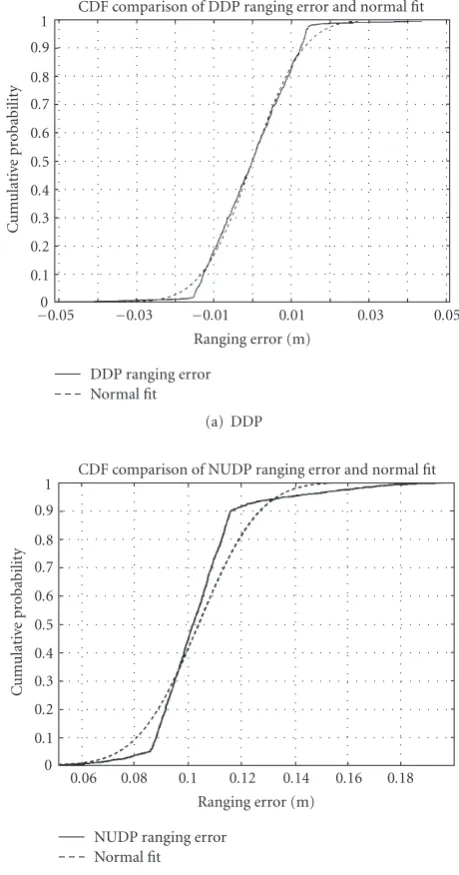
Figure5: Distribution modeling of the ranging error with normal distribution for (a) DDP class of receiver locations and (b) NUDP class of receiver locations.
For each class of receiver locations, we provide the histogram and, if necessary, the probability plot of the error for visual-ization of the goodness of fit.
Figure 5(a)compares the CDF of the observed ranging error for DDP class of receiver locations with its respective normal distribution fit. In DDP class of receiver locations,
λi=0, and using (4) leads us to
fεDDP(ε)= f
M(ε)=N(μ
DDP,σDDP). (25)
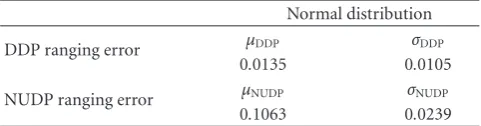
Table1: Parameters of normal distribution and ranging error of DDP and NUDP classes.
Normal distribution
DDP ranging error μDDP σDDP
0.0135 0.0105
NUDP ranging error μNUDP σNUDP
0.1063 0.0239
Table2: Passing rate ofK−Sand statistical value ofχ2hypothesis tests at 5% significance level, and ranging error for SUDP class.
Distribution SUDP
K−S χ2 Akaike weight
Normal 78.71% 50.84% 0
Weibull 85.02% 74.91% 8.6×10⁻¹⁰
GEV 96.86% 85.31% 1
Log-normal 87.82% 67.11% 6.4×10⁻¹⁷
tend to be more positive. Therefore, the distribution of rang-ing error can be represented as
fεNUDP(ε)= f
M+NUDP(ε)=N(μ
NUDP,σNUDP), (26)
whereμNUDP> μDDP.
Our explanation to such observation is the presence of propagation delay and the larger separation of the antenna pair, which allow multipath and loss of the DP to be more effective.Table 1provides the statistics of ranging errors ob-served in such classes of receiver locations.
In SUDP class of receiver locations, the ranging errors are following a heavy-tail distribution which cannot be modeled with a Gaussian distribution. It can be observed that in such scenarios, the infrastructure of the indoor environment com-monly obstructs the DP component and causes unexpected larger ranging errors. As a result, the statistical characteristics of the ranging error in SUDP class exhibit a heavy-tail nomenon in its distribution function. This heavy-tail phe-nomenon has been reported and modeled in the literature. As in [19,39], the observed ranging error was modeled as a combination of a Gaussian distribution and an exponential distribution, and the work in [37,38] modeled the ranging error with a log-normal distribution.
Traditionally, log-normal, Weibull, and generalized ex-treme value (GEV) distributions are used to model the phe-nomenon with heavy tail. The GEV class of distributions, with three degrees of freedom, is applied to model the ex-treme events in hydrology, climatology, and finance [41].
Table 2summarizes the results of theK−Stest andχ2test for SUDP class of different distributions. It can be observed that from the distributions offered to model the SUDP rang-ing error, normal distribution fails bothK−Sandχ2 hypoth-esis tests, while the rest of distributions pass the hypothhypoth-esis tests.
Figure 6(a)compares the PDF of the ranging error for SUDP state with its respective normal, Weibull, GEV, and log-normal fits. Figure 6(b)illustrates the probability plot and the closeness of the fits for SUDP class. FromTable 2,
Table 3: Parameters of GEV distribution and ranging error of SUDP class.
GEV distribution
SUDP ranging error μSUDP σSUDP kSUDP 2.5218 1.2844 0.4198
it can be also observed that GEV distribution passing rate is the highest amongst all distributions, which is expected as GEV models the heavy-tail phenomenon with three de-grees of freedom compared to two dede-grees of freedom of log-normal and Weibull distributions. Similar observations have been reported in [40] using UWB measurements con-ducted in different indoor environments. Quantitatively, for the selection of the best distribution, we refer to the Akaike information criterion [42], represented inTable 2, by form-ing the log-likelihood function of the candidate distribution and penalizing each distribution with its respective number of parameters to be estimated. Following the methodology described in [42], the Akaike weights can be used to deter-mine the best model which fits the empirical data. The higher values of Akaike weight represent more plausible distribu-tion, and the highest value can be associated with the best model. The result of such experiment also confirms the re-sult of probability plot and suggests that the best distribution to model the ranging error associated with SUDP class is in fact a GEV distribution, since all the other Akaike weights are practically zero.
The GEV distribution is defined as
f(x|k,μ,σ)
=
1
σ
exp
−
1+k(x−μ) σ
−1/k
1+k(x−μ) σ
−1−1/k
,
(27)
for 1 +k((x−μ)/σ)>0, whereμis defined as the location parameter,σ is defined as the scale parameter, andkis the shape parameter. The value ofkdefines the type of the GEV distribution;k =0 is associated with type I, also known as Gumbel, andk < 0 is associated with type II, which is also correspondent to Weibull. However, type III, associated with
k >0, which is known as Frechet type, best models the heavy
tail observed in ranging errors associated with SUDP class of receiver locations. Parameters of the GEV distribution, mod-eling the ranging error observed in SUDP class of receiver locations, are reported inTable 3. Evidentally, it can be noted that the presented GEV distribution for ranging errors ob-served in SUDP class of receiver locations belongs to the third category with its respectivek >0. Hence,
fεSUDP(ε)= f
M+NUDP+SUDP(ε)=GE Vμ
SUDP,σSUDP,kSUDP
, (28)
wherekSUDP>0.
2 4 6 8 10 12 14 16 18 20 Ranging error (m)
0 0.05 0.1 0.15 0.2 0.25 0.3 0.35 0.4
Denist
y
PDF comparison of SUDP ranging error
SUDP ranging error Normal fit Weibull fit
GEV fit Log-normal fit (a) Histogram
0 2 4 6 8 10 12 14 16 18 20
Ranging error (m) 0.0001
0.00005.001 0.0005.01 0.050.1 0.25 0.5 0.75 0.9 0.95 0.99 0.995 0.999 0.9995 0.9999
P
robabilit
y
Probability plot of the SUDP ranging error
SUDP ranging error Normal fit Weibull fit
GEV fit Log-normal fit (b) Probability plot
Figure6: Statistical analysis of ranging error observed in SUDP class of receiver locations. (a) Histogram of ranging error and (b) probability plot of ranging error versus different distributions. It can be concluded that GEV distribution best models the ranging error observed in such class of receiver locations.
for DDP and NUDP classes enable the user to use the chan-nel models reported in IEEEP802.15.3 [10,12,15] for rang-ing purposes, while larger rangrang-ing errors observed in SUDP region prevent such model from being used for ranging pur-poses.
5.2. Improvement over IEEE 802.15.3
recommended model
IEEE 802.15.3 is assumed, through (2), to be the basic dis-crete model of the wireless channel in indoor environment. From our observations, in DDP class, since the DP is eas-ily detected, ranging error is at its minimum. Although it is shown that DDP state multipath error exists [18], for UWB systems the multipath error is in the order of few centimeters, which is acceptable for cooperative localization and wireless sensor networks. In NUDP class, we hypothesize that the first cluster is detected. However, the power of DP is not within the dynamic range of the receiver, which results in detecting the second path (or any of the following paths after DP) as the FDP. Therefore, the error should be approximated with the ray arrival rate in the IEEE 802.15.3 model. It is reported that the ray arrival rate is in the order ofλ=2.1(1/nsec). By detecting the following paths with the specified arrival rate, an error of (1/λ×10−9×c=0.15) meters is expected, which is in agreement with the average error observed in the NUDP state and reported inTable 1.
However, in the SUDP class, which is characterized by extreme NLoS condition in IEEE 802.15.3, blockage of the first cluster results in detecting a path from the next clus-ter, and hence the receiver makes an unexpectedly large er-ror. IEEEP802.15.3 model provides the cluster arrival rate of
Λ=0.0667(1/nsec); hence algorithm makes a ranging error
in the order of (1/Λ×10−9×c=4.5) meters. The mean of the GEV distribution is given byμ−σ/k+σ/k×Γ(1−k), whereΓ(x) represents the gamma function. Substituting the reported parameters of SUDP ranging error yields an aver-age of 4.31 meters, which on averaver-age is in agreement with the assumption of loss of the first cluster. Based on this analysis, we recommend that if IEEE 802.15.3 model is being used for ToA-based ranging purposes in extreme NLoS conditions, slight modifications are necessary for acquiring tangible esti-mate of the ranging error observed in such conditions.
5.3. Markov model representation
The transition probabilities in Markov chain are analyti-cally obtained using IDM realization, capturing the areas and boundary lengths and consequently using (15). To validate the analytical derivation of transition probabilities of Markov chain, we consider arandom walkprocess traveled by the mo-bile user in the third floor scenario of the AK Labs at WPI, as shown inFigure 1. In thisrandom walkprocess, we calculate the number of state transitions and compare them to the an-alytical derivation in (15).
5.3.1. Parameters of the Markov chain
movement results in crossing the borders of states whenever mobile client is close to the boundary of two states, yielding
αc1. The separation of the movement at each time instant, that is, 1 second, is 14.28 cm, resulting invT1/7. Further-more, according to the IDM model, the parameters of the floor plan are
l12=17.07 (m), l13=28.48 (m),
l14=0 (m), S1=255.02 (m2),
l21=17.07 (m), l23=23.34 (m),
l24=14.00 (m), S2=217.51 (m2),
l31=28.48 (m), l32=23.34 (m),
l34=16.70 (m), S3=164.03 (m2),
l41=0 (m), l42=14.00 (m),
l43=16.70 (m), S4=299.60 (m2),
(29)
which according to the analytical derivation of Section 4
forms a transition probability matrix of
P=
⎡ ⎢ ⎢ ⎢ ⎢ ⎣
0.9744 0.0095 0.0159 0 0.0112 0.9642 0.0153 0.0091 0.0248 0.0203 0.9403 0.0145 0 0.0066 0.0079 0.9853
⎤ ⎥ ⎥ ⎥ ⎥
⎦. (30)
On the other hand, once the class of each receiver loca-tion was identified, we generated 7000 CIRs associated with the receiver locations of therandom walkto empirically cal-culate the transition probability matrix of the Markov model. We repeated the steps for several different configurations of
random walkinside the building under study and averaged the transition probabilities. The experiment yielded
P=
⎡ ⎢ ⎢ ⎢ ⎢ ⎣
0.9645 0.0085 0.027 0 0.0126 0.9501 0.0156 0.0217 0.0259 0.0179 0.9322 0.024
0 0.0108 0.0169 0.9723
⎤ ⎥ ⎥ ⎥ ⎥
⎦, (31)
which, considering the fact that the type of movement im-pliesβ=α×vT 1/7, is very close to the analytical tran-sition probability obtained from (15) and reported in (30). The differences between the two matrices are mainly due to the pattern ofrandom walk,as it only considers moving along hallways and in and out of offices. Note thatp14 = p41 =0 in both matrices confirms the absence of the link between DDP and NC classes. It is worth mentioning that altering the parameters of the simulation such as η,α, andvresults in different transition probabilities.
For our second measure of validity of the Markov model, we used state occupancy times. Finding the vector associated with the exponential parameters ofP, we can compare CDFs of the width of staying times of different classes of receiver locations. The corresponding waiting time vector is found to be
υ=[39.19 27.98 16.75 68.31], (32)
0 100 200 300 400 500 600 700 800 Width of staying in SUDP (s)
0 0.1 0.2 0.3 0.4 0.5 0.6 0.7 0.8 0.9 1
C
u
m
ulati
ve
pr
obabilit
y
CDF comparison of width of staying in SUDP
RT simulation Markov simulation Exponential estimation
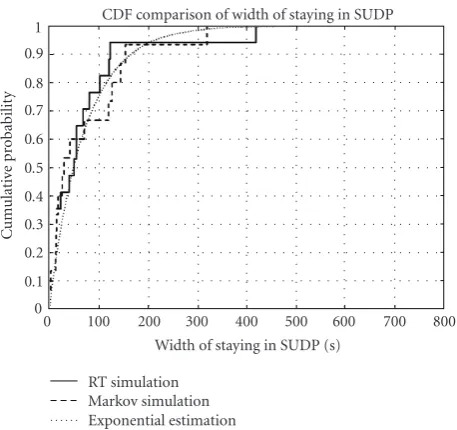
Figure7: Comparison of width of staying in SUDP state for simu-lation and modeling.
which yields the parameters of the exponential model of re-siding in each state for DDP, NUDP, SUDP, and NC states, respectively.
We simulated the exponential distributions and com-pared them to the width of the staying times resulting from RT simulation and width of staying times obtained from run-ning the Markov chain. Figure 7represents the CDF com-parison of width of staying times in SUDP class of receiver locations. It is worth mentioning that other Markov states demonstrate similar close fits.
5.3.2. Ranging error statistics
As discussed inSection 4.2, empirical models using measure-ment and RT have confirmed that ranging errors occurring in DDP and NUDP states can be modeled with normal dis-tribution whose moments are functions of the bandwidth of the channel [18,27]. However, in SUDP class of receiver loca-tions, the distribution which fits the observed ranging error is GEV. Tables1and3summarize the statistics of ranging er-ror for different states of the presented Markov model for a bandwidth of 5 GHz obtained from the analysis of CIRs of the same 14000 receiver locations on the third floor of the AK Labs.
Using the statistics of ranging error and the parameters of the Markov model ofFigure 3provided by (15) enables us to simulate the dynamic behavior of ranging error observed by the mobile user. In order to validate the effectiveness of the Markov model, we initialized the Markov model with an estimate of state probabilities obtained from MND model, and ran the Markov process with the transition probabili-ties reported in (30). According to the class of ranging er-rors produced by Markov model, we simulated the ranging error of each state by using parameters of Tables 1and 3.
−10 0 10 20 30 40 50 Ranging error (m)
0 0.1 0.2 0.3 0.4 0.5 0.6 0.7 0.8 0.9 1
P
robabilit
y
<
abscissa
CDF comparison of total ranging error observed by a mobile user in indoor environment
Experimental data Markov simulation
Figure8: Comparison of ranging error observed by a mobile user with simulation.
by the mobile user traveling in indoor environment for em-pirical data using simulation and analytical dynamic Markov model. It is worth mentioning that comparisons of empirical and simulated ranging errors observed in individual classes also show close agreement.
5.4. Modeling and analysis of state probabilities
For the building under study, varying the location of the transmitter and recording the state probabilities using IDM realization yielded
µ=[0.3662 0.4332 0.0747],
Σ=
⎡ ⎢ ⎢ ⎣
0.0081 −0.0015 0.004 −0.0015 0.0096 −0.0031
0.004 −0.0031 0.0018
⎤ ⎥ ⎥
⎦. (33)
Following the Cholesky decomposition method and re-generating the state probabilities, we can approximate the pa-rameters of the MND model and compare the MND model with the result of simulation.Figure 9illustrates the recon-struction of the state probabilities with 100 iterations for the main three states using MND model. The NC state can be found deterministically using
PNC=1−PDDP−PNUDP−PSUDP. (34)
It can be observed that the MND model-generated state probabilities closely follow IDM.
6. CONCLUSION
In this paper, we presented a novel application of Markov chain for modeling the dynamic behavior of the ranging er-ror in a typical indoor localization application which assists
0 0.1 0.2 0.3 0.4 0.5 0.6 0.7 0.8 probability
0 0.1 0.2 0.3 0.4 0.5 0.6 0.7 0.8 0.9 1
P
(pr
o
babilit
y
>
abscissa)
Normal fit to state probabilities
DDP-simulation NUDP-simulation SUDP-simulation NC-simulation
DDP-model NUDP-model SUDP-model NC-model
Figure9: Comparison of the CDF of the state probabilities for dif-ferent states with their respective normal fit.
us in the design and performance evaluation of tracking ca-pabilities of such systems. The parameters of the Markov model and exponential waiting times were obtained from analytical derivation based on real UWB measurement con-ducted on the third floor of the AK Labs. The parameters of distributions of ranging error observed in each Markov state were extracted from empirical data obtained from 14000 channel impulse responses on the third floor of the AK Labs at WPI. The results of simulation for the dynamic behavior of ranging error using the Markov chain were shown to provide close agreement with the results of empirical data.
ACKNOWLEDGMENTS
The material presented in this paper was partially prepared during a joint project collaboration between Charles Stark Draper Laboratory and CWINS at WPI. The authors would like to thank Dr. Allen Levesque and Nayef A. Alsindi at WPI for their constructive review and comments.
REFERENCES
[1] K. Pahlavan, X. Li, and J.-P. M¨akel¨a, “Indoor geolocation science and technology,” IEEE Communications Magazine, vol. 40, no. 2, pp. 112–118, 2002.
[2] A. H. Sayed, A. Tarighat, and N. Khajehnouri, “Network-based wireless location: challenges faced in developing techniques for accurate wireless location information,”IEEE Signal Pro-cessing Magazine, vol. 22, no. 4, pp. 24–40, 2005.
[4] K. Pahlavan, F. O. Akg¨ul, M. Heidari, A. Hatami, J. M. Elwell, and R. D. Tingley, “Indoor geolocation in the absence of direct path,”IEEE Wireless Communications, vol. 13, no. 6, pp. 50–58, 2006.
[5] A. Saleh and R. Valenzuela, “A statistical model for indoor multipath propagation,” IEEE Journal on Selected Areas in Communications, vol. 5, no. 2, pp. 128–137, 1987.
[6] T. S. Rappaport, S. Y. Seidel, and K. Takamizawa, “Statistical channel impulse response models for factory and open plan building radio communication system design,”IEEE Transac-tions on CommunicaTransac-tions, vol. 39, no. 5, pp. 794–807, 1991. [7] H. Hashemi, “The indoor radio propagation channel,”
Pro-ceedings of the IEEE, vol. 81, no. 7, pp. 943–968, 1993. [8] H. Hashemi, “Impulse response modeling of indoor radio
propagation channels,”IEEE Journal on Selected Areas in Com-munications, vol. 11, no. 7, pp. 967–978, 1993.
[9] B. Alavi, Distance measurement error modeling for time-of-arrival based indoor geolocation, Ph.D. thesis, Worcester Poly-technic Institute, Worcester, Mass, USA, 2006.
[10] A. F. Molisch, J. R. Foerster, and M. Pendergrass, “Channel models for ultrawideband personal area networks,”IEEE Wire-less Communications, vol. 10, no. 6, pp. 14–21, 2003.
[11] A. F. Molisch, D. Cassioli, C.-C Chong, et al., “A comprehen-sive standardized model for ultrawideband propagation chan-nels,”IEEE Transactions on Antennas and Propagation, vol. 54, no. 11, pp. 3151–3166, 2006.
[12] D. Cassioli, M. Z. Win, and A. F. Molisch, “The ultra-wide bandwidth indoor channel: from statistical model to simu-lations,”IEEE Journal on Selected Areas in Communications, vol. 20, no. 6, pp. 1247–1257, 2002.
[13] S. S. Ghassemzadeh, R. Jana, C. W. Rice, W. Turin, and V. Tarokh, “Measurement and modeling of an ultra-wide band-width indoor channel,”IEEE Transactions on Communications, vol. 52, no. 10, pp. 1786–1796, 2004.
[14] S. S. Ghassemzadeh, L. J. Greenstein, T. Sveinsson, A. Kavcic, and V. Tarokh, “UWB delay profile models for residential and commercial indoor environments,”IEEE Transactions on Ve-hicular Technology, vol. 54, no. 4, pp. 1235–1244, 2005. [15] A. F. Molisch, “Ultrawideband propagation channels-theory,
measurement, and modeling,”IEEE Transactions on Vehicular Technology, vol. 54, no. 5, pp. 1528–1545, 2005.
[16] C. Falsi, D. Dardari, L. Mucchi, and M. Z. Win, “Time of ar-rival estimation for UWB localizers in realistic environments,”
EURASIP Journal on Applied Signal Processing, vol. 2006, Arti-cle ID 32082, 13 pages, 2006.
[17] S. Gezici, Z. Tian, G. B. Giannakis, et al., “Localization via ultra-wideband radios: a look at positioning aspects of future sensor networks,”IEEE Signal Processing Magazine, vol. 22, no. 4, pp. 70–84, 2005.
[18] B. Alavi and K. Pahlavan, “Modeling of the TOA-based dis-tance measurement error using UWB indoor radio measure-ments,”IEEE Communication Letter, vol. 10, no. 4, pp. 275– 277, 2006.
[19] B. Denis and N. Daniele, “NLOS ranging error mitigation in a distributed positioning algorithm for indoor UWB Ad-hoc Networks,” inIEEE International Workshop on Wireless Ad-Hoc Networks (IWWAN ’05), pp. 356–360, London, UK, May-June 2005.
[20] J. L. Krolik and R. H. Anderson, “Maximum likelihood coor-dinate registration for over-the-horizon radar,”IEEE Transac-tions on Signal Processing, vol. 45, no. 4, pp. 945–959, 1997.
[21] A. M. Ladd, K. E. Berkis, A. P. Rudys, D. S. Wallach, and L. E. Kavraki, “On the feasability of using wireless ethernet for in-door localization,”IEEE Transactions on Robotics and Automa-tion, vol. 20, no. 3, pp. 555–559, 2004.
[22] C. Morelli, M. Nicoli, V. Rampa, and U. Spagnolini, “Hidden Markov models for radio localization in mixed LOS/NLOS conditions,”IEEE Transactions on Signal Processing, vol. 55, no. 4, pp. 1525–1542, 2007.
[23] G. Yang, K. Pahlavan, and T. J. Holt, “Sector antenna and DFE modems for high speed indoor radio communications,”IEEE Transactions on Vehicular Technology, vol. 43, no. 4, pp. 925– 933, 1994.
[24] A. Falsafi, K. Pahlavan, and G. Yang, “Transmission techniques for radio LAN’s—a comparative performance evaluation us-ing ray tracus-ing,”IEEE Journal on Selected Areas in Communi-cations, vol. 14, no. 3, pp. 477–491, 1996.
[25] K. Pahlavan and A. H. Levesque,Wireless Information Net-works, John Wiley & Sons, New York, NY, USA, 2nd edition, 2005.
[26] M. Heidari and K. Pahlavan, “A new statistical model for the behavior of ranging errors in TOA-based indoor localization,” inIEEE Wireless Communications and Networking Conference (WCNC ’07), Las Vegas, Nev, USA, November 2007.
[27] M. Heidari and K. Pahlavan, “A model for dynamic behavior of ranging errors in TOA-based indoor geolocation systems,” inProceedibgs of the 64th IEEE Vehicular Technology Conference (VTC ’06), pp. 1–5, Montreal, QC, Canada, September 2006. [28] I. Guvenc, C.-C. Chong, and F. Watanabe, “Joint TOA
esti-mation and localization technique for UWB sensor network applications,” inProceedings of the 65th IEEE Vehicular Tech-nology Conference (VTC ’07), pp. 1574–1578, Dublin, Ireland, April 2007.
[29] I. Guvenc and Z. Sahinoglu, “Threshold selection for UWB TOA estimation based on kurtosis analysis,”IEEE Communi-cations Letters, vol. 9, no. 12, pp. 1025–1027, 2005.
[30] J. Karedal, S. Wyne, P. Almers, F. Tufvesson, and A. F. Molisch, “A measurement-based statistical model for industrial ultra-wideband channels,”IEEE Transactions on Wireless Communi-cations, vol. 6, no. 8, pp. 3028–3037, 2007.
[31] B. Alavi and K. Pahlavan, “Analysis of undetected direct path in time of arrival based UWB indoor geolocation,” in Proceed-ings of the 62nd IEEE Vehicular Technology Conference (VTC ’05), vol. 4, pp. 2627–2631, Dallas, Tex, USA, September 2005. [32] N. Alsindi, X. Li, and K. Pahlavan, “Performance of TOA esti-mation algorithms in different indoor multipath conditions,” inProceedings of IEEE Wireless Communications and Network-ing Conference (WCNC ’04), vol. 1, pp. 495–500, Atlanta, Ga, USA, March 2004.
[33] A. Leon-Garcia,Probablity and Random Processes for Electrical Engineering, Addison Wesley, Boston, Mass, USA, 2nd edition, 1994.
[34] H. V. Poor and X. Wang, “Code-aided interference suppression for DS/CDMA communications. Part II: parallel blind adap-tive implementations,”IEEE Transactions on Communications, vol. 45, no. 9, pp. 1112–1122, 1997.
[35] S. E. Bensley and B. Aazhang, “Maximum likelihood synchro-nization of a single user for code-divistion multiple access communication systems,”IEEE Transactions of Communica-tions, vol. 46, no. 3, pp. 392–399, 1998.
[37] Y.-H. Jo, J.-Y. Lee, D.-H. Ha, and S.-H. Kang, “Accuracy en-hancement for UWB indoor positioning using ray tracing,” inIEEE/ION Position, Location, And Navigation Symposium, vol. 2006, pp. 565–568, San Diego, Calif, USA, April 2006. [38] N. A. Alsindi, B. Alavi, and K. Pahlavan, “Spatial
character-istics of UWB TOA-based ranging in indoor multipath envi-ronments,” inIEEE International Symposium on Personal In-door and Mobile Radio Communications (PIMRC ’07), Athens, Greece, September 2007.
[39] B. Alavi and K. Pahlavan, “Modeling of the distance error for indoor geolocation,” inIEEE Wireless Communications and Networking Conference (WCNC ’03), vol. 1, pp. 668–672, New Orleans, La, USA, March 2003.
[40] N. A. Alsindi, B. Alavi, and K. Pahlavan, “Measurement and modeling of UWB TOA-based ranging in indoor multipath environments,” 2007, to appear inIEEE Transactions on Ve-hicular Technology.
[41] S. Markose and A. Alentorn, “The generalized extreme value (GEV) distribution, implied tail index and option pricing,” Economics Discussion Papers 594, Department of Economics, University of Essex, Essex, UK, April 2005,http://ideas.repec .org/p/esx/essedp/594.html.