Whiskey & Spirits
FORWhiskey & Spirits
FORDUMmIES
‰Whiskey & Spirits For Dummies®
Published by
Wiley Publishing, Inc.
111 River St.
Hoboken, NJ 07030-5774
Copyright © 2008 by Wiley Publishing, Inc., Indianapolis, Indiana Published by Wiley Publishing, Inc., Indianapolis, Indiana Published simultaneously in Canada
No part of this publication may be reproduced, stored in a retrieval system, or transmitted in any form or by any means, electronic, mechanical, photocopying, recording, scanning, or otherwise, except as permitted under Sections 107 or 108 of the 1976 United States Copyright Act, without either the prior written permission of the Publisher, or authorization through payment of the appropriate per-copy fee to the Copyright Clearance Center, 222 Rosewood Drive, Danvers, MA 01923, 978-750-8400, fax 978-646-8600. Requests to the Publisher for permission should be addressed to the Legal Department, Wiley Publishing, Inc., 10475 Crosspoint Blvd., Indianapolis, IN 46256, 317-572-3447, fax 317-572-4355, or online at http:// www.wiley.com/go/permissions.
Trademarks: Wiley, the Wiley Publishing logo, For Dummies, the Dummies Man logo, A Reference for the Rest of Us!, The Dummies Way, Dummies Daily, The Fun and Easy Way, Dummies.com and related trade dress are trademarks or registered trademarks of John Wiley & Sons, Inc. and/or its affiliates in the United States and other countries, and may not be used without written permission. All other trademarks are the property of their respective owners. Wiley Publishing, Inc., is not associated with any product or vendor mentioned in this book.
LIMIT OF LIABILITY/DISCLAIMER OF WARRANTY: THE PUBLISHER AND THE AUTHOR MAKE NO REP-RESENTATIONS OR WARRANTIES WITH RESPECT TO THE ACCURACY OR COMPLETENESS OF THE CONTENTS OF THIS WORK AND SPECIFICALLY DISCLAIM ALL WARRANTIES, INCLUDING WITHOUT LIMITATION WARRANTIES OF FITNESS FOR A PARTICULAR PURPOSE. NO WARRANTY MAY BE CRE-ATED OR EXTENDED BY SALES OR PROMOTIONAL MATERIALS. THE ADVICE AND STRATEGIES CON-TAINED HEREIN MAY NOT BE SUITABLE FOR EVERY SITUATION. THIS WORK IS SOLD WITH THE UNDERSTANDING THAT THE PUBLISHER IS NOT ENGAGED IN RENDERING LEGAL, ACCOUNTING, OR OTHER PROFESSIONAL SERVICES. IF PROFESSIONAL ASSISTANCE IS REQUIRED, THE SERVICES OF A COMPETENT PROFESSIONAL PERSON SHOULD BE SOUGHT. NEITHER THE PUBLISHER NOR THE AUTHOR SHALL BE LIABLE FOR DAMAGES ARISING HEREFROM. THE FACT THAT AN ORGANIZATION OR WEBSITE IS REFERRED TO IN THIS WORK AS A CITATION AND/OR A POTENTIAL SOURCE OF FUR-THER INFORMATION DOES NOT MEAN THAT THE AUTHOR OR THE PUBLISHER ENDORSES THE INFOR-MATION THE ORGANIZATION OR WEBSITE MAY PROVIDE OR RECOMMENDATIONS IT MAY MAKE. FURTHER, READERS SHOULD BE AWARE THAT INTERNET WEBSITES LISTED IN THIS WORK MAY HAVE CHANGED OR DISAPPEARED BETWEEN WHEN THIS WORK WAS WRITTEN AND WHEN IT IS READ.
For general information on our other products and services, please contact our Customer Care Department within the U.S. at 800-762-2974, outside the U.S. at 317-572-3993, or fax 317-572-4002.
For technical support, please visit www.wiley.com/techsupport.
Wiley also publishes its books in a variety of electronic formats. Some content that appears in print may not be available in electronic books.
Library of Congress Control Number: 2007936470 ISBN: 978-0-470-11769-9
About the Author
Perry Luntz has been involved in one way or another with the beverage alcohol business most of his adult life. For more than 20 years he has been publisher and editor of Beverage Alcohol Market Report,an international e-letter for marketing executives in beer, wine, and spirits. He served as Director of Marketing Communications for Seagram Distillers for a decade, worked on the creative side of several advertising agencies, including a spell as a creative director of a Young & Rubicam division, and for sev-eral years headed his own marketing communications agency.
A consultant, lecturer, teacher, and news media source, Perry is frequently interviewed in newspapers, radio, and television, including the BBC. He is chairman emeritus of the Wine Media Guild, proving he knows his way around vineyards and breweries, as well as distilleries.
Like many native New Yorkers, Perry is a political junky. He served several years as president of a highly regarded NYC political club.
For the past decade, Perry has been Senior Editor of the Beverage Media Group, a network of trade magazines read by 140,000 licensed retailers. He also writes a weekly column for the group’s B-to-B Internet site.
Dedication
For Lloyd, whose light is gone but whose spirit is always with us.
Acknowledgments
It’s impossible to say how much I owe to Carol Ann Rinzler, my wife, confidant, love of my life, and a damned good editor as well as a prolific and terrific author. I’ll settle for saying just this: I couldn’t have done it without you!
For my children, Ira and Jackie, Russell and Lisa, and my grand-children Ari and Eli — my cheering section — most appreciation and love.
On a professional level, my blessings are extended to the many friends and mentors in the spirits business with whom I’ve worked over the years. They are the most generous and forthcoming people in the world, and I love them all.
In particular, I want to thank Bill Slone, whose support made this book possible. Special acknowledgment goes to my oldest and wisest friends in the business, Gerry Slone, Ron Kapon, and Herbert Silverman, as well as the two best mixologists in the world, Dale De Grof and Ray Foley.
Particular thanks to Lisa Hawkins of DISCUS and Chris Morris of Brown-Forman, who helped make sure the chapter on distillation was accurate. In all cases, any errors are mine, not those who helped me.
And of course where would this book have been without the gentle editorial ministrations of Wiley’s Michael Lewis, Tim Gallan, Sarah Faulkner, and my guardian angel agent Phyllis Westberg.
Publisher’s Acknowledgments
We’re proud of this book; please send us your comments through our Dummies online registration form located at www.dummies.com/register/.
Some of the people who helped bring this book to market include the following:
Acquisitions, Editorial, and Media Development
Senior Project Editor:Tim Gallan
Acquisitions Editor: Michael Lewis
Copy Editor:Sarah Faulkner
Technical Reviewers:William Greenman, Mike Tully
Editorial Program Coordinator:
Erin Calligan Mooney
Editorial Managers: Christine Meloy Beck, Michelle Hacker
Editorial Assistants:Joe Niesen, David Lutton, Leeann Harney
Cover Photo: © Dorling Kindersley/ Getty Images
Cartoons: Rich Tennant (www.the5thwave.com)
Composition Services
Project Coordinator: Erin Smith
Layout and Graphics: Stephanie D. Jumper, Shelley Norris, Christine Williams
Anniversary Logo Design:Richard Pacifico
Proofreaders:Todd Lothery, Nancy L. Reinhardt
Indexer: Becky Hornyak
Publishing and Editorial for Consumer Dummies
Diane Graves Steele, Vice President and Publisher, Consumer Dummies
Joyce Pepple, Acquisitions Director, Consumer Dummies
Kristin A. Cocks, Product Development Director, Consumer Dummies
Michael Spring, Vice President and Publisher, Travel
Kelly Regan,Editorial Director, Travel
Publishing for Technology Dummies
Andy Cummings,Vice President and Publisher, Dummies Technology/General User
Composition Services
Gerry Fahey,Vice President of Production Services
Contents at a Glance
Introduction...1
Part I: Entering the Spirits World ...7
Chapter 1: Discovering Distilled Spirits ...9
Chapter 2: How Distilled Spirits Are Created...23
Chapter 3: Enjoying Spirits...43
Part II: Whiskeys from Around the World...59
Chapter 4: Sipping the Irish Whiskeys...61
Chapter 5: Saluting the Scots ...79
Chapter 6: American Cousins: Bourbon and Tennessee Whiskey ...97
Chapter 7: More Whiskeys from America and Other Parts of the World ...115
Chapter 8: Channeling the Canadians...131
Part III: Surfing the White Waters:
A Guide to “Clear” Spirits...147
Chapter 9: Getting the Goods on Gin ...149
Chapter 10: Vodka: Toasting the Russians ...169
Chapter 11: Tequila: Unearthing the Aztecs ...191
Chapter 12: Yo Ho Ho and a Bottle of Rum ...209
Part IV: Enjoying the “After Dinner” Specials...231
Chapter 13: Cultivating Brandy ...233
Chapter 14: Collecting Cordials, Lining Up Liqueurs...255
Part V: The Part of Tens...275
Chapter 15: Ten (or so) Classic Spirits Cocktails ...277
Chapter 16: Ten Spirited Dishes ...291
Chapter 17: Ten Nutrition Profiles of Alcohol Beverages...303
Chapter 18: Ten (or so) Health Benefits of Moderate Drinking ...307
Table of Contents
Introduction ...1
Conventions Used in This Book ...2
What You’re Not to Read...2
Foolish Assumptions ...3
How This Book Is Organized...3
Part I: Entering the Spirits World...4
Part II: Whiskeys from Around the World...4
Part III: Surfing the White Waters: A Guide to “Clear” Spirits...4
Part IV: Enjoying the “After Dinner” Specials...4
Part V: The Part of Tens...5
Icons Used in This Book...5
Where to Go from Here ...5
Part I: Entering the Spirits World ...7
Chapter 1: Discovering Distilled Spirits . . . 9
A Brief History of Distilled Spirits...9
Eureka! Wine! Beer! ...10
Advancing the art ...10
Distillation arrives ...12
The secret gets out...12
The process goes global ...14
Setting Standards for Producing Modern Distilled Spirits...15
The not-so-noble experiment ...15
New rules for better times...16
The Types of Spirits...17
The clear spirits...17
The dark spirits...18
A Word about the Words ...19
Chapter 2: How Distilled Spirits Are Created . . . 23
The Distillation Process in a Nutshell ...23
The Basic Material for Distilling...26
Milling and Mashing...26
Starting the fermentation process...27
Bringing on the micros...28
Distilling: The Main Event ...28
The pot still ...29
Aging Gracefully ...35
The classic oak barrel ...36
Is getting older always better? ...37
Blending Science with Art...37
Straight spirits...38
Blended spirits ...38
Bottle, Bottle, Who’s Got the Bottle?...40
Choosing a model bottle...40
The bottling line...40
Chapter 3: Enjoying Spirits . . . 43
Assembling the Accoutrements ...43
Choosing your spirit...44
Setting the tasting table ...45
Creating the tasting sheet...46
Getting to the Good Part ...48
Enjoying the view: Color and legs ...48
The nose knows ...49
The tasting technique ...50
Describing what you’re tasting ...51
Serving Spirits Day to Day ...53
Choosing a liquor store...53
Surfing the Net ...54
Reading a spirits label...54
Protecting your investment...55
Taking temperature into account ...56
Avoiding glass warfare ...56
Part II: Whiskeys from Around the World...59
Chapter 4: Sipping the Irish Whiskeys . . . 61
Entering the Emerald Isle...61
Tracking the origins of Irish whiskey...62
Sailing the Irish seas...63
Beginning well: The early days of the Irish whiskey trade ...63
Go west, young distiller ...64
Losing — and again finding — the luck of the Irish ...65
The Uniqueness of Irish Whiskey ...66
Beginning with barley ...66
Following the flow...67
Firing the spirit ...67
The Leading Irish Whiskeys...68
Midleton...69
Bushmills ...71
Tasting Irish Whiskey ...73
Creating the tasting sheet...73
Setting up the tasting ...73
Observing and tasting the whiskeys ...73
Planning a Blended Meal...76
Touring the Source ...76
Chapter 5: Saluting the Scots . . . 79
Which Came First: Whiskey or Whisky?...79
From monastery to market...80
The “smugglers” take to the high seas ...81
Making Scotch Whisky ...82
The Scottish difference ...82
Distilling the whisky ...84
The Styles of Scotch Whisky ...85
The whisky-making regions of Scotland: Where the single malts come from and the blends are born ...86
Blended Scotch whiskies ...89
Tasting Scotch Whisky ...91
Creating the tasting sheet...92
Choosing your samples...92
Appreciating the appearance...93
Inhaling the aromas...93
Tasting the flavors ...94
Planning a Scotch-Friendly Meal...95
Traveling through Distillery Land...96
Chapter 6: American Cousins: Bourbon
and Tennessee Whiskey . . . 97
Life, Liberty, and the Pursuit of . . . Whiskey? ...98
Rumbling to rebellion...99
Over the mountains...100
Bourbon beginnings ...100
The great schism: Bourbon gets its name, and Tennessee splits ...101
Making Bourbon and Tennessee Whiskey ...104
Selecting the grain and making the mash...104
Fermenting and producing distillate ...105
Distilling the whiskey ...106
Changing the color and building the flavor: Aging...106
Filtering ...107
The Types of Bourbon...107
Tasting Bourbons and Tennessee Whiskeys ...108
Gentlemen, choose your whiskeys...108
What your senses sense when you taste Bourbon or Tennessee whiskey...110
Pairing Foods with Bourbon and Tennessee Whiskey ...111
Chapter 7: More Whiskeys from America
and Other Parts of the World . . . 115
The Character of American Blended Whiskey ...116
The birth of the blends ...116
A man with a plan ...117
Building a Blended Whiskey ...119
Producing a unique American flavor...119
Choosing whiskeys for the blend ...120
Tasting American Blended Whiskeys ...121
Choosing the whiskeys ...121
What you see, taste, and smell when sampling American blended whiskey ...123
Planning an American Blended Meal...124
Traveling the American Whiskey Trail...125
Off the Beaten Whiskey Trails ...126
Japan ...126
India...127
New Zealand ...128
Wales ...129
Chapter 8: Channeling the Canadians. . . 131
Starting at the Top (of the World) ...131
Molson’s multitudinous accomplishments ...131
Entering the modern era with a bang ...132
Moving into the modern markets ...135
What Makes a Whisky Canadian? ...136
How Canadian Whisky Is Made ...137
Tasting the Best of Canada ...139
Selecting the whiskies for your tasting...140
Savoring the flavor of Canadian whisky ...143
Pairing Foods with Canadian Whisky ...144
Part III: Surfing the White Waters:
A Guide to “Clear” Spirits...147
Chapter 9: Getting the Goods on Gin . . . 149
The Origins of Gin ...149
Hello, Holland; welcome, jenevre ...150
Holland’s balm for British soldiers...150
The Brits Take Charge ...151
Protecting the home teams ...151
Spreading the gin gospel...152
Riding out the rougher years ...153
Making Modern Gin ...154
Protecting the secret...154
Touring the World of Gin...156
British gins...156
American gins...159
Holland gins...161
Gins from other countries ...161
Tasting the World’s Gin ...163
What to look for when tasting gin ...164
What to sniff and sip ...165
Serving Gin...167
Chapter 10: Vodka: Toasting the Russians . . . 169
What Is Vodka, Anyway? ...169
The Birth of a “Breathless” Spirit ...170
The monks move north...170
The Russians stake a claim ...171
Huzzah for Ivan IV, the not-so-terrible czar...171
Regulations, regulations, and more...172
Vodka Takes a Long Voyage ...172
“Why would people pay money for this stuff?” ...173
With a kick like a Moscow mule...174
Yesterday, the Cold War; today, the world ...175
Distilling Vodka...176
First comes the mash ...177
Next comes fermentation ...177
Don’t forget the water ...177
Into the still ...178
And then into the bottle ...178
The Second Vodka Revolution: The Flavor Factor ...179
Tasting Vodkas ...181
Creating the tasting sheet...181
Classifying vodkas ...182
Tasting vodka neat ...186
Sampling vodkas: What to see, sniff, and taste...186
Serving vodka after the tasting ...187
The Foods That Match the Drinks ...188
Chapter 11: Tequila: Unearthing the Aztecs. . . 191
The First North American Spirit ...192
Ancient history ...192
Tequila’s middle ages ...194
Tequila’s trek north ...196
Defining Tequila: New Standards for a New Global Spirit ...196
How Tequila Is Made ...198
Choosing the base material...198
Pressing the agave...199
Preparing the mash ...200
Distilling not once but twice ...201
Aging the spirit...201
Blending and bottling...202
The Different Brands of Tequila ...203
Tasting Tequila and Mezcal ...205
Making a tasting sheet ...205
Choosing the Tequilas to taste ...206
Tasting the Tequilas ...206
Pairing Food with Tequila ...207
Chapter 12: Yo Ho Ho and a Bottle of Rum . . . 209
The History of Rum ...209
From arak to rum ...210
Hooray for Christopher Columbus...210
Rum rises ...211
Sugar into rum: A trade bonus...211
How Rum Is Produced ...212
The base...213
Fermentation ...214
Distillation ...214
Aging...215
Blending ...215
Flavoring a favorite...216
Where That Rum Is From and Why It Matters...217
Hola! Rums from the Caribbean...217
Other places, other rums ...224
Tasting the World’s Rums ...227
Prepping your tasting sheet ...227
Selecting the rums you want to sample...227
Gettin’ to tastin’ ...228
Trying the rum with mixers...229
Part IV: Enjoying the “After Dinner” Specials ...231
Chapter 13: Cultivating Brandy. . . 233
The “Champagne” of Distilled Spirits ...234
Where Do Brandies Come From? ...234
France...235
Spain...239
Italy...239
United States ...240
Other places, other brandies ...241
Brandy by Type ...244
Wine brandies ...244
Fruit brandies...244
Distilling Brandies...245
Choosing a base ...245
Bringing out the spirit ...245
Aging...246
Blending ...247
Tasting Brandy ...248
Tasting by type...248
Tasting by country ...249
Tasting by price ...250
What you taste (and smell) when you sniff and sip...250
Serving Brandy: Neat or Mixed? Warm or Cool? ...251
Pairing Brandy and Food ...252
Flambé — with care...252
Chapter 14: Collecting Cordials,
Lining Up Liqueurs . . . 255
The Birth of the Liqueur ...256
The first “medicines”...257
Cordial? Liqueur? A tale of two words ...258
Cordially Yours: The Making ...258
Choosing the base spirit ...259
Marking the differences ...259
Adding the flavor ...260
The final touches ...261
The two types of cordials ...262
Cordials by the Ingredients ...263
Fruit flavors ...264
Seeds and nuts ...266
Branded, spirit-based...268
Cream liqueurs...269
Bitters...270
Two classic liqueurs...271
A Cordial Tasting...271
Pairing Foods with Cordials and Liqueurs...273
Part V: The Part of Tens...275
Chapter 15: Ten (or so) Classic Spirits Cocktails . . . . 277
Oops! Tomato Juice on My Blouse: The Bloody Mary ...277
Alexander! Another Brandy! ...279
War Is Hell, so Pass the Rum — in a Daiquiri, if You Please...280
A Shipboard Romance: The Gimlet...281
Uptown, Downtown: The Manhattan...282
If You Knew Margie Like I Know Margie: The Margarita...283
A Cuban Cup of Cheer: The Mojito ...285
The Highland Fling: Rob Roy ...286
Simple Perfection: The Whiskey Sour ...287
Horses, Grass, and Mint: The Mint Julep ...288
Chapter 16: Ten Spirited Dishes . . . 291
Chilled Melon Pepper Soup with Glazed Shrimp ...292
Game Pâté Terrine ...293
Marinated Salmon ...295
Penne à la Vodka ...296
Chicken Fajitas ...297
Filet Mignon with Whiskey Sauce ...298
Green Beans with Toasted Pine Nuts ...299
Tennessee Whiskey Candied Apples ...300
AppleJack Pound Cake ...301
Nut Ball Cookies ...302
Chapter 17: Ten Nutrition Profiles
of Alcohol Beverages . . . 303
Rum...304
Gin...304
Vodka ...304
Whiskey ...304
Coffee Liqueur ...305
Coffee with Cream Liqueur ...305
Whiskey Sour (Cocktail, Made from a Powdered Mix)...305
Tequila Sunrise (Cocktail, Canned) ...306
Piña Colada (Cocktail, Canned) ...306
Daiquiri (Cocktail, Canned) ...306
Chapter 18: Ten (or so) Health Benefits
of Moderate Drinking . . . 307
Heartening News ...308
Lowering Bad Cholesterol, Raising Good Cholesterol ...309
Busting Blood Clots ...310
Lowering the Pressure ...310
Staving Off Stroke...312
Deterring Diabetes ...312
Protecting Intelligence ...313
Preserving the Brain...314
Boosting Bones ...314
Enhancing Appetite ...315
Controlling Weight ...315
Countering the Common Cold...316
Introduction
F
or thousands of years man and womankind celebrated major events — religious and secular — by having a taste or even two of a fermented beverage that contained alcohol. Things got even tastier around 800 CE — the height of development of the Moorish culture. That’s when a brilliant alchemist in the perpetual search for a way to turn lead into gold attempted to urge the release of the “essence” of various fruits and grains. The result was not only better than anything ever enjoyed before, but it also could be repeated over and over again.That brilliant alchemist had found distillation. The art of making the most noble of beverages was created by nature and perfected by men and women. This book is dedicated to giving you a full explanation of distillation from the simplest and most popular spirit (vodka) to the most complicated (whiskey and brandy).
No, Whiskey & Spirits For Dummiesdefinitely won’t tell you how to set up your very own still in the basement (or bathtub) so that you can whip up a batch of your very own whiskey, gin, vodka, Tequila, rum, cordial, or Cognac.
Instead, this book aims to increase your appreciation of the quali-ties in fine distilled spirits, enabling you to make wise choices from the myriad products on the shelves in your local liquor store or in the literally hundreds of cocktails available for serving or drinking on social occasions. Drinking alcohol beverages is indeed a social thing to do. It’s also part of religious services, and its use as a psy-chic benefit is unquestioned. There are other sides to these noble beverages as well.
For those readers who know absolutely nothing about distilled spirits other than that these beverages enhance a social setting and dining experience, this book is a good place to start to pick up the basics.
More experienced connoisseurs will find this a refresher course that can confirm their own good taste, introduce them to a few new types and brands of distilled spirits, and provide the kind of odds and ends — for example, why whiskey is spelled whiskeyin Ireland and whiskyin Scotland — that enliven cocktail conversation. And, yes, I give you several classic cocktail recipes in here, too.
Conventions Used in This Book
To make the text consistent and easier to read, Whiskey & Spirits For Dummiesfollows the usual Dummies style. For example:
All Web addresses are printed in monofont.
When this book was printed, some Web addresses may have needed to break across two lines of text. If that happened, rest assured that I didn’t put in any extra characters (such as hyphens) to indicate the break. So, when using one of these Web addresses, just type in exactly what you see in this book, pretending that the line break doesn’t exist.
New terms appear in italictype and are followed by an easy-to-understand definition.
Bold type is used to highlight the action parts of numbered steps.
What You’re Not to Read
Imagine: An author telling you that you don’t have to read every word that appears in his book. The truth is that some small parts of this book are fun or provide information that you may not find anywhere else, but they aren’t absolutely essential to your under-standing of the basic facts about distilled spirits. For example:
The text next to a Technical Stuff icon: Readers who want to know every single fact about how things work will find these paragraphs a delight. Readers who can do without the techni-cal details can surf on by.
The text on the copyright page: Really. This page is for pub-lishers and libraries. If my editor put the dedication there to save space, I think you should read about the people who helped make this book possible, but the publisher’s address? The number of editions? The Library of Congress identifica-tion number? Nah.
Foolish Assumptions
If an author clicks the computer, hits typewriter keys, or pushes a quill pen across the page, what’s in front of him or her is an image of the person for whom the book is being written. These are some of the assumptions I made about you:
You know the names of the different types of distilled spirits, but you may not be totally familiar with the characteristics that differentiate a whiskey from a Tequila (you may even know why Tequila is spelled with a capital letter and whiskey is not).
You’ve read conflicting reports about the risks and benefits of spirits (and other kinds of alcohol beverages), and you want to pin down the real facts.
You want the basic information about these products and how they’re made, but you have no intention of opening your own distillery. That’s good, because a few paragraphs back you were told that this book isn’t designed to tell you how to do that.
Most important, you enjoy the flavor, aroma, and panache of distilled spirits — but only and always in moderation.
How This Book Is Organized
The following is a brief summary of each part of Whiskey & Spirits For Dummies.You can use this as a fast guide to check out the stuff you want to go to first, because the best thing about a For Dummies
Part I: Entering the Spirits World
Chapter 1 is (what else?) a general introduction to the universe of distilled spirits. Chapter 2 is more technical: A detailed description of the distillation process in all its traditional glory. Chapter 3 tells you how to serve, evaluate, and enjoy the products produced in Chapter 2.
Part II: Whiskeys from
Around the World
Chapter 4 is all about how the Irish introduced the first whiskeys. Chapter 5 explains how the Scots adopted the Irish spirits — and changed the spelling to “whisky,” thus confusing generation after generation of whiskey (or is it whisky?) drinkers.
Chapter 6 salutes two quintessential Americans — Bourbon and Tennessee whiskey. Chapter 7 describes the other great American innovation, American blended whiskey, and tells you all about upstarts from India, Japan, and New Zealand. Chapter 8 goes north to talk about a Canadian contribution to New World whisky choices.
Part III: Surfing the White Waters:
A Guide to “Clear” Spirits
Chapter 9 focuses on gin, from its birth in the Netherlands, toward its perfection in London, through its Prohibition adolescence, to its present presence. Chapter 10 is about vodka, the clear Russian spirit now often enjoyed in totally unexpected flavors. Chapter 11 is all about Tequila, the Aztec contribution to your drinking pleas-ure. Chapter 12 focuses on rum, the spirit made from sugar cane first carried to the Western hemisphere by Christopher Columbus. Yes, that Christopher Columbus.
Part IV: Enjoying the “After Dinner”
Specials
Part V: The Part of Tens
This is the part of the book regular For Dummiesreaders never skip. Chapter 15 pours recipes for ten classic cocktails (with an extra from the bartender). Chapter 16 dishes out menu choices — entrees, main dishes, veggies, and desserts — whose ingredients include at least one type of spirit. Chapter 17 tells what nutrients (!) are in one serving of each type of distilled spirits. Chapter 18 concludes with the actual health benefits of moderate spirits consumption.
Icons Used in This Book
This icon points out general good ideas, such as serving sugges-tions, buying advice, and so forth.
I use this icon to highlight important concepts that you shouldn’t forget.
This icon flags nonessential information that may be too technical or detailed for some readers. You can skip it if you want.
Where to Go from Here
Now the question is where to begin reading. The real answer is any-where your curiosity takes you in the Table of Contents. However, one good starting point is Chapter 2, the one that explains how dis-tilled spirits are made. A second good starting point is Chapter 3, the one that shows you how to enjoy distilled products. Both chap-ters have information that applies to all types of spirits.
Part I
In this part . . .
Chapter 1
Discovering Distilled Spirits
In This Chapter
How distilled spirits were invented
How distilled spirits became popular
The foods from which spirits are made
The varieties of distilled spirits
T
his chapter is called “Discovering Distilled Spirits,” but “Distilled Spirits 101” would also do nicely because this is a down-to-earth basic guide to the multicultural history of the won-derful beverages human beings produce via distillation.Naturally, the chapter includes some spirits history, starting with a graceful bow to other types of alcohol beverages and how they differ from the distilled varieties. The different types of spirits are listed here, as are the foods from which they’re made. And just for kicks, I give you a quiz about famous spirits (okay, famous ghosts) in classic movies.
A Brief History of Distilled Spirits
The road to distilled spirits begins with those otherbeverages, wine and beer.
Looking closely, he saw the goats feasting on rotting grapes fallen from a nearby vine. Being a curious goatherd, he tasted a few grapes himself. Then he tried a few more, and maybe another handful after that, and soon goats and goatherd ambled happily back to their village to share their discovery with others.
Of course, you know what that anonymous goatherd didn’t: Those “rotten” grapes had fermented.
In other words, naturally occurring microorganisms in the air had landed on the grapes and started feeding on the fruit, digesting the grape sugars, and turning them into gas (carbon dioxide) and liquid ethanol/ethyl alcohol, which is the same alcohol used in all modern alcohol beverages.
Eureka! Wine! Beer!
Very quickly, the goatherd’s friends, neighbors, and acquaintances far and near grasped the idea that squeezing rotten, sorry,
fermented,fruit released a pleasantly intoxicating beverage called wine (from the Greek vinos,the Latin vinum,the Old Englishwin,
and the Germanic winam).
And then they discovered that fermenting grains released an equally pleasant intoxicating beverage called beer (from the Latin
bibere [to drink], the German bier,and the Old English beor,
pronounced beer).
After that, a jolly good time was had pretty much everywhere fruits and grains were grown. And it was a profitable time, as well: The oldest known Sumerian tablet is a receipt for a shipment of beer from Mesopotamia to some lucky merchant in Northern Greece. This tablet is a hunk of clay that made it possible for modern scholars to translate the language of Sumer, the nation of Middle Eastern city-states that was one of the world’s earliest civilizations.
Advancing the art
The first step was to take control of fermentation by adding spe-cific microorganisms (yeasts) to the fruit and grains rather than simply allowing miscellaneous little buggers to waft in and ferment the fruit by accident.
The second step was to distill alcohol from the liquid released by the fermented food.
Unlike the discovery of fermentation, which seems to have been a happy coincidence, learning how to distill alcohol was the result of a deliberate series of experiments conducted by an Arab scholar named Abu Musa Jabir ibn Hayyam (?–803 CE). Most modern scien-tists generally accept Jabir, known in the West as Geber, as the Father of Modern Chemistry.
Sometime during the eighth century CE — these dates are never quite as clear as one might like them to be — Geber was puttering around with his al-ambiq,a round pot with a tall spout rising from the top, sort of like an oversized tea kettle. When liquid was heated in the pot, the vapors rose through the spout to be cooled, con-densed, and collected as a liquid in a vessel conveniently posi-tioned under the spout.
Not all alcohol is “alcohol”
Ethanol (ethyl alcohol) is the only alcohol used in food and beverages, but it isn’t the only alcohol used in consumer products.
Other alcohols that may be sitting on the shelf in your bathroom or workshop are:
Methyl alcohol (methanol):Methanol is a poisonous alcohol made from wood. It’s used as a chemical solvent (a liquid that dissolves other chemicals). During Prohibition, when the sale of beverage alcohol was illegal, some unscrupulous illegal producers would substitute methanol for ethanol, thus leading to many truly unpleasant results, such as blindness and even death, among people who drank it.
Isopropyl alcohol (isoproanol, “rubbing alcohol”):Isopropyl alcohol is a poi-sonous alcohol made from propylene, a petroleum derivative. It’s denatured, which means that it includes a substance that makes it taste and smell bad so you won’t drink it by mistake.
The al-ambiq was standard equipment for alchemists, the medieval practitioners who spent their lives trying to turn base metal into gold and, as a sideline, looking for the magical “elixir of life” that would make men immortal.
But Geber, who may have been a wine aficionado, took a different tack. He wondered what would happen if he poured wine into the al-ambiq and boiled it.
In other words — “Eureka!” will do nicely — the man was about to invent distillation.
Distillation arrives
It’s a physical fact that alcohol boils at a lower temperature than water, so when Geber poured his wine into his al-ambiq and set the pot over a fire, the alcohol in the fermented grape juice or the fer-mented grain and water mixture used to make beer vaporized before the rest of the liquid in the pot.
The alcohol vapors rose through the spout on the al-ambiq, were collected and condensed, and, just like that, Geber produced the world’s first distilled spirit. And it needed a new name.
The solution was simple: While some alchemists were playing around with longevity tonics, early cosmeticians used their al-ambiqs to boil up powdered antimony in water, producing a dark liquid called kohlor al-kohl.
Al-kohlbecame alcohol.The al-ambiq became the alembic still, also known as the pot still, which is described in detail in Chapter 2. And that’s how your favorite distilled spirit drink was born.
The secret gets out
Geber died in 803 CE, but his distillation process lived on among his Arab compatriots who used the distillate they produced not as a beverage but as a medicine.
grain and fruits into a potent medicine remained behind to be taken in hand by those doctors of the Middle Ages — monastery monks. Like the Arabs, the monks prescribed the distillates, includ-ing some that they originated — such as Benedictine and
Chartreuse liqueurs — for medicinal purposes.
The missionary/medicine men met with enough successes to con-vince the European pagans that these liquids carried the blessings of God to assure a long, healthy life. Around the year 1300, Arnald of Villanova, a professor of medicine at Montpellier (France), one of the earliest European medical schools, compiled the first (hand) written instructions for distilling alcohol from wine.
Arnald christened distilled alcohol aqua vitae(Latin for “water of life”), which translated to eau de viein French, uisege beatha
among the Celts, akavitin Scandinavia, and vodka/wodka(“dear little water”) in Russia and Poland. By any name, the distillate was reputed, in Villanova’s words, to “prolong life, clear away ill-humors, revive the heart, and maintain youth.” Others claimed it also alleviated diseases of the brain, nerves, and joints; calmed toothaches; cured blindness, speech defects, and paralysis; and warded off the Black Death.
Moderation is the message
In 1478, 48 years after Gutenberg invented the printing press, an Austrian physician named Michael Puff von Schrick published the very first book on distillation. Puff’s piece immediately hit the 15th-century bestseller list, going through 14 editions in 20 years.
Most readers probably bought the book to use as a medical reference, but a sig-nificant number likely picked it up in order to learn how to make distilled spirits with local fruits and other produce for pleasure.
The new distilled spirits were very popular, so much so that in 1496, a doctor in Nuremberg, Germany, whose name is unfortunately lost to history, offered a word to the wise imbiber: “In view of the fact that everyone at present has gotten into the habit of drinking aqua vitae, it is necessary to remember the quantity one can permit oneself to drink, and learn to drink it according to one’s capacity, if one wishes to behave as a gentleman.”
Not surprisingly, nobody at all complained about having to take Arnald’s medicine instead of the crushed leaves, boiled grains, and pressed herbs it came from.
The process goes global
Serendipitously, the spread of distillation occurred just as Europeans began to seriously explore and colonize the world, establishing regular trade routes between Europe and the East and Europe and the New World.
The Spanish and the Portuguese were leaders in the exploration game, bringing back new products and taking their alcohol bever-ages with them. Spirits, in particular, were a win-win trade-off because they were
Virtually unknown in the lands the explorers explored
Easy to produce
A really smart way to turn an excess crop, such as grain, into a cash product rather than leaving it to rot in the field
A stable beverage that resisted spoilage and turned tastier as it aged in wooden barrels
Best of all, distilled spirits were a totally natural product that — after distillation became common knowledge — could be produced from virtually any local plant anywhere in the world. As a result, by the 19th century, distilled spirits of one sort or another were avail-able pretty much anywhere a traveler traveled.
Table 1-1 is a list of the plant foods that can be fermented to pro-vide the base for making distilled spirits.
Table 1-1
Foods Used in Distillation
This Food . . . . . . Makes This Distilled Spirit
Grains
Oats Scotch whisky
Rice Sake (distilled rice wine), Japanese whiskey
Rye Whiskey
This Food . . . . . . Makes This Distilled Spirit
Fruits and Vegetables
Agave fruit (piña) Tequila
Apples Apple jack, brandy
Grapes Brandy, eau de vie, grappa
Other fruits Brandy, cordials, liqueurs
Potatoes Vodka
Sweeteners
Sugar cane, molasses Rum, aguardiente, cachaça
Honey Cordials, liqueurs
Botanicals (Herbs and Seeds) Gin, cordials, liqueurs
Setting Standards for Producing
Modern Distilled Spirits
Distilled spirits came to the United States just as they had every-where else — with the explorers and the immigrants. The Irish brought their own whiskey and so did the Scots. The Brits and Dutch brought gin, the French brandy, and Slavic people vodka.
The only difference was that while religious objections led to forbidding the use of any alcohol beverages (including spirits) in some countries, the United States stands alone in having once prohibited drinking for political reasons. (State legislatures under pressure from their constituents passed bans of varying severity on beverage alcohol production and distribution. So many states had bans, in fact, that ultimately the federal government had to follow suit or face interstate warfare.)
The not-so-noble experiment
Two years later, after ratification by the requisite three-fourths of the states, Prohibition became the law of the land. Congress then passed the Volstead Act (the National Prohibition Enforcement Act) defining an alcohol beverage as any liquid containing more than 0.5 percent alcohol.
The result was an increase in crime as Americans in general said, “No way,” to what President Herbert Hoover called “the Noble Experiment.” Americans did their drinking at home or in speakeasies (nightclubs hidden behind locked doors, opened only to a secret password such as “Joe sent me”). Alcohol was shipped in surrepti-tiously by bootleggers sneaking across the country’s seacoasts or its northern or southern borders. Worse yet, there was also an increase in illness due to the fact that much of the alcohol making its way into America’s drinking glasses and teacups was unregulated, unsafe, and sometimes deadly.
By 1933, the country had had enough: On December 5, the 21st Amendment to the Constitution was ratified, repealing the 18th, and Americans could once again legally enjoy alcohol beverages, including those of the distilled variety.
New rules for better times
The bad news about Prohibition is that it increased crime and reduced the safety of alcohol beverages. The good news is that after the country recovered from its dry spell, the federal govern-ment sat down to write the Alcohol Administration Act on what exactly constituted a specific spirit.
Since then, other countries and economic entities such as the European Union have followed suit. As a result, when you buy Scotch whisky or Bourbon or any other distilled spirit from a recognized distiller anywhere in the world, you know that you’re getting a standardized, reliable product.
The American rules, known formally as Standards of Identity,are contained in Title 27 of the Code of Federal Regulations, Chapter 1, Part 5, Section 5.22.
government-ese, you can find a slightly more user-friendly version posted online by an organization called The Online Distillery Network for Distilleries & Fuel Ethanol Plants Worldwide at
www.distill.com/specs/USA10.html.
Or you can read the clear descriptions in the next section, which lays out the basics minus the boring factoids only distillers really need to know to make sure their product meets U.S. standards. And of course, each chapter in this book is devoted to a specific spirit and presents the important facts about the drink.
In essence, the take-away points are:
No, a distiller can’t just pour some ethanol into a bottle and call it whiskey or one of the other popular distilled spirits.
Yes, when you buy your favorite brand, you’re getting a standardized product that meets all the relevant government standards.
The Types of Spirits
All distillates come off the still as clear liquids. How the distiller processes the liquid determines the taste, smell, and appearance of the final product.
As a rule, however, all spirits fall into one of two broad categories:
clear spiritsand dark spirits.Put in the simplest terms, clear spirits are the ones you can see though; dark spirits range in color from warm amber to deep brown.
The clear spirits
All clear spirits are clear, but depending on the foods from which they were distilled, some have a specific flavor.
Rumis distilled from molasses or sugar cane. All rums start out as totally clear spirits; some are aged in barrels, a process described in Chapter 2. Aging turns the rum golden, amber, or very dark.
Sakeis a clear spirit distilled from rice wine.
Tequilais distilled from the fruit of the blue agave plant. Like rum, all tequilas start out clear, but some turn golden or amber with aging.
Vodka is a true neutral spirit, crystal clear, with no discernible flavor or aroma. Modern vodka producers, however, may flavor their vodkas, changing the taste and sometimes the color to match the color of the fruit juice or synthetic flavoring.
The dark spirits
With the exception of brandy, which is distilled from wine (remem-ber Ge(remem-ber from earlier in this chapter?), dark spirits are beverages distilled from grains.
Like clear spirits, the dark spirits start out clear, but aging in barrels and the addition of coloring agents such as caramel (burnt sugar) to maintain color consistency from year to year turns them characteristically golden amber.
Brandyis a spirit distilled from wine or a mash (fermented mass) of any fruit, most commonly grapes.
Whiskeyis a spirit distilled from grain, such as barley, corn, rye, or wheat. A straight whiskey is made from the distillate produced by one operation of a still and added neutral spirits. A blended whiskey contains several straight whiskeys and added neutral spirits.
Bourbonand Tennessee Whiskeyare distilled spirits made only in the United States; by law, they must be made of 51 percent corn.
Canadian Whiskyis a distilled spirit made in Canada, gener-ally from a mix of grains, primarily corn, plus rye, wheat, and barley.
Irish Whiskey is a distilled spirit made in Ireland from a mix of grains dominated by barley.
A Word about the Words
Like other fine craftsmen, distillers cringe when folks describe their products in derogatory terms.
Prime example: booze.The word comes either from the old English word blouse(to drink heavily) or, more likely as the Online Etymology Dictionarysuggests, from the name of early Philadelphia distiller E.G. Booze. Either way, it’s a no-no in the company of serious spirits connoisseurs.
Another no-no is hooch,short for Hoochinoo,the name of a native Alaskan Tlingit Indian tribe whose distilled spirits were a fave with miners during the Alaskan Gold Rush. The Merriam Webster Online Dictionary says this one first popped up around 1880. But it really took off during Prohibition, possibly because someone discovered that the tribe’s name comes from an Indian word for grizzly bear fortand figured that the hooch packed the punch of a big, bad bear. Or not.
For spirits, every year is a good year
Unlike wine and with the exception of some brandies, spirits aren’t classified by vintage.
For wine, quality and flavor depend to a great extent on the characteristics of the grapes from which the wine is made. Specifically important is their sugar content, which may vary from year to year along with the weather.
Distillation, on the other hand, produces a liquid (distillate) free of all sugars; it’s the still master’s skill, not the weather, that determines the quality of the liquor.
Ditto for aging. Wines age in the bottle as active microorganisms continue to digest and process residual sugars, maturing and mellowing the flavor of the wine. Spirits, on the other hand, age only in barrels. After they’re bottled, they are what they are: Time doesn’t change them.
Yes, some distillers, notably the Scots, promote high-priced specialty whiskies that have been aged for more than 21 years and proudly display the year in which they were bottled. But what matters isn’t the year they were bottled, but the time they spent in the barrel.
By preventing Americans from enjoying safely made alcohol bever-ages, Prohibition triggered the production of some fairly nasty homemade substitutes with equally nasty names. One example is
rot gut,a pretty clear description of what happens to your innards if you drink alcohol beverages made by careless amateurs.
As for bathtub gin,yes, people really did whip up this stuff in their bathtubs using medical alcohols and flavorings. Unfortunately, as the sidebar “Not all alcohol is ‘alcohol’” explains, the alcohols used in medicinal products, such as rubbing alcohol, aren’t safe to drink. Which brings us back to — you got it — rot gut, a term that’s been pretty much discarded now that alcohol beverages are legal and safe when consumed in moderation.
Entertaining spirits
Check out the following list to see how many entertaining spirits you can match with the actors who embodied them.
On the left, the name of a famous motion picture starring a member of the spirit world. On the right, a list of actors and actresses who starred in the films. Match ‘em up. Answers follow.
Movie Star(s)
1. Ghost (1990) a. Bill Murray
2. The Ghost and Mrs. Muir (1947) b. Bob Hope, Paulette Goddard
3. The Ghost Breakers (1940) c. Gene Tierney, Rex Harrison
4. Ghost Story (1981) d. Fred Astaire
5. Ghost Busters (1984) e. Patrick Swayze, Demi Moore
6. The Ghost Goes West (1935) f. Charles Laughton
7. The Canterville Ghost (1944) g. Robert Donat
8. Ghost Catchers (1944) h. Nancy Sinatra, Harvey Lembeck
9. Ghosts of Mississippi (1996) i. (John Sigvard “Ole”) Olson and (Harold Ogden) Johnson
10. The Ghost in the Invisible Bikini j. Whoopi Goldberg, Alec Baldwin (1966)
But that doesn’t stop people from calling spirits hard liquorto differentiate them from beer and wine. Actually, because no liquid is either hard or soft, the more sensible terms are higher proofor
higher ABV(more about that in Chapter 2), descriptions based on the alcohol content of the beverage.
Finally, the term alcoholic beverages(rather than alcohol beverages
Chapter 2
How Distilled Spirits
Are Created
In This Chapter
Tracking spirits from distiller to consumer
Exploring the chemistry of distillation
Defining the still master’s job
Showing the various stills used in distillation
N
o, this chapter doesn’t explain how to cook up spirits at home. Even if the United States government didn’t frown onmoonshining(producing distilled spirits without having the required licenses), you’d still find it difficult, not to mention costly, to install a still in your basement or garden shed.
Instead, this chapter addresses the Real Deal: the multitudinous steps a licensed distiller must take from start (“I think I’ll sell a new vodka.”), to middle (“Wow! The marketing guy’s decision to put it in a blue bottle is terrific!”), to end (“Here, dear customer, try my product.”).
It’s a hard job, but somebody has to do it. Luckily, so many people do it well enough to enable the rest of us to enjoy the fruits (and/or grains) of their labor.
The Distillation Process
in a Nutshell
The microorganisms ferment carbohydrates in the food. Translation: They convert the starches in food and produce a liquid (alcohol), a gas (carbon dioxide), and flavoring agents (congeners).
For brewers and winemakers, the fermentation process ends when the microorganisms have digested enough carbohydrates to pro-duce a liquid that’s 25 percent alcohol, which is much higher than the concentration of alcohol in most beers and just about right for a lot of wines.
However, 25 percent alcohol is too low for most distilled spirits. To obtain sufficient quantities of neutral spirits(the virtually pure alco-hol used as a base for spirits products), the distiller must distill the wash(the liquid drained from the food/yeast/water mix) to separate out the alcohol.
Distillation is a physical separation process that’s so simple, in fact, that as you read this, it’s a good bet that somewhere in the world a freshman student in a chemistry class is heating a liquid until it boils and watching the steam rise into a collector where it cools and condenses back into a liquid. But making the alcohol is only one step in the process that yields distilled spirits.
There are only five steps needed to arrive at a distilled spirit. Here they are:
Step 1:Choosing the food from which to distill the alcohol
Step 2:Preparing the food for distillation
Step 3:Heating the prepared mixture to produce (distill) a specific spirit type
Step 4:Maturing the distilled spirit
Step 5:Packaging (and shipping) the finished product
Steps 1, 2, 3, and 5 apply to all distilled spirits; some types, such as vodka, aren’t aged — no Step 4 for them. (I talk about maturing, called aging,in the “Aging Gracefully” section later in this chapter.) At every step along the way — from carbs to spirits to you — the process is monitored by a still master and his assistants (yes, it’s still a very masculine profession) to make certain that the ethanol the distiller turns out meets health and safety standards for use in beverages. The still master totals every ounce of alcohol produced during each distillation period so that the revenue agents have a clear record for tax purposes.
Talking the distillation talk
Like all professionals — doctors, lawyers, chemists, wrestlers — distillers have a language all their own. The following table lists some of the basic vocabulary.
ABV (alcohol by volume) A measurement term used to describe the concentra-tion of alcohol in a bottle of beer, wine, or spirits
Batch Alcohol distilled in one limited run through the still; also used to describe selecting barrels for use in making a special product
Congeners Flavoring agents and alcohols generated by reactions and procedures in making spirits
Ethanol, ethyl alcohol The chemical name for the alcohol used in food and beverages
Fermentation The process by which microorganisms digest and convert carbohydrates (sugars and starches) to a liquid (alcohol) and a gas (carbon dioxide)
Milling Procedure to strip away the outer covering of grains used in making distilled spirits
Mash Soupy mass of fermenting food from which spirits are distilled; the process of creating a mash is called mashing
Mash bill The recipe for amounts and types of foods used in the mash
Neutral spirits The ethanol collected and condensed during distilla-tion at or above 190 proof
Proof An increasingly outmoded measurement term used to describe the concentration of alcohol in a bottle of beer, wine, or spirits
Still The container in which the alcohol/water liquid from fermented food is distilled
Still master The person who determines the “recipe” for a distilled spirit and who watches over its creation
The Basic Material for Distilling
Virtually any carbohydrate-rich food can be used as a base from which to distill alcohol.
With the exception of milk — which contains lactose (milk sugar) and is often used after it ferments to produce an alcohol beverage called kumis — foods from animals don’t contain carbs, which is why nobody’s ever made a chicken, fish, or hamburger whiskey, gin, or vodka.
Plant foods, on the other hand, are carb rich; grains, fruits, nuts, seeds, and at one time or another flowers have all been used as the base for a distilled spirit.
Picking the right food(s) is the job of the still master, who, along with other members of the distillery staff, is charged with creating a shopping list called a mash bill,a recipe listing the food(s) to be used in distilling a specific whiskey, gin, vodka, or other spirit.
In most countries, including the United States, the government plays a role in drawing up the mash bill, laying down some basic rules to govern how much of which foods go into what kinds of spirits. For example, a Bourbon must be distilled from a minimum of 51 percent corn with the remainder being other grains. What’s in the balance is left up to the individual distiller, which is why all Bourbons have a similar flavor with slightly different flavor notes, depending on the “house style” of the source.
Distillers use neutral spirits in blending dark spirits, such as whiskey, and to produce clear spirits, such vodka and gin. These neutral spirits may be distilled from any of the following:
Any grain, such as barley, corn, rice, rye, or wheat
Any high carbohydrate food, such as potatoes, agave, sugar cane, and others
Fruits, such as grapes for brandy. Unfermented fruits, nuts, herbs, and seeds are also used as flavoring agents.
Milling and Mashing
In the first process, the grains that are used as a base for distilling go through a millwhere mechanical rollers, hammers, and/or grinders break and strip away the husk (outer covering) of the grain to expose as much of the surface of the grain as possible.
In the second of these two processes, the grains are plunked into water and mushed into a mash.The water pulls carbs out of the grains into a solution so that those determined microorganisms can get to work.
Before distillation can take place, the mash is heated and fermented by adding yeast.
Starting the fermentation process
After the grain is mixed into a mash, the mash is heated in a large vat so that naturally occurring enzymes in the grains (malt enzymes) soften the grains into a soupy mass called a wort.
Warning: Yeasty beasties at work
Sailors crossing the Equator for the first time are often subject to an initiation that ranges from the fun (being splashed with water) to the more rigorous (actually being dunked in the ocean).
People visiting a distillery for the first time may also run into a rite of passage. When they enter the mash room, the distillery guide may open the top of the fermentation vat and invite the victim, sorry, visitor, to step closer and take a really deep breath.
Ooops.
Gases produced during fermentation collect right under the covering, so that really deep breath may lead to sudden — but temporary — dizziness.
If the distillery folks offer a taste of the fermenting product, the smart answer is a polite, “No, thank you.” Why? Because consuming the active yeasts in the vat has been known to trigger certain gastric discomforts best left to the imagination. In all fairness, you should know that the folks who work in distilleries do taste the fer-menting mash without suffering any consequences. Perhaps repeated exposure acclimates their tummies.
The wort is then pumped into a large vat called a mash tun.The mash tun may be either a wooden container with an open top or a steel or copper container with a closed top. Either way, the bottom of the tun is a strainer through which the liquid flows from the mash into a separate container (the fermentation tank). Protein-rich residue is left atop the strainer in the mash tun, and it’s compacted and used as animal feed.
Bringing on the micros
Now the still master adds microorganisms — the yeasts — to the liquid in the fermentation tank. Two kinds of yeast work together at this point:
Cultivated yeast: Distillers guard their cultivated yeasts as closely as Fort Knox to prevent the competition from stealing the strain and preserving it in temperature-controlled splen-dor for future growth for generations (of yeasts).
Wild yeast:These yeasts enhance flavor differences even in products from distilleries located within short distances apart. Wild yeasts are a lot less trouble to handle than their often richer relatives, cultivated yeasts. Leave the fermenta-tion tank open and zap, you’ve got local yeasts dropping in to help out. Although still masters don’t often talk about it, there’s a difference in yeasts. It’s tough fitting these uncon-trolled rascals into the ultimate taste profile desired, but adding complexity is often worth the effort.
Almost immediately, the yeasts go to work digesting carbohydrates in the liquid, emitting alcohol and carbon dioxide. As the carbon dioxide rises to the surface, the solution bubbles. Poetic distillers may describe this phenomenon as “the dance of life.” You can call it — what else? — fermentation.
As the yeasts continue to digest the carbs, the amount of alcohol in the liquid steadily rises. When the alcohol concentration reaches 3 percent, the still master transfers the liquid — now known as distiller’s beer— from the fermentation tank into the still for the main event: distillation.
Distilling: The Main Event
Because alcohol boils at a lower temperature than water, vapors from the alcohol rise first, to be collected and condensed as liquid ethyl alcohol, the alcohol used in beverages. The alcohol produced in the still is also known as neutral spiritsbecause it’s free (or rela-tively free) of flavoring and aroma compounds.
The modern still master works with two distinct types of stills: |the pot stilland the column still.
The pot still
The first pot still was the alembic stillused by the Arabs who invented distillation sometime during the 11th century CE (for more on the historic discovery and the men who accomplished it, turn to Chapter 1).
The classic alembic still is a simple copper pot with a rounded bottom and an elongated spout (or swan’s neck) on top that tradi-tionally ends in a twisted coil called the worm.
So perfect is the design that modern distillers still use the alembic still centuries after it was designed. The process goes something like this:
1. A distillers pours his mash into the pot still.
2. He heats the vessel over an open fire.
3. The fire sends the alcohol vapors up into the swan’s neck.
Distillation: Up close and personal
Here’s a Mr. Wizard–like experiment for you:
Put 1 cup of plain water in a small (1-quart) pot with its own lid.
Put the lid on the pot, put the pot on the stove, and heat the pot until you can hear the water boiling inside. (Yes, if you listen really carefully, you can hear the boil.)
Let the water boil for a minute or so.
Turn off the heat, and lift the lid off the pot.
See the drops of water on the underside of the pot lid? That water is steam that rose from the boiling water to collect and condense as (huzzah!) distilled water.
4. The vapors go into a water-cooled condenser or jacket.
5. In the condenser, the vapors are condensed into liquid alcohol.
6. The liquid alcohol runs out of the worm into a waiting container.
What pot stills are used for
The pot still turns out relatively small amounts of alcohol. As a result, modern distillers most commonly reserve it for batch distilling,the distillation of limited amounts of alcohol to make
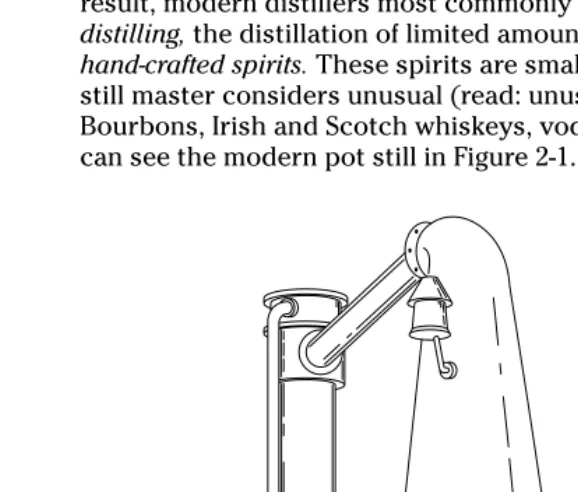
hand-crafted spirits.These spirits are small quantities of what the still master considers unusual (read: unusually good) brandies, Bourbons, Irish and Scotch whiskeys, vodkas, rums, and gins. You can see the modern pot still in Figure 2-1.
Figure 2-1: The modern pot still.
One example of this is Brown-Forman’s Woodford Reserve Kentucky Bourbon, which is made exclusively on pot stills. As a result, sampling craft whiskeys and other spirits — whether from giant distilleries or limited production brewpubs or wineries — can be an exciting experiment. Of course it can also be a waste of time and money.
The American Distilling Institute is a good source of information for fans of hand-crafted spirits. The Institute publishes its own newsletter (American Distiller), runs conferences on craft distilling, and maintains a list of reputable, fully licensed craft distillers. You have to be a member to enjoy the full range of benefits. Interested? Check it out at www.distilling.com, or send an e-mail to
[email protected]. You can also go the snail mail route by writing to American Distilling Institute, Box 577, Hayward, California, 94543-0577.
How pot stills work
To use a pot still, today’s distiller pumps the liquid from the fer-mentation tank into the still; applies heat via piped-in steam, coils, or an open fire under the still; and then collects the liquid that forms as the alcohol vapors rise through the condenser (the worm).
Actually, the distiller goes through this process twice: Distilling alcohol with a modern pot still means distilling in two pot stills (and sometimes three). They’re called wash stillsand spirits stills
depending on when they’re used in the distillation process.
The trip through the first pot still
The liquid that comes off the first still, or wash still, is called
low wine.Low wines are suitable for making spirit products because they contain substantial amounts of compounds called
congeners,which are formed during fermentation. The primary congeners are
Aromatic esters: Aroma compounds formed by chemical reac-tions between alcohol and acids
Aldehydes:Flavor and aroma compounds formed by chemical reactions between alcohol and oxygen
To obtain the alcohol he needs to make a good-tasting, pleasant-smelling, safe bottle of distilled spirits, the still master must elimi-nate all or most of these congeners. The amount of congeners the still master allows in the alcohol depends on the product in which the alcohol will be used; whiskeys have some congeners, vodkas have virtually none (and some claim no flavor at all).
The trip through the second pot still
The distiller pours or pumps the low wine from the wash still into a smaller spirits still. Once again, the still is heated, and the alcohol vapors rise to be collected and condensed into liquid alcohol called the distillate.
The distillate comes off the still in three distinct phases:
Phase 1:The foreshots(or heads) of the batch are low-boiling compounds generally not fit to drink.
Phase 2:The potable spirits(or mid-cut) of the batch is the alcohol you can drink.
Phase 3:The feintsor tailsof the batch are unpleasant, oily, smelly, bad-tasting compounds that would make the product, well, oily, smelly, and bad-tasting.
How the still master earns his big bucks
The still master’s job is to collect the distillate at exactly the right moment. In other words, like Goldilocks and her Three Bears, whose chairs, beds, and bowls were “too big, too small, and just right,” the still master must contend with distillates that are too early, too late, and just right.
These “just right” potable spirits are set aside to be bottled unblended just as they are or blended with other spirits of the same type. The too-early foreshots and too-late feints are poured back into the spirits still and put through again with the next run of low wines.
The column still
Column stills were invented in the 19th century to enable distillers to meet the growing demand for distilled spirits.
The column still’s greater capacity remains its greatest virtue. Its second selling point is that, unlike the pot still, it doesn’t have to be cleaned at the end of a distillation — a point that anyone who’s ever wanted to throw out the dinner dishes rather than wash them one more darned time will appreciate.
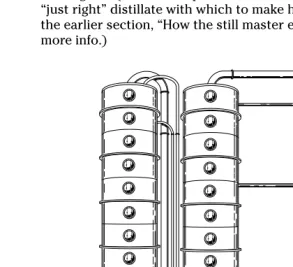
As a result, the column still predominates in large commercial dis-tilleries in producing just about any type of mass-market spirit from whiskey to rum and certainly vodka. Figure 2-2 shows a dia-gram of a typical column still.
Working the column still
The column still itself is an enormous piece of equipment that has two huge stainless steel or copper cylinders that may stand as high as a three-story building.
Inside each cylinder are perforated, heated copper or steel plates placed evenly apart. The plates at the top of the first column in the still are cooler than the plates farther down the column. As a result, when the alcohol/water wash from the fermentation tank is pumped into the column, the alcohol — which has a lower boiling point than water — boils first, producing vapors that collect near the top of the column. The vapors at the top of the column move into a cooled condenser tube where they turn back into liquid alco-hol, spilling down the tube to an opening at the bottom of the second column in the still.
If two columns are used, the second column also has heated, perfo-rated copper or stainless steel plates that are hotter at the bottom and cooler at the top. As the alcohol enters the second column, it’s
Beauty is as beauty does
again heated. The alcohol vapors rise to an opening near the middle of the second column and flow through the opening to a cooling condenser tube. From there, they spill as distillate into a holding vat. (As with the pot still, the still master must choose the “just right” distillate with which to make his spirits product; see the earlier section, “How the still master earns his big bucks,” for more info.)
Figure 2-2: The column still.
And then the distiller pours more wash into the first column, and the whole process continues without interruption. Remember: There’s no need to clean the column still between distillation ses-sions, which, of course, is why the column still is also known as the
continuous still.
Two columns or three?
To remove as many congeners as possible, some distillers — usually those making vodkas — put their wash through a still with three columns. This procedure makes it possible for them to label the finished product as triple distilled,which is a fancy way of saying, “Hey, our still has a third column and yours doesn’t.”
Does removing more congeners throu