Funded by
CARE International, United Kingdom
Oxfam Community Aid Abroad, Australia | Learning to Learn, Government of South Australia Oxfam New Zealand | Christian Aid, United Kingdom | Exchange, United Kingdom
Ibis, Denmark | Mellemfolkeligt Samvirke (MS), Denmark
The ‘Most Significant Change’
(MSC) Technique
A Guide to Its Use
by
Acronyms
4
Preface: The Structure of this Guide
5
Acknowledgements
7
Chapter One: A Ten Minute Overview of MSC
8
What is MSC, in a nutshell? 8
What’s in a name? 8
The MSC story 9
Overview of implementation steps 10
The kernel 11
The purpose 12
When and when not to use MSC 12
Where to get further information 14
Chapter Two: Ten Steps to Implementing MSC
15
Step 1: How to start and raise interest 15
Step 2: Defining domains of change 17
Step 3: Defining the reporting period 22
Step 4: Collecting SC stories 23
Step 5: Selecting the most significant of the stories 28
Step 6: Feeding back the results of the selection process 34
Step 7: Verification of stories 36
Step 8: Quantification 38
Step 9: Secondary analysis and meta-monitoring 38
Step 10: Revising the system 44
Chapter Three: Troubleshooting
46
Concerns expressed by participants 46
Concerns expressed by others 50
Chapter Four: Building Capability for Effective MSC
54
Building the capacity of MSC ‘champions’ 54
Building the capacity of the staff tp participate fully in MSC 55
Considering resources and time required 56
Chapter Five: MSC within a Monitoring and Evaluation (M&E) Framework
58
MSC within the program cycle 58
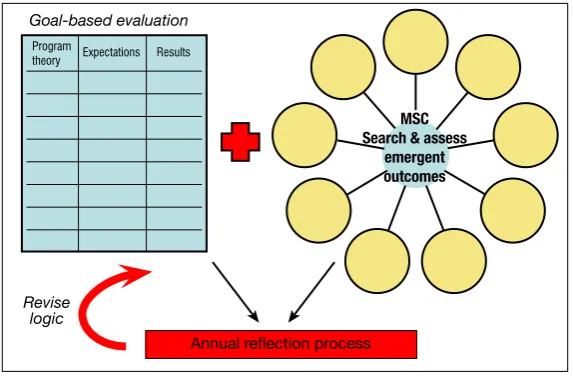
MSC as monitoring and evaluation 58
MSC as a specific type of monitoring 58
MSC as program evaluation 61
MSC and organisational learning 63
Other uses of MSC within programs 64
Chapter Six: Validity and Voice in MSC
67
MSC: a valid technique 67
Purposive sampling 69
Bias in MSC 70
Issues of voice and power in MSC 71
Chapter Seven: How MSC Compares to Other Approaches and Epistemologies
72
Appreciative Enquiry 72
Participatory Monitoring and Evaluation (PM&E) 72
Case studies and vignettes 72
Evolutionary epistemology and MSC 73
MSC under a constructivist lens 74
Chapter Eight: History of MSC
75
History as process 75
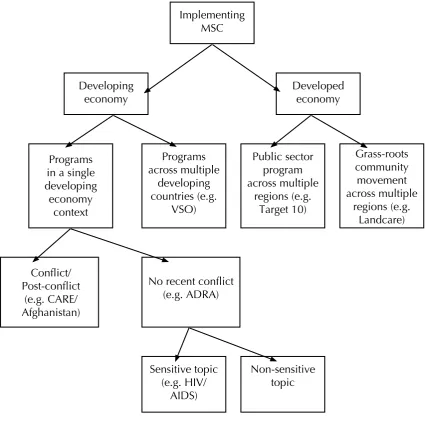
Types of MSC uses 75
The differences that make a difference 77
Chapter Nine: New Directions for MSC
81
Fine tuning 81
Combining with other approaches 82
Innovations 84
Future research areas 86
An invitation to innovate, review and communicate 87
Bibliography
88
Appendices
Appendix 1: Sample Story Collection Formats 92
Appendix 2: Sample Significant Change Stories 97
Appendix 3: Sample Story Reporting Format 103
ADB Asian Development Bank
ADRA Adventist Development and Relief Agency, Australia AKRSP Aga Khan Rural Support Program
BADSP Brong Ahafo Rural District Support Project, Ghana CCDB Christian Commission for Development in Bangladesh
CRS Catholic Relief Services
DFID Department for International Development, UK IDSS International Development Support Services, Australia M&E monitoring and evaluation
MSC most significant change (MSC) technique
NGO non-government organisation
ONZB Oxfam New Zealand
SC stories Significant change stories
VSO Voluntary Service Overseas
T
his publication is aimed at organisations, community groups, students and academics who wish to use MSC to help monitor and evaluate their social change programs and projects, or to learn more about how it can be used. The technique is applicable in many different sectors, including agriculture, education and health, and especially in development programs. It is also applicable to many different cultural contexts. MSC has been used in a wide variety of countries by a range of organisations. By 2004, MSC had been used both by NGOs and governments in Africa, Asia, Latin America, Europe and Australasia.The structure of this Guide
The introductory chapter provides a quick overview of MSC. In Chapter 2 we focus on the practicalities of implementing MSC and divide the process into ten steps. Chapter 3 offers guidance on practical troubleshooting, and Chapter 4 looks at building capacity for effective use of MSC. In Chapter 5 we examine how MSC fits into the program cycle and how it can contribute to program improvement.
After Chapter 5, we delve more into the theory. We believe that MSC can be successfully implemented without a strong understanding of the theory. So if you just want to know about the practicalities – stop there! But for those readers who enjoy a foray into theory, Chapters 6 and 7 examine validity in MSC and how it fits with other approaches and epistemologies. The final two chapters outline the evolution of MSC: where it came from and where it might be heading next.
The structure of this Guide reflects our attempt to cater for different types of use. We want the Guide to be of practical help to those choosing to implement MSC for the first time. But we also want to provide information and analysis that will be of use to those who are already experienced in using MSC yet want to extend their knowledge of the technique or refine the way they use it. As well as addressing the needs of practitioners, we also hope to address the interests of those doing research on MSC and related methods of participatory and qualitative research.
Notes about the terminology
We struggled at times in writing this Guide to find language that worked equally well in the development sector and the public sector of developed economies. We have made a few choices in the name of consistency and we encourage you to consider translating these terms to ones that makes sense for you.
Firstly, we had to decide how to refer to the people who are targeted by social change programs. In the development sector, these people are often referred to as beneficiaries. In the public sector context of developed economies, they are referred to as clients, service users or participants. In this publication we used the term ‘participant’ where the meaning is clear, and ‘beneficiary’ as a second resort.
Secondly, we needed to choose between program, project and intervention. In this publication we have chosen to use the term ‘program’ to cover all descriptions of social interventions with a beginning and an end, regardless of size.
Thirdly, we needed to describe the people who fund programs and are variously referred to as donors, investors, funders or purchasers. In this Guide we settled on the term ‘funders’. In the published literature, MSC is sometimes called an approach, at other times a process – it has even been referred to as a model. The experts have advised us that it is a monitoring and evaluation technique. However, we also believe that MSC embodies some aspects of an approach because it has a particular theoretical basis; this is discussed further in Chapter 7.
Disclaimer
This publication is based on the collective experience of Rick Davies and Jess Dart in monitoring and evaluating social programs. While we make every effort to ensure the accuracy of this work, any judgments as to the suitability of information for the reader’s purposes are the reader’s responsibility. We cannot extend any warranties, and assume no responsibility, for the suitability of this information or the consequences of its use.
Copyright and distribution
Copyright for the MSC Guide is held by the authors, Rick Davies and Jess Dart.
We are interested in making the Guide as widely available as possible. This document is freely available in pdf format from our websites at www.mande.co.uk/docs/MSCGuide.htm
and www.clearhorizon.com.au You can also download pdf copies from the sponsors’ websites.
Hard copies may be made on condition that the Guide is reproduced in full, in its existing format, and that these copies are made available free of charge, not for sale or profit. Where there is a need to reproduce parts of the Guide only, please contact us for permission to do so.
Third parties interested in selling copies of the MSC Guide should contact us for permission and to establish appropriate terms and conditions.
Copyright © RJ Davies and J Dart (2004) Please address all inquiries to:
Dr Rick Davies
82 Bishops Rd, Trumpington,
Cambridge CB2 2NH United Kingdom
Phone: 44 (0) 1223 841 367 Mobile: 44 (0) 7855 766 354 Fax (to Email): 44 08701 640 239
Dr Jessica Dart
Clear Horizon, PO Box 341, Hastings VIC 3915 Australia
This Guide would not have been written without the generous sponsorship of the following organisations.
CARE International, United Kingdom www.careinternational.org.uk
Oxfam Community Aid Abroad, Australia www.oxfam.org.au
Learning to Learn, Government of South Australia www.learningtolearn.sa.edu.au
Oxfam New Zealand www.oxfam.org.nz
Christian Aid, United Kingdom www.christian-aid.org.uk
Exchange, United Kingdom www.healthcomms.org
Ibis, Denmark www.ibis.dk
Mellemfolkeligt Samvirke (MS), Denmark www.ms.dk
Lutheran World Relief, United States of America www.lwr.org
While both authors have considerable experience of using MSC, we have also tried to make use of the growing body of grey literature on other people’s experiences with using MSC. We would like to acknowledge all the authors of this material, who are listed in the bibliography at the end of the Guide.
We would also like to thank the following for their comments on the draft version of this guide: Jay Goulden, CARE; Deborah Elkington, Oxfam CAA; Robyn Kerr, ADRA; Silke Mason, Ibis; Gillian Holmes, Ibis; Peter Sisgaard, MS.
What is MSC, in a nutshell?
T
he most significant change (MSC) technique is a form of participatory monitoring and evaluation. It is participatory because many project stakeholders are involved both in deciding the sorts of change to be recorded and in analysing the data. It is a form of monitoring because it occurs throughout the program cycle and provides information to help people manage the program. It contributes to evaluation because it provides data on impact and outcomes that can be used to help assess the performance of the program as a whole. Essentially, the process involves the collection of significant change (SC) stories emanating from the field level, and the systematic selection of the most significant of these stories by panels of designated stakeholders or staff. The designated staff and stakeholders are initially involved by ‘searching’ for project impact. Once changes have been captured, various people sit down together, read the stories aloud and have regular and often in-depth discussions about the value of these reported changes. When the technique is implemented successfully, whole teams of people begin to focus their attention on program impact.What’s in a name?
MSC has had several names since it was conceived with each emphasising a different aspect. Monitoring-without-indicators
MSC does not make use of pre-defined indicators, especially ones that have to be counted and measured.
The ‘story’ approach
The answers to the central question about change are often in the form of stories of who did
Monitoring
MSC was first developed as a means of monitoring changes in a development aid project (Davies, 1996). We think it can also be used for evaluation purposes.
Impact monitoring
Unlike traditional monitoring techniques that focus largely on monitoring activities and outputs, MSC focuses on monitoring intermediate outcomes and impact.
Evolutionary approach to organisational learning
This was the original name given to the technique by Rick. The name reflects the epistemology that informed the original design (see Chapter 7).
In 2000, we settled on the name Most Significant Change technique. This embodies one of the most fundamental aspects of the approach: the collection and systematic analysis of significant changes.
The MSC story
The most significant change (MSC) technique was invented by Rick Davies in an attempt to meet some of the challenges associated with monitoring and evaluating a complex participatory rural development program in Bangladesh, which had diversity in both implementation and outcomes. The program was run by the Christian Commission for Development in Bangladesh (CCDB), a Bangladeshi non-government organisation, which in 1996 had over 500 staff and worked with more than 46,000 people in 785 villages. Approximately 80 per cent of the direct beneficiaries were women. The large scale and open-ended nature of the activities posed a major problem for the design of any system intended to monitor process and outcome (Davies, 1996).
Rick developed the MSC technique as part of the fieldwork for his PhD on organisational learning in non-government aid organisations (Davies, 1996). Both the thesis and MSC were informed by an evolutionary epistemology. While you don’t need to know this background theory in order to use MSC, you can find out more about it in Chapter 7. It is also worth noting that Jess and others have analysed the use of MSC from different theoretical perspectives to that used by Rick. This flexibility is consistent with the underlying design of MSC.
More information on the history of the use of MSC, including Jess’s role in its promotion in Australia, can be found in Chapter 8.
Bangladesh – five years later
Overview of implementation steps
MSC is an emerging technique, and many adaptations have already been made that will be discussed throughout this Guide. Before getting into modifications, we present a comprehensive overview of what a ‘full’ implementation of MSC might look like. We have described this using ten steps.
1. How to start and raise interest 2. Defining the domains of change 3. Defining the reporting period 4. Collecting SC stories
5. Selecting the most significant of the stories 6. Feeding back the results of the selection process 7. Verification of stories
8. Quantification
9. Secondary analysis and meta-monitoring 10. Revising the system.
The first step in MSC generally involves introducing a range of stakeholders to MSC and fostering interest and commitment to participate. The next step is to identify the domains of change to be monitored. This involves selected stakeholders identifying broad domains— for example, ‘changes in people’s lives’—that are not precisely defined like performance indicators, but are deliberately left loose, to be defined by the actual users. The third step is to decide how frequently to monitor changes taking place in these domains.
SC stories are collected from those most directly involved, such as participants and field staff. The stories are collected by asking a simple question such as: ‘During the last month, in your opinion, what was the most significant change that took place for participants in the program?’ It is initially up to respondents to allocate their stories to a domain category. In addition to this, respondents are encouraged to report why they consider a particular change to be the most significant one.
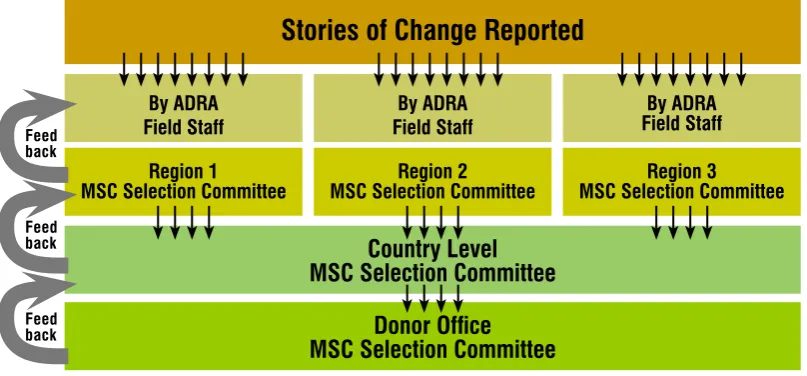
The stories are then analysed and filtered up through the levels of authority typically found within an organisation or program. Each level of the hierarchy reviews a series of stories sent to them by the level below and selects the single most significant account of change within each of the domains. Each group then sends the selected stories up to the next level of the program hierarchy, and the number of stories is whittled down through a systematic and transparent process. Every time stories are selected, the criteria used to select them are recorded and fed back to all interested stakeholders, so that each subsequent round of story collection and selection is informed by feedback from previous rounds. The organisation is effectively recording and adjusting the direction of its attention – and the criteria it uses for valuing the events it sees there.
After this process has been used for some time, such as a year, a document is produced with all stories selected at the uppermost organisational level over that period in each domain of change. The stories are accompanied by the reasons the stories were selected. The program funders are asked to assess the stories in this document and select those that best represent the sort of outcomes they wish to fund. They are also asked to document the reasons for their choice. This information is fed back to project managers.
accurately and honestly, and to provide an opportunity to gather more detailed information about events seen as especially significant. If conducted some time after the event, a visit also offers a chance to see what has happened since the event was first documented. The next step is quantification, which can take place at two stages. When an account of change is first described, it is possible to include quantitative information as well as qualitative information. It is also possible to quantify the extent to which the most significant changes identified in one location have taken place in other locations within a specific period. The next step after quantification is monitoring the monitoring system itself, which can include looking at who participated and how they affected the contents, and analysing how often different types of changes are reported. The final step is to revise the design of the MSC process to take into account what has been learned as a direct result of using it and from analysing its use.
The kernel
The kernel of the MSC process is a question along the lines of:
‘Looking back over the last month, what do you think was the most significant change in [particular domain of change]?’
A similar question is posed when the answers to the first question are examined by another group of participants:
‘From among all these significant changes, what do you think was the most significant change of all?’
This process provides a simple means of making sense of a large amount of complex information collected from many participants across a range of settings.
Telling each level about the choice of significant changes made at the higher levels is an essential component of the whole process. This helps readjust the focus of searches for significant change in each subsequent reporting period.
Figure 1. e MSC selection process (example from ADRA Laos)
Feed back
Stories of Change Reported
By ADRA
Field Staff Field StaffBy ADRA Field StaffBy ADRA Region 1
MSC Selection Committee MSC Selection CommitteeRegion 2 MSC Selection CommitteeRegion 3
Country Level
MSC Selection Committee
Donor Office
MSC Selection Committee
FeedThe purpose
There are several reasons why a wide range of organisations have found MSC monitoring very useful and these include the following.
1. It is a good means of identifying unexpected changes.
2. It is a good way to clearly identify the values that prevail in an organisation and to have a practical discussion about which of those values are the most important. This happens when people think through and discuss which of the SCs is the most significant. This can happen at all levels of the organisation.
3. It is a participatory form of monitoring that requires no special professional skills. Compared to other monitoring approaches, it is easy to communicate across cultures. There is no need to explain what an indicator is. Everyone can tell stories about events they think were important.
4. It encourages analysis as well as data collection because people have to explain why they believe one change is more important than another.
5. It can build staff capacity in analysing data and conceptualising impact.
6. It can deliver a rich picture of what is happening, rather than an overly simplified picture where organisational, social and economic developments are reduced to a single number.
7. It can be used to monitor and evaluate bottom-up initiatives that do not have predefined outcomes against which to evaluate.
When and when not to use MSC
MSC is better suited to some program contexts than others. In a simple program with easily defined outcomes (such as vaccination, perhaps), quantitative monitoring may be sufficient and would certainly consume less time than MSC. In other program contexts, however, conventional monitoring and evaluation tools may not provide sufficient data to make sense of program impacts and foster learning. The types of programs that are not adequately catered for by orthodox approaches and can gain considerable value from MSC include programs that are:
• complex and produce diverse and emergent outcomes • large with numerous organisational layers
Myanmar – senior staff hear results first-hand
• focused on social change • participatory in ethos
• designed with repeated contact between field staff and participants
• struggling with conventional monitoring systems
• highly customised services to a small number of beneficiaries (such as family counselling).
Monitoring and evaluation in an organisation may serve several purposes. MSC addresses some purposes more than others. In our experience, MSC is suited to monitoring that focuses on learning rather than just accountability. It is also an appropriate tool when you are interested in the effect of the intervention on people’s lives and keen to include the words of non-professionals. In addition, MSC can help staff to improve their capabilities in capturing and analysing the impact of their work.
There are also some instances where the benefits may not justify the cost of MSC. While MSC can be used to address the following, there may be other less time-consuming ways to achieve the same objectives:
• capture expected change
• develop good news stories for public relations (PR)
• conduct retrospective evaluation of a program that is complete • understand the average experience of participants
• produce an evaluation report for accountability purposes • complete a quick and cheap evaluation.
Some program contexts are more conducive to the successful implementation of MSC. In our experience, some of the key enablers for MSC are:
• an organisational culture where it is acceptable to discuss things that go wrong as well as success
• champions (i.e. people who can promote the use of MSC) with good facilitation skills
• a willingness to try something different • time to run several cycles of the approach
• infrastructure to enable regular feedback of the results to stakeholders
Where to get further information
The bibliography section of this Guide contains a range of references and suggestions for further reading.
For continuing access to information about MSC, including new usages and the experiences of existing users, you might like to join the Most Significant Changes mailing list at
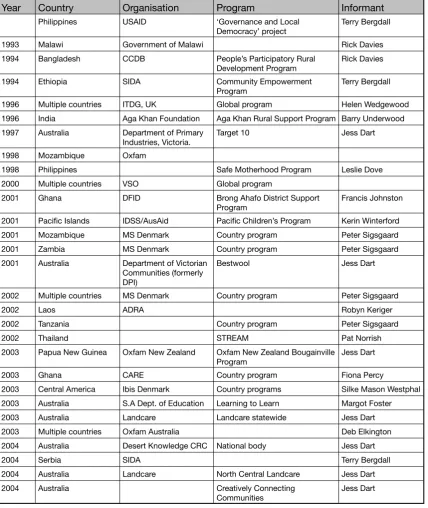
http://groups.yahoo.com/group/mostsignificantchanges. This was set up by Rick in 2000 and now has more than 200 members. The mailing list has a files section that contains information on MSC usage in a range of organisations and countries from 1993 to the present.
Learning about the past quickly – Fortune Magazine
“If you knew what was going to happen in advance every day you could do amazing
things. You could become insanely wealthy, influence the political process et cetera.
Well, it turns out that most people don’t even know what happened yesterday in
their own business. So, a lot of businesses are discovering they can take tremendous
competitive advantage simply by finding out what happened yesterday as soon as
possible.”
(Steve Jobs, 1994:23)
USA – using MSC for small, individualised programs
B
efore we elaborate on the individual steps, it is worth considering which steps are fundamental, and which are discretionary. We believe that out of the ten MSC steps, steps 4, 5 and 6 fundamentally define the process.• collection of SC stories (Step 4)
• selection of the most significant of these stories by at least one group of stakeholders (Step 5)
• feedback to relevant stakeholders concerning which SC stories were selected and why they were selected (Step 6).
Whether the other steps are included will depend on the organisational context and purpose for implementing MSC.
Step 1: How to start and raise interest
Getting started is perhaps the most daunting step. People may be sceptical about the validity of the technique and fear that it will take too much time.
It often takes an enthusiastic individual or small group to raise interest in MSC. This can involve visiting key people and groups and showing them the methodology. It can often help to present stories from other programs and to show example reports. The message to be conveyed is that MSC is simple and straightforward to implement. Many practitioners will not need to understand the theory behind MSC.
If you want to raise interest in MSC, you need to be clear about the purpose of MSC and the role it will play in your organisation (see Chapter 4). We emphasise that MSC is not a stand-alone technique for monitoring and evaluation (see Chapter 6).
Chapter Two:
Ten Steps to Implementing MSC
In this chapter, we discuss how to implement MSC using the following steps: 1. Getting started: establishing champions and getting familiar with the approach 2. Establishing ‘domains of change’
3. Defining the reporting period 4. Collecting stories of change
5. Reviewing the stories within the organisational hierarchy
6. Providing stakeholders with regular feedback about the review process 7. Setting in place a process to verify the stories if necessary
8. Quantification
For potential MSC adopters and users who want to know more about the theory, Chapter 7 sets out the underlying ideas and explains how and why the MSC approach differs from other approaches.
Metaphors for explaining the approach
If you are the person attempting to initiate the adoption of MSC, it may help to use a metaphor to explain it. These are our favourites.
Newspaper
A newspaper does not summarise yesterday’s important events via pages and pages of ‘indicators’ (though they can be found in some sections) but by using news stories about interesting events. Papers are structured into different subject areas (foreign news, domestic news, financial news, sport, leisure) in the same way that MSC uses domains. The most important stories go on the front page and the most important of these is usually at the top of the front page.
School of fish
A social change program has numerous practitioners (fish) swimming in slightly different directions, each with individual values but a common goal. MSC helps the individual fish to communicate with each other: ‘Where do we really want to go? Should we swim away from the sharks and towards a safe place to lay our eggs or first head for food?’ MSC uses communication to help all the fish swim in roughly the same direction, away from what is not good and towards what is good. It helps them swim as a school towards a commonly valued destination.
Another related metaphor is of the organisation as an amoeba, extending in directions where it wants to go, and withdrawing from areas it does not like, all on the basis of the signals being received from its surrounding environment.
Holiday memories
What do you remember from an overseas holiday? Do you remember the average things or the wonderful and terrible things? MSC helps teams of people focus on the memorable eventsand uses these events to help realign effort towards achieving more of the wonderful things and less of the terrible things. When the focus is on learning, we need to capture more than just the average experiences.
Restaurant menu
MSC does not present one version of what is happening but a series of glimpses of what a program is achieving. Stakeholders can select from these glimpses in much the same way as they would select food from a restaurant menu. Choices are based on individual preferences. In the MSC restaurant, you are asked to try and articulate the reasons for your choice. Because the restaurant has a very responsive chef, the choices your table makes will encourage the chef to present a revised menu to the next groups of customers.
Getting familiar with the approach
When piloting MSC, try to begin with the people and sections of your organisation that are most interested and enthusiastic about its potential.
Role of champions
Once the pilot is complete and there is sufficient interest, start working out where MSC might best fit in your organisation. Even in these early stages, it is worth identifying key people who are excited by MSC and could champion the technique and act as catalysts in the process. These people can be involved in designing how to implement MSC across the organisation. They will need a greater understanding of MSC so they can respond to the questions that will inevitably arise.
These champions can:
• excite and motivate people
• answer questions about the technique • facilitate selection of SC stories
• encourage people to collect SC stories • ensure that feedback occurs
• ensure that the stories are collected and organised and sent to review meetings
• develop protocols to ensure confidentiality where necessary.
Step 2: Defining domains of change
What are domains of change?
Domains are broad and often fuzzy categories of possible SC stories. In CCDB, participants in MSC were asked to look for significant changes in four domains:
• changes in the quality of people’s lives
• changes in the nature of people’s participation in development activities • changes in the sustainability of people’s organisations and activities • any other changes.
Pacific Islands – gaining donor acceptance
“In preparing the M&E framework, IDSS followed best practice, meeting donor
A domain of change is not an indicator. Good indicators are supposed to be SMART (specific, measurable, achievable, relevant and time-bound). Indicators must be defined so that everyone interprets them in the same way. Domains of change, on the other hand, are deliberately fuzzy to allow people to have different interpretations of what constitutes a change in that area.
How to use domains
Using domains of change has immediate practical value. It helps organisations to group a large number of SC stories into more manageable lots, which can each be analysed in turn. A benefit of determining the domains in advance is that they can provide some guidance to the people collecting stories concerning the kind of changes they need to be searching for without being too prescriptive.
A second reason to use predetermined domains is that many organisations want to use MSC to help track whether they are making progress towards their statedobjectives. For example, CCDB wanted poor communities in Bangladesh to become less poor (i.e. improved quality of life), to actively participate in development activities in their communities, and for those activities and supporting organisations to be sustainable. But because CCDB believed each local community should individually define these goals in more detail, they did not want to monitor these developments using very specific indicators of change that might not apply to all communities. So they adopted three general categories of change (domains) associated with the quality of people’s lives, the nature of people’s participation and the sustainability of people’s organisations and activities.
The ‘open window’ domain
Negative changes
One choice facing organisations implementing MSC is whether to have a domain that explicitly focuses on significant negative changes. Our experience suggests that 90 to 95 per cent of SC stories within these types of domains tend to be about positive changes. However, this figure varies according to how clearly those in charge signal that negative as well as positive changes should be reported. It also depends on the extent to which negative changes, once reported, are then acknowledged and responded to positively. Some organisations have set up a domain specifically for negative stories, thus creating an explicit demand. In the case of Target 10, a major dairy industry extension program in Victoria, Australia, this extra domain was called ‘lessons learned’. This put a positive spin on the existence of negative changes and emphasised the need to extract value from such events. ADRA Laos took a similar approach, using an extra domain called ‘changes that reflect an area to improve (negative)’.
Types of domains
Many MSC users have focused on changes in the lives of individuals. In some cases this was because individuals were the focus of the program’s over-arching objectives. Another reason is because focusing on people’s lives overcomes the problem of quantitative and indicator-based monitoring systems that focus on activities and outputs.
However, some users of MSC, including CCDB, have used domains that focus on more than one unit of analysis, i.e. on more than individuals. CCDB asked about significant changes in the sustainability of people’s institutions and MS Denmark asked about organisational performance. Others, such as the Landcare support program in Australia, have included domains that focus on changes in whole communities or in policy. Oxfam New Zealand asked about changes in partnerships. Most of these are people-centred domains, which we believe are more likely to be understood by participants than those domains that focus on abstract processes.
How many domains should be used?
In our experience, between three and five domains is a manageable number. The limiting factor is how much time participants are willing to spend in discussing each domain. Participants may find the process too time-consuming if it takes more than two hours to review changes in all the domains in any one meeting.
Mozambique – difficulty with conceptual domains:
Are domains essential?
Domains are not essential. MSC stories can be collected and analysed as a group (see Step 5 below) without first being categorised into domains. Participants can be asked to go out and look for significant changes without being given guidance in the form of specific domains of concern. With smaller organisations where there are likely to be fewer SC stories to examine, the MSC approach will probably be easier without domains.
In organisations such as VSO, field staff are asked to identify and document MSC stories of any kind. It is only when the stories reach the country office level that they are categorised into domains that are of concern to the country office and to VSO headquarters in UK. Letting middle and upper level staff within an organisation categorise MSC stories into domains produces some incidental benefits. If the domains are focused on organisational objectives, then the sorting decisions tell the rest of the organisation how those staff interpret the meaning of those objectives.
At the field level, especially where program participants are involved in identifying and selecting MSC stories, it may be useful to start without specifying domains. Instead, see what sort of stories are generated and valued by the beneficiaries, and then divide these into appropriate domains or have the beneficiaries do so. The choice depends on the extent to which the organisation using MSC wants to be led by its participants rather than its own objectives.
What should domains focus on?
One question that often arises is whether the domains of change should only be about changes caused by the organisation that is using MSC, or include changes caused by other people, organisations or influences in general. For example, increased participation by individuals could result from changes in government legislation relating to the right to free
Gujarat – classification brings debate
“In these meetings, the changes noticed were classified under three headings and sent
up to the HQ level. In the whole exercise the cluster staff participated with great
enthusiasm and debates ensued with regards to classification of changes.”
(Barry
Underwood, 1996, AKRSP)
South Australia – deciding not to set predetermined domains
association rather than anything to do with the organisation’s own activities. Nevertheless, in most societies, such changes would be considered significant.
In practice, most users of MSC have focused on changes that are a direct or indirect result of what their organisations are doing. There is, however, an argument for saying that many organisations already see the world too narrowly, and that it would be healthy to identify SCs arising from any cause.
These options do not need to be mutually exclusive. It should be possible to track both types of changes through the one application of MSC. One or more domains could be about changes caused by the organisation’s work, while another could ask specifically about changes not caused or influenced by the organisation.
Doing so would help provide what Chris Roche (1999) has described as a ‘project out’ and a ‘context in’ perspective.
Who should be involved in determining domains?
In some organisations, existing commitments to the pursuit of specific objectives are likely to lead to the use of domains based on program objectives. Hopefully they will already be well-known and owned by the staff and clients. Where there is more freedom to select the domains, using a participatory process to identify appropriate domains is likely to encourage all participants to take a more active interest in the MSC process and its products.
Different techniques for developing domains
Domains can be identified by a top-down or bottom-up process, i.e. by the senior managers of an organisation or by its beneficiaries, or though a wider process encompassing other stakeholders as well. In the case of CCDB, the four domains were identified by Rick through consultations among the five most senior staff. In the case of Target 10, Jess used the Delphi technique1 to identify four domains of change through consultations with 150
program stakeholders The Delphi technique is a form of interactive (postal) surveying that utilises an iterative questionnaire and feedback approach to provide participants with an opportunity to revise earlier views based on the responses of other participants until some desired level of consensus is reached.
Oxfam CAA – lessons from impact assessments
“Related to these specific findings was the broad observation that even the most
successful community development programs should be aware of the context in which
they are situated ... For example, a group of waste-picker women who had enormous
success in empowerment that led to significant changes to their working and living
conditions, were having their livelihoods threatened by a proposed privatisation of
waste management in their city. is change in urban waste management policy had
the potential to undermine the strong empowerment results that had been achieved.
A broader advocacy campaign on waste management may be required to address the
rights of these women.”
(Linda Kelly, Patrick Kilby, Nalini Kasynathan, 2004)
Domains can be identified before SC stories are collected or afterwards by sorting SC stories into meaningful groups (see above). This depends on the extent to which the organisation wants to be open to new experiences rather than continuing to be guided by past experiences.
Any documentation about the MSC process and its products should explain, albeit briefly, how the domains were selected. This helps other people reading about the results to put them in context.
Step 3: Defining the reporting period
Most applications of MSC have been as a form of monitoring. Monitoring involves periodic collection of information, but the frequency of monitoring varies across programs and organisations. The same applies with uses of MSC. The frequency of collection of SC stories has varied from fortnightly to yearly. The most common frequency has probably been three-monthly, coinciding with the prevalence of quarterly reporting in many organisations. Low frequency reporting, such as the yearly reporting used by VSO, runs the risk of staff and project participants both forgetting how the MSC process works, or why it is being used. At the very least it means there is likely to be a slow process of learning how to use MSC, and an equally slow process of organisational learning that is being stimulated by MSC. On the other hand, a yearly cycle might require less time and resources and may be appropriate in certain contexts.
With higher frequency reporting, all the participants in the MSC process are likely to learn more quickly how to best use the process. However, frequent reporting will soon lead to the exhaustion of known cases of longer-term significant change and a focus on the shorter-term significant changes that can be identified. Frequent reporting will also increase the cost of the process, in terms of the amount of participants’ time taken up by the process. Each organisation using MSC has to make its own decision about the most appropriate reporting period, balancing the costs and benefits involved, and taking into account the reporting gaps that any existing M&E systems may be ignoring.
Our experience suggests that organisations tend to start MSC with more regular reporting and decrease the frequency as the process continues. In the Bangladesh (CCDB) case, SC stories were selected every two weeks for the first two months. This was followed by monthly selection, which was changed to three-monthly at the end of the first two years. In the Victorian case (Target 10), the initial monthly selection process eventually evolved into a three-monthly selection.
Victoria: a bottom-up approach for developing domains
When you first introduce the MSC process, there may be a whole backlog of SC stories that people are keen to document. As implementation proceeds, these historical stories are exhausted and subsequent SC stories tend to refer to more recent events. This change may be accompanied by a decrease in the quantity of stories that are generated.
Step 4: Collecting SC stories
Eliciting SC stories
The central part of MSC is an open question to participants, such as:
‘Looking back over the last month, what do you think was the most significant change in the quality of people’s lives in this community?’
This example is taken from CCDB, which was the first organisation to use MSC monitoring, in Rajshahi, Bangladesh, in 1994. The question has six parts:
1. ‘Looking back over the last month…’– It refers to a specific time period.
2. ‘…what do you think was...’ – It asks respondents to exercise their own judgment.
3. ‘…the most significant…’ – It asks respondents to be selective, not to try to comment on everything, but to focus in and report on one thing.
4. ‘…change…’ – It asks respondents to be more selective, to report a change rather than static aspects of the situation or something that was present in the previous reporting period.
5. ‘…in the quality of people’s lives…’ – It asks respondents to be even more selective, not to report just any change but a change in the quality of people’s lives. This tag describes a domainof change and can be modified to fit other domains of change. For example, another one of CCDB’s MSC questions referred to a change ‘in people’s participation’.
6. ‘…in this community?’ – Like the first part of the sentence, this establishes some boundaries. In this particular case we are not asking about people’s lives in New York or Alaska, but in Rajshahi. This part can also be adjusted.
Ghana – the need for current stories
How to capture SC stories
There are several ways in which SC stories can be identified, then documented. The choice of method depends in part on how actively the organisation wants to search for new SC stories, versus its need to tap into the existing knowledge of its field workers through retrospective inquiry. Active searching is likely to be more demanding in terms of the amount of the participant’s time that is required, unless their time is already available via existing processes of stakeholder participation (see below). Active searching through purposive interviews also runs the risk of producing ‘expected’ accounts of change by the respondents.
Fieldworkers write down unsolicited stories that they have heard
In this case, fieldworkers document unsolicited stories they have heard in the course of their work. This technique was used in the CCBD example. The implicit assumption here was that good CCDB fieldworkers should come to learn about change stories in the normal course of their work because they have daily and close contact with their beneficiaries. If they cannot find such SC stories this itself may signal something about the quality of their work. Here MSC is incidentally monitoring the staff as well as the lives of the organisation’s beneficiaries (see the section on meta-monitoring below)
By interview and note-taking
Some organisations encourage nominated people to ‘interview’ beneficiaries and write comprehensive notes by hand. To strengthen this method, interviewers read their notes back to the storyteller to check they have captured the essence of the story. The story is more valid if it is recorded in the storyteller’s own words. The technique can be improved by using a semi-structured interview guide such as provided in Appendix 2. Such interviews can be a useful way of generating many SC stories in a short time through the efforts of a group of people who are dedicated to the task. Stories may also be captured using a tape recorder and then transcribed. This proactive method of identifying SC stories may be especially useful when MSC is being used for evaluation rather than monitoring processes (see Chapter 7).
During group discussion
Rather than having one person interviewing another, a group of people can share their SC stories. In the case of Target 10, sharing stories at committee meetings often triggered additional stories from other farmer stakeholders who were present. It is a very human thing to respond to a story with a second one! For this reason, a tape recorder was used at these meetings to record spontaneous SC stories. This can be a very fruitful and enjoyable way of collecting stories. Stories collected in a group situation can also be documented using pen and paper.
The beneficiary writes the story directly
What information should be documented?
Information to be documented should include:
1. Information about who collected the story and when the events occurred 2. Description of the story itself – what happened
3. Significance (to the storyteller) of events described in the story.
Documenting who collected the story and when helps the reader put the story in context and enables any follow-up inquiries to be made about the story, if needed.
The SC story itself should be documented as it is told. The description of the change identified as the most significant should include factual information that makes it clear who was involved, what happened, where and when. Where possible, a story should be written as a simple narrative describing the sequence of events that took place.
Nicaragua – testimonies rather than stories
The storyteller is also asked to explain the significance ofthe story from their point of view. This is a key part of MSC. Some storytellers will naturally end their stories this way, but others will need to be prompted. Without this section, people reading and discussing the story may not understand why the story was significant to the storyteller. For example, a woman may tell a story about going to a community meeting and sitting at the back and asking a question. ‘So what?’ you may think. She then tells you that this story was significant because she had not previously had the confidence to go to a community meeting, and that the program helped her gain the confidence to express her views in front of the village elders for the first time.
Optional things to document
A useful addition to an SC story is a headline or title similar to what might be used in a newspaper article. This can be a convenient handle for participants to use to refer to the story when comparing it to others. It can also help the writer distil and communicate the essence of what happened.
In the case of CCDB, the question ‘Why is this significant to you?’ was followed by an additional question ‘What difference has this made now or will it make in the future?’ Asking at the end of the story about recommendations or lessons learned can help to draw out the implications of the story. Responses to these additional questions can be placed in the section that describes the significance of the story.
How long should the stories be?
Most MSC stories we have seen are a page or less in length, with some being up to two pages. Shorter MSC stories are quicker and easier to read, but they should not be so short that vital information is left out. Different organisations tend to favour different lengths of stories, depending on their culture. Some organisations value short and to-the-point accounts of change, while others favour epic accounts told in an engaging manner. The selection process will favour stories that fit with organisational values, and this is to be encouraged as long as the stories are detailed enough to allow for some verification.
Reporting forms
Several organisations have developed standard formats for documenting stories. Some examples are provided in the Appendices. This helps to ensure that important details are not omitted. However, it is important that the form is not too complex. The more complex the form, the harder it is to motivate people to use and appreciate MSC. The essence of the technique is to ask a couple of simple open-ended questions – you do not require a structured questionnaire.
It is important though to capture sufficient detail. People who tell MSC stories often assume that other people reading their stories will have all the background knowledge. Watch for assumptions about background knowledge and encourage the writer to make it more explicit. When people give hazy or unspecific answers, this may be because they think their readers will know all the background, or they may simply not have all the details. The more specific and detailed the MSC account is, the more credible it will be, partly because it will be easier to verify.
encounter a hazy story, you could choose not to select that story and advise storytellers that stories need to be more specific. This will give storytellers a better idea of what is required. In this way the stories can become clearer and more focused with every round of collection and feedback.
Whose stories to collect?
Deciding which people to ask to tell SC stories depends on the organisational context and the subject matter of the domains. For example, for a domain concerning changes in people’s lives, appropriate people to ask for stories would be the beneficiaries themselves, or the people who interact with them, such as grassroots workers.
However, for a domain about ‘changes in partnerships and networks with other NGOs’, the best storytellers are likely to be program staff and staff from partner organisations who are in a position to comment.
The context of the project or program will also affect whose stories should be collected. If the organisation is community-based and accountable to donors, it may be most appropriate for their members to run the MSC process themselves, i.e. to share SC stories, select the most significant ones and document them along with the reasons for their choice.
Experience suggests that stories narrated by beneficiaries are especially valuable but are often the most difficult to elicit. Ideally, beneficiary groups would be trained in sharing and selecting SC stories, and would report their selected story along with the reasons for their choice. However, in some contexts this is not practical, and the storytellers by default will be the fieldworkers. (See Step 6 for a discussion about the benefits and risks of having beneficiaries involved in the feedback process.)
Even when the stories are to come directly from the communities, it often helps to start off by first collecting stories from fieldworkers. This helps to ensure that staff understand the process before introducing it to others.
Individual stories versus situational stories
We are often asked whether situational or group stories are permitted in MSC. A situational story describes a change in a community or group, rather than being focused on an individual. Any form of SC story is permissible in MSC. The choice will depend on what the organisation using MSC is looking for: individual changes, group changes or institutional changes. These options were discussed in Step 2 above in connection with choice of
Papua New Guinea – whose voices?
domains. Because beneficiaries may not be aware of changes that are occurring in more than one location, it is useful to also seek stories from field staff as well.
In one UK aid organisation, middle-level managers were allowed to submit their own SC stories, which could be about larger scale and program-level changes. After a review, however, it was realised that these staff tended to use the MSC process as just another reporting channel. They wrote the same way as they did in their normal reports and did not describe or explain any significant events in detail, preferring to offer bullet points and general discussions of changes taking place. The lesson from this is that those who are closest to where the changes are occurring or intimately involved in the program are more likely to be able to narrate useful stories that tell us things we don’t already know.
Ethics of collecting stories
Attention must be paid to the ethics of collecting stories from individuals. We suggest that you develop processes to track consent right from start. When a storyteller tells a story, the person collecting the story needs to explain how the story is to be used and to check that the storyteller is happy for the story to be used. The storyteller should also be asked whether they wish their name to accompany the story. If not, names need to be deleted from the story from then on.
If a person or group is mentioned or identifiable within a story not told by them, ask the storyteller to consult with the third party to check whether they are happy for their name to be mentioned in the story. If a storyteller wants to tell a story about a third party without naming that person, the identity of that person should be protected.
It is also worth noting that in some countries, including Australia, children under a certain age cannot be interviewed without parental consent.
If a storyteller believes that their story is only going to be used for monitoring and evaluation purposes, it would be unethical to publish the story in the local paper without consulting the storyteller. Even when consent has been given, it is good practice to check with storytellers before placing any stories in external media such as newspapers.
One way of making sure that ethical considerations are observed is to have a ‘tick box’ on the reporting form to prompt the person recording a story to ask for the consent of the storyteller. Appendix 2 gives an example.
Step 5: Selecting the most significant of the stories
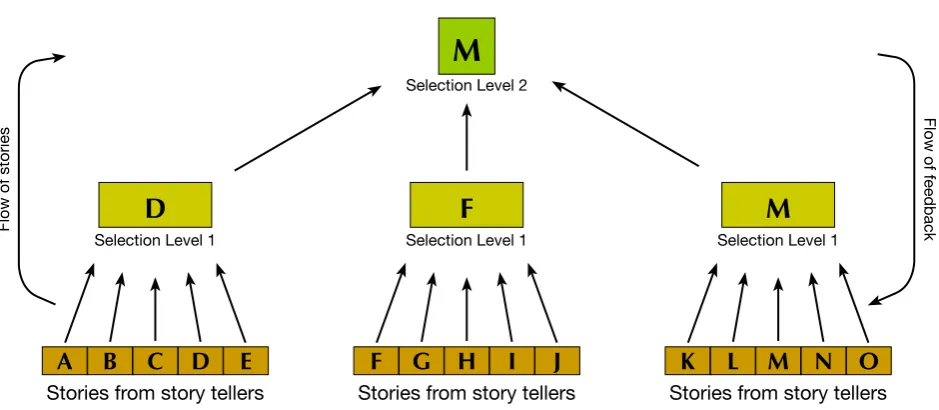
The MSC approach uses a hierarchy of selection processes. People discuss SCs within their area and submit the most significant of these to the level above, which then selects the most significant of all the SCs submitted by the lower levels and passes this on to the next level. The diagram below (Figure 2) illustrates this process.
This hierarchical process can be structured in different ways. One way is for the structure to ‘ride on the back’ of the existing organisational structure. Another way is to set up specific structures for selecting SCs.
Most organisations have a hierarchical structure with lots of field staff and one chief executive. It makes practical sense to use this existing organisational structure to organise the selection process. SC stories can be examined in the course of meetings already scheduled for related purposes (such as quarterly and annual review meetings held in local and head offices) rather than having to plan special events specifically for the analysis of SC stories. This also helps ensure that staff at all levels of the organisation are involved in analysing SC stories. MSC can also make use of pre-existing mechanisms for engaging with other stakeholders. For example, the Target 10 MSC process used the pre-existing stakeholder steering committees at regional and statewide levels.
A second reason for using existing structures is that the process of selecting SC stories can help reveal the values of those within the organisation’s authority structure and open these up to discussion and change.
On the other hand, creating new structures for selecting SC stories can be useful where a broader perspective is needed, or where the perspectives of different stakeholder groups need to be highlighted. VSO brought senior staff members from different sections (e.g. marketing, finance, programs) together in a single SC selection group. In CCDB, the annual roundtable meeting with donors made use of five different SC selection groups representing beneficiaries, junior staff, senior staff and two donor groups.
Before planning a complex SC selection process, we urge you to trial the technique in a small way. Once you have trialled the technique and are ready to design an organisation-wide structure, there are several things you may need to consider.
• How many levels of selection will there be above the field staff who initially document the SC stories? This usually depends on the number of layers of management that already exist within the organisation.
A
B
C D
E
F
G H
I
J
K
L
M N O
D
F
M
M
Stories from story tellers Selection Level 1
Selection Level 2 Figure 2. Flow of stories and feedback in MSC
Stories from story tellers Stories from story tellers
Selection Level 1 Selection Level 1
Flow of stories
• At each of these levels, how many separate selection processes will there be? This will depend on the number of separate offices at each level (based on location or specialisation).
• In each of these levels, how many SC stories can be managed by the staff involved? It is unrealistic to expect staff to meet and work on the selection of SC stories for more than two hours at the most. If there are four domains of change to review, this means 30 minutes for each. Within each domain, aim to read through and discuss no more than 10 SC stories.
• Who should participate in each selection process? This aspect is covered in more detail below.
• How often should selection occur? Normally this choice would be dependent on the frequency with which SC are collected (see Step 3).
While the initial SC stories might be identified by individual fieldworkers, the selection processes at each level in the hierarchy normally involve groups of people, not individuals. The selection process should involve open debate rather than solitary decision-making.
Who should be involved in the selection process?
At a minimum, it should be people with line management responsibilities in relation to the people who have forwarded the SC stories. It would be preferable to also include people with advisory responsibilities in relation to the same staff as well as others who would normally make use of information coming from the people who forwarded the stories. The uppermost level would ideally involve donors, investors and other stakeholder representatives.
Although there are many reasons to involve beneficiaries in the selection and feedback process, there are also some risks to be considered. Firstly, beneficiaries’ time may not be paid for in the same way as field staff and so asking beneficiaries to collect and select stories could be seen as an unethical imposition.
by themselves. Selection appears to be easier when the stories have been written by different people. The acceptability of self-selection seems to depend on the culture of the organisation. When in doubt, it may be better to design a structure so that most of the SC stories are selected by people other than those who wrote them.
In some cases, including CCDB, the people involved in documenting SC stories have also been involved in the subsequent selection process at the district level, along with their managers. But at the Dhaka level, the next level up, only the senior staff were involved in the selection process.
How to select stories
Story selection usually involves a group of people sitting down together with a pile of documented stories that may or may not be assigned to domains. The task is to reduce the pile of stories to one per domain. For each domain the group will select a story that they believe represents the most significant change of all. If the stories have not been assigned to domains, this is the one of the first jobs to be done.
The selection process invariably begins with reading some or all of the stories either out loud or individually. We tend to prefer reading the stories aloud, as it brings the stories to life, but the effectiveness and practicality of this may depend on the context. If the stories have already been allocated to domains, then all the stories from one domain are considered together. Various facilitated and unfacilitated processes can be used to help groups choose the most significant of the stories. Then the reasons for the choice are documented. We encourage you to experiment with different selection processes to find what best suits your cultural context. While various processes can be used, the key ingredients to story selection are:
• everybody reads the stories
• the group holds an in-depth conversation about which stories should be chosen
• the group decides which stories are felt to be most significant • the reasons for the group’s choice(s) are documented.
Ghana – discomfort with story selection
Criteria for selecting SCs
One choice that must be made is whether to identify criteria for selecting stories before or after reading them. If the criteria are agreed beforehand, the process of learning (via selection of SCs) will be significantly influenced by what the organisation already thinks it knows. When the selection criteria are not discussed until after the stories have been read, the process becomes much more open to new experiences. Personal preferences may also be relevant. People vary in their degree of personal comfort about making judgments with or without predefined criteria. Although there is a choice here, we believe that if MSC is being used to aid organisational learning, the selection criteria should not be decided in advance but should emerge through discussion of the reported changes.
There are several ways of reaching a decision about which stories to select. Majority rules
A simple way of coming to a decision is to read the stories, make sure everyone understands them, and then vote by show of hands. The main risk is that a choice will be made without any substantial discussion. Arguments about the merits of different SCs are important because they help to reveal the values and assumptions behind people’s choices. Only when this is done can participants make more informed choices about what is really of value.
Iterative voting
In iterative voting, after the first vote, people discuss why they voted as they did. This is followed by a second and then a third vote, ideally with some movement towards consensus. In some cases, the participants who disagree with the majority view will eventually decide to agree. Where they are unwilling to do so, their dissenting views can be recorded as an important caveat to the group’s main judgment: for example, about an aspect of the story that was unclear or contradicted the main point of the story. Where groups remain more evenly split in their opinions, two stories may need to be chosen. Iterative voting can be time-consuming, but it fosters good quality judgments.
Scoring
Instead of voting, participants can rate the value of a SC story. The ratings for each of the stories are then aggregated and the story with the highest rating is selected as the most significant. This is a more discriminating way of summarising judgments than a simple show of hands. It is also a method that can be used remotely, as well as in face-to-face meetings. The downside is the limited opportunity for dialogue, although explanations for ratings can be given at the same time as the ratings. Explanations are especially important when a participant rates an SC story much higher or lower than other participants.
Pre-scoring then a group vote
Secret ballot
It is also possible to cast votes anonymously. Each person writes their choice of SC story on a slip of paper, and then the total votes are presented. This should be followed by an open discussion of the reasons for the choices. This process can be surprisingly useful, especially if there are power inequalities in the group, or if people are initially reluctant to cast their votes publicly.
It is important to remember that in MSC, transparency is an important way of making subjectivity accountable. Therefore, it is very important to add the second step of capturing and discussing the reasons for choice.
To facilitate or not?
Facilitation can speed up the story-selection process and ensure equal participation by group members. In some situations, an outside facilitator can be very useful. In the Target 10 implementation of MSC, all the story sessions were run by trained facilitators. The facilitation process used by Target 10 is described in Appendix 4.
It might not always be possible or appropriate to facilitate story selection. In small, informal groups, it may not be necessary.
Documenting the results of the selection process
The reasons for selecting an SC story as the most significant should be documented and attached to the story following the explanations given by people who initially documented the story. The SC and the explanations for its selection are then sent on to the next level of the selection process, if there is one. The results of the selection process should also be fed back to all the people who provided SCs for review. Explanations that are not attached to the stories they apply to will make less sense to the reader.
Because documenting the reasons for selection is usually the last task in a selection meeting, there is a risk that this will be done too hastily and that what is written will not do justice to the depth of discussion or the quality of the judgments made. Explanations should be more than a few key words, such as ‘more sustainable’ or ‘gender equity’. Full sentences should be used to express what was seen as significant in the selected SC story. If multiple criteria were used to justify selection of a story, these should be listed along with an explanation of their relative importance.
The documentation attached to the most significant SC story should also record the process used to select the story. This will provide other users of the SC stories with important contextual knowledge, and explain the origin of the SC they are reading.
Myanmar – forgetting to record the reasons for selection
What happens to the stories that are filtered out?
Stories that are filtered out should not be thrown away. They should be kept on file so that they are accessible to others within the organisation using MSC, for as long as they continue to use MSC, and arguably even for a while after that. This is to enable some systematic content analysis of the full set of documented SC stories. See Step 9 in this chapter.
It is also worth noting that the SC stories that are not selected at higher levels in the organisation still have some local value. Each story is important to the person who originally documented it, and possibly to others at higher levels even though it was finally decided that a different SC was more significant. It may be worthwhile following up all such stories later on to see how they were used, or whether they had any influence on what people did. This is discussed in Step 6.
Step 6: Feeding back the results of the selection process
The role of feedback in MSC
Feedback is important in all monitoring, evaluation and learning-oriented systems, and MSC is no exception. The results of a selection process must be fed back to those who provided the SC stories. At the very least, this feedback should explain which SC was selected as most significant and why. It would also help to provide information on how the selection process was organised. In some cases, including CCDB, participants provided more comprehensive feedback in the form of tables showing who gave which rating to what SC story.
it seems to be most needed. Feedback about why a selection was made can expand or challenge participants’ views of what is significant. Feedback about the selection process can help participants to assess the quality of the collective judgments that were made. Feedback also shows that others have read and engaged with the SC stories – rather than simply filed them, which is the unfortunate fate of a lot of monitoring data.
Providing feedback about what was selected, and why and how, can potentially complete a communication loop between different levels of participants in an organisation. In doing so, it can create an ongoing dialogue about what is significant change.
Different ways to provide feedback