•
UNISYS
System V Operating
System
Programmer's
Reference Manual
Volume 2
Copyright © 1987 Unisys Corporation. Unisys is a trademark of Unisys Corporation.
Priced Item
December 1987
This document is intended for software releases based on AT&T Release 3 of UNIX System V or a subsequent release of the System unless otherwise indicated.
NO WARRANTIES OF ANY NATURE ARE EXTENDED BY THIS DOCUMENT. Any product and related material disclosed herein are only furnished pursuant and subject to the terms and conditions of a duly executed Program Product License or Agreement to purchase or lease equipment. The only warranties made by Unisys, if any, with respect to the products described in this document are set forth in such License or Agreement. Unisys cannot accept any financial or other responsibility that may be the result of your use of the information in this document or software material, including direct, indirect, special or consequential damages.
You should be very careful to ensure that the use of this information and/or software material complies with the laws, rules, and regulations of the jurisdictions with respect to which it is used.
The information contained herein is subject to change without notice. Revisions may be
issued to advise of such changes and/or additions.
ACT, Micro-Term, and MIME are trademarks of Micro-Term. Ann Arbor is a trademark of Ann Arbor Terminals.
Beehive and Superbee are registered trademarks of Beehive International. Concept is a trademark of Human Designed Systems.
DEC, PDP , VAX, and VT100 are trademarks of Digital Equipment Corp. Diablo is a registered trademark of Xerox Corp.
DOCUMENTER'S WORKBENCH is a trademark of AT&T. Teletype and WE are registered trademarks of AT&T. UNIX is a registered trademark of AT&T in the USA and other countries.
HP and Hewlett-Packard 45 are registered trademarks of Hewlett-Packard, Inc. LSI ADM is a trademark of Lear Siegler.
TEKTRONIX, TEKTRONIX 4010, and TEKTRONIX 4014 are registered trademarks of Tektronix, Inc.
Teleray and Teleray 1061 are trademarks of Research. TeleVideo is a registered trademark of TeleVideo Systems.
Texas Instruments, T1735, T1725, and TI745 are registered trademarks of Texas Instruments, Inc.
Versatec and Versatec D1200A are registered trademarks of Versatec Corp. Portions of this material are copyrighted 0 by
AT&T Technologies and are reprinted with their parmisslon.
ThIs documentation Is based In part on the fourth Berkeley Software DlsIributIon. under Ilcansa from the Regents 0/ the Unlvarslty 0/ California. We ecknowledge the following Individuals and Institutions for their role In its davaIopmant:
Computer ScIence Division
Department of ElectrIcal Engineering and Computer Science Univeraity 0/ California
Table of Contents
(The following are contained in three vOlumes.)
1. Commands
intro(1) ... introduction to programming commands admin(1) ... create and administer
sees
files ar(1) ... archive and library maintainer for portable archives as(1) ... common assembler cb(1) ...e
program beautifier cc(1) ...e
compiler cdc(1) ... change the delta commentary of ansees
delta cflow(1) ... generatee
flowgraph comb(1) ... combinesees
deltas cpp(1) ... thee
language preprocessor cprs(1) ... compress a common object file ctags(1 B) ... create a tags file ctrace(1) ...e
program debugger cxref(1) ... generatee
program cross-reference delta(1) ... make a delta (change) to ansees
file dis(1) ... object code disassembler dump(1) ... dump selected parts of an object file gencc(1 M) ... create a front-end to the cc command get(1) ... get a version of ansees
file infocmp(1M) ...
compare or print out terminfo descriptions install (1M) ...
install commands Id(1) ... link editor for common object files lex(1) ... generate programs for simple lexical tasks lint(1) ...a
e
program checker list(1) ... producee
source listing from a common object file lorder(1) ... find ordering relation for an object library m4(1) ... macro processor make(1) ... maintain, update, and regenerate groups of programs mcs(1) ... manipulate the object file comment section mkshlib(1) ... create a shared libraryTable of Contents
mkstr(1 B) ... create error message file from
e
source nm(1) ... print name list of common object file prof(1) ... display profile data prs(1) ... print ansees
file regcmp(1) ... regular expression compile rmdel(1) ... remove a delta from ansees
file sact(1) ... print currentsees
file editing activity sccsdiff(1) ... compare two versions of ansees
file sdb (1) ... symbolic debugger size(1) ... print section sizes in bytes of common object files strip(1) ... strip symbol & line no. info. from a common object file tic(1 M) ... terminfo compiler tsort(1) ... topological sort unget(1) ... undo a previous get of ansees
file val(1) ... validatesees
file vc(1) ... version control what(1) ... identifysees
files xstr(1 B) ... extract string frome
program yacc(1) ... yet another compiler-compiler2. System Calls
intro(2) ... introduction to system calls and error numbers access (2) ... determine accessibility of a file acct(2) ... enable or disable process accounting alarm (2) ... set a process alarm clock brk(2) ... change data segment space allocation chdir(2) ... change working directory chmod (2) ... change mode of file chown(2) ... change owner and group of a file ch root (2) ... change root directory close(2) ... close a file descriptor creat(2) ... create a new file or rewrite an existing one dup(2) ... duplicate an open file descriptor exec (2) ... execute a file exit(2) ... terminate process fcntl (2) ... file control fork(2) ... create a new process getdents(2) ... read directory entries and put in a file getmsg (2) ... get next message off a stream getpid(2) ... get process. process group. and parent process IDs getuid(2) .. get real user. effective user. real grp .• effective grp. IDs
Table of Contents
ioctl (2) ... control device kill(2) ... send a signal to a process or a group of processes link(2) ... link to a file Iseek(2) ... ; ... move read/write file pointer mkdir(2) ... make a directory mknod(2) ... make a directory. or a special or ordinary file mount(2) ... mount a file system msgctl(2) ... message control operations msgget(2) ... get message queue msgop(2) ... message operations nice(2) ... change priority of a process open(2) ... open for reading or writing pause(2) ... suspend process until signal pipe(2) ... create an interprocess channel plock (2) ... lock process. text. or data in memory poll(2) ... STREAMS input/output multiplexing profil (2) ... execution time profile ptrace(2) ... process trace putmsg (2) ... send a message on a stream read (2) ... read from file rmdir(2) ... remove a directory semctl (2) ... semaphore control operations semget(2) ... get set of semaphores semop(2) ... semaphore operations setpgrp(2) ... set process group 10 setuid(2) ... set user and group IDs shmctl (2) ... shared memory control operations shmget(2) ... get shared memory segment identifier shmop(2) ... shared memory operations signal(2) ... specify what to do upon receipt of a signal sigset(2) ... signal management stat (2) ... get file status statfs(2) ... get file system information stime(2) ... set time sync(2) ... update super block sysfs(2) ... get file system type information time(2) ... get time times(2) ... get process and child process times uadmin(2) ... administrative control ulimit(2) ... get and set user limits umask(2) ... set and get file creation mask
Table of Contents
umount(2) ... unmount a file system uname(2) ... get name of current UNIX system unlink (2) ... remove directory entry ustat(2) ... get file system statistics utime(2) ... set file access and modification times wait(2) ... wait for child process to stop or terminate write (2) ... write on a file
3. Subroutines
intro(3) ... introduction to functions and libraries a641(3C) .... convert between long integer and base-64 ASCII string abort(3C) ... generate an
lOT
fault abs(3C) ... return integer absolute value bsearch (3C) ... binary search a sorted table clock (3C) ... report CPU time used conv(3C) ... translate characters crypt(3C) ... generate hashing encryption ctermid(3S) ... generate file name for terminal ctime(3C) ... convert date and time to string ctype(3C) ... classify characters cuserid(3S) ... get character login name of the user dial (3C) ... establish an out-going terminal line connection drand48(3C) ... generate uniformly distributed pseudo-random no.s dup2(3C) ... duplicate an open file descriptor ecvt(3C) ... convert floating-point number to string end (3C) ... last locations in program fclose(3S) ... close or flush a stream ferror(3S) ... stream status inquiries fopen(3S) ... open a stream fpgetround(3C) ... IEEE floating point environment control fread(3S) ... binary input/output frexp(3C) ... manipulate parts of floating-point numbers fseek(3S) ... reposition a file pointer in a stream ftw(3C) ... walk a file tree getc(3S) ... get character or word from a stream getcwd(3C) ... get path-name of current working directory getenv(3C) ... return value for environment name getgrent(3C) ... get group file entry getlogin(3C) ... get login name getopt(3C) ... get option letter from argument vector getpass(3C) ... read a passwordTable of Contents
getpw(3C) ... get name from
UID
getpwent(3C) ... get password file entry gets (3S) ... get a string from a stream getut(3C) ... access utmp file entry hsearch (3C) ... manage hash search tables isnan(3C) ... test for floating point NaN (Not-A-Number) 13tol (3C) ... convert between 3-byte integers and long integers lockf(3C) ... record locking on files Isearch(3C) ... linear search and update malloc(3C) ... main memory allocator memory(3C) ... memory operations mktemp(3C) ... make a unique file name monitor(3C) ... prepare execution profile nlist(3C) ... get entries from name list perror(3C) ... system error messages popen(3S) ... initiate pipe to/from a process printf(3S) ... print formatted output putc(3S) ... put character or word on a stream putenv(3C) ... change or add value to environment putpwent(3C) ... write password file entry puts (3S) ... put a string on a stream qsort(3C) ... quicker sort rand (3C) ... simple random-number generator scanf(3S) ... convert formatted input setbuf(3S) ... assign buffering to a stream setjmp(3C) ... non-local goto sleep(3C) ... suspend execution for interval sSignal (3C) ... software signals stdio(3S) ... standard buffered input/output package stdipc(3C) ... standard interprocess communication package string (3C) ... string operations strtod(3C) ... convert string to double-precision number strtol(3C) ... convert string to integer swab (3C) ... swap bytes system (3S) ... issue a shell command tmpfile(3S) ... create a temporary file tmpnam(3S) ... create a name for a temporary file tsearch(3C) ... manage binary search trees ttyname(3C) ... find name of a terminal ttyslot(3C) ... find the slot in the utmp file of the current user ungetc(3S) ... push character back into input streamTable of Contents
vprintf(3S) ... print formatted output of a varargs argument list bessel (3 M) ... Bessel functions erf(3M) ... error function and complementary error function exp(3M) ... exponential, logarithm, power, square root functions floor(3M) ... floor, ceiling, remainder, absolute value functions gamma(3M) ... log gamma function hypot(3M) ... Euclidean distance function matherr(3M) ... error-handling function sinh (3M) ... hyperbolic functions trig (3M) ... trigonometric functions t_accept(3N) ... accept a connect request t_alloc(3N) ... allocate a library structure t_bind(3N) ... bind an address to a transport endpoint t_ close(3N) ... close a transport endpoint t_ connect(3N) .. establish a connection with another transport user t_ error(3N) ... produce error message t_free(3N) ... free a library structure t_getinfo(3N) ... get protocol-specific service information t_getstate(3N) ... get the current state tJisten (3N) ... listen for a connect request tJook(3N) ... look at the current event on a transport endpoint t_ open(3N) ... establish a transport endpoint t_ optmgmt(3N) ... manage options for a transport endpoint t_rcv(3N) .... receive data or expedited data sent over a connection t_rcvconnect(3N) . receive the confirmation from a connect request t_rcvdis(3N) ... retrieve information from disconnect t_rcvrel(3N) ... acknowledge receipt of an orderly release indication t rcvudata(3N) ... receive a data unit
~rc\luderr(3N) ... receive a unit data error indication t_ snd (3N) ... send data or expedited data over a connection t_snddis(3N) ... send user-initiated disconnect request t_sndrel(3N) ... initiate an orderly release t_sndudata(3N) ... send a data unit t_ sync(3N) ... synchronize transport library t_unbind(3N) ... disable a transport endpoint assert (3X) ... verify program assertion crypt (3X) ... password and file encryption functions curses (3X) ... terminal screen handling and optimization package directory(3X) ... directory operations Idahread(3X) ... read archive header of a member of an archive file Idclose(3X) ... close a common object file
Table of Contents
Idfhread(3X) ... read the file header of a common object file Idgetname(3X) retrieve sym. name for common obj. file sym. table Idlread(3X) manipulate line no. entries of common obj. file function Idlseek(3X) .... seek to line no. entries of sect of a common obj. file Idohseek(3X) ... seek to optional file header of common obj file Idopen(3X) ... open a common object file for reading Idrseek(3X) seek to relocation entries of sect. of a common obj. file Idshread(3X) read indexed/named sect. header of common obj. file Idsseek(3X) ... seek to indexed/named sect. of common obj. file Idtbindex(3X) ... compu'te index of sym. table entry of com. obj. file Idtbread(3X) ... read indexed sym. table entry of common obj. file Idtbseek(3X) ... seek to the symbol table of a common object file logname(3X) ... return login name of user malloc(3X) ... fast main memory allocator plot(3X) ... graphics interface subroutines regcmp(3X) ... compile and execute regular expression abort(3F) ... terminate Fortran program abs(3F) ... Fortran absolute value acos(3F) ... Fortran arccosine intrinsic function aimag(3F) ... Fortran imaginary part of complex argument aint(3F) ... Fortran integer part intrinsic function asin(3F) ... Fortran arcsine intrinsic function atan(3F) ... Fortran arctangent intrinsic function atan2(3F) ... Fortran arctangent intrinsic function bool(3F) ... Fortran Bitwise Boolean functions conjg(3F) ... Fortran complex conjugate intrinsic function cos (3F) ... Fortran cosine intrinsic function cosh (3F) ... Fortran hyperbolic cosine intrinsic function dim (3F) ... positive difference intrinsic functions dprod(3F) ... double precision product intrinsic function exp(3F) ... Fortran exponential intrinsic function ftype(3F) ... explicit Fortran type conversion getarg(3F) ... return Fortran command-line argument getenv(3F) ... return Fortran environment variable iargc(3F) ... return the number of command line arguments index(3F) ... return location of Fortran substring len(3F) ... return length of Fortran string log (3F) ... Fortran natural logarithm intrinsic function log10(3F) ... Fortran common logarithm intrinsic function max(3F) ... Fortran maximum-value functions mclock(3F) ... return Fortran time accounting
Table of Contents
mil (3F) ... Fortran Military Standard functions min(3F) ... Fortran minimum-value functions mod (3F) ... Fortran remaindering intrinsic functions rand (3F) ... random number generator round(3F) ... Fortran nearest integer functions sign(3F) ... Fortran transfer-of-sign intrinsic function signal(3F) ... specify Fortran action on receipt of a system signal sin (3F) ... Fortran sine intrinsic function sinh(3F) ... Fortran hyperbolic sine intrinsic function sqrt(3F) ... Fortran square root intrinsic function strcmp(3F) ... string comparison intrinsic functions system (3F) ... issue a shell command from Fortran tan(3F) ... Fortran tangent intrinsic function tanh(3F) ... Fortran hyperbolic tangent intrinsic function
4. File Formats
intro(4) ... introduction to file formats a.out(4) ... common assembler and link editor output acct(4) ... per-process accounting file format ar(4) ... ... ... ... .... common archive file format checklist(4) ... list of file systems processed by fsck and ncheck co re (4) ... format of core image file cpio(4) ... format of cpio archive dir(4) ... format of directories dirent(4) ... file system independent directory entry filehdr(4) ... file header for common object files fS(4) ... format of system volume fspec(4) ... format specification in text files fstab(4) ... file-system-table gettydefs(4) ... speed and terminal settings used by getty gps(4) ... graphical primitive string, format of graphical files group(4) ... group file inittab (4) ... script for the init process inode(4) ... format of an i-node isort(4) ... international sort issue(4) ... issue identification file Idfcn(4) ... common object file access routines limits(4) ... file header for implementation-specific constants linenum(4) ... line number entries in a common object file master(4) ... master configuration database mnttab (4) ... mounted file system table
Table of Contents
passwd(4) ... password file plot(4) ... graphics interface profile(4) ... setting up an environment at login time prsetup(4) ... international printer spooler reloc(4) ... relocation information for a common object file rfmaster(4) ... Remote File Sharing name server master file sccsfile(4) ... format of
sces
file scnhdr(4) ... section header for a common object file scr _ dump(4) ... format of curses screen image file syms(4) ... common object file symbol table format system (4) ... system configuration information table term (4) ... format of compiled term file terminfo(4) ... terminal capability data base timezone(4) ... set default system time zone unistd(4) ... file header for symbolic constants utmp(4) ... utmp and wtmp entry formats5. Miscellaneous Facilities
intro(5) ... introduction to miscellany ascii (5) ... map of ASCII character set environ(5) ... user environment fcntl (5) ... file control options math (5) ... math functions and constants prof(5) ... profile within a function regexp(5) ... regular expression compile and match routines stat (5) ... data returned by stat system call term (5) ... conventional names for terminals types (5) ... primitive system data types values(5) ... machine-dependent values varargs(5) ... handle variable argument list
INTRO(3)
NAME
intro - introduction to functions and libraries
DESCRIPTION
This section describes functions found in various libraries, other than those functions that directly invoke UNIX system primitives, which are described in Section 2 of this volume. Certain major collections are identified by a letter after the section number:
(3C) These functions, together with those of Section 2 and those marked (3S) , constitute the Standard C Library Jibe, which is automatically loaded by the C compiler, ee (1). (For this reason the (3C) and (3S) sections together comprise one section of this manual.) The link editor /d(1) searches this library under the ·Ie option. A "shared library" version of Jibe can be searched using the ·Ie _ s option, resulting in smaller
a.outs.
Declara-tions for some of these funcDeclara-tions may be obtained from#inelude files indicated on the appropriate pages.
(3S) These functions constitute the "standard I/O package" [see stdio (3S)]. These functions are in the lib rary Jibe, already mentioned. Declarations for these functions may be obtained from the #inelude file < stdio.h > . (3M) These functions constitute the Math Library, Jibm. They
are automatically loaded as needed by the FORTRAN compiler 177(1). They are not automatically loaded by the C compiler, ec(1); however, the link editor searches this library under the ·Im option. Declarations for these functions may be obtained from the #inelude file
< math.h >. Several generally useful mathematical
con-stants are also defined there [see
math
(5)].(3N) This contains sets of functions constituting the Network Services library. These sets provide protocol indepen-dent interfaces to networking services based on the ser-vice definitions of the OSI (Open Systems Interconnec-tion) reference model. Application developers access the function sets that provide services at a particular level.
UP-13712
The function sets contained in the library are:
TRANSPORT INTERFACE (TJ) - provide the services of the OSI Transport Layer. These services provide
INTRO(3)
reliable end-to-end data transmission using the ser-vices of an underlying network. Applications writ-ten using the TI functions are independent of the underlying protocols. Declarations for these func-tions may be obtained from the #include file
<
tiuser.h> .
The link editor Id (1) searches this library under the -Insl_s option.(3X) Various specialized libraries. The files in which these libraries are found are given on the appropriate pages. (3F) These functions constitute the FORTRAN intrinsic
func-tion library, IibF77. These funcfunc-tions are automatically available to the FORTRAN programmer and require no special invocation of the compiler.
DEFINITIONS
A character is any bit pattern able to fit into a byte on the
machine. The null character is a character with value 0,
represented in the C language as '\0'. A character array is a
sequence of characters. A null-terminated character array is a
sequence of characters, the last of which is the null character.
A string is a designation for a null-terminated character array.
The null string is a character array containing only the null
character. A NULL pointer is the value that is obtained by casting 0 into a pointer. The C language guarantees that this value will not match that of any legitimate pointer, so many functions that return pointers return it to indicate an error. NULL is defined as 0 in
<
stdio.h >; the user can include an appropriate definition if not using<
stdio.h > .Many groups of FORTRAN intrinsic functions have generic
function names that do not require explicit or implicit type declaration. The type of the function will be determined by the type of its argument(s). For example, the generic function
max will return an integer value if given integer arguments (maxO) , a real value if given real arguments (amax1) , or a
double-precision value if given double-precision arguments
(dmax1).
Netbuf
In
the Network Services library, netbuf is a structureused in various Transport Interface (TI) functions to send and receive data and information. It contains the following members:
unsigned int maxlen; unsigned int len; char *buf;
INTR()(3)
Buf points to a user input and/or output buffer. Len generally specifies the number of bytes contained in the buffer. If the structure is used for both input and output, the function will replace the user value of len on return.
Maxlen generally has significance only when buf is used to receive output from the TI function. In this case, it specifies the physical size of the buffer, the maximum value of len that can be set by the function. If maxlen is not large enough to hold the returned information, an TBUFOVFLW error will gen-erally result. However, certain functions may return part of the data and not generate an error.
FILES
LIBDIR usually /Iib LIBDIR/libc.a LIBDIR/libc _ s.a LIBDIR/libm.a LIBDIR/lib77.a /shlib/libc _ s /shlib/libnsl_ s (3N) /usr/lib/libnsLs.a (3N)
SEE ALSO
ar(1), cc(1), Id(1), Iint(1), nm(1), intro(2), stdio(3S), math(5).
DIAGNOSTICS
Functions in the C and Math Libraries (3C and 3M) may return the conventional values 0 or ± HUGE (the largest-magnitude
single-precision floating-point numbers; HUGE is defined in the < math.h > header file) when the function is undefined for the given arguments or when the value is not representable. In these cases, the external variable errno [see intro (2)] is set to the value EDOM or ERANGE.
WARNING
Many of the functions in the libraries call and/or refer to other functions and external variables described in this section and in Section 2 (System Calls). If a program inadvertently defines a function or external variable with the same name, the presumed library version of the function or external variable
INTRO(3)
may not be loaded. The Iint(1) program checker reports name conflicts -of this k~nd as "'multiple declarations'" of the names in
quest1on. Definitions for Sections 2J
SC,
and3S
ar-e checkedautomaticallY4 . Other definitions can be jnc~ded by ... sing -the .. option. (For example ••
1m
includes definitions for Section 3MJ the Math UbrarY4) Use oflint
is highly r-ecommended.A64L(3C)
NAME
a641, 164a - convert between long integer and base-64 ASCII string
SYNOPSIS long a641 (s) char *s;
char *164a (I) long I;
DESCRIPTION
These functions are used to maintain numbers stored in base-64 ASCII characters. This is a notation by which long integers can be represented by up to six characters; each character represents a "digit" in a radix-64 notation.
The characters used to represent "digits" are. for 0, / for 1, 0 through 9 for 2-11, A through Z for 12-37, and a through z for 38-63.
a641 takes a pointer to a null-terminated base-64
representa-tion and returns a corresponding long value. If the string pointed to by s contains more than six characters, a641 will
use the first six.
a641 scans the character string from left to right, decoding
each character as a 6 bit Radix 64 number.
164a takes a long argument and returns a pointer to the
corresponding base-64 representation. If the argument is 0,
164a returns a pointer to a null string.
CAVEAT
The value returned by 164a is a pointer into a static buffer, the
contents of which are overwritten by each call.
A64L(3C)
[This page left blank.]
AB()RT(3C)
NAME
abort - generate an
lOT
faultSYNOPSIS
int abort ( )
DESCRIPTION
abort does the work of exit (2), but instead of just exiting,
abort causes SIGABRT to be sent to the calling process. If SIGABRT is neither caught nor ignored, all stdio (3S) streams are flushed prior to the signal being sent, and a core dump results.
abort returns the value of the kill (2) system call. SEE ALSO
sdb(1), exit (2) , kill(2), signal(2).
DIAGNOSTICS
If SIGABRT is neither caught nor ignored, and the current directory is writable, a core dump is produced and the mes-sage "abort - core dumped" is written by the shell.
ARORT(3C)
[This page left blank.]
NAME
abs - return integer absolute value
SYNOPSIS int abs (i) int i;
DESCRIPTION
ABS(3C)
abs returns the absolute value of its integer operand. SEE ALSO
floor(3M).
CAVEAT
In two's-complement representation, the absolute value of the negative integer with largest magnitude is undefined. Some implementations trap this error, but others simply ignore it.
ARS(3C)
[This page left blank.]
BSEARCH(3C)
NAME
bsearch - binary search a sorted table
SYNOPSIS
#include
<
search.h >char *bsearch «char *) key, (char *) base, nel, sizeof (*key), com par)
unsigned nel; int (*compar)( );
DESCRIPTION
bsearch is a binary search routine generalized from Knuth (6.2.1) Algorithm B. It returns a pOinter into a table indicating where a datum may be found. The table must be previously sorted in increasing order according to a provided comparison function. Key points to a datum instance to be sought in the table. Base points to the element at the base of the table.
Ne/ is the number of elements in the table. Compar is the name of the comparison function, which is called with two arguments that point to the elements being compared. The function must return an integer less than, equal to, or greater than zero as accordingly the first argument is to be con-sidered less than, equal to, or greater than the second.
EXAMPLE
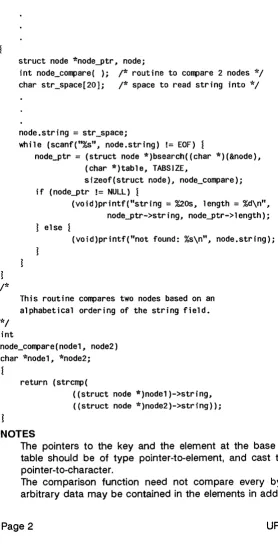
The example below searches a table containing pointers to nodes consisting of a string and its length. The table is ordered alphabetically on the string in the node pointed to by each entry.
This code fragment reads in strings and either finds the corresponding node and prints out the string and its length, or prints an error message.
#include <stdio.h> #include <search.h>
#define TABSIZE 1000
struct node { char *string; int length;
I;
struct node table[TABSIZE];
UP-13712
/* these are stored in the table */
/* table to be searched */
BSEARCH(3C)
I
/*
*/
int
struct node *node-ptr, node;
int node_comparee ); /* routine to compare 2 nodes */
char str_space[20]; /* space to read string into */
node.string
=
str_space;while (scanf("%s", node.string) != EOF)
I
node-ptr = (struct node *)bsearch«char *)(&node),
(char *)table, TABSIZE,
sfzeof(struct node), node_compare);
if (node-ptr != NULL)
I
else
(void)printf("string = %20s, length = %d\n",
node-ptr->string, node-ptr->length);
(void)printf("not found: %s\n", node.string);
This routine compares two nodes based on an alphabetical ordering of the string field.
node_compare(node1, node2) char *node1, *node2;
I
return (strcmp(
«struct node *)node1)->string, «struct node *)node2)->string»;
NOTES
The pointers to the key and the element at the base of the table should be of type pointer-to-element. and cast to type pointer -to-character.
The comparison function need not compare every byte. so arbitrary data may be contained in the elements in addition to
BSEARCH(3C)
the values being compared.
Although bsearch is declared as type pointer-to-character, the value returned should be cast into type pointer-to-element.
SEE ALSO
hsearch (3C) , Isearch (3C) , qsort(3C) , tsearch (3C).
DIAGNOSTICS
A NULL pOinter is returned if the key cannot be found in the table.
RSEARCH(3C)
[This page left blank.]
CLOCK(3C)
NAME
clock - report CPU time used
SYNOPSIS
long clock ( )
DESCRIPTION
clock returns the amount of CPU time (in microseconds) used
since the first call to clock. The time reported is the sum of
the user and system times of the calling process and its ter-minated child processes for which it has executed
wait
(2),pclose (3S) , or system (38) .
SEE ALSO
times(2), wait (2) , popen(3S), system(38).
BUGS
The value returned by clock is defined in microseconds for
compatibility with systems that have CPU clocks with much higher resolution. Because of this, the value returned will wrap around after accumulating only 2147 seconds of CPU time (about 36 minutes).
CLOCK(3C)
[This page left blank.]
C()NV(3C)
NAME
conv: toupper. tolower. _toupper. _tolower. toascii - translate characters
SYNOPSIS
#include
<
ctype.h >int toupper (c) int c;
int tolovver (c) int c;
int _toupper (c) int c;
int _ tolovver (c) int c;
int toascii (c) int c;
DESCRIPTION
Toupper and t%wer have as domain the range of gete (3S): the integers from -1 through 255. If the argument of toupper
represents a lower-case letter. the result is the corresponding upper-case letter. If the argument of t%wer represents an upper-case letter. the result is the corresponding lower-case letter. All other arguments in the domain are returned unchanged.
The macros _toupper and _t%wer. are macros that accom-plish the same thing as toupper and t%wer but have res-tricted domains and are faster. _toupper requires a lower-case letter as its argument; its result is the corresponding upper-case letter. The macro _t%wer requires an upper-case letter as its argument; its result is the corresponding lower-case letter. Arguments outside the domain cause undefined results.
Toaseii yields its argument with all bits turned off that are not part of a standard ASCII character; it is intended for compati-bility with other systems.
SEE ALSO
ctype(3C). getc(3S).
C()NV(3C)
[This page left blank.]
CRYPT(3C)
NAME
crypt, setkey, encrypt - generate hashing encryption
SYNOPSIS
char *crypt (key, salt) char *key, *salt;
void setkey (key) char *key;
void encrypt (block, ignored) char *block;
int ignored;
DESCRIPTION
crypt is the password encryption function. It is based on a
one way hashing encryption algorithm with variations intended (among other things) to frustrate use of hardware implementa-tions of a key search.
Key is a user's typed password. Salt is a two-character string
chosen from the set [a-zA-ZO-9./]; this string is used to per-turb the hashing algorithm in one of 4096 different ways, after which the password is used as the key to encrypt repeatedly a constant string. The returned value points to the encrypted password. The first two characters are the salt itself.
The setkey and encrypt entries provide (rather primitive)
access to the actual hashing algorithm. The argument of set-key is a character array of length 64 containing only the
char-acters with numerical value 0 and 1. If this string is divided into groups of 8, the low-order bit in each group is ignored; this gives a 56-bit key which is set into the machine. This is the key that will be used with the hashing algorithm to encrypt the string block with the function encrypt.
The argument to the encrypt entry is a character array of
length 64 containing only the characters with numerical value
o
and 1. The argument array is modified in place to a similar array representing the bits of the argument after having been subjected to the hashing algorithm using the key set by set-key. Ignored is unused by encrypt but it must be present.SEE ALSO
getpass(3C) , passwd(4).
login(1), passwd(1) in the User's Reference Manual.
CRYPT (3C)
CAVEAT
The return value paints to static data that are overwritten by each call.
NAME
ctermid - generate file name for terminal
SYNOPSIS
#include
<
stdio.h > char *ctermid (s) char *s;DESCRIPTION
CTERMID(3S)
ctermid generates the path name of the controlling terminal
for the current process, and stores it in a string.
If s is a NULL pointer, the string is stored in an internal static area, the contents of which are overwritten at the next call to
ctermid, and the address of which is returned. Otherwise, s is
assumed to point to a character array of at least L_ctermid elements; the path name is placed in this array and the value of s is returned. The constant L_ctermid is defined in the
< stdio.h > header file. NOTES
The difference between ctermid and ttyname (3C) is that
ttyname must be handed a file descriptor and returns the
actual name of the terminal associated with that file descrip-tor, while ctermid returns a string (ldev/tty) that will refer to the terminal if used as a file name. Thus ttyname is useful only if the process already has at least one file open to a ter-minal.
SEE ALSO ttyname (3 C) .
CTER~lID(3S)
[This page left blank.]
CTIME(3C)
NAME
ctime, localtime, gmtime, asctime, tzset - convert date and time to string
SYNOPSIS
#include
<
sys/types.h > #include<
time.h >char *ctime (clock) time_t *clock;
struct tm *Iocaltime (clock) time _ t *clock;
struct tm *gmtime (clock) time _ t *clock;
char *asctime (tm) struct tm *tm;
extern long timezone;
extern int daylight;
extern char *tzname[2];
void tzset ( )
DESCRIPTION
ctime converts a long integer, pointed to by c/ock,
represent-ing the time in seconds since 00:00:00 GMT, January 1, 1970, and returns a pOinter to a 26-character string in the following form. All the fields have constant width.
Sun Sep 16 01 :03:52 1985\n\0
Loca/time and gmtime return pOinters to "tm" structures,
described below. Loca/time corrects for the time zone and possible Daylight Savings Time; gmtime converts directly to Greenwich Mean Time (GMT), which is the time the UNIX sys-tem uses.
Asctime converts a "tm" structure to a 26-character string, as
shown in the above example, and returns a pointer to the string.
Declarations of all the functions and externals, and the "tm" structure, are in the < time.h > header file. The structure declaration is:
CTIME(3C)
struct tm {
}; int tm_sec; int tm_min; int tm_hour; int tm_mday; int tm_mon; int tm _year; int tm_wday; int tm_yday; int tm Jsdst;
/* seconds (0 - 59) * / /* minutes (0 - 59) * / /* hours (0 - 23) * /
/* day of month (1 - 31) */ /* month of year (0 -11) */ /* year - 1900 */
/* day of week (Sunday = 0) * / /* day of year (0 - 365) * /
Tm _isdst is non-zero if Daylight Savings Time is in effect. The external long variable timezone contains the difference, in seconds, between GMT and local standard time (in EST,
timezone is 5*60*60); the external variable daylight is non-zero if and only if the standard U.S.A. Daylight Savings Time conversion should be applied. The program knows about the peculiarities of this conversion in 1974 and 1975; if necessary, a table for these years can be extended.
If an environment variable named TZ is present, asctime uses the contents of the variable to override the default time zone. The value of TZ must be a three-letter time zone name, fol-lowed by a number representing the difference between local time and Greenwich Mean Time in hours, followed by an optional three-letter name for a daylight time zone. For exam-ple, the setting for New Jersey would be EST5EDT. The effects of setting TZ are thus to change the values of the external variables timezone and daylight; in addition, the time zone names contained in the external variable
char *tzname[2]
= {
nESTn, nEDTn };are set from the environment variable TZ. The function tzset sets these external variables from TZ; tzset is called by
asc-time and may also be called explicitly by the user.
Note that in most installations, TZ is set by default when the user logs on, to a value in the local/etc/profile file [see
pro-file (4)].
SEE ALSO
time(2), getenv(3C), profile(4), environ(5).
CTIME(3C)
CAVEAT
The return values point to static data whose content is overwritten by each call.
CTI:\:lE(3C)
[This page left blank.]
CTYPE(3C)
NAME
ctype: isalpha, isupper, islower, isdigit, isxdigit, isalnum, isspace, ispunct, isprint, isgraph, iscntrl, isascii - classify char-acters
SYNOPSIS
#include
<
ctype.h >int isalpha (c) int c;
DESCRIPTION
These macros classify character-coded integer values by table lookup. Each is a predicate returning nonzero for true, zero for false. [saseii is defined on all integer values; the rest are defined only where isaseii is true and on the single non-ASCII value EOF [-1; see stdio (3S)].
isa/pha isupper is/ower is digit isxdigit isa/num isspaee ispunet isprint isgraph isentr/ isaseii SEE ALSO
e is a letter.
e is an upper-case letter.
e is a lower-case letter.
e is a digit [0-9].
e is a hexadecimal digit [0-9], [A-F] or [a-fl.
e is an alphanumeric (letter or digit).
e is a space, tab, carriage return, newline, vertical tab, or form-feed.
e is a punctuation character (neither control nor alphanumeric).
e is a printing character, code 040 (space) through 0176 (tilde).
e is a printing character, like isprint except false for space.
e is a delete character (0177) or an ordinary control character (less than 040).
e is an ASCII character, code less than 0200.
stdio(3S), ascii(5).
CTYPE(3C)
DIAGNOSTICS
If the argument to any of these macros is not in the domain of the function, the result is undefined.
CUSERID(3S)
NAME
cuserid - get character login name of the user
SYNOPSIS
#include
<
stdio.h>
char *cuserid (s) char *s;
DESCRIPTION
cuserid generates a character-string representation of the login name that the owner of the current process is logged in under. If
s
is a NULL pointer, this representation is generated in an internal static area, the address of which is returned. Otherwise,s
is assumed to point to an array of at least L_cuserid characters; the representation is left in this array. The constant L_cuserid is defined in the < stdio.h > header file.DIAGNOSTICS
If the login name cannot be found, cuserid returns a NULL pointer; if s is not a NULL pointer, a null character (\0) will be placed at s[OJ.
SEE ALSO
getlogin (3 C) , getpwent (3C).
CUSERID
(3S)[This page left blank.]
DIAL(3C)
NAME
dial - establish an out-going terminal line connection
SYNOPSIS
#include < dial.h >
int dial (call) CALL call;
void undial (fd) int fd;
DESCRIPTION
dial returns a file-descriptor for a terminal line open for
read/write. The argument to dial is a CALL structure (defined in the < dial.h > header file).
When finished with the terminal line, the calling program must invoke undial to release the semaphore that has been set dur-ing the allocation of the terminal device.
The definition of CALL in the < dial.h > header file is:
typedef struct
I
struct termio *attr;
int baud;
int speed;
char *line;
char *telno;
int modem;
char *device;
int dev_len;
I
CALL;/* pointer to termio attribute struct */
/* transmission data rate */ /* 212A modem: low=300,
high=1200 */
/* device name for out-going 1 ine * /
/* pointer to tel-no digits string */
/* specify modem control for direct lines */
/* Will hold the name of the device used to make a connection */
/* The length of the device used to make connection */
The CALL element speed is intended only for use with an out-going dialed call, in which case its value should be either 300 or 1200 to identify the 113A modem, or the high- or low-speed
DIAL(3C)
setting on the 212A modem. Note that the 113A modem or the low-speed setting of the 212A modem will transmit at any rate between 0 and 300 bits per second. However, the high-speed setting of the 212A modem transmits and receives at 1200 bits per secound only. The CALL element baud is for the desired transmission baud rate. For example, one might set
baud to 110 and speed to 300 (or 1200). However, if speed
set to 1200 baud must be set to high (1200).
If the desired terminal line is a direct line, a string pointer to its device-name should be placed in the line element in the CALL structure. Legal values for such terminal device names are kept in the L-devices file. In this case, the value of the baud element need not be specified as it will be determined from the L-devices file.
The telno element is for a pointer to a character string representing the telephone number to be dialed. Such numbers may consist only of symbols described on the
acu (7). The termination symbol will be supplied by the dial
function, and should not be included in the telno string passed to dial in the CALL structure.
The CALL element modem is used to specify modem control for direct lines. This element should be non-zero if modem control is required. The CALL element attr is a pointer to a
termio structure, as defined in the termio.h header file. A
NULL value for this pointer element may be passed to the dial function, but if such a structure is included, the elements specified in it will be set for the outgoing terminal line before the connection is established. This is often important for cer-tain attributes such as parity and baud-rate.
The CALL element device is used to hold the device name (cuI..) that establishes the connection.
The CALL element dev _len is the length of the device name that is copied into the array device.
FILES
/usr /Iib/uucp/L-devices
/usr /spool/uucp/LCK .. tty-device
SEE ALSO
alarm (2) , read (2) , write(2).
acu(7) I termio(7) in the System Administrator's Reference
DIAL(3C)
Manual.
uucp(1 C) in the User's Reference Manual.
DIAGNOSTICS
On failure, a negative value indicating the reason for the failure will be returned. Mnemonics for these negative indices as listed here are defined in the < dial.h > header file.
INTRPT -1 /* interrupt occurred */
D_HUNG -2 /* dialer hung (no return from
write) */
NO_ANS -3 /* no answer within 10 seconds */
ILL_BD -4 /* illegal baud-rate */
A_PROB -5 /* acu problem (open() failure) */
L_PROB -6 /* line problem (open() failure) */
NO_Ldv -7 /* can't open LDEVS file */
DV_NT_A -8 /* requested device not available */
DV_NT_K -9 /* requested device not known */
NO_BD_A -10 /* no device available at
requested baud */
NO_BD_K - 11 /* no device known at requested
baud */
WARNINGS
The dial (3C) library function is not compatible with Basic
Net-working Utilities on UNIX System V Release 2.0.
Including the
<
dial.h > header file automatically includes the<
termio.h > header file.The above routine uses
<
stdio.h >, which causes it to increase the size of programs, not otherwise using standard I/O, more than might be expected.BUGS
An alarm (2) system call for 3600 seconds is made (and
caught) within the dial module for the purpose of "touching"
the LCK .. file and constitutes the device allocation semaphore for the terminal device. Otherwise, uucp (1 C) may simply
delete the LCK .. entry on its 90-minute clean-up rounds. The alarm may go off while the user program is in a read (2) or write (2) system call, causing an apparent error return. If the
user program expects to be around for an hour or more, error returns from reads should be checked for (errno
= =
EINTR), and the read possibly reissued.DIAL(3C)
[This page left blank.]
DRAND48 (3C)
NAME
drand48, erand48, Irand48, nrand48, mrand48, jrand48, srand48, seed48, Icong48 generate uniformly distributed pseudo-random numbers
SYNOPSIS
double drand48 ( )
double erand48 (xsubi) unsigned short xsubi[3];
long Irand48 ( )
long nrand48 (xsubi) unsigned short xsubi[3];
long mrand48 ( )
long jrand48 (xsubi) unsigned short xsubi[3];
void srand48 (seedval) long seedval;
unsigned short *seed48 (seed16v) unsigned short seed16v[3];
void Icong48 (param) unsigned short param[7];
DESCRIPTION
This family of functions generates pseudo-random numbers using the well-known linear congruential algorithm and 48-bit integer arithmetic.
Functions drand48 and erand48 return non-negative double-precision floating-point values uniformly distributed over the interval [0.0, 1.0).
Functions Irand48 and nrand48 return non-negative long integers uniformly distributed over the interval [0, 231).
Functions mrand48 and jrand48 return signed long integers uniformly distributed over the interval [_231
, 231).
DRAND48
(3C)
Functions srand48, seed48 and Icong48 are initialization entry
points, one of which should be invoked before either drand48, lrand48 or mrand48 is called. (Although it is not recommended
practice, constant default initializer values will be supplied automatically if drand48, Irand48 or mrand48 is called without a
prior call to an initialization entry point.) Functions erand48, nrand48 and jrand48 do not require an initialization entry point to
be called first.
All the routines work by generating a sequence of 48-bit integer values, Xii according to the linear congruential formula
Xn + 1
=
(aXn+
C)mod m n~O.The parameter m = 248; hence 48-bit integer arithmetic is
performed. Unless Icong48 has been invoked, the multiplier value
a and the addend value
c
are given bya = 5DEECE66D16 = 2736731631558
C
=
816=
138 .The value returned by any of the functions drand48, erand48, Irand48, nrand48, mrand48 or jrand48 is computed by first
generating the next 48-bit Xi in the sequence. Then the appropriate number of bits, according to the type of data item to be returned, are copied from the high-order (leftmost) bits of Xi and transformed into the returned value.
The functions drand48, Irand48 and mrand48 store the last 48-bit
Xi generated in an internal buffer, and must be initialized prior to being invoked. The functions erand48, nrand48 and jrand48
require the calling program to provide storage for the successive Xi values in the array specified as an argument when the functions are invoked. These routines do not have to be initialized; the calling program must place the desired initial value of Xi into the array and pass it as an argument. 8y using different arguments, functions erand48, nrand48 and jrand48 allow
separate modules of a large program to generate several
independent streams of pseudo-random numbers, i.e., the
sequence of numbers in each stream will not depend upon how
many times the routines have been called to generate numbers for the other streams.
DRAND48 (3C)
The initializer function srand48 sets the high-order 32 bits of Xi to the 32 bits contained in its argument. The low-order 16 bits of Xi are set to the arbitrary value 330E16
The initializer function seed48 sets the value of Xi to the 48-bit value specified in the argument array. In addition, the previous value of Xi is copied into a 48-bit internal buffer, used only by
seed48, and a pointer to this buffer is the value returned by
seed48. This returned pointer, which can just be ignored if not needed, is useful if a program is to be restarted from a given point at some future time use the pointer to get at and store the last Xi value, and then use this value to reinitialize via seed48
when the program is restarted.
The initialization function /cong48 allows the user to specify the initial Xii the multiplier value a, and the addend value
c.
Argument array elements param[O-2] specify Xj, param[3-5]specify the multiplier a, and param[6] specifies the 16-bit addend
c. After /cong48 has been called, a subsequent call to either
srand48 or seed48 will restore the "standard" multiplier and addend values, a and
c,
and specified on the previous page.NOTES
The source code for the portable version can be used on computers which do not have floating-point arithmetic. In such a situation, functions drand48 and erand48 are replaced by the two new functions below.
long irand48 (m) unsigned short m;
long krand48 (xsubi, m) unsigned short xsubi[3], m;
Functions irand48 and krand48 return non-negative long integers uniformly distributed over the interval [0, m - 1].
SEE ALSO
rand(3C).
[This page left blank.]
NAME
dup2 - duplicate an open file descriptor
SYNOPSIS
int dup2 (fildes, fildes2) int fildes, fildes2;
DESCRIPTION
DUP2(3C)
Fildes is a file descriptor referring to an open file, and fildes2 is a non-negative integer less than NOFILES. dup2 causes
fildes2 to refer to the same file as fildes. If fildes2 already referred to an open file, it is closed first.
dup2 will fail if one or more of the following are true: [EBADF]
[EMFILE]
SEE ALSO
Fildes is not a valid open file descriptor. NOFILES file descriptors are currently open.
creat(2) , close (2) , exec (2) , fcntl(2) , open(2), pipe(2) , lockf(3C).
DIAGNOSTICS
Upon successful completion a non-negative integer, namely the file descriptor, is returned. Otherwise, a value of -1 is returned and errno is set to indicate the error.
DUP2(3C)
[This page left blank.]
ECVT(3C)
NAME
ecvt, fcvt, gcvt - convert floating-point number to string
SYNOPSIS
char *ecvt (value, ndigit, decpt, sign) double value;
int ndigit, *decpt, *sign;
char *fcvt (value, ndigit, decpt, sign) double value;
int ndigit, *decpt, *sign;
char *gcvt (value, ndigit, buf) double value;
int ndigit; char *buf;
DESCRIPTION
ecvt converts value to a null-terminated string of ndigit digits
and returns a pointer thereto. The high-order digit is non-zero, unless the value is zero. The low-order digit is rounded. The position of the decimal point relative to the beginning of the string is stored indirectly through decpt (negative means
to the left of the returned digits). The decimal pOint is not included in the returned string. If the sign of the result is negative, the word pOinted to by sign is non-zero, otherwise it
is zero.
Fcvt is identical to ecvt, except that the correct digit has been
rounded for printf "%f" (FORTRAN F-format) output of the number of digits specified by ndigit.
Gcvt converts the value to a null-terminated string in the array
pointed to by but and returns but. It attempts to produce ndi-git significant dindi-gits in FORTRAN F-format if possible,
other-wise E-format, ready for printing. A minus sign, if there is one, or a decimal point will be included as part of the returned string. Trailing zeros are suppressed.
SEE ALSO printf(3S) .
BUGS
The values returned by ecvt and tcvt point to a single static
data array whose content is overwritten by each call.
ECVT(3C)
[This page left blank.]
NAME
end, etext, edata - last locations in program
SYNOPSIS extern end; extern etext; extern edata;
DESCRIPTION
END(3C)
These names refer neither to routines nor to locations with interesting contents. The address of etext is the first address above the program text, edata above the initialized data region, and end above the uninitialized data region.
When execution begins, the program break (the first location beyond the data) coincides with end, but the program break may be reset by the routines of brk (2), malloe (3C) , standard input/output [stdio(3S)], the profile (-p) option of cc(1), and so on. Thus, the current value of the program break should be determined by sbrk (char *)(0) [see brk(2)].
SEE ALSO
cc(1), brk(2), malloc(3C), stdio(3S).
END(3C)
[This page left blank.]
NAME
fclose. fflush - close or flush a stream
SYNOPSIS
#include < stdio.h >
int fclose (stream) FILE *stream;
int fflush (stream) FILE *stream;
DESCRIPTION
FCLOSE(3S)
fclose causes any buffered data for the named stream to be written out. and the stream to be closed.
fclose is performed automatically for all open files upon calling
exit (2).
Fflush causes any buffered data for the named stream to be written to that file. The stream remains open.
SEE ALSO
close(2). exit(2). fopen(3S). setbuf(3S). stdio(3S).
DIAGNOSTICS
These functions return 0 for success. and EOF if any error (such as trying to write to a file that has not been opened for writing) was detected.
FCL()SE
(3S)[This page left blank.]
FERR() R
(3S)NAME
ferror. feof. clearerr. fileno - stream status inquiries
SYNOPSIS
#include < stdio.h >
int ferror (stream) FILE *stream;
int feof (stream) FILE *stream;
void clearerr (stream) FILE *stream;
int fileno (stream) FILE *stream;
DESCRIPTION
ferror returns non-zero when an I/O error has previously occurred reading from or writing to the named stream. other-wise zero.
Feof returns non-zero when EOF has previously been detected reading the named input stream. otherwise zero.
C/earerr resets the error indicator and EOF indicator to zero on the named stream.
Fileno returns the integer file descriptor associated with the named stream; see open (2) .
NOTES
All these functions are implemented as macros; they cannot be declared or redeclared.
SEE ALSO
open (2). fopen (38). stdio (38).
FERROR(3S)
[This page left blank.]
NAME
fopen, freopen, fdopen - open a stream
SYNOPSIS
#include
<
stdio.h >FILE *fopen (filename, type)
char *filename, *type;
FILE *freopen (filename, type, stream)
char *filename, *type;
FILE *stream;
FILE *fdopen (fildes, type)
int fildes; char *type;
DESCRIPTION
F()PEN(3S)
fopen opens the file named by filename and associates a stream with it. fop en returns a pointer to the FILE structure
associated with the stream.
Filename points to a character string that contains the name
of the file to be opened.
Type is a character string having one of the following values:
"r" open for reading
"W" truncate or create for writing
II a" append; open for writing at end of file, or
create for writing
"r
+
II open for update (reading and writing)"W
+
II truncate or create for update"a
+
II append; open or create for update atend-of-file
Freopen substitutes the named file in place of the open stream. The original stream is closed, regardless of whether
the open ultimately succeeds. Freopen returns a pointer to the FILE structure associated with stream.
Freopen is typically used to attach the preopened streams
associated with stdin, stdout and stderr to other files.
Fdopen associates a stream with a file descriptor. File descriptors are obtained from open, dup, creat, or pipe (2) I
.'()PEN
(3S)which open files but do not return pointers to a FILE structure
stream. Streams are necessary input for many of the Section
3S library routines. The type of stream must agree with the mode of the open file.
When a file is opened for update, both input and output may be done on the resulting stream. However, output may not be directly followed by input without an intervening fseek or
rewind, and input may not be directly followed by output
without an intervening fseek, rewind, or an input operation which encounters end-of-file.
When a file is opened for append (i.e., when type is 11 all or lIa
+
11). it is impossible to overwrite information already in the file. Fseek may be used to reposition the file pOinter to any position in the file, but when output is written to the file, the current file pointer is disregarded. All output is written at the end of the file and causes the file pointer to be repositioned at the end of the output. If two separate processes open the same file for append, each process may write freely to the file without fear of destroying output being written by the other. The output from the two processes will be intermixed in the file in the order in which it is written.SEE ALSO
creat(2) , dup(2). open (2) , pipe(2), fclose(3S). fseek(3S). stdio(3S).
DIAGNOSTICS
fop en , fdopen, and freopen return a NULL pointer on failure.
FPGETR()UND(3C)
NAME
fpgetround, fpsetround, fpgetmask, fpsetmask, fpgetsticky, fpsetsticky - IEEE floating point environment control
SYNOPSIS
#inc1ude <ieeefp.h>
typedef enum
I
FP_RN=O, /* round to nearest */
FP_RP, /* round to plus */
FP_RM, /* round to minus */
FP_RZ, /* round to zero (truncate) */
1
fp_rnd;fp_rnd fpgetround();
fp_rnd fpsetround(rnd_dir) fp_rnd rnd_dir;
#define fp_except int
#define FP_X_INV Oxl0
#define FP_X_OFL Ox08
#define FP_X_UFL ox04
/* invalid operation exception*/
/* overflow exception*/ /* underflow exception*/
#define FP_X_DZ Ox02 /* divide-by-zero exception*/
#define FP_X_IMP OxOl
fp_except fpgetmask();
fp_except fpsetmask(mask); fp_except mask;
fp_except fpgetsticky();
fp_except fpsetsticky(sticky); fp_except sticky;
DESCRIPTION
/* imprecise (loss of precision)*/
There are five