Volume 2006, Article ID 28636, Pages1–11 DOI 10.1155/ASP/2006/28636
Macrocell Builder: IP-Block-Based Design Environment for
High-Throughput VLSI Dedicated Digital Signal
Processing Systems
Nacer-Eddine Zergainoh,1Ludovic Tambour,1, 2, 3Pascal Urard,2and Ahmed Amine Jerraya1
1TIMA Laboratory, National Polytechnique Institute of Grenoble, 46 Avenue F´elix Viallet, 38031 Grenoble Cedex 1, France 2ST Microelectronics, 850 Rue Jean Monnet, 38926 Crolles Cedex, France
3CIRAD, TA 40/01, avenue Agropolis Lavalette, 34398 Montpellier Cedex 5, France
Received 3 October 2004; Revised 14 April 2005; Accepted 25 May 2005
We propose an efficient IP-block-based design environment for high-throughput VLSI systems. The flow generates SystemC register-transfer-level (RTL) architecture, starting from a Matlab functional model described as a netlist of functional IP. The refinement model inserts automatically control structures to manage delays induced by the use of RTL IPs. It also inserts a control structure to coordinate the execution of parallel clocked IP. The delays may be managed by registers or by counters included in the control structure. The flow has been used successfully in three real-world DSP systems. The experimentations show that the approach can produce efficient RTL architecture and allows to save huge amount of time.
Copyright © 2006 Hindawi Publishing Corporation. All rights reserved.
1. INTRODUCTION
As the complexity of the high-throughput dedicated digi-tal signal processing (DSP) systems under hardware design increases, development efforts increase dramatically. At the same time, the market dynamics for electronic systems push for shorter and shorter development times [1]. In order to meet the design time requirements, a design methodology for VLSI dedicated DSP system that favors reuse and early error detection is essential. One idea, largely widespread and applied to design DSP systems, is to adopt a modular ap-proach based on divide-and-conquer strategy (recursive). The global complexity of the system should be divided into subsystems (i.e., elementary signal processing functions), well known and of easily accessible complexity such as fil-ter (FIR, IIR), fast Fourier transform (FFT), Vifil-terbi decoder, and so forth. The system can be obtained by the hierarchi-cal assembly of these common functions of signal processing (also known as IP blocks). The intellectual-property- (IP)-based design is obviously an important issue for improving not only design productivity, but also design from the higher-level abstraction [2,3].
However, designers encounter two major problems with the IP-block-based design approach [2–4]. Thefirst problem
is the difficulty in using IPs blocks for high-throughput DSP systems that require various performances (throughput) or
functions with nonstandard algorithms [5]. This is because VLSI DSP system cannot be parameterized for global per-formance and functions; for example, necessary processing cycles cannot be adjusted for IPs blocks. The second prob-lemcomes from interfacing of IPs blocks between themselves. Designers have to design IPs blocks that can communicate according to the blocks’ interface specification. When they connect two different IP blocks, they have to insert an extra interface circuitry in order to synchronize them. Area and de-lay overhead for circuitry cannot be neglected in some cases. Our goal is to find some appropriate design tactics to avoid these problems.
registers or by counters included in the control structure. The main contribution of this paper is a prototype implementa-tion and experimentaimplementa-tion of the approach. The rest of the paper is organized as follows. After investigating related work inSection 2, we introduce our methodology and discuss its merits, the important issues, and how this approach handled the IP-based design problems.Section 4details the IP-block-based design environment for high-throughput VLSI DSP systems. Section 5describes several experiments to analyze the efficiency of the proposed design flow andSection 6 con-cludes the paper.
2. RELATED WORK
2.1. Standard design flow for ASIC
A standard design flow for hardware implementation of al-gorithms has four phases which are typically handled by four different designers. Algorithm designers conceive the chip and deliver a specification to system designers, often in the form of a floating-point simulation. The system or archi-tecture designers begin to add structure to this simulation, partitioning the design into functional units. They must also convert the data types from floating to fixed-point and ver-ify that finite word-length effects and pipeline depth do not compromise the algorithm. The hardware designers map the simulation RTL code and verify that the code matches the specified functionality and pipeline depth. Physical designers take standard-cell netlists synthesized from the RTL code and generate layout mask patterns. This flow requires three trans-lations of the design, expressing the functionality as grad-ually less sequential and more structural with requirements for reverification at each stage. Opportunities for algorithmic modifications, to reduce power and area, are often lost due to the separation of engineering decisions. Performance bot-tlenecks discovered during the physical design phase are un-known to the algorithm designer. Aggressive system require-ments may require new and unusual architectures, which can stall the flow, leading to uncontrolled looping back to earlier stages of the design process and extending the design time in-definitely. The main problem with this flow is that it attempts to avoid feedback information to algorithm designers.
The flow we need would allow algorithm designers to ex-plore the design space as thoroughly as possible by creating RTL model and obtaining performance estimates. This ex-ploration should allow refinement of fixed-point types to be constrained libraries of efficient hardware blocks, and to be carried out by automated design flow. This encourages feed-back of RTL design issues to algorithm designers by allowing them to maintain ownership of the design data at all times. It also would encourage interaction with algorithm and hard-ware designers by reducing the design process to a single phase.
2.2. Current methods and flows for DSP algorithm implementation
Recent efforts have identified the gaps between algorithm, system, hardware, and physical design, but yet have to
encompass the complete problem. Some attempt to close the gap between algorithm and hardware design by basing syn-thesis tools on C/C++ description [6–11]. However, these solutions require a style of code that is very similar to RTL code and it is unattractive to algorithm designers. Commer-cial tools from design automation companies offer RTL code generation solutions from block diagrams [12]. However, these tools are targeted mostly for hardware designers and obscure the information about the algorithm and architec-ture through the code generation process.
Some have proposed using high-level system design flows, such as Ptolemy [13], and POLIS [14]. These flows em-phasize overall system cosimulation and cosynthesis for het-erogeneous systems rather than the details required in creat-ing and integratcreat-ing DSP-ASIC into an existcreat-ing system. There are also some works on system-level design flows targeted for DSP hardware systems [15–19]. Grape-II [15], Cham-pion [16], Logic foundry [17], and MATCH [18] follow this scheme. In Grape-II, the target architecture consists of com-mercial DSP processors, bond-out versions of core proces-sors, and FPGAs linked to form a powerful heterogeneous multiprocessor. The Logic foundry is system-level design flow for the rapid creation and integration of FPGA-based DSP by using predictable, preverified IP blocks that have standardized interfaces. The problem of this approach is that the area and delay overhead for standard interface circuitry cannot be neglected in some cases. Champion is IP-block-based design approach for data path of DSP-ASIC. The de-sign automation of data path is performed using two libraries of predesigned basic blocks (functional and cells libraries). Unfortunately, the lack of flexibility of libraries (no param-eterized blocks) limits the reuse of the IP blocks especially for high-throughput DSP systems which require various per-formances (throughput) or functions with nonstandard al-gorithms. This work was also limited to data paths without runtime control considerations. MATCH has attempted to compile high-level languages, such as Matlab, directly into hardware implementations (including code for DSP, embed-ded processors, and FPGA).
However, we believe that in all above works, design methodologies tackle some issues of DSP design but they yet have to encompass the entire problem. In fact, most of the above-mentioned approaches cannot satisfy a tradeoff be-tween architecture quality, rapid algorithm/architecture ex-ploration, and fast modeling and validation.
2.3. IP-based design issues
System-level simulation (parameters exploration)
Automatic delay correction method Generic
functional DSP-IP library
Generic RTL DSL-IP library
Refinement (parameters extraction, FSM integration, automatic assembly)
Functional model
In Out
F-IP1 F-IP2 F-IP3
F-IP4
RTL architecture FSM
In Out
RTL-IP1 RTL-IP2 RTL-IP3
RTL-IP4
Behavior difference?
Figure1: IP-based design methodology for VLSI dedicated DSP.
and interface types for each IP. However, the interface types for IPs are restricted to coprocessor integration style. Inter-rupt/trap or shared-mapped I/O memories are often used. The software called handshaking offers flexible communica-tion between hardware and software, but it is too slow. Some researchers are trying to develop general communication in-terfaces in hardware. In the area of the application-specific integrated circuit (ASIC) design, communication between IPs is often conducted by shared registers or shared memo-ries. The typical interface configuration contains multiplexes with enable signals or address decoders. The concept of a generic virtual interface has been attracting a lot of attention as a way to increase the design reuse. General virtual inter-faces lead to designers believing that any IP could communi-cate with any other IP [27]. Some practical approaches are re-ported such as the automatic matching/generation/deletion of interface pins [3,4,24,25]. General virtual interfaces are kinds of wrapper IPs, so they would have the area and delay overhead.
None of the above works solve the two above-mentioned problems for the high-throughput ASIC DSP systems. The main contribution in this paper is to provide some appropri-ate design tactics to avoid these problems.
3. OVERVIEW OF DESIGN METHODOLOGY
The IP-based design methodology is based on designer’s practice [28,29]. The methodology, described in Figure 1, generates register-transfer-level (RTL) architecture starting from a functional model, given in Matlab. The functional modeling and RTL architecture generation are performed us-ing two libraries of predesigned DSP basic blocks (functional and RTL libraries).
In our IP-block-based design approach, the functional model is created by assembly of existing functional IP written in Matlab [30]. The refinement process keeps the same archi-tecture and replaces each functional IP by a corresponding
RTL one, according to a set of parameters given by the designer. These are present as attributes in the functional model. The choice of IP parameter values (i.e., architec-tural parameter values such as bit width) is made by the system designer in order to satisfy a tradeoff between sig-nal quality and implementation constraints. To generate the architecture, IP parameter values are firstly extracted from a validated functional architecture model and then used to instantiate the predesigned RTL IP written in synthesizable hardware language (i.e., VHDL, SystemC). The architecture is then built by automatic assembly of predesigned RTL IPs (with the same assembly topology as the functional model). The connection between the RTL IPs is made by name. The design flow includes a unified verification platform used to verify both RTL and functional models.
The platform exploits directly the high-level environ-ment used for functional validation. The results of the methodology are a safety functional and RTL models of the whole DSP application. The functional model can be used as an executable reference for the next generation of design. Overall, the final architecture takes implicit advantage of the hardware designer expertise. The RTL model is suitable for logical synthesis.
3.1. Generic DSP-IPs blocks
N=number of coefficients
nbit in
In Z−1 Z−1 Z−1
coeff1 coeff2 coeffN
nbit sum
Round Saturation Out · · ·
· · ·
+
Figure2: Generic RTL-IP description of FIR filter.
parameters are in italic). The external interface concepts (e.g., external ports-structure, functional, and timing details, generic parameters, etc.) of IPs provide how the IP block ex-changes information with its environment. The F-IP inter-face defines the component name, I/O data stream names, and generic parameters names. The external interface in-formation of RTL-IP block is described by the component definition (including component name, generic parameters names, ports names, ports directions, and ports data types). The ports can be data, clock, reset, control, and test ports.
Figure 3illustrates the analogy between F-IP and RTL-IP in-terfaces. Therefore, just by setting appropriate parameters (problem 2), unnecessary functions and redundant interfaces are eliminated in the IP-based assembly approach (no need to insert an extra interface circuitry). Furthermore, the de-signer does not have to pay attention to the communication of interface protocols.
3.2. Overview of automatic delay correction method (ADCM)
Although each functional IP and its equivalent RTL pro-duce individually the same digital values, in some cases, the register-transfer model obtained by automatic assembly from the functional model can be wrong [31]. This can oc-cur due to delays induced by implementation constraints (pipeline registers, output buffers, etc.). This behavioral fault is caused by the existence of delays in the RTL model, which cannot be found in the functional model. These delays occur when the DSP application contains parallel branches of IPs converging towards another IP, feedback loops of IPs, and/or time-depending IP. This problem is generally known as re-timing issue.
There are three main techniques able to correct the diff er-ent behavior between the two models. The first technique in-volves the insertion of synchronization protocol (e.g., hand-shake protocol) for each IP component, which indicates when the input and output data are valid. The advantage of this technique is that the delay problems are solved be-fore the assembly of RTL IPs. The main drawback of this
technique is the area and delay overhead for each IP. How-ever, the problem occurs only in the three cases above. The second technique involves the insertion of registers between RTL IPs in order to compensate the additive delays. This technique has the advantage of being nonintrusive. However, performing the corrections manually (i.e., locating the places where the problems are, determining exactly how many reg-isters need to be inserted, and where to insert them) is a very difficult task, increasing the number of IPs. The third tech-nique involves the modification of the initial finite-state ma-chine (FSM) by generating additional signals to control the IPs. These signals are time shifted of the initial signals of the global FSM. Therefore, they are able to put back or to put for-ward the activation of the IPs. This technique adopts various stages of the second technique (i.e., locating the places where the problems are, determining exactly how many signals are needed) and requires the FSM to be modified. Modification costs more because of the complexity of the FSM (multiplies the number of control signals and increases the number of states).
In our IP-block-based design, we have implemented a systematic approach called “automatic delay correction method (ADCM) to solve the problem without inserting an extra interface circuitry. The ADCM implements efficiently the last two techniques (register-insertion-based and FSM modification-based). We have developed two algorithms (algorithm-1 and algorithm-2) to perform ADCM [31]. The first algorithm (algorithm-1), similar to the Bellman labeling algorithm [32], determines an optimal solution in latency; whereas the second algorithm (algorithm-2), similar to the simplex algorithm [32], determines an optimal solution in the number of inserted registers (i.e., optimizing area).
4. DSP MACROCELL BUILDER: IP-BLOCK-BASED DESIGN ENVIRONMENT FOR
VLSI DEDICATED DSP
Functional
In1
In2
Generic F-IP block
para1, para2
Out1
Out2
RTL In1
In2
En#1 En#2 Clock Reset
Generic RTL-IP block
para1, para2
Out1
Systematic analogy
Function [out1, out2] =GF IP (
In1, In2, para1, para2)
Outputs
Inputs
Generic parameters
Component GRT IP
generic (
port (
end component; para1: positive; para2: positive);
in1: in std· · ·; in2: in std· · ·;
out1: out std· · ·; out2: out std· · ·;
control: in std· · ·; clock: in std· · ·; reset: IN std· · ·)
Generic parameters
Inputs
Outputs
Other ports
Figure3: F-IP interface versus RTL-IP interface.
Matlab functional
Colif functional
Colif RTL Prepare-1
Prepare-2
Mat2Colif
ColifRefiner ColifLatencer
Delay correction method
GenFSM
CosimX
CosimX SystemC functional
architecture
•Registers insertion-based (RegInsert) •FSM modification-based (ModFSM)
FSM (SystemC RTL code)
SystemC RTL netlist
Figure4: DSP macrocell builder.
FSM), and delay correction flow for high-throughput VLSI dedicated DSP systems. The main feature of our configura-tion is that the tool flow is based on a unified design model for simulation and synthesis of system-on-chip (SoC) ar-chitectures, called “Colif” [33]. Other tools take advantage of information from the Colif and the characteristics of the
M1
M1.1
M1.2
M2.1
M3
Black box
Wrapper
Module
Task
Configuration parameters
Virtual component
Virtual port
Virtual channel
Figure5: Colif representation.
and then used by Prepare1 and CosimX tools to generate the functional architecture in SystemC [11]. The delay correction flow (including ColifRefiner, ColifLatencer, and ADCM), as will be explained later, transforms the Colif functional into acorrectedColif RTL. Architectural parameters are used to instantiate the predesigned RTL IP written in synthesizable hardware language (i.e., VHDL, SystemC). The DSP macro-cell builder includes the automatic generation of RTL Sys-temC of the final architecture (including data path and FSM). After cycle-level simulation, the generated architecture can be passed to a logic synthesis, automatic placement, and routing tools, in order to achieve a good performance circuit. The following subsections detail the several automatic phases of the macrocell builder.
4.1. Colif (Codesign language-independent format)
Colif is a unified abstract model for high-level system design and refinement methodology [33]. Colif represents a system as a hierarchical network of virtual components using three basic concepts: module, port, and net. Virtual components use wrappers to separate the interface of the internal compo-nent from the interface of external nets (seeFigure 5). The wrapper is the set of virtual ports of a virtual component. Virtual ports contain internal and external ports that can be different in terms of communication protocol and abstrac-tion level. Colif uses a uniform syntax to represent systems that are described at multiple abstraction levels. A virtual port can contain multiple levels of hierarchy to represent an “N:M” (NandMare natural numbers) correspondence be-tween internal and external ports. The internal ports are used to connect the internal behavior of the module to the vir-tual port. The external ports are used to connect the external communication channel to the virtual port. A virtual chan-nel groups nets that are parts of the same communication
protocol. Each Colif object has a list of local parameters, for example the kind of protocol used in a virtual channel and addresses of ports.
Colif is used as intermediate language for describing the design model through different phases of the DSP macrocell builder.
4.2. Mat2Colif
TheMat2Colif is developed to transform the functional Mat-lab model into a functional description in Colif language. It consists of a lexical and syntactical analyzer applied upon the Matlab description, the functions treating the different in-put parameters of the tool, and the functions necessary for producing the correct output file. The tool needs an inter-mediate variable for integrating the inputs and the outputs. This means that it is not possible to use directly the labels of the inputs and the outputs for calling these functions. After the intermediate form is explored, the tool imports the Colif objects corresponding to functional IPs. After all the objects are correctly imported into the Colif tree structure located in memory, the tool instantiates this structure in order to obtain a suitable file for visualization. This file describes the func-tional description in Colif language.
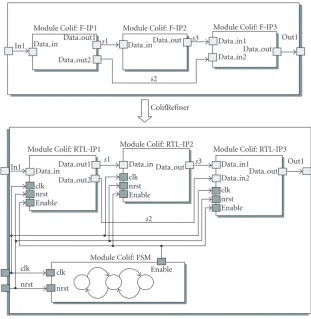
4.3. ColifRefiner
In1
Module Colif: F-IP1
Data in Data out1
Data out2
s1
Module Colif: F-IP2
Data inData out
s2
s3
Module Colif: F-IP3
Data in1
Data in2 Data out
Out1
ColifRefiner
In1
Module Colif: RTL-IP1
Data in
clk nrst Enable
Data out1
Data out2
s1
Module Colif: RTL-IP2
Data in clk nrst Enable
Data out s3
s2
Module Colif: RTL-IP3
Data in1
Data in2 clk nrst Enable
Data out Out1
Module Colif: FSM clk
nrst clk
nrst
Enable
Figure6: Input and output of ColifRefiner tool.
description of the system (including data path and FSM structure).Figure 6illustrates an example of the input and output ofColifRefinertool.
4.4. Delay correction flow
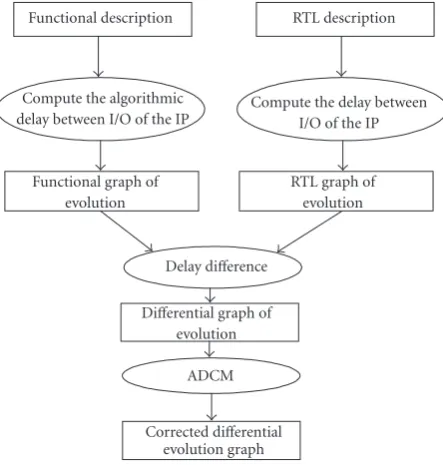
Figure 7shows the flow of the delay correction method [31]. The inputs of this flow are Colif functional and Colif RTL descriptions of the entire system. The output of this flow is a corrected RTL-level description producing the same digital displays as the functional description. The localization and the calculation of the number of delays to be inserted require the use of an intermediate form called differential graph of evolution, highlighting the delays present in the RTL model and absent from the functional one. For that, the functional model (resp., the RTL model) is represented by a graph called
functional graph of evolution(resp.,RTL graph of evolution) describing its own delays. Thedifferential graph of evolution
is created by performing one by one the difference between the weight of edges of the functional graph of evolution and those of the RTL graph of evolution. This difference makes possible to see only the additive delays due to the constraints of implementation, by removing all the delays related to the functionality.
Starting from the differential graph, the ADCM deter-mines the corrections necessary to compensate the additive
delays. The ADCM uses two algorithms in performing the corrections needed by the differential graph of evolution in order to obtain a balanced graph. The first algorithm (algorithm-1) determines an optimal solution in latency, while the second algorithm (algorithm-2) gives an optimal solution in number of inserted registers, optimizing area. Fi-nally, the step of code generation produces a corrected RTL description of the system, inserting the right number of de-lays into the right place. The ADCM implements efficiently two alternatives to correct the RTL description of the system: one based on registers insertion while the second is based on FSM modification. According to the implementation con-straints and the target application, the designer can choose the suitable techniques to be used. In practice, the ColifLa-tencertool inserts automatically the latency values into the Colif files (Colif RTL and functional), while the ADCM per-forms the correction.
4.5. Synthetic example
In order to highlight the problem of behavior difference and its solution in a real case of IP-block-based design, we have willfully selected a synthetic example composed of two par-allel branches of block IPs tending towards the same IP (see
Functional description RTL description
Compute the algorithmic delay between I/O of the IP
Compute the delay between I/O of the IP
Functional graph of evolution
RTL graph of evolution
Delay difference
Differential graph of evolution
ADCM
Corrected differential evolution graph
Figure7: Delay correction flow.
FIR1 FIR2 FIR3
FIR4
FIR5
−2 −1.5 −1 −0.5 0 0.5 1 1.5
2×10⁵
0 10 20 30 40 50 60 70 80 90 100
Matlab SystemC RTL
Output
+
Figure8: Synthetic example and problem of behavior problem be-tween functional and RTL models.
the RTL and functional model has been detected by our ADCM as well as during both functional and cycle accurate simulations (both digital data curves inFigure 6are diff er-ent). The problem is due to an output register present in each RTL FIR filter and absent in functional filters. This register induces an additional delay in the RTL model. The diff eren-tial graph of evolution is shown inFigure 9. The first path has three additional delays, whereas the second path has one additional delay. It was necessary to add two delays in the sec-ond path in order to balance the differential graph. This de-lay correction was translated in two ways on the RTL model. The first one consists of inserting two registers in the second
path (Figure 10(a)). The other method involves modifying the initial FSM (Figure 10(b)). The initial FSM generates a control signal at each fourth clock cycle. In the case of the second correction method, the FSM has to produce a supple-mentary control signal, but delayed initially by two impulses of the first signal (8 clock cycles). Then, the filter in the sec-ond branch starts its computation after the same period as the filters of the first path. Both of the two techniques were applied upon this example. Independently of the used cor-rection method, the RTL models produce exactly the same digital values as the functional one (seeFigure 11).
4.6. Discussion
We assumed the systems are mono-rates, do not include time-varying IPs, and can be built by acyclic assembly of IPs. We assumed the model is a static data flow graph (SDF graph), that is, latency and data throughput of IPs are con-stant, and this model is not a limitation of our methodol-ogy. In practice, when designing data-dependency IPs, the FIFOs with parameterized sizes are placed at the outputs of IPs; it boils down to SDF graph case. In the case of cyclic graph, heuristic algorithms that build acyclic graphs from cyclic ones need to be considered, which are outside the scope of this paper. The most high-throughput DSP systems can be supported by our methodology.
5. EXPERIMENTAL RESULT
We applied our ADCM and associated IP-based design flow to synthetic example (previously presented) and three high-throughput dedicated DSP systems: digital modulation chain circuit extracted from a real design of TV digital transmis-sion satellite application, decoder based on the soft-output Viterbi algorithm (SOVA), MP3 (MPEG-1 audio layer-3) au-dio compression standard. Functional and RTL models of these three applications were built by assembling the various predesigned and prevalidated IPs. The behaviors were sub-jected to ADCM; we used two alternatives (registers insertion and FSM modification) of implementing delay correction on these circuits. The logic synthesis was performed using Syn-opsys Design Compiler [34] and the resultant circuits were mapped to AMS’s 0.35μcell-based array library. The resul-tant gate-level circuits were compared with respect to the following metrics:area and performance. The area and clock period are obtained after performing synthesis and technol-ogy mapping. The performance, that is, execution time is the product of clock period and number of clock cycles (RTL simulation).
Table 1 presents the number of registers inserted af-ter the behaviors which were performed by ADCM (i.e., algorithm-1 and algorithm-2). Save for the synthetic exam-ple, algorithm-2 improves significantly the solutions found by algorithm-1. The average registers improvement is 50% (the averages were calculated based on comparing the sum of the values in algorithm-1 and algorithm-2 columns).
IN1 0 FIR1 1 FIR2 1 FIR3 1
IN2 0 FIR4
Correction
1 +2
0 FIR5 0 Out +
Figure9: Balanced differential graph of evolution.
FIR1 FIR2 FIR3
C1 C1 C1
FIR4 Z−1 Z−1
C1 C1 C1 FIR5
C1
+
FSM
Clk
C1
C1 Correction
(a)
FIR1 FIR2 FIR3
C1 C1 C1
FIR4
C2 FIR5
C1
Correction
FSM
Clk C1
C2
C1 C2
+
(b)
Figure10: Two ways to correct the behavior in RTL model: (a) delay correction by registers insertion and (b) delay correction by modi-fying FSM.
−8 −6 −4 −2 0 2 4 6 8×10⁵
0 10 20 30 40 50 60 70 80 90 100
Matlab RTL
Output
Figure11: Output signals of functional and corrected RTL models.
designs with ADCM by registers insertion (third column), and ADCM by FSM modification (fourth column). In the first case (second column), the interfacing of IPs blocks was performed by inserting an extra interface circuitry (i.e., handshake protocol), in order to synchronize them.
Tables2 and3 indicate that our ADCM results in sig-nificant improvements of performance and area, the aver-age performance improvement is 15.67%, whereas the av-erage area improvement is 10.7%. Area and delay overhead
Table1: Registers insertion performed by ADCM algorithms.
System Registers inserted no.
Algorithm-1 Algorithm-2
Synthetic example 2 2
Modulation chain 15 7
SOVA 9 5
MP3 decoder 12 5
for circuitry cannot be neglected in the first case (second column). Regarding both alternatives of ADCM (registers insertion versus FSM modification), the two corrections are equivalent in terms of performances (third and fourth columns inTable 2). With regard to area (third and fourth columns inTable 3), the two corrections give the slightly dif-ferent results. We note that the difference is the area no more than 4% for the cases studied. This difference is due to the way in which theNdelays correction are distributed on the balanced differential graph. TheNdelays correction on dif-ferential graph correspond toM(1 ≤M ≤N,M depends on the distribution of delays correction on the differential graph) supplementary control signals in ADCM by FSM modification, whereas they always correspond toNregisters in ADCM by registers insertion. The choice of a method is closely related to the application and must be done after ap-plying the two methods, and analyzing the area results.
6. SUMMARY AND CONCLUSIONS
Table2: Performance results: registers versus FSM modification.
System Execution time (ns)
Without ADCM ADCM by registers insertion ADCM by FSM modification
Modulator 4567870 3859850 3859854
MP3 decoder 2297500 1929902 1929907
SOVA∗ 68266 58026 58027
∗Time required to decode a single 1024-bit block of information using 4-stage iterative decoding.
Table3: Area results: registers insertion versus FSM modification.
System Area (# kgates)
Without ADCM ADCM by registers insertion ADCM by FSM modification
Modulator 541.7 482.5 483.2
MP3 decoder 149.4 134.1 134.9
SOVA 52.5 47.5 47.1
the RTL model in a judicious way that includes locating the places where the problems occur, determining how many de-lays are needed, and implementing the correction. We have described two alternatives (registers insertion and FSM mod-ification) of implementing delay correction methods and we have presented a realistic example where the delay correction method has been efficiently applied. Experimental results in real cases, also, demonstrate significant improvements in the quality of the synthesized implementations.
REFERENCES
[1] International Technology Roadmap for Semiconductors, 2003 Edition Report,http://public.itrs.net.
[2] A. Sangiovanni-Vincentelli, L. Carloni, F. De Bernardinis, and M. Sgroi, “Benefits and challenges for platform-based design,” in Proceedings of 41st IEEE Design Automation Conference (DAC ’04), pp. 409–414, San Diego, Claif, USA, June 2004. [3] G. Martin, “Design methodologies for system level IP,” in
Proceedings of IEEE Design, Automation and Test in Europe (DATE ’98), pp. 286–289, Paris, France, February 1998. [4] D. D. Gajski, A. C.-H. Wu, V. Chaiyakul, S. Mori, T. Nukiyama,
and P. Bricaud, “Essential issues for IP reuse,” inProceedings of IEEE Asia and South Pacific Design Automation Conference (ASP-DAC ’00), pp. 37–42, Yokohama, Japan, January 2000. [5] K. K. Parhi, VLSI Digital Signal Processing Systems: Design
and Implementation, John Wiley & Sons, New York, NY, USA, 1998.
[6] Celoxica,Handel-C Language Reference Manual, 2003. RM-1003-4.0,http://www.celoxica.com.
[7] G. De Micheli, “Hardware synthesis from C/C++ models,” in Proceedings of IEEE Design, Automation and Test in Europe Conference and Exhibition (DATE ’99), pp. 382–383, Munich, Germany, March 1999.
[8] S. A. Edwards, “The challenges of hardware synthesis from C-like languages,” inProceedings of IEEE Design, Automation and Test in Europe (DATE ’05), vol. 1, pp. 66–67, Munich, Ger-many, March 2005.
[9] D. D. Gajski, J. Zhu, R. D¨omer, A. Gerstlauser, and S. Zhoa, Spec C: Specification Language and Methodology, Kluwer Aca-demic, Boston, Mass, USA, 2000.
[10] D. C. Ku and G. De Micheli, “HardwareC: A language for hard-ware design,” Tech. Rep. CSTL-TR-90-419, Computer Systems Laboratory, Stanford University, Stanford, Calif, USA, August 1990.
[11] SystemC Community,http://www.systemc.org.
[12] Xilinx System Generator v2.1 for Simulink Reference Guide, Xilinx, 2000.
[13] J. Buck, S. Ha, E. A. Lee, and D. G. Messerschmitt, “Ptolemy: a framework for simulating and prototyping heterogeneous systems,”International Journal of Computer Simulation, vol. 4, no. 2, pp. 155–182, 1994.
[14] F. Balarin, M. Chiodo, P. Di Giusto, et al.,Hardware-Software Co-Design of Embedded Systems: The POLIS Approach, Kluwer Academic, Boston, Mass, USA, 1997.
[15] R. Lauwereins, M. Engels, M. Ade, and J. A. Peperstraete, “Grape-II: a system-level prototyping environment for DSP applications,”IEEE Computer, vol. 28, no. 2, pp. 35–43, 1995. [16] S. Natarajan, B. Levine, C. Tan, D. Newport, and D. Bouldin,
“Automatic mapping of khoros-based applications to adaptive computing systems,” inProceedings of Military and Aerospace Applications of Programmable Devices and Technologies Inter-national Conference (MAPLD ’99), pp. 101–107, Laurel, Md, USA, Septemper 1999.
[17] G. Spivey, S. S. Bhattacharyya, and K. Nakajima, “Logic foundry: rapid prototyping for FPGA-based DSP systems,” EURASIP Journal on Applied Signal Processing, vol. 2003, no. 6, pp. 565–579, 2003.
[18] P. Banerjee, N. Shenoy, A. Choudhary, et al., “MATCH: A MATLAB Compiler for Configurable Computing Systems,” Tech. Rep. CPDCTR-9908-013, Center for Parallel and Dis-tributed Computing, Northwestern University, Evanston, Ill, USA, August 1999.
[19] W. R. Davis, N. Zhang, K. Camera, et al., “A design environ-ment for high-throughput low-power dedicated signal pro-cessing systems,”IEEE Journal of Solid-State Circuits, vol. 37, no. 3, pp. 420–431, 2002.
[20] R. K. Gupta and Y. Zorian, “Introducing core-based system design,”IEEE Design and Test of Computers, vol. 14, no. 4, pp. 15–25, 1997.
15th International Conference on VLSI Design (ASP-DAC ’02), pp. 21–23, Bangalore, India, January 2002.
[22] W. Cescirio, A. Baghdadi, L. Gauthier, et al., “Component-based design approach for multicore SoCs,” inProceedings of 39th IEEE Design Automation Conference (DAC ’02), pp. 789– 794, New Orleans, La, USA, June 2002.
[23] B.-W. Kim and C.-M. Kyung, “Exploiting intellectual proper-ties with imprecise design costs for system-on-chip synthesis,” IEEE Transactions on Very Large Scale Integration (VLSI) Sys-tems, vol. 10, no. 3, pp. 240–252, 2002.
[24] M. Vachharajani, N. Vachharajani, S. Malik, and D. I. August, “Facilitating reuse in hardware models with enhanced type in-ference,” inProceedings of IEEE/ACM/IFIP International Con-ference on Hardware/Software Codesign and System Synthesis (CODES+ISSS ’04), pp. 86–91, Stockholm, Sweden, Septem-ber 2004.
[25] R. Passerone, J. A. Rowson, and A. Sangiovanni-Vincentelli, “Automatic synthesis of interfaces between incompatible pro-tocols,” inProceedings of 35th IEEE Design Automation Confer-ence (DAC ’98), pp. 8–13, San Francico, Calif, USA, June 1998. [26] H. Choi, J. H. Yi, J.-Y. Lee, I.-C. Park, and C.-M. Kyung, “Ex-ploiting intellectual properties in ASIP designs for embedded DSP software,” inProceedings of 36th IEEE Design Automation Conference (DAC ’99), pp. 939–944, New Orleans, La, USA, June 1999.
[27] VSI Alliance,http://www.vsi.org.
[28] L. Tambour, “Efficient methodology for design and vali-dation of complex DSP system-on-chip,” Ph.D. thesis, In-stitut National Polytechnique de Grenoble (INPG), Greno-ble, France, December 2003,http://tima.imag.fr/publications/ files/th/mfs 196.pdf.
[29] N. E. Zergainoh, K. Popovici, A. A. Jerraya, and P. Urard, “Matlab based environment for designing DSP systems using IP blocks,” inProceedings of 12th Workshop on Synthesis and System Integration of Mixed Information Technologies (SASIMI ’04), pp. 296–302, Kanazawa, Japan, October 2004.
[30] The MathWorks Incorporation,http://www.mathworks.com. [31] N. Zergainoh, L. Tambour, H. Michel, and A. A. Jerraya,
“M´ethode de correction automatique de retard dans les mod`eles RTL des syst`emes monopuces DSP obtenus par as-semblage de composants IP,”Techniques et Sciences Informa-tiques, vol. 24, no. 10, pp. 1227–1257, 2005.
[32] A. Gibbons,Algorithmic Graph Theory, Cambridge University Press, Cambridge, UK, 1985.
[33] W. O. Cesario, G. Nicolescu, L. Gauthier, D. Lyonnard, and A. A. Jerraya, “Colif: A design representation for application-specific multiprocessor SOCs,”IEEE Design and Test of Com-puters, vol. 18, no. 5, pp. 8–20, 2001.
[34] Synopsys Incorporation,http://www.synopsys.com.
Nacer-Eddine Zergainohreceived the State Engineering degree in electrical engineering from National Telecommunication School and the M.S. and Ph.D. degrees in computer engineering from University of Paris XI, in 1992 and 1996, respectively. Currently, he is an Associate Professor at Ecole Poly-technique of University of Joseph Fourier, Grenoble, and member of the research staff of the Techniques of Informatics and
Mi-croelectronics for Computer Architecture Laboratory, Grenoble. Prior to that, he was an R&D Engineer at ILEX-Computer Systems, Paris, France. His current research interests are hardware/software
codesign, high-level synthesis and CAD issues for real-time digi-tal signal processing, design and exploration of application-specific multiprocessor SoC (including design and analysis of on-chip com-munication architectures, network on-chip issues). He also main-tains an active interest in parallel processing, multiprocessor archi-tectures, and real-time operating systems. Professor Zergainoh has served on the technical program committees for several interna-tional conferences and workshops.
Ludovic Tambour received the Engineer degree in computer science from the Ecole Polytechnique de Grenoble in 2000 and the M.S. and Ph.D. degrees in computer science from the Institut National Polytechnique de Grenoble (INPG), Grenoble, France, in 2000 and 2003, respectively. In 2000, he joined the R&D SHIVA Group at ST Micro-electronics and SLS Group at TIMA Lab-oratory where he worked on methodology
and flow for design and validation of digital signal processing ASIC macrocells. In 2004, Dr. Tambour moved to hold an Engineer po-sition at CIRAD (International Cooperating Center in Research for Agronomic Developing), Montpellier, France. His research inter-ests include software tools for modeling, simulation and data anal-ysis in a large field of activities including microelectronic, signal processing, agronomy, and so forth.
Pascal Urardjoined ST Microelectronics in 1992 where he has worked successively in test, engineering, ASIC design, and archi-tecture of mixed signal processing ASICs. In 2000, he joined ST R&D to work on ESLD flows. He initiated a Matlab-2-RTL flow that is now used internally in ST. In 2001, he initiated cooperations with HLS tools companies. He is now the Manager of High-Level Synthesis Group within ST Mi-croelectronics Central—CAD.
Ahmed Amine Jerraya received the Engi-neer degree from the University of Tunis in 1980 and the DEA, “Docteur Ing´enieur,” and the “Docteur d’Etat” degrees from the University of Grenoble in 1981, 1983, and 1989, respectively, all in computer sciences. In 1986, he held a Full Research posi-tion with the CNRS (Centre Naposi-tional de la Recherche Scientifique). From April 1990 to March 1991, he was a member of the