Volume 2006, Article ID 70572, Pages1–10 DOI 10.1155/ASP/2006/70572
Efficient Bidirectional DFE for Doubly Selective
Wireless Channels
Stefano Tomasin
Department of Information Engineering, University of Padova, Via Gradenigo 6/B, 35131 Padova, Italy
Received 1 June 2005; Revised 3 November 2005; Accepted 7 November 2005
The bidirectional decision feedback equalizer (DFE) performs two equalizations, one on the received signal and one on its time-reversed version. In this paper, we apply the bidirectional DFE to wireless transmissions on rapidly time-varying dispersive chan-nels and we propose an efficient implementation obtained by implementing the feedforward filter in the frequency domain. The feedback filter is adapted to the channel variations within one block and we propose a simplified design of the feedback filter coefficients based on a polynomial model of channel variations. Simulations performed on time-varying channels show that the proposed structure significantly outperforms existing architectures.
Copyright © 2006 Hindawi Publishing Corporation. All rights reserved.
1. INTRODUCTION
Recent developments in wireless communications have seen the extension to mobile applications of existing standards originally conceived for static receivers [1–4]. The push to provide access to wideband services on mobile terminals has posed a number of issues in the design of transmit and re-ceive physical layers. In particular, the channel on which communication takes place is affected by both frequency se-lectivity and time sese-lectivity, thus yielding a time-varying in-tersymbol interference (ISI) on the received signal.
In order to compensate for the distortion introduced by doubly selective channels, equalization is required. Among various equalization techniques, we mention the block lin-ear equalizer (BLE) [5,6] which has a high complexity, since it requires the inversion and multiplication of huge matri-ces. The time-invariant BLE has been considered in [5]. An extension to a time-varying finite impulse response (FIR) equalization has been considered in [6], where the doubly selective channel is described using a basis expansion model. For time-invariant dispersive channels, it is well known that nonlinear equalization outperforms linear equalization, due to its ability of reducing ISI by means of interference cancelation through past detected symbols [7]. In particu-lar, decision feedback equalization (DFE) is able to signifi-cantly lower the bit error rate below linear equalization. This comes in general at a relatively high cost in terms of com-putational complexity, which can be reduced by implement-ing the filters in the frequency domain (FD) with the use of efficient discrete Fourier transforms (DFTs) [8–10]. The
FD implementation requires a particular transmission for-mat that forces the circularity of the convolution between the channel and the transmitted signal. On the other hand, DFE is prone to error propagation, since errors in symbol detec-tion are propagated to next detecdetec-tions through the feedback part. This phenomenon can be partially alleviated with the use of a bidirectional DFE, where equalization is performed both on the received signal and on its time-reversed version [11,12]. In [12], the bidirectional DFE was studied for the special case of a feedforward filter limited to be a pure gain. It was later extended to the general case of a finite impulse response feedforward filter and the research has focused on how decisions are taken from the signals coming from the two equalizers. The bidirectional arbitrated DFE performs a selection on the basis of a local maximum a posteriori (MAP) criterion [13] and achieves better performance than the lin-ear combining of the equalized signals [14].
p0p1 pL−1 dkMdkM+1 · · · dkM+M−1p0p1 pL−1 d(k+1)M
Figure1: PN-extended transmission format for TV-Bi-DFE.
the detection of the two equalized signals, we consider both a maximum ratio combining approach and an arbitrated tech-nique, which also takes into account the time-varying nature of the channel. We also investigate the design of the TV-Bi-DFE filters and we describe the variations of the channel taps with a linear model, which allows a simple implementation, while being sufficiently accurate in many scenarios. We show that most of the operations necessary for the design can be shared between the two TV-FD-DFEs. Moreover, the linear channel model yields an easy adaptation of the FB filters, as well as a simple implementation of the arbitration pro-cess. Computer simulations have been carried out to assess the performance of TV-Bi-DFE on dispersive time-varying channels, and comparisons with static-equalizer structures are presented.
The paper is organized as follows. We first describe in Section 2 the received signal for a time-varying dispersive channel and inSection 3 we provide a general description of the proposed TV-Bi-DFE. InSection 4we describe the de-sign of the filters, including the adaptation of the FB filter. Some simulation results are presented inSection 5, includ-ing a comparison of TV-Bi-DFE with existinclud-ing equalization structures both in terms of bit error rate and in terms of computational complexity. Lastly, conclusions are outlined inSection 6.
2. SYSTEM MODEL
We consider a single user communication system over a time-varying dispersive channel. In order to implement fre-quency domain (FD) equalization at the receiver, the data signaldnis divided into blocks of sizeMwhich are extended with a PN extension of length L to obtain blocks of size P=M+L:
s(k)=skP,skP+1,. . .,skP+P−1
=dkM,dkM+1,. . .,dkM+M−1,p0,p1,. . .,pL−1
, (1)
where [p0,p1,. . .,pL−1] is the PN extension [9]. This
trans-mission format implements a single carrier communica-tion that allows to exploit the benefits of the FD equaliza-tion at the receiver, without having the high peak-to-average power ratio of orthogonal frequency division multiplexing (OFDM) and with a simpler bit and power allocation [9]. The PN-extended transmission has been adopted in the Wi-MAX standard IEEE 802.16a [15]. The transmission for-mat, including the PN extension, is shown inFigure 1. Upon transmission, the formatted signalsnat rate 1/Tis filtered by a transmit filter and interpolated to obtain the continuous-time signals(t).
As a transmission model, we consider a time-varying channel with impulse response at time t hCh(t,τ). The
re-ceived signal at timetcan be written as
r(t)=
hCh(t,τ)s(t−τ)dτ+w(t), (2)
wherew(t) is the noise term, which we assume to be Gaus-sian distributed with zero mean. The characteristics of the considered time-varying dispersive channel will be described with more details inSection 5.
At the receiver,r(t) is filtered by a receive filter and sam-pled at timekT,k∈IwhereIis the set of integer numbers. Let us indicate with{h(n)}the sampled impulse response at timenof the cascade of the transmit filter, the channel and the receive filter, that is,
h(n)=T
dτ1dτ2hCh
nT−Δ−τ1,τ2
×htx
T−Δ−τ1−τ2
hrx
τ1
,
(3)
where Δ is a proper delay and htx(τ), hrx(τ) are the
im-pulse responses of the transmit and receive filters, respec-tively. Then, the signal after sampling can be written as
rn= L−1
=0
h(n)sn−+w, (4)
wherewis the noise term and, by properly delaying the sam-pling, we have assumed that the overall channel impulse re-sponse has its support in [0,L−1].
3. THE TIME-VARYING BIDIRECTIONAL DECISION FEEDBACK EQUALIZER
The time-varying bidirectional DFE (TV-Bi-DFE) operates on blocks of the received signal by means of DFTs. In partic-ular, the received sampled signalrnis first divided into blocks of sizeP:
r(k)=rkP,rkP+1,. . .,rkP+P−1
. (5)
The direct TV-FD-DFE performs a nonlinear equaliza-tion of r(k), while the time-reversed TV-FD-DFE operates on the time-reversed block:
r(I)(k)=r
kP+P−1,rkP+P−2,. . .,rkP
. (6)
r r R S/P DFT
Dir. DFE Inv. DFE d(I)
d(D)
Comb.
d
P/S
d
DETd
Figure2: General scheme of the TV-Bi-DFE receiver. S/P and P/S blocks are serial-to-parallel and parallel-to-serial converters, respectively.
RkP+P−1 RkP
YkP+P−1 YkP
FP−1 F0
. . .
IDFT
ykP+M−1 . . . ykP
P/S reversalTime
Time reversal yn
dn
dn
bl(n)
Sn PN
Figure3: Scheme of TV-FD-DFE.
The scheme of TV-Bi-DFE is shown inFigure 2. First, the receiver transforms the received block into the FD to obtain the vector signal:
R=R0,R1,. . .,RP−1
, (7)
where
Rk= P−1
=0
e−j2π(k/P)r
. (8)
Then, the vector signal R is fed to the two TV-FD-DFEs (dir. DFE and inv. DFE, in Figure 2) that operate in par-allel. A detailed description of TV-FD-DFE is provided in Section 3.1.
The output signal vectorsd(D)andd(I), from the direct
and inverse DFEs, are combined in the block comb. to pro-vide the signal{dn}. Note that the combining block may also perform an arbitrated ML sample selection. Lastly, a detector (DET) or decoder follows, and user data{dn}are obtained.
3.1. Time-varying frequency-domain DFE
The purpose of the equalizer is to compensate for the time-varying ISI of the channel. This objective is achieved by a bidirectional nonlinear operation. The TV-FD-DFE com-prises a feedforward (FF) filter implemented in the FD and a feedback (FB) filter implemented in the time domain. The implementation of the FF filter in the FD allows to reduce complexity, in terms of complex operations per received sample, with respect to the time-domain implementation. At the same time, the FB filter is still implemented in time do-main in order to allow adaptation to channel variations. The overall scheme is similar to the DFE structure proposed in [8,9] while here the FB filter is time varying in order to track the variations of the channel. Moreover, here the DFE is ex-tended to operate on the time-reversed signal.
The scheme of TV-FD-DFE is shown in Figure 3. The blocks with dashed lines are used for the implementation of the time-reversed part of TV-Bi-DFE.
The input of the equalizer is the block of the received samples after DFT,R. The first operation of the equalizer is the FF filtering, implemented in the FD as the elementwise multiplication ofRby the feedforward (FF) vector of
coeffi-cients. The FF filter is static and this allows the efficient im-plementation in the FD. The time variations of the channel are compensated for by the FB filter. For the direct and time-reversed TV-FD-DFEs, the FF coefficient vectors are denoted asF(D)andF(I), respectively. In the scheme ofFigure 3, the
coefficients are denoted byF to accommodate both direct and time-reversed TV-FD-DFEs. The signal in the FD after FF filtering for the direct TV-FD-DFE is
Yp(D)=R(pD)Fp(D), p=0, 1,. . .,P−1, (9)
while for the time-reversed TV-FD-DFE (9) holds with the index (D) substituted with (I). The coefficients of the FF filter are computed for each block, in order to track the channel variations.
After FF equalization, the FB part of TV-FD-DFE is im-plemented in the time domain. First, the signal in the FD is converted into the time domain by means of an inverse DFT (IDFT), providing the vector signal
y(D)
n = P−1
p=0
e2π j(np/P)Y(D)
p , n=0, 1,. . .,P−1. (10)
Feedback filtering follows, which we describe now for the di-rect and inverse TV-FD-DFEs.
FB for the direct TV-FD-DFE
decided symbols are used for the removal of residual interfer-ence before the detection of the next sample follows. The re-moval of ISI is performed by the FB filter which is time vary-ing accordvary-ing to the channel variations. Details on the design of the FB filters are provided inSection 4. Let us indicate with {b(D)
(n)}the impulse response of the FB filter of the direct TV-FD-DFE for theth output sample at timen. The FB fil-ter will be designed to have a support=1, 2,. . .,NFB, where
NFB≤L.
Let us indicate withdp(D)the detected symbol at timep. The generic sample p = 0, 1,. . .,P−1 at the input of the detector is obtained by subtracting fromy(nD)the interference generated by the previously detected symbols, that is,
d(D)
n =yn(D)+ NFB
=1
b(D)(n)d
(D)
n−, n=0, 1,. . .,M−1. (11)
Initially, the feedback filter is fed with the PN extension, that is, in (11) we set
d−(Dn)=pL−n, n=1, 2,. . .,L. (12)
FB for the time-reversed TV-FD-DFE
The time-reversed TV-FD-DFE processes the FF equalized block in reverse order, that is, detection starts from the last sample of the equalized blockdP(I−)1and the removal of the
residual ISI is performed from the last symbol to the first. In other words, the equivalent channel model, obtained by the cascade of the discrete-time channel and the feedforward fil-ter, is an anticausal filter. In this case, we indicate withb(I)(n), =1, 2,. . .,NFB, the impulse response of the FB filter for the
time-reversed TV-FD-DFE at timen. Then the signal at the input of the detector is
d(I)
n =y(nI)+ NFB
=1
b(I)(n)d
(I)
n+, n=0, 1,. . .,M−1, (13)
where we set
dM(I+)n=pn, n=0, 1,. . .,L−1. (14)
In order to perform the FB time-reversed filtering, the FF equalized block is time reversed (dashed block inFigure 3) and a conventional FB follows. The result of the FB equaliza-tion is again time reversed (indicated by the corresponding dashed block inFigure 3) to obtain the signald(I).
Note that both the direct and the time-reversed TV-FD-DFEs rely on the presence of the PN extension. In fact, the ISI on the first (last) samples of the FF equalized blocks is due to the PN extension, which is known at the receiver and then can be effectively removed. Indeed, any other permutation of the block and consequent equalization could not remove ISI from the beginning of the permuted block, since the FB filter could not be properly initialized.
3.2. Signal combining and arbitration
The direct and time-reversed TV-FD-DFEs provide signals that are affected by errors also due to error propagation in
the FB parts. Since they process the received block in oppo-site directions, the errors are at least partially uncorrelated. There are two major methods to combine the signals of the two TV-FD-DFEs before decoding or detection: (a) maximal ratio combining (MRC), (b) symbol arbitration.
In MRC, the two signals are linearly combined with weights obtained by the signal-to-interference-plus-noise ra-tio (SINR) of each equalized signal. As will be seen in Section 4, by an MSE design of the filters, the average SINR is the same for both signals and MRC boils down to equal gain combining (EGC).
As described in [13], the arbitrated Bi-DFE performs the decision on a symbol-by-symbol basis, according to a local maximum a posteriori (MAP) criterion. In particular, the quality of the local match between the estimated and the received sequence is estimated in a window of W samples around the bit of interest (see [13] for details). The symbol which provides a closer match with the received sequence for a set of neighboring samples is selected in the arbitration.
4. FILTER DESIGN
The filter design of the Bi-FD-DFE takes into account two issues: (i) the transmission channel is time varying and the FB filters track its variations; (ii) filters must be designed for both the direct and time-reversed signals.
As a design criterion, we aim at the minimization of the mean square error (MSE) at the equalizer output:
J=Eyn−dn
2
, (15)
where yn must be read as yn(D) and yn(I) for the direct and time-reversed TV-FD-DFEs, respectively.
Since the channel is time varying during one slot, each sample will be characterized by a different MSE. The MSE design criterion would require the minimization of a com-pound function of the MSEs, for example, their arithmetic average. However, this criterion would be exceedingly com-plex since the MSE should be evaluated for each sample. On the other hand, by considering that the FB filter compensates for time variations of the channel, we can assume that the MSE is almost constant for each symbol of a block.
Under this assumption and in order to obtain a simpler solution, we model the time-varying channel by expanding into a Taylor series each time-varying tap and truncating the expansion to the linear terms. Overall, for each block, theth channel tap is modeled as
h(n)=h(0)
1−n P
+h(P)n
P, n=0, 1,. . .,P−1,=0, 1,. . .,L−1, (16)
inserting a training sequence at the beginning of each trans-mitted block [8].
In particular, the FF filter is designed through the average channel on the block, that is,
h=h(P)−h(0)
2 , =0, 1,. . .,L−1. (17) The design criterion aims at minimizing the MSE at the de-tector input, under the assumption that the channel is time invariant with an impulse responseh. Let us define theP -size DFT ofhas
Hp= L−1
=0
e−j2π( p/P)h, p=0, 1,. . .,P−1. (18)
4.1. Feedforward filter design
We describe now the design of the FF filters of TV-FD-DFEs.
FF filter design of the direct TV-FD-DFE
For the direct DFE, the FF filter minimizes the MSE by taking into account that the FB filter removes up toNFBtaps of the
residual ISI. For a time-invariant channel, in [9] it has been shown that an efficient technique for the computation of the FF filter coefficients is based first on the design of the FB filter for{h}through the solution of a linear system and then the derivation of the FF filter. Following the procedure described in [9], let us define the matrixADand the column vectorbD as
AD]m,= P−1
n=0
e−j2π(n(−m)/P)
Hn2
+σ2
w/σd2
, 1≤m,≤L, (19)
bD
m= P−1
n=0
ej2π(nm/P)
Hn2
+σ2
w/σd2
, 1≤m≤L, (20)
whereσ2
d=E[|d|2] andσw2is the noise power.
For the design of the FF filter, we first design the causal FB filter that equalizesh with coefficientsgD =[gD,1,gD,2,. . .,
gD,L]T. Note that this filter will not be used in TV-FD-DFE since it will be substituted by a time-varying filter. The FF filter that minimizes the MSE is obtained by first solving the following linear system [9]:
ADgD=bD, (21)
and then obtaining the FF filter as
F(pD)= H∗p
1−NFB
=1gD,e−j2π(p/P)
Hp2
+σ2
w/σd2
, p=0, 1,. . .,P−1.
(22)
Note that{gD,}is the FB filter that minimizes the MSE for a time-invariant channel having impulse response{h}. For the direct TV-FD-DFE, the resulting MSE relative to the av-erage channel is
JD= σ
2
w P
P−1
p=0
1 Hp2
+σ2
w/σd2 1−
NFB
=1
gD,e−j2π( p/P)
2
.
(23)
FF filter design for the time-reversed TV-FD-DFE
The time-reversed TV-FD-DFE equalizes the transmission on the time-reversed channel with the following impulse re-sponse:
h−=h, =0, 1,. . .,L−1. (24)
In the frequency domain, the DFT ofh−is
Hp=H
∗
P−1−p, p=0, 1,. . .,P−1, (25)
where∗denotes the complex conjugate.
On the other hand, the FB filter is still causal and with Ltaps, since it is fed with time-reversed detected symbols. Hence, for the design of the FF filter, we can model the time-reversed TV-FD-DFE as a time-invariant FD-DFE that equal-izes the channel{Hp}by minimizing the MSE for the average channelh. The solution is provided by solving the following linear system:
AIgI=bI, (26)
where, similarly to (19) and (20), we obtain
AI
m,= P−1
n=0
e−j2π(n(−m)/P)
H
n
2
+σ2
w/σd2
, 1≤m, ≤L, (27)
bI]m= P−1
n=0
ej2π(nm/P)
H
n
2
+σ2
w/σd2
, 1≤m≤L. (28)
Now, by observing that ej2π(n/P) = e−j2π((P−n)/P) and by
comparing (19) with (27) and (20) with (28), we conclude that
AI=A∗D, bI=b∗D, (29)
and consequently
gI=g∗D. (30)
This observation has two important consequences: (a) the design of the FF filters requires only the solution of one linear system, (b) from (23), the MSE of the direct and inverse DFEs is the same since
JI= σ
2
w P
P−1
p=0
1 HP−p2
+σ2
w/σd2 1−
NFB
=1
gI,e−j2π( p/P)
2
= σw2 P
P−1
p=0
1 HP−p2
+σ2
w/σd2 1−
NFB
=1
g∗D,e−j2π( p/P)
2
= σw2 P
P−1
p=0
1 HP−p2
+σ2
w/σd2 1−
NFB
=1
gD,e−j2π((P−p)/P)
2
=JD.
(31)
even if both the architecture and the filter derivations are dif-ferent. Since both direct and time-reversed DFEs yield the same useful signal gain, we conclude that both DFEs provide the same SINR at the detection point.
The resulting FF filter for the inverse DFE is
Fp(I)= H∗P−p
1−NFB
=1gI,e−j2π(p/P)
HP−p2
+σ2
w/σd2
, p=0, 1,. . .,P−1.
(32)
4.2. Adaptation of the feedback filter
The feedback filter tracks the variations of the channel and compensates for the residual ISI after the feedforward equal-ization. We now describe how that FB filter is adapted for the direct and time-reversed TV-FD-DFEs.
Direct TV-FD-DFE
For the direct TV-FD-DFE, the FB filter cancels the interfer-ence generated by the previousNFBsymbols, that is,
compen-sates for the firstNFBtaps of the overall impulse response of
the cascade of the channel and the FF filter. In particular, by indicating the impulse response of the FF filter as
f(D)= P−1
p=0
F(pD)ej2π(p/P), =0, 1,. . .,P−1, (33)
the overall impulse response of the cascade of the channel and FF filter seen by the direct DFE at timenis
h(D,eq)(n)= P−1
m=0
fm(D)h−m(n), (34)
and the FB filter is
b(D)(n)= −h
(D,eq)
(n), =1, 2,. . .,NFB. (35)
For a general time-varying channel, (34) and (35) provide the equations for the update of the FB filter, independently of the channel model. In the following, we derive the partic-ular expression of the FB filter update when the channel is modeled as linearly time varying. Note that for a higher or-der polynomial model the or-derivation of the FB coefficients would be straight forward, though with a consequent in-crease in complexity, due to the higher number of coefficients that must be taken into account.
Considering that the channel is modeled in (16) as early time varying, the FB filter can also be described as lin-early time varying. In particular, by inserting (16) into (34) and (35), we obtain
b(D)(n)= −h
(D,eq)
(0)
1−n P
−n Ph
(D,eq)
(P),
=1, 2,. . .,NFB,
(36)
whereh(D,eq)(0) andh
(D,eq)
(P) are the equivalent filters com-puted from (34) with the channel at the first symbol of the current and next blocks, respectively.
Time-reversed TV-FD-DFE
For the time-reversed TV-FD-DFE, (33) and (34) hold with the indices (I) instead of (D), and the FB filter is
b(I)(n)= −h
(I,eq)
− (0)
1−n P
−n Ph
(I,eq)
− (P),
=1, 2,. . .,NFB.
(37)
Note that ifNFB < L, the time variations of the
chan-nel are only partially tracked by TV-FD-DFE, since taps {h(D,eq)
(n)}and{h
(I,eq)
(n)}are not compensated for by the FB when > NFB. On the other hand, if the FB filter has
NFB = Ltaps, then all taps of the equivalent channels are
tracked.
4.3. Time-varying gain adaptation
The variations in the channel impulse response yield changes not only on the ISI but also on the gain of the useful signal, that is,h(0D,eq)(n) andh
(I,eq)
0 (n). These variations change the
amplitude and the phase of the signal at the input of the de-tector/decoder. In order to compensate for these variations, we multiply the equalized signal by the complex conjugate of the gain, and arbitration or MRC combining is performed on the signals
d(D)
n =h
(D,eq)∗
0 (n)dn(D),
dn(I)=h
(I,eq)∗
0 (n)d(nI).
(38)
4.4. Time-invariant bidirectional DFE
For comparison purposes, we consider also a time-invariant bidirectional FD-DFE, implemented with the scheme of Figure 2. In this case the FF filters are designed as for TV-Bi-DFE, while the FB filters are not adapted to the channel variations but are kept static for the entire burst. In partic-ular, the FB filters for the direct and time-reversed DFEs are provided bygDandgIin (26) and (30), respectively.
5. NUMERICAL RESULTS
In order to assess the performance of TV-Bi-DFEs, we have evaluated the averaged uncoded bit error rate (BER) for transmissions on time-varying dispersive channels. TV-Bi-DFE has been compared with the static FD-TV-Bi-DFE, designed according to the MSE criterion outlined in [9] for the average channelh. Moreover, we also compared the performance of TV-Bi-DFE with the time-invariant bidirectional FD-DFE.
10 20 30 40 50 60 70 80 90 100 v (km/h)
10−4 10−3 10−2
BER
FD-DFE BiA-DFE BiMRC-DFE
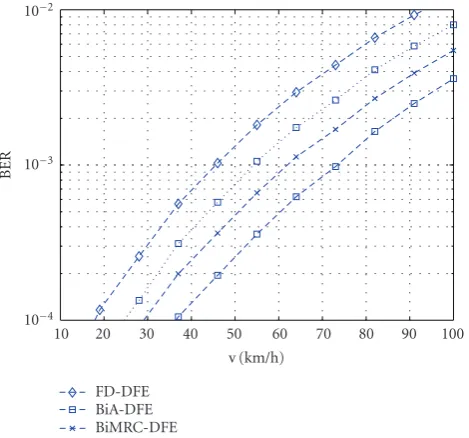
Figure4: Average BER as a function of the speed. The performance of TV-Bi-DFEs is shown in dashed lines, while dotted lines show the performance of TI-Bi-DFEs.
Randomly time-varying dispersive channels
First, we assume that the channel taps have a Rayleigh statis-tic and a uniform random phase. The power profile is expo-nentially decreasing and the average root mean square delay spread is 2T, whereTis the duration of a transmitted sym-bol. The time-varying taps have a Jakes’ spectrum which is related to the Doppler frequency:
fD=v
cf0, (39)
wherevis the terminal speed,cis the light speed, and f0is
the carrier frequency. We consider a transmission operating at f0=20 GHz, with a symbol rate 1/T=2 MHz.
Linearly time-varying channels
The second scenario that we consider is a time-varying chan-nel that evolves linearly from the chanchan-nel impulse response [13]
h(ref,1)
=0.183 0.916 0.289 −0.183 0.092 −0.046 0.018 (40)
to the impulse response of the channelCof [17]
h(ref,2)=0.227 0.460 0.688 0.460 0.227 0 0. (41)
The variation of the channel fromh(ref,1) toh(ref,2) is made
linearly on a per tap basis, that is,
h(n)=
1− n N−1
h(ref,1) +
n N−1h
(ref,2)
,
n=0, 1,. . .,N−1,
(42)
where the number of symbols N determines the speed of variation between the two channels. Although being favor-able to our TV-Bi-DFE with linear interpolation of the FB filter, this scenario provides an insight into the capabilities of the equalizers against channels with spectral nulls, which are usually hard to equalize.
We will indicate with BiMRC-DFE the TV-Bi-DFE using the MRC rule for the combination of the TV-FD-DFE sig-nals, while TV-Bi-DFE using the arbitration technique is de-noted as BiA-DFE.
For both TV-Bi-DFEs, we consider blocks of sizeP = 128, a PN extension ofL =16 symbols, and QPSK modu-lated data. For the feedback filter, we considerNFB=16 taps,
and for the arbitration of BiA-FDE, we consider a window sizeW=5.
Figure 4shows the average BER as a function of the speed for an SNR of 30 dB. Dashed lines report the results for TV-Bi-DFEs, while the dotted line shows the performance of the time-invariant bidirectional DFE (TI-Bi-DFE) with arbitra-tion. Indeed, the TI-Bi-DFE with MRC has not been shown since it has a performance very close to FD-DFE. We observe that TV-Bi-DFE provides an advantage of about 15 km/h over FD-DFE, and BiA-DFE further outperforms BiMRC-DFE by about 5 km/h. We also observe that by adapting the FB filter to the channel variations, TV-Bi-DFEs significantly outperform TI-Bi-DFEs. Lastly, from this figure we can also derive the impact of the block lengthPon the system perfor-mance. In fact, a higherPyields a larger time variation of the channel within each block.
6 8 10 12 14 16 18 20 SNR (dB)
10−4 10−3 10−2 10−1
BER
FD-DFE BiA-DFE BiMRC-DFE
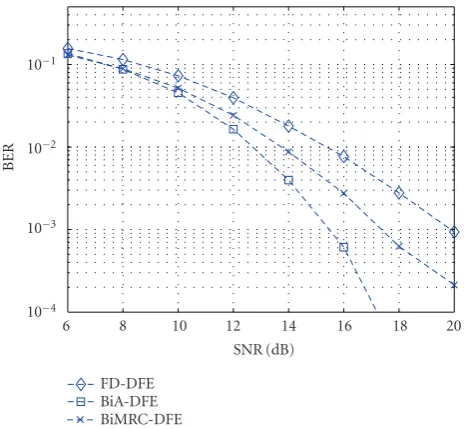
Figure5: Average BER as a function of the averageEb/N0for different equalizer structures. Linearly time-varying channel according to (42),
withN =3P.
6 8 10 12 14 16 18 20
SNR (dB) 10−4
10−3 10−2 10−1
BER
FD-DFE BiA-DFE BiMRC-DFE
Figure6: Average BER as a function of the averageEb/N0for different equalizer structures. Linearly time-varying channel according to (42), withN =30P.
within each frame. Moreover, we note that BiA-DFE out-performs significantly BiMRC-DFE since it out-performs a MAP choice on the equalized signals provided by the DFEs.
5.1. Computational complexity
The computational complexity of the proposed schemes is compared with existing schemes in terms of number of com-plex multiplications (CMUL) required both for signal pro-cessing and for filter design. For the computation, we assume that aP-size DFT requires (P/2) log2(P)−PCMULs.
The TV-Bi-DFE requires one DFT and two IDFTs, and CMULs for two FF filters. When BiMRC-DFE is considered, the combining does not require additional CMULs, while for BiA-DFE, two filters withLtaps are applied to the equalized signals, requiringLCMULs per received sample each.
6 8 10 12 14 16 18 20 SNR (dB)
10−4 10−3 10−2 10−1
BER
FD-DFE BiA-DFE BiMRC-DFE
Figure7: Average BER as a function of the averageEb/N0for different equalizer structures. Linearly time-varying channel according to (42),
withN =300P.
Table1: Computational complexity of the system.
Structure
Computational complexity
CMULs/sample Simulation
scenario
FD-DFE P
Mlog2(P) +NFB 24
BiMRC-DFE 3P
2Mlog2P− P
M+ 2NFB 43
BiA-DFE 3P
2Mlog2P− P
M+ 2NFB+ 2L 58
Block DFE [5] 2P 256
TV-FIR-DFE [18] (Q+ 1)(L+ 1) + (Q+ 1)L 169
block DFE (DFE) of [5] and TV-FIR-DFE of [18]. The B-DFE requires a signal processing complexity of 2PCMULs/ sample. For TV-FIR-DFE, we model the channel withL=16 taps and with Q = 2 basis functions (corresponding to a speed up to 100 km/h) and we consider a feedforward (feed-back) filter with L = 10 (L = 16) taps and Q = 10 (Q =2) basis functions. The signal processing complexity of TV-FIR-DFE is (Q+1)(L+1)+(Q+1)LCMULs/sample [18].
For the design of the filter coefficients, we observe that the most relevant operation is the solution of the linear sys-tem (21) which is shared by both the direct and the inverse TV-Bi-DFEs. Hence, the design of BiA-DFE does not yield an increase in complexity with respect to FD-DFE, providing in particular [9]
Cdesign=O
L2+L
2log2L+
P 2log2P
. (43)
The TV-FIR-DFE [18] has a complexity in design of [(Q+ Q+ 1)(L+L+ 1)]3, which is considerably higher than that
of our proposed scheme.
6. CONCLUSIONS
In this paper we presented a novel bidirectional time-varying FD-DFE structure which is suitable for the equalization of rapidly time-varying channels. By exploiting the duality of time convolution and frequency-domain multiplication, the feedforward filtering is implemented in the frequency do-main by means of efficient discrete Fourier transforms. At the same time, the feedback part of DFEs is implemented in the time domain and adaptively changed in order to track the channel variations. Moreover, two DFEs are applied on blocks of the received signal and their time-reversed ver-sions, thus achieving a diversity gain. For the combination of the two equalized signals, we considered two alternatives and we evaluated the bit error rate of the proposed schemes for a time-varying transmission scenario. We conclude that the proposed structure is effective in equalizing time-varying channels with an efficient architecture.
ACKNOWLEDGMENT
This work was supported in part by MIUR under the FIRB Project reconfigurable platforms for wideband wireless com-munications, prot. RBNE018RFY.
REFERENCES
[2] IEEE 802.16 Task Group e: Mobility,http://wirelessman.org/ mobile/.
[3] S. Parker, M. Sandell, M. S. Yee, et al., “Space-time codes for future WLANs: principles, practice, and performance,”IEEE Communications Magazine, vol. 42, no. 12, pp. 96–103, 2004. [4] IEEE 802.20: Mobile Broadband Wireless Access (MBWA),
http://grouper.ieee.org/groups/802/20/.
[5] H. Liu and G. B. Giannakis, “Deterministic approaches for blind equalization of time-varying channels with antenna ar-rays,”IEEE Transactions on Signal Processing, vol. 46, no. 11, pp. 3003–3013, 1998.
[6] I. Barhumi, G. Leus, and M. Moonen, “Time-varying FIR equalization for doubly selective channels,”IEEE Transactions on Wireless Communications, vol. 4, no. 1, pp. 202–214, 2005. [7] N. Benvenuto and G. Cherubini,Algorithms for
Communi-cations Systems and Their AppliCommuni-cations, John Wiley & Sons, Chichester, UK, 2002.
[8] D. Falconer, S. L. Ariyavisitakul, A. Benyamin-Seeyar, and B. Eidson, “Frequency domain equalization for single-carrier broadband wireless systems,” IEEE Communications Maga-zine, vol. 40, no. 4, pp. 58–66, 2002.
[9] N. Benvenuto and S. Tomasin, “On the comparison between OFDM and single carrier modulation with a DFE using a frequency-domain feedforward filter,” IEEE Transactions on Communications, vol. 50, no. 6, pp. 947–955, 2002.
[10] N. Benvenuto and S. Tomasin, “Block iterative DFE for single carrier modulation,”IEE Electronics Letters, vol. 38, no. 19, pp. 1144–1145, 2002.
[11] H. Suzuki, “Performance of a new adaptive diversity-equalization for digital mobile radio,”IEE Electronics Letters, vol. 26, no. 10, pp. 626–627, 1990.
[12] S. Ariyavisitakul, “A decision feedback equalizer with time-reversal structure,”IEEE Journal on Selected Areas in Commu-nications, vol. 10, no. 3, pp. 599–613, 1992.
[13] J. K. Nelson, A. C. Singer, U. Madhow, and C. S. McGa-hey, “BAD: bidirectional arbitrated decision-feedback equal-ization,”IEEE Transactions on Communications, vol. 53, no. 2, pp. 214–218, 2005.
[14] J. Balakrishnan and C. R. Johnson Jr., “Time-reversal diversity in decision feedback equalization,” inProceedings of Allerton Conference on Communication, Control and Computing, Mon-ticello, Ill, USA, October 2000.
[15] IEEE 802.16a-2003,Part 16: Air Interface for Fixed Broadband Wireless Access Systems Amendment 2: Medium Access Control Modifications and Additional Physical Layer Specifications for 2 11 GHz, IEEE Standard Specifications, New York, NY, USA, April 2003.
[16] W. C. Jakes,Microwave Mobile Communications, IEEE Press, New York, NY, USA, 1994.
[17] J. G. Proakis, Digital Communications, McGraw-Hill, New York, NY, USA, 1994.
[18] I. Barhumi, G. Leus, and M. Moonen, “Time-varying FIR decision feedback equalization of doubly-selective channels,” inProceedings of IEEE Global Telecommunications Conference (GLOBECOM ’03), vol. 4, pp. 2263–2268, San Francisco, Calif, USA, December 2003.
Stefano Tomasinis an Assistant Professor at University of Padova, Italy. After the Laurea degree in telecommunications engineering (1999), he was with the IBM Research Labo-ratory, Zurich, Switzerland, working on sig-nal processing for magnetic recording sys-tems. In 2000, he started the Ph.D. course in telecommunication engineering, work-ing on multicarrier communication systems for wireless broadband communications. In