Volume 2008, Article ID 347495,16pages doi:10.1155/2008/347495
Research Article
Flicker Compensation for Archived Film Sequences Using
a Segmentation-Based Nonlinear Model
Guillaume Forbin and Theodore Vlachos
Centre for Vision, Speech and Signal Processing, University of Surrey, GU2 7XH, Guildford, Surrey, UK
Correspondence should be addressed to Guillaume Forbin,[email protected]
Received 28 September 2007; Accepted 23 May 2008
Recommended by Bernard Besserer
A new approach for the compensation of temporal brightness variations (commonly referred to as flicker) in archived film sequences is presented. The proposed method uses fundamental principles of photographic image registration to provide adaptation to temporal and spatial variations of picture brightness. The main novelty of this work is the use of spatial segmentation to identify regions of homogeneous brightness for which reliable estimation of flicker parameters can be obtained. Additionally our scheme incorporates an efficient mechanism for the compensation of long duration film sequences while it addresses problems arising from varying scene motion and illumination using a novel motion-compensated grey-level tracing approach. We present experimental evidence which suggests that our method offers high levels of performance and compares favourably with competing state-of-the-art techniques.
Copyright © 2008 G. Forbin and T. Vlachos. This is an open access article distributed under the Creative Commons Attribution License, which permits unrestricted use, distribution, and reproduction in any medium, provided the original work is properly cited.
1. INTRODUCTION
Flicker refers to random temporal fluctuations in image intensity and is one of the most commonly encountered artefacts in archived film. Inconsistent film exposure at the image acquisition stage is its main contributing cause. Other causes may include printing errors in film processing, film ageing, multiple copying, mould, and dust.
Film flicker is immediately recognisable even by nonex-pert viewers as a signature artefact of old film sequences. Its perceptual impact can be significant as it interferes substantially with the viewing experience and has the potential of concealing essential details. In addition it can be quite unsettling to the viewer, especially in cases where film is displayed simultaneously with video or with electronically generated graphics and captions as is typically the case in modern-day television documentaries. It may also lead to considerable discomfort and eye fatigue after prolonged viewing. Camera and scene motion can partly mask film flicker and as a consequence, the latter is much more noticeable in sequences consisting primarily of still frames or frames with low-motion content. In addition it must also be pointed out that inconsistent intensity
between successive frames reduces motion estimation
accu-racy and by consequence the efficiency of compression
algorithms.
Flicker has often been categorised as a global artefact
in the sense that it usually affects all the frames of a
sequence in their entirety as opposed to so-called local artefacts such as dirt, dust, or scratches which affect a limited number of frames and are usually localised on the image plane. Nevertheless it is by no means constant within the boundaries of a single frame as explained in the next section and one of the main aims of this work is to address this issue.
1.1. Spatial variability
Flicker can be spatially variable and can manifest itself in
any one of the following ways. Firstly, when flicker affects
approximately the same position of all the frames in a sequence. This may occur directly during film shooting if scene lighting is not synchronised with the shutter of the camera. For example, if part of the scene is illuminated with synchronised light while the rest is illuminated with natural
light a localised flickering effect may occur. This can also be
B
C D
A
(a)
100 50
0
Frame number 130
175 220
M
edian
value
of
the
p
at
ch
es
Block A Block B
Block C Block D (b)
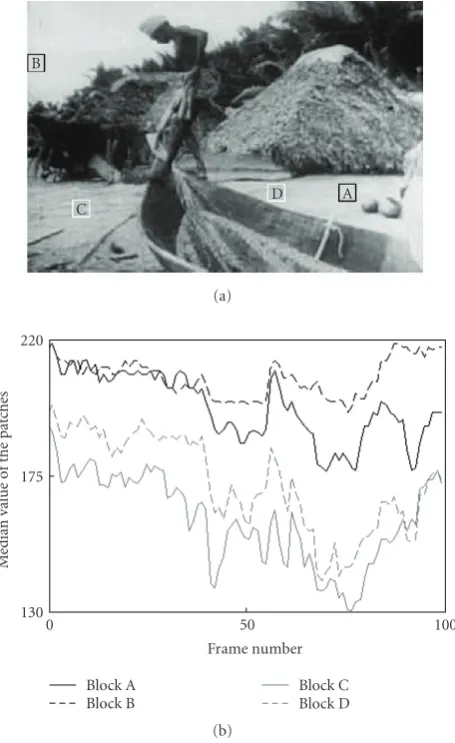
Figure1: (a) Test sequenceBoatused to illustrate spatial variability of flicker measured at selected location. (b) Evolution of the median intensity of the selected blocks.
by the accidental exposure of film to incident light, partial immersion or the use of old or spent chemicals on the film strip in the developer bath. Drying stains from chemical agents can also generate flicker [1–6].
It is also possible that flicker localisation varies randomly. This is the case when the film strip ages badly and becomes
affected by mould, or when it has been charged with static
charge generated from mechanical friction. The return to a normal state often produces static marks.
Figure 1shows the first frame of the test sequenceBoat
(Our Shrinking World(1946) Young America Films, Inc.
-Sd, B&W. (1946)). The camera lingers in the same position during the 93 frames of the sequence. There is also some slight unsteadiness. Despite some local scene motion, overall motion content is low. This sequence is chosen to illustrate that the spatial variation of flicker is not perceivable on the top-left part of the shot, while the bottom-left part changes from brighter initially to darker later on. On the right-hand side of the image, flicker is more noticeable, with faster
variations of higher amplitude. This is shown in Figure 1,
where the median intensities of four manually selected blocks
(16×16 pixels) located at different parts of the frame are
plotted as a function of frame number.
The selected blocks are motionless, low-textured and have pairwise similar grey levels (A, B and C, D) at the start of the sequence. As the sequence evolves we can clearly observe that each block of a given pair undergoes a substantially
different level of flicker with respect to the other block. This
example also illustrates that flicker can affect only a temporal
segment of a sequence. Indeed, from the beginning of the shot to frame 40 the evolution of the median intensities for blocks A and B is highly similar, thus degradation is low compared to the segment that follows the first 40 frames.
This paper introduces two novel concepts for flicker compensation. Firstly, the estimation of the flicker com-pensation profile is performed on regions of homogeneous
intensity (Section 4). The incorporation of segmentation
information enhances the accuracy and the robustness of flicker estimation.
Secondly, the concept of grey-level tracing (developed in Section 5) is a fundamental mechanism for the correct estimation of flicker parameters as they evolve over time. Further, this is integrated into a motion-compensated, spatially-adaptive algorithm which also incorporates the
nonlinear modelling principles proposed in [7, 8]. It is
worth noting that [7] is a proof-of-concept algorithm that
was originally designed to compensate frame pairs but was never engineered as a complete solution for long-duration sequences containing arbitrary camera and scene motion, intentional scene illumination changes, and spatially varying flicker effects.
This is demonstrated inFigure 2where the algorithm in
[7] achieves flicker removal by stabilising the global frame
intensity over time but only with respect to the first frame of the sequence which is used as a reference. In contrast the proposed algorithm is well-equipped to deal with motion, intentional illumination fluctuations and spatial variations and, together with a shot change detector, it can be used as a complete solution for any sequence irrespective of content and length.
This paper is organised as follows.Section 2reviews the
literature of flicker compensation while Section 3provides
an overview of our previous baseline approach based on
a nonlinear model and proposed in [7]. Improvements
reported in [8] and related to the flicker compensation
pro-file estimation are presented in Sections3.2and3.3. Spatial
adaptation and incorporation of segmentation information
are described in Section 4. Finally, a temporal
compen-sation framework using a motion-compensated grey-level
tracing approach is presented inSection 5and experimental
results are presented inSection 6. Conclusions are drawn in
Section 7.
2. LITERATURE REVIEW
100 90 80 70 60 50 40 30 20 10 0
Frame number 80
85 90 95 100 105 110 115 120 125 130 135
M
ean
fr
ame
int
ensit
y
for
test
sequenc
e
“boat
”
Original Baseline Proposed
Figure2: Comparison of mean frame intensity as a function of time between the original, the baseline scheme [7,8] and the proposed approach.
variability issues illustrated previously. More recent attempts have addressed spatial variability.
2.1. Global compensation
Previous research has frequently led to linear models where the corrected frame was obtained by linear transformation of the original pixel values. A global model was formulated
which assumed that the entire degraded frame was affected
with a constant intensity offset. In [1], flicker was modelled
as a global intensity shift between a degraded frame and the
mean level of the shot to which this frame belongs. In [2],
flicker was modelled as a multiplicative constant relating the mean level of a degraded frame to a reference frame. Both the additive and multiplicative models mentioned above require the estimation of a single parameter which although straightforward fails to account for spatial variability.
In [3] it was observed that archive material typically has
a limited dynamic range. Histogram stretching was applied to individual frames allowing the available dynamic range to be used in its entirety (typically [0 : 255] for 8 bits per pixel image). Despite the general improvement in picture quality the authors admitted that this technique was only moderately
effective as significant residual intensity variations remained.
The concept of histogram manipulation has been further
explored in [1] where degradation due to flicker was
mod-elled as a linear two-parameters grey-level transformation. The required parameters were estimated under the constraint that the dynamic range of the corresponding non-degraded frames does not change with time.
Work in [4,9] approached the problem using histogram
equalisation. A degraded frame was first histogram-equalised and then inverse-histogram was performed with respect
to a reference frame. Inverse equalisation was carried out in order for the degraded frame to inherit the histogram profile of the reference. Our previous work described in
[7] used non-linear compensation motivated by principles
of photographic image registration. Its main features are
summarised inSection 3.1.Table 1presents a brief overview
of global compensation methods.
2.2. Spatially-adaptive compensation
Recent work has considered the incorporation of spatial
variability into the previous models. In [5] a semi-global
compensation was performed based on a block-partitioning of the degraded frame. Each block was assumed to have undergone a linear intensity transformation independent of all other blocks. A linear minimum mean-square error (LMMSE) estimator was used to obtain an estimate of the required parameters. A block-based motion detector was also used to prevent blocks containing motion to contribute to the estimation process and thus the missing parameters due to the motion were interpolated using a successive over-relaxation technique. This smooth block-based sparse parameter field was bi-linearly interpolated to yield a dense pixel-accurate correction field.
Research carried out in [10,11] has extended the global
compensation methods of [1, 2] by replacing the additive
and multiplicative constants with two-dimensional second-order polynomials. It matches the visual impression one
gets by inspecting actual flicker-impaired material. In [10] a
robust hierarchical framework was proposed to estimate the polynomial functions, ranging from zero-order to second-order polynomials. Parameters were obtained using M-estimators minimising a robust energy criterion while lower-order parameters were used as an initialisation for higher-order ones. Nevertheless, it has to be pointed out that the previous estimators were integrated in a linear regression scheme, which introduces a bias if the frames are not entirely correlated (regression “fallacy” or regression “trap”
[12], demonstrated by Galton [13]). In [11] an alternative
approach to the parameter estimation problem which tried to solve this issue was proposed. A histogram-based method
[6] was formulated later on and joint probability density
functions (pdfs) (establishing a correspondence between grey levels of consecutive frames) were estimated locally in several control points using a maximum-a-posteriori (MAP) technique. Afterwards a dense correction function was obtained using interpolation splines. The same authors
proposed recently in [14] a flicker model able to deal
within a common framework with very localised and smooth spatial variations. Flicker model is parametrised with a single parameter per pixel and is able to handle non-linear distorations. A so-called “mixing model” is estimated reflecting both the global illumination of the scene and the flicker impact.
A method suitable for motionless sequences was
described in [15]. It was based on spatiotemporal
Table1: An overview of the global flicker compensation techniques.
Global compensation techniques Summary
Wu and Suter [1] linear compensation—flicker is modelled as a global intensity shift. Decenci`ere [2] linear compensation—flicker is modelled as a multiplicative constant.
Richardson and Suter [3] histogram-based compensation—histogram stretching across the avail-able greyscale.
Wu and Suter [1] histogram-based compensation—histogram stretching across the refer-ence frame greyscale.
Schallauer et al. [9] and Naranjo and Albiol [4] histogram-based compensation—histogram equalisation with respect to a reference frame.
Vlachos [7] Non-linear approach: flicker parameters are estimated independently for each grey-level and a compensation profile is obtained.
Table2: An overview of the spatially adaptive compensation techniques.
Spatially adaptive compensation techniques Summary
van Roosmalen et al. [5] Linear compensation: block-partitioning of the degraded frame.Smoothing of the sparse parameter field.
Ohuchi et al. [10] Linear compensation: flicker is modelled as 2-parameter 2nd order polynomials, hierarchical parameters estimation.
Kokaram et al. [11]
Linear compensation: flicker is modelled as 2-parameter 2nd order polynomials, parameters estimation based on an unbias linear regression.
Jung et al. [15]
Linear compensation: spatio-temporal segmentation isolating the background and the moving objects. Temporal average of the grey levels preserving the edges to reduce the flicker.
Piti´e et al. [6]
Histogram-based compensation: Joint probability density functions (pdfs) estimated locally in several control points. Dense correction function obtained using interpolation splines.
Forbin et al. [8]
Non-linear formulation: block-partionning of the degraded frame and estimation of intensity error profiles on each blocks using motion-compensated frame. Non-linear Interpolation of the compensation values weighted by estimated reliabilities.
Piti´e et al. [14] Pixel-based flicker estimation: flicker strength is estimated for each pixel using a “mixing model” of the global illumination.
(preserving the edges) of the sequence frames, while moving objects were motion compensated, averaged and regularised
to preserve spatial continuities. Table 2 presents a brief
overview of the above methods.
Based on the nonlinear model formulated in [7],
we proposed significant enhancement towards a
motion-compensation-based spatially-adaptive model [8]. These
improvements are extensively detailed in Sections 3.2,3.3,
and4.1.
2.3. Compensation for sequences of longer duration
While the above efforts addressed the fundamental
esti-mation problem with varying degrees of success far fewer attempts were made to formulate a complete and integrated compensation framework suitable for the challenges posed by processing longer sequences. In such sequences the main challenges relate to continuously evolving scene motion
and illumination rendering considerably more difficult the
appointment of reference frames. In [9] reference frames
were appointed and a linear combination of the inverse histogram equalisation functions of the two closest reference frames (forward/backward) was used for the compensation.
In [4] a target histogram was calculated for histogram
equalisation purposes by averaging neighbouring frames’ histograms within a sliding window. This technique was also
used in [16], but there the target histogram was defined as
a weighted intermediary between the current frame and its neighbouring histograms, the computation being inspired from scale-time equalisation theory.
In [5] compensation was performed recursively. Error
propagation is likely in this framework as previously gen-erated corrections were used to estimate future flicker parameters. A bias was introduced and the restored frame was a mixture of the actual compensated frame and the
original degraded one. In [11,14] an approach motivated
by video stabilisation described in [2] is proposed. Several
frame within a temporal window and an averaging filter is employed to provide a degree of smoothing of those parameters.
3. NONLINEAR MODELLING
This section summarises our previous work reported in [7],
which addressed the problem using photographic acquisition principles leading to a nonlinear intensity error profile between a reference and degraded frame. The proposed model assumes that flicker is originated from exposure inconsistencies at the acquisition stage. Quadratic and cubic models are provided, which means that the method is able to compensate for other sources of flicker respecting these constraints. Important improvements are discussed in
Sections3.2and3.3.
3.1. Intensity error profile estimation based on
the Density versus log-Exposure characteristic
The Density versus log-Exposure characteristic D(logE)
attributed to Hurter and Driffield [17] (Figure 3) is used
to characterise exposure inconsistencies and their associated density errors.
The slope of the linear region is often referred to as gamma and defines the contrast characteristics of the
photosensitive material used for image acquisition. In [7]
it was shown that an observed image intensity I with
underlying densityDand associated errorsΔI andΔDdue
to flicker are related via
I−→ΔI, (1)
which can as well be expressed by
exp(−D)−→ΔD·exp(−D). (2)
The mappingI →ΔIrelates grey-levelIin the reference
image and the intensity error ΔI in the degraded image.
In other words, this mapping determines the amount of
correction ΔI to be applied to a particular grey-level I
in order to undo the flicker error. As the Hurter-Driffield
characteristic is usually film stock dependent and hence
unknown,DandΔDare difficult to obtain. Nevertheless an
intensity error profileΔI across the entire greyscale can be
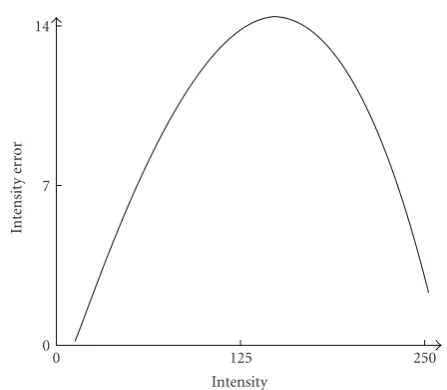
estimated numerically.Figure 3shows a typical such profile
which is highly non-linear, concave, peaking at the midgrey region and decreasing at the extremes of the available
scale, as plotted inFigure 4. As a consequence, a quadratic
polynomial could be chosen to approximate the intensity error profile in a parametrised fashion. Nevertheless, telecine grading (contrast, greyscale linearity, and dynamic range adjustments performed during film-to-video transfer) can
introduce further non-linearity as discussed in [7] and a
cubic polynomial approximation is more appropriate in those cases.
An intensity error profileΔIt,refis determined between
a reference and a degraded frame Fref andFt, respectively,
whereIrefandIt =Iref−ΔIt,ref(It) are grey levels of co-sited
pixels in the reference and degraded frames andΔIt,ref(It) is
4 2
0
log (exposure) 0
1.5 3
Densit
y
Exposure error
Density error
Figure 3: Hurter-Driffield D(logE) characteristic (dashed) and density error curve (solid) due to exposure inconsistencies.
250 125
0
Intensity 0
7 14
In
te
nsit
y
er
ror
Figure 4: Theoretical intensity error profile as a function of intensity (all units are grey-levels).
the flicker component for grey-levelIt. For monochrome
8-bits-per-pixel images,It,Iref∈ {0, 1,. . ., 255}. This
compen-sation profile allows to reduce Ft flicker artefact according
to Fref. In this framework, Fref is chosen arbitrarily, as a
nondegraded frame is usually not available. It is assumed that motion content between those two images is low and does not interfere in the calculations. To estimateΔIt,ref(It), pixel
differences between all pixels with intensityItin the degraded
frame and their cosited pixels in position p =(x,y) in the
reference frame are computed and a histogramHt,ref(It) of
the error is compiled as follows:
∀Ftp=It:Ht,ref
It=histFtp−Fref
30 0
−30
Intensity difference 0
125 250
N
u
mb
er
of
o
ccur
renc
es
Greylevel=50
(a)
30 0
−30
Intensity difference 0
125 250
N
u
mb
er
of
o
ccur
renc
es
Greylevel=60
(b)
Figure5: Intensity difference histogramsHt,ref(50) andHt,ref(60) and their maxima for two consecutive frames of test sequenceCaption.
An example is shown inFigure 5 for the test sequence
Caption and two sample grey levels. The intensity error is
given by
ΔIt,ref
It=arg maxHt,ref
It. (4)
The process is repeated for each intensity level It to
compile an intensity error profile for the entire greyscale. As the above computation is obtained from real images, the profileΔIt,refis unlikely to be smooth and is likely to contain
noisy measurements. Either a quadratic or cubic polynomial least-squares fitting can be applied to the compensation profile. Cubic approximation is more complex and more sensitive to noise but is able to cope with nonlinearity
originated from telecine grading, as discussed in [7]:
A=arg min
It
Pt,ref
It−ΔIt,ref
It2,
withA=a0,. . .,aL
, Pt,ref
It= L
k=0 ak·Itk.
(5)
L being the polynomial order. An example is shown
in Figure 4. Finally the correction applied to the pixel at locationpis:
Ft
p=Ftp+Pt,ref
Ftp. (6)
3.2. Grey-level intensity error reliability weighting
The first important improvement to the baseline scheme in
[7] is motivated by the observation that taking into account
the frequency of occurrence of grey-levels can enhance the reliability of the estimation process. This enhancement is
presented in [8]. grey-levels with low pixel representation
should be less relied upon and vice versa. In addition,
ΔIt,ref estimation accuracy can vary for different intensities
as illustrated in Figure 5. It can be seen for example that
Ht,ref(50) is spread around an intensity error of 15 and even
if the maximum is reached for 12, many pixels actually
voted for a different compensation value. On the other hand
the strength of consensus (i.e., height of the maximum)
of Ht,ref(60) suggests a more unanimous verdict. Thus the
reliability ofΔIt,refdepends on the frequency ofIrefbut also
on Ht,ref. A weighted polynomial least square fitting [18]
is then used to compute the intensity error profile and the weighting function reflecting grey-level reliability is chosen as:
rt,ref
It=maxHt,ref
It. (7)
Indeed, ifIt does not occur very frequently in Ft then
rt,ref(It) will be close to 0 and reliability will be influenced
accordingly. The polynomial Ct,ref parameters are now
obtained as the solution to the following weighted least-squares minimisation problem:
A=arg min
It rt,ref
It·Ct,ref
It−ΔIt,ref
It2. (8)
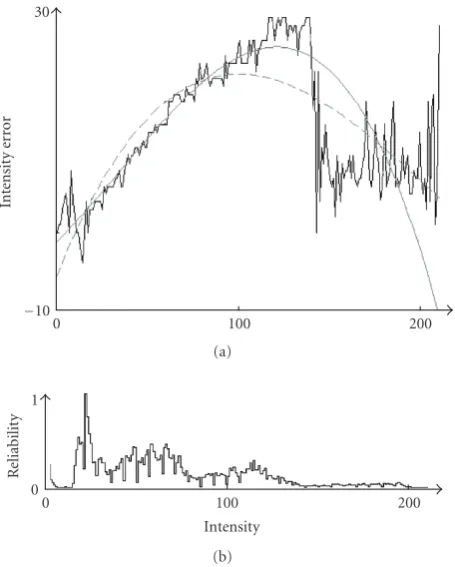
An example of reliability distribution rt,ref is shown at
the bottom ofFigure 6, and highlights that pixel intensities
above 140 are poorly represented. A comparison between the
resulting unweighted correction profile Pt,ref (dashed line)
and the improved oneCt,ref(solid line) confirms that more
densely populated grey-levels have a stronger influence on the fidelity of the fitted profile.
A side benefit of this enhancement is that it allows our scheme to deal with compressed sequences such as MPEG material. The quantisation used in compression
may obliterate certain grey levels. An absent grey-level It
implies that Ht,ref(It) = 0, thus rt,ref(It) = 0, which
means that ΔIt,ref(It) will not be used at all in the fitting
process.
3.3. Motion compensated intensity error
profile estimation
The above works well if motion variations between a
refer-ence and a degraded frame are low. As stated in [8], motion
compensation must be employed to be able to cope with longer duration sequences. This will enable the estimation of a flicker compensation profile between a degraded- and
a motion-compensated reference frame Ftc,ref. In our work
200 100
0
−10
30
In
te
nsit
y
er
ror
(a)
200 100
0
Intensity 0
1
R
eliabilit
y
(b)
Figure6: Measured and polynomial approximated (dashed:basic fitting - solid:weighted fitting) intensity error profiles as a function of intensity between the first two frames of test sequenceCaption. A quadratic model is used. The histogram below shows the normalised confidence valuesrt,reffor each grey-level.
of the brightness constancy assumption, which is a defining feature of flicker applications. Other dense or sparse motion estimators can be used depending of robustness and speed requirements. Robustness is crucial as incorrect motion estimation will fail the flicker compensation. The motion compensation error will provide a key influence towards
intensity error profile estimation. Indeed, (3) attributes the
same importance to each pixel contributing to the histogram. The motion compensation error is employed to decrease the influence of poorly compensated pixels. This is achieved by compilingHtc,ref(It) using real-valued (as opposed to unity)
increments for each pixel located at p (i.e., Ft(p) = It)
according to the following relationship:
ect,ref
p=1− E c t,ref
p
maxEct,ref
p, (9)
Etc,refbeing the motion prediction error, that is,Ect,ref=Frefc − Ft. Thus ect,ref(p) varies between 0 and 1 and is inversely
proportional toEct,ref(p), and so high confidence is placed on
pixels with a low motion compensation error and vice versa. In other words, areas where local motion can be reliably predicted (hence yielding low levels of motion compensation error) are allowed to exert high influence on the estimation of flicker parameters. Pixels with poorly estimated motion,
on the other hand, are prevented from contributing to the flicker correction process.
4. SPATIAL ADAPTATION
The above compensation scheme performs well if the
degraded sequence is globally affected by flicker artefact.
However, as illustrated inSection 1.1this is not always the
case. Spatial adaptation is achieved by taking into account regions of homogeneous intensity. The incorporation of segmentation information enhances the accuracy and the robustness of flicker parameters estimation.
4.1. Block-based spatial adaptation
Spatial adaptation requires mixed block-based/region-based frame partitioning. The block-based part is illustrated in
Figure 7. Correction profilesCt,ref,b are computed
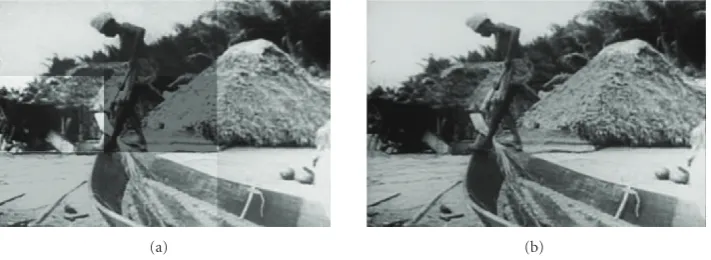
indepen-dently for each blockbof frameFt. As brute force correction
of each block would lead to blocking artefacts at block
boundaries (Figure 8), a weighted bilinear interpolation is
used.
It is assumed initially that flicker is spatially invariant within each block. For each block a correction profile is
computed independently betweenIrefandIt, yielding values
forΔIt,ref,b,Ct,ref,b andrt,ref,b,b = [1;B],b being the block
index andBthe total number of blocks.
Blocking is avoided by applying bilinear interpolation of the B available correction valuesCt,ref,b(Ft(p)) for pixel
p. Interpolation is based on the inverse of the Euclidean
distancecb(p)=
(x−xb)2+ (y−yb)2,
dbp= 1
cbp+ 1 (10)
with (xb,yb) being the coordinates of the centre of the block
b for which the block-based correction derived earlier is
assumed to hold true.
This interpolation smooths the transitions across blocks
boundaries. In addition, reliability measurements rt,ref,b of
Ct,ref,b detailed in Section 3.2 are also used as a second
weight in the bilinear interpolation. This allows to discard
measurements coming from blocks where Ft(p) is poorly
represented. Polynomial approximation on blocks with a low grey-level dynamic will only be accurate on a narrow part of the greyscale, but rather unpredictable for absent
grey levels. rt,ref,b is employed to lower the influence of
such estimation. Intensity error estimationCt,ref,bare finally
Ct,R,1(Ft(−→p))
rt,R,1(Ft(−→p))
Ct,R,9(Ft(−→p))
rt,R,9(Ft(−→p))
Ct,R,3(Ft(−→p))
rt,R,3(Ft(−→p))
Figure7: Block-based partition of the first frame ofBoatusing a 3×3 grid. The pixel undergoing compensation and the centre of each block are represented by black and white dots, respectively. The black lines represent the Euclidean distancescb(p). Polynomial correction profiles
Ct,ref,band associated reliabilitiesrt,ref,bare available for each blockb. Compensation value for pixelpis obtainted by a bilinear interpolation of
the block-based compensation values (9 in this example). Bilinear interpolation involves weighting by block-based reliabilities and distances db.
(a) (b)
Figure8: (a) Compensation of the frame 20 of the test sequenceBoatapplied independently on each block of a 3×3 grid. As expected blocking artefacts are visible. (b) Compensation using the spatially adaptive version of the algorithm.
weights provide a good balance between the two. The final correction value is then given by
Ft
p=Ftp− B
b=1
dbp·rt,ref,b
Ftp·Ct,ref,b
Ftp,
with
B
b=1
dbp·rt,ref,b
Ftp=1.
(11)
Figure 7illustrates the bilinear interpolation scheme. It shows block-partitioning, computed compensation profiles and reliabilities, and distancesdb. For pixelpthe correspond-ing compensation value is given by bilinear interpolation of the block-based compensation values, weighted by their reliabilities and distancesdb.
4.2. Segmentation-based profile estimation
So far entire blocks have been considered for the compen-sation profile estimation. It was shown that the weighted polynomial fitting and the motion prediction are capable of dealing with outliers. However, it is also possible to
enhance the robustness and the accuracy of the method by performing flicker estimation of regions of homogeneous
brightness. The presence of outliers (Figure 5) is reduced in
the compensation profile estimation and the compensation
profile (Figure 6) is computed on a narrower grey-level
range, improving the polynomial fitting accuracy.
In our approach we divide a degraded block into regions of uniform intensity and then perform one compensation profile estimation per region. Afterwards, the most reliable sections of the obtained profiles are combined to create a compound compensation profile. The popular unsupervised
segmentation algorithm called JSeg [20] is used to partition
the degraded image Ft into uniform regions (Figure 9).
The method is fully automatic and operates in two stages. Firstly, grey-level quantisation is performed on a frame based on peer group filtering and vector quantisation. Secondly,
spatial segmentation is carried out. A J-image where high
and low values correspond to possible regions boundaries
is created using a pixel-based so-called J measure. Region
Table3: Number of frames processed per second for the different
compensation techniques.
Proposed Piti´e [6] Roosmalen [5] 352×288 resolution 0.62 0.80 0.55 720×576 resolution 0.35 0.43 0.27
F1
t,2 F2t,2 Ft3,2
F4
t,2 Ft5,2
Figure 9: Segmentation and block-partitionning using a 3×3 grid of the 20th frame of the sequenceTunnel. Block partitioning (B =9) and the overlaid segmentation map are presented on the left, while the right figure illustrates the segmentation of blockFt,2.
Sub-regionsFk
t,2 (k =1,. . ., 5) where local compensation profiles
are estimated are labelled.
of segmentation algorithm is not of particular importance.
Alternative approaches such as Meanshift [21] or Statistical
region merging [22] can also be employed for segmentation
with similar results as the ones presented later in this paper.
The segmentation map is then overlaid onto the block
grid, generating block-based subregions Ftk,b, k being the
index of the region within the block b. Block partitioning
allows to deal with flicker spatial variability while grey-level segmentation permits to estimate flicker in uniform
regions. Local compensation profiles Ctk,ref,b and associated
reliabilitiesrtk,ref,bare then computed independently on each
subregion of each block. k compensation values are then
available for each grey level and the aim is to retain the most accurate one. The quality of the region-based estimations is proportional to the frequency of occurrence
of grey levels. Reliability measurement rk
t,ref,b presented in
Section 3.2is employed to reflect the quality of the region-based compensation values estimation. The block-region-based
compensation value associated with grey-levelIt for block
b is obtained by maximising the reliability rk
t,ref,b for the k
region-based compensation values estimation:
Ct,ref,b
It= max
rk t,ref,b(It)
Ctk,ref,b
It,
rt,ref,b
It=max
k
rk t,ref,b
It. (12)
Finally, maxk{rtk,ref,b(It)}is retained as a measure of the
block-based compensation value reliability.
5. FLICKER COMPENSATION FRAMEWORK
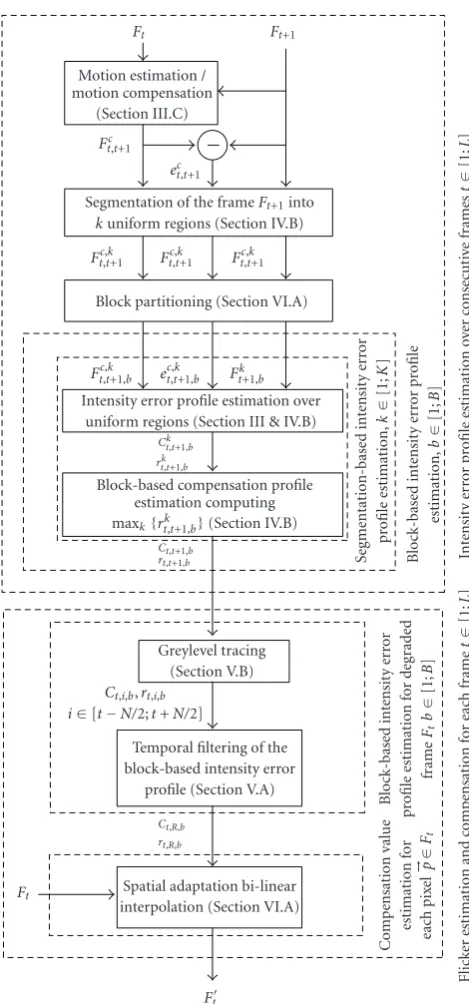
In this section, a new adaptive compensation framework achieving a dynamic update of the intensity error profile is presented. It is suitable for the compensation of long duration film sequences while it addresses problems arising from varying scene motion and illumination using a novel motion-compensation grey level tracing approach. Com-pensation accuracy is further enhanced by incorporating a
block-based spatially adaptive model. Figure 10 presents a
flow-chart describing the entire algorithm while Figure 2
shows the mean intensity of compensated frames between
the baseline approach [7,8] and the proposed algorithm. The
baseline method relies on a reference frame (usually the first frame of the sequence) and is unable to cope with intentional brightness variations.
5.1. Adaptive estimation of the intensity error profile
The baseline compensation scheme described in [7] allows
the correction of the degraded frame according to a fixed
reference frame Fref (typically the first frame of the shot).
This is only useful for the restoration of static or nearly static sequences as performance deteriorates with progressively longer temporal distances between a compensated frame and the appointed reference especially when considerable levels of camera and scene motion are present. In
addi-tion it gives incorrect results if Fref is degraded by other
artefacts (scratches, blotches, special effects like fade-ins or
even MPEG compression can damage a reference frame). Restoration of long sequences requires a carefully engineered compensation framework.
Let us denote byCt,R the intensity error profile between
frame Ft and flicker-free frame FR. We use an intuitively
plausible assumption by considering that the average of
intensity errors Ct,i(It) between frames It and Ii within a
temporal window centred at frame t yields an estimate of
flicker-free grey-levelIR. Other assumptions could be
formu-lated and median or polynomial filtering could be employed.
The intensity error Ct,R(It) between grey-levels It and IR
is estimated using the polynomial approximation Ct,i(It)
which provides a smooth and compact parametrisation of the correction profile (Section 3.2):
Ct,R
It=≈ 1 N
t+N/2
i=t−N/2
ΔIt,i
It. (13)
In other words a correction valueCt,R(It) on the profile
is obtained by averaging correction valuesCt,i(It) wherei∈
[t−N/2;t+N/2], that is, a sliding window of widthNcentred at the current frame. We incorporate reliability weighting (as
obtained fromSection 3.2) by taking into account individual
reliability contributions for each frame within the sliding window which are normalised for unity:
Ct,R
It= t+N/2
i=t−N/2 rt,i
It·Ct,i
It with
t+N/2
i=t−N/2 rt,i
It=1.
Ft Ft+1
Motion estimation / motion compensation
(Section III.C) Fc
t,t+1
ect,t+1
Segmentation of the frameFt+1into
kuniform regions (Section IV.B) Ftc,,tk+1 Ftc,,tk+1 Ftc,,tk+1
Block partitioning (Section VI.A)
Ftc,,tk+1,b etc,,tk+1,b Fk
t+1,b
Intensity error profile estimation over uniform regions (Section III & IV.B)
Ck
t,t+1,b
rk
t,t+1,b
Ct,t+1,b
rt,t+1,b
Ct,R,b
rt,R,b
Block-based compensation profile estimation computing maxk{rkt,t+1,b}(Section IV.B)
Greylevel tracing (Section V.B) Ct,i,b,rt,i,b
i∈[t−N/2;t+N/2]
Temporal filtering of the block-based intensity error
profile (Section V.A)
Ft Spatial adaptation bi-linear
interpolation (Section VI.A)
Ft In te nsit y er ror pr ofile est imat ion o ver co nse cut iv e fr ames t ∈ [1; L ] Blo ck-base d int ensit y er ro r p ro file estimatio n , b ∈ [1; B ] S eg m entat ion-base d int ensit y er ro r p ro fi le estimatio n , k ∈ [1; K ] Flic ke r estimation and co mpensation for eac h fr ame t ∈ [1; L ] Blo ck-base d int ensit y er ro r p ro fi le estimatio n fo r d eg rad ed fr ame Ft b ∈ [1; B ] Com p en sa ti on va lu e estimatio n fo r eac h pix el
−→ p∈ Ft
Figure 10: Flow chart of the proposed compensation algorithm. The algorithms operates in two stages: intensity error profile over consecutive frames are first computed on a block-based basis. Afterwards these profiles are employed to calculate block-based compensation profiles related to a specific degraded frame, which are finally bi-linearly interpolated to obtained pixels compensation values.
The scheme is summarised in the block diagram of
Figure 11. A reliable correction value Ct,i(It) will have a
proportional contribution to the computation of Ct,R(It).
A reliability measure corresponding to Ct,R(It) is obtained
by summing unnormalised reliabilitiesrt,i(It) of interframe
correction valuesCt,i(It) inside the sliding window:
rt,R
It= t+N/2
i=t−N/2 rt,i
It. (15)
5.2. Intensity error estimation between distant frames
using motion-compensated grey-level tracing
As Frames Ft and Fi can be distant in a film sequence,
large motion may interfere and the motion compensation
framework presented isSection 3.3cannot be used directly
· · · · · ·
Ct,t−N/2(It) Ct,t−1(It) Ct,t+1(It) Ct,t+N/2(It)
rt,t−N/2(It) rt,t−1(It) rt,t+1(It) rt,t+N/2(It)
Ct,R(It)=ti=+N/t−2N/2rt,i(It)·Ct,i(It)
It
Figure11: Compensation valueCt,R(It) for a specific grey-levelItis
obtained by averaging inter-frame compensation valuesCt,i(It),i∈
[t−N/2;t+N/2] within a temporal window of widthNcentered at current frameFt. Each inter-frame compensation value is weighted
by its associated reliabiltyrt,i(It).
frames. Raw intensity error profiles and associated relia-bilities are computed between consecutive frames in both directions yielding values toΔIt,t+1,ΔIt+1,tandrt,t+1,rt+1,tfor
t = [0;L], Lbeing the number of frames of the sequence
(flow-chart 10, first stage). The mapping functions are then combined as follows:
ΔIt,t+2
It=ΔIt,t+1
It+ΔIt+1,t+2
It+ΔIt,t+1
It (16)
which can be generalised forΔIt,t±i,i >2. This amounts to
tracing correction values from one frame to the next along trajectories of estimated motion. The associated reliability is computed as follows:
rt,t+2
It=minrt,t+1
It,rt+1,t+2
It+ΔIt,t+1
It. (17)
The above generalises for any frame-pair (flow-chart 10, second stage). If a specific correction ΔIt,t±1 is unreliable
then the min operator above ensures that the compound reliabilityrt,t±i(It) will also be rendered unreliable.
A numerical example is presented in Figure 12 where
correction of grey-level 15 between frames Ft and Ft+1
is estimated as ΔIt,t+1(15) = −1. Thus, grey-level 15
is mapped to grey-level 14 in Ft+1. As ΔIt+1,t+2(14) =
2 we have ΔIt,t+2(15) = −1 + 2 = 1. Nevertheless
we know that rt+1,t+2(14) = 0.1 which means that
ΔIt+1,t+2(14) is unreliable. As a consequence ΔIt,t+2(15) =
1 is not a trustworthy estimation and its reliability com-puted as rt,t+2(15) = min(rt,t+1(15),rt+1,t+2(ΔIt,t+1(15))) =
min(0.9,rt+1,t+2(14))=min(0.9, 0.1)=0.1 reflects that.
In the same manner we find that ΔIt,t+2(20) =
ΔIt,t+1(20) +ΔIt+1,t+2(ΔIt,t+1(20) + 20)=5 +ΔIt+1,t+2(25)=8
andrt,t+2(20) = min(rt,t+1(20),rt+1,t+2(ΔIt,t+1(20) + 20)) =
min(0.7,rt+1,t+2(25)) = min(0.7, 1) = 0.7 which is more
reliable than before.
6. EXPERIMENTAL RESULTS
6.1. Test material
The proposed flicker compensation framework is compared with two spatially-adaptive state-of-the-art techniques,
25 15
5
−4
0 10
Δt,
t
+1
25 15
5
It
1 0.5 0
rt,t+1
(a)
30 20
14 10
−4
0 10
Δt+1,
t
+2
30 20
14 10
It+1
1 0.5 0
rt+1,
t
+2
(b)
25 15
5
−4
0 10
Δt,
t
+2
25 15
5
It
1 0.5 0
rt,t
+2
(c)
100 90 80 70 60 50 40 30 20 10 0 Frame number −25 −20 −15 −10 −5 0 5 10 15 20 25 M ean fr ame int ensit y for test sequenc e “b o at ” (a) 200 160 120 80 40 0 Frame number −30 −20 −10 0 10 20 30 M ean fr ame int ensit y for test sequenc e “L umi `er e” (b) 50 45 40 35 30 25 20 15 10 5 0 Frame number −10 −8 −6 −4 −2 0 2 4 6 8 M ean fr ame int ensit y for test seq u enc e “t unnel” (c) 150 100 50 0 Frame number −25 −20 −15 −10 −5 0 5 10 15 20 25 M ean fr ame int ensit y for test sequenc e “g re atwall” Original Roosmalen Pitie Proposed (d)
Figure13: Comparison of mean frame intensity as a function of time. 100 90 80 70 60 50 40 30 20 10 0 Frame number 58 59 60 61 62 63 64 65 Me as u re 2 for te st sequenc e “boa t” (a) 200 160 120 80 40 0 Frame number 73 74 75 76 77 78 79 80 Me as u re 2 for te st sequenc e “L umi `er e” (b) 50 45 40 35 30 25 20 15 10 5 0 Frame number 36
36.5 37 37.5 38 38.5 39 Me as u re 2 for te st sequenc e “t unnel” (c) 150 100 50 0 Frame number 40 41 42 43 44 45 46 47 48 49 50 Me as u re 2 for te st sequenc e “g re at w al l” Original Roosmalen Pitie Proposed (d)
100 90 80 70 60 50 40 30 20 10 0 Frame number 3
3.5 4 4.5 5 5.5 6 6.5 7 7.5
Me as u re 1 for te st sequenc e “boa t” (a) 200 160 120 80 40 0 Frame number 3
3.5 4 4.5 5 5.5 6 6.5 7 Me as u re 1 for te st sequenc e “L umi `er e” (b) 50 45 40 35 30 25 20 15 10 5 0 Frame number 3
3.5 4 4.5 5 5.5 6 Me as u re 1 for te st sequenc e “t unnel” (c) 140 120 100 80 60 40 20 0 Frame number 3.5
4 4.5 5 5.5 6 6.5
Me as u re 1 for te st sequenc e “g re at w al l” Original Roosmalen Pitie Proposed (d)
Figure 15: Comparison of time-normalised cumulative average of absolute differences between consecutive motion-compensated frames. 15 10 5 0 Greylevel threshold 10 20 30 40 50 60 70 80 90 100 Me as u re 2 for te st sequenc e “boa t” (a) 30 25 20 15 10 5 0 Greylevel threshold 10 20 30 40 50 60 70 80 90 100 Me as u re 2 for te st sequenc e “L umi `er e” (b) 16 14 12 10 8 6 4 2 0 Greylevel threshold 10 20 30 40 50 60 70 80 90 100 Me as u re 2 for te st sequenc e “t unnel” (c) 20 18 16 14 12 10 8 6 4 2 0 Greylevel threshold 20 30 40 50 60 70 80 90 100 Me as u re 2 for te st sequenc e “g re at w al l” Original Roosmalen Pitie Proposed (d)
detailed, respectively, in [5, 6] (cf. Section 2). Four CIF
resolution (360×288) monochromes test sequences,Boat,
Lumi`ere,TunnelandGreatwallcomposed of 93, 198, 50 and
141 frames, respectively, are used for evaluation purposes. Each of these sequences represent historical footage and are therefore susceptible to other archive-related artefacts (such as dirt, unsteadiness and scratches) in addition to flicker.
The first three sequences contain slight unsteadiness but substantial levels of flicker. The impairments are highly nonlinear in and present various degrees of spatial variability. Motion content is quite low as the camera is fixed. The last sequence is a panoramic pan of the Chinese Great Wall.
6.2. Evaluation protocol
For each test sequence, a 4 × 4 grid-partitioning (cf.
Section 4) is employed. In addition, the temporal window
length (Section 5.1) is set to 15 frames centred at the current
degraded frame. Flicker reduction algorithms are tradition-ally evaluated by examining the variation of the mean frame intensity over time. Those measurements are presented in
Figure 13for each of the test sequences. The smoother the curve, the better the compensation is supposed to be. It is also useful to compare the standard deviation of each frame as a good-quality compensation should not distort the greyscale dynamic range of the original frames. Time-normalised cumulative standard deviation of the frames for the available
sequence are presented in Figure 14. Nevertheless these
measurements cannot highlight the spatial variation issues
discussed earlier inSection 1.1. Two new visualisation
meth-ods are proposed in order to highlight spatial variability. These provide flicker compensation objective measurements for sequences impaired by localised flicker and containing substantial scene motion.
Let us now consider a pair of flicker-compensated frames. In the case of a near-perfect correction, the first frame and the motion-compensated second one should be very
similar, the differences being only due to motion estimation
inaccuracy. The remaining two of the new visualisation techniques are based on this hypothesis and assess the similarity between those two images as follows.
(i) The absolute difference between co-sited pixels of the
above frames is averaged. In addition this average is weighted for each pixel by considering the motion prediction error. The better the compensation, the closer to zero this value should be.
(ii) A threshold on the available greyscale (typically between 0 and 255) is applied. Then the percentage
of co-sited pixels having an absolute difference lower
than this threshold is counted. Each pixel’s influence is weighted by the motion prediction error. A curve for the entire greyscale is then compiled by suitably moving the threshold across the scale.
The above are applied to image sequences by accumulat-ing measurements obtained for pairs of consecutive frames. Normalising the values by the running total number of frames give mores clarity to the plots, which are, respectively,
presented in Figures15and16for the seven test sequences
under consideration.
6.3. Discussion
Overall, our results show that the three competing algo-rithms perform well both in terms of measured
perfor-mances as well as subjective quality.Figure 13demonstrates
that a smoothing of frame mean intensity variation is achieved so the global flicker component is substantially
reduced while temporal filtering (Section 5) allows to
preserve natural brightness variation. It must be noticed that Roosmalen’s curve is somehow more noisy than the two others for several test sequences and this is visually confirmed. Residual flicker is still visible, as the compensated frames are a mixture of the corrected and degraded ones (Section 2.3).
This performance difference is significantly more
notice-able in Figure 14 where the time-normalised cumulative
standard deviation of the frames are plotted. In terms of
this criterion effective methods should reduce flicker while
maintaining simultaneously the greyscale range of the test sequences. Piti´e and the proposed method are able to preserve the dynamic range characteristics of the sequences,
and increase it for test sequencesBoatandLumi`ere. However,
a dramatic reduction may be observed for Roosmalen’s method. Comparing Piti´e’s technique to ours, we can see that each have a slight advantage for approximately half the test sequences. As mentioned previously, these measurements cannot highlight the flicker spatial variation issues. Next we assess performance in relation to spatial variability.
Better discrimination can be obtained by examining
Figure 15, which shows the average variation between motion-compensated frames. It may be observed that the proposed technique compares favourably for all test sequences.
Finally the percentage of pixels having a lower absolute
difference than a variable threshold between consecutive
frames is computed inFigure 16. The higher the percentage
the better the performance of the scheme under assessment. Also in this case our method performs best.
Test sequences and results obtained with the different
approaches above are available at: http://www.ee.surrey
.ac.uk/Personal/G.Forbin/EURASIP/index.html.
7. CONCLUSION
In this paper, a new scheme for flicker compensation was introduced. The approach was based on non-linear mod-elling introduced in previous work and contains important novel components such as flicker estimation on homoge-neous regions and temporal filtering using grey-level tracing. These novelties allows to address, respectively, the challenges posed by the spatial variability of flicker impairments and the adaptive estimation of flicker compensation profile for long duration sequences and also scene motion. Our results
demonstrate that the algorithm is very effective towards
and compares favourably to state-of-art methods that feature in the literature.
LIST OF SYMBOLS
Ft: Frame sampled at timet
Ft: Flicker compensated frame sampled at timet
Fref: A generic reference frame
L: Total number of frames in a test sequence
p=(x,y): Pixel coordinates
Ft(p): Grey-level value of frameFtat positionp
I: Image intensity (grey-level value)
It: IntensityIin frameFt
ΔIt,ref: Intensity error profile between framesFrefand
Ft
ΔIt,ref(It): Intensity error for grey-levelItbetween frames FrefandFt
rt,ref: Intensity error reliability between framesFref
andFt
rt,ref(It): Reliability associated with intensity error
ΔIt,ref(It)
Pt,ref: Polynomial fitted to intensity error profile
between framesFrefandFt
Ct,ref: Weighted polynomial fitted to intensity error
profile between framesFrefandFt
Ht,ref(It): Histogram of the intensity errors between
pixels with intensityItin frameFrefand
co-sited pixels in frameFt
Ftc,ref: Motion-compensated version ofFrefrelative to
Ft
ect,ref: Motion prediction error ofFtc,ref Etc,ref: Error weighting derived fromHtc,ref(It) Htc,ref(It): Histogram of the intensity errors between
pixels with intensityItin frameFtand co-sited
pixels in
B: Number of blocks considered in the block
partitioning scheme
Ct,ref,b: Intensity error profile computed within blockb
between framesFrefandFt
rt,ref,b: Reliability associated with intensity errorCt,ref,b Ckt,ref,b: Intensity error profile computed within region
kbetween blocksFref,bandFt,b rk
t,ref,b: Reliability associated with intensity errorCtk,ref,b
db(p): Inverse of euclidean distance between position
pand centre of blockb
N: Number of frames in the temporal filtering
window
FR: Flicker-free frameFt
IR: Flicker-free intensityIt
Ct,R: Intensity error profile between flicker-free
framesFRandFt
rt,R: Reliability associated with intensity error
Ct,R(It).
ACKNOWLEDGMENT
This work was supported by the UK Engineering and Physical Sciences Research Council (EPSRC) under Research Grant GR/S70098/01.
REFERENCES
[1] Y. Wu and D. Suter, “Historical film processing,” in Applica-tions of Digital Image Processing XVIII, vol. 2564 ofProceedings of SPIE, pp. 289–300, San Diego, Calif, USA, July 1995. [2] E. Decenci`ere Ferrandi`ere,Restauration automatique de films
anciens, Ph.D. dissertation, Ecole Nationale Sup´erieure des Mines de Paris (ENSMP), Paris, France, 1997.
[3] P. Richardson and D. Suter, “Restoration of historic film for digital compression: a case study,” in Proceedings of IEEE International Conference on Image Processing (ICIP ’95), vol. 2, pp. 49–52, Washington, DC, USA, October 1995.
[4] V. Naranjo and A. Albiol, “Flicker reduction in old films,” in Proceedings of IEEE International Conference on Image Processing (ICIP ’00), vol. 2, pp. 657–659, Vancouver, Canada, September 2000.
[5] P. M. B. van Roosmalen, R. L. Lagendijk, and J. Biemond, “Correction of intensity flicker in old film sequences,”IEEE Transactions on Circuits and Systems for Video Technology, vol. 9, no. 7, pp. 1013–1019, 1999.
[6] F. Piti´e, R. Dahyot, F. Kelly, and A. C. Kokaram, “A new robust technique for stabilizing brightness fluctuations in image sequences,” inProceedings of the ECCV Workshop on Statistical Methods in Video Processing (ECCV-SMVP ’04), vol. 3247, pp. 153–164, Prague, Czech Republic, May 2004. [7] T. Vlachos, “Flicker correction for archived film sequences
using a nonlinear model,”IEEE Transactions on Circuits and Systems for Video Technology, vol. 14, no. 4, pp. 508–516, 2004. [8] G. Forbin, T. Vlachos, and S. Tredwell, “Spatially adaptive flicker compensation for archived film sequences using a nonlinear model,” in Proceedings of the 2nd IEE European Conference on Visual Media Production (CVMP ’05), pp. 241– 250, London, UK, November-December 2005.
[9] P. Schallauer, A. Pinz, and W. Haas, “Automatic restoration algorithms for 35 mm film,”Videre, vol. 1, no. 3, pp. 60–85, 1999.
[10] T. Ohuchi, T. Seto, T. Komatsu, and T. Saito, “A robust method of image flicker correction for heavily-corrupted old film sequences,” inProceedings of IEEE International Conference on Image Processing (ICIP ’00), vol. 2, pp. 672–675, Vancouver, Canada, September 2000.
[11] A. C. Kokaram, R. Dahyot, F. Piti´e, and H. Denman, “Simul-taneous luminance and position stabilization for film and video,” inImage and Video Communications and Processing, vol. 5022 ofProceedings of SPIE, pp. 688–699, Santa Clara, Calif, USA, January 2003.
[12] S. Stigler,The History of Statistics, Belknap Press of Harvard University Press, Cambridge, Mass, USA, 1986.
[13] F. Galton, “Regression towards mediocrity in hereditary stature,”Journal of the Anthropological Institute, vol. 15, pp. 246–263, 1886.
[14] F. Piti´e, B. Kent, B. Collis, and A. C. Kokaram, “Localised deflicker of moving images,” in Proceedings of the 3rd IEE European Conference on Visual Media Production (CVMP ’06), pp. 134–143, London, UK, November 2006.
[15] J. Jung, M. Antonini, and M. Barlaud, “Automatic restora-tion of old movies with an object oriented approach,” in Proceedings of the French Conference on Pattern Recognition and Artificial Intelligence (RFIA ’00), pp. 557–565, Paris, France, February 2000.
[17] C. Mess, The Theory of the Photographic Process, McMillan, New York, NY, USA, 1954.
[18] P. J. Huber,Robust Statistics, John Wiley & Sons, New York, NY, USA, 1981.
[19] M. J. Black and P. Anandan, “The robust estimation of multiple motions: parametric and piecewise-smooth flow fields,”Computer Vision and Image Understanding, vol. 63, no. 1, pp. 75–104, 1996.
[20] Y. Deng and B. S. Manjunath, “Unsupervised segmentation of color-texture regions in images and video,”IEEE Transactions on Pattern Analysis and Machine Intelligence, vol. 23, no. 8, pp. 800–810, 2001.
[21] D. Comaniciu and P. Meer, “Mean shift: a robust approach toward feature space analysis,”IEEE Transactions on Pattern Analysis and Machine Intelligence, vol. 24, no. 5, pp. 603–619, 2002.