R E S E A R C H
Open Access
Face recognition using nonparametric-weighted
Fisherfaces
Dong-Lin Li
1, Mukesh Prasad
2, Sheng-Chih Hsu
1, Chao-Ting Hong
1*and Chin-Teng Lin
1Abstract
This study presents an appearance-based face recognition scheme called the nonparametric-weighted Fisherfaces (NW-Fisherfaces). Pixels in a facial image are considered as coordinates in a high-dimensional space and are transformed into a face subspace for analysis by using nonparametric-weighted feature extraction (NWFE). According to previous studies of hyperspectral image classification, NWFE is a powerful tool for extracting hyperspectral image features. The Fisherfaces method maximizes the ratio of between-class scatter to that of within-class scatter. In this study, the proposed NW-Fisherfaces weighted the between-class scatter to emphasize the boundary structure of the transformed face subspace and, therefore, enhances the separability for different persons’ face. The proposed NW-Fisherfaces was compared with Orthogonal Laplacianfaces, Eigenfaces, Fisherfaces, direct linear discriminant analysis, and null space linear discriminant analysis methods for tests on five facial databases. Experimental results showed that the proposed approach outperforms other feature extraction methods for most databases.
Keywords:appearance-based vision, face recognition, nonparametric-weighted feature extraction (NWFE)
1. Introduction
Face representation is important in recognizing face in many applications such as database matching, security systems, face indexing on web pictures, and human-computer interfaces. The appearance-based method is one of the well-studied techniques for face representa-tion [1,2]. Two purposes of the appearance-based method are reducing dimensionality and increasing dis-criminability of extracted features. Hence, a good feature extraction method helps recognize face in a highly dis-criminative subspace with low dimensionality.
Two of the most classical feature extraction techni-ques for this purpose are the Eigenfaces and Fisherfaces methods. Eigenfaces [3] applies principal component analysis (PCA) to transform facial data to the linear sub-space spanned by coordinates that maximize the total scatter across all classes. Unlike the Eigenfaces method, which is unsupervised, the Fisherfaces method is super-vised. Fisherfaces applies linear discriminant analysis (LDA) to transform data into directions with optimal
discriminability. LDA searches for coordinates that sepa-rate data of different classes and draw data of the same class close. However, both Eigenfaces and Fisherfaces see only the global Euclidean structure, which may lose some discriminability contained in other hidden structures.
To discover local structure, He et al. [4] and Cai et al. [5] proposed the Laplacianfaces method [4] and its orthogonal form, which is referred to as O-Laplacian-faces [5]. The LaplacianO-Laplacian-faces algorithm is based on the locality preserving projection (LPP) algorithm, which aims at finding a linear approximation to the eigenfunc-tions of the Laplace Beltrami operator on the face mani-fold. Han et al. [1] proposed the eigenvector-weighting function based on graph embedding framework.
Recently, many LDA-based methods have been pro-posed to embed manifold structure into the facial fea-ture extraction process [6-13]. Park and Savvides [6] proposed a multifactor extension of LDA. Na et al. [7] proposed the linear boundary discriminant analysis, which increases class separability by reflecting different significances of nonboundary and boundary patterns.
There are several drawbacks in LDA. First, it suffers from the singularity problem, which makes it hard to
* Correspondence: [email protected]
1
Department of Electrical Engineering, National Chiao-Tung University, 1001 University Road, Hsinchu, Taiwan 300, ROC
Full list of author information is available at the end of the article
perform. Second, LDA has the distribution assumption which may make it fail in applications where the distri-bution is more complex than Gaussian. Third, LDA cannot determine the optimal dimensionality for discri-minant analysis, which is an important issue but has often been neglected previously. Fourth, applying LDA may encounter the so-called small sample size problem (SSSP) [14].
However, the classical LDA formulation requires the nonsingularity of the scatter matrices involved. For undersampled problems, where the data dimensionality is much larger than the sample size, all scatter matrices are singular and classical LDA fails. Many extensions, including null space LDA (N-LDA) [15] and orthogonal LDA (OLDA), have been proposed in the past to over-come this problem. N-LDA aims to maximize the between-class distance in the null space of the within-class scatter matrix, while OLDA computes a set of orthogonal discriminant vectors via the simultaneous diagonalization of the scatter matrices.
Direct linear discriminant analysis (D-LDA) [16] is an extension of LDA to deal with SSSP. D-LDA does not use the information inside the null space, as some dis-criminative information may be lost. D-LDA will be equivalent to N-LDA and LDA in high-dimensional data and small sample size.
In this study, we propose an appearance-based face recognition scheme called nonparametric-weighted Fish-erfaces (NW-FishFish-erfaces). The NW-FishFish-erfaces approach is a derivative of the nonparametric-weighted feature extraction (NWFE) [17], which performs well in the stu-dies of hyperspectral image classification [18,19]. The proposed NW-Fisherfaces method weights the between-class scatter to emphasize the boundary structure of the transformed face subspace and, therefore, enhances the face recognition discriminability. The proposed approach is compared with O-Laplacianfaces, Eigenfaces, Fisherfaces, N-LDA, and D-LDA methods for tests on five face databases. Experimental results show that the proposed approach gains the least error rates in low-dimensional subspaces for most databases.
The rest of this article is organized as follows. Section 2 gives a brief review of related studies. Section 3 intro-duces the NW-Fisherfaces algorithm. Section 4 presents the experimental results on face recognition. In Section 5, we draw some conclusions and provide some ideas for future research.
2. Related study
Linear feature extraction methods can reduce excessive dimensionality of image data with simple computation. In essence, linear methods project high-dimensional data to low-dimensional subspace.
2.1. PCA
PCA finds directions efficient for representation. Con-sidering a set of Nsample images,x1,x2,...,xN, in ann
-dimensional image space, the original n-dimensional
image space is linearly transformed to anm-dimensional feature space, where m<n. The new feature vectors yk
are defined by the following linear transformation:
yk=wTxk, k= 1, 2, ...,N (1)
where W Î Rn×mis a matrix with orthonormal
col-umns. Total scatter matrixSTis defined as
ST= N
k=1
(xk−μ)(xk−μ)T (2)
whereNis the number of sample images and μis the
mean of all samples. The objective function is as follows
WPCA= max
W W TS
TW= [w1w2...wm] (3)
whereWPCA is the set ofn-dimensional eigenvectors
ofSTcorresponding to themlargest eigenvalues.
2.2 LDA
LDA finds directions efficient for discrimination. Con-sidering a set of N sample images, x1, x2,...,xN, which
belong to l classes of face in ann-dimensional image
space, the objective function of LDA is as follows
WLDA= arg max
w
WTSbW
WTS
wW
(4)
Sb=
l
i=1
Ni(μi−μ)(μi−μ) T
(5)
Sw=
l
i=1
Ni
j=1
(xij−μi)(xij−μi)T (6)
whereμis the mean of all samples, Niis the number
of samples in class i,μiis the average of classi, and xi j
is thejth sample in classi. Swis the within-class scatter
matrix.Sbis the between-class scatter matrix.WLDAis
the set of generalized eigenvectors of (Sw)-1Sb
corre-sponding to themlargest generalized eigenvalues.
2.3 D-LDA
(4) while some authors use the alternative given in (6) proposed by Liu [22,23].
W= arg max
w
WTSbW
WTS
tW
(6a)
St=Sb+Sw (7)
whereStis population scatter matrix.
A variant of Fisher criterion of D-LDA is expressed as follows
W= arg max
w
WTStW
WTS
wW
(8)
2.4 N-LDA
In this new LDA method, they proved that the most expressive vectors derived in the null space of the within-class scatter matrix using PCA are equal to the optimal discriminant vectors derived in the original space using LDA. This method is more efficient, accu-rate, and stable to calculate the most discriminant pro-jection vectors based on the modified Fisher’s criterion (7). This process starts by calculating the projection vec-tors in the null space of the within-class scatter matrix Sw. This null space can be spanned by those
eigenvec-tors corresponding to the set of zero eigenvalues ofSw.
If this subspace does not exist, i.e., Sw is nonsingular,
thenStis also nonsingular. Under these circumstances,
we choose those eigenvectors corresponding to the set of the largest eigenvalues of the matrix (Sb+Sw)-1Sbas
the most discriminant vector set; otherwise, the SSSP will occur.
2.5 LPP
LPP finds directions efficient for preserving the intrinsic geometry of the data and local structure. The objective function of LPP is as follows:
WLPP= arg min
W
ij
(yi−yj)2Sij
= arg min W
ij
(WTxi−WTxj)
2
Sij= arg min
W W
TXLXTW (9)
with the constraint
WTXDXTW= 1 (10)
where Dii = ∑jSij and L = D - S is the Laplacian
matrix.Sis a similarity matrix attempting to ensure that if xi andxjare “close”, thenyiandyj are close as well.
The basic functions of LPP are the eigenvectors of the
matrix (XDXT)-1XLXT associated with the smallest
eigenvalues. Moreover, Cai et al. [5] proposed the ortho-gonal form of LPP (OLPP) and proved that OLPP
outperforms LPP. In this study, OLPP is applied with a supervised similarity matrix for comparison. The weights ofSare defined as follows:
Sij=
cos(xki,xlj), ifk=l
0 otherwise, (11)
where cos(·) denotes the cosine distance measure,iandj
denote sample indices, andkandldenote classes. The
appliedSpreserves the locality depending on the cosine distance measure and ensures preservation only for within-class face by setting the between-class weights as 0.
3. Methodology: NW-Fisherfaces
The proposed NW-Fisherfaces scheme is based on the NWFE method proposed by Kuo and Landgrebe [17]. NWFE is an LDA-based method that improves LDA by focusing on samples near the eventual decision bound-ary location. Both NWFE and OLPP use distance func-tion to evaluate closeness between samples. While OLPP emphasizes the local structure by defining a clo-seness graph map, NWFE emphasizes the boundary structure by weighting the calculation of mean and cov-ariance with the measured closeness. The main ideas of NWFE put different weights on every sample to
com-pute the “weighted means” and define new
nonpara-metric between-class and within-class scatter matrices. In NWFE, the nonparametric between-class scatter matrix is defined as follows:
SNWb = l
j=1
Pi l
i=1
i=j Ni
k=1
λ(i,j)
k
Ni ×
xik−Mj(xik) xik−Mj(xik) T
(12)
SNW w =
l
i=1
Pi Ni
k=1
λ(i,i)
k
ni ×
xi
k−Mi(xik) xik−Mi(xik) T
(13)
Mj(xik) = Nj
l=1
w(kli,j)xjl (14)
λ(i,j)
k =
dist(xik,Mj(xik))−
1
Ni
l=1
dist(xil,Mj(xil))
−1 (15)
w(kli,j)= dist(x
i k,x
j l)
−1
Ni
l=1
dist(xik,xjl)−1 (16)
where Ni is the training sample size of class i, xik is
mean corresponding to xik for class j, and dist(x, y) is
the distance measured from x toy. The closer xik and
Mj(xik) are, the larger the weight λ
(i,j)
k is. The sum of
λ(i,j)
k for classiis one. The weight w
(i,j)
kl for computing
weighted means is a function of xik and xjl. The closer
xki and xjl are, the larger wkl(i,j) is. The sum of w(kli,j) for Mj(xik) is one.
In face recognition, the dimension of face data often exceeds the size of data. In this case, the covariance was not a full rank matrix and could not be inverted. A sim-ple method to deal with the SSSP is called regularized discriminant analysis, which artificially increases the number of available samples by adding white noise to existing samples. Some regularized techniques [18,24], can be applied to within-class scatter matrix. In this article, the within-class scatter matrix was regularized by
SRNWw = 0.5SNWw + 0.5 diag(SNWw ) (17)
where diag(.) denotes the diagonal part of a
matrix.
The NW-Fisherfaces computational scheme is as follows.
(1)PCA projection: Face images are projected into the PCA subspace by throwing away the components corre-sponding to zero eigenvalue.WPCAdenotes the
transfor-mation matrix of PCA projection. The projected components are statistically uncorrelated and the rank of the projected data matrix is equal to the data dimen-sionality. This study applied the PCA projection method proposed in [5,25] to prevent the singularity ofSwdue
to the simple computation and fair comparison with Fisherfaces and O-Laplacianfaces. However, throwing the dimensionalities corresponding to zero eigenvalue may lose important discriminant information [26]. For further applying LDA-based methods to practical appli-cations, an advanced regularization method proposed in [26] is suggested.
(2) Compute the distances between each pair of sam-ples and form the distance matrix.
(3) Compute w(kli,j) with the distance matrix.
(4) Use w(kli,j) to compute the weighted means Mj(xik).
(5) Compute the scatter matrix weight λ(i,j)
k .
(6) Compute SNWb and the regularized SRNWw .
(7) ComputeWNWFE= [w1,...,wm] as the eigenvectors
of ((SRNWw ))−1SNWb corresponding to the m largest eigenvalues.
(8) Compute NWFE embedding as follows:
W=WPCAWNWFE
whereWis the transformation matrix and the column
vectors ofWare the so-called NW-Fisherfaces.
4. Experimental results
The performance of the proposed NW-Fisherfaces method was compared with the three most popular lin-ear methods in face recognition: Eigenfaces [3], Fisher-faces [20], and O-LaplacianFisher-faces [5]. Three face databases were tested: Yale database, Olivetti Research Laboratory (ORL) database, and the PIE (pose, illumina-tion, and expression) database from CMU [24]. This study applied the same preprocessing in [5] to locate face. Gray level images were manually aligned, cropped, and re-sized to 32 × 32 pixels. Each image was repre-sented by a 1,024-dimensional vector. For simplicity, the k nearest-neighbor (k-nn) classifier, wherek= 1, was applied in all experiments. Recognition processes were as follows: face subspace was calculated from training samples; new testing face images were projected into calculated subspace; and new facial images were identi-fied by the 1-nearest neighbor classifier.
4.1. ORL database
The ORL database contains 10 different images for each of 40 distinct individuals. For some individuals, the images were captured at different times, varying the lighting, facial expressions (open/closed eyes, smil-ing/not smiling), and facial details (glasses/no glasses) as shown in Figure 1. The database is divided into training and testing sets for experiment. The applied
divisions are nimages per individual for training and
10 -nimages per individual for testing, where n= 2, 3, 4, and 5. Furthermore, experimental results are aver-aged over 20 random sets for each division. Table 1 presents the least error rates and the corresponding dimensions obtained by Eigenfaces, Fisherfaces, O-Laplacianfaces, and NW-Fisherfaces. The proposed NW-Fisherfaces outperformed other methods on the ORL database. Figure 1 shows the plots of error rate versus reduced dimensionality. Since the optimization
of LDA produces at most L- 1 features [20], the
maxi-mal dimension of Fisherfaces is also L - 1, whereL is
the number of individuals. As observed, error rates of O-Laplacianfaces are below those of PCA and LDA after the dimension reaches a certain degree, which is 19 in Figure 2a. The error rates of NW-Fisherfaces are lower than those of other methods where over all
Figure 1Sample images of two different persons with different conditions.
Table 1 Performance Comparisons on the ORL Database
Method 4 Train 5 Train 6 Train 7 Train
Eigenfaces 80.25%(522) 78.24%(678) 77.15%(658) 75.49%(844)
Fisherfaces 47.69%(135) 50.30%(135) 48.78%(135) 49.71%(135)
D-LDA 39.59%(133) 37.13%(133) 31.43%(136) 26.45%(136)
N-LDA 41.32%(135) 44.36%(135) 45.28%(135) 51.32%(135)
O-Laplacianfaces 33.06%(198) 28.71%(355) 24.70%(443) 20.93%(543)
NW-Fisherfaces 31.05%(34) 26.27%(35) 21.96%(37) 17.70%(34)
0 10 20 30 40 50 60
10 20 30 40 50 60 70 80
Dims
E
rr
or
rat
e (%
)
Eigenfaces Fisherfaces DLDA NLDA O-Laplacianfaces NW-Fisherfaces
0 5 10 15 20 25 30 35 40 45 50
5 10 15 20 25 30 35 40 45 50
Dims
E
rr
or
rat
e (%
)
Eigenfaces Fisherfaces DLDA NLDA O-Laplacianfaces NW-Fisherfaces
(a) (b)
0 5 10 15 20 25 30 35 40 45 50
0 5 10 15 20 25 30 35 40 45
Dims
E
rro
r r
at
e (
%
)
Eigenfaces Fisherfaces DLDA NLDA O-Laplacianfaces NW-Fisherfaces
0 5 10 15 20 25 30 35 40 45
0 5 10 15 20 25 30 35
Dims
E
rro
r r
at
e (
%
)
Eigenfaces Fisherfaces DLDA NLDA O-Laplacianfaces NW-Fisherfaces
(c)
(d)
4.2. Yale database
The Yale face database contains 165 grayscale images of 15 individuals. There are 11 images per individual, one per different facial expression or configuration: center-light, w/glasses, happy, left-center-light, w/no glasses, normal, right-light, sad, sleepy, surprised, and wink as shown in Figure 3. The database is divided into training and test-ing sets for experiment. The applied divisions are
nimages per individual for training and 11 - n images
per individual for testing, where n = 2, 3, 4, and 5.
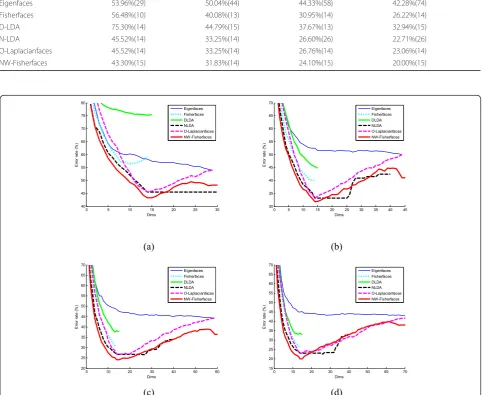
Furthermore, the experimental results are averaged over 20 random sets for each division. Table 2 and Figure 4 show the experimental results. The proposed NW-Fisher-faces still outperformed other methods with low dimensionality.
4.3. PIE database
The CMU PIE face database contains 41,368 face images of 68 individuals. Each individual was imaged under var-ious poses, illuminations, and expressions. In this study, 5 near frontal poses (C05, C07, C09, C27, and C29) and all the images under various illuminations, lighting, and expressions were gathered as 170 near frontal facial images for each individual as shown in Figure 5. The database is divided into training and testing sets for experiment. The applied divisions arenimages per indi-vidual for training and 170 -nimages per individual for
testing, where n= 5, 10, 20, and 30. Furthermore, the
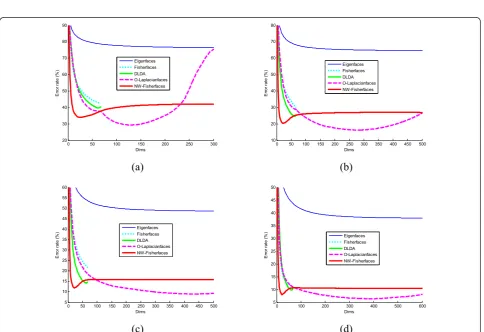
experimental results were averaged over 20 random sets for each division. Table 3 presents the least error rates and the corresponding dimensions. Both O-Laplacian-faces and NW-FisherO-Laplacian-faces outperformed the FisherO-Laplacian-faces and Eigenfaces. O-Laplacianfaces resulted in the least error rates on PIE database. However, the dimensional-ity required by the NW-Fisherfaces to reach its least error rate is much lower than the dimensionalities required by other methods. As shown in Figure 6, NW-Fisherfaces outperformed other methods over the
dimensions below L - 1, where L is the number of
individuals.
There is no result for N-LDA for PIE database after 10 Train. Because the sample number in training set is larger than the dimension of feature, there was no null space for within scatter matrixSw.
4.4. PIE_Small database
The PIE_Small database is a part of PIE database. To check the performance of the proposed method, we reduced number of pictures for each subject. Instead of 170 images, we took 15 images for each person as shown in Figure 7 and found that the performance of the proposed method is better than that of others espe-cially for small sample size data. The applied divisions
are n images per individual for training and 15 - n
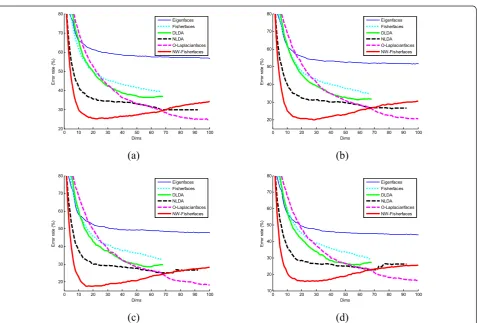
images per individual for testing, wheren= 5, 6, 7, and 8. Furthermore, the experimental results were averaged over ten random sets for each division. Table 4 presents the least error rates and the corresponding dimensions. Both O-Laplacianfaces and NW-Fisherfaces outper-formed the Fisherfaces and Eigenfaces. O-Laplacianfaces resulted in the least error rates on PIE_Small database. However, the dimensionality required by the NW-Fish-erfaces to reach its least error rate is much lower than the dimensionalities required by other methods. As shown in Figure 8, NW-Fisherfaces outperformed other
methods over the dimensions below L- 1, where L is
the number of individuals.
4.5. AR database
In order to check the capability of invariance to lighting condition and face orientation, which have been better solved by 3D deformation approaches. We used AR face database for our proposed method and we found that it is giving better result compare to other method which has been proposed previously.
In this database, there are totally 126 subjects (70 men, 56 women) and each subject has 26 different images as shown in Figure 9. This had taken in differ-ent facial expressions, illumination conditions, and
occlusions. The applied divisions are n images per
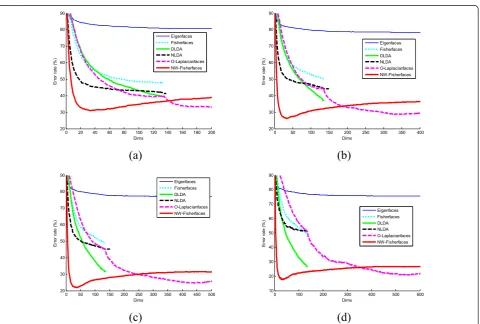
individual for training and 13 - nimages per individual for testing, where n= 5, 6, 7, and 8. Furthermore, the experimental results are averaged over ten random sets for each division. Table 5 and Figure 10 show the experimental results. The proposed NW-Fisher-faces still outperformed other methods with low dimensionality.
The pictures were taken at the CVC under strictly controlled conditions. No restrictions on wear (clothes,
Table 2 Performance comparisons on the Yale database
Method 2 Train 3 Train 4 Train 5 Train
Eigenfaces 53.96%(29) 50.04%(44) 44.33%(58) 42.28%(74)
Fisherfaces 56.48%(10) 40.08%(13) 30.95%(14) 26.22%(14)
D-LDA 75.30%(14) 44.79%(15) 37.67%(13) 32.94%(15)
N-LDA 45.52%(14) 33.25%(14) 26.60%(26) 22.71%(26)
O-Laplacianfaces 45.52%(14) 33.25%(14) 26.76%(14) 23.06%(14)
NW-Fisherfaces 43.30%(15) 31.83%(14) 24.10%(15) 20.00%(15)
0 5 10 15 20 25 30
40 45 50 55 60 65 70 75 80
Dims
E
rro
r r
at
e (
%
)
Eigenfaces Fisherfaces DLDA NLDA O-Laplacianfaces NW-Fisherfaces
0 5 10 15 20 25 30 35 40 45 30
35 40 45 50 55 60 65 70
Dims
E
rro
r r
at
e (
%
)
Eigenfaces Fisherfaces DLDA NLDA O-Laplacianfaces NW-Fisherfaces
(a) (b)
0 10 20 30 40 50 60 20
25 30 35 40 45 50 55 60 65 70
Dims
E
rro
r r
at
e (
%
)
Eigenfaces Fisherfaces DLDA NLDA O-Laplacianfaces NW-Fisherfaces
0 10 20 30 40 50 60 70 15
20 25 30 35 40 45 50 55 60 65 70
Dims
E
rro
r r
at
e (
%
)
Eigenfaces Fisherfaces DLDA NLDA O-Laplacianfaces NW-Fisherfaces
(c) (d)
Figure 4Error rate versus reduced dimensionality on the Yale database.(a)2 Train,(b)3 Train,(c)4 Train, and(d)5 Train.
Table 3 Performance comparisons on the PIE database
Method 5 Train 10 Train 20 Train 30 Train
Eigenfaces 76.50%(334) 64.68%(670) 48.88%(822) 1.92%(896)
Fisherfaces 42.58%(67) 29.24%(67) 21.53%(67) 10.93%(67)
D-LDA 39.70%(63) 24.64%(62) 14.26%(62) 9.80%(62)
O-Laplacianfaces 29.33%(131) 16.23%(272) 1.03%(601) 1.05%(701)
NW-Fisherfaces 33.97%(25) 20.34%(22) 1.66%(608) 1.08%(785)
0 50 100 150 200 250 300
20 30 40 50 60 70 80 90
Dims
E
rro
r r
at
e (
%
)
Eigenfaces Fisherfaces DLDA O-Laplacianfaces NW-Fisherfaces
0 50 100 150 200 250 300 350 400 450 500
10 20 30 40 50 60 70 80
Dims
E
rro
r r
at
e (
%
)
Eigenfaces Fisherfaces DLDA O-Laplacianfaces NW-Fisherfaces
(a) (b)
0 50 100 150 200 250 300 350 400 450 500
5 10 15 20 25 30 35 40 45 50 55 60
Dims
E
rro
r r
at
e (
%
) EigenfacesFisherfaces
DLDA O-Laplacianfaces NW-Fisherfaces
0 100 200 300 400 500 600
5 10 15 20 25 30 35 40 45 50
Dims
E
rro
r r
at
e (
%
)
Eigenfaces Fisherfaces DLDA O-Laplacianfaces NW-Fisherfaces
(c)
(d)
Figure 6Error rate versus reduced dimensionality on the PIE database.(a)5 Train,(b)10 Train,(c)20 Train, and(d)30 Train.
Table 4 Performance comparisons on the PIE_Small database
Method 5 Train 6 Train 7 Train 8 Train
Eigenfaces 55.97%(272) 51.26%(164) 47.00%(376) 43.34%(164)
Fisherfaces 39.56%(65) 34.64%(67) 32.74%(67) 29.35%(67)
D-LDA 36.32%(55) 31.47%(59) 28.51%(58) 25.76%(60)
N-LDA 29.97%(67) 26.36%(82) 25.18%(75) 22.73%(67)
O-Laplacianfaces 24.66%(99) 20.56%(97) 18.35%(99) 16.32%(99)
NW-Fisherfaces 25.21%(23) 20.00%(29) 17.50%(20) 15.69%(22)
Figure 9Different 26 sample images of two individual. Intial first two rows are images of male in different conditions with various facial expressions and last two rows are images of female with various facial expressions in different conditions.
0 10 20 30 40 50 60 70 80 90 100
20 30 40 50 60 70 80
Dims
E
rro
r r
at
e (
%
)
Eigenfaces Fisherfaces DLDA NLDA O-Laplacianfaces NW-Fisherfaces
0 10 20 30 40 50 60 70 80 90 100
20 30 40 50 60 70 80
Dims
E
rro
r r
at
e (
%
)
Eigenfaces Fisherfaces DLDA NLDA O-Laplacianfaces NW-Fisherfaces
(a) (b)
0 10 20 30 40 50 60 70 80 90 100
20 30 40 50 60 70 80
Dims
E
rro
r r
at
e (
%
)
Eigenfaces Fisherfaces DLDA NLDA O-Laplacianfaces NW-Fisherfaces
0 10 20 30 40 50 60 70 80 90 100
10 20 30 40 50 60 70 80
Dims
E
rro
r r
at
e (
%
)
Eigenfaces Fisherfaces DLDA NLDA O-Laplacianfaces NW-Fisherfaces
(c)
(d)
glasses, etc.), make-up, hair style, etc. were imposed to participants. Each person participated in two sessions, separated by 2 weeks (14 days) time. The same pictures were taken in both sessions.
In this face database, there are totally 13 expressions of each person. The expressions are as follows: Neutral expression, Smile, Anger, Scream, Left light on, Right light on, All side lights on, Wearing sun glasses, Wear-ing sun glasses and left light on, WearWear-ing sun glasses and right light on, Wearing scarf, Wearing scarf and left light on, Wearing scarf and right light on 14 to 26: sec-ond session (same csec-onditions as 1 to 13).
5. Conclusions and future works 5.1. Conclusions
(1) The proposed NW-Fisherfaces consistently outper-forms the Eigenfaces, Fisherfaces, D-LDA, and N-LDA methods.
(2) This study applied a nonparametric feature extrac-tion method into the scheme of appearance-based face recognition.
(3) The proposed NW-Fisherfaces method weights the between-class scatter to emphasize boundary structure of the transformed face subspace and, therefore, enhances the discriminability of face recognition.
0 20 40 60 80 100 120 140 160 180 200
20 30 40 50 60 70 80 90
Dims
E
rr
or rat
e
(%
)
Eigenfaces Fisherfaces DLDA NLDA O-Laplacianfaces NW-Fisherfaces
0 50 100 150 200 250 300 350 400
20 30 40 50 60 70 80 90
Dims
E
rr
or rat
e
(%
)
Eigenfaces Fisherfaces DLDA NLDA O-Laplacianfaces NW-Fisherfaces
(a) (b)
0 50 100 150 200 250 300 350 400 450 500
20 30 40 50 60 70 80 90
Dims
E
rr
or rat
e
(%
)
Eigenfaces Fisherfaces DLDA NLDA O-Laplacianfaces NW-Fisherfaces
0 100 200 300 400 500 600
10 20 30 40 50 60 70 80 90
Dims
E
rr
or rat
e
(%
)
Eigenfaces Fisherfaces DLDA NLDA O-Laplacianfaces NW-Fisherfaces
(c)
(d)
Figure 10Error rate versus reduced dimensionality on the AR database.(a)5 Train,(b)6 Train,(c)7 Train, and(d)8 Train.
Table 5 Performance comparisons on the AR database
Method 4 Train 5 Train 6 Train 7 Train
Eigenfaces 80.25%(522) 78.24%(678) 77.15%(658) 75.49%(844)
Fisherfaces 47.69%(135) 50.30%(135) 48.78%(135) 49.71%(135)
D-LDA 39.59%(133) 37.13%(133) 31.43%(136) 26.45%(136)
N-LDA 41.32%(135) 44.36%(135) 45.28%(135) 51.32%(135)
O-Laplacianfaces 33.06%(198) 28.71%(355) 24.70%(443) 20.93%(543)
(4) For practical applications, the computational load will depend on the dimensionality of the trained linear projection matrix. In this study, experimental results show that the proposed method can reach its lowest error rate with low dimensionality. Hence, the NW-Fisherfaces method is practical for real-world face recog-nition due to the low dimensionality requirement.
5.2. Future works
The future research in this area could involve the following.
(1) The supervised OLPP weights the scatter matrix to preserve the locality of within class face. This weighting concept may enhance the within-class scatter of LDA and other LDA-based methods such as NDA and NWFE.
(2) Linear feature extraction methods measure and optimize closeness between samples depending on Euclidean distance. However, Euclidean distance is basi-cally light variant. Variance caused by lighting should be reduced before using linear feature extraction methods. Several solutions to reduce light variances of face images are proposed:
(a) Mapping face images into the same intensity dis-tribution by simple preprocessing such as histogram specification.
(b) Transforming images into frequency domain by Fourier-based methods such as Gabor wavelets.
The performance of NW-Fisherfaces in nonlinear fea-ture space, such as kernel Hilbert space, can be further evaluated.
Acknowledgements
The authors would like to thank the editors and reviewers for their helpful comments. They would also like to thank Dr. Li-Wei Ko, Department of Electrical and Control Engineering, National Chiao-Tung University, Taiwan, for their support in writing this article, and Dr. Deng Cai, for his essential contribution and providing a complete framework on face recognition.
Author details
1
Department of Electrical Engineering, National Chiao-Tung University, 1001 University Road, Hsinchu, Taiwan 300, ROC2Institute of Computer Science
and Engineering, National Chiao-Tung University, 1001 University Road, Hsinchu, Taiwan 300, ROC
Competing interests
The authors declare that they have no competing interests.
Received: 9 May 2011 Accepted: 26 April 2012 Published: 26 April 2012
References
1. PY Han, ATB Jin, LH Siong, Eigenvector weighting function in face recognition. Discrete Dyn Nat Soc.2011, 521935. doi:10.1155/2011/521935 2. H Murase, SK Nayar, Visual learning and recognition of 3-D objects from
appearance. Int J Comput Vis.14, 5–24 (1995). doi:10.1007/BF01421486
3. M Turk, AP Pentland, Face recognition using Eigenfaces, inPresented at the IEEE Conf Computer Vision and Pattern Recognition Maui, HI, pp. 586–591 (1991)
4. X He, S Yan, Y Hu, P Niyogi, H-J Zhang, Face recognition using Laplacianfaces. IEEE Trans Pattern Anal Mach Intell.27(3), 328–340 (2005) 5. D Cai, X He, J Han, H-J Zhang, Orthogonal Laplacianfaces for face
recognition. IEEE Trans Image Process.15(11), 3608–3614 (2006) 6. SW Park, M Savvides, a multifactor extension of linear discriminant analysis
for face recognition under varying pose and illumination. EURASIP J Adv Signal Process.2010, 158395. doi:10.1155/2010/158395
7. JH Na, MS Park, JY Choi, Linear boundary discriminant analysis. Pattern Recogn.43(3), 929–936 (2010). doi:10.1016/j.patcog.2009.09.015 8. W Sanayha, Y Rangsanseri, Weighted LDA image projection technique for
face recognition. IEICE Trans Fund.E92.A(9), 2257–2265 (2009). doi:10.1587/ transfun.E92.A.2257
9. M Sugiyama, Dimensionality reduction of multimodal labeled data by local fisher discriminant analysis. J Mach Learn Res.8, 1027–1061 (2007) 10. C Liu, H Wechsler, Gabor feature based classification using the enhanced
fisher linear discriminant model for face recognition. IEEE Trans Image Process.11(4), 467–476 (2002). doi:10.1109/TIP.2002.999679
11. M Loog, RPW Duin, Linear dimensionality reduction via a heteroscedastic extension of LDA: the Chernoff criterion. IEEE Trans Pattern Anal Mach Intell. 26(6), 732–739 (2004). doi:10.1109/TPAMI.2004.13
12. Q Liu, H Lu, S Ma, Improving kernel Fisher discriminant analysis for face recognition. IEEE Trans Circ Syst Video Technol.14(1), 42–49 (2004). doi:10.1109/TCSVT.2003.818352
13. S Yan, Y Hu, D Xu, H-J Zhang, B Zhang, Q Cheng, Nonlinear discriminant analysis on embedded manifold. IEEE Trans Circ Syst Video Technol.17(4), 468–477 (2007)
14. K Fukunaga,Introduction to Statistical Pattern Recognition, (Academic Press, New York, 1990)
15. L-F Chen, H-Y Mark Liao, M-T Ko, J-C Lin, G-J Yu, A new LDA-based face recognition system which can solve the small sample size problem. Pattern Recognition.13(10), 1713–1726 (2000)
16. X-J Wu, J Kittler, J-Y Yang, K Messer, S Wang, A new direct LDA (D-LDA) algorithm for feature extraction in face recognition, inProceedings of the 17th International Conference on Pattern Recognition 2004 ICPR 2004.4, 545–548 (2004)
17. B-C Kuo, DA Landgrebe, Nonparametric weighted feature extraction for classification. IEEE Trans Geosci Remote Sens.42(5), 1096–1105 (2004) 18. JA Benediktsson, JA Palmason, JR Sveinsson, Classification of hyperspectral
data from urban areas based on extended morphological profiles. IEEE Trans Geosci Remote Sens.43(3), 480–491 (2005)
19. B-C Kuo, K-Y Chang, Feature extractions for small sample size classification problem. IEEE Trans Geosci Remote Sens.45(3), 756–764 (2007) 20. PN Belhumeur, JP Hepanha, DJ Kriegman, Eigenfaces vs. Fisherfaces:
recognition using class specific linear projection. IEEE Trans Pattern Anal Mach Intell.19(7), 711–720 (1997). doi:10.1109/34.598228
21. H Yu, J Yang, A direct LDA algorithm for high-dimensional data-with application to face recognition. Pattern Recogn.34, 2067–2070 (2001). doi:10.1016/S0031-3203(00)00162-X
22. K Liu, YQ Cheng, JY Yang, A generalized optimal set of discriminant vectors. Pattern Recogn.25(1), 731–739 (1992)
23. JW Lu, KN Plataniotis, AN Venetsanopoulos, Face recognition using LDA-based algorithms. IEEE Trans Neural Netw.14(1), 195–200 (2003). doi:10.1109/TNN.2002.806647
24. T Sim, S Baker, M Bsat, The CMU pose, illumination, and expression database. IEEE Trans Pattern Anal Mach Intell.25(12), 1615–1618 (2003). doi:10.1109/TPAMI.2003.1251154
25. AM Martinez, AC Kak, PCA versus LDA. IEEE Trans Pattern Anal Mach Intell. 23(2), 228–233 (2001). doi:10.1109/34.908974
26. B Mandal, X Jiang, H-L Eng, A Kot, Prediction of eigenvalues and regularization of Eigenfeatures for human face verification. Pattern Recogn Lett.31(8), 717–724 (2010). doi:10.1016/j.patrec.2009.10.006
doi:10.1186/1687-6180-2012-92
Cite this article as:Liet al.:Face recognition using nonparametric-weighted Fisherfaces.EURASIP Journal on Advances in Signal Processing