Multisensor Processing Algorithms for Underwater
Dipole Localization and Tracking Using MEMS Artificial
Lateral-Line Sensors
Saunvit Pandya,1Yingchen Yang,1Douglas L. Jones,2Jonathan Engel,1and Chang Liu1
1Micro and Nanotechnology Laboratory, University of Illinois, Urbana-Champaign, Urbana, IL 61801, USA 2Coordinated Science Laboratory, University of Illinois, Urbana-Champaign, Urbana, IL 61801, USA Received 1 January 2006; Revised 12 June 2006; Accepted 16 July 2006
An engineered artificial lateral-line system has been recently developed, consisting of a 16-element array of finely spaced MEMS hot-wire flow sensors. This represents a new class of underwater flow sensing instruments and necessitates the development of rapid, efficient, and robust signal processing algorithms. In this paper, we report on the development and implementation of a set of algorithms that assist in the localization and tracking of vibrational dipole sources underwater. Using these algorithms, accurate tracking of the trajectory of a moving dipole source has been demonstrated successfully.
Copyright © 2006 Saunvit Pandya et al. This is an open access article distributed under the Creative Commons Attribution License, which permits unrestricted use, distribution, and reproduction in any medium, provided the original work is properly cited.
1. MOTIVATION
In nature, almost all species of fish use arrays of cilium-like haircell sensors in a lateral-line configuration for flow sensing and near-field hydrodynamic imaging [1]. Each haircell sen-sor in the lateral line is capable of measuring local fluid flow velocity. Fish utilize the lateral-line organ for a rich set of be-haviors including schooling, navigation, predator avoidance, and prey capture.
Manmade underwater vehicles currently use technolo-gies such as sonar or optical systems for navigation and imag-ing. However, these established methods have limitations. Active sonar, for example, may reveal the location of the source. Furthermore, many sonar systems rely on pulse-echo width analysis. This method has limited resolution and does not work well in close range. Optical systems cannot operate in deep or murky waters.
In light of these limitations, a biomimetic flow sensing system inspired by the fish lateral line could augment or com-plement current technologies. Potential applications would include imaging and maneuvering control for autonomous underwater vehicles (AUVs), intrusion detection (ID) sys-tems, and hydro-robotics. For example, underwater vehicles and platforms equipped with artificial lateral lines could de-tect intruders (e.g., a swimmer) based on the hydrodynamic signature, thereby allowing unprecedented methods of threat monitoring.
An engineering equivalent of the biological lateral-line organ, an artificial lateral line, has never been developed. This is primarily due to the fact that commercially available flow sensors are typically bulky and therefore not amenable for high-density array integration.
However, recent advancement in micromachining and MEMS makes it possible to mimic functions and structures of biological sensors such as lateral lines [2,3]. MEMS sen-sors can offer high sensitivity and high-resolution capabil-ities with low power consumption, small footprint, and at low cost (due to integrated-circuit-style batch production). Researchers have made MEMS sensors based on many trans-duction principles and for many applications, including tem-perature sensors, accelerometers [4,5], gyroscopes, pressure sensors, tactile sensors [6–9], flow sensors [10–13], and mul-timodal sensors [6,14]. MEMS flow sensors based on prin-ciples such as hot-wire anemometry and biomimetic haircell sensing have also been developed [10,13,15–23].
(a)
(b) (c)
Figure1: (a) An optical micrograph of an artificial lateral line,
con-sisting of a linear array of hot-wire anemometers. (b) Schematic di-agram of a single raised hot-wire sensor. (c) An SEM micrograph of the same array.
2. SENSOR DESCRIPTION
The artificial lateral line consists of a linear array of hot-wire anemometers (HWAs) [12,15,16,19,20]. InFigure 1, an ar-ray of 16 HWA sensors with 1 mm spacing between each is shown. An individual HWA consists of a thermal resistive el-ement (hot wire) and operates on the principle of convective heat loss. During operation, the hot-wire element is heated above the ambient temperature using an electrical current. When it is exposed to a flow medium, the fluid convectively removes heat from the hot wire and causes its temperature to drop and its resistance value to change.
The density of the sensors approaches that of the biolog-ical lateral line in some fish. Through the use of microma-chining technology such high-density arrays can be made, together with analog integrated circuits [15] for local signal conditioning.
The HWA sensor offers high performance in terms of sensitivity. The fabricated MEMS HWA can sense flow at the order of 10 mm/s. Another advantage of the MEMS HWA sensor is the desired frequency range. The micromachined hot-wire anemometer has a viable frequency range from 0 (DC) to∼10 kHz, thus spanning the entire frequency range for hydrodynamic events of interest [12].
3. FLUID THEORY OVERVIEW
Using the lateral-line sensing organ, fish can detect water flow disturbances underwater. One of the simplest and most commonly encountered forms of disturbance is an acoustic dipole [12]. Biologists have studied fish lateral-line response
y
z θ
r
γ
Figure2: Schematic of analytical model (dipole at origin and
ob-servation point atr,θ,γ) [25].
to acoustic dipoles extensively and found that fish can locate the source of a dipole and track its movement [1]. There-fore, we choose to investigate the performance of our arti-ficial lateral-line sensor in response to an oscillating dipole source.
The acoustic dipole model has been well established [1,22,24,25]. The pressure and velocity distributions, re-spectively, can be described according to an abridged version of the model as
p(r,θ)= −ρωa3Uocos(θ)
2r2 , (1)
vflow(r,θ)=
a3U o
cos(θ) r3
er+
a3U
o 2
sin(θ) r3
eθ. (2)
Equation (1) relates the scalar pressure field of a dipole in the local flow region to the dipole diametera, the densityρ, the observation distancerand angleθ, the angular frequencyω, as well as the dipole’s initial vibrational velocity amplitude Uo. Equation (2) describes the local fluid flow velocity (vec-tor field) as a function of the initial velocity, position, and dipole diameter. The position of the observation point, as well as the coordinate description, is shown inFigure 2.
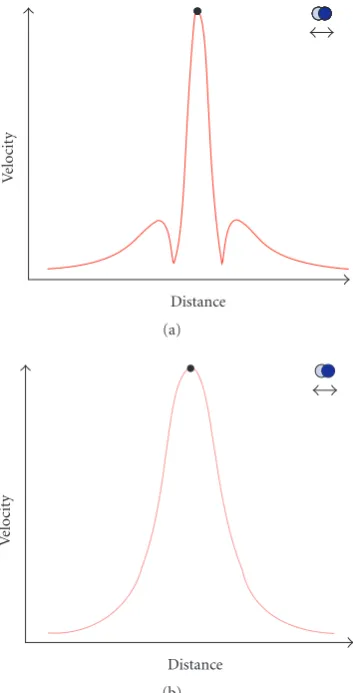
The root-mean-square (rms) velocity distribution in re-sponse to an oscillating dipole, as per the analytical model presented in (1)-(2), is shown in Figure 3(a). Figure 3(b) shows the experimental response of an HWA to a dipole stimulus. The experimental output of the sensor matches pertinent profile information predicted by the theoretical model. The difference between the two profiles can be at-tributed to the directional sensitivity of the sensor. A detailed explanation of this phenomenon is beyond the scope of this paper.
4. EXPERIMENTAL SETUP
Ve
lo
ci
ty
Distance (a)
Ve
lo
ci
ty
Distance (b)
Figure3: (a) Velocity distribution in response to a dipole
(repre-sented as a filled-in circle) as a function of distance away from the dipole (x-axis—along the receiver array) and derived from the an-alytical model. (b) Velocity distribution of an HWA response to a dipole (represented as a filled-in circle) as a function of distance away from the dipole. In both figures, the oscillating direction of the dipole is shown.
HWA sensor array for sensing and detection. A B&K min-ishaker (model 4010) was mounted to the stage system. It can generate sinusoidal vibration along its axis within a fre-quency range from 2 Hz to 11000 Hz. A PCB accelerometer (model 352B10) was attached to the rod to measure acceler-ation of vibracceler-ation. The sphere vibrated in a direction parallel to the axis of the sensor array, at a fixed frequency of 75 Hz and displacement amplitude of 0.4 mm.
5. SIGNAL PROCESSING ALGORITHMS
We investigated and implemented two approaches to suc-cessfully predict the dipole location. These approaches con-sisted of the template training approach and the model-ing approach, both of which operate on empirical data col-lected using the systems described inSection 4. A minimum mean-squared error (MMSE) algorithm was used in both approaches. As shown in [26], for independent, identically
(a)
(b)
Figure4: (a) Overview of the experimental setup. (b) Local details
of a dipole source (vibrating sphere) and the HWA sensor array.
distributed Gaussian noise at each sensor (a reasonable as-sumption for electronic noise), this is also a maximum like-lihood estimator (MLE). We describe these approaches and their implementation in detail in the following sections.
8 mm 7 mm 6 mm 5 mm
Sensors Offset
1 2 3 4 5 6 7 8 9 10 11 12 13 14 15 16
15 14 13 12 11 10 9 8 7 6 5 4 3 2 1 0 1 2 3 4 5 6 7 8 9 10 11 12 13 14 15
Figure5: The training grid used for recording template and experimental data. They-axis is the distance away from the sensor array
(repre-sented by filled-in circles at the bottom). Thex-axis is the distance along the sensor array. As mentioned, there were three experimental data sets. One experimental data set is along thex-axis (horizontal sweep). Another is along they-axis (vertical sweep). The third experimental data set was a zigzagged path.
For each integer position on the y-axis (within the rel-evant scope), a training matrix was created with rows being the horizontal integer positions (31 positions along the ar-ray) and with columns being the sensor outputs (16 sen-sors) averaged over four dipole measurement runs. Effec-tively, there were 9 positions (5–13 mm inclusive) vertically, leading to nine training matrices. These were coalesced into a combined three-dimensional matrix, indexed by vertical po-sition first, called the training data set as mentioned above. Each of the experimental data sets consisted of anm-by-n matrix, wheremis the number of experimental positions and nis the number of sensor outputs.
A minimum mean-squared error (MMSE) estimator was used. We assume that we have a calibrated data training set as well as an experimental data set taken using hardware cal-ibrated in the same manner. For a set of sensor readings cor-responding to a particular position (k) in the experimental data set, a search is then performed through the templatex-y grid. When the error between the experimental data set un-der consiun-deration and a particular template is minimal, the xandycoordinates corresponding to that template consti-tutes the predictive solution. The algorithm is presented in pseudocode inAlgorithm 1.
The modeling approach was used in an effort to improve the performance of the training algorithm. A model was em-pirically developed for the MEMS HWA for this study. Due to the visual form of the data, we speculated that a Gaus-sian mixture model might work well as an empirical model. Gaussian mixtures of the form of (3) were tried.
f(x)= k
n=1
ane((−(x−bn)/
√
2cn)2). (3)
From (3), the variablekis hereto referred to as the order of the fit. The first-order fit suitably approximates the sensor data, while higher-order fits fine-tune the approximation and increase the goodness of fit.Figure 6shows the
approxima-Let
xbe the distance along the array
ybe the distance away from the array
s(x,y) be the position of the dipole relative to the array
dbe the experimental data set withkpositions of the dipole
tbe the template data set
Soptimal(x,y) be the predicted position of the dipole
εbe the error
forX=1tox, (horizontal search space){
forY=1toy, (vertical search space){
A= t
T x,y,k·d
tT x,y,k·tx,y,k
ε=N
1
(A·tx,y,k−d)2
if (ε <minimumerror) minimumerror=ε}} Soptimal,k=minx,y(ε)
Algorithm1: (Top) Definition of variables used. (Bottom) MMSE
algorithm in pseudocode.Ais the correlation factor between the template and data sets for the MMSE algorithm,εis the error, while
Sis the predictive solution.
5 10 15 20 25 30 0
50 100
Col Gauss 1 Gauss 2
(a)
5 10 15 20 25 30
0 50 100
Col Gauss 2 Poly 1
(b)
Figure6: (a) Curve fitting comparison of MEMS sensor data with Gaussian curves. (b) Curve fitting comparison of MEMS sensor data
between candidate Gaussian and high-order polynomial curve.
Once the applicable curve was chosen (two-mixture Gau-ssian), the curve was fit to all 16 columns of sensor training data. Then, the fitted model was used as a template for the MMSE algorithm. The algorithm was designed to predict the position of the dipole to within a millimeter using the Gaus-sian fit. However, to achieve a greater accuracy (nearest tenth of a millimeter), simple linear interpolation was used be-tween the points of the fit curve. As with training with the sensory data, the MMSE algorithm was used and three ex-perimental runs were conducted as a test of this approach.
6. RESULTS AND DISCUSSIONS
The template training approach was used to track the loca-tion of the dipole source as it moves through the three repre-sentative pathways as described earlier. As shown inFigure 7, the MMSE algorithm accurately predicts the dipole’s local-ization along the array (in thex-axis) as well as away from the array (y-axis) in all three experimental cases. For the horizontal sweep, the maximum error in predicting the loca-tion of the dipole source is 0.9 mm in thex-axis and 0.5 mm in the y-axis. The average error is 0.1 mm along either axis. The percentage error of most individual measurements is less than 5%. For the vertical sweep, the maximum error in pre-dicting the location of the dipole source is 0.2 mm along the x-axis and 1.5 mm in the y-axis (vertical axis). The aver-age error is 0.0 mm in thex-axis and 0.4 mm in the y-axis. The percentage error for most of the experimental points is less than 5% in thex-axis and less than 10% in the y-axis. For the zigzag inclined path, the maximum error along the x-axis is 0.9 mm and the maximum error along the y-axis is 3.7 mm. The average errors, 0.1 mm along thex-axis and 0.3 mm along they-axis, are significantly smaller. This is be-cause, statistically, the accuracy for predicting the location of
5 6 7 8 9 10 11 12 13 14
V
er
tical
position
(mm)
0 5 10 15 20 25 30 35
Horizontal position (mm) Horizontal predicted
Horizontal actual Vertical predicted
Vertical actual Zizzag predicted Zigzag actual
Figure7: Prediction of experimental runs using MMSE algorithm
and template training approach.
the dipole decreases as the distance between the dipole and the lateral line increases in both thex-axis andy-axis. Since a few points on the inclined path are a combination in this regard, the accuracy at the fringe is often limited.
5 6 7 8
V
er
tical
position
0 5 10 15 20 25 30 35
Horizontal position (mm) Horizontal predicted
Horizontal actual Vertical predicted
Vertical actual Zizzag predicted Zizzag actual
Figure8: Prediction of experimental runs using MMSE algorithm
and Gaussian-modeled data.
location is 0.1 mm along thex-axis and 1.1 mm along they -axis. Once again, outliers distort the performance. The av-erage error is 0.04 mm along the x-axis and 0.3 mm along the y-axis. For the zigzag inclined run, the maximum pre-dictive error along thex-axis is 15.1 mm and 8.0 mm along the y-axis (primarily due to outliers). The average error is 0.9 mm along thex-axis and 0.4 mm along the y-axis. The performance of the modeling approach is similar to the per-formance of the training approach, but slightly worse due to the inaccuracies of the model. Like the training approach, ac-curacy at the fringes is low and distorts the overall perfor-mance of points within the scope of the array.
We have shown the ability to localize a dipole source us-ing an array of MEMS sensors and bioinspired approaches. The training approach produced accurate results using the MMSE algorithm. Furthermore, the approach can be imple-mented in a straightforward manner on both static and real-time systems. However, this approach does have its limita-tions. The computational power and the raw data set (sen-sory data) need to be significantly large when this approach is applied to complex scenarios. The introduction of variables such as dipole orientation, vibrational frequency and size or a complicated environment involving multiple dipoles would necessitate the use of a much more complex raw data set. Fur-thermore, the speed and effort of a real-time implementation of the training algorithm would be proportional to the size of the underlying data set.
In contrast, the modeling approach is more flexible. The accuracy of the model can place its performance and lim-itations anywhere between the formal training to informal heuristics. For our purposes, we used a very accurate model (R2value>0.99). At this accuracy, the model closely resem-bles the underlying data set. Therefore, the model achieves comparable accuracy. The main disadvantage to using a model (Gaussian for the MEMS HWA sensors or analyti-cal model for an ideal dipole) is the difficulty and cost of a system-level implementation. This is due to the fact that the raw data sets must be prefitted to a particular model for the
of both approaches would be possibly warranted depending on the application goal and engineering constraints. Differ-ent applications such as monitoring and targeting for sub-marines and ships, port and harbor defense, intrusion detec-tion, and hydro-robotics, as well as different environmental conditions might call for a fusion of both approaches.
ACKNOWLEDGMENTS
The researchers would like to thank their colleagues in the MASS Group as well as collaborators on the DARPA BioSENSE project. This work was funded by the DARPA BioSENSE project through the AFOSR (Program: FA9550-05-1-0459).
REFERENCES
[1] S. Coombs, “Nearfield detection of dipole sources by the goldfish (Carassius auratus) and the mottled sculpin (Cottus bairdi),” Journal of Experimental Biology, vol. 190, pp. 109– 129, 1994.
[2] C. Liu, “Progress in MEMS and micro systems research,” in
Proceedings of the IMAPS/ACerS 1st International Conference and Exhibition on Ceramic Microsystems Technologies (CICMT ’05), Baltimore, Md, USA, April 2005.
[3] C. Liu,Foundations of MEMS, Pearson Education, Upper Sad-dle River, NJ, USA, 2006.
[4] A. Partridge, J. K. Reynolds, B. W. Chui, et al., “High-perfor-mance planar piezoresistive accelerometer,”Journal of Micro-electromechanical Systems, vol. 9, no. 1, pp. 58–66, 2000. [5] K. E. Petersen, A. Shartel, and N. F. Raley,
“Micromechani-cal accelerometer integrated with MOS detection circuitry,”
IEEE Transactions on Electron Devices, vol. 29, no. 1, pp. 23– 27, 1982.
[6] J. Engel, J. Chen, Z. Fan, and C. Liu, “Polymer micromachined multimodal tactile sensors,”Sensors and Actuators A: Physical, vol. 117, no. 1, pp. 50–61, 2005.
[7] J. Engel, J. Chen, and C. Liu, “Development of polyimide flex-ible tactile sensor skin,”Journal of Micromechanics and Micro-engineering, vol. 13, no. 3, pp. 359–366, 2003.
[8] J. Engel, J. Chen, X. Wang, Z. Fan, C. Liu, and D. L. Jones, “Technology development of integrated multi-modal and flex-ible tactile skin for robotics applications,” in Proceedings of the IEEE/RSJ International Conference on Intelligent Robots and Systems (IROS ’03), vol. 3, pp. 2359–2364, Las Vegas, Nev, USA, October 2003.
[9] J. Engel, J. Chen, and C. Liu, “Development of a multi-modal, flexible tactile sensing skin using polymer micromachining,” inProceedings of the 12th International Conference on Solid-State Sensors, Actuators and Microsystems, vol. 2, pp. 1027– 1030, Boston, Mass, USA, June 2003.
“Artificial lateral line and hydrodynamic object tracking,” in
Proceedings of the 19th IEEE International Conference on Micro Electro Mechanical Systems (MEMS ’06), pp. 694–697, Istan-bul, Turkey, January 2006.
[13] J. Engel, J. Chen, N. Chen, S. Pandya, and C. Liu, “Develop-ment and characterization of an artificial hair cell based on polyurethane elastomer and force sensitive resistors,” in Pro-ceedings of the 4th IEEE International Conference on Sensors, Irvine, Calif, USA, October-November 2005.
[14] J. Engel, J. Chen, and C. Liu, “Polymer-based MEMS multi-modal sensory array,” in Proceedings of the 226th National Meeting of the American Chemical Society (ACS ’03), New York, NY, USA, September 2003.
[15] J. Chen, J. Engel, M. Chang, and C. Liu, “3D out-of-plane flow sensor array with integrated circuits,” inProceedings of the 18th European Conference on Solid-State Transducers (Eurosensors XVI), Rome, Italy, September 2004.
[16] J. Chen, J. Engel, N. Chen, and C. Liu, “A monolithic in-tegrated array of out-of-plane hot-wire flow sensors and demonstration of boundary-layer flow imaging,” in Proceed-ings of the 18th IEEE International Conference on Micro Electro Mechanical Systems (MEMS ’05), pp. 299–302, Miami Beach, Fla, USA, January-February 2005.
[17] J. Chen, J. Engel, and C. Liu, “Development of polymer-based artificial haircell using surface micromachining and 3D as-sembly,” in Proceedings of the 12th International Conference on Solid-State Sensors, Actuators and Microsystems, vol. 2, pp. 1035–1038, Boston, Mass, USA, June 2003.
[18] J. Chen, Z. Fan, J. Engel, and C. Liu, “Towards modular in-tegrated sensors: the development of artificial haircell sen-sors using efficient fabrication methods,” inProceedings of the IEEE/RSJ International Conference on Intelligent Robots and Systems (IROS ’03), vol. 3, pp. 2341–2346, Las Vegas, Nev, USA, October 2003.
[19] J. Chen and C. Liu, “Development and characterization of surface micromachined, out-of-plane hot-wire anemometer,”
Journal of Microelectromechanical Systems, vol. 12, no. 6, pp. 979–988, 2003.
[20] J. Chen, J. Zou, and C. Liu, “A surface micromachined, out-of-plane anemometer,” inProceedings of the 15th IEEE Interna-tional Conference on Micro Electro Mechanical Systems (MEMS ’02), pp. 332–335, Las Vegas, Nev, USA, January 2002. [21] S. Coombs, R. R. Fay, and J. Janssen, “Hot-film anemometry
for measuring lateral line stimuli,”Journal of the Acoustical So-ciety of America, vol. 85, no. 5, pp. 2185–2193, 1989.
[22] P. S. Dubbelday, “Hot-film anemometry measurement of hy-droacoustic particle motion,”Journal of the Acoustical Society of America, vol. 79, no. 6, pp. 2060–2066, 1986.
[23] Z. Fan, J. Chen, J. Zou, D. Bullen, C. Liu, and F. Delcomyn, “Design and fabrication of artificial lateral line flow sensors,”
Journal of Micromechanics and Microengineering, vol. 12, no. 5, pp. 655–661, 2002.
[24] S. Coombs, “Smart skins: information processing by lateral line flow sensors,”Autonomous Robots, vol. 11, no. 3, pp. 255– 261, 2001.
[25] S. Coombs, “Dipole 3D user guide,” Loyola University, Chicago, Ill, USA, Internal Report and User Guide, 2003.
with highest honors in computer engineer-ing from the ECE Department at the Geor-gia Institute of Technology, where he also was a recipient of the President’s Under-graduate Research Scholarship. He is cur-rently an M.S./Ph.D. candidate in the De-partment of Electrical and Computer En-gineering at the University of Illinois at Urbana-Champaign. His interests are in
al-gorithms, ASIC design for DSP and biomimetic MEMS sen-sors, wireless sensing, sensing and computing architecture, and substrate-to-system integration.
Yingchen Yangreceived his Ph.D. degree in mechanical engineering from Lehigh Uni-versity in May 2005. He is currently a Post-doctoral Researcher in the Micro and Nan-otechnology Laboratory at the University of Illinois, involving the development of bioinspired haircell receptive sensors. His research focuses are on flow-structure (sen-sor) interaction for optimization of sensor design and hydrodynamic trail tracking via application of sensor arrays.
Douglas L. Jones received the B.S.E.E., M.S.E.E., and Ph.D. degrees from Rice University in 1983, 1986, and 1987, re-spectively. During the 1987-1988 academic year, he was at the University of Erlangen-Nuremberg in Germany on a Fulbright Postdoctoral Fellowship. Since 1988, he has been with the University of Illinois at Urbana-Champaign, where he is currently a Professor in the Electrical and Computer
Engineering Department, the Coordinated Science Laboratory, and the Beckman Institute. He was on sabbatical leave at the University of Washington in Spring 1995 and at the University of California at Berkeley in Spring 2002. In the Spring semester of 1999, he served as the Texas Instruments Visiting Professor at Rice University. He is an author of two DSP laboratory textbooks, and was selected as the 2003 Connexions Author of the Year. He is a Fellow of the IEEE. He served on the Board of Governors of the IEEE Signal Process-ing Society from 2002 to 2004. His research interests are in digi-tal signal processing and communications, including nonstationary signal analysis, adaptive processing, multisensor data processing, OFDM, and various applications such as advanced hearing aids.
Jonathan Engel received the B.S. degree in general engineering from Harvey Mudd College in 1999 and the M.S. degree in mechanical engineering from the Uni-versity of Illinois at Urbana-Champaign (UIUC) in 2003. He is working toward the Ph.D. degree at UIUC. From 1999 to 2001, he served as the director of techni-cal sales for MindCruiser Inc. From 2002 to present, he has held a Research
Chang Liu received his M.S. and Ph.D. degrees from Caltech in 1991 and 1996, respectively. In January 1997, he became an Assistant Professor with major appoint-ment in the Electrical and Computer En-gineering Department and minor appoint-ment in the Mechanical and Industrial En-gineering Department. In 2003, he was pro-moted to Associate Professor with tenure. His research interests cover microsensors,