Original Article
Developmental potential of mouse tetraploid cells in
diploid
↔
tetraploid chimeric embryos
YUJI GOTO
1, JUNKO MATSUI
2and NOBUO TAKAGI*
Division of Bioscience, Graduate School of Environmental Earth Science and Research Center for Molecular Genetics, Hokkaido University, Japan
ABSTRACT Mouse 2n (lacZ -) ↔ 4n (lacZ +) aggregation chimeras were examined 5 or 10 days after uterine transfer to test the potential of 4n cells to contribute to embryonic tissues. Recovered embryos corresponded to embryonic day 7.5~8.0 and 12.5, respectively. Ten days after transfer, 4n cells were never detected, as reported earlier, in embryonic tissues of chimeras produced by the standard procedure in which one 2n embryo at the 8-cell stage is aggregated with a 4n embryo at the 4-cell stage. However,β-gal positive cells were present in embryonic tissues, though in a low number, in chimeras produced by a 2n and a 4n embryo at the 4-cell stage. Similar results were obtained when one 2n embryo at the 8-cell stage was aggregated with two 4n embryos at the 4-cell stage.β-gal positive cells were found in the heart, liver, skin and intestinal epithelium. The majority of chimeras 5 days after uterine transfer retained β-gal positive cells in embryonic tissues. The complete lack of 4n cell contribution to chimeras produced by the standard procedure is therefore attributed to the initial low proportion of 4n cells allocated to epiblast and their severe elimination from embryonic tissues.
KEY WORDS:
tetraploid, chimera, mouse development, lacZ transgene
0214-6282/2002/$25.00 © UBC Press
Printed in Spain
www.ijdb.ehu.es
*Address correspondence to: Dr. N. Takagi. Division of Bioscience, Graduate School of Environmental Earth Science, Hokkaido University, North 10, West 5, Kita-ku, Sapporo 060-0810, Japan. Tel and Fax: +81-11-706-4524. e-mail: [email protected]
1. Present Address: Institut de Genetique Moleculaire de Montpellier, CNRS, UMR-5535, 1919, Route de Mende, 34293 Montpellier cedex 5, France.
2. Present Address: Large Scale Mouse Mutagenesis Project, Riken Genomic Sciences Center, 1-7-22 Suehiro-cho, Tsurumi-ku, Yokohama 230-0045, Kanagawa, Japan
Abbreviations used in this paper: β-gal, β-galactosidase; ES, embryonic stem; ICM, inner cell mass.
Introduction
As early as 1971 Graham reported that 4n cells do not colonize to any fetus derived from 2n ↔ 4n aggregation chimeras in mice. Subsequent studies consistently confirmed the lack of 4n cell contribution to embryonic tissues, whereas they are abundant in extraembryonic tissues in such chimeras (Tarkowski et al., 1977; Nagy et al., 1990; James et al., 1995; Everett and West, 1996). Hence, 4n embryo has been used for the rescue of various mutant embryos by forming chimeras on the assumption that 4n cells help to organize functional extraembryonic tissues without contributing to fetal tissues.
At variance with the majority of current reports, Lu and Markert (1980) found two overt 2n ↔ 4n coat color chimeras. In their study, an agouti 4-cell stage 4n embryo induced by cytochalasin B was aggregated with an albino 8-cell stage 2n embryo. Although cytogenetic examination demonstrated the presence of 4n cells in one chimera, it was difficult to eliminate the possibility that 2n/4n mosaicism occurred in the cytochalasin B-induced 4n embryo (Tarkowski et al.,1977). Strictly speaking, Lu and Markert (1980) proved neither that the pigmented cells of the coat were 4n, nor 4n cells detected cytogenetically were of agouti origin.
Recently, in accordance with the above report, we found two 2n ↔ 4n overt coat color chimeras as byproducts of our
effort to rescue embryos having an additional X chromosome copy of maternal origin with the help of 4n embryos (Goto and Takagi, 1998). When an agouti 2n embryo at the 8-cell stage was aggregated with an albino 4n embryo at the 4-cell stage, all pups born were uniformly agouti without any albino hair. When the 2n and the 4n embryo were aggregated at the 4-cell stage, on the other hand, two out of 32 pups had extensively chimeric coat. Since we verified electrofusion of blastomeres at the two cell stage under a binocular microscope, it is unlikely that albino 2n cells contributed to coat chimerism. In one chimera, we identified 4n cells from the albino embryo in the tail fibroblast. The Robertsonian X-autosome translocation made it possible to determine the donor origin of individual metaphase cells. This finding invariably showed that 4n cells are capable of contributing to adult tissues under certain conditions.
aggregation are larger in size and less in number than 2n cells, although they are equal in age. Roles of these factors for determin-ing the fate of 4n cells in 2n ↔ 4n chimeras were difficult to be assessed separately due to technical limitations. Even after exten-sive and detailed studies (James et al., 1995; Everett and West 1996; Tang and West, 2000; Tang et al., 2000) there is no consensus of opinion on the roles of such factors as size, number, ploidy and age of blastomeres in determining the tissue-specific contribution of 4n cells in 2n ↔ 4n chimeras. On the basis of our finding mentioned above, we focused our attention to the ratio of 2n and 4n blastomeres as a possible main factor affecting contribution of 4n cells to fetal tissues. This study invariably showed that the increase in the initial number of 4n cell considerably raise the contribution of 4n cells to the fetus counteracting powerful selection pressure.
Results
Effects of Initial Ratio of Tetraploid and Diploid Cell Number in Aggregation Chimeras
First we examined whether the relative number of aggregated blastomeres affects the contribution of 4n cells in 2n ↔ 4n chimeras at midgestation. As summarized in Table 1, embryos were aggre-gated in four different combinations to produce 2n (lacZ-) ↔ 2n (lacZ+) and 2n (lacZ-) ↔ 4n (lacZ+) chimeras, varying the total cell number and the ratio of two classes of blastomeres. LacZ transgene will be designated by an asterisk hereafter as 2n ↔ 4n* chimera.
Chimeric blastocysts were transferred to pseudopregnant foster mothers and recovered 10 days later, and distribution of β-gal positive cells, most probably tetraploid cells was examined histologi-cally after X-gal staining.
Loss of aggregated embryos during in vitro culture was slightly higher in 2n ↔ 4n* chimeras than that in 2n ↔ 2n* chimeras. However, there was no clear difference in the frequency of success-ful implantation and postimplantation survival between both types of chimeras. The frequency of embryos recovered at 10 days after uterine transfer was also nearly the same in all combinations of embryos producing 2n ↔ 4n* and 2n ↔ 2n* chimeras (Table 1). 2n ↔ 2n* chimeric embryos showed neither gross abnormalities nor
TABLE 1
CHIMERAS RECOVERED 10 DAYS AFTER UTERINE TRANSFER OF AGGREGATED BLASTOCYSTS
Aggregation patterns No. aggregation No. transferred No. recovered No. implants
2n ↔4n*
8-cell ↔ 4-cell 110 78 (70.9%) 58 (74.4%) 35 (60.3%) 8-cell ↔ 4-cellx2 80 59 (73.8%) 40 (67.8%) 27 (67.5%) 4-cellx2↔ 4-cell 98 70 (71.4%) 56 (80.0%) 36 (64.3%) 4-cell ↔ 4-cell 111 89 (80.2%) 68 (76.4%) 45 (66.2%)
2n ↔ 2n*
4-cell ↔ 8-cell 112 95 (84.8%) 82 (86.3%) 56 (68.3%) 8-cell ↔ 8-cellx2 65 58 (89.2%) 42 (72.4%) 31 (73.8%) 8-cell ↔ 8-cell 145 135 (93.1%) 121 (89.6%) 86 (71.1%) 4-cellx2 ↔ 4-cell 71 58 (81.7%) 45 (77.6%) 31 (68.9%)
* carrier of the bacterial lacZ transgene
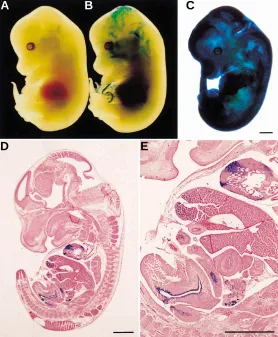
Fig. 1. Contribution of tetraploid cells to embryos recovered 10 days after uterine transfer of chimeric blastocysts. (A) A chimeric embryo between a tetraploid 4-cell embryo (lacZ+) and a diploid 8-cell embryo (lacZ-). (B) A chimeric embryo between two tetraploid 4-cell embryos (lacZ+) and a diploid 8-cell embryo (lacZ-). (C)Chimeric embryo between a diploid 8-cell embryo (lacZ+) and a diploid 8-cell embryo (lacZ-). (D,E) Histological sections of a chimeric embryo produced by aggregation of two tetraploid 4-cell embryos and a diploid 8-cell embryo. Scale bar, 1 mm
growth retardation, although stages of development differed to some extent among different foster mothers. In 2n ↔ 4n* chimeras, on the other hand, some embryos showed slight growth retardation. No gross abnormality was seen in these embryos.
As summarized in Table 2, practically no β-gal positive cells were present in fetal tissues, although they were abundant in extraembryonic tissues in 21 of 35 (60%) 2n(8-cell) ↔ 4n*(4-cell) chimeric embryos (Fig. 1A). Remaining embryos had no β-gal positive cells in any tissue. In chimeras produced by a single diploid embryo at the 8-cell stage and two tetraploid embryos at the 4-cell stage [2n(8-cell) ↔ 4n*(4-cellx2)], on the other hand, β-gal positive cells contributed to embryo proper in nine out of 27 (33.3%) conceptuses (Fig. 1B). Ten chimeras (37%) had 4n cells only in extraembryonic tissues such as amnion and yolk sac. Chimerism was absent in remaining eight embryos. In these two sets of experiments, the age of each blastomere was identical, and only difference was the pres-ence or abspres-ence of an additional 4-cell stage 4n embryo to make the 4n and the 2n cell number equal.
A single diploid and a 4n embryo at the 4-cell stage were aggregated to confirm and extend results obtained above.
A
B
C
Blastomeres were identical in size but 4n tomeres were 12 hours older than 2n blas-tomeres. As shown in Table 2, β-gal positive cells contributed considerably to embryonic tissues in 13 of 45 (29%) embryos as in the case of 2n(8-cell) ↔ 4n*(4-cellx2) chimeras. Eleven (24%) embryos did not carry any β-gal positive cells in both embryonic and extraembryonic tissues. It is noteworthy that 4n cells did not contribute to embryonic tissues at all if two instead of one 2n embryos were aggregated with a 4n* embryo at the 4 cell stage. The most likely possibility would be that 4n cells are severely selected against in embryonic tissues, but some of them survive if the initial proportion of 4n cells is high enough. Unlike 2n ↔ 4n* chimeras, β-gal positive cells contributed equally well to both extraembryonic and embryonic tissues in all 2n ↔ 2n* chimeras (Table 2; Fig. 1C).
Distribution of Tetraploid Cells in Midgestation 2n ↔ 4n Chimeras
Histological analysis revealed that β-gal positive cells contributed to the liver, the car-diac muscle, the epithelial layer of intestine and other epithelial tissues (Fig. 1 B,D,E). β-gal positive cells were small in number but they tended to form large patches in these tissues.
A,B). In three embryos the embryonic region was stained as dark as the extraembryonic region. Although 4n cells were abundant in the ectoplacental cone, β-gal negative cells contributed to small but significant fraction of the tissue in 18 embryos.
TABLE 2
CHIMERIC PATTERNS IN CONCEPTUSES RECOVERED 10 DAYS AFTER UTERINE TRANSFER OF AGGREGATED BLASTOCYSTS
No. of embryos with β-gal positive cells in Embryo
No. recovered No.non-chimeric Amnion Amnion
Aggregation patterns conceptuses conceptuses Yolk sac Yolk sac Yolk sac
2n ↔ 4n*
8-cell ↔ 4-cell 35 14 (40.0%) 0 (0%) 0 (0%) 21 (60.0%) 8-cell ↔ 4-cellx2 27 8 (29.6%) 9 (33.3%) 3 (11.1%) 7 (25.9%) 4-cellx2 ↔ 4-cell 36 12 (33.3%) 0 (0%) 0 (0%) 24 (66.7%) 4-cell ↔ 4-cell 45 11 (24.0%) 13 (29.0%) 1 (2.0%) 20 (44.0%)
2n ↔ 2n*
8-cell ↔ 4-cell 56 3 (5.0%) 45 (80.0%) 4 (7.0%) 4 (7.0%) 8-cell ↔ 4-cellx2 31 4 (12.9%) 25 (80.6%) 2 (6.5%) 0 (0%) 8-cell ↔ 8-cell 86 5 (6.0%) 74 (86.0%) 5 (6.0%) 2 (2.0%) 4-cellx2 ↔ 4-cell 31 4 (12.9%) 24 (77.4%) 0 (0%) 3 (9.7%) * carrier of the bacterial lacZ transgene
TABLE 3
TETRAPLOID CELL CONTRIBUTION IN CHIMERIC EMBRYOS ASCERTAINED BY HISTOLOGICAL EXAMINATION
No. embryos with β-gal positive cells in Liver Liver Liver Heart Heart
Aggregation patterns No. embryos Skin
2n(8-cell) ↔ 4n*(4-cellx2) 9 4 3 2 2n(4-cell) ↔ 4n*(4-cell) 13 7 3 3 *carrier of the bacterial lacZ transgene
Fig. 2. Contribution of tetraploid cells to embryos 5 days after uterine transfer of chimeric blastocysts. (A,B) Chimeric embryos between a tetraploid 4-cell embryo (lacZ+) and a diploid 8-cell embryo (lacZ-). (C,D) Chimeric embryos between two tetraploid 4-cell embryos (lacZ+) and a diploid 8-cell embryo (lacZ-). Scale bar, 1mm.
As summarized in Table 3, β-gal positive cells were present in liver of all chimeric fetuses, whereas they were detected in heart in 17 of 22 chimeras. β-gal positive cells contributed to epithelial tissues in a half of chimeric embryos. It should be noted that there was no chimera with β-gal positive cells in epithelial tissues but not in heart. We also produced 2n ↔ 2n* chimeras derived from same strains which were used to produce 2n ↔ 4n* chimeras. In these 2n ↔ 2n* chimeras, β-gal positive cells contributed equally to all embryonic tissues at histological examination (Data not shown). It was often difficult, however, to distinguish the weakly β-gal positive cells from negative ones, because of the low β-gal activity in the cytoplasm. Thus the proportion of the β-gal negative cell tended to be overesti-mated.
Higher Proportion of Tetraploid Cells in 2n ↔ 4n Chimeras at Early Postimplantation Stages
All midgestation fetuses derived from 2n(8-cell) ↔ 4n*(4-cell) chimeric blastocysts retained no β-gal positive cells of 4n origin, whereas two out of 32 2n ↔ 4n chimeric pups obtained in our earlier study were overt coat color chimeras. Increase in the proportion of 4n cells allocated to the embryonic region should have prevented complete elimination of 4n cells from 2n(8-cell) ↔ 4n*(4-cellx2) and 2n(4-cell) ↔ 4n*(4-cell) fetuses. To obtain further clues to selection against 4n cells during embryonic development, we examined β-gal positive cells in 2n ↔ 4n* chimeric embryos 5 days after uterine transfer. Recovered chimeric embryos were comparable in size and morphology to normal embryos at embryonic day 7.5 to 8.0.
Among 27 2n(8-cell) ↔ 4n*(4-cell) chimeras examined, as many as 24 embryos contained β-gal positive cells in the embryonic region 5 days after uterine transfer of fully grown blastocysts. A small minority of embryonic cells were β-gal positive in 17 embryos (Fig. 2
A
B
In 2n(8-cell) ↔ 4n*(4-cellx2) chimeras, β-gal positive cells were much more frequent not only in the extraembryonic but also in the embryonic tissues (Fig. 2 C,D). Thus, no β-gal positive cells were found in 22 out of 23 embryos. The embryonic region was stained much less heavily than the extraembryonic region in 17 embryos, but β-gal positive cells were apparently more abundant than in average 2n(8-cell) ↔ 4n*(4-cell) chimeras. The embryonic region was stained even darker than the extraembryonic region in remain-ing seven embryos. The ectoplacental cone was chimeric in eight embryos β-gal negative cells being a minor component.
Thus, it is likely that 4n cells were eliminated from the embryonic tissues nearly completely in 2n(8-cell) ↔ 4n*(4-cell) chimeras by midgestation. Apparently, however, selection was not strong enough to completely eliminate 4n cells from 2n(8-cell) ↔ 4n*(4-cellx2) chimeras in which more 4n cells should have been allocated to embryonic as well as extraembryonic tissues.
Discussion
In agreement with previous reports, the present study showed that 4n cells never contributed to embryonic tissues in 2n(8-cell) ↔ 4n(4-cell) chimeras produced by the standard procedure(Nagy et al., 1990, 1993; Allen et al., 1994; Guillemot et al.,1994; James et al., 1995; Spindle et al., 1996; Everett and West, 1996; Tang et al., 2000). Based on our earlier finding (Goto and Takagi, 1998) we hypothesized that the higher proportion of 4n cells at aggregation facilitates their contribution to fetal tissues. To test this hypothesis, we compared distribution of 4n cells expressing lacZ transgene in chimeras derived from aggregates having the initial 4n/2n ratio of 0.5 and 1.0. Contribution of 4n cells to the fetus, though severely limited in quantity and in tissue distribution, was detected in a considerable proportion of chimeras at midgestation, if equal number of 4n and 2n blastomeres were aggregated. Our findings suggest that the initial ratio of blastomeres at aggregation is of crucial importance for the contribution of 4n cells to embryo proper. In agreement with James et al. (1995), extensive selection against 4n cells in embryonic tissues was demonstrated by the observation that the majority of 2n(8-cell) ↔ 4n(4-cell) chimera retained the 4n cells in the embryonic region 5 days after uterine transfer, whereas such cells were scarcely found in fetuses 5 days later. The proportion of 4n cells in 2n(4-cell) ↔ 4n(4-cell) and 2n(8-cell) ↔ 4n(4-cellx2) chimeras was generally higher than that in 2n(8-cell) ↔ 4n(4-cell) chimeric embryos at earlier postimplantation stages. Thus, it is likely that the failure of complete elimination of abundant 4n cells from embryonic tissues is responsible for the occasional occurrence of overt 2n(8-cell) ↔ 4n(4-cellx2) chimeras. If this is the case, it should be a matter of probability that the 2n ↔ 4n chimeric fetus is obtained even by the standard method of chimera formation.
Various studies in 2n ↔ 4n chimeras suggested, however, that 4n cells are not only selected against in epiblast cell lineages, but also they are allocated preferentially to non-epiblast tissues (James et al., 1995; Everett and West, 1996, 1998; Tang et al., 2000). Divergence of ICM from trophectoderm is completed by the 64-cell stage or 3.5 days after fertilization (Gardner, 1972, 1975a, b; Gardner and Johnson, 1975; Rossant, 1975a, b). Tarkowski and Wroblewska (1967) proposed that the position of blastomeres in an embryo determines their developmental destiny; the outside and the inside cells give rise to trophectoderm and ICM, respectively. The primitive endoderm diverges from epiblast, the progenitor of the entire fetus by 4.5 days after fertilization. It is possible that 4n blastomeres larger
than 2n blastomeres tend to be allocated to outside position (Everett and West, 1996). Furthermore, difference in the age of aggregating blastomeres may affect their relative contribution to the fetus and extraembryonic structures, because compaction of blastomeres essential for generating the inner and outer cells occurs at the 8-cell stage.
Recently, Tang et al. (2000) produced chimeras between one 2n blastomere of 2-cell stage embryo and a large 2n blastomere produced by electrofusion of an enucleated and a normal blastomere at the 2-cell stage. In such chimeras that differed only in the size of blastomere but not their age, number and ploidy, the cells derived from large blastomere contributed significantly more frequently to the mural trophectoderm and polar trophectoderm than to the ICM. They also aggregated one 4n blastomere produced by electrofusion of 2-cell embryo with a large 2n blastomere produced as mentioned above. In such chimeras that differed only in ploidy but not in three other variables, 4n cells contributed significantly more to the mural trophectoderm than to the ICM. These findings imply that both larger cell size and higher ploidy contribute to the non-random distribution of 4n cells to the trophectoderm lineages in 2n ↔ 4n chimeras. In 2n ↔ 2n chimeras, however, twofold difference in cell size may or may not be responsible for preferential allocation of larger cells to trophec-toderm (Spindle, 1982; James et al., 1995; Tang and West, 2000). The contribution of 4n cells was restricted to certain specific tissues in 2n ↔ 4n chimeric fetuses such as cardiac muscle, skeletal muscle, liver and intestinal epithelium. These results suggest that 4n cells can survive in certain embryonic tissues during postimplantation development. Selection pressure should be strong even in extraem-bryonic structures, because conceptuses free of β-gal positive cells are much more frequent in 2n ↔ 4n* than 2n ↔ 2n* chimeras. These findings are consistent with the recent report by Ying et al. (2002) showing that 4n ES-like cells, produced by fusion of ES cells and mouse brain cells, contribute to a significant fraction of embryonic and adult tissues after their injection into host blastocysts. A single embryonic 2n cell injected into the blastocyst could contribute extensively throughout the body (Gardner and Lyon, 1971). It is likely, therefore, that the initial high proportion of 4n ES-like cells incorpo-rated into the inner cell mass counteracted powerful selection pressure achieving mosdest 4n cell contribution to fetal and adult tissues as in the case of present 2n ↔ 4n chimeras.
It may not be a mere coincidence that 4n or polyploid cells are abundant in liver and heart in which β-gal positive 4n cells survive. If so, small but significant proportion of intestinal epithelial cells would be tetraploid. A cytogenetic study (Goto and Takagi, unpublished data) indicated that the cell cycle of 4n cells were slightly longer than that of 2n cells as reported earlier in 3n cells (Takagi and Sasaki, 1976). It is doubtful, however, that elimination of 4n cells from 2n ↔ 4n chimeras is solely attributable to the longer cell cycle. Most probably 4n cells are less competent in differentiation into certain cell types, although why genetically balanced 4n cells are unable to differentiate properly remains unknown.
Materials and Methods
Mice
mating a male 129/Sv-TgR26Sor transgenic mouse mated with a wild type 129/Sv female (Tada et al. 1998).
Superovulation and Recovery of Embryos
Superovulation was induced by an intraperitoneal injection of 10 IU pregnant mare’s serum gonadotropin followed 46-48 hr later by an injection of 10 IU human chorionic gonadotropin (Teikoku Hormone, Tokyo). Em-bryos at 2-, 4- and 8-cell stage were recovered from oviducts or uteri by flushing with M2 medium and cultured in M16 medium at 1.5, 2.0 and 2.5 days after copulation (dpc), respectively.
Production of Tetraploid Embryos
Embryos were flushed from oviducts of superovulated (C57BL/6JxCBA/J)F1 (shortened to BCF1) females mated with TgR26Sor male and CD-1 females mated with CD-1 male at 1.5 dpc. 4n embryos were produced by electrofusion of blastomeres at 2-cell stage with an electric cell fusion system SSH-2 (Shimadzu, Kyoto) as described earlier (Goto and Takagi, 1998). Because blastomeres are fused at 2-cell stage, 4n embryos at 4-cell stage are chronologically equivalent to 2n embryos at 8-cell stage.
Production of Aggregation Chimeras
Embryos at the 4-cell or 8-cell stage were recovered from BCF1 females mated with BCF1 males, at 2.0 or 2.5 dpc. After removal of the zona pellucida in acidic Tyrode solution (Nicolson et al., 1975), two or three embryos to be aggregated were transferred to a drop of M2 medium containing 10% PHA-P (Difco, Detroit) in stead of 1% originally used by Mintz et al. (1973) in bacteriological grade Petri dishes. After aggregation, chimeric embryos were cultured in a drop of M16 medium under paraffin oil at 37 ˚C in an atmosphere of 5% CO2 in air. Chimeric embryos which developed into blastocyst within 2 days of culture were transferred to the uterus of 2.5-day pseudopregnant females.
Staining of β-galactosidase Activity for Histological Examination
2n ↔ 2n or 2n ↔ 4n chimeric embryos were recovered from foster mother 5 or 10 days after transfer. Embryos mostly equivalent to 7.5-8.0 or 12.5 dpc embryos in size were fixed with 4% paraformaldehyde in phos-phate buffer. After X-gal staining, embryos were embedded in paraffin wax, and sections cut at 7-8 µm were counterstained with eosin.
Acknowledgements
We thank anonymous reviewers for their invaluable advice for the improvement of the manuscript. Mice used for this study were maintained at the Center for Experimental Plants and Animals, Hokkaido University. This study was supported by a Grant-in-Aid from the Ministry of Education, Science, Sports and Culture, Japan.
References
ALLEN, N. D., BARTON, S. C., HILTON, K., NORRIS, M. L. and SURANI, M. A.(1994). A functional analysis of imprinting in parthenogenetic embryonic stem cells. Development 120: 1473-1482.
EVERETT, C. A. and WEST, J. D. (1996). The influence of ploidy on the distribution of cells in chimaeric mouse blastocysts. Zygote 4: 59-66.
FRIEDRICH, G. and SORIANO, P. (1991). Promoter traps in embryonic stem cells: a genetic screen to identify and mutate developmental gene in mice. Genes Dev. 5: 1513-1523.
GARDNER, R. L. (1972). An investigation of inner cell mass and trophoblast tissue following their isolation from the mouse blastocyst. J. Embryol. Exp. Morph. 28: 279-312. GARDNER, R. L. (1975a). Origins and properties of trophoblast. In The
Immunol-ogy of Trophoblast (Eds. R. G.Edwards, C. W. S. Howe and M. H. Johnson). Cambridge University Press, London, pp. 43-65.
GARDNER, R. L. (1975b). Analysis of determination and differentiation in the early mammalian embryo using intra- and inter-specific chimeras. In The Developmental Biology of Reproduction (33rd Symp. Soc. Dev. Biol.) (Ed. C.L.Markert). Academic Press, New York, pp. 207-238.
GARDNER, R. L. and JOHNSON, M. H. (1975). Investigation of cellular interaction and deployment in the early mammalian embryo using interspecific chimaeras between the rat and mouse. In Cell Patterning (Ciba. Found. Symp. 29). Associated Scientific Publishers, Amsterdam pp. 183-200.
GARDNER, R. L. and LYON, M. F. (1971). X-chromosome inactivation studied by injection of a single cell into the mouse blastocyst. Nature 231:385-386. GOTO, Y and TAKAGI, N. (1998). Tetraploid embryos rescue embryonic lethality
caused by an additional maternally inherited X chromosome in the mouse. Devel-opment 125: 3353-3363.
GRAHAM, C. F. (1971). Virus assisted fusion of embryonic cells. In Karolinska Symposia on Research Methods in Reproductive Endocrinology (Ed. E. Diczfalusy). Stockholm, pp. 154-165.
GUILLEMOT, F., NAGY, A., AUERBACH, A., ROSSANT, J. and JOYNER, A. L. (1994). Essential role of Mash-2 in extraembryonic development. Nature 371: 333-336. JAMES, R. M., KLERKX, A. H., KEIGHREN, M., FLOCKHART, J. H. and WEST, J. D.
(1995). Restricted distribution of tetraploid cells in mouse tetraploid ↔ diploid chimeras. Dev. Biol. 167: 213-226.
LU, T.-Y. and MARKERT, C. L. (1980). Manufacture of diploid/tetraploid chimeric mice. Proc. Natn. Acad. Sci. USA. 77: 6012-6016.
MINTZ, B., GEARHART, J. D. and GUYMONT, A. O. (1973). Phytohemagglutinin-mediated blastomere aggregation and development of allophenic mice. Dev. Biol. 31: 195-199.
NAGY, A., GOCZA, E., DIAZ, E. M., PRIDEAUX, V. R., IVANYI, E., MARKKULA, M. and ROSSANT, J. (1990). Embryonic stem cells alone are able to support fetal development in the mouse. Development 110: 815-821.
NAGY, A., ROSSANT, J., NAGY, R., ABRAMOW-NEWERLY, W. and RODER, J. C. (1993). Derivation of completely cell culture-derived mice from early-passage embryonic stem cells. Proc., Natl. Acad. Sci. USA 90: 8424-8428.
NICOLSON, G. L., YANAGIMACHI, R. and YANAGIMACHI, H. (1975). Ultrastructural localization of lectin-binding sites on the Zonae pellucidae and plasma membranes of mammalian eggs. J. Cell Biol. 66: 263-274.
ROSSANT, J. (1975a). Investigation of the determination state of the mouse inner cell mass. I. Aggregation of isolated inner cell mass with morulae. J. Embryol. Exp. Morph. 33: 979-990.
ROSSANT, J. (1975b). Investigation of the determination state of the mouse inner cell mass. II. The fate of isolated inner cell mass transferred to the oviduct. J. Embryol. Exp. Morph. 33: 991-1001.
SPINDLE, A. (1982). Cell allocation in preimplantation mouse chimeras. J. Exp. Zool. 219: 361-367.
SPINDLE, A., STURM, K. S., FLANNERY, M., MENESES, J. J., WU, K. and PEDERSEN, R. A. (1996). Defective chorioallantoic fusion in mid-gestation lethality of parthenogenone ↔ tetraploid chimeras. Dev. Biol. 173: 447-458.
TADA, T., TADA, M., HILTON, K., BARTON, S. C., SADO, T., TAKAGI, N. and SURANI, M. A. (1998). Epigenetic switching of imprintable loci in embryonic germ cells. Dev. Genes Evol: 207: 551-561.
TAKAGI, N. and SASAKI, M. (1976). Digynic triploidy after superovulation in mice. Nature 264: 278-281.
TANG, P.-C. and WEST, J. D. (2000). The effects of embryo stage and cell number on the composition of mouse aggregation chimaeras. Zygote 8: 235-243. TANG, P.-C., RITCHIE, W. A., WILMUT, I. and WEST, J. D. (2000). The effects of the
cell size and ploidy on cell allocation in mouse chimaeric blastocysts. Zygote 8: 33-43.
TARKOWSKI, A. K., WITKOWSKA, A. and OPAS, J. (1977). Development of cytocha-lasin B-induced tetraploid and diploid ↔ tetraploid mosaic mouse embryos. J. Embryol. Exp. Morph. 41: 47-64.
TARKOWSKI, A. K. and WROBLEWSKA, J. (1967). Development of blastomeres of mouse eggs isolated at 4- and 8-cell stage. J. Embryol. Exp. Morphol. 13: 155-180. YING, Q.-L., NICHOLS, J., EVANS, E. P. and SMITH, A. G. (2002). Changing potency
by spontaneous fusion. Nature 416: 545-548.