CSEIT1831500 | Received : 10 Nov 2017 | Accepted: 30 Nov 2017 | November-December-2017 [(2)6 : 1391-1395 ]
International Journal of Scientific Research in Computer Science, Engineering and Information Technology © 2017 IJSRCSEIT | Volume 2 | Issue 6 | ISSN : 2456-3307
1391
Optimum Routing for AODV for Secure Mobility and Distributed Services
Dr. N. Sathishkumar
Professor in Department of ECE Teegala Krishna Reddy Engineering College, Medbowli, Telangana, India
ABSTRACT
Cellular networks are expected to provide distributed services and broadband access to a continuously growing number of mobile users. An cost effective solution to Internet broadband access for both stationary is must for mobile hosts. To efficiently support the large number of customers in the network, the network is expected to support distributed services. Unfortunately, present networks do not support network services because of the absence of a dynamic routing algorithm that would locate the destination even if the mobile node moves from one cell to another. We have used AODV algorithm to compute the performance of the proposed algorithm. Our conclusions are based on four important performance on Route discovery time.
Keywords : Route discovery time, AODV.
I.
INTRODUCTIONThe evolution of wireless networks technologies have made internet access more flexible. Internet access is now accessible on the move. Wireless networks enable users to access the internet from any place, unlike the wired network which provides only fixed point of network attachment. In the recent years, WLANs and cellular networks have gained much importance in replacing wired networks for internet access. Nowadays WLANs are successfully deployed in home and office environments for internet access; however they are not suitable for mobile users because of narrow coverage and lack of mobility support. Cellular networks on the other hand provide wider coverage and better mobility support. This makes it more suitable for mobile users. On the contrary, communication cost and narrow bandwidth of the cellular network makes it less attractive for internet access.
The AODV protocol builds routes between nodes only if they are requested by source nodes. AODV is
therefore considered an on-demand algorithm and does not create any extra traffic for communication along links. The routes are maintained as long as they are required by the sources. They also form trees to connect multicast group members. AODV makes use of sequence numbers to ensure route freshness. They are self-starting and loop-free besides scaling to numerous mobile nodes..
In AODV, networks are silent until connections are established. Network nodes that need connections broadcast a request for connection. The remaining AODV nodes forward the message and record the node that requested a connection. Thus, they create a series of temporary routes back to the requesting node.
A node that receives such messages and holds a route to a desired node sends a backward message through temporary routes to the requesting node. The node that initiated the request uses the route containing the least number of hops through other nodes. The entries that are not used in routing tables are recycled after some time. If a link fails, the routing error is passed back to the transmitting node and the process is repeated.
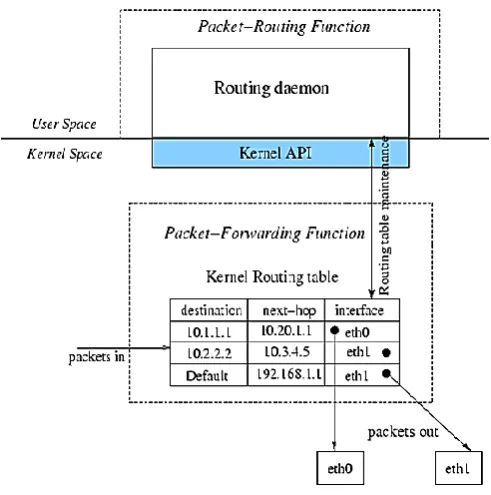
Routing refers to establishing the routes that data packets take on their way to a particular destination. This term can be applied to data traveling on the Internet, over 3G or 4G networks, or over similar networks used for telecom and other digital communications setups. Routing can also take place within proprietary networks.
Techopedia explains Routing
In general, routing involves the network topology, or the setup of hardware, that can effectively relay data. Standard protocols help to identify the best routes for data and to ensure quality transmission. Individual pieces of hardware such as routers are referred to as "nodes" in the network. Different algorithms and protocols can be used to figure out how to best route data packets, and which nodes should be used. For example, some data packets travel according to a distance vector model that primarily uses distance as a factor, whereas others use Link-State Protocol, which involves other aspects of a "best path" for data.
Data packets are also made to give networks information. Headers on packets provide details about origin and destination. Standards for data
help with future routing methodologies. As the world of digital technology evolves, routing will also evolve according to the needs and utility of a particular network.
Routing Information Protocol (RIP) is a dynamic protocol used to find the best route or path from end-to-end (source to destination) over a network by using a routing metric/hop count algorithm. This algorithm is used to determine the shortest path from the source to destination, which allows the data to be delivered at high speed in the shortest time.
RIP plays an important role providing the shortest and best path for data to take from node to node. The hop is the step towards the next existing device, which could be a router, computer or other device. Once the length of the hop is determined, the information is stored in a routing table for future use. RIP is being used in both local and wide area networks and is generally considered to be easily configured and implemented.
Architectural Design
II.
EXPERIMENTAL VIEWAd hoc On Demand Distance Vector (AODV) The Ad hoc On Demand Distance Vector (AODV) routing algorithm is a routing protocol designed for adhoc mobile networks AODV is capable of both unicast and multicast routing. It is an on demand algorithm, meaning that it builds routes between nodes only as desired by source nodes. It maintains these routes as long as they are needed by the sources. Additionally, AODV forms trees which connect multicast group members. The trees are composed of the group.
Members and the nodes needed to connect the members. AODV uses sequence numbers to ensure the freshness of routes. It is loop - free, self -starting, and scales to large numbers of mobile nodes .AODV builds routes using a route request / route reply query cycle. When a source node desires a route to a destination for which it does not already have a route, it broadcasts a route request (RREQ) packet across the network. Nodes receiving this packet update their information for the source node and set up backwards pointers to the source node inthe route tables. In addition to the source node's IP address, current sequence number, and broadcast ID, the RREQ also contains the most recent sequence number for the destination of which the source node is aware. A node receiving the RRE Q may send a route reply (RREP) if it is either the destination or if it has a route to the destination with corresponding.
The delay is affected by high rate of CBR packets as well. The buffers become full much quicker, so the packets have to stay in the buffers a much longer period of time before they are sent. This can be seen at the DSR routing protocol when it was reach around 2400 packets at the 0 mobility. Refer to the graph below, at the 600 pause time the delay is very high for all protocols. This is because at this pause time happen extremely high data rate and the low mobility.
The low mobility will mean that already found routes are valid for much longer time period. This means that found Routes can be used for more packets. From the graph above would be able to conclude that AODV, since routes are established on demand and destination sequence numbers are used to find the latest route to the destination. The connection setup delay is less. DSDV, whenever the topology of the network changes, a new sequence number is necessary before the network re-converges.
III.
CONCLUSIONSIV.
REFERENCES[1]. Ama Royer, E.M.: A Review of Current Routing Protocols for Ad Hoc Mobile Wireless Networks. University of California, Santa Barbara Chai-Keong Toh, Georgia Institute of Technology, vol. 2, pp. 1–22 (2004).
[2]. Johnson, D.B., Maltz, D.A., Hu, Y.-C.: The dynamic source routing protocol for mobile ad hoc networks. Internet-Draft, draft-ietf- manet-dsr-10.txt, July 2004Raza, H.: Selection of cluster-head using PSO in CGSR protocol. In: International conference on digital Object identifier, vol. 3, Issue 4, pp. 91-94 (2010) [3]. Perkins, C.E., Royer, E.M.: Ad hoc on-demand
distance vector routing. In: Proc. 2nd IEEE Workshop on Mobile Computing Systems and Applications, February 1999, pp. 90–100 (1999).
[4]. Hakak, S., et al.: Impact of packet size and node mobility pause time on average end to end delay and jitter in MANETs. In: IEEE International Conference on Computer and Communication Engineering (ICCCE), pp. 56– 59 (2014).
[5]. Lego, K., Singh, P.K., Sutradhar, D.: Comparative study of adhoc routing protocol AODV, DSR and DSDV in mobile adhoc Modern Trends Eng. Res. 1(5), 61–70 (2014). [7]. Khattak, M.A.K., Iqbal, K., Khiyal, S.H.:
Challenging ad-hoc networks under reliable & unreliable transport with variable node density. J. Theoret. Appl. Inf. Technol. (2008). [8]. Gupta, S., Kumar, C., Rani, S., Bhushan, B.:
Performance comparison of routing protocols using different mobility models. IJMECS 4(8), 54–61 (2012)CrossRef.
[9]. Lee, J.-H.: Performance comparison of mobile
Journal Conference on Advanced Technologies for Communications, pp. 399–402, Oct 2008. [10]. Taksande, V.K., et al.: Performance comparison
of DSDV, DSR and AODV protocol with IEEE 802.11 MAC for chain topology for MANET using NS-2. In: 2nd National Conference on Computing, Communication and Sensor Network, pp. 26–31, CCSN (2011).
[11]. Ahmed, A.: A comparative study of AODV & DSR with varying speed, pause time and node density over TCP connections in VANET. Int. J. Appl. Eng. Res. 2(12), 3915–3955 (2014). [12]. Jamalia, A., et al.: Scenario based pause time
analysis of AODV, DSDV and DSR over CBR connections in MANET. Lect. Notes Softw. Eng. 1(1), 57–60 (2013).
[13]. Park, V., Corson, S.: Temporally-ordered routing algorithm (TORA) version 1 functional specification. Internet Engineering Task Force (IETF) draft, July 2001.
[14]. Rahman, A., Azad, S., Anwar, F., Abdalla, A.H.: A simulation based performance analysis of reactive routing protocols in wireless mesh networks. IEEE (2009). doi: 10.1109/ICFN.2009 [15]. The Network simulator ns-allinone 2.35.
http://www.isi.edu/nsnam/ns
[16]. Fall, K., Varadhan, K.: The ns Manual, University of Southern California, Information
sciences Institute (ISI).
protocols. In: Proceedings of ACM, MOBICOM 98, Dallas, TX, Oct 1998.
[21]. Upadhyaya, S., Joshi, P.: Comparison and performance analysis of reactive type DSR, AODV and proactive type DSDV routing protocol for wireless mobile ad-hoc network, using NS-2 simulator. J. Eng. Comput. Innov. 2(10), 36–47 (2012).
[22]. http://www.isi.edu/nsnam/ns/ns
[23]. Mahdi, M.A., Wan, T.C.: Performance comparison of MANETS routing protocols for dense & sparse topology. In: International Conference on Information & Computer Networks (ICICN) (2012). Gupta, A.K., Sadawarti, H., Verma, A.K.: Review of various routing protocols for MANETs. Int. J. Inf. Electr. Eng. 1(3), 251–259 (2000) .
Author’s Profile
N. Sathishkumar received the Bachelor of Engineering in Electronics and communication
Engineering from Sri