Branco Mommer s0121045
Advertising our “soldiers”;
testing effectiveness of ingame advertising
University of Twente
Faculty of Behavioral Sciences Bachelor assignment
Enschede, August 25, 2008
Tutors: Dr. A. Heuvelman
Dr. O. Peters
Advertising our “soldiers”;
testing effectiveness of ingame advertising
Dr. A. Heuvelman
Advertising our “soldiers”;
1.Abstract
This study assessed whether playing an arousing video game interfered with the memory of
advertisements shown in a subsequent videogame. Participants playing an arousing videogame were hypothesized to have worse performance on a memory test for advertisements. The worse
2.Introduction
After years of playing videogames I recently stumbled across an article about in game advertising (IGA). IGA is advertising embedded into games where players for instance see a real world brand like coca cola on a virtual billboard or less obvious product placement such as a coca cola machine in the game world or cans of coca cola on a table while playing a videogame. In the aforementioned article several games which the author himself played, some quite vigorously, were mentioned. Much to my surprise several games I had played featured this form of advertising.
I could not remember any brand advertised in these games and soon began to wonder if others did remember the brands advertised in their favorite videogames. The use of
advertising in videogames is increasing in frequency (e.g. more games feature them) and in amount spent on advertising. Relatively small in scale in comparison to other forms of advertising, for instance in 2008 the projected in-game advertising spending was 332.4 million dollars, compared to an estimated 154,070 million dollars spent on advertisement in magazines, radio and TV (NAA, 2005). Although not yet able to compare to the more regular outlets, projected spending on IGA is estimated to reach 971.3 million dollars in 2011
(Yankee group, 2005). With such increases in spending; a valid question concerns the effectiveness of advertising placed in videogames. If indeed gamers are like the author, this might be bad news for advertising companies and game developers alike. Much research into advertising on television (e.g. Gunther, 2007) or the internet (Donthu & Garcia, 1999) has been done, but relatively little research has been done into advertising into videogames, with examples being research into brand placement done by Lee and Faber (2007), who found poor results in brand memory (only 12% of brands were remembered) and Chaney, Lin and Chaney (2004) who found that half of the participants did not remember any brands placed inside the videogame.
Indeed brand placement has long been a form of advertisement used in videogames; one need only pick up a first person shooter to find Colt’s signature rifle the M16 or
Kalashnikov’s assault rifle the AK-47. Racing simulators have always been a place to advertise car brands. But the inclusion of more visible advertising such as virtual billboards has been a more recent addition to IGA (An early example being the FIFA international soccer series, which has had billboard advertisement since 1994). In the past it was commonplace to include billboards of imaginary brands to first person shooters, but recently this has been changed to real life brands such as Nike and Ford paying for advertising space in
business model is quite common in other parts of the world such as Korea but is quite new to the western world.
In game advertising has been seen as a way for developers to create more revenue to offset growing development costs, development of a videogame for a 7th generation videogame console is projected to rise to an average of 20 million US dollar (13 million Euros).
Advertisers on the other hand are attracted to video gaming because of its potential to target the 18-34 year old consumer market (Guardian, 2006; VGChartz.com, 2008). Estimates about gaming suggested that up to 75% of households between with males between ages 8 and 34 owned a video game system (be it pc or console) (Comscore, 2006). Developers furthermore welcome the concept of IGA since it allows them to develop better and more creative games, since advertising fees offset the cost and dangers of failure. In short IGA seems to be here to stay.
2.1 Excitation transfer
The concept of excitation transfer (Zillman, 1971) is a well known and relatively well
researched concept, mainly in the realm of television and movies (e.g. Bushman & Bonnanci, 2002 ; Gunter, 2007). The idea of excitation transfer is relatively simple. When a person is excited or aroused by something this arousal will be carried over from one situation to the next, the adrenalin produced by arousal (Zillman, 1994) will remain active for a while. This arousal will then influence subsequent performance and actions. It can even lead to
misattributions of emotions, such as when arousal is thought to come from another person instead of the situation (which is why maybe confessing to your lifelong love on a shaky bridge above a canyon or a rollercoaster may not be such a bad idea, (Meston & Frohlich, 2003).
When a person watches a movie or television program that is stimulating or arousing and is subsequently exposed to advertising the arousal the person has is bound to have an effect. Previous research done into the excitation transfer effect points to a detrimental effect for memory performance when trying to remember advertisements. (Bushman & Bonacci, 2001; Furnham, Gunter & Richardson, 2007;Parker & Furnham, 2007). The advertising shown after exciting and arousing programs or movies is usually remembered worse than advertisement shown in neutral programs or movies. This is of course not a mayor boon for advertising companies who have purchased advertising time right in the middle of an American super bowl match or the championship final of the UEFA cup.
When confronted with advertising in a videogame the question is whether the arousal that the player has at that time has an effect on the advertisement perceived and in this study specifically the memory of the advertisement or more specifically whether arousal of the player will impede memory of said advertisement.
Games are specifically designed to let people take control of the action and to allow them to play through the stories like they are the main character themselves. One of the biggest genres in video games is the first person shooter, in which players are supposed to take control of an in game character and fight it out using either guns, swords or fists. Games like these have been shown to arouse players (Barlett et al 2007).
It should be noted however, that excitation transfer is a transient effect that fades rapidly. In fact duration of excitation transfer has been estimated to be around two and a half minutes (Mundorf, Zillmann & Drew, 1999). This is no problem in the traditional research on
television advertisement since most adverts only last for twenty to thirty seconds, but exposure to advertising in videogames is for extended periods, lasting as long as the gamer decides to continue playing.
However, when showing advertisement in movies or television programs the advertisements are separate from the programming and viewers can calm down. While playing videogames, gamers continue to be aroused for as long as they continue to play the video game. This means that any excitation transfer effect while playing videogames will probably have a larger effect than in the more traditional media.
Comparing arousing and non arousing videogames however is very hard to do. Brands that are advertised in multiple videogames are presented in a very different manner in different videogames. In certain racing games for instance advertising can be found at the traditional locations, one the cars and on the sides of the road as well as billboards located above the road, but in a first person shooter advertisement is usually placed in less obvious locations, such as a vending machine for coca cola standing in the corner or a poster of an advertised brand pasted to the wall. Further difficulty in comparing advertisement in videogames is that advertisers usually pick one videogame or one videogame genre to place their adverts in (e.g. NIKE placing their advertisements in several action games). This of course leads to problems in keeping conditions for both experimental groups the same except in the variable of interest.
Also, given the short time the excitation transfer is thought to last (roughly two and a half minutes) we expect that memory for advertisements that are displayed early will be worse than for advertisements that will be displayed later on.
2.2 Choice of videogames
In this experiment the choice was made to use existing videogames for several reasons. Firstly development of a modern day videogame requires a lot of expertise in coding, scripting, graphics and more, without such extensive knowledge developing a believable videogame that is comparable to “real” video games is an impossible task. Secondly
development of a videogame is a long process and can take up to six years to develop, which is furthermore done by teams of tens if not hundreds of people. Development of a
videogame is a costly process as well. These factors did not make the development of a videogame a feasible option, and as such existing videogames were used in the current experiment.
The videogames used were a first person shooter, in which the objective is to shoot enemies to get to an objective safely, in this case the game Black was used and the objective was to cross a valley in to a nearby location. The valley in this case was occupied by enemies which had to be shot down in order to reach the objective. This game was chosen for the high arousal condition because of its emphasis on fast paced action. The game used in low arousal condition was World Championship Poker, in which the objective is to play a competitive poker game in order to get maximum profit.
The game in which the advertisement was displayed was Grant Turismo 4, a racing simulation. This game was chosen because of its relative ease of playing and the fact that advertising was clearly visible throughout the game. Furthermore the length of one round was lasted roughly two and a half minutes for each participant which was the required length of playing for the second game, all participants were able to complete the course once (and thus seeing all the advertisements displayed in game). Skill with videogames was not a requirement for participation in the experiment but was measured using a
2.3 Hypothesis
In light of the preceding discussion one might question the decision to include advertising in video games. If indeed the gamer is aroused and is thus unable to recall seeing any
advertising, advertising would have a limited, if any, use in videogames.
Participants in this study will first either play an arousing or a non arousing game followed by a game in which advertising will be displayed. As stated before when one is aroused memory for advertisements following shortly after arousal will be impeded. This leads us to the hypothesis of this experiment:
H1:Participants playing an arousing videogame will perform worse on the subsequent memory tasks than participants playing a non arousing game.
3. Method
3.1 Participants
Fifty participants aged 18-31 (average age 21) were recruited from students from the University of Twente, one law student, two business students, thirty five undergraduate psychology students and furthermore twelve communications science students (TCW). There were twenty eight male participants and twenty two female participants. Participants
received credits for their participation when they registered for the study via a website, forty five students received credits.
The remaining students did not receive any credits nor any other form of compensation for their participation in the experiment. No restraints were placed on the participants as long as they were able to hold a controller with both hands and play a videogame. No restraints were placed on participation in the experiment, previous videogame experience was measured by filling in a self report questionnaire about their previous videogame experience.
Participants were required to fill in an informed consent form before participating in the study. After that participants were randomly assigned to their respective conditions.
3.2 Apparatus
3.3 Questionnaires
To test the effectiveness of IGA several questionnaires were developed for use in this
experiment. The first questionnaire is an existing questionnaire, namely the Self Assessment manikin (SAM), a visual scale, which directly assesses the arousal, pleasure and dominance (whether participants felt in control of the situation or if they were being controlled) associated with an object or an event (Lang, 1980; Hodes, Cook, & Lang, 1985). Each of the three scales are formed by five figurines which each ranges from one emotion to the other. The pleasant –unpleasant scale for instance ranges from a happy smiling figurine to sad figurine. The participant can place an X below any of the five figurines as well as indicating an X between two of the figurines, thus giving nine scoring options to the participant. Participants thus indicated their current arousal, pleasure or dominance by choosing an answer on a nine point scale. Figure 1 illustrates the SAM used in this study.
Figure 1. The self assessment manikin (SAM) used to measure valence (top panel), arousal (middle panel) and dominance (bottom panel)
The second questionnaire was a free recall questionnaire, participants had to indicate the number of advertisements they thought to have seen, followed by writing these
were displayed among eighteen other randomly selected (related) brands and participants had to choose as many of these seven as they could. The recognition questionnaire was placed before the cued recall questionnaire with reason, firstly this order was used in other studies researching similar questions with television advertisements (e.g. Gunther et al, 2007) and secondly the cued recall cued the participants to certain brands before asking them to answer any questions, which means that if and when this questionnaire were to be used before the recognition questionnaire this would influence the results of the subsequent recognition questionnaire.
The third questionnaire was a cued recall questionnaire in which participants were cued with the brand name and had to answer multiple choice questions about these
advertisements, such as what the main colour of the advertisement was, if there was a company logo in the advert or if the company motto was advertised in the advertisement. Fifteen of these multiple choice questions had to be answered. The last questionnaire was a questionnaire to check participant’s previous gaming experience and knowledge. The first fifteen questions entailed previous console and game experiences as well as time spent playing videogames.
The next six questions were general video gaming knowledge questions in which
participants had to answer open ended questions about video gaming in general such as what is a frag or what is a MMORPG. This was followed by four questions about racing in general to test familiarity with racing seeing the similarity between actual races and the videogame used. Participants in the low arousal condition were also asked to indicate their familiarity with playing poker. The questionnaires used in this study can be viewed in their entirety in Appendix A.
3.4 Task
Participants in this experiment were assigned to a high or a low arousal condition and the task for either condition was a little different. In the high arousal conditions participants had to play the first person shooter Black. They were told verbally to try and stay alive as long as possible and to play as best as possible. Participants who expressed concerns over their ability to play videogames were reassured that they simply needed to play as well as
3.5 Procedure
Verbal instructions to participants were given according to a standard protocol which was the same for all participants. After signing an informed consent form participants were told to play the videogame (dependent on the condition the participant was assigned to) for a total of seven minutes. After these seven minutes participants were verbally instructed to fill in the first SAM questionnaire. After they filled this out they were instructed to play the racing simulator which they were allowed to play for two and a half minutes (roughly 2 laps across the circuit, dependent on the ability of the participants) all participants were allowed to complete at least one lap.
After playing the second videogame the participants were told to fill in the remainder of the questionnaires. The standard order of these questionnaires was first the SAM after the first game, the second SAM after the second game and then the following questionnaires in order, the free recall questionnaire, the recognition questionnaire, the cued recall questionnaire followed at the end by the gaming aptitude and racing knowledge
questionnaire. After this last questionnaire the participant was done and was thanked for his or her participation. Participants who wanted to know more about the experiment were told to leave their email addresses for further clarification.
3.6 Analysis
To ensure participants in the high arousal were actually aroused a MANOVA was used to compare scores on the SAM excitement scale in the first condition with scores for SAM excitement scale in the second condition. The score on the Excitement-Calm scale was used as a dependent variable; the condition the participants were in was used as an independent variable. Further analysis to investigate differences between SAM measures in the first and second measurement were done using a repeated measures MANOVA with the scores on the first and second as between subject variables and condition as between subject variables.
To analyze the results a between groups MANOVA was used comparing the two conditions taking performance on the free recall, recognition and cued recall as variables. The
performances of interest were the results on several questions in the questionnaires. The first question of interest was the free recall question where participants had to write down the brands he or she remembered to see in the game they had just played.
4. Results
4.1 Manipulation Check
The participants in the high arousal condition (playing the first person shooter) were significantly more aroused (as measured with the SAM excitement scale) than the
participants in the low arousal condition (playing the poker game) (F (1, 45) = 22.08, p < .01). When measured for the second time, both conditions no longer differed in arousal (F (1, 45) = 2.26, p = .14). This means that the manipulation was successful in creating a higher and a lower arousal group, at least when comparing the two this was analyzed by using a MANOVA with the scores on the SAM as dependent variables and condition as fixed factor.
To check whether playing the racing game was arousing as well the scores on the SAM aroused- calm scale before and after playing the racing game (the second videogame) were compared using a repeated measures MANOVA using the score before and after as between subject variables, and the condition as between subject variables. This analysis showed that there was no significant difference between arousal before and after playing the second videogame (F = (1, 48) = 1.82, p =.18) but there was a significant interaction between arousal and condition (F = (1, 48) 23.99, p <.01). This interaction means that while there is no
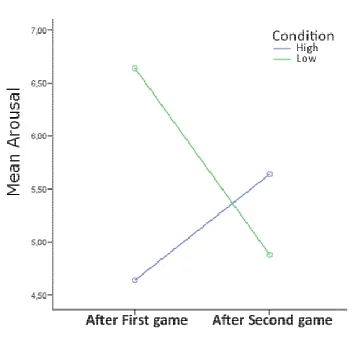
significant difference in arousal between the high and low condition on the second measure, scores for the conditions are significantly different when compared to the scores on the first measure of the excitement scale. The interaction is shown in figure 2. further analysis of this interaction using one way ANOVA’s showed that there was no significant difference between arousal in the high and low condition (F = (1, 48) = 2.03, p =.16) for the second measure. The difference in arousal between low arousal condition before and after was significant (F = (2, 23) = 156.05, p <.01) the mean score for the low arousal group was M = 6.6, SD = 1.84, before playing the second videogame. The mean score after playing the game was M = 4.8, SD = 1.90. The fact that no significant difference was found between the low and high arousal condition on the arousal scale can be explained by the finding that there was also a significant difference in scores on the SAM arousal scale before and after playing the second videogame (F = (2,23) = 166.41, p<.01). The mean score for the high arousal condition before playing the videogame was M = 4.6, SD = 1.75, the mean score for the high arousal condition was M = 5.6, SD = 1.86. This means while the arousal off the low condition group rose (a higher score on this scale means you are less aroused, e.g. more calm) the arousal for the high condition group decreased.
observed in figure 2. The high arousal condition felt less arousal after playing the second videogame while the low arousal condition felt more. This could either mean that the second game was arousing for the low arousal condition or that the first game offered so little in terms of arousal the scores for the second measure was bound to be higher, but with the current data we cannot test either assumption.
Figure 2. Differences in arousal between first and second measure of SAM, compared between high and low arousal co
Differences in the other two SAM scales used in this study were compared using repeated measures MANOVA’s with the score on the first and second test being the within subject variables, and condition as a between subject variable. The pleasure
not show a significant difference between the first and second measurement (
0.14, p=.71), the interaction between pleasure and condition was also not found to be significant (F = (1, 48) = 2.41, p=
A significant difference between the high and low arousal condition on the first SAM measurement was found however (
condition being M = 3.8, SD = 1.63, and the mean score for the low arousal condition being The high arousal condition felt less arousal after playing the second videogame while the low arousal condition felt more. This could either mean that the second game was arousing for the low arousal condition or that the first game offered so
in terms of arousal the scores for the second measure was bound to be higher, but with the current data we cannot test either assumption.
Figure 2. Differences in arousal between first and second measure of SAM, compared between high and low arousal condition.
Differences in the other two SAM scales used in this study were compared using repeated measures MANOVA’s with the score on the first and second test being the within subject variables, and condition as a between subject variable. The pleasure- displeasure scale did not show a significant difference between the first and second measurement (
.71), the interaction between pleasure and condition was also not found to be
p=.13).
difference between the high and low arousal condition on the first SAM
measurement was found however (F = (1, 48) = 11.52, p=.02). With mean score for the high condition being M = 3.8, SD = 1.63, and the mean score for the low arousal condition being
The high arousal condition felt less arousal after playing the second videogame while the low arousal condition felt more. This could either mean that the second game was arousing for the low arousal condition or that the first game offered so
in terms of arousal the scores for the second measure was bound to be higher, but with
Figure 2. Differences in arousal between first and second measure of SAM, compared
Differences in the other two SAM scales used in this study were compared using repeated measures MANOVA’s with the score on the first and second test being the within subject
ispleasure scale did not show a significant difference between the first and second measurement (F = (1, 48) =
.71), the interaction between pleasure and condition was also not found to be
difference between the high and low arousal condition on the first SAM
M=2.84, SD= 0.98. The low arousal condition thus indicated that they had more pleasure (lower score means more pleasure) than the high arousal condition. The scores on the dominance scale did not significantly differ before and after playing the second videoga = (1, 48) = 2.46, p=.12), there was no significant interaction between condition and dominance either (F = (1, 48) = 0.52,
whether the participant watched racing had a significant effect on the fir SAM pleasure- displeasure scale (
4.2 Performance
The average amount of brands that participants remember
analysis was done using a MANOVA with performance on the four questionnaires dependent variables and condition as a fixed factor. Responses on the aptitude questionnaire about video gaming and racing experience were used as concomitant variables. All the concomitant variable
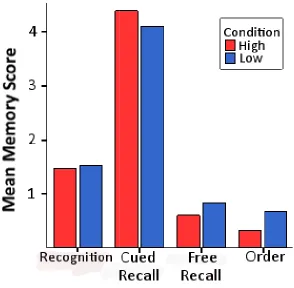
Figure 3. Differences in Mean arousal on the four questionnaires between the high and low arousal condition.
The actual amount of brands remembered however paints a different picture. When comparing the two conditions (high and low arousal) no significant differen
between performance in the two conditions (
84, SD= 0.98. The low arousal condition thus indicated that they had more pleasure (lower score means more pleasure) than the high arousal condition. The scores on the dominance scale did not significantly differ before and after playing the second videoga
.12), there was no significant interaction between condition and = (1, 48) = 0.52, p=.43). The other significant effect found was that whether the participant watched racing had a significant effect on the first measure of the
displeasure scale (F = (2, 44) = 3.21, p=.05)
The average amount of brands that participants remembered was M= 5.60, SD= 12.04. An analysis was done using a MANOVA with performance on the four questionnaires
variables and condition as a fixed factor. Responses on the aptitude questionnaire about video gaming and racing experience were used as concomitant variables. All the concomitant variables used can be seen in Appendix B.
Differences in Mean arousal on the four questionnaires between the high and low
The actual amount of brands remembered however paints a different picture. When comparing the two conditions (high and low arousal) no significant differen
between performance in the two conditions (F = (4, 16) = 0.41, p =.21). The two conditions 84, SD= 0.98. The low arousal condition thus indicated that they had more pleasure (lower score means more pleasure) than the high arousal condition. The scores on the dominance scale did not significantly differ before and after playing the second videogame (F
.12), there was no significant interaction between condition and The other significant effect found was that
st measure of the
M= 5.60, SD= 12.04. An analysis was done using a MANOVA with performance on the four questionnaires as
variables and condition as a fixed factor. Responses on the aptitude questionnaire about video gaming and racing experience were used as concomitant
Differences in Mean arousal on the four questionnaires between the high and low
The actual amount of brands remembered however paints a different picture. When comparing the two conditions (high and low arousal) no significant difference was found
did not differ significantly when comparing the two for performance on the free recall questionnaire (F = (1, 19) = 1.22, p = .28) for the high arousal condition the average number of correct brands recalled was M = 0.42, SD = 0.228, for the low arousal condition the average score was M = 1.13, SD = 0.228. There was no significant difference between the two conditions on the number of brands put into correct order (F = (1, 19) = 0.12, p = .73) the average score for the high arousal condition was M = 0.34, SD = 0.215, the average score for the low arousal condition was M =0 .72, SD = 0.215. Average score can be seen in figure 2.
Performance on the multiple choice questionnaire did not significantly differ between groups either (F = (1, 19) = 1.10, p = .31). The average score for the high arousal condition was M = 3.91, SD = 0.642, the average score for the low arousal condition was M = 4.52, SD = 0.642. Performance on the cued recall did not significantly differ between the two conditions either, although this effect nearly reached significance (F = (1, 19) = 3.49, p = .08). The mean score for the high arousal condition was M = 0.9, SD = 0.363, the mean score for the low arousal condition was M = 2.12, SD = 0.363. Thus although the main effect was not found to be significant, the direction of the effect was as expected. The low arousal condition did score higher than the high arousal condition. A check was also done for age, gender and education, but none of these reached significance. (F = (4, 14) = 0.64, p = .64) for gender, (F = (16,43) = 0.49, p =.95) for age and (F = (4, 13) < 0.01, p = 1.00) for education. The brand that was mentioned the most was the brand Lotus, which was the brand of the car the
participants drove in the car, this brand was mentioned by 23 of the participants, 10 times by participants in the high condition and 13 times by participants in the low arousal
condition.
4.3 Errors
4.4 Co variants
Off the co variants used several reached significance, the grade that participants gave themselves (F = 4, 16) = 6.21, p <.01). Whether participants currently watched racing (F (4, 16) = 8.10, p <.01) or watched racing in the past (F (4, 16) = 6.41, p <.01) also reached
significance. As did the amount of racing that was currently being watched (F (4, 16) = 7.61, p
<.01) and the amount of racing watched in the past (F (4, 16) = 5.91, p <.01) which also reached significance. The amount of hours spent playing videogames neared significance (F
(4, 16) = 2.66, p =.07) as did the amount of consoles owned by the participant (F (4, 16) = 2.969, p =.05), as these did not reach significance they were not analyzed any further. The other covariant to reach significance was the score on the SAM pleasure- displeasure scale before (F (4, 16) = 5.28, p < .01) and after playing the racing game reached near significance (F (4, 16) = 2.64, p = .07). These effects were further analyzed to see what their influence is on the performance on the four questionnaires.
The direction and influence of co variants on the scores of the memory questionnaires were tested by using a MANOVA taking performance on the four questionnaires (free recall, recognition, cued recall and putting the brands into correct order) as dependent variables and taking the co variants as independent variables. Of the co variants used having watched racing in the past had a significant effecton the performance on the recall questionnaire (F = (1, 46) = 4.0, p=.05) those participants that had watched racing in the past tended to score higher on the recall questionnaire (M= 1.86, SD= 1.407, compared to M= 0.90, SD =0.87 for those that did not watch racing) when they were in the high arousal condition. When they were in the low arousal condition this effect was reversed, those that did not watch racing (M= 1.83, SD=1.74 compared to M= 1.23, SD = 1.23 for those who did watch racing) scored higher than those that did watch racing in the past.
4.5 Comparisons between gamers
To allow direct comparison between experienced and non experienced gamers a few transformations were done on the data from the aptitude questionnaire. Firstly all the respondents who answered “yes” on questions 1,3,5,7 and 8 were given one point, while participants answering no received 0 points. For questions 9, 10 and 11 participants were given one to four points, one for answering 1-2 and four points for answering 7-8 or 7+. For questions 2 4 and 6 the averages of all participants were taken and participants scoring above the average received 1 point while those scoring below the average would receive 0 points. For questions 12, 13 and 14 participants received one point if they indicated that they preferred gaming as their activity. For each open question that was answered correctly the participants received one point.
This enabled participants to receive a score ranging from a minimum of three to a maximum of 29. Average score was M = 12.82. Participants scoring more than 15 (15 and above) were classified as being experienced gamers while participants whom scored 14 or below were classified as being inexperienced gamers. This was done to allow direct comparison between experienced and inexperienced gamers. There were 32 inexperienced gamers in the current experiment and 18 more experienced gamers.
The racing questionnaire was given the same treatment, in that everyone who indicated that they watched racing or watched racing in the past was given one point while everyone whom indicated they did not watch racing were granted one point. When indicating time watched was 1-2 hours one point was awarded, and when indicated that time watched was 7-8 hours four points were given, this allowed participants to get a minimum of 2 points and a maximum of 10 points. Average score was M = 3.66, participants scoring lower than 5 (4 or below) this were classified as inexperienced in watching races, participants scoring higher than 5 were classified as experienced in watching races. As with the classing of gamers as high or low experience this allowed direct comparison of people experienced in watching races and people inexperienced in watching races.
Prior knowledge of brands did have a significant effect (F = (12, 119) = 2.63, p<.01) but no significant interaction was found with condition (F = (4, 37) <0.01, p=.00). No significant difference was found between those who were experienced in racing and those
5. Discussion
The goal of this study was to get a closer look at the effectiveness of in game advertising. The hypothesis was that when playing an arousing videogame memory for advertising would show decrements, as compared to playing a non arousing videogame. The results did not show a difference between the high and low arousal groups. But the results did show a generally bad memory performance. The average number of advertisements recalled were just two out of 14 advertisements shown in the videogame. Comparing this performance and the performance on the other questionnaires with performance in other related studies from television (e.g. Gunther, 2007) the performance in this study is truly below average. The average number of correct responses on the multiple choice questionnaire for instance is barely higher than chance (28.4% correct). Furthermore excitation transfer is thought to be a short lasting effect of roughly two and a half minutes (Mundorf, Zillmann & Drew, 1999) but unfortunately due to the overall bad performance such an effect could not be found in the present data.
While the high arousal condition did indeed show a higher arousal than the low arousal condition the scores between the two conditions did not differ, this would indicate that the premise of the excitation transfer effect in the case of videogames is wrong. Excitation transfer does predict a decrement of score on the memory questionnaires when the participant is aroused, but when the participant is not aroused there should not be a decrement in performance. This is in direct contrast with findings from television that viewers who are aroused remember less advertising than viewers who are not aroused (Bushman & Bonacci, 2001; Furnham, Gunter & Richardson, 2007;Parker & Furnham, 2007). Thus while the excitation transfer effect is seen in television it does not seem to apply to videogames, this could be due to the different nature of videogames. One cause for this different finding may be the placement of advertisement in television compared to that in videogames. In most advertisements seen on television, advertising is separate from the main programming and this is the setup used in many research done with excitation transfer (e.g. Gunther, 2007) while advertising in videogames is shown during the playing of the videogame. Comparing video gaming to product placement may thus be a better
comparison, but compared to product placement memory performance in videogames is poor as well (Lee & Faber, 2007).
Furthermore unlike television videogames is not passive entertainment, but it requires the user to take direct control of the situation and drive the story forward on the user’s own pace. When viewers watch television in excitation transfer tasks they are not usually
the fact that participants who played a videogame had to directly control the action instead of passively viewing may supply an alternative explanation for the results found in this study. One of the comments that were most often made by the participants was “I was paying attention to racing my car, I was trying to go as fast as possible, and make the turns as good as possible, I didn’t pay attention to anything else that was happening”. Another participant commented that “making the turns and keeping up speed is difficult enough as it is, I didn’t have the time to look at anything else”. These observations may be quite correct, as a lot of limited resource models for attention as well as working memory have been proposed, such as the limited resource model of Baddeley and Hitch (1974) or Broadbent (1985) and a more recent version (Baddeley, 2000). Whether this is a single resource or multiple component system is still up for debate (Cowan, Elliot, Saults, Morey, Mattox, Hismjutullina & Conway, 2005) but the idea of a limited resource model is generally accepted idea (e.g. Miyake & Shah, 1999).
One model that fits the current study the best is the limited capacity model of mediated message processing proposed by Annie Lang (2000). This model sees humans as active information processors, who have limited resources available to process information. Processing requires mental resources. Information processing is seen as a “group of simultaneously occurring component processes (or sub processes) that people perform on stimuli and on the mental representation of stimuli that they construct” (Lang, 2000, p.47). Encoding, storage and retrieval are the sub processes proposed by Lang (2000). Each of these sub processes is involved in processing messages from media. These sub processes occur in parallel and each of these processes takes up mental resources. Every sub processes has automatic components that are not under control of the information processor as well as components that are under the control of the information processor (intention of the information processor). When viewing a message in the media information is stored in the sensory stores (Zechmeister & Nyberg, 1982) and a selection is encoded into working memory where a mental representation is formed which can be processed further by for instance combining it with previous information (retrieval) or storing it in long term memory (storage). The only limiting factor is that we can only attend to a limited amount of
information at once.
The fact that no difference was found between experienced and inexperienced gamers shows that even experienced gamers focus their attention on the car alone, and not on stimuli in the environment.
Another sub process of interest from Lang’s limited capacity model is the storage
component. During the encoding sub process a mental representation of the information is formed in working memory, as a person thinks about this information associations are formed between the new information and old information from long term memory (Carpenter, 1989; Chakbrabart & Basu, 2008). The more associations are formed with old information the better retrieval will work. Some parts of the information will be more thoroughly stored than others.
As with encoding, both automated and controlled processes are thought to operate here, and thus the amount of storage is dependent on individual differences and limitations of human processing. As with television the information presented in a racing game is
continuous, while under more control than with television (the player may choose to break and look at the surroundings) when the goal is to drive a circuit as swiftly as possible the information will be as continuous as television, this will limit the amount of information that can be stored by the participant.
Furthermore the goal of driving the car will presumably call upon much of the attention of the player, causing fewer resources to be available for storing information. Another factor influencing the storage sub process are the goals and needs of the participants. The goal of the participants was to drive the car around the circuit, it was not to attend to the
advertising and try to remember as much as possible. A participant that would have been explicitly instructed to attend to the advertising would presumably show better performance than a participant that has not been instructed to do so, but future research will have to look at the effects of different instructions given to participants who are required to play a
videogame.
The tendency found for participants not experienced in racing to score higher in the low arousal group could be caused by the more displeasure that group felt, thus perhaps giving less attention to the racing itself and thus freeing up more processing resources for watching other stimuli, in this case advertising near the road. Research has shown that negative emotions impede motivation (Lang, Bradley & Cuthbert, 1999), and a lack of motivation would certainly allow the participants to attend to other stimuli in the game, most importantly the advertising shown next to the circuit.
The last sub process of importance in the limited capacity model of mediated message processing is the retrieval process. This sub process is most important during the filling out of the memory questionnaires when the participants have to remember as many brands as they can; this is not constrained by time demands in the present study.
The process that would interfere with performance the most would be concurrent retrieval, retrieving previously known information to aid in understanding, storage and acting. We expect previously known information to have little or no effect, as no prior knowledge is needed for playing the game. Retrieval might have some effect on those who are not
familiar with operating a Playstation 2, as they would have to actively remember and attend to the buttons they would have to push to operate the car efficiently. Carrying out an unfamiliar action sequence would require step by step attention and control on every step off the sequence (Anderson, 1983), until the sequence is learned, after which it would form procedural rules which can act outside of attention and do not need this step by step attention (Anderson, 1993, Keele & Summers, 1976).
The failure to find a significant effect of previous knowledge off operating the Playstation 2, or ownership of the console disproves this. While certain participants did indeed have problems to control the game, no significant difference in performance or memory has been found between those who were familiar with the controls, and those that were not. Thus we believe that the participant would invest few or no resources in concurrent retrieval as the situation did not demand it. Furthermore the operations of the games were rather simple, with no more than 3 buttons requiring operation.
5.2 Conclusion
In summary, the limited capacity model of mediated message provides an alternative explanation for the results found in the current study. Due to the participants focusing their attention on controlling the vehicle they had no more resources available to process
information from the surroundings of the car, and thus were not able to remember many of the advertisements displayed in game.
the secondary task (remembering the advertisements). The implications of the current study should be clear, until further research is done into the effectiveness of IGA, advertisers should perhaps take caution into placing advertising into video games as it may not be money well spent. Lee and Faber (2007) showed that incongruity of advertisement and videogame may be the best way to get gamers to remember the brands advertised in videogames.
5.3 Limitations and future research
Due to the difficulty of comparing advertisement in two separate videogames, this study used a slightly different method in comparing high and low arousal groups, by first letting them play one game followed by another videogame. While gamers in the real world will certainly switch to another videogame after a while of playing, it’s more likely they will spend a lot of time playing one videogame, often for hours at a time. This means that the results may be different in a normal setting.
A second related limitation is the play time. Two and a half minutes of playtime for the second game is certainly not long, and normal playing time is bound to be longer than this. Future studies should definitely look to the effects of longer play time. Another related limitation in the current study is the reason players will play a game. In the current study playing a videogame was a needed part of getting a credit or completing the study, in real life it is assumed videogames will generally be played for entertainment or pleasure and seeing the effect emotions may have on the storage sub process, this may influence results. Videogames is not solely first person shooters or racers dedicated to action, but there are a multitude of genres including the real time strategy and turn based strategy, which may be more suited for advertising. Furthermore several advertisement supported games do not display advertisement during play, but force the player to watch advertisements upfront before play, and this may be more successful in getting gamers to remember games. As shown in the research of Lee and Faber incongruity of advertisements may be the best way to get gamers to remember advertising, for example deodorant advertisement during racing. Future research should indeed look to the effects of different genre’s as well as different ways of presenting advertising (before playing a game or incongruous with the game subject itself).
5.4 Acknowledgement
I would like to thank Dr. Ard Heuvelman for his support and assistance in making this
6. Appendix A: Questionnaires
Met ondertekening van dit formulier stem ik toe mee te doen aan dit onderzoek, ik ben me ervan bewust dat deelname aan dit onderzoek geheel vrijwillig is. Ik kan mijn medewerking op elk tijdstip stopzetten en de gegevens verkregen uit dit onderzoek terugkrijgen, laten verwijderen uit de database, of laten vernietigen.
Proefpersoonummer (indien ingeschreven via proefpersonenpool): ...
Leeftijd: ...
Studierichting: PSY/TCW/ Anders: ...
Geslacht: M/V
De volgende punten zijn nog van belang:
• Het onderzoek duurt ongeveer 40 minuten.
• Er behoort geen stress of ongemak voort te vloeien uit deelname aan dit onderzoek.
• De gegevens verkregen uit dit onderzoek zullen anoniem verwerkt worden en kunnen daarom
niet bekend gemaakt worden op een individueel identificeerbare manier.
• De onderzoeker zal alle verdere vragen over dit onderzoek beantwoorden, nu of gedurende het
verdere verloop van het onderzoek.
• Deelnemers die graag willen weten wat het doel is van het onderzoek kunnen hun email adres
opgeven bij de onderzoeker die daarna een uitleg naar hun toe zal mailen.
Handtekening onderzoeker: ……… Datum: ………..
Handtekening proefpersoon: ……… Datum: ………..
SAM QUESTIONNAIRE
:Hieronder zul je 3 sets van van 5 figuren zien, elk gearrangeerd langs een continuum. We
deze set van figuren SAM en deze figuren gebruik je om aan te geven hoe je je voelt. De SAM laat drie verschillende soorten gevoelens zien: Plezierig versus Onplezierig , Opgewonden versus Kalm, en Beheerst worden of Beheersen. Je kunt zien dat elke
Het is de bedoeling dat jij op deze schaal aangeeft in hoeverre de emotie op dit moment op jouw van
Beheerst (gedomineerd) worden vs. Beheersen (domineren)
Hieronder zul je 3 sets van van 5 figuren zien, elk gearrangeerd langs een continuum. We
deze set van figuren SAM en deze figuren gebruik je om aan te geven hoe je je voelt. De SAM laat drie verschillende soorten gevoelens zien: Plezierig versus Onplezierig , Opgewonden versus Kalm, en Beheerst worden of Beheersen. Je kunt zien dat elke SAM-figuur langs een schaal gevarieerd wordt. Het is de bedoeling dat jij op deze schaal aangeeft in hoeverre de emotie op dit moment op jouw van
betrekking is.
Plezierig - Onplezierig
Opgewonden-Kalm
Beheerst (gedomineerd) worden vs. Beheersen (domineren)
Hieronder zul je 3 sets van van 5 figuren zien, elk gearrangeerd langs een continuum. We noemen deze set van figuren SAM en deze figuren gebruik je om aan te geven hoe je je voelt. De SAM laat drie
verschillende soorten gevoelens zien: Plezierig versus Onplezierig , Opgewonden versus Kalm, en figuur langs een schaal gevarieerd wordt. Het is de bedoeling dat jij op deze schaal aangeeft in hoeverre de emotie op dit moment op jouw van
In de videogame Gran Turismo 4 dat je net gespeeld hebt was reclame voor een aantal merken ingevoegd. De volgende vragenlijst gaat over hoeveel merken jij nog kunt herrineren na het spel gespeeld te hebben. Vul deze
vragenlijst zo volledig en accuraat mogelijk in. Neem rustig de tijd.
1. Hoeveel verschillende reclames denk je gezien te hebben in het spel?
...
2. Schrijf de merken die jij je nog kan herrineren op:
... ... ... ... ... ... ...
3. Schrijf de merken uit vraag 2 op in de volgorde waarin jij ze gezien hebt
... ... ... ... ... ... ...
4. Kende je deze merken al van voor dat je dit spel gespeeld hebt?
Ja/Nee
5. Zo ja, welke?
Recognition Questionnaire
In de videogame Gran Turismo 4 die jij net gespeeld hebt komen een aantal reclames voor, een aantal van deze reclames die jij tijdens het spelen bent tegenkomen staan tussen de volgende 18 reclames;
het is de bedoeling dat jij hieruit de (NUM) reclames aangeeft die jij daadwerkelijk bent tegengekomen. Neem rustig de tijd en doe dit zo accuraat mogelijk.
Heineken EA Games
Firestone Rolex
Activision Ford
Mercedes Pontiac
Dodge Nvidia
Samsung Texaco
Nissan Volkswagen
Porsche Mazda
Cued Recall
Hieronder volgen een aantal meerkeuze vragen over de reclames die jij bent
tegengekomen in het spel Gran Turismo 4, voor de vragen staat het merk
waarop de vraag betrekking heeft, kruis telkens het goede antwoord aan, neem
rustig de tijd.
Firestone
1: Wat was de kleur van deze reclame?
a) Groen
b) Geel
c) Rood
d) Oranje
2: Stond er een bedrijfslogo op bij deze reclame?
a) Ja
b) Nee
c) Weet niet
Halvoline:
3: Welk bedrijfslogo stond bij deze reclame?
a) Texaco
b) BP
c) Shell
d) Q4
4: Welke kleuren had deze reclame?
a) Blauw/Groen
b) Blauw/Geel
c) Zwart/Groen
d) Zwart/Geel
Ford
5: Wat stond er in de tekst bij de reclame?
a) Driving
b) Racing
c) Cars
6: Stond het bedrijfslogo van Ford bij de reclame?
a) Ja
b) Nee
c) Weet Niet
Valvoline
7: Stond het bedrijfslogo bij deze reclame?
a) Ja
b) Nee
c) Weet Niet
8: Welke kleur kwam in de reclame voor?
a) Blauw
b) Groen
c) Rood
d) Zwart
Cadillac:
9: Stond het logo van cadillac bij de reclame?
a) Ja
b) Nee
c) Weet Niet
10: Stond er verder nog tekst bij de reclame?
a) Ja
b) Nee
c) Weet niet
Texaco
11: Stond het bedrijfslogo in de reclame?
a) Ja
b) Nee
Chevrolet
12: Welke kleur had deze reclame?
a) Zwart
b) Blauw
c) Geel
d) Wit
13: Stond het bedrijfslogo bij de reclame?
a) Ja
b) Nee
c) Weet niet
Penzoil:
14: wat waren de kleuren van deze reclame?
a) Geel/zwart
b) Groen/zwart
c) Blauw/Geel
d) Groen/Blauw
15: Stond bij deze reclame het bedrijfslogo?
a) Ja
b) Nee
Gaming Aptitude
Hieronder volgen een aantal vragen die over jouw gebruik van videogames gaan. Neem rustig de tijd en vul deze vragen zo accuraat mogelijk in. Na deze vragen volgen een aantal vragen met betrekking
van jouw kennis over videogames, vul deze ook zo accuraat mogelijk in.
1. Bezit je een game console? (omcirckel het juiste antwoord)
Ja/ Nee
2. Welke?
... ...
3. Ben je bekend met de Playstation 2?
Ja/Nee
4. Zo ja; hoeveel uur heb je gebruik gemaakt van de Playstation 2 of een andere console op
weekbasis?
5. Speel je wel eens een videogame?
Ja/Nee
6. Zo ja, welke?
... ... ... ...
7. Zo nee, heb je in het verleden ooit videogames gespeeld?
Ja/Nee
8. Heb je ooit in het verleden wel eens een racing game gespeeld?
Ja/Nee
9. Hoeveel games bezit je zelf?
1-2 3-4 5-6 7+
10. Hoeveel uur besteed je per dag aan het spelen van videogames?
1-2 3-4 5-6 7-8
11. Hoeveel uur ben je van plan de volgende week (gemiddeld) per dag te spelen?
12. Als je een keuze moet maken tussen televisie kijken en videogames, wat zou je dan kiezen? Televisie kijken/Videogames
13. Als je een keuze moet maken tussen uitgaan en videogames, wat zou je dan kiezen?
Uitgaan/Videogames
14. Als je een keuze moet maken tussen sporten en videogames, wat zou je dan kiezen?
Sporten/Videogames
15. Hoe goed denk je dat je bent in het spelen van videogames? (geef jezelf een cijfer van 1-10)
...
Hieronder volgen een aantal open vragen, deze vragen gaan over jouw videogame kennis, beantwoord deze vragen zo accuraat mogelijk, neem de tijd.
1. Wat is een MMORPG
5. Welke game consoles ken je?
Hieronder volgen nog een paar vragen over in hoe verre jij bekent met auto
race’s over het algemeen, beantwoord deze ook zo compleet en accurraat,
mogelijk, neem de tijd.
1. Kijk jij wel eens naar auto races (Formule 1 etc)?
Ja/Nee
2. Zo ja; hoeveel uur per week denk je hier gemiddeld naar te kijken?
1-2 3-4 5-6 7-8
3. Zo nee; heb jij in het verleden wel eens naar auto races gekeken?
Ja/Nee
4. Zo ja; hoeveel uur denk jij in het verleden gemiddel per week te hebben bekeken?
Appendix B: Statistics
Test of arousal:
Multivariate Tests(b)
Effect Value F Hypothesis df Error df Sig.
Arousal Pillai's Trace ,037 1,819(a) 1,000 48,000 ,184
Wilks' Lambda ,963 1,819(a) 1,000 48,000 ,184
Hotelling's Trace ,038 1,819(a) 1,000 48,000 ,184
Roy's Largest Root ,038 1,819(a) 1,000 48,000 ,184
Arousal * Conditie Pillai's Trace ,333 23,985(a) 1,000 48,000 ,000
Wilks' Lambda ,667 23,985(a) 1,000 48,000 ,000
Hotelling's Trace ,500 23,985(a) 1,000 48,000 ,000
Roy's Largest Root ,500 23,985(a) 1,000 48,000 ,000
a Exact statistic
b Design: Intercept+Conditie Within Subjects Design: Arousal
Comparison between arousal in the low condition between first and second measure. Multivariate Tests(b)
Effect Value F Hypothesis df Error df Sig.
Arousal Pillai's Trace ,569 31,738(a) 1,000 24,000 ,000
Wilks' Lambda ,431 31,738(a) 1,000 24,000 ,000
Hotelling's Trace 1,322 31,738(a) 1,000 24,000 ,000
Roy's Largest Root 1,322 31,738(a) 1,000 24,000 ,000
a Exact statistic b Design: Intercept
Performance on questionnaires; only the relevant covariants are shown, in the complete analysis, all the covariants were used, thus the values may differ slightly. But to reduce clutter (there are a lot of different co variants, only the relevant ones are shown.
Multivariate Tests(b)
Sam1PlezierigOnplezierig Pillai's Trace ,209 2,575(a) 4,000 39,000 ,053
Comparison between experienced gamers and in experienced gamers aswell as experienced racers vs inexperienced racers.
Multivariate Tests(b)
Effect Value F Hypothesis df Error df Sig.
Intercept Pillai's Trace ,763 34,662(a) 4,000 43,000 ,000
Wilks' Lambda ,237 34,662(a) 4,000 43,000 ,000
Hotelling's Trace 3,224 34,662(a) 4,000 43,000 ,000
Roy's Largest Root 3,224 34,662(a) 4,000 43,000 ,000
racerank Pillai's Trace ,129 1,594(a) 4,000 43,000 ,193
Wilks' Lambda ,871 1,594(a) 4,000 43,000 ,193
Hotelling's Trace ,148 1,594(a) 4,000 43,000 ,193
Roy's Largest Root ,148 1,594(a) 4,000 43,000 ,193
gamerankalt Pillai's Trace ,096 1,146(a) 4,000 43,000 ,348
Wilks' Lambda ,904 1,146(a) 4,000 43,000 ,348
Hotelling's Trace ,107 1,146(a) 4,000 43,000 ,348
Roy's Largest Root ,107 1,146(a) 4,000 43,000 ,348
racerank * gamerankalt Pillai's Trace ,082 ,958(a) 4,000 43,000 ,440
Wilks' Lambda ,918 ,958(a) 4,000 43,000 ,440
Hotelling's Trace ,089 ,958(a) 4,000 43,000 ,440
Roy's Largest Root ,089 ,958(a) 4,000 43,000 ,440
a Exact statistic
Appendix C: Flyer
Videogames en reclame
Heb jij nog credits nodig of wil je gewoon
meedoen aan een leuk onderzoek?
Doe dan mee met het onderzoek
“
Videogames en reclame
credit kunt verdienen, na het spelen van een
videogame moet je
Meld je aan via de proefpersonenpool of mail
naar
Videogames en reclame
Heb jij nog credits nodig of wil je gewoon
meedoen aan een leuk onderzoek?
Doe dan mee met het onderzoek
Videogames en reclame
” waarmee je 1
credit kunt verdienen, na het spelen van een
videogame moet je een paar reclames
beoordelen
Meld je aan via de proefpersonenpool of mail
Videogames en reclame
Heb jij nog credits nodig of wil je gewoon
meedoen aan een leuk onderzoek?
Doe dan mee met het onderzoek
” waarmee je 1
credit kunt verdienen, na het spelen van een
een paar reclames
Meld je aan via de proefpersonenpool of mail
7. References
Anderson, J. R. (1983). The architecture of cognition. Cambridge, MA: Harvard University Press.
Anderson, J. R. (1993). Rules of mind. Hillsdale, NJ: Erlbaum.
Baddeley, A.D. (2000) The episodic buffer: a new component of working memory?. Trends in Cognitive Sciences, 4 (11), 417-423.
Baddeley, A.D., & Hitch, G.J. (1974). Working memory. In The Psychology of Learning and Motivation (Bower, G.A., ed.), pp. 47–89, Academic Press.
Barlett, C.P., Harris, R.J., & Baldassaro, R. (2007). The longer you play, the more hostile you feel: examination of first person shooter video games and aggression during video game play . Aggressive Behavior, 33, 486-497.
Broadbent, D. (1985). A question of levels: Comment on McClelland and Rumelhart. Journal of Experimental Psychology: General, 114, 189-192.
Bushman, B. J., & Bonacci, A. M. (2002). Violence and sex impair memory for television ads.
Journal of Applied Psychology, 87, 557-564.
Bushman, B. J., & Phillips, C.M. (2001). If the television program bleeds, memory for the advertisement recedes, Current Directions in Psychological Science, 10, 43-47.
Carpenter, G.A. (1989) Neural network models for pattern recognition and associative memory. Neural Networks, 2, 243-257.
Chaney, I. M., Ku-Ho, L., & Chaney, J. (2004).The effect of billboards within the gaming environment. Journal of Interactive Advertising, 5 (1).
Christianson, S.A. (1992). Emotional stress and eyewitness memory: a critical review.
Psychological Bulletin, 112, 284-309.
Comscore, (2006). comScore Study Reveals Gamers Are an Attractive Online Advertising Segment. Aquired on march 4, 2003, from
http://www.comscore.com/press/release.asp?press=861.
Cowan, N., Elliot, E.M., Saults, J.S., Morey, C. C., Mattox, S., Hismjutallina, A., & Conway, A.R.A. (2005). On the capacity of attention: Its estimation and its role in working memory and cognitive aptitudes. Cognitive Psychology, 51 (1), 42-100.
Furnham, A., Gunter, B., & Richardson, F. (2002). Effects of product-program congruity and viewer involvement on memory for televised advertisements. Journal of Applied Social Psychology, 32, 124-141.
Gunter, B. ,Furnham, A., & Pappa, E. (2007). Effects of television violence on memory for violent and nonviolent advertising. Journal of Applied psychology, 35 (8), 1680-1697. Hodes, R., Cook, E. W. III, & Lang, P. J. (1985). Individual differences in autonomic response:
conditioned association or conditioned fear? Psychophysiology, 22,545-560
Ivory, J.D., & Kalyanaraman, S. (2007). The effects of technological advancement and violent content in video games on players' feelings of presence, involvement, physiological arousal, and aggression. Journal of Communication, 57, 532-555.
Johnson, B. (2006). Advertisers get young gamers in their sights. Acquired on May 23 2008 from http://www.guardian.co.uk/technology/2006/may/19/games.news
Keele, S. W., & Summers, J. J. (1976). The structure of motor programs. In G. E. Stelmach (Ed.), Motor control: Issues and trends (pp. 109– 142). New York: Academic Press.
Kapucu, A., Rotello, C.M., Ready, R.E., & Seidl, K.N. (2008). Response bias in “remembering” emotional stimuli: a new perspective on age differences. Journal of Experimental
Psychology, Learning, Memory and Cognition, 34, 703-711.
Lang, A. (2000). The limited capacity model of mediated message processing. Journal of communication, 46, 46-70.
Lang, P. J. (1980). Behavioral treatment and bio-behavioral assessment: computer
applications. In J. B. Sidowski, J. H. Johnson, & T. A. Williams, Technology inmental health care delivery systems (pp. 119-l 37). Norwood, NJ: Ablex.
Lang, P. J., Bradley, M.M., & Cuthbert, B. N. (1998). Emotion, motivation, and anxiety: brain mechanisms and psychophysiology.
Lee,M., Faber R.J. (2007) Effects of Product Placement in On-Line Games on Brand Memory: A Perspective of the Limited-Capacity Model of Attention. Journal of Advertising,36, 75-90.
Miyake, A., & Shah, P. (1999). Models of working memory: Mechanisms of active maintenance and executive control. Cambridge: Cambridge University Press. Meston, C. M. & Frohlich, M.A. (2003) Love at First Fright: Partner Salience Moderates
Roller-Coaster-Induced Excitation Transfer. Archives of Sexual Behavior, 32, 537-544. Mundorf, N., Zillmann, D., & Drew, D. (1991). Effects of disturbing televised events on the
Newspaper Association of America (NAA) (2005). Advertising expenditures. Aquired on February 26, 2008 from http://www.naa.org/TrendsandNumbers/Advertising-Expenditures.aspx.
Parker , E., & Furnham, A. (2007). Does sex sell? The effect of sexual programme content on the recall of sexual and non-sexual advertisements. Applied Cognitive Psychology, 21, 1217-1228.
Parker, E., Furnham, A. ( 2007). Does sex sell? The effect of sexual programme content on the recall of sexual and non-sexual advertisements. Applied Cognitive Psychology, 21,
1217-1232.
Parzuchowski, M., Szymkow-Sudziarska, A. (2008). Well, slap my thing: expression of surprise facilitates memory of surprising material. Emotion, 8, 430-434.
Ravaja, N., Turpeinen, M., & Saari, T. (2008). The psychophysiology of James Bond: phasic emotional responses to violent video game events . Emotion, 8, 114-120.
VGChartz.com. (2008) Hardware comparison charts. Aquired on March 7,2008, from http://www.vgchartz.com/hwcomps.php?weekly=1.
Yankee group (2005). In-Game Advertising. Acquired on February 25, 2008, from http://blog.seattletimes.nwsource.com/techtracks/archives/2003844689.gif.
Zechmeister. E. B., & Nyberg, S.E. (1982). Human memory: An introduction to research and theory. Monterey, CA: Brooks/Cole.
Zillman, D. (1971). Excitation transfer in communication mediated aggressive behaviour.
Journal of Experimental Social Psychology, 7, 419-434.