Improving quality models for MT evaluation based on evaluators’ feedback
Paula Estrella
1, Andrei Popescu-Belis
2, Maghi King
11
ISSCO/TIM/ETI, University of Geneva 40, bd. du Pont-d’Arve
1211 Geneva, Switzerland 2
IDIAP Research Institute Av. des Prés-Beudin 20 1920 Martigny, Switzerland
E-mail: [email protected], [email protected], [email protected]
Abstract
The Framework for the Evaluation for Machine Translation (FEMTI) contains guidelines for building a quality model that is used to evaluate MT systems in relation to the purpose and intended context of use of the systems. Contextual quality models can thus be constructed, but entering into FEMTI the knowledge required for this operation is a complex task. An experiment has been set up in order to transfer knowledge from MT evaluation experts into the FEMTI guidelines, by polling experts about the evaluation methods they would use in a particular context, then inferring from the results generic relations between characteristics of the context of use and quality characteristics. The results of this hands-on exercise, carried out as part of a conference tutorial, have served to refine FEMTI’s ‘generic contextual quality model’ and to obtain feedback on the FEMTI guidelines in general.
1.
Introduction
The Framework for the Evaluation of Machine Translation (FEMTI) was introduced by the ISLE Evaluation Working Group, as an implementation of the EAGLES evaluation guidelines in the case of MT systems. The guidelines help evaluators to define quality models used to evaluate MT systems, based on the purpose and intended context of use of the systems (Hovy et al. 2002, King et al. 2003). The FEMTI framework is publicly available and benefits from user-friendly interfaces that guide evaluators with the definition of quality models and the selection of metrics (http://www.issco.unige.ch/femti/).
In this paper, we report results from an experiment aimed at transferring knowledge from MT evaluation experts into the FEMTI guidelines. After a brief reminder of FEMTI’s main features (Section 2), we demonstrate their relevance by relating them to two recent examples of contextualized evaluation of MT systems, for real-world uses (Section 3). The conditions of the hands-on MT evaluation exercise are outlined in Section 4, while the method for transforming the experts’ output into FEMTI knowledge and the results obtained with this approach are described in Section 5. Section 6 shows the integration of results into the FEMTI framework, while some conclusions and future work are outlined in Section 7.
2.
Evaluation of MT Systems in Context
2.1.FEMTI Components
FEMTI is made up of three components: the first one (‘Part I’) is a classification of possible user requirements or, more generally, of contexts of use of an MT system. Therefore, FEMTI Part I classifies the characteristics concerning the task to be performed by the MT system, the
author and text type of the input to the system, and the type of user of the system. The second component of FEMTI (‘Part II’) is a classification of quality characteristics based on the general ones first defined in the ISO/IEC 9126-1 standard for software evaluation (ISO/IEC 1991, 2001). The six top level characteristics of FEMTI Part II are the ISO ones, namely functionality, reliability, usability, efficiency, maintainability and portability, plus an extra characteristic, namely cost. Each top level characteristic is further decomposed into a hierarchy of characteristics which are specific to MT systems, and human and/or automatic metrics are attached to each node of this hierarchy, which can be used to evaluate the corresponding feature of the system, i.e. a quality attribute. The third component of FEMTI is the linking mechanism between Part I and Part II described in the next section.
2.2.Linking Mechanism
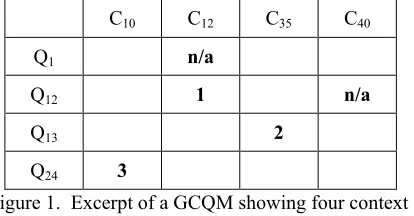
The generation of evaluation plans is based on particular quality models, which are subsets of the FEMTI Part II repertoire of quality characteristics and metrics. To extract such a subset, evaluators define first the requirements for the system (Part I), then apply a mechanism that uses the relations between each user requirement and the relevant quality characteristics of the system to be evaluated to construct the quality model.
quite close to each other, leading in the end to the creation of different GCQMs for each group. (It is, of course, reasonable to design specific evaluation plans for systems intended to perform different tasks.) In addition, it is worth noting that the contexts of use that were defined not only focused on the translation task, but also included other important items such as the user of the MT system, thus suggesting that FEMTI offers indeed a richer methodology for evaluation.
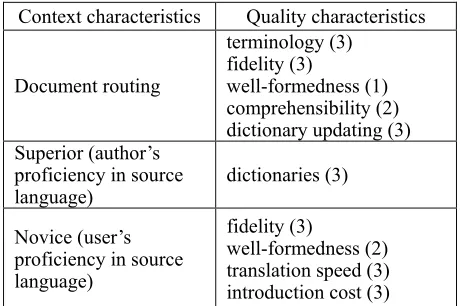
In the answers obtained from the four expert groups participating in these experiments, several context characteristics were shared by more than one group, independently of the exact translation task chosen by the groups, suggesting that for scenarios similar to the one proposed in Figure 2, the following context characteristics are of significant interest for an evaluation:
domain or field of application (text/document type – 1.3.1.2 in FEMTI)
superior proficiency in source language (author – 1.3.2.1.4)
novice proficiency in source language (user – 1.4.1.2.1)
superior / distinguished proficiency in target language (user – 1.4.1.3.4/5)
The numbers after a context or quality characteristic indicate their position in the FEMTI framework, available at http://www.issco.unige.ch/femti/.
We also expected links (relations between context and quality characteristics) to reach a significant number of terminal nodes in Part II, i.e. the measurable attributes. Indeed, if most of the context characteristics were linked to only one quality characteristic, this would mean that the context has no longer an impact on evaluation and assessing that single quality characteristic would always be enough, which is not the case for real-world systems, as illustrated above. In our experiment, we observed a diversity of answers, due to the different contexts defined in the first place. However, a series of quality characteristics appear to be important for the given scenario, such as fidelity, terminology, dictionaries, input to output translation speed and cost.
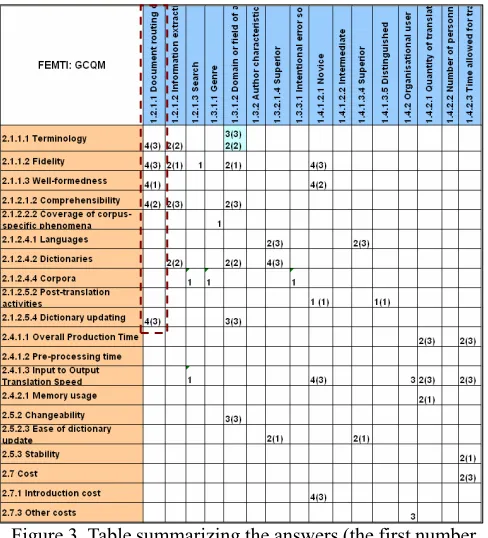
The results of the exercise – i.e. the context characteristics, quality characteristics, and weighted links – were summarized at the end of the tutorial in a table representing the GCQM jointly generated by the experts, as shown in Figure 3. The groups were numbered from 1 to 4 (first figure in each table cell) and the numbers 1–3 in parenthesis denote the relevance of each relation assigned by each group; no number between parenthesis means that there is a link but no weight was assigned, as explained in Section 2.2. An example is shown in Figure 3, where some of the results from Table 1 transferred to the GCQM are marked with dashed boxes, e.g. the translation task is document routing (1.2.1.1) and it is related to terminology (2.1.1.1), assigning a score of 3 for the importance of this relation.
Figure 3. Table summarizing the answers (the first number in each cell refers to the group that indicated the link, and
the number in parenthesis is the weight).
6.
Contribution to FEMTI
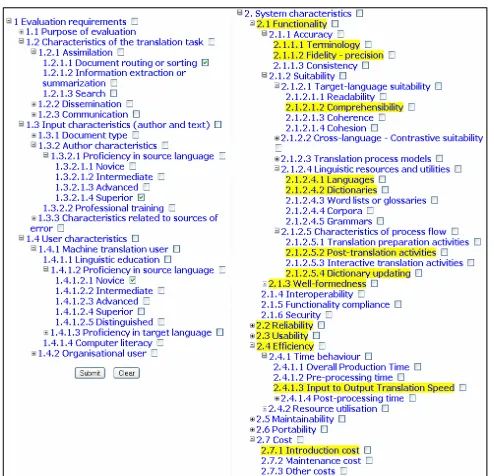
From this hands-on exercise, around 40 new links were added to FEMTI’s GCQM. Although these changes and the whole mechanism behind FEMTI’s interfaces are transparent to the user, once the links are sufficiently populated, the resulting behavior of the FEMTI interface is that many more quality characteristics get suggested once context characteristics are specified. Another interesting aspect of introducing more links is that weights on links are considered for the final quality model to rank the quality characteristics according to their importance, that is, if many of the selected context characteristics point to the same quality characteristic, this one becomes more important to the evaluation and will appear higher in the list of quality characteristics to assess. Figure 4 illustrates the integration of these results into the current version of FEMTI; the qualities highlighted in Part II (right-hand side) come from links previously present in the GCQM plus the new links when selecting the context of Table 1.
7.
Conclusion and Future Work
We intend to carry out larger scale experiments in the future, to populate relations between Parts I and II of FEMTI, as well as to identify areas of improvement for each of the two parts, possibly reorganizing the classifications or including new qualities or metrics. Another intended activity is to generate templates or typical use cases of FEMTI to facilitate its application to real-world scenarios, again based on input from MT experts.
Figure 4. Links retrieved from FEMTI’s GCQM when selecting context of use defined in Table 1.
8.
References
Blench, M. 2007. Global Public Health Intelligence Network (GPHIN). In MT Summit XI, 45 - 49. Copenhagen, Denmark.
Estrella, P., A. Popescu-Belis, and N. Underwood 2005. Finding the System that Suits you Best: Towards the Normalization of MT Evaluation. In 27th ASLIB International Conference on Translating and the
Computer, 23-34. London, UK.
Hovy, E., M. King and A. Popescu-Belis 2002. Principles of Context-Based Machine Translation Evaluation. Machine Translation, 17(1), p.43-75.
ISO/IEC 1991. ISO/IEC 9126: Information Technology -- Software Product Evaluation / Quality Characteristics
and Guidelines for Their Use. Geneva:
International Organization for Standardization / International Electrotechnical Commission.
ISO/IEC 2001. ISO/IEC 9126-1:2001 (E) -- Software Engineering -- Product Quality -- Part 1:Quality Model. Geneva: International Organization for Standardization / International Electrotechnical Commission.
King, M., A. Popescu-Belis, and E. Hovy 2003. FEMTI: creating and using a framework for MT evaluation. In
Machine Translation Summit IX, 224-231. New Orleans,
LA, USA.
Popescu-Belis, A., P. Estrella, M. King, and N. Underwood 2006. A model for context-based evaluation of language processing systems and its application to
machine translation evaluation. In LREC 2006 (5th International Conference on Language Resources and Evaluation), 691-696. Genova, Italy.
Stadler, H.-U., and U. Peter-Spörndli 2007. The quest for machine translation quality at CLS Communication. In