72
Time Reduction using Change Concept for Agility-A
Case Study
Pankaj Sharma
1, Dr.P.Thareja
2, Dr. G.S. Brar
3,
Vikas Ucharia
4, Rupinder S. Kanwar
5 School of Mechanical Engineering1, 2, 3, 4, 5, Bahra University1, 4, 5 PEC University2 GNDEC, Ludhiana3Email: [email protected]1
Abstract- A change concept is a general approach to change that has been found to be useful in developing
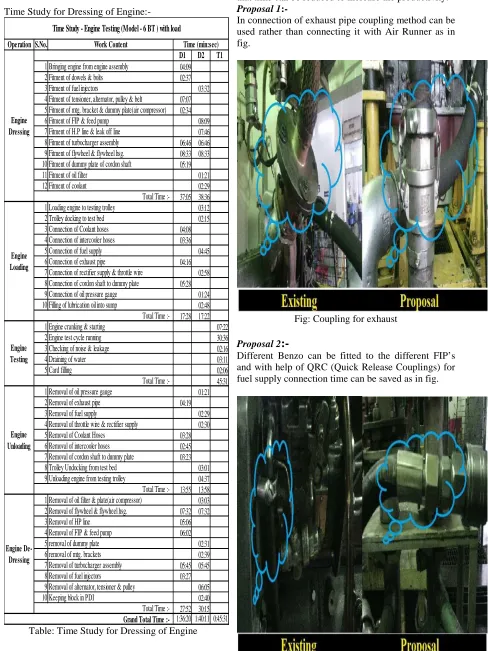
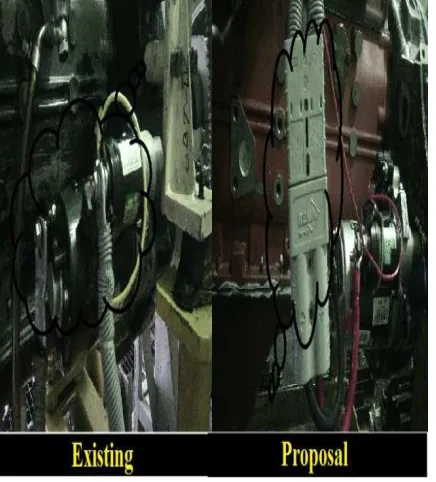
specific ideas for changes that lead to improvement. The ability to develop, test and implement changes is essential for any group or organization that wants to improve continually. After generating ideas, run Plan-Do-Study-Act (PDSA) cycles to test a change or group of changes on a small scale to see if they result in improvement. Concept of managing time provides an opportunity to make time a focal point for improving any organization. An organization can gain a competitive advantage by reducing the time to develop new products and cycle times for all functions in the organization. Present study at TATA Motors had been done for the dressing of different engine blocks before testing and time was noted down. The whole process was analyzed properly and use of Coupling for exhaust, Plug for rectifier supply and Quick Release Coupling for fuel supply connection was improvised. After applying change concept, productivity is improved by decreasing the dressing time.
Index Terms- Time Reduction; Change Concept; Productivity Improvement; PDSA cycle.
1. INTRODUCTION
Change Concept plays an important role in any effort to improve. Since improvement comes from the
application of knowledge, any approach to
improvement must consider how knowledge is obtained and applied. An article in 1996 on Quality Progress [1] introduced methods to facilitate creative thinking and to integrate these methods into
improvement activities using the Model for
Improvement [2]. The use of the model encourages making improvements by obtaining new knowledge, then using this knowledge to develop, test, and implement changes. A practical approach to enhancing organizational performance identified seventy-two change concepts, falling under nine
overarching categories. These categories are:
eliminating waste, improving work flow, optimizing inventory, changing the work environment, enhancing the consumer relationship, managing time, managing variation, designing the system to avoid mistakes, and focusing on a product or service.
Fig: Model for Improvement
Originating from a general and abstract change concept, a change idea is an actionable, specific idea
for changing a process. Change ideas can come from research, best practices, or from other organizations
that have recognized a problem and have
demonstrated improvement on a specific issue. Change ideas can be tested to determine whether they will result in improvement and are often revised as a result of these tests. Teams test change ideas by running Plan-Do-Study-Act (PDSA) cycles, which are also called tests of change. These tests of change are about learning what works and what does not in your efforts to improve your processes. Initially, these cycles are carried out on a small scale to see if they result in improvement. Teams can then expand the tests and gradually incorporate larger and larger samples until they are confident that the changes will result in sustained improvement. It can be challenging to get started and know when or how to begin the first PDSA cycle in an improvement process. With each PDSA, teams will improve the design of their change ideas and be able to determine how big (or small) subsequent PDSA cycles need to be.
76 When the changes made were successful then they
were applied for the whole process which is the last step of PDSA cycle.
3. CONCLUSION
The change concept for improvement, results very good to reduce the time for engine dressing and increase the quality and productivity of the engine blocks. The productivity is increased by 15% and the down time of engine is reduced as well.
As shown in the graph before week 5 the cycle time was high but after making changes it is reduced from 100 min. to 90 min.
REFERENCES
[1] Provost, L. and Sproul, R. (1996),
“Creativity and Improvement: A Vital Link,” Quality Progress.
[2] Langley, G.J., Nolan, K.M. and Nolan, T.W.
(1994), “The Foundation of Improvement” Quality Progress.
[3] Langley, G.J., Moen, R., Nolan K.M., Nolan
T.W., Norman C.L., and Provost L.P. (2009), “The Improvement Guide: A Practical Approach to Enhancing Organizational Performance”.
[4] Graham, N.O. (1995), “Quality in health
care”
[5] Gaithersburg, MD: Aspen Publishers, Inc.
[6] Batalden, P.B. and Stoltz, P.K. (1995)
“Quality management and continual
improvement of health care: a framework”, The Journal of Continuing Education in the Health Professions.
[7] Brar, G.S., Ucharia, V., and Kanwar, R.S.
(2013) “Growth through Engineering Six
Sigma”, International Conference on
Research and Innovations in Mechanical Engineering.
[8] Sharma, P., Ucharia, V., Kanwar, R.S. and
Rafi, M. (2014) “MSA and Process Capability Effective Tools of Six Sigma to
Enhance the Productivity”, National
Conference on Innovation in Engineering, Pharmaceutical, Legal and Management Sciences.
[9] Sharma, A., Sood, A., Kanwar, R.S.,
Ucharia, V. and Babbar, S. (2014)