Encompassing a spectrum of LT users in the CLARIN-DK Infrastructure
Lina Henriksen
1, Dorte H. Hansen
2, Bente Maegaard
3,
Bolette S. Pedersen
4, Claus Povlsen
5University of Copenhagen, Centre for Language Technology Njalsgade 140, DK-2300 Copenhagen
E-mail: 1[email protected], 2[email protected], 3[email protected], 4[email protected], 5[email protected]
Abstract
CLARIN-DK is a platform with language resources constituting the Danish part of the European infrastructure CLARIN ERIC. Unlike some other language based infrastructures CLARIN-DK is not solely a repository for upload and storage of data, but also a platform of web services permitting the user to process data in various ways. This involves considerable complications in relation to workflow requirements. The CLARIN-DK interface must guide the user to perform the necessary steps of a workflow; even when the user is inexperienced and perhaps has an unclear conception of the requested results. This paper describes a user driven approach to creating a user interface specification for CLARIN-DK. We indicate how different user profiles determined different crucial interface design options. We also describe some use cases established in order to give illustrative examples of how the platform may facilitate research.
Keywords: Digital humanities infrastructure, user interface, CLARIN
1.
Introduction
Language technology (LT) plays an increasingly important role for many disciplines within the humanities. This paper concerns a new interface design specification for CLARIN-DK, a platform launched in 2011 as the Danish part of the European infrastructure CLARIN ERIC. CLARIN-DK1 provides language data, LT tools
and web services in this integrated and sustainable EU-wide infrastructure for researchers in the humanities. Today CLARIN-DK’s user interface is only an interim version, even if the underlying features and functionalities of the platform are all fully implemented. Examples of tools already in the platform are POS-tagger, lemmatizer, repetitiveness checker, and facetracker. The language data comprise newspapers, magazines, literature, pictures with text, video and audio files as well as lexical resources such as wordnets.
The existing interim interface was primarily designed with a focus on resource upload and retrieval. This is not sufficient as CLARIN-DK is not solely a repository, but also a platform for processing of data permitting the user to perform his own analyses and studies of data.
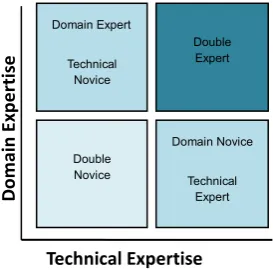
The users we want to reach with CLARIN-DK are not only the usual experienced LT users; we want to reach all types of users who can gain from CLARIN-DK in their research, even if language is not their primary concern. Consequently, the gap between possible system operations and the users’ expertise levels is too wide For the new interface design we therefore resolved on
1 https://clarin.dk
acquiring a deeper understanding of the potential users through user surveys. These revealed different user profiles, work conditions, domain and technical expertise levels, immediate and overall research goals, as well as different perspectives in relation to working with language.
This paper describes a user driven approach to creating a user interface specification for CLARIN-DK. We indicate how different user profiles determined different crucial interface design options. We also describe some use cases established in order to provide users with illustrative examples of how the platform may facilitate research.
2.
Related work
We have taken inspiration for the new user interface from other similar platforms such as VLO2, META-SHARE3 ,
the LAUDATIO Repository4, Språkbanken5 and the
CLARIN center LINDAT6. These are all similar in
providing access to language based data, but also different in various aspects.
VLO (the Virtual Language Observatory) is a search facility of metadata for language resources. It harvests the metadata descriptions from resources stored in the archives of all CLARIN centres (including CLARIN-DK). In many ways the objectives of VLO and CLARIN-DK are very similar, e.g. in terms of showing
2 http://catalog.clarin.eu/vlo/ 3 http://metashare.dfki.de/
4 http://www.laudatio-repository.org/repository/ 5 http://spraakbanken.gu.se/
4.
User surveys
In order to understand the context in which the research infrastructure is used and will be used in the future, we have carried out surveys. These surveys were arranged as open meetings for all interested staff, primarily researchers, from the Humanities at the universities in Copenhagen, Aarhus, Aalborg and Kolding. Later we also visited researchers/administrative staff in all departments at the Faculty of Humanities at the University of Copenhagen.
4.1. CLARIN-DK survey
The main focus of the open meetings for humanities researchers was to get an overview through debate of the types of research conducted at our universities. We also wished to gain better insight into the research methods applied in order to determine research needs which could potentially be addressed through CLARIN-DK functionality.
A wide range of institutes and disciplines were represented at the meetings. Examples include from Copenhagen: Department of English, Germanic and Romance Studies, Department of Scandinavian Studies and Linguistics, Department of Media Cognition and Communication; from Kolding: Design and Communication, Philosophy; from Aarhus: Department of Aesthetics and Communication, Department of Culture and Society; and from Aalborg: Center for User-driven Innovation Learning and Design. This means that many different user profiles were represented at the meetings, both academically and in terms of familiarity with the use of IT tools.
The idea and purpose of the CLARIN-DK repository was widely appreciated so our main focus was on demonstration of web services.
A general observation from the completed series of meetings is that the researchers have very different approaches to and experience with IT and quantitative research methods. Some have an extensive insight into corpus work and the use of digital platforms; for others this was new territory and the usefulness of the web services (if not the repository) still debatable. Traditionally research within the humanities is based on qualitative methods. Discussions revealed that the more quantitative studies remain somewhat scarcer. Still, many researchers expressed a clear interest in learning more about how LT tools can contribute to their work and in the infrastructure in general.
The essence of all the open meetings was that the CLARIN-DK repository is interesting for researchers and it does not really need further introduction. CLARIN-DK web services are also interesting, but if we want to reach beyond the traditional LT user, we have to focus on how to make the use of web services more intuitive.
4.2. Faculty of Humanities survey
In order to organize and support the development of digital humanities and the use of research infrastructures, the Faculty of Humanities at the University of Copenhagen has created a steering group for digital research infrastructures. To construct a basis for the work of this steering group, an overview was made of ongoing activities in each department at the faculty. It is well-known that researchers do not want to reply to electronic surveys, so focused meetings were organized with relevant staff. Several relevant observations came out of these meetings:
Many researchers have collected materials during their career, and at a certain point they wish that “somebody” will take the responsibility to keep the materials for the future. Of course there are many technical challenges regarding formats etc., but the wish to have a secure place to store materials is a very good driver for the use of the research infrastructure. All departments have shown this interest, but of course not all departments and researchers have language based materials – some have collected photos from archeological excavations, some have surveys mostly consisting of yes/no or numbers; we will leave this type of resources out of consideration here and concentrate on language based materials.
Concerning language based materials there is a wealth of resources, historical texts, literary texts, old language texts, dialect materials etc. The most interesting resources found at the departments are those that are free of property right problems, i.e. older texts or texts from public sources. For other resources a priority list for negotiation of access rights will be made.
The tools used range from no tools, over simple tools, to commercial tools (e.g. for statistics) and complex self-produced tools. Here again there is a strong wish from the researchers to have access to better tools, and to have tools maintained. This e.g. applies for some researchers at history. They take an interest in sophisticated data processing results involving word/text statistics, named entity recognition and geospatial visualization methods and tools. These approaches allow researchers to extract or analyze information about places, people and events and find new relationships between them.
Altogether there is a readiness to use a digital research infrastructure with those researchers that are already using digital materials and for some even digital methods, and these researchers may inspire others.
potential users in the infrastructure.
A strong guiding principle for many design options is to incorporate learnability and serendipity whenever possible (Russell-Rose and Tate, 2013). Learnability concerns the users’ learning speed/ease regarding platform functions and use which can be improved with e.g. contextual instructions and visual designs. Serendipity refers to the situation where a user is presented with relevant and interesting information which he did not actively seek and thus gains an unexpected insight e.g. with use cases (see below).
5.1.
Workspace
A private workspace is envisioned to be the environment where the user performs most of his work. The user can e.g. upload documents from his own computer to the workspace, download documents from the CLARIN-DK archive and he can complete requested data processing tasks and temporarily save the results in his own workspace.
Not only data processing results, but also workflows can be saved in the private workspace – and they can be shared with other researchers. The sharing of workflows will be communicated through a news feed section showing possible and relevant workflows within different research domains. The workflow sharing feature is created in response to the users’ request for better workflow guidelines and has a potential to become one of the very important features of CLARIN-DK.
The workspace is an essential feature in transforming CLARIN-DK from an archive into an infrastructure platform. The workspace is an essential feature for all types of users.
5.2.
Workflow planner
Sometimes a single tool does not produce the result requested by a user. Combining a meaningful sequence of tools however requires some insight into the input-output requirements of each tool which is not necessarily easy for technical novices. The workflow planner automatically designs workflows that serve the user’s intentions on the basis of tools currently integrated in the infrastructure as web services (Jongejan, 2013). The workflow planner is useful for all, but essential for technical novices.
5.3.
Metadata editor
Metadata are essential in infrastructures. Upload of data to CLARIN-DK currently requires that metadata exist and conform to standards as specified in various schemas for the different resource types. For many users it is a quite demanding task to create the XML metadata file and then validate it against the schema. Therefore, the metadata editor will, on the basis of resource type, select a metadata template for the user to fill in. Further, the user will be
able to scale his metadata ambitions up or down. A user mainly concerned with data storage for download may be satisfied with just the mandatory metadata, whereas a user wishing to describe his collection of empirical data in detail may wish to fill in a wealth of resource specific metadata. In this way the metadata editor is a feature for everyone.
5.4.
Search facilities
We have opted for 3 main search methods: Simple search has the look and feel of a Google search (and VLO). This type of search will appeal to all users, but perhaps technical novices in particular. Advanced search gives access to specify particular metadata fields and their content. Advanced search is for technical experts. Browsing similar to what we know from VLO, will allow the user to browse data by selection of the subjects, formats, authors, data providers, languages, etc. he is interested in. Browsing will give the user an overview of the content and thus promotes serendipity and is for both kinds of novices. CLARIN Federated Content Search will be implemented as soon as possible.
6.
Use cases
Use cases are to be understood as inspiring examples for the users of how to apply the web services, tools and resources available through the platform. All members of CLARIN ERIC are currently involved in a number of use cases and eventually a wide range of research topics will be represented by one or more use cases giving ideas to possible workflows – and these use cases will be accessible through the CLARIN-DK platform interface. Below, we present two examples of use cases, a monolingual one which presents search facilities in historical documents, and a multilingual one that looks at wordnets across languages.
6.1.
Search in ancient documents
The first use case is primarily directed towards the domain expert who wishes to perform advanced searches in documents. We selected the historical document Gesta Danorum (GD) written by Saxo around 1200 as a text example for this use case. GD can be characterized as both a historical monograph describing contemporary political events and as a compilation - based on oral tradition - of mythical stories about Danish legendary kings. Topics of interest in this document could be to examine when specific historical events took place or how the author’s language usage reflects the particular period. For the analysis of GD, a digital version of a translation from Latin to Danish (Friis-Jensen and Zeeberg, 2005) was selected and the first steps of the use case workflow include lemmatizing and POS-tagging 7. The next
workflow step is import of the document together with annotations in a corpus tool with advanced search facilities permitting exploitation of annotated linguistic information. This enables identification of subject area specific elements in the various books of GD and it enables display of search results in a manageable way.
Traditionally GD, in terms of composition analysis, is divided into two main sections. One section consists of the books 1-9 dealing with Norse mythology and the second section, books 10-16, describes the introduction of Christianity in Denmark.
In 1969, a competing thesis was launched (cf. Skovgaard-Petersen, 1969). In this approach based, inter alia, on genre comparisons with other medieval works, the composition of GD is split into books 1-8 and books 9-16. This alternative analysis, however, was not met with accept by the research community (cf. Kværndrup, 1999). The dispute could, in this context, be crystalized into the research question: Is it book 9 or book 10 that represents the transition from the heathen to the Christian period in GD? The procedure was as follows. First, some elements characterizing Christian language were identified, e.g. “helgen” (en: saint), ”kristen” (en: Chris- tian), ”kristendom” (en: Christianity) ”synd” (en: sin) but importantly not ”synd” as an adjective like in ”det var synd for hende” (en: it was a pity for her). The next step was to generate a search pattern that in a precise and efficient way would represent the elements of Christian language usage:
[lemma="helgen"] (all word forms of helgen) [word="krist.*"] (all words in the corpus starting with ”krist”) recognizing, ”kristen”, ”kristne”, ”kristendom” etc. (en: Christian, Christianity)) [word="synd.*" & pos="N.*"] (all the words in the corpus starting with synd (en: sin) and tagged as a noun i.e. excluding the adjective reading of ”synd”).
[lemma="helgen"] | [word="krist.*"] | [word="synd.*" & pos="N.*"] | [word="Herren"] | [word="ang(re|er)"] | [word="hellig.*"] | [word="Gud"]
Figure 1: The search pattern
Figure 2: Display of distributed search results
Figure 3 below shows the query results achieved and how the occurrences of Christian language usage are distributed over the 16 books.
It is important to bear in mind that the number of words in book 9 is about 10,000 while book 10 consists of about 20,000 words. The part conclusion here is that the average frequency of occurrences of Christian language usage is approximately the same in book 9 and 10. Since the relative frequency of Christian elements in book 8 is significantly lower than in book 9 and 10 (0.25, 2.0, and 2.0) the search results clearly reveal that the change - in terms of Christian language usage - lies between book 8 and 9. In other words the results support the thesis that the composition of GD falls into two main sections, books 1-8 and books 9-16. Assuming that relatively frequent use of words from a register – in this context Christianity - is closely related to the topic described, the survey results speak in favor of book 9 as the constituting element that introduces the Christian main section of GD, i.e., supporting the 1969 thesis as expressed in Skovgaard-Petersen (1969).
Another angle in order to exploit this platform would be to get an answer to the basic question in connection with quantifying approaches to compositional analysis: how large, in terms of number of words, are the various structural segments of texts in the work in question? The structural mark up of ”bøger” (en: books) makes it easy to get an overview of such a distribution via use of the corpus tool. You write the search pattern: [pos!="RESID_SIGN"] expressing that you want all tokens in GD except punctuation markers.
Figure 3: Distribution of words in GD
6.2.
Browsing aligned wordnets through
WordTies
The second use case, WordTies (wordties.cst.dk, cf. Pedersen et al. 2013) allows for browsing aligned wordnets for a number of Nordic and Baltic languages. The browser is mostly directed towards the technological expert, such as the computational linguist or the lexicographer who is familiar with wordnets and their use. However, the browser can also be used by the layman for asking more general questions regarding cultural differences realized through language.
Wordnets are lexical-semantic dictionaries where concepts are related to other concepts in language via semantic relations. They group words into sets of synonyms (so-called synsets), provide short, general definitions, and record the various semantic relations between these synsets. Wordnets generally serve two purposes: to produce a combination of dictionary and thesaurus of a particular language that is more intuitively usable, and to support HLT applications that include some degree of text understanding8. A classical problem that
arises when working with multilingual HLT is that wordnets and other semantic resources are often built in very different ways for particular languages and that it is hard to get an intuitive impression of similarities and differences between the resources. To remedy this problem, WordTies has been developed as a prototype in the META-NORD project for viewing, aligning and evaluating the wordnets that have been compiled during the last decade in the Nordic and Baltic area9. It is
currently being extended by CLARIN to include more languages.
In WordTies, the wordnets are visualized in an intuitive fashion with each semantic relation expressed graphically with its own individual colour. The alignment facility enables the user to move freely within one language as well as from one language to another at the synset level. Similar facilities are found with other wordnet browsers, but only a few of them give high priority to visualizing other than the hyponymy relation; see also Vercruysse & Kuiper (2011) and Chaplot et al. (2014).
Examples of questions that the user might want to ask are: What are the differences in the way wordnets are organized in different languages? Can these be explained on the basis of different compilation strategies: monolingually based, based on corpora, based on lexica/term lists, cross-lingually based (via translations) etc. Or are they culturally based? In general, questions on taxonomical structure (i.e. how deep are the lexical hierarchies), synset structure (i.e. how many synonyms per synset) and number of relations per synset can be answered by browsing in WordTies.
8 Cf. http://en.wikipedia.org/wiki/WordNet
9The tool was developed by Anders Johannsen and
Mitchell Seaton.
To the extent where the relevant languages and domains are covered, WordTies can also be used at a more general level for addressing questions regarding cultural differences realized through language: How are educational systems expressed in wordnets in different European languages? Are the divergences rooted in actual differences in the educational systems across countries? How are food taxonomies expressed in terminologies/wordnets in the different European languages? For example, are cheeses structured differently from a taxonomical view point depending on whether we in each particular country typically eat them as a starter, as a dessert or in a sandwich? Do we have comparable taxonomies for bread? Are these taxonomies changing over time due to more globalized eating habits? (for at study of food taxonomies in wordnets, see Pedersen et al. 2010).
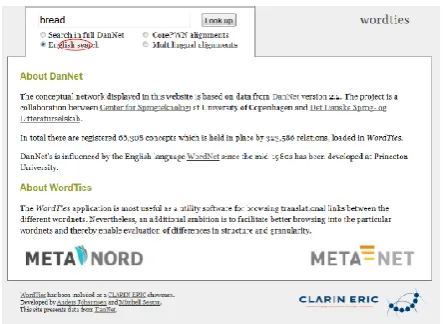
A browsing task in WordTies would typically involve the following steps and decisions:
Decide on which wordnet to browse as your source language and consider which compilation strategy lies behind this particular wordnet (to be found in the description of each wordnet). Choose between browsing the full monolingual
wordnet or only the concepts that are aligned with other wordnets; a drop-down list ensures that you are informed about relevant aligned concepts at each point
Further, either browse the wordnet via searches in the language of the chosen wordnet or via English
The selected concepts can be browsed in different ways and you can move around in the semantic hierarchy by clicking on each concept; if the wordnet includes ontological types as features, these are presented at the bottom of the page
If you have chosen to view alignments with other wordnets, these alignments will become visible and you can click into the aligned concepts and view in more detail how these are described in the target language
Figure 4: Search for ‘bread’ in DanNet
Figure 5: Aligned concept in the Finnish wordnet
Figure 6: ‘bread’ (brød, leipä) aligned between the Danish and Finnish wordnets.
7.
Conclusion
When constructing infrastructures for digital humanities the focus is often technical: on data, data management and interoperability. In this paper we have changed the focus to the potential users of the Danish research infrastructure CLARIN-DK, since the success of the infrastructure is determined by its use.
The survey of Danish researchers of humanities has indicated some gaps between current platform services and potential users. In this paper we have shown how we are bridging this gap by implementing new features as a private workspace, a workflow planner, a metadata editor, different search strategies and different use cases in CLARIN-DK. Many tools, services and linguistic resources are already available and when the gaps are filled these may give fast solutions to some issues now solved in a low-tech way.
8.
References
Chaplot, Devendra Singh, Sudha Bhingardive and Pushpak Bhattacharyya (2014). IndoWordnet Visualizer: A Graphical User Interface for Browsing and Exploring Wordnets of Indian Languages. In Proceedings of Global WordNet Conference (GWC-2014). Tartu, Estonia.
Friis-Jensen, K and Zeeberg, P. (2005). Saxo Grammaticus - Gesta Danorum – Danmarkshistorien. Gads Forlag, Denmark, 2005.
Jongejan, B (2013). Workflow Management in CLARIN-DK. In Proceedings of the workshop on Nordic language research infrastructure at NODALIDA 2013, NEALT Proceedings Series 20. Kværndrup, S. (1999). Tolv principper hos Saxo. En
tolkning af Danernes Bedrifter. Multivers Aps Forlag, Denmark, 1999.
Pedersen, B.S., S. Nimb, A. Braasch (2010). Merging specialist taxonomies and folk taxonomies in wordnets. - a case study of plants, animals and foods in the Danish wordnet In Proceedings from the Seventh International Conference on Language Resources and Evaluation, 2010 p. 3181-3186. Malta.
Pedersen, Bolette S., Krister Lindén, Kadri Vider, Markus Forsberg, Neeme Kahusk, Jyrki Niemi, Lars Nygaard, Mitchell Seaton, Heili Orav, Lars Borin, Kaarlo Voionmaa, Niklas Nisbeth and Eirikur Rögnvaldsson. (2013) Nordic and Baltic wordnets aligned and compared through “WordTies”. In Proceedings from the 19th Nordic Conference on Computational Linguistics (NODALIDA). Linköping Electronic Conference Proceedings; Volume 85 (ISSN 1650-3740).
Piotrowski, M. (2012) Natural Language Processing for Historical Texts. Morgan & Claypool Publishers, USA, 2012.
Russell-Rose, T and Tate, T. (2013). Designing the Search Experience. The Information Architecture of Discovery. Morgen Kaufmann, USA, 2013.
Skovgaard-Petersen, I. (1969) Saxo, Historian of the Patria, in Medieval Scandinavia 2, Denmark, 1969. Vercruysse, Steven and Martin Kuiper, (2011). WordVis: