Linked Open Data and Web Corpus Data for noun compound bracketing
Pierre Andr´e M´enard, Caroline Barri`ere
Centre de recherche en informatique de Montr´eal405, avenue Ogilvy, bureau 101 Montr´eal (Qu´ebec), Canada
[email protected], [email protected]
Abstract
This research provides a comparison of a linked open data resource (DBpedia) and web corpus data resources (Google Web Ngrams and Google Books Ngrams) for noun compound bracketing. Large corpus statistical analysis has often been used for noun compound bracketing, and our goal is to introduce a linked open data (LOD) resource for such task. We show its particularities and its performance on the task. Results obtained on resources tested individually are promising, showing a potential for DBpedia to be included in future hybrid systems.
Keywords:noun compound bracketing, linked open data, Google Ngrams
1.
Introduction
In the field of computational linguistics, large corpora have been shown to be quite good for the task of noun compound bracketing. Such task consists in determining which nouns within a larger noun compound form sub-groups. For example (from Lauer (1995)), woman aid workerwould be bracketed aswoman [aid worker], called a right-bracketing, contrarily to copper alloy rod, which would be bracketed as [copper alloy] rod, called a left-bracketing.
In compound bracketing, when only three words are used, n1 n2 n3, the task becomes a binary decision between groupingn1andn2or grouping n2andn3. Two models, described in early work by Lauer (1995) and still used in recent work, are the adjacency model and the dependency model. The former compares probabilities (or more loosely strength of association) of two alternative adjacent noun compounds, that of n1 n2and of n2 n3. The latter com-pares probabilities of two alternative attachment (modify-ing) noun relations, that ofn1 n3and ofn2 n3.
Most compound bracketing research has focus on three-noun compounds, often using a dataset from Lauer (1995). Some recent work (Pitler et al. (2010), Vadas and Curran (2007b)) looks at larger compounds, using a dataset cre-ated by Vadas and Curran (2007a) which we will also use in our research. For these larger noun compounds, for ex-amplehome market stock index futures tradingtaken from the dataset, the adjacency model alone will not allow longer range dependencies to be taken into account. The bracket-ing algorithm we present mixes adjacency and dependency models, and looks at the complete expression to make its decisions. It relies on word pair association scores provided by different resources.
Among the resources used are web-corpus resources in the form of pre-processed ngrams. We look at Google ngrams and Google books ngrams (less often seen in use for differ-ent tasks). Then, a main contribution of this research is to introduce a linked-open data (LOD) resource and explore ways to use it to provide association scores.
Section 2 presents a short literature review, mostly from the perspective of resources used by different researchers
for the task of compound bracketing. Section 3 presents the dataset used in our experiments. Section 4 describes the linked-open data and corpus-based resources we use. Section 5 defines association scores for each resource. Sec-tion 6 presents our bracketing method. SecSec-tion 7 explains our evaluation approach and discusses the results obtained on the dataset. Section 8 concludes and discusses future work.
2.
Related work
Noun bracketing has not receive as much attention as many other Natural Language Processing (NLP) task. Nakov and Hearst (2005) calls it an understudied language analysis problem. Nevertheless, a small body of work has emerged in the 1990s taking root and inspiration in earlier linguistic work (Levi, 1978). This body of work is expanding, using empirical methods which rely on the availability of larger and larger corpus.
Noun compound bracketing, sometimes referred to as NP parsing (Pitler et al., 2010), has been studied as a task in itself (e.g. Lauer (1995), Vadas and Curran (2007a), Nakov and Hearst (2005)). It is also studied as the first step of se-mantic analysis of NPs (Girju et al., 2005) where not only subgroups of words are found within the compound, but se-mantic relations between these groups are looked at (Nas-tase et al., 2013).
To address the noun compound bracketing task, different authors use different datasets, different views on the prob-lem (adjacency, dependency), different methods of resolu-tion (supervised, unsupervised) and different constraints on the problem (compound seen in isolation or in context). In-dependently of such differences, all researchers look at dif-ferent resources and difdif-ferent methods for evaluating word-pair associations, since this is a core component in the prob-lem’s resolution steps.
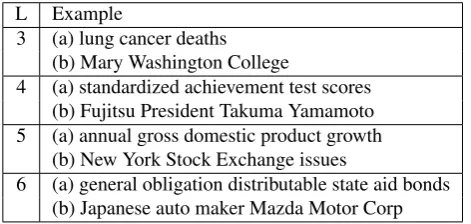
L Example
3 (a) lung cancer deaths (b) Mary Washington College
4 (a) standardized achievement test scores (b) Fujitsu President Takuma Yamamoto 5 (a) annual gross domestic product growth
(b) New York Stock Exchange issues
6 (a) general obligation distributable state aid bonds (b) Japanese auto maker Mazda Motor Corp
Table 2: Examples of expressions.
Web Ngrams ((Lin et al., 2010)), or GWN, and the En-glish (non-fictional) Google Books ngrams ((Michel et al., 2011), or GBN. From this last resource, we compiled term frequencies by summing up all the years in which a term ap-pears. This leads to a frequency-based resource referred to as GBN-A (all years). We also compiled term frequencies from the last 30 years, which we call GBN-R (for recent years).
The third resource is the open linked data DBpedia V3.9 which is based on the English Wikipedia pages. The main limitation in using structured resources is usually their lack of coverage. The knowledge acquisition bottleneck, refer-ring to the gatherefer-ring of large-scale coverage structured in-formation, has often been cited as a major issue for NLP re-search. But in the past decade, collaborative world-wide ef-forts have allowed larger structured resources emerge, such as the Semantic Web. To the best of our knowledge, no previous research has used the semantic web for the noun bracketing task, and our research aims at introducing this resource and explore its usefulness.
4.1.
Frequency-based resources
The GWN resource was generated from the set of archived pages used by the Google search engine in July 2009. They tokenized each page and summed up each word, number, punctuation and symbol and filtered any ngrams with a fre-quency count lesser than 200 occurrences. The GBN was created in the same way but the ngrams were generated from the archived electronic books from the Google Books website. As for the GWN, all character or number groups or single punctuation and symbol were added as a token. All case-aware ngrams were compiled separately and those that fell under the 40 mark were removed. Ngrams of length ranging from 1 to 5 were created for both of these resources.
For our purposes, both GWN and the GBN were filtered to remove entries which included numbers, parenthesis and symbols to be more manageable. As entries from both of these resources included multiple similar entries with dif-ferent cases (i.e. test, TEST, Test), the interrogation tech-nique was modified to add up all the frequencies from each similar entries. Table 3 shows the approximate count of ex-pressions used in this research for the two frequency-based resource. GBN-A and GBN-R are represented as GBN in the table as they are both taken from this dataset.
Resource 1-gram count 2-gram count GWN >7.3 millions >228.4 millions
GBN >7.1 millions >105.6 millions
Table 3: Number of one- and two-words expressions avail-able in the frequency resources.
4.2.
Linked open data resource
DBpedia4 (Hellmann et al., 2009) is built from one of the largest resource on the web, Wikipedia. Many Wikipedia pages contain an Infobox (a small two-column table) to pro-vide structured information about the entity described. All infoboxes are automatically parsed to generate DBpedia. DBpedia follows an RDF (Resource Description Format) representation, which is a W3C (World Wide Web Consor-tium) standard for the semantic web. DBpedia is growing every year, and the version we use (DBpedia V3.9) de-scribes over 4 millions ”‘things”’ for the English dataset, with many properties and links to other entities.
Components within the noun compounds to parse are found as entity names in DBpedia. For exampleNew York Medi-cal Schoolcontains two entity namesNew Yorkand Medi-cal Schoolwhich exist in DBpedia. This split into compo-nents resembles query segmentation, useful in Information Retrieval. Query segmentation is ”the process of taking a user’s search engine query and dividing the tokens into in-dividual phrases or semantic units” (Bergsma and Wang, 2007). Such segmentation reduces the complexity of the task, since in this example, the four word compound is re-duced to two entity namesNew York Medical School, basi-cally solving the bracketing problem.
But that would be too easy. Unfortunately, ambiguity comes into play. For example,Mary Washington College, leads to two competing interpretations, Mary Washing-ton CollegeandMary Washington College. The complex-ity is therefore not that much reduced as we now work with competing entity names (rather than competing strings) which furthermore could each lead to multiple entities. We differentiate entity names from entities. Entity names are surface forms that exists in DBpedia but they can lead to many different entities (word senses or actual named entities). There are usually disambiguation markers (e.g. New York(disambiguation)) to show links between entity names and entities. There are also ”redirects” links in DB-pedia (and WikiDB-pedia) which can be tricky to use as some of them are true synonyms (e.g. automobileandcar) but others are just related items (e.g.videoandAudio-visual). Using a structured linked open data resource brings a completely new dimension, as we now work with enti-ties and entity names instead of surface strings as for the frequency-based resources. Table 4 shows all existing en-tity names in DBpedia with their number of word senses for the complex compoundNew York Stock Exchange Com-posite Trading. Examples of the entities are also shown, to illustrate different relations between entity names and entities. Entity names can be considered abbreviations (New - Net economic welfare), shorter forms (Exchange - Heat exchange), or domain specific terms (Composite
-4
Resource 1-gram
GWN 92.70%
GBN 92.86%
DBpedia 88.78%
Table 5: Unigram coverage of our dataset.
Composite (finance)). We also show some examples of
redirects in Table 4 (indicated by ”R”).
The large number of entities (especially for single words) and the set of possible segmentations make the use of DB-pedia for noun bracketing not at all trivial. Furthermore, we wish to make use of its structured data. In DBpedia, enti-ties are linked via predicates, for examplePariswould be linked toFranceusing a predicatecapital-of, orlocated-in. Such predicates provide paths between entities which we will use to measure their association scores. Our algorithm, presented in Section 5, will look into both segmentation and paths.
4.3.
Resource coverage
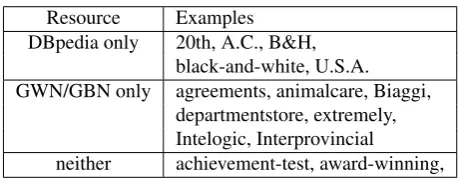
Knowing the coverage of each resource provides an upper-bound on its usefulness to compute association measures. Table 5 shows resource coverage for the unigrams extracted from the noun compounds in our dataset. It is interesting to note that the GWN and GBN resources have very similar coverage for the unigrams, a marginal difference of only 0.16%. Datasets GBN-R and GBN-A both have the same coverage, represented as GBN in the table. DBpedia is not far behind, also providing a large coverage of unigrams. Table 6 presents a few examples to illustrate coverage dif-ferences between DBpedia and GWN/GBN. Here are a few types of coverage problems.
• Concatenations. For example animal care, and
de-partment store, found as written in one-word in
GWN/GBN but not as an entity names in DBpedia.
• Tokenization. For exampleU.S.A.orA.C.will not be found as a unigram in GWN and GBN since the to-kenization used in these resources includes punctua-tions.
• Plurals. Since we did not search for plurals in DBpe-dia, we lowered their coverage.
• Company names. Counter-intuitively, we assume DB-pedia will contain companies, but maybe they are small and do not have their own entry, but they are ”talked about” enough to be in GWN.
• People’s names. Some links are not explicit in DBpe-dia (forBiaggifor example) even if a few people with last nameBiaggiare in DBpedia.
• Part-of-speech. Some adjectives or adverbs ( ex-tremely,interprovincial,award-winning) will not be in DBpedia. Although, many adjective/adverbs are actu-ally found because they also appear as nouns.
Some of these problems are relatively easy to look into in our future work, but others are not. The tokenization prob-lem in GBN and GWN cannot really be resolved, since it
Resource Examples
DBpedia only 20th, A.C., B&H, black-and-white, U.S.A. GWN/GBN only agreements, animalcare, Biaggi,
departmentstore, extremely, Intelogic, Interprovincial
neither achievement-test, award-winning,
Table 6: Examples of unigrams missing in different re-sources.
Size Examples
3 magnetic resonance imaging nuclear power plant
Vincent van Gogh
International Monetary Fund 4 The Wall Street Journal
New Jersey Turnpike Authority Carlos Salinas de Gortari Ho Chi Minh City
5 Defense Advanced Research Projects Agency Pennsylvania State Employees Retirement System real estate mortgage investment conduit
New York State Supreme Court
6 Ateliers de Constructions Mecaniques de Vevey St. Johns River Water Management District
Table 7: Examples of larger entities found in DBpedia.
is intrinsic to how the resources were built (e.g. U.S.A.). On the other hand, augmenting DBpedia coverage should be easily possible by searching for plurals, and for entities containing unigrams as part of their names.
4.4.
Named entities
Many named entities are found in the Penn Treebank (PTB), like cities, people names, or company names. A manual analysis of our subset of PTB showed that 5,286 out of 6,600 expressions (80.09%) contained at least one named entity. While it is not surprising for texts in the news domain, this proportion of named entities is not representa-tive of texts found in other domains.
For named entities, we would expect an entity-oriented re-source such as DBpedia to be useful. Many composite named entities like Los Angeles Mayor Tom Bradley (an-notated as a noun compound in the revised PTB) are not found as complete expression but Los Angeles and Tom Bradleyare found separately. DBpedia does contain enti-ties of larger sizes, as shown in Table 7. In our bracket-ing approach, since we try to find dependencies between all word-pairs, we do not use entity names with more than two words.
trans-Surface found Nb Senses found Nb Redirects Examples
New 14 6 New (surname), Net economic welfare
York 88 1 Yorktown, University of York
Stock 87 0 Livestock, Stock (album)
Exchange 16 1 Heat exchange, Exchange (chess)
Composite 15 0 Composite material, Composite (finance)
Trading 0 1 (R)Trade
New York 29 1 New York City, New York (U2 song)
Stock Exchange 0 1 (R)Stock exchange
Stock Trading 0 1 (R)Stock trader
Exchange Trading 0 1 (R)Stock exchange
New York Stock Exchange 0 1 (R)New York Stock Exchange
Table 4: All entities found forNew York Stock Exchange Composite Trading.
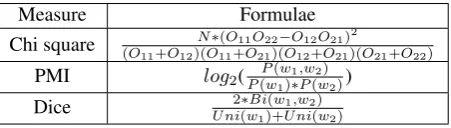
Measure Formulae
Chi square N∗(O11O22−O12O21)2
(O11+O12)(O11+O21)(O12+O21)(O21+O22)
PMI log2(P(Pw(w1,w2) 1)∗P(w2))
Dice 2∗Bi(w1,w2)
U ni(w1)+U ni(w2)
Table 8: Association measure formulae used in the study.
formed those into right bracketed, as we wanted to have all expressions fully bracketed. This will have an impact on our results, and we will revisit this decision in future work, as we study more closely this relation between named enti-ties and compositionality of noun compounds.
5.
Association measures
A first step for noun bracketing, as we emphasized in Sec-tion 2, is to establish associaSec-tion scores between nouns us-ing different resources and measures. Since we use both web corpus data (unstructured), and a link-open data (struc-tured), we present two different ways of calculating associ-ation scores. We also discuss the fact that in DBpedia, we must deal with entities described and not surface forms.
5.1.
Frequency-based resources
For our two frequency-based resources, we calculate asso-ciation strength using the Chi square (used in (Vadas and Curran, 2007b)), the pointwise mutual information (PMI) (used both in Nakov and Hearst (2005) and Pitler et al. (2010)), as well as the Dice measure. These statistical mea-sures were used on both the GWN and the GBN (-A and -R) resources. These three measures are defined in Table 8. The Chi square measure refers to a 2x2 table of bigram oc-currences for the four frequencies of bigrams containing both words (O11), none of the two words (O22), the first
word but the the second (O21) or the second but not the
first (O12). In this formulae, N refers to the total number
of bigrams in the resource andOnmrefers to the frequency count found in the 2x2 table at theNthrow and theMth column. The PMI measure applies a binary-based log to the bigram probability divided by the product of its uni-grams probabilities. The Dice measure uses twice the raw frequency of the studied bigram divided by the sum of the frequency of its unigrams.
5.2.
Linked open data resource
As mentioned in Section 4.2, calculating association scores using DBpedia can take on many forms. For the present ex-ploration, we construct our algorithm to combine two hy-pothesis. The first one is to minimize the number of entity names found in the expression. The second one is to max-imize the number ofvalid pathsamong the entities repre-sented by the entity names. As we saw earlier, many entity names (either single or multi-words) are ambiguous and re-fer to difre-ferent possible entities (such as in Table 4).
Our definition of a valid path is limited to two possibili-ties. First, both entities are part of the same triple. Sec-ond, both entities are part of different triples sharing a subject or an object. For example, given the two triples (New York, located in, United States) and (Chicago, lo-cated in, United States), there is a valid path between New York and United States (same triple) and also a valid path between New York and Chicago (shared object). In the present work, the two types of paths are counted equally, but future work could assign different weights to them.
Figure 1: Example of path strength evaluation in DBpedia
6.
Bracketing method
As in the work of Pitler et al. (2010), our bracketing algo-rithm looks at the whole expression for its evaluation. This is different form the algorithm suggested in (Barker, 1998) and used in (Vadas and Curran, 2007b) which only uses local information (three-words at a time, in a right-to-left moving window).
Our algorithm consists in creating a list (L1) containing ev-ery word pairs that can be generated from an expression. L1 is then sorted in decreasing order of association scores. The score of each pair is provided either from GBN-A, GBN-R, GWN or Dbpedia and is calculated using one of the methods detailed in Section 5. In our algorithm, asso-ciation scores are considered as dependency scores, that is modifier/head scores. For example, an expression “1 2 3 4 5” would generate a list L1 containing{(1,2), (1,3), (1,4), (1,5), (2,3), (2,4), (2,5), (3,4), (3,5), (4,5)} and each pos-sible modifier/head pair would be scored using a specific association measure and ordered into L1 in a descending order.
From there, we construct the final list of dependencies (L2), which will define the complete bracketing of the expres-sion. This is done by selecting in order each word pair (A,B) from L1 and adding it to L2 only if both (a) the modi-fier has not already been used, and (b) the new pair does not create a crossing of modifier/head pairs in the expression (e.g. if L2 already contains (12)(3(45)), then (24) would create an invalid crossing and is not accepted). The selec-tion of pairs from L1 is ended when all words are used as modifiers in L2, except for the right-most one in the expres-sion.
Our algorithm is greedy as only the best score (enabling a valid integration of the word pair into L2) is chosen at every step without consideration for the actual distance between the two words in the source expression. This helps link-ing far reachlink-ing dependencies in noun compounds, but it might also force some strong association between two dis-tant words without regard to the soundness of using nearer words.
7.
Evaluation
Two methods are used to evaluate the bracketing algorithm against the gold standard. The first method is a strict match, like the exact evaluation method used in Vadas and Curran (2007b). It requires a complete and exact match for all the
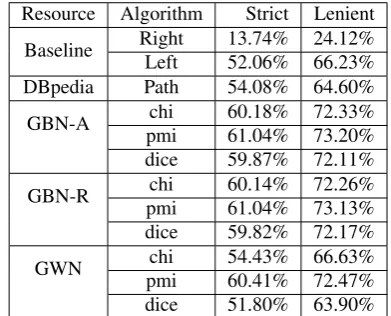
Resource Algorithm Strict Lenient
Baseline Right 13.74% 24.12%
Left 52.06% 66.23%
DBpedia Path 54.08% 64.60%
GBN-A chi 60.18% 72.33%
pmi 61.04% 73.20%
dice 59.87% 72.11%
GBN-R chi 60.14% 72.26%
pmi 61.04% 73.13%
dice 59.82% 72.17%
GWN chi 54.43% 66.63%
pmi 60.41% 72.47%
dice 51.80% 63.90%
Table 9: Comparing strict and lenient evaluation results.
groups found in the reference expression without consider-ing the tags. The final score is thus the number of correctly bracketed expressions divided by the number of inspected expressions.
The second method, called lenient, checks for each paren-thesis group of an expression and compares it to the gold standard. For example, a six word long candidate ”‘((((A B) C) D) E) F”’ (groups: [AB], [ABC], [ABCD], [ABCDE]) compared to a gold standard ”‘(((A B)(C D)) E) F”’ (groups: [AB], [CD], [ABCD], [ABCDE]) would score a recall of 3/4 = 75% as three groups are correct compared to the four in the gold. As both the gold and test expressions (of length N) are fully bracketed, the number of groups (N-1 excluding the top level group) are always the same in both expressions and thus, precision and recall will be the same as the F-measure.
Our suggested lenient evaluation is different, and more se-vere, than looking at word relations in a binary tree. Using the previous example, the gold expression would give A-B, B-D, C-D, D-E and E-F and the test expression would give A-B, B-C, C-D, D-E, E-F which would give a score of 80%. Furthermore, compared to a gold three word ex-pression ((A B) C), a test bracketing of (A (B C)) would obtain 0% for the lenient, as the test expression would miss the only non-trivial choice to be made, but the binary tree evaluation method would give 50% as B-C is still present in both cases.
We first show, in Table 9 the comparative results from the three resources, for a strict or lenient evaluation. Two base-lines were also calculated, with a default right and left bracketing. Following the findings by Lauer (1995), the left-bracketing is much more common in our dataset. Com-pared to the left-bracketing baseline, all methods score a bit over for the strict evaluation, and all but DBpedia score again over in the lenient evaluation.
Base-L Rand. BL DBpedia GWN pmi
GBN-A pmi
GBN-R pmi
3 50% 79.2% 69.86% 80.68% 81.23% 81.47%
4 20% 12.67% 37.67% 36.76% 37.70% 37.23%
5 7.1% 0.73% 15.46% 13.53% 13.77% 13.53%
6 2.4% 0.0% 0.75% 6.06% 6.06% 6.06%
7 0.8% 0.0% 3.13% 3.13% 6.25% 6.25%
8 0.2% 0.0% 0.0% 0.0% 0.0% 0.0%
9 <0.1% 0.0% 0.0% 0.0% 0.0% 0.0%
All 36.88% 52.06 54.08% 60.41% 61.04% 61.04%
Table 10: Strict evaluation results, per expression size.
line (right branching), 32.66 chi-square dependency and 35.86 chi-square adjacency. As we obtain around 60% for strict matches, we seem well-above the unsupervised ap-proach they used, which combines their association scores using an implementation of Barker’s algorithm.
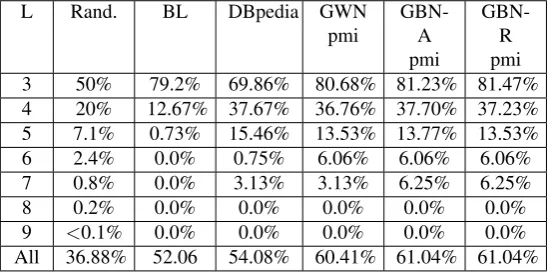
As mentioned in Pitler et al. (2010), the number of pos-sible binary trees (pospos-sible bracketing) increases with the Catalan numbers5meaning random results as shown in the
second column (named ”‘Rand.”’) of Table 10. Results by noun compound length is shown for the left bracketing (BL), DBpedia, as well as the best measure for GWN (pmi) and GBN (chi square). Results were good for the base-line on 3 words expressions but degraded very quickly for longer expressions. All methods did better than random and baseline of lengths from 4 to 7 for the strict evaluation. The top row of Table 10, shows results above 80% obtained (for GBN and GWN) on the 3-word compounds. This is comparable to results in Vadas and Curran (2007b) of around 80% with voters (dependency and adjacency). DB-pedia does not perform as well on 3-word compounds, but does on the larger ones, probably showing the usefulness of detecting entity names within the expression.
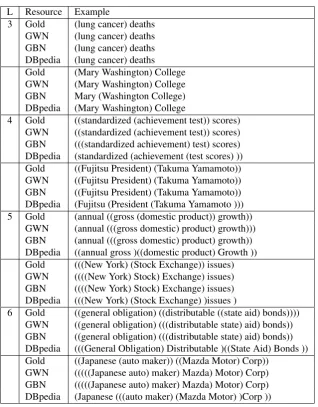
To get a better sense of the results achieved using each re-source, we show in Table 11 the bracketed outputs for the examples previously given in Table 2.
8.
Discussion and Conclusion
Even if bracketing of three-word expressions have been performed quite successfully using unsupervised ap-proaches using web-corpus resources ((Nakov and Hearst, 2005), (Vadas and Curran, 2007b)), compound bracketing of large expressions remains a challenge.
One research direction, taken by Vadas and Curran (2007b) and Pitler et al. (2010) is to investigate supervised learning approaches which will be able to build on the redundancy within the dataset. We take a different direction, that of exploring other resources, but keeping an unsupervised ap-proach, to make our method independent of any dataset. Our research provides a first exploration of the usefulness of DBpedia for the noun bracketing task. Although pro-viding lower results on three-word expressions, DBpedia does provide reasonable results on larger expressions, even though entity names larger than two words have not even been used in our experiment.
5
see http://en.wikipedia.org/wiki/Catalan number
We measured that out of 6600 queries, DBPedia found at least one entity name of two words in 65% of them. It found sometimes 2 entity names, for a total of 5800. We have started a discussion on the relation between named entities and bracketing issues, but we hope to further investigate this issue, and the related issue of determining compounds on which DBPedia does well compared to GWN/GBN (and vice-versa). DBpedia, built from Wikipedia, has grown large enough to allow coverage near the one of GWN/GBN. Eventually, we believe an hybrid model, built after a good understanding of the strength and weaknesses of each re-source, will provide a good solution to the noun compound bracketing problem. Within that hybrid model, individual models should also take further advantage of the individ-ual resources. For the frequency-based resource, different searches (as suggested in Vadas and Curran (2007b)) such as simple paraphrases, could be tested. For DBpedia, our simple valid path count algorithm should be revisited to make better use of different path lengths and path types.
9.
Acknowledgements
This research project is partly funded by an NSERC grant RDCPJ417968-11, titledToward a second generation of an automatic product coding system.
10.
References
Barker, K. (1998). A Trainable Bracketer for Noun Mod-ifiers. InTwelfth Canadian Conference on Artificial In-telligence (LNAI 1418).
Bergsma, S. and Wang, Q. (2007). Learning Noun Phrase Query Segmentation. InProceedings of the 2007 Joint Conference on Empirical Methods in Natural Lan-guage Processing and Computational Natural LanLan-guage Learning, number June, pages 819–826.
Girju, R., Moldovan, D., Tatu, M., and Antohe, D. (2005). On the semantics of noun compounds.Computer Speech & Language, 19(4):479–496, October.
Hellmann, S., Stadler, C., and Lehmann, J. (2009). DBpe-dia Live Extraction.On the Move to Meaningful Internet
Systems OTM 2009, 5871(0):1209–1223.
L Resource Example
3 Gold (lung cancer) deaths GWN (lung cancer) deaths GBN (lung cancer) deaths DBpedia (lung cancer) deaths Gold (Mary Washington) College GWN (Mary Washington) College GBN Mary (Washington College) DBpedia (Mary Washington) College
4 Gold ((standardized (achievement test)) scores) GWN ((standardized (achievement test)) scores) GBN (((standardized achievement) test) scores) DBpedia (standardized (achievement (test scores) )) Gold ((Fujitsu President) (Takuma Yamamoto)) GWN ((Fujitsu President) (Takuma Yamamoto)) GBN ((Fujitsu President) (Takuma Yamamoto)) DBpedia (Fujitsu (President (Takuma Yamamoto ))) 5 Gold (annual ((gross (domestic product)) growth))
GWN (annual (((gross domestic) product) growth))) GBN (annual (((gross domestic) product) growth)) DBpedia ((annual gross )((domestic product) Growth )) Gold (((New York) (Stock Exchange)) issues) GWN ((((New York) Stock) Exchange) issues) GBN ((((New York) Stock) Exchange) issues) DBpedia (((New York) (Stock Exchange) )issues )
6 Gold ((general obligation) ((distributable ((state aid) bonds)))) GWN ((general obligation) (((distributable state) aid) bonds)) GBN ((general obligation) (((distributable state) aid) bonds)) DBpedia (((General Obligation) Distributable )((State Aid) Bonds )) Gold ((Japanese (auto maker)) ((Mazda Motor) Corp))
GWN (((((Japanese auto) maker) Mazda) Motor) Corp) GBN (((((Japanese auto) maker) Mazda) Motor) Corp) DBpedia (Japanese (((auto maker) (Mazda Motor) )Corp ))
Table 11: Examples of bracketed expressions using different resources
Lauer, M. (1994). Conceptual association for compound noun analysis. Proceedings of the 32nd annual meet-ing on Association for Computational Lmeet-inguistics, pages 337–339.
Lauer, M. (1995). Corpus statistics meet the noun com-pound: some empirical results. Proceedings of the 33rd annual meeting on Association for Computational Lin-guistics, pages 47–54.
Levi, J. (1978).The syntax and semantics of complex nom-inals.
Lin, D., Church, K., Ji, H., and Sekine, S. (2010). New Tools for Web-Scale N-grams.LREC.
Marcus, M. P., Beatrice, S., and Marcinkiewicz, M. A. (1994). Building a large annotated corpus of English: the Penn Treebank. Computational Linguistics, 19:313– 330.
Michel, J., Shen, Y., Aiden, A., and Veres, A. (2011). Quantitative analysis of culture using millions of digi-tized books. science.
Nakov, P. and Hearst, M. (2005). Search engine statis-tics beyond the n-gram: Application to noun compound bracketing. Proceedings of the Ninth Conference on Computational Natural Language Learning, (June):17–
24.
Nastase, V., Nakov, P., O Seaghdha, D., and Szpakowicz, S. (2013). Semantic Relations Between Nominals. Morgan and Claypool Publishers.
Pitler, E., Bergsma, S., Lin, D., and Church, K. (2010). Us-ing web-scale N-grams to improve base NP parsUs-ing per-formance. Proceedings of the 23rd International Confer-ence on Computational Linguistics, (August):886–894. Vadas, D. and Curran, J. (2007a). Adding noun phrase
structure to the Penn Treebank. 45th Annual Meet-ing of the Association of Computational LMeet-inguistics, (June):240–247.
Vadas, D. and Curran, J. (2007b). Large-scale supervised models for noun phrase bracketing. 10th Conference of the Pacific Association for Computational Linguistics, (2004):104–112.