Building and Modelling Multilingual Subjective Corpora
Motaz Saad, David Langlois, Kamel Sma¨ıli
SM arT Group, LORIA Inria, Villers-l`es-Nancy, F-54600, France
Universit´e de Lorraine, LORIA, UMR 7503, Villers-l`es-Nancy, F-54600, France CNRS, LORIA, UMR 7503, Villers-l`es-Nancy, F-54600, France
{first.surname}@loria.fr
Abstract
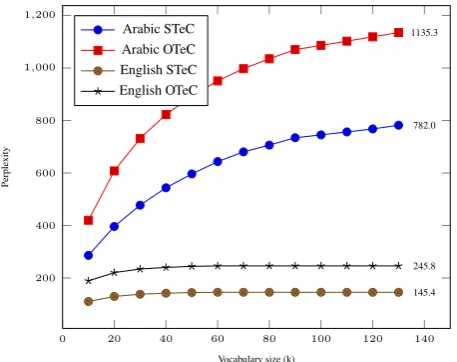
Building multilingual opinionated models requires multilingual corpora annotated with opinion labels. Unfortunately, such kind of corpora are rare. We consider opinions in this work as subjective or objective. In this paper, we introduce an annotation method that can be reliably transferred across topic domains and across languages. The method starts by building a classifier that annotates sentences into subjective/objective label using a training data from “movie reviews” domain which is in English language. The annotation can be transferred to another language by classifying English sentences in parallel corpora and transferring the same annotation to the same sentences of the other language. We also shed the light on the link between opinion mining and statistical language modelling, and how such corpora are useful for domain specific language modelling. We show the distinction between subjective and objective sentences which tends to be stable across domains and languages. Our experiments show that language models trained on objective (respectively subjective) corpus lead to better perplexities on objective (respectively subjective) test.
Keywords:subjectivity analysis, cross-lingual annotation, language modelling
1.
Introduction
Opinion mining or sentiment analysis determines the posi-tion of a writer with respect to a topic (Pang and Lee, 2008). One of opinion mining tasks is subjectivity identification, which is to classify a given text into subjective or objective (Pang and Lee, 2008).
A subjective or opinionated text conveys the opinions of the writer, while an objective text represents facts. For ex-ample, the following statement: “I think it is cold” is sub-jective because it conveys the opinion of a specific person. This opinion can be different from a person to another (a person lives in Mediterranean climate vs. a person lives in tundra climate). On the other hand, the following state-ment: “the temperature is (-15)” is objective because it rep-resents a fact. However, for controversial statements, hu-mans may disagree between themselves about the subjec-tivity of these statements. This is why automatic subjective analysis is a challenging task.
According to the opinion definition above, subjective and objective texts are very different in terms of writing style. Consequently, language models built from subjective texts may differ from ones built from objective texts. Therefore, opinion language models built from opinion corpora can be useful for certain domains and applications because they are better and more precise than non-domain specific lan-guage models. The distinction between multilingual sub-jective/objective text is investigated in the experiments of this work.
One of the wide applications of language modelling is text/speech machine translation, which require multilin-gual corpora. Since subjective/objective texts are distinct as mentioned earlier, then building multilingual subjec-tive/objective corpora is quite useful for building machine translation systems in this domain.
Building opinionated language models requires corpus of
both modalities (subjective and objective). So, Section 2. describes an automatic method (Saad et al., 2013a) to an-notate multilingual parallel corpus with opinion labels. The parallel corpus represents different domain topics (United Nations resolutions, newspapers, and talks). This work fo-cus on English/Arabic parallel corpus. Annotating this lan-guages pair can be useful because such corpus is not avail-able. Moreover, cross-lingual annotation can be used in in-formation extraction in low-resourced languages.
Then, Section 3. shows how statistical language models trained on opinion corpora obtain better performance on test corpora. In addition, the link between subjectivity an-notation and language modelling is studied in this section.
2.
Subjective Corpora Annotation
This section describes the method of automatic subjective annotation of parallel corpora with opinion labels. The method requires a pre-annotated monolingual corpus to au-tomatically annotate a parallel corpus. Before describing the method, these corpora are described here.2.1. Corpora Description
The pre-annotated monolingual corpus is a collection of movie reviews. It is in English language and composed of 5,000 subjective and 5,000 objective sentences. The cor-pus was collected and annotated by (Pang and Lee, 2004). Subjective reviews were obtained from Rotten Tomatoes websitewww.rottentomatoes.com, while Objective reviews were obtained from IMDb plot summaries www. imdb.com. A Sample of subjective/objective sentences are presented in Tables 1 and 2.
Regarding parallel corpus, it is described in Table 3, where
pretty much sucks, but has a funny moment or two. smart and alert, thirteen conversations about one thing is a small gem works both as an engaging drama and an incisive look at the difficulties facing native Amer-icans.
even a hardened voyeur would require the patience of job to get through this interminable, shapeless docu-mentary about the swinging subculture.
when perry fists a bull at the Moore farm, it’s only a matter of time before he gets the upper hand in mat-ters of the heart.
Table 1: A sample of subjective reviews of movie corpus
spurning her mother’s insistence that she get on with her life, Mary is thrown out of the house, rejected by Joe, and expelled from school as she grows larger with child.
Amitabh can’t believe the board of directors and his mind is filled with revenge and what better revenge than robbing the bank himself, ironic as it may sound. the movie begins in the past where a young boy named Sam attempts to save Celebi from a hunter.
Table 2: A sample of objective reviews of movie corpus
AFP1, ANN2, and ASB3 news corpora were provided by (Ma and Zakhary, 2009). Medar news corpus was provided bywww.medar.info. NIST4news corpus was provided by (NIST, 2010). UN corpus is resolutions of United Na-tion and was provided by (Rafalovitch and Dale, 2009). TED5 talks corpus was provided by (Cettolo et al., 2012). Tatoeba6 parallel sentences was provided by (Tiedemann, 2012).
Corpus |S| |W| |V|
English Arabic English Arabic
AFP 4K 140K 114K 17K 25K
ANN 10K 387K 288K 39K 63K
ASB 4K 187K 139K 21K 34K
TED 88K 1.9M 1.6M 88K 182K
UN 61K 2.8M 2.4M 42K 77K
Medar 13K 398K 382K 43K 71K
NIST 2K 85K 64K 15K 22K
Tatoeba 1K 17K 13K 4K 6K
Total 183K 5.9M 5M 269K 480K
Table 3: Parallel Corpora
2.2. Automatic Annotation
The method (Saad et al., 2013a) automatically annotates English/Arabic parallel corpus with the help of English cor-pus which is composed of movie reviews and pre-annotated
1
Agence France Presse www.afp.com
2
Annahar News paper www.annahar.com
3Assabah newspaper www.assabah.com.tn 4
National Institute of Technology www.nist.gov
5
www.ted.com
6
www.tatoeba.org
with opinion labels.
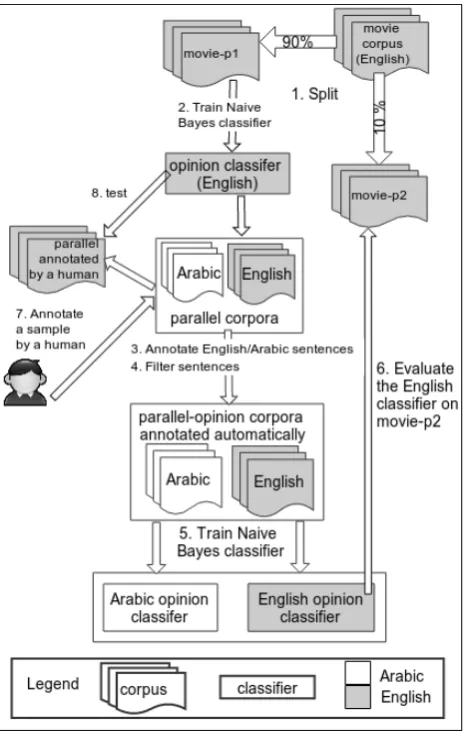
Figure 1: Parallel corpus annotation and evaluation
Corpus Description
movie Monolingual pre-annotated opinion corpus (10K sentences)
movie-p1
Part 1 ofmovie(90%): used to build the classifier which is used for annotation task
movie-p2
Part 2 ofmovie(10%): This is the (test corpus) which is used to test the annotated corpora
parallel Parallel corpora (183K sentences) opinion-parallel Automatically annotated
Table 4: Corpora description
First, a Naive Bayes classifier is built using the movie cor-pus, then the classifier is used to automatically annotate En-glish sentences of parallel corpus. Then, the same opinion label is assigned to corresponding Arabic sentences of par-allel corpus as illustrated in Figure 1. Corpora which are denoted in Figure 1 are described in Table 4.
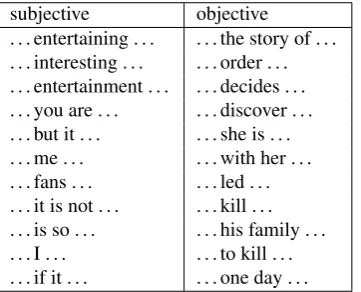
subjective objective
. . . entertaining . . . the story of . . . . . . interesting . . . order . . . . . . entertainment . . . decides . . . . . . you are . . . discover . . . . . . but it . . . she is . . . . . . me . . . with her . . . . . . fans . . . led . . . . . . it is not . . . kill . . . . . . is so . . . his family . . . . . . I . . . to kill . . . . . . if it . . . one day . . .
Table 5: A sample of subjective/objective n-gram features of the classifier
of the classifier are presented in Table 5. As can be noted from the table, subjective n-gram features are expressions that the reviewer uses to express what he/she thinks about the movie, while objective n-gram features are used by the reviewer to describe the events of the movie. The accuracy of this classifier on the 10% ofmovie-p1is 0.926 and objec-tive F-Measure (F1) is 0.926 and subjectiveF1is 0.927. So Naive Bayes classifier is used for automatic annotation task as described in our method steps in Figure 1. In sake of robustness, sentence annotation (steps 3 and 4 in Figure 1) is made only if the probability of the highest class label is above 0.8.
2.3. Annotation Results
The annotation method is applied on the parallel corpus, and results are presented in Table 6. The table presents per-centage of annotated sentences with respect to the corpus, the table also shows the class distribution of annotated sen-tences for each corpus (steps 3 and 4 of Figure 1). As can be seen in the table, 81% of all sentences are annotated, 45% of these are subjective and 55% are objective.
Corpus Annotatedsentences Subjective Objective
AFP 90.6% 9.4% 90.6%
ANN 89.9% 18.6% 81.4%
ASB 91.7% 17.8% 82.2%
TED 88.7% 74.8% 25.2%
UN 89.6% 15.7% 84.3%
Medar 89.6% 25.8% 74.2%
NIST 79.4% 20.6% 79.4%
Tatoeba 86.4% 59.3% 40.7%
Total 81% 45% 55%
Table 6: Parallel corpus annotation
A preliminary evaluation (step 6 of Figure 1) of the annota-tion process consists in: (1) training Naive Bayes classifiers usingparallel-opinioncorpus. (2) testing the obtained clas-sifiers onmovie-p2. Results are presented in Table 7. The classification accuracy is 0.79, subjectiveF1 is 0.81, and objectiveF1is 0.74.
To make sure that the classifier built from movie domain can correctly identify the subjectivity of sentences of par-allel corpus which is composed of news and non-news
do-Accuracy subjectiveF1 objectiveF1
0.79 0.81 0.74
Table 7: Evaluation onmovie-p2(step 6)
mains, a secondary evaluation is done on a sample of 330 sentences selected randomly and annotated by the first au-thor of this paper (step 7 in Figure 1). News sentences are selected from AFP, ANN, ASB, Medar, and NIST cor-pora, while non-news sentences are selected from TED, UN, Tatoeba corpora. This manually annotated material is described in Table 8. Then, the classifier built from movie reviews is tested on these sentences (step 8 in Fig-ure 1). The results of the classifier on these sentences are described in Table 9. The classification accuracy of news sentences is 0.718, subjective F1 is 0.717, and objective F1is 0.720, while the classification accuracy of non-news sentences is 0.658, subjective F1 is 0.667, and objective F1is 0.649. As can be seen from the results, the classifier built from movie reviews can classify sentences from other domains: the classifier can detect subjective and objective sentences from news corpus and from non-news corpus. In other words, the classifier does not modelize the genres of the corpus (news/non-news) but the objectivity/subjectivity. Another validation by language models is presented in the next section.
Corpus Subjective Objective
News 112 101
Non-News 60 57
Total 330
Table 8: The sample of parallel sentences annotated by a human (step 7)
Corpus Accuracy subjectiveF1 objectiveF1
News 0.718 0.717 0.720
Non-News 0.658 0.667 0.649
Table 9: Evaluation on parallel corpus annotated by a hu-man (step 8)
3.
Statistical Language Modelling
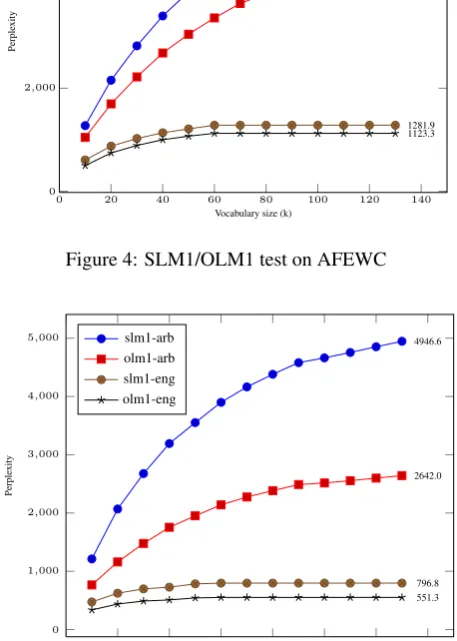
test them with opinion language models SLM1 and OLM1 built from opinion corpora (parallel-opinion). Results of these tests are presented in Figures 4 and 5. The Figures present the perplexity of SLM1/OLM1 tested on AFEWC and eNews comparable corpora. We first note that the per-plexity values for all test are high. This is maybe because language models are built from different corpus and domain than the test one. We also note from the figures that OLM1 fits better to English/Arabic AFEWC and eNews compa-rable corpora (has lower perplexity) than SLM1. Classi-fication results and language models tests in the Table 13 and the Figures 4 and 5 confirm the distinction of sub-jective/objective text. Their results accord to each others. This leads us to confirm that comparable corpora eNews and AFEWC are more objective.
4.
Conclusion
We have presented a method for cross-lingual annotation with subjective/objective labels. We tested successfully our classifier with manually labelled data. By training and test-ing statistical language models, we also showed that sub-jective/objective texts are statistically different in terms of writing style. We tested several models and corpora of dif-ferent genres and we always obtained the same conclusion: subjective/objective texts are distinct. Moreover, results of the classifier and of objective/subjective language mod-els highlighted that our comparable corpora (AFEWC and eNews: data extracted from Wikipedia and news website in English and Arabic) are more objective than subjective. In the future, this work can be extended to polarity in order to go towards a review system which is able to retrieve mul-tilingual articles about a topic, and to classify these articles in terms of opinion.
5.
References
Mauro Cettolo, Christian Girardi, and Marcello Federico. 2012. Wit3: Web inventory of transcribed and trans-lated talks. InProceedings of the 16thConference of the European Association for Machine Translation (EAMT), pages 261–268, Trento, Italy, May.
Xiaoyi Ma and Dalal Zakhary. 2009. Arabic newswire en-glish translation collection. Linguistic Data Consortium, Philadelphia.
Karima Meftouh, Med Tayeb Laskri, and Kamel Sma¨ıli. 2010. Modeling Arabic Language using statistical meth-ods. Arabian Journal for Science and Engineering, 35(2C):69–82.
Multimodal Information Group NIST. 2010. NIST 2008/2009 open machine translation (OpenMT) evalu-ation. Linguistic Data Consortium, Philadelphia. B. Pang and L. Lee. 2004. A sentimental education:
Senti-ment analysis using subjectivity summarization based on minimum cuts. InProceedings of the 42nd Annual Meet-ing on Association for Computational LMeet-inguistics, page 271. Association for Computational Linguistics. Bo Pang and Lillian Lee. 2008. Opinion mining and
sen-timent analysis. Found. Trends Inf. Retr., 2(1-2):1–135, January.
Alexandre Rafalovitch and Robert Dale. 2009. United na-tions general assembly resoluna-tions: A six-language par-allel corpus. InProceedings of the MT Summit XII, vol-ume 13, pages 292–299.
Motaz Saad, David Langlois, and Kamel Sma¨ıli. 2013a. Comparing multilingual comparable articles based on opinions. In Proceedings of the Sixth Workshop on Building and Using Comparable Corpora, pages 105– 111, Sofia, Bulgaria, August. Association for Computa-tional Linguistics.
Motaz Saad, David Langlois, and Kamel Sma¨ıli. 2013b. Extracting comparable articles from wikipedia and mea-suring their comparabilities. Procedia - Social and Be-havioral Sciences, 95(0):40 – 47. Corpus Resources for Descriptive and Applied Studies. Current Challenges and Future Directions: Selected Papers from the 5th Interna-tional Conference on Corpus Linguistics (CILC2013). Andreas Stolcke et al. 2002. SRILM-an extensible
lan-guage modeling toolkit. InProceedings of the interna-tional conference on spoken language processing, vol-ume 2, pages 901–904.