entity-Table 1: Basic counts of the data.
ENS EL JNS JL TOTAL
Number of texts 48 36 34 48 166
Number of sentences 755 492 473 799 2,519
Average number of sentences per text 15.73 13.67 13.91 16.65 15.17
For this study, the corpus needs to be local and small enough to be compiled in a specific environment to address questions specific to a particular group of learners (Seidlhofer, 2002).
3.
Key Concepts and Theory
3.1.
Entity Coherence
Our major concern is entity coherence, as opposed to relational coherence that is ensured by rhetorical relations (Mann and Thompson, 1987), of a discourse. Let us first present some key concepts and their definitions that we employ for the discussion here.
Entity coherence concerns repeated reference to the same entity in a discourse. By the standard definition, discourse entities can be individuals, objects, sets, events, facts, propositions, etc., and may be evoked or inferred in a discourse model. In many cases, reference is made to concrete individuals or objects that are typically introduced into a discourse in nominal forms, via explicit linguistic mention (e.g., pronouns, definite NPs), as in the example (from our corpus data) below.
(1) Pingu is playing with wooden blocks. He has trouble stacking the blocks so he becomes frustrated.
In this example, reference is made to an individual entity Pingu by a personal pronoun he, and to an object entity wooden blocks by a definite NP the blocks.
Reference can also be made to so-called “abstract entities” (Hegarty, 2003), also known as “higher order entities” (Gundel et al, 1999). This type of entity is introduced to a discourse by a clause, a sequence of clauses or even a larger unit such as a whole discourse segment. Event reference is one such instance. An example from Gundel et al. (1999) is presented in (2).
(2) There was a snake on my desk. That scared me; …
In this particular example, the demonstrative pronoun that refers to an “event entity” introduced by a whole previous clause.
Discourse entities can be concrete or abstract, as contrasted in examples (1) and (2). We will call the former type “nominal entities” and the latter “clausal entities” in this paper.
3.2.
Centering Framework
(Yamura-Takei, 2005). A sentence which does not share any discourse entities with an immediately previous one is labeled NULL (or elsewhere called “No CB” condition).
It is important to note how centering defines a set of discourse entities called CENTERs. Kameyama (1986) assumes that CENTERs are “(sets of) individuals, objects, states, actions and events” (p. 200). Grosz at al. (1995) also suggests that “events and other entities that are more often directly realized by VPs can also be centers” (p. 209, footnote 6), but leaves this beyond their scope, and so does the majority of succeeding centering work.
For the purpose of applying centering analysis to the data, we will follow this line and consider only nominal entities for CENTERs. We will then examine in this analysis result how clausal entities interact.
4.
Corpus Analysis Results
The purpose of the analysis is to explicate learner-specific and language-specific tendencies that could serve as a pedagogical base to help raise students’ and teachers’ awareness of local referential cohesion back in the EFL/JFL teaching/learning environments where the data was initially collected.
4.1.
Centering Analysis
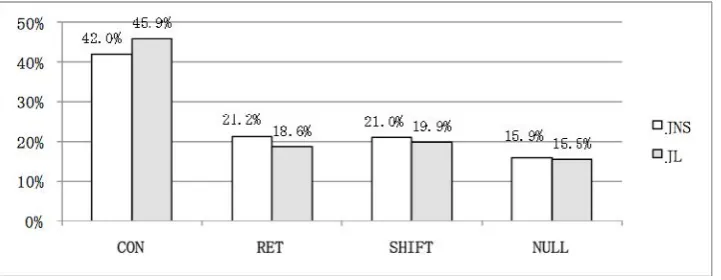
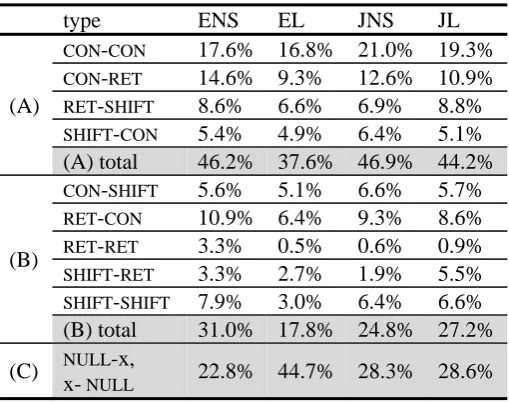
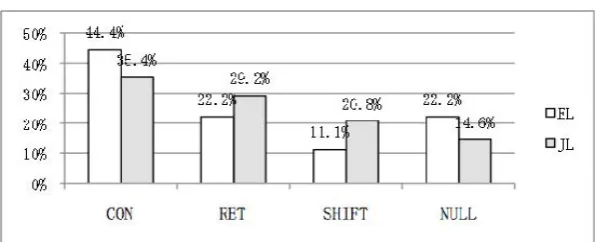
In order to characterize (nominal) entity coherence of the data, let us first look at our centering analysis results.1 Figures 2 and 3 present the distribution of centering TRANSITION types in English and Japanese data respectively.
Figure 2: Use of four centering TRANSITION types in the ENS and EL writing samples.
Figure 3: Use of four centering TRANSITION types in the JNS and JL writing samples.
1
This RET-CON often creates RET-CON-RET-CON sequence in which its CENTER moves back and forth in various syntactic positions while maintaining a reasonable degree of coherence with the same CENTER, as exemplified in a segment below from ENS data (with CENTER in bold).
(3)
a. [CON] When his mother offers him a potato, Pingu throws it back at her. (subject)
b. [RET] While Mama cleans up, Papa scolds Pingu for the way he's acting. (object)
c. [CON] Angry at his parents, Pingu starts rocking back and forth in his chair, until he rocks too far forward and falls over, bumps into the table, and spills all the food onto the floor. (subject)
d. [RET] Pingu's parents are very angry, and spank him before starting to clean up the mess. (possessive/object)
e. [CON] Angrier than ever, Pingu walks outside to run away from home. (subject)
A possible explanation for this phenomenon might be found in Table 3 below. The table shows the ratio of syntactic position that CENTERs occupy in each sub-corpus. The data contains CENTERs realized by either full NPs or pronouns (including zero arguments in Japanese).
Table 3: Ratio of CENTER positions in ENS/EL and JNS/JL data.
CENTER position ENS EL JNS JL
subject 69.3% 74.3% 77.9% 71.1%
possessive 18.6% 4.4% 4.7% 9.1%
object 8.9% 17.2% 15.7% 15.0%
other 3.2% 4.1% 1.6% 4.8%
English native speakers realize more CENTERs in possessor positions (18.6%) than learners do (4.4%). It potentially implies that English learners tend to maintain CENTER in subject and object positions due to the lack of skills of “retaining” CENTER in possessor positions, or due to L1 transfer (J->E). That is, English learners place CENTERs in possessor positions as infrequently in their native language (4.7% in JNS data). Conversely, JL data exhibits a higher percentage of possessive CENTERs than JNS, which could also suggest L1 transfer (E->J).
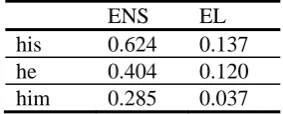
In contrast, EL data exhibits an abundant use of CENTERs in object positions (17.2%), most of which, however, are realized in the form of full NPs rather than pronominal forms. This explains the infrequent occurrences of accusative pronouns (i.e., him) in EL data, as indicated in Table 4 below. The table shows the occurrence ratio per sentence of the three personal pronouns (i.e., he, his, him), which, in most cases, refer to Pingu, the major discourse entity.
Table 4: Ratio of three pronouns per sentence in English data.
ENS EL
his 0.624 0.137
he 0.404 0.120
We have attempted to characterize each sub-corpus in terms of its (nominal) entity coherence within the framework of centering. In the next section, we will focus on (clausal) entity coherence established by event reference within and beyond the centering account.
4.2.
Event Reference
As is defined in section 3.1, “event reference” is a type of reference made to clausal entities evoked in a discourse. This phenomenon is not very frequent but is cross-linguistic. Event reference found in our data comprises a total of 157 cases (47 cases in ENS, 9 in EL, 53 in JNS, and 48 in JL). In English, events are usually referred to by demonstrative pronouns (this, that) or demonstrative NPs (e.g., this behavior), and less commonly by a personal pronoun (it). In case of Japanese, typical referring expressions for event entities are demonstrative pronouns (kore, sore) and demonstrative NPs (e.g., sono taido, ‘the attitude’).
As is previously discussed in section 3.2, event entities are not counted as CENTERsin our centering analysis; hence reference to such entities do not contribute to coherence that centering account can describe. Our interest is in how these 157 cases interact with the standard centering analysis. Figures 4 and 5 below present the distribution of event reference in each TRANSITION type.
Introspectively speaking, event reference functions to fill (nominal) entity-coherence gaps and appears in NULL-labeled environments. However, it does not seem to be the case; the distribution is noticeably varied among the four types of TRANSITION types. Over 70 % of cases for each subset appear in nominal-entity-cohesive situations, i.e., CON, RET and SHIFT. One RET example from ENS data is illustrated in (4).
Figure 4: Distribution of event reference in NS data.
Figure 5: Distribution of event reference in NNS (learner) data.
(4) [RET] Pingu’s father got very angry, and scolded Pingu.
This example exhibits both nominal entity reference made by a full NP (Pingu) and event reference made by a demonstrative pronoun (this) that together enhance coherence between the utterances.
On the other hand, there is also the case in which event reference alone creates a cohesive link between adjacent pairs of utterances, as exemplified in (5).
(5) [CON] Pingu walked over to Pinga’s bed and she woke and started crying. [SHIFT] Mama hugged Pinga and began playing with her.
[NULL] Pingu saw this and became jealous.
In this particular case, the CENTER “roughly” shifts from Pingu to Pinga and introduces a new entity Mama in a salient subject position in the 2nd utterance (SHIFT), which results in an entity-coherence gap when the next utterance exclusively mentions the comeback entity Pingu (NULL). This CON-SHIFT-NULL sequence is a very abrupt pattern in a centering sense. The presence of the event reference realized by this in the object position, however, successfully establishes the connection to the previous utterance and makes this three-utterance discourse unit reasonably smooth and natural.
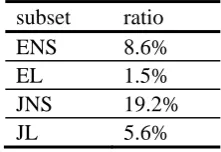
Table 5: Ratio of event reference occurrences in NULL
subset ratio ENS 8.6% EL 1.5% JNS 19.2% JL 5.6%
Table 5 above shows the ratio of event reference occurrences per all NULL situations in each subset. Native speakers, both English and Japanese, tend to use more event reference in NULL than learners do. Out of 93 NULL cases found in ENS data, eight cases of event reference are found (8.6%), including example (5) above, while EL data exhibits only two instances out of 128 NULL cases (1.5%). Out of 73 NULL cases found in JNS data, 14 utterances exhibit event reference where there is no common nominal entities shared between two adjacent utterances (19.2%), as exemplified in (6) below. On the other hand, JL data includes only seven instances of event reference in 124 NULL cases (5.6%).
(6) ピングーは野菜をママに投げつけてしまいました。
Pingu-wa yasai-o mama-ni nage-tukete-simai-masita.
Pingu-TOP vegetable-ACC mom-at throw-PAST ‘Pingu threw vegetables at Mom.’
このことでパパはさらに怒りました。 kono-koto-de papa-wa sarani okori-masita.
this-thing-by papa-TOP more get-angry-PAST ‘Because of this, papa got even angrier.’
As is apparent, native speakers, consciously or subconsciously, fill the gap in nominal entity-coherence, more often than their non-native counterparts, with the use of event reference. The high ratio for JNS data (19.2%) is particularly outstanding.
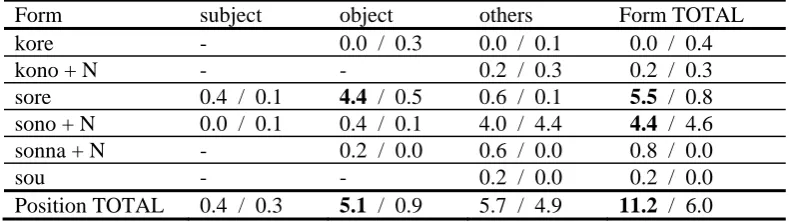
positions of the referring expressions. The two figures separated by a slash are for a native speaker and a learner data respectively.
Table 6: Types of event reference found in ENS / EL data.
Form subject object others Form TOTAL
this 2.1 / 0.0 1.2 / 0.0 0.5 / 0.0 3.8 / 0.0 this + N - 0.1 / 0.2 0.8 / 0.0 0.9 / 0.2
that 0.5 / 0.0 - 0.8 / 0.2 1.3 / 0.2
that + N - - 0.0 / 0.8 0.0 / 0.8
it 0.1 / 0.6 - - 0.1 / 0.6
Position TOTAL 2.8 / 0.6 1.3 / 0.2 2.1 / 1.0 6.2 / 1.8
Table 7: Types of event reference found in JNS / JL data.
Form subject object others Form TOTAL
kore - 0.0 / 0.3 0.0 / 0.1 0.0 / 0.4
kono + N - - 0.2 / 0.3 0.2 / 0.3
sore 0.4 / 0.1 4.4 / 0.5 0.6 / 0.1 5.5 / 0.8 sono + N 0.0 / 0.1 0.4 / 0.1 4.0 / 4.4 4.4 / 4.6 sonna + N - 0.2 / 0.0 0.6 / 0.0 0.8 / 0.0
sou - - 0.2 / 0.0 0.2 / 0.0
Position TOTAL 0.4 / 0.3 5.1 / 0.9 5.7 / 4.9 11.2 / 6.0
Most noticeable is a higher occurrence rate in NS data for both English (6.2 versus 1.8) and Japanese (11.2 versus 6.0). This may imply that, in terms of the event reference, learners have not reached the level of native speaker norms.
To characterize native speaker norms, let us closely look at the referring expressions used in the NS data. A demonstrative pronoun this plays a major role in English (3.8), while so- demonstratives (e.g., sore, sono) are dominant in Japanese (11.0 altogether). As for the syntactic positions in which they appear, there seems to be a clear contrast: subjects for English (2.8) and objects for Japanese (5.1), as represented in examples (7) and (8) below.
(7) This frustrates Pingu, and he begins to cry.
(8) ピングーは それを 見て、やきもちを 焼いてしまいました。
Pingu-wa sore-o mi-te, yakimoti-o yaite-simai-masita. Pingu-NOM this-ACC see jealousy-ACC feel-PAST
‘Pingu saw this, and became jealous.’
In addition, the demonstrative pronoun this in a subject position often co-occurs with emotion verbs, such as upset, worry and cheer. However, no such example is observed in EL data. On the other hand, so-demonstratives in Japanese usually appear in object positions of perception verbs, such as miru ‘see’ and kizuku ‘notice.’ This is extremely rare in JL data.