CSEIT1722367 | Received : 01 May 2017 | Accepted : 20 May 2017 | May-June-2017 [(2)3: 943-950 ]
International Journal of Scientific Research in Computer Science, Engineering and Information Technology © 2017 IJSRCSEIT | Volume 2 | Issue 3 | ISSN : 2456-3307
943
Efficiency of Clustering Data Streams Based on Micro-Clusters
Shared Density
Avula Chitty
Department of CSE, Assistant Professor, Sri Indu College of Engineering And Technology, Hyderabad, Telangana, India
ABSTRACT
As more and a lot of applications produce streaming information, clustering knowledge streams has become a very important technique for data and information engineering. A typical approach is to summarize the information stream in time with an online method into an oversized number of therefore known as micro-clusters. Micro-clusters represent native density estimates by aggregating {the information} of the many data points in an outlined area. On demand, a (modified) typical bunch formula is used in a very second offline step to recluster the micro-clusters into larger final clusters. For reclustering, the centers of the micro-clusters are used as pseudo points with the density estimates used as their weights. However, data concerning density within the area between micro-clusters isn't preserved within the on-line process and reclustering relies on probably inaccurate assumptions concerning the distribution of knowledge inside and between micro-clusters (e.g., uniform or Gaussian).This paper describes DBSTREAM, the primary micro-cluster-based on-line bunch part that expressly captures the density between micro-clusters via a shared density graph. The density data during this graph is then exploited for reclustering supported actual density between adjacent micro-clusters. We have a tendency to discuss the house and time complexness of maintaining the shared density graph. Experiments on a good vary of artificial and real knowledge sets highlight that mistreatment shared density improves bunch quality over alternative popular knowledge stream bunch ways that need the creation of a bigger variety of smaller micro-clusters to realize comparable results.
Keywords: Data Mining, Data Stream Clustering, Density-Based Clustering
I.
INTRODUCTION
CLUSTERING data streams has become n important technique for data and knowledge engineering. A data stream is an ordered and potentially unbounded sequence of data points. Such streams of constantly arriving data are generated for many types of applications and include GPS data from smart phones, web click-stream data, computer network monitoring data, telecommunication connection data, readings from sensor nets Stock quotes, etc.Data stream clustering is typically done as a two-stage process with an online part which summarizes the
Current reclustering approaches completely ignore the data density in the area between the clusters (grid cells) and thus might join micro-clusters (cells) which are close together but at the same time separated by a small area of low density. To address this problem, Tu and Chen introduced an extension to the grid-based D-Stream algorithm based on the concept of attraction between adjacent grids cells and showed its effectiveness. In this paper, we develop and evaluate a new method to address this problem for micro- cluster-based algorithms. We introduce the concept of a shared density graph, which explicitly captures the density of the original data between micro-clusters during clustering, and then show how the graph can be used for reclustering micro-clusters. This is a novel approach since instead on relying on assumptions about the distribution of data points assigned to a micro-cluster (MC) (often a Gaussian distribution around a center); it estimates the density in the shared region between micro-clusters directly from the data. To the best of our knowledge, this paper is the first to propose and investigate using a shared-density-based reclustering approach for data stream clustering.
II.
RELATED WORK
Density-based clustering is a well-researched area and we can only give a very brief overview here. DBSCAN [10] and several of its improvements can be seen as the prototypical density-based clustering approach. DBSCAN estimates the density around each data point by counting the number of points in a specifies-neighbourhood and applies user-specified thresholds to identify core, border and noise points. In a second step, core points are joined into a cluster if they are density-reachable (i.e., there is a chain of core points where one falls inside the eps-neighborhoodof the next). Finally, border points are assigned to clusters.
Other approaches are based on kernel density estimation (e.g., DENCLUE [11]) or use shared nearest neighbours (e.g., SNN [12], CHAMELEON
[13]). However, these algorithms were not developed with data streams in mind. A data stream is an ordered and potentially unbounded sequence of data points X = hx1; x2; x3; i. It is not possible to permanently store all the data in the stream which implies that repeated random access to the data is infeasible. In addition, data streams exhibit concept drift over time where the position and/or shape of clusters changes, and new clusters may appear or existing clusters disappear. This makes the application of existing clustering algorithms difficult. Data stream clustering algorithms limit data access to a single pass over the data and adapt to concept drift. Over the last 10 years, many algorithms for clustering data streams have been proposed [5], [6], [8], [9], [14], [15], [16], [17], [18], [19], and [20]. Most data stream clustering algorithms use a two-stage online/offline approach [4]:
1) Online: Summarize the data using a set of k0 micro clusters organized in a space-efficient data structure, which also enables fast lookup. Micro-clusters are representatives for sets of similar data points and are created using a single pass over the data (typically in real time when the data stream arrives)cluster centres and additional statistics as weight (density) and dispersion (variance) typically represent .Micro-clusters. Each new data point is assigned to its closest (in terms of a similarity function) micro-cluster. Some algorithms use a grid instead and non-empty grid cells represent micro clusters (e.g., [8], [9]). If a new data point cannot be assigned to an existing micro-cluster, a new micro cluster is created. The algorithm might also perform some housekeeping (merging or deleting microclusters) to keep the number of micro-clusters at manageable size or to remove noise or information outdated due to concept drift.
that they use a conventional clustering algorithm (typically k-means or a variation of DBSCAN [10]) by regarding the micro-cluster center positions as pseudo-points. The algorithms are often modified to take also the weight of micro-clusters into account.
However, these algorithms were not developed with data streams in mind. A data stream is an ordered and potentially unbounded sequence of data points X ¼ hx1; x2; x3; . . .i. It is not possible to permanently store all the data in the stream, which implies that repeated random access to the data is infeasible. Also, data streams exhibit concept drift over time where the position and/or shape of clusters changes, and new clusters may appear or existing clusters disappear. This makes the application of existing clustering algorithms diffi-cult. Data stream clustering algorithms limit data access to a single pass over the data and adapt to concept drift. Over the last 10 years, many algorithms for clustering data streams have been proposed. Most data stream clustering algorithms use a two-stage online/offline approach.
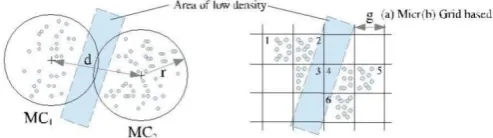
Figure 1. Problem with reclustering when dense areas are separated by small areas of low density with (a) micro clusters and (b) grid cells.
Reclustering methods based solely on micro-clusters only take closeness of the micro-clusters into account. This makes it likely that two micro-clusters, which are close to each other, but separated by an area of low density still, will be merged into a cluster. Information about the density between micro-clusters is not available since the information is not recorded in the online step and the original data points are no longer available. Fig. 1a illustrates the problem where the micro-clusters MC1 and MC2 will be merged as long as their distance d is low. This is even true when density-based clus-tering methods (e.g., DBSCAN) are used in the offline reclustering
step, since the reclustering is still exclusively based on the micro-cluster centres and weights.
Figure 2. MC1 is a single MC. MC2 and MC3 are close to each other but the density between them is low relative to the two MCs densities while MC3 and MC4 are connected by a high-density area.
III. PROPOSED SYSTEM
In this paper, we develop and evaluate a new method to address this problem for micro-cluster-based algorithms. We introduce the concept of a shared density graph which explicitly captures the density of the original data between micro-clusters during clustering and then show how the graph can be used for reclustering micro-clusters. This is a novel approach since instead on relying on assumptions about the distribution of data points assigned to a microcluster (often a Gaussian distribution around a center); it estimates the density in the shared region between micro clusters directly from the data.
IV. THE DBSTREAM ONLINE COMPONENT
available since it is not retained during the online stage.
The basic idea of this work is that if we can capture not only the distance between two adjacent MCs but also the connectivity using the density of the original data in the area between the MCs, then the reclustering results may be improved. In the following, we develop DBSTREAM, which stands for density-based stream clustering.
Leader-Based Clustering
Leader-based clustering was introduced by Hartigan [21] as a conventional clustering algorithm. It is straightforward to apply the idea to data streams (see, e.g., [20]).DBSTREAM represents each MC by a leader (a data point defining the MC’s center) and the density in an area of a user-specified radius r (threshold) around the center. This is similar to DBSCAN’s concept of counting the points is an eps-neighborhood, however, here the density is not estimated for each point, but only for each MC which can easily be achieved for streaming data. A new data point is assigned to an existing MC (leader) if it is within a fixed radius of its center. The assigned point increases the density estimate of the chosen cluster and the MC’s center is updated to move towards the new data point. If the data point falls in the assignment area of several MCs then all of them are updated. If a data point cannot be assigned to any existing MC, a new MC (leader) is created for the point. Finding the potential clusters for a new data point is a fixed-radius nearest-neighbor problem [22] which can be efficiently dealt with for data of moderate dimensionality using spatial indexing data structures like a k-d tree [23]. Variations of this simple algorithm were suggested in [24] for outlier detection and in [25] for sequence modeling.
Competitive Learning
New leaders are chosen as points, which cannot be assigned to an existing MC. The positions of these newly formed MCs are most likely not ideal for the clustering. To remedy this problem, we use a
competitive learning strategy intro-duced in [26] to move the MC centers towards each newly assigned point. To control the magnitude of the movement, we use a neighborhood function hðÞ similar to self-organiz-ing maps.
Capturing Shared Density
Capturing shared density directly in the online component is a new concept introduced in this paper. The fact, that in dense areas MCs will have an overlapping assignment area, can be used to measure density between MCs by counting the points, which are assigned to two or more MCs. The idea is that high density in the intersection area relative to the rest of the MCs’ area means that the two MCs share an area of high density and should be part of the same macro-cluster-ter. In the example in Fig. 2, we see that MC2 and MC3 are close to each other and overlap. However, the shared weight s2; three is small compared to the weight of each of the two involved MCs indicating that the two MCs do not form a single area of high density. On the other hand, MC3 and MC4 are more distant, but their shared weight s3; four is large indicating that both MCs form an area of high density and thus should form a single macro-cluster.
Fading and Forgetting Data
The Complete Online Algorithm
Algorithm 1 Update DBSTREAM clustering.
Require clustering data structures initially empty or 0
MC. Set of MCs
Mc 2 MC has elements mc = (c; w; t). Center, weight, Last update time
S. weighted adjacency list for shared density graph sij 2 S has an additional field t . time of last update t. current time step
Require User-specified parameters r . clustering threshold
_ . fading factor tgap . cleanup interval wmin . minimum weight _ . intersection factor
1: function UPDATE(x) . new data point x 2: N _ndFixedRadiusNN(x;MC; r)
3: if jN j < 1 then . create new MC 4: add (c = x; t = t;w = 1) to MC 5: else . update existing MCs 6: for each i 2 N do
7: mci[w] mci[w] 2�_(t�mci[t]) + 1 8: mci[c] mci[c] + h(x; mci[c])(x � mci[c]) 9: mci[t] t
. update shared density
10: for each j 2 N where j > i do 11: sij sij 2�_(t�sij [t]) + 1 12: sij [t] t
13: end for 14: end for
. prevent collapsing clusters
15: for each (i; j) 2 N _ N and j > i do 16: if dist(mci[c]; mcj [c]) < r then
17: revert mci[c], mcj [c] to previous positions 18: end if
19: end for 20: end if 21: t t + 1 22: end function
Algorithm 1 shows our approach and the used clustering data structures and user-specified
parameters in detail. Micro-clusters are stored as a set MC. Each micro-cluster is repre-sented by the tuple ðc; w; tÞ representing the cluster center, the cluster weight and the last time it was updated, respectively. The weighted adjacency list S represents the sparse shared density graph which captures the weight of the data points shared by MCs. Since shared density estimates are also subject to fading, we also store a timestamp with each entry. Fading also shared density estimates is important since MCs are allowed to move which over time would lead to estimates of intersection areas the MC is not covering anymore.
V.
COMPUTATIONAL COMPLEXITY
Space complexity of the clustering depends on the number of MCs that need to be stored in MC. In the worse case, the maximum number of strong MCs at any time is tgap MCs and is reached when every MC receives exactly a weight of one during each interval of tgap time steps. Given the cleanup strategy in Algorithm 2, where we remove weak MCs every tgap time steps, the algorithm never stores more than k0 ¼ 2tgap MCs.
Algorithm 2 Cleanup process to remove inactive microclusters
and shared density entries from memory.
Require: _, _, tgap, t, MC and S from the clustering. 1: function CLEANUP( )
2: wweak = 2�_tgap 3: for each mc 2 MC do
4: if mc[w] 2�_(t�mc[t]) < wweak then 5: remove weak mc from MC
6: end if 7: end for
8: for each sij 2 S do
9: if sij 2�_(t�sij [t]) < _wweak then 10: remove weak shared density sij from S 11: end if
The space complexity of MC is linear in the maximal number of MCs k0. The worst case size of the adjacency list of the shared density graph S depends on k0 and the dimensionality of the data. In the 2D case each MC can have a maximum of jN j¼ 6 neighbors (at optimal packing). Therefore, each of the k0 MCs has in the adjacency list S at most six entries resulting in a space complexity of storing MC and S of OðtgapÞ. For higher-dimensional data streams, the maximal num-ber of possible adjacent hyper spheres is given by Newton’s number also referred to as kissing number [29]. Newton’s number defines the maximal number of hyper spheres which can touch a hyper sphere of the same size without intersecting any other hyper sphere. If we double the radius of all hyper spheres in this configuration then we get our scenario with sphere centers touching the surface of the center sphere. We use Kd do denote Newton’s number in d dimensions. Newton’s exact number is known only for some small dimensionality values d, and for many other dimensions only lower and upper bounds are known Note, that Newton’s number grows fast, reaches 196,560 for d ¼ 24 and is unknown for most larger d. This growth would make storing the shared weights for high-dimensional data in a densely packed area very expensive. However, we also know that the maximal neighborhood size jN maxj _ minðk0 _ 1; KdÞ, since we cannot have more neigh-bors than we have MCs. Therefore, the space complexity of maintaining S is bounded by Oðk0jN maxjÞ.To analyze the algorithm’s time complexity, we need to consider all parts of the clustering function. The fixed-radius nearest neighbor search can be done using linear search in Oðdnk0 Þ, where d is the data dimensionality, n is the number of data points clustered and k0 is the number of MCs. The time complexity can be improved to Oðd n logðk0ÞÞ using a special indexing data structure like a k-d tree [23]. Adding or updating a single MC is done in time linear in n.
VI. EXPERIMENTS ANALYSIS
To perform our experiments and make them reproducible, we have implemented/interfaced all algorithms in a pub-licly available R-extension called stream [30]. Stream pro-vides an intuitive interface for experimenting with data streams and data stream algorithms. It includes generators for all the synthetic data used in this paper as well as a growing number of data stream mining algorithms including clustering algorithms available in the MOA (Massive Online Analysis) framework [31] and the algorithm discussed in this paper. In this paper we use four synthetic data streams called Cassini, Noisy Mixture of Gaussians, and DS3 and DS41 used to evaluate CHAMELEON [13]. These data sets do not exhibit concept drift. For data with concept drift we use MOA’s Random RBF Generator with Events. In addition we use several real data sets called Sensor,2 Forest Cover Type3 and the KDD CUP’99 data4 which are often used for com-paring data stream clustering algorithms.
the F-measure) depends on the number of clusters and thus makes comparison of clustering’s with a different number of clusters invalid. The within cluster sum of squares favors algorithms which produce spherical clusters (e.g., k-means-type algorithms).
VII.
CONCLUSION
This paper, we have developed the first data stream clustering algorithm which explicitly records the density in the area shared by micro-clusters and uses this information for reclustering. We have introduced the shared density graph together with the algorithms needed to maintain the graph in the online component of a data stream mining algorithm. Although, we showed that the worst-case memory requirements of the shared density graph grow extremely fast with data dimensionality, complexity analysis and experiments reveal that the procedure can be effectively applied to data sets of moderate dimensionality. Experiments also show that shared-density reclustering already performs extremely well when the online data stream clustering component is set to produce a small number of large MCs. Other popular reclustering strategies can only slightly improve over the results of shared density reclustering and need significantly more MCs to achieve comparable results. This is an important advantage since it implies that we can tune the online component to produce less micro-clusters for shared In -density reclustering. This improves performance and, in many cases, the saved memory more than offset the memory requirement for the shared density graph.
VIII.
REFERENCES
[1]. S. Guha, N. Mishra, R. Motwani, and L. O’Callaghan, "Clustering data streams," in Proceedings of the ACM Symposium on Foundations of Computer Science, 12-14 Nov. 2000, pp. 359–366.
[2]. C. Aggarwal, Data Streams: Models and Algorithms, ser. Advances in Database Systems, Springer, Ed., 2007.
[3]. J. Gama, Knowledge Discovery from Data Streams, 1st ed. Chapman & Hall/CRC, 2010.
[4]. J. A. Silva, E. R. Faria, R. C. Barros, E. R. Hruschka, A. C. P. L.F. d. Carvalho, and J. a. Gama, "Data stream clustering: A survey,"ACM Computing Surveys, vol. 46, no. 1, pp. 13:1– 13:31, Jul. 2013.
[5]. C. C. Aggarwal, J. Han, J. Wang, and P. S. Yu, "A framework for clustering evolving data streams," in Proceedings of the International Conference on Very Large Data Bases (VLDB ’03), 2003, pp. 81–92.
[6]. F. Cao, M. Ester, W. Qian, and A. Zhou, "Density-based clustering over an evolving data stream with noise," in Proceedings of the 2006 SIAM International Conference on Data Mining. SIAM, 2006,pp. 328–339.
[7]. Y. Chen and L. Tu, "Density-based clustering for real-time stream data," in Proceedings of the 13th ACM SIGKDD International Conference on Knowledge Discovery and Data Mining. New York, NY,USA: ACM, 2007, pp. 133–142.
[8]. L. Wan, W. K. Ng, X. H. Dang, P. S. Yu, and K. Zhang, "Densitybased clustering of data streams at multiple resolutions," ACM Transactions on Knowledge Discovery from Data, vol. 3, no. 3, pp.1–28, 2009.
[9]. L. Tu and Y. Chen, "Stream data clustering based on grid density and attraction," ACM Transactions on Knowledge Discovery from Data, vol. 3, no. 3, pp. 1–27, 2009.
[10]. L. Ertoz, M. Steinbach, and V. Kumar, "A new shared nearestneighbor clustering algorithm and its applications," in Workshopon Clustering High Dimensional Data and its Applications at 2nd SIAM International Conference on Data Mining, 2002.
[11]. P. Kranen, I. Assent, C. Baldauf, and T. Seidl, "The clustree:indexing micro-clusters for anytime stream mining," Knowledge and Information Systems, vol. 29, no. 2, pp. 249– 272, 2011.
evolving data stream," Journal of Computer and Communications, vol. 1, no. 5, pp. 26–31, 2013. [13]. J. A. Hartigan, Clustering Algorithms, 99th ed. New York, NY,USA: John Wiley & Sons, Inc., 1975.
[14]. E. Eskin, A. Arnold, M. Prerau, L. Portnoy, and S. Stolfo, "A geometric framework for unsupervised anomaly detection: Detecting intrusions in unlabeled data," in Data Mining for Security Applications. Lower, 2002.
[15]. M. Hahsler and M. H. Dunham, "Temporal structure learning for clustering massive data streams in real-time," in SIAM Conference on Data Mining (SDM11). SIAM, April 2011, pp. 664–675.
[16]. C. Isaksson, M. H. Dunham, and M. Hahsler, "Sostream: Self organizing density-based clustering over data stream," in Machine Learning and Data Mining in Pattern Recognition, ser. Lecture Notesin Computer Science. Springer Berlin Heidelberg, 2012, vol. 7376,pp. 264–278.
[17]. "Neurocomputing: Foundations of research," J. A. Andersonand E. Rosenfeld, Eds. Cambridge, MA, USA: MIT Press, 1988, ch.Self-organized Formation of Topologically Correct Feature Maps, pp. 509–521.
[18]. M. Hahsler, M. Bolanos, and J. Forrest, stream: Infrastructure for Data Stream Mining, 2015, R package version 1.2-2.
[19]. A. Bifet, G. Holmes, R. Kirkby, and B. Pfahringer, "MOA: massive online analysis," Journal of Machine Learning Research, vol. 99, pp. 1601–1604, August 2010.
[20]. H. Kremer, P. Kranen, T. Jansen, T. Seidl, A. Bifet, G. Holmes, and B. Pfahringer, "An effective evaluation measure for clustering on evolving data streams," in Proceedings of the 17th ACM SIGKDD international conference on Knowledge discovery and data mining. ACM, 2011, pp. 868–876.
[21]. J. Gama, R. Sebasti˜ao, and P. P. Rodrigues, "On evaluating stream learning algorithms," Machine Learning, pp. 317–346, 2013.