Research Article
ANTIOXIDANT AND ANTHELMINTIC ACTIVITY OF TERMINALIA ARJUNA ROXB. STEM BARK
EXTRACTS
YADAV D. BODKE
1*, ARUNA SINDHE M
1, RAJESH K. GUPTA
2, MANJUNATHA H
21Department of PG Studies and Research in Industrial chemistry, Jnana Sahyadri, Kuvempu University, Shankaraghatta- Karnataka, India
2Department of PG Studies and Research in Biotechnology and Bioinformatics, Jnana Sahyadri, Kuvempu University, Shankaraghatta-
Karnataka, India. Email: [email protected]
Received: 11 June 2013, Revised and Accepted: 12 July 2013
ABSTRACT
In the present investigation, four complementary assays, total reductive power, total antioxidant activity, 2,2-diphenyl-1-picrylhydrazyl (DPPH) radical scavenging activity and metal chelating ability for ferrous ions were used to screen the antioxidant property of Terminalia arjuna bark extracts. The extracts showed significant antioxidant activity in correlation to the phytoconstituents present in the extrac ts. The phytochemical analysis revealed that the major bioactive components of the plants are terpenoides, polyphenols, saponins, tannins and glycosides. Live earthworms Pheretima posthuma were used for screening anthelmintic activity of bark extract. All extracts showed effective anthelmintic activity at 20 mg ml-1 concentration.
Keywords:Terminalia arjuna, Antioxidant, Anthelmintic, DPPH, Pheretima posthuma
INTRODUCTION
The usage of herbs to treat variety of ailments is universal and exists in every human culture on Earth. Herbal medicine is still the mainstay of about 75–80% of the world population, mainly in the developing countries for primary health care because of better cultural acceptability, better compatibility with the human body and lesser side effects [1]. However, the last few years have seen a tremendous increase in their use in the developed world. In recent decades, many studies have been conducted with the aim of identifying natural origin substances, which can be used in the development of insecticides, especially for vectors of human and animal pathogens.
India always stands as a golden mark of recorded and well-practiced knowledge of traditional herbal medicine. Herbal plants play an important role in the development of potent therapeutic agents. Over the years, various medicinal plants and their extracts have been reported to be effective in the treatment of diseases [2]. Plants are rich sources of anthelmintic and antioxidant agents such as flavonoids [3], alkaloids [4], terpenoids [5]and other related polyphenols[6]. These plant phytoconstituents have potential to treat number of diseases. Terminalia arjuna Roxb. (Combretaceae) commonly known as arjuna is one of the medicinally important
evergreen tree [7] which possesses antimicrobial, cytotoxic,
antidiabetic [8], antidiarrheal, antidysentric [9] and
hepatoprotective [10] activities.
Metabolic pathway of the body results in continuously exposures to several degradative stresses, like Reactive Oxygen Species (ROS) and free radicals. These reactive ions extensively cause the oxidative damage to the biomolecules [11] and contribute to the pathogenesis of oxidative stress related diseases like cancer, ageing and heart failure, etc., [12,13]. On the other hand, antioxidants are considered as possible protective agents against oxidative damage of human body. Consequently, there is a growing interest in the substances exhibiting antioxidant properties that are supplied to human and animal organisms. Hence natural antioxidants have become one of the major areas of scientific research [14, 15].
Helminth infection is a medical and public health problem of high magnitude, both in humans and domestic animals, causing considerable suffering and poor growth. In addition, helminths of livestock pose a serious economic loss, in particular in areas where extensive grazing is practiced [16]. Chemical control of helminths
coupled with improved management has been the important worm control strategy throughout the world. However, increasing problems of development of resistance in helminthes [17] against anthelmintic have led to the proposal of screening of medicinal plants for their anthelmintic activity. Therefore, the present study focused on antioxidant and anthelmintic activity of T.arjuna bark extracts.
MATERIALS AND METHODS
Chemicals
All the chemicals and solvents used were of analytical grade. Butylated hydroxyl anisole (BHA) was purchased from Merck (Germany). Gallic acid, catechin hydrate, Quercetin, 2,2-diphenyl-1-picrylhydrazyl (DPPH) were purchased from Sigma Aldrich (Poznan, Poland). Ferric chloride, Ferrozine, Trichloroacetic acid (TCA) and Folin-Ciocalteu reagents were procured from Himedia (India).
Plant material
Healthy stem bark of T.arjuna was collected from Bhadra Reserve forest, Shivamogga, Karnataka, India. Plant was identified as
T.arjuna with the help of faculty of Department of Applied Botany, Kuvempu University, Shankaraghatta, Karnataka, India. Bark was separated from unwanted materials, brushed, shade dried and powdered mechanically.
Estimation of inorganic constituents in plant material
The inorganic components of T. arjuna was estimated by slightly modified method described by Narendhirakannan et, al [18]. Briefly, the shade dried and pulverized plant material was placed in a vitreosil crucible overnight in an electric muffle furnace maintained at a temperature between 400 to 420˚C. Ashing will destroy all the organic materials present in the samples. The crucible containing pure ash was then taken out from the muffle furnace and kept in a desiccator. Then, 2 gm of the ash was digested with the triple acid mixture of nitric acid: sulfuric acid: perchloric acid (11: 6: 3). The digested sample was dissolved in 100 ml distilled water and filtered through Whatman filter paper. The filtrate was used for the assay of trace elements by atomic absorption spectrophotometer (AAS-Varion 200AA) using suitable hollow-cathode lamp.
300 Gm of stem bark powder was defatted using petroleum ether and sequentially extracted with chloroform, double distilled ethanol and double distilled water in soxhlet apparatus and extracts were referred as T. arjuna chloroform extract (TACE), T. arjuna ethanolic extract (TAEE) and T. arjuna aqueous extract (TAAE) respectively. The extracts were filtered and concentrated in vacuum using rotary flash evaporator (Buchi Rotavapor R-200) and the obtained crude extracts were stored in desiccator until further studies.
Qualitative phytochemical screening
The crude extracts were qualitatively examined for the presence of various phytochemical constituents using standard tests as described by Kokate, C and Harborne [19, 20].
Quantitative analysis of crude extracts
Determination of total phenolic contents
Total phenolic content in the extracts were estimated by Folin-Ciocalteu method using Gallic acid as a standard [21]. Briefly, 2 ml of each extract at different concentrations (50-150 µg) in ethanol was mixed with 2.5 ml Folin-Ciocalteu reagent (diluted 1:10 v/v) and 2 ml of Na2CO3 (7.5 % v/v) solution in the test tubes. The mixture is
than allowed to stand for 90 min. at room temperature. Absorbance of content in each test tube was measured against the blank at 750 nm using a spectrophotometer (Shimadzu UV-1609, Japan). Total phenolic content of the extract was expressed in terms of µg equivalent to gallic acid. Estimation was repeated thrice and the results were averaged.
Determination of total flavonoid content
Total flavonoid content in the extracts was determined according to modified method of Zhishen et al.,[22] using catechin as a standard. Briefly, 2 ml of extract at different concentrations (50-150 µg) in ethanol was mixed with 0.3 ml each of 5 % NaNO2 and 10% AlCl3,
incubated at room temperature for 6 min. Then, 2 ml of 1M NaOH was added and the volume in each test tube was made up to 5 ml by adding distilled water. Absorbance was measured against the blank at 510 nm using a spectrophotometer. Total flavonoid content in the extract was expressed in terms of µg equivalent to quercetin. Tests were repeated thrice and the results were averaged.
Biological evaluation
Further, all extracts were screened for biological activities such as in vitro antioxidant (total antioxidant capacity, total reductive capability, DPPH radical scavenging and metal chelating activity) and invitro anthelmintic activity.
Invitro antioxidant activities
Total antioxidant capacity
Total antioxidant capacity of extract was determined as described by Prieto [23]. Extracts in 3000 µl of methanol at different concentrations (20–100 µg ml-1) were taken in separate test tubes.
To this, 3 ml of reagent mixture containing 4 mM ammonium molybdate, 0.6 M sulfuric acid and 28 mM of sodium phosphate was added. Test tubes were kept for incubation at 95˚C for 90 min. and allowed to cool. Absorbance of the content of each test tube was measured at 695 nm against a blank and antioxidant capacity of each extract is expressed as equivalents of ascorbic acid. Test was performed in triplicate and the results were averaged.
Total reductive capability
Total reductive capacity of extract was determined according to the method of Oyaizu [24]. Briefly, 1 ml of extract solution at different concentrations (20-100 µg ml-1) in ethanol was mixed with 2.5 ml of
0.2 mol/L phosphate buffer having pH 6.5 and 2.5 ml, 1% potassium ferricyanide. Then, the mixture was incubated at 50˚C for 20 min. At the end of the incubation, 2.5 ml, 10% trichloroacetic acid was added to the mixture and centrifuged at 3000 rpm for 10 min. The upper layer solution was collected and mixed with 2.5 ml distilled water and 0.5 ml, 0.1% ferric chloride. The absorbance was measured at 700 nm against a blank. Test was performed in triplicate, and the
2,2-Diphenyl-1-picrylhydrazyl (DPPH) radical scavenging
activity
All the extracts were screened for free radical scavenging activity by DPPH method of Braca[25]. The plant extracts in ethanol at different concentrations (20-100 µg ml-1) were added to each test tube and
volume was made up to 4 ml using methanol. To this, 3 ml of 0.004% DPPH in methanol was added and the mixtures were incubated at room temperature under dark condition for 30 min. The scavenging activity on the DPPH radical was determined by measuring the absorbance at 517 nm. Radical scavenging activity was calculated using the formula:
% of Radical scavenging activity = ([(Acontrol - Atest)/Acontrol]) × 100,
Where Acontrol is the absorbance of the control sample (DPPH solution
without test sample) and Atest is the absorbance of the test sample
(DPPH solution + test compound). The DPPH radical scavenging activity of BHA was also assayed for comparison. Test was performed in triplicate, and the results were averaged.
Metal chelating activity
percentage of inhibition of ferrozine-Fe2+ complex formation was
calculated from the formula:
% of inhibition = ([(Acontrol - Atest)/Acontrol]) × 100
Where Acontrol is the absorbance of the control sample and Atest is the
absorbance of the test sample. Test was performed in triplicate, and the results were averaged.
In vitro Anthelmintic activity
Test organisms
Live earthworms P. posthuma of nearly equal size (6±1cm) were collected from Vermicomposting manufacturing farm. Worm type was identified at the Agriculture Research Station, Shivamogga, Karnataka. The worms were acclimatized to laboratory conditions for one week before experimentation.
Anthelmintic activity
The in vitro anthelmintic assay was carried out according to the method of Ajaiyeoba [27] with appropriate modifications. The earthworms were divided into five groups of six each. Albendazole diluted with normal saline solution to obtain 1% (m/V) is served as standard and normal saline served as a control. The extracts were dissolved in normal saline to prepare different concentrations (5-20 mg ml-1) of each extract. The time taken for complete paralysis and
death was recorded. The mean paralysis time and mean lethal time were calculated for each extract (each reading was taken in triplicate). The time taken by worms to become motionless was noted as paralysis time. To ascertain death, each worm was frequently subjected to external stimuli that stimulate and induce movement in earth worms, if alive.
Statistical analysis
Data was statistically expressed as mean (SEM, Statistical evaluation was done using one-way analysis of variance (ANOVA)), P<0.05. Difference was considered to be significant at P<0.05.
RESULTS AND DISCUSSION
In the present study, our primary focus was to examine the in vitro
antioxidant and anthelmintic, activity of T.arjuna bark extracts. The yield and physical appearance of bark extracts have been tabulated
in Table 1. The analysis for inorganic component in the sample
These elements play a pivotal role in the formation of secondary metabolites which in turn responsible for pharmacological actions of medicinal plants [28].
The crude extracts were prepared from the T.arjuna stem bark and the preliminary phytochemical screening of crude extract indicates the presence of flavonoids, glycosides, triterpenoids, saponins, and tannins in the crude ethanolic extract (Table 3).
Table 1: Yield and physical appearance of extracts
Extracts Yield (gm/300 g.) Color Physical appearance
TACE 8 White Amorphous
TAEE 50 Red Crystalline
TAAE 10 Brown Amorphous
Table 2: Concentration of inorganic elements in plant sample
Metals Wave length
Table 3: Phytochemical screening of T.arjuna stem bark
extracts
Total phenolic and flavonoid contents of all the extracts are shown in
Table 4. From the observation, it was found that the phenolic and flavonoid contents were high in TAEE compared to other extracts. The total amount of phenols were found to be 174.80±0.82µg/mg, 623.20±1.84 µg/mg and 372.66±0.17µg/mg equivalent to Gallic acid for TACE, TAEE and TAAE respectively and the flavonoid content were 29.33±1.6 µg/mg, 418.06±2.5 µg/mg and 220.00±0.9 µg/mg equivalent to catachin in TACE, TAEE and TAAE respectively.
Table 4: Qualitative phytochemical analysis of T.arjuna stem
bark extracts
Total antioxidant capacity of extracts was performed by phosphomolybdenum method and expressed in terms of equivalents of ascorbic acid. Among the extracts, TAEE possess significant antioxidant activity, TAAE shown moderate activity whereas TACE shown very least activity (TAEE>TAAE > TACE) (Fig. 1). The enhanced antioxidant property could be attributed to the presence of good phenolic and flavonoid content in extracts. The ethanolic extract of T.arjuna had highest antioxidant capacity with a value of 85.73±2.45 mg ascorbic acid/g extract and the lowest capacity was found in the chloroform extract with a value of 61.13±1.56 mg ascorbic acid/g extract, the aqueous extracts showed 73.56±1.98 mg ascorbic acid/g extract.
The reductive ability of compounds was determined according to the method of Oyaizu, (1986). The reductive activity of extracts was expressed in equivalents of BHA. The results obtained imply that the ethanol extract of bark exhibit the maximum reducing capacity and is found to be 86.12±1.01 mg BHA/g extract, chloroform extract have least value of 60.01±0.98 mg BHA/g extract and the aqueous extract showed 68.11±2.08±1.64 mg BHA/g extract. The high reducing ability of ethanol extract may be due to the presence of high concentrations of polyphenols in the extract. Among the extracts, TAEE and TAAE emerged as good reducing agents whereas TACE shown minimal activity (Fig. 2).
The extracts were screened for free radical scavenging evaluation by using DPPH as a radical. All the extracts exhibited promising scavenging activity comparing with the standard ascorbic acid in dose dependent manner (Fig. 3). The results of free radical scavenging ability clearly indicate that percentage inhibition was observed in the range of 29–96% for ethanol extract (IC50- 44.74±1.
38 µg/mL), 22-82 % (IC50-54.49±2.45µg/mL) for aqueous extract
and 19-61 % (IC50-83.81±2.63µg/mL) for chloroform extract at100
µg/mL concentration while ascorbic acid showed 33-97 % (IC50
-41.21±2.01µg/mL) of inhibition. The results imply that there was no significant difference between chelating capacity of ethanol extract and standard ascorbic acid at all concentrations.
The plant extracts were also screened for metal chelating activity using EDTA as a standard. All extracts possess dose dependent activity. At the concentration of 100µg/mL, they showed 45.67%
(IC50-108.52±1.05µg/mL), 75.16% (IC50-58.21±1.78µg/mL) and
64.74 % (IC50-71.41±1.44µg/mL) chelating ability for chloroform,
ethanol and aqueous extract respectively. Among them, TAEE shown significant activity, while TAAE and TACE shown moderate activity (Fig. 4).
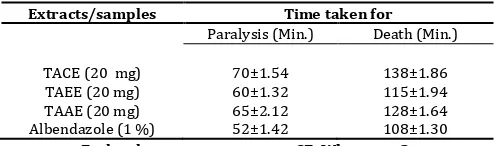
The crude extracts were screened for anthelmintic activity against
P.posthuma owing to its resemblance in all the way with the intestinal parasites. In the study, the effectiveness of drug was judged on the basis of loss of spontaneous movement or death of trematodes. Anthelmintic activities of all the extracts are represented in Table 5. Among all the extracts, TAEE activity was more significant than TACE and TAAE activity.
Table 5: Anthelmintic activities of T. arjuna stem bark extracts
Extracts/samples Time taken for
Each value represents mean±SE, Where, n= 3.
The ethanol extract showed more significant effect on paralyzing the worms, in terms of paralysis time, at every concentration compared to that of water and chloroform extracts. Similar observations were made in the anthelmintic activity as well. The ethanol extract exhibited an increased paralytic as well as helminthiatic effect over albendazole at the given experimental concentrations. This may be due to the increased level of polyphenols in ethanol followed by aqueous and chloroform extracts.
CONCLUSION
In conclusion, the extracts TACE, TAEE and TAAE of T.arjuna
emerged as potentially active antioxidants and also tend to be possesses good anthelmintic activity. Hence, this plant can be used as a source of pharmaceutical agent. The current analysis has also opened a path for further research especially with reference to the development of potent herbal formulation and purification of the active components present in these plant extracts.
ACKNOWLEDGMENT
Authors are very grateful to University Grant Commission (UGC F.No.37-260/2009 (SR), New Delhi for financial assistance.
REFERENCES
1. Saswati Roy, Dutta Choudhury M, Paul S.B. Antioxidant Potential of Rhizome of Alocasia Decipiens Schott. Asian J Pharm Clin Res 2013; 6(2):120-122.
2. Ramesh B, Karuna R, Sreenivasa RS, Haritha K, Sai MD, Sasi BB, Saralakumari D. Effect of Commiphora mukul gum resin on hepatic marker enzymes, lipid peroxidation and antioxidants status in pancreas and heart of streptozotocin induced diabetic rats. Asian Pacific Journal of Tropical Biomedicine 2012; 2(11):895-900.
3. Gyo-Nam K, Jung-Geun S, Hae-Dong J. Antioxidant and antidiabetic activity of Dangyuja (Citrus grandis Osbeck) extract treated with Aspergillus saitoi. Food Chemistry
4. Jung M, Park M, Lee HC, Kang YH, Kang ES, Kim SK.
Antidiabetic agents from medicinal plants. Curr Med Chem. 2006; 13(10):1203-18.
5. Rabyah BA, Item JA, Navneet K, Elsnoussi AHM, Ali JM, Mohd ZA and Roziahanim M. Hypoglycemic and anti-hyperglycemic study of Phaleria macrocarpa fruits pericarp. J. Med. Plants Res 2012; 6(10):1982-1990.
6. Kunyanga CN, Imungi JK, Okoth M, Momanyi C, Biesalski
HK, Vadivel V. Antioxidant and antidiabetic properties of condensed tannins in acetonic extract of selected raw and processed indigenous food ingredients from Kenya. J Food Sci 2011; 76(4):560-567.
7. Kumar DS and Prabhakar YS. On the ethnomedical
significance of the arjun tree, Terminalia arjuna (Roxb.) Wight and Arnot. J Ethnopharmacol 1987; 20:173–190. 8. Ragavan B, Krishnakumari S. Antidiabetic effect of T.
Arjuna bark extract in alloxan induced Diabetic rats. Indian Journal of Clinical Biochemistry 2006; 21(2):123-128.
9. Alawa JP, Jokthan GE, Akut K. Ethnoveterinary practice for ruminants in the sub humid zone of northeren Nigeria. Prev Vet Med. 2002; 54(1):79-90.
10. Doorika P and Ananthi T. Antioxidant and
Hepatoprotective properties of Terminalia arjuna Bark on Isoniazid Induced Toxicity in Albino rats. Asian J. Pharm. Tech 2012; 2(1):15-18.
Activity of Desert Plants of Apocynaceae Family. Asian J Pharm Clin Res 2012; 5(1):75-83.
12. Maxwell SRJ. Prospects for the use of antioxidant
therapies. Drugs 1995; 49: 345–361.
13. satheesh kumar D, Kottai muthuand A, Manavalan R. In-vivo antioxidant and lipid peroxidation effect of whole plant of Ionidium suffruticosum (ging.) In rats fed with high fat diet. Asian J Pharm Clin Res 2012; 5(2):132-135. 14. Dipankar Chaudhuri, Nikhil Baban Ghate, Rhitajit Sarkar,
Nripendranath Mandal. Phytochemical analysis and evaluation of antioxidant and free radical scavenging activity of Withania somnifera root. Asian J Pharm Clin Res 2012; 5(4):193-199.
15. Sanchez-Moreno C, Larrauri JA, Saura-Calixto F. Free radical scavenging capacity and inhibition of lipid oxidation of wines, grape juices and related polyphenolic constituents. Food Research International 1999; 32:407– 412.
16. Mehta preeti, phutane shweta, sutar shreyas. In vitro anthelmintic activity of whole plant of ventilago denticulata willd. Against pheretima posthuma. Asian J Pharm Clin Res 2012; 5(3):200-201.
17. Coles GC. Nematode control practices and anthelmintic resistance on British sheep farms, Vet Rec 1997 Jul 26; 141(4):91-93.
18. Narendhirakannan RT, Subramanian S and Kandaswamy
M. Mineral Content of Some Medicinal Plants Used in the Treatment of Diabetes Mellitus. Biol Trace Elem Res 2005; 103(2):109-15.
19. Kokate C.K. Practical Pharmacognosy. Vallabh Prakashan,
New Delhi; 1994:107–113.
20. Harborne, J.B. Phytochemistry. Academic Press, London; 1993: 89-131.
21. Singleton VL, Rossi JA. Colorimetry of total phenolics with phosphomolybdic and phosphotungtic acid reagents. Am. J. Enol. Vitic 1965; 16(3):144-158.
22. Zhishen J, Mengcheng T, Jianming W. The determination of flavonoid content in mulberry and their scavenging effects on superoxide radicals. Food Chemistry1999; 64(4):555-559.
23. Prieto P, Pineda M, Aguilar M. Spectrophotometric
quantitation of antioxidant capacity through the formation of a phosphomolybdenum complex: specific application to the determination of vitamin E. Anal Biochem 1999; 269(2):337-41.
24. Oyaizu M. Studies on product of browning reaction
prepared from glucose amine. Japanese Journal of Nutrition 1986; 44:307–315.
25. Braca A, Tommasi, Nunziatina D, Bari LD, Pizza, Cosimo, Politi, Mateo, Morelli I. Antioxidant principles from Bauhinia terapotensis. J. of Natural Products 2001; 64:892–895.
26. Dinis TC, Maderia VM, Almeida LM. Action of phenolic
derivatives (acetaminophen, salicylate, and
5-aminosalicylate) as inhibitors of membrane lipid peroxidation and as peroxyl radical scavengers. Arch Biochem Biophys 1994; 315(1):161-169.
27. Ajaiyeoba EO, Onocha PA, Olarenwaju OT.
In-vitro anthelmintic properties of Buchholzia
coiaceaeand Gynandropsis gynandra extract. Pharm Biol 2001; 39(3):217–20.
28. Kiran Yasmin Khan, Mir Ajab Khan, Rabia Niamat,
Mamoona Munir, Hina Fazal, Paras Mazari, Nighat Seema, Tasmia Bashir, Ammarah Kanwal, Sidra Nisar Ahmed. (2011) Element content analysis of plants of genus Ficus using atomic absorption spectrometer. Afr. J. Pharm. Pharmacol 2011; 5(2):317 – 321.
29. Padmaa M. Paarakh.Terminalia arjuna (Roxb.) Wt. and Arn.: A Review. Int. J. pharmacol 2010; 6(5):515-534. 30. Eldeen IM, Van Heerden FR, Van Staden J. Isolation and
biological activities of termilignan B and arjunic acid from
Terminalia sericea roots. Planta Med 2008 ; 74(4):411-413.
31. Sun FY, Chen XP, Wang JH, Qin HL, Yang SR, Du GH.
Arjunic acid, a strong free radical scavenger from
Terminalia arjuna. Am J Chin Med 2008; 36(1):197-207. 32. Singh DV, Gupta MM, Tripathi AK, Prajapati V, Kumar S.
Arjunetin from Terminalia arjuna as an insect feeding-deterrent and growth inhibitor. Phytother Res 2004; 18(2):131-134.
33. Sai Ramesh A, Godwin Christopher J, Setty C.R,
Thankamani V. In-vitro study on antioxidant property of Arjunolic acid. Journal of Pharmacognosy & Herbal Formulations 2010; 1(1):1-11.
34. H.s. Vishwanath, k.r. Anilakumar, s.n.harsha, farhath khanum and a.s. Bawa. In vitro antioxidant activity of sesamum indicum seeds. Asian J Pharm Clin Res 2012; 5(1):56-60.