CSEIT172471 | Received : 18 July 2017 | Accepted : 29 July 2017 | July-August-2017 [(2)4: 309-314]
International Journal of Scientific Research in Computer Science, Engineering and Information Technology © 2017 IJSRCSEIT | Volume 2 | Issue 4 | ISSN : 2456-3307
309
Automatic Irrigation System for Smart City Using PLC AND
SCADA
Gaddipathi Bharathi
*1, Chippada Gnana Prasunamba
21
Associate Professor,Department of MCA , St. Mary's Group of Institutions, Guntur, Andhra Pradesh, India
2
PG Student, Department of MCA , St. Mary's Group of Institutions, Guntur, Andhra Pradesh, India
ABSTRACT
Sustainability of clean water resource has been a big issue being discuss lately. From the reason of lack of resources to the attitude of end user that frequently waste clean water, the problem seems not having any improvement on finding ways to at least contain it from increasing. The problem is related to poor water allocation and monitoring, inefficient use, wastage and lack of adequate integrated water management. There are some Reason that this cannot be controllable such as raw resources and the attitude of end user. However, there is an area that we can at least control it to the lowest level possible by applying better technology and management. The area that can be improved is the monitoring and management of water storage and distribution. Usually we see water pipe leaks, which results in a fountain of burst water. As a result, there will be a water shortage problem because of the pressure lost, which prevents the water from being supplied to the storage tank. By applying the automation system such as SCADA with the integration of Fuzzy control to control water storage, the management of water distribution and monitoring can be improved thus resulting in reducing the level of water wastage and maintaining the supply of clean water.
Keywords: Water management, Irrigation, OPC UA, Internet of Things
I.
INTRODUCTION
Water management is defined as the activity of planning, developing, distributing and managing the optimum use of water resources. These impacts on several key matters [1] of human lives, such as food production, water consumption, sewage treatment, irrigation, purification, energy generation and utilization, etc.
The lack of water ICT (Information and communications technology) standards prevents an effective interoperability, and increases the cost and the maintenance of new products. Nowadays there are many small and local producers of specific solutions in a weak and fragmented market. The almost no adoption of complex and interoperable systems jeopardizes the control and monitoring of water distribution networks, preventing also their evolution and necessary
improvements, as an adoption of IoT (Internet of Things) paradigm.
In addition, current ICT systems for water management are proprietary and packed as independent products; support all management levels from the product development to the communication with management systems. System maintenance and sustainability depends on the company providing it. This entails the SMEs (Small and medium-sized enterprises) that develop water management ICT systems and tools may not enter the water market even with powerful solutions without considering a complete system that jeopardize their strengths.
manufacturers. The most recent version of OPC (OPC UA) is based on web services technology, so OPC UA becomes platform-independent and can thus be applied in scenarios where classic OPC is not used.
In this work, we complete the smart water management model that we proposed on [2]. In our previous work, we defined an Internet of Things-based model for smart water management using OPC UA. This previous work has been extended by the provision of a detailed architecture in which we consider IoT technologies for decoupling decision support systems and monitoring from business processes coordination and subsystem implementation. This functional architecture considers several layers and interfaces to enable layer interaction. We also extended our reference model describing a practical use case defining how the MEGA architecture is used to develop a simple water management process control by using recipes, and explaining more practical aspects of our validation scenario, held in a water management experimental station in Zaragoza, Spain.
The rest of the paper is as follows: Section 2 proposed a high level architecture based on industrial challenges, water management requirements and OPC UA functionalities; Section 3 describes the integration of IoT into the water management system; Section 4 develops the reference model for smart water management, comes up with a simple use case, and finally analyses current water management scenario and future implementation.
II.
METHODS AND MATERIAL OVERVIEW OF
SYSTEM
1. Existing Technology: Traditionally, In PCMC area the water distribution infrastructure is widely spread effectively. Now-a-days, Water distribution system faces some problems like water leakage & improper water supply. This leakage causes drastic reduction in pressure of water flowing through supply line. Due to this, consumer gets less amount of water. Hence, their need to develop the system to overcome such problems.
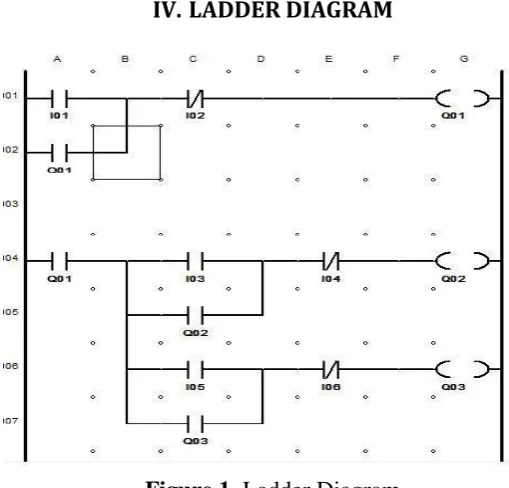
2. Need for PLC: Programmable Logic Controller is the heart of automated water supply system. PLC helps in controlling pump station motor contactors, stirrer motors, and distributed valves as well as to measure pressure transmitter of the water. PLC programming is done using Ladder Diagram
Language. Ladder diagram is specialized schematic language commonly used to document industrial control logic systems.
On level, pressure, flow parameters and it also minimizes human efforts for the same. If there is any problem in system then using SCADA system, we can detect problem easily.
Integrating IoT in water management
Contributing to solutions that integrate the Internet of Things paradigm into water management processes can be beneficial to address expected solutions. The rest of this Section describes the main benefits of adopting IoT and the IoT characteristics that are considered in the proposed MEGA model, considering new advances on ICT technologies for creating feasible and commercial systems [9].
Mark Weiser defined a ”Smart Environment” [10] as - the physical world that is richly and invisibly interwoven with sensors, actuators, displays, and computational elements, embedded seamlessly in the everyday objects of our lives, and connected through a continuous network. There are many research works that contributes to solve various issues in Smart Environments, such as seamless access to re-sources and devices [11], distributed service executions [12], social choice techniques [13], etc. Other works explains how IoT is based on three paradigms - internet-oriented (middleware), things oriented (sensors) and knowledge-oriented (semantics) [14]. Although this type of delineation is required due to the interdisciplinary nature of the subject, the usefulness of IoT can be unleashed only in an application domain where the three paradigms intersect.
IoT for Water Management
The provision of Internet of Things capabilities in water management scenarios can be achieved if we consider some considerations from the business, social and technical point of view. Here we list the main benefits of providing IoT in water management scenarios:
actuators to monitor and improve water management infrastructures, making them more efficient, reducing energy costs and minimizing human intervention.
Cost savings: water management costs can be reduced through improved asset utilization, process efficiencies and productivity. Customers and organizations can benefit from improved asset utilization (e.g., smart water irrigation units that eliminate manual operation) and service improvements (e.g., re-mote monitoring of irrigation conditions)
Asset utilization: with improved tracking of assets (machinery, equipment, tools, etc.) using sensors and connectivity, companies can benefit from transparency and visibility into their assets and supply chains. They can easily locate assets and run preventive maintenance on critical pieces of infrastructure and machinery.
Productivity increase: Productivity is a critical parameter that affects the profitability of any organization. IoT allows real-time control, new business models, process optimization, resource conservations, service time reduction, and the capability to do all of this globally, reducing the mismatch of required vs. available skills and improving labor efficiency.
Expansion of new and existing business models: IoT is beneficial in any of the three defined layers. In the subsystem layer, IoT subsystems are able to execute processes and communicate using a standard communication interface; in the coordination layer, it can be useful to enable SMEs to design new coordination applications, with the purpose to orchestrate the management and exploitation layer with the subsystem layers; and finally, in the management and exploitation layer, IoT identification capabilities contribute to provide tailored information services for an specific water distribution network community.
As we explained before, IoT builds on three pillars [14]: Internet orientation, thing orientation, and knowledge orientation. We link these pillars with the ability of objects to (i) be identifiable (anything identifies itself), (ii) communicate (anything communicates) and (iii) to interact (anything interacts), either among themselves, building networks of interconnected objects, or with end-users or other entities in the network. The proposed MEGA model considers these properties:
Internet-oriented: the proposed MEGA model identifies three layers (see Figure.). These layers are communicated with two web interfaces enabling the definition of a flexible and scalable communication system for controlling the huge amount of subsystems to be required for a complete water management system.
The Coordination and Management - Exploitation layers are defined as Cloud services. IoT, as a broader vision of the previous concept of machine-to-machine (M2M) communications, is gaining support by current Cloud computing infrastructures, which begin to provide so-called cloud-based IoT solutions.
Furthermore, subsystem capabilities (i.e. sensing, actuating, computing and communication technologies) depend on the specific conditions of the scenarios in which they are deployed. A seamless access to subsystems will require that the Subsystems layer include homogenization through a large diversity of communication paradigms and higher granularity, to deal with many communication technologies.
Thing-oriented: Due to previous experiences of the development of systems for water management, the most granular element to be accessible is the subsystem. It is expected higher granularity in the coming years, as many devices and interrelations compose subsystems, as we describe in the physical and process models of Section 4. These elements can be redefined as Smart Objects, being objects, which are able to describe its own possible interactions. Smart Object may provide the following information: Object properties (physical properties and a text description), behavior (different behaviors based on state variables) and interaction information (current state of dials, gauges, switches, etc.).
It is important to define how subsystems as smart object containers fulfill the features identified by [14] and [15]. Subsystems define and provide object identification, to do that they must incorporate
Knowledge-oriented: Due to the large heterogeneity of subsystems for water management, it is important to model the characteristics that these subsystems have in common, and their behavior. In this work, we provide a physical model, defining the physical elements executing water management processes in a hierarchical way, and a process model, organizing the execution of particular processes in water management subsystems. Based on these models, smart execution of water management processes is supported through collaboration between subsystems and the Coordination layer, based on the interchange of information among them (see Figure. 3). Thanks to knowledge, provision systems can be monitored to facilitate public entities tracking the fulfillment of regulations. Information to be monitored is autonomously provided by the subsystems based on sensor capabilities. These models can be enriched with semantics to describe, share, and integrate information, inferring new knowledge related to water management and irrigation processes. Semantics also helps to create machine-interpretable and self-descriptive data in the IoT domain. Semantic descriptions can support data integration by enabling interoperability between different data sources (sensors, devices); however, analysis and mapping between different semantic description models is still required to facilitate the IoT data integration with other existing domain knowledge.
III.
CONSTRUCTION & WORKING
A. Block Diagram:
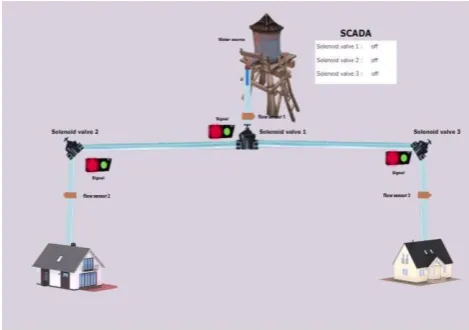
Figure 1.
Block Diagram
B. Proposed System
Figure 2.
Proposed System
C. Components
1. A programmablelogiccontroller,(PLC)or
Programmable controller is a digital computer used for automation of typically industrial electromechanical processes, such as control of machinery on factory assembly lines, amusement rides, or light fixtures. PLCs are used in many machines, in many industries. PLCs are designed for multiple arrangements of digital and analog inputs and outputs, extended temperature ranges, immunity to electrical noise, and resistance to vibration and impact. Programs to control machine operation are typically stored in battery-backed-up or non-volatile memory. A PLC is an example of a "hard" real-time system since output results must be produced in response to input conditions within a limited time, otherwise unintended operation will result.
A solenoid valve is an electromechanically operated valve. The valve is controlled by and electric current through a solenoid in the case of a two-port valve the flow is switched on or off; in the case of a three-port valve, the outflow is switched between the two outlet ports. Multiple solenoid valves can be placed together on a manifold.
2. SCADA is used to monitor and control field instruments. It provides intelligence in the field equipment allow to communicate with SCADA unit. WinCC Simatic HMI is used to configure the hardware and process status is displayed on the SCADA screen.
i. Power Supply:
Input Voltage: 85-132 or 170-264.
Output Voltage: 24VDC @ 4.5A.
AC input range selectable by switch.
Protections: short circuit/over load/over voltage.
Approvals: UL / TUV / CB / CE.
Cooling by free air convection.
Fixed switching frequency at 83kHz.
100% full load burn-in test.
IV.
LADDER DIAGRAM
Figure 1.
Ladder Diagram
V.
FUTURE SCOPE
Future work deals with tasks such as water level detection and intimation of less volume of water in main tanks which are gathered from other tanks located in different places. GSM module can be used for status updates on mobile. In future this system can be modified as, it will detect the exact location of pressure drop and this system can also be applied to other remaining ESR„s for proper water distribution.
VI.
CONCLUSION
Extensive growth of population development and technology has leads to the need of proper utilization of the natural resources especially water. Thus our proposed system and the review of all the possible implementation of technology is the first step toward prevention and proper utilization of water. To overcome the problem of the water theft vandalism and mainly the automation in water distribution system is successfully implemented. The review of automated water distribution system with the various controllers and parameters focuses on the entities such as proper supply, red alarm pop-ups, filtration, flow control, supervision using various protocols is concluded with the future aspects of real time implementation in the municipal corporations where scarcity of water is the huge issue.
The project discussed here is PLC controlled Water Distribution System. The conventional method used before in older times, results into problems like empty running, overflow, leakage. The automation of the process thus helped to overcome this problems based on level, pressure, flow parameters and it minimizes human efforts for the same. The automation thus implanted at the PCMC Water Treatment Plant has proved to be effective. In this project, we have successfully studied the following objectives. Thus, we have successfully studied the programming by using ladder diagram using online simulators. We have used Nexgine 2000 PLC and programming software is Coveys. We have also introduced to central monitoring system using SCADA and HMI for this application.
VII.
REFERENCES
[1] United Nations. Global Sustainable Development Report - Executive Summary: Building the Common Fu-True We Want. New York: United Nations Department of Economic and Social Affairs, Division for Sustain-able Development. 2013.
http://sustainabledevelopment.un.org/globalsdrepo rt/, last viewed November 2014.
Workshops (WAINA‟14), Victoria, Canada. IEEE, May 2014, pp. 821–826.
[3] HollandTrade, homepage:
http://www.hollandtrade.com/, last viewed November 2014, 2014.
[4] Association of Water Technologies, homepage: http://www.awt.org/, last viewed November 2014, 2014.
[5] EU Water Framework Directive (Directive 2000/60/EC), 2000.
[6] TRAGSA group home page: http://www.tragsa.es/en/, last viewed November 2014.
[7] MEGA project homepage:
http://www.gestiondelagua.es/en/, last viewed November 2014.
[8] OPC homepage: https://opcfoundation.org, last viewed November 2014.
[9] J. Gubbi, R. Buyya, S. Marusic, and M. Palaniswami, “Building the common future we want,” United Nations Department of Economic and Social Affairs, 2013.
[10] M. Weiser, R. Gold, and J. S. Brown, “The Origins of Ubiquitous Computing Research at PARC in the Late 1980s,” IBM Systems Journal, vol. 38, no. 4, pp. 693–696, December 1999. [11] R. Alcarria, T. Robles, A. Morales, D. L. de
Ipina,˜ and U. Aguilera, “Enabling flexible and continuous capability invocation in mobile prosumer environments,” Sensors, vol. 12, no. 7, pp. 8930–8954, June 2012.
[12] R. Alcarria, T. Robles, A. Morales, and E. Cedeno,˜ “Resolving coordination challenges in distributed mobile service executions,” International Journal of Web and Grid Services, vol. 10, no. 2, pp. 168–191, January 2014. [13] E. Serrano, P. Moncada, M. Garijo, and C.
Iglesias, “Evaluating social choice techniques into intelligent environments by agent based social simulation,” Information Sciences, vol. 286, pp. 102–124, December 2014.
[14] L. Atzori, A. Iera, and G. Morabito, “The Internet of Things: A survey,” Computer Networks, vol. 54, no. 15, pp. 2787–2805, October 2010.
[15] D. Miorandi, S. Sicari, F. D. Pellegrini, and I. Chlamtac, “Internet of things: Vision, applications and research challenges,” Ad Hoc Networks, vol. 10, no. 7, pp. 1497–1516, September 2012.
[16] AENOR EN 61512: Batch control – Part 2: Data structures and guidelines for languages, 2002. [17] AENOR EN 62264: Enterprise-control system
integration - Part 1: Models and terminology, 2013.
[18] M. Melik-Merkumians, T. Baier, M. Steinegger, W. Lepuschitz, I. Hegny, and A. Zoitl, “Towards OPC UA as portable SOA middleware between control software and external added value applications,” in Proc. of the 17th IEEE Conference on Emerging Technologies and Factory Automation (ETFA‟12), Krakow,´ Poland. IEEE, September 2012, pp. 1–8.
[19] J. Imtiaz and J. Jasperneite, “Scalability of OPC-UA down to the chip level enables Internet of Things,” in Proc. of the 11th IEEE International Conference on Industrial Informatics (INDIN‟13), Bochum, Germany. IEEE, July 2013, pp. 500–505.