Integrating Word Embedding Offsets into the Espresso System
for Part-Whole Relation Extraction
Van-Thuy Phi
Nara Institute of Science and Technology
Computational Linguistics Laboratory
8916-5 Takayama, Ikoma, Nara Japan
[email protected]
Yuji Matsumoto
Nara Institute of Science and Technology
Computational Linguistics Laboratory
8916-5 Takayama, Ikoma, Nara Japan
[email protected]
Abstract
Part-wholerelation, ormeronymyplays an im-portant role in many domains. Among ap-proaches to addressing the part-whole relation extraction task, the Espresso bootstrapping al-gorithm has proved to be effective by signif-icantly improving recall while keeping high precision. In this paper, we first investigate the effect of using fine-grained subtypes and careful seed selection step on the performance of extracting part-whole relation. Our multi-task learning and careful seed selection were major factors for achieving higher precision. Then, we improve the Espresso bootstrapping algorithm for part-whole relation extraction task by integrating word embedding approach into its iterations. The key idea of our ap-proach is utilizing an additional ranker com-ponent, namely Similarity Ranker in the In-stances Extraction phase of the Espresso sys-tem. This ranker component uses embedding offset information between instance pairs of part-whole relation. The experiments show that our proposed system achieved a precision of 84.9% for harvesting instances of the part-whole relation, and outperformed the original Espresso system.
1
Introduction
A major information extraction task is relation ex-traction, whose goal is to predict semantic relations between entities or events expressed in the struc-tured or unstrucstruc-tured text. There are several dif-ferent kinds of semantic relations that connect two or more concepts. Among those semantic relations,
part-wholerelation, ormeronymyplays an important
role in many domains and applications. Extracting part-whole relations in the text is also a crucial step towards applications in several fields, such as In-formation Extraction, Web/Text Mining and Ontol-ogy Building. Such systems often need to recognize part-whole relations for better understanding seman-tic relationships between concepts. Therefore, in our research, we aim at extraction of part-whole relation. We are interested in relations between entities in the newswire domain.
Among approaches to addressing the part-whole relation extraction problem, the Espresso bootstrap-ping algorithm (Pantel and Pennacchiotti, 2006) has proved to be effective by significantly improving re-call while keeping high precision. Espresso is a well-known bootstrapping algorithm that uses a set of seed instances to induce extraction patterns for the target relation and then acquire new instances in an iterative bootstrapping manner. Nevertheless, it has a bias, called semantic drift,to select unrelated in-stances if a polysemous instance has been extracted as the iteration proceeds.
Recently, Mikolov et al. (2013) have intro-duced the skip-gram text modeling architecture. It has been shown efficiently to learn meaningful dis-tributed representations of terms from unannotated text. The vectors have some of the semantic char-acteristics in element-wise addition and tion. For example, the result of a vector subtrac-tion vec(“Madrid”) - vec(“Spain”) is close to vec-tor subtraction vec(“Paris”) - vec(“France”). That is an example ofthe country to capital city relation-ship. It indicates that the embedding offsets repre-sent the shared semantic relation between the two
dress two important questions:
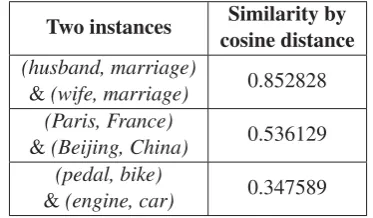
1. Is Word2Vec model appropriate for pairs of part-whole relation? That is, we investigate typi-cal instances of part-whole relation to measure their similarities by cosine distance.
2. How to integrate Word2vec model efficiently into the Espresso system?
The details of our contribution are as follows:
• We apply the Espresso bootstrapping algorithm for part-whole relation, and study the effect of using careful seed sets and fine-grained sub-types on the performance of extracting part-whole relation.
• We investigate similarities between two stances of the part-whole relation. Then, we in-tegrate an additional ranker component into the Espresso bootstrapping algorithm to improve the performance when using iterative boot-strapping process and reduce semantic drift phenomenon for extracting part-whole relation. That ranker component uses similarity score between embedding offsets to keep similar in-stances in each iteration.
To the best of our knowledge, ours is the first study to integrate word embedding approach in a bootstrapping algorithm for part-whole relation ex-traction task.
2
Related Work
In this section, we provide an overview of previ-ous studies related to relation extraction problem. Approaches for relation extraction are divided into three classes: rule-based methods, supervised ods, and semi-supervised and unsupervised meth-ods.
The first approach is usually used in domain-specific tasks. Systems which use this one rely on some linguistic rules to capture patterns in text. Pat-terns are manually defined for a particular seman-tic relation. Hearst (1992) describes the usage of
relations, for example, meronymy (part-whole rela-tion).
Supervised approaches for relation extraction are divided into feature-based methods and kernel meth-ods. In feature-based methods, syntactic and seman-tic features can be extracted from the text given a set of positive and negative relation examples. Kamb-hatla (2004) employs Maximum Entropy model to combine diverse lexical, syntactic and semantic fea-tures derived from the text in relation extraction. Zhou et al. (2005) explore various features in relation extraction using Support Vector Machine (SVM). They report that chunking information con-tributes to most of the performance improvement from the syntactic aspect. In kernel methods, a ker-nel is used to calculate the similarity between two objects. Kernel-based relation extraction methods were first attempted by Zelenco et al. (2003). They devise contiguous subtree kernels and sparse sub-tree kernels for recursively measuring the similarity of two parse trees to apply them to binary relation extraction. Bunescu and Mooney (2005) present a different kernel based on the shortest path between two relation entities in the dependency graph. Zhao and Grishman (2005) define a feature-based com-posite kernel to integrate diverse features for rela-tion extracrela-tion. Girju et al. (2006) present a domain independent approach for the automatic extraction of part-whole relation. Their method discovers the lexico-syntactic patterns and the semantic classifi-cation rules needed for the disambiguation of these patterns.
the knowledge base, from which they first select a seed set of reliable patterns. Other works include Espresso bootstrapping algorithm (Pantel and Pen-nacchiotti, 2006), TextRunner (Yates et al., 2007).
3
Part-Whole Relation Extraction Task
The part-whole relation is a relationship between the parts of things and the wholes which comprise them. We are interested in relations between two entities in the English newswire domain. If the entities X and Y are related in such a manner that X is one of the constituents of Y, then there is a part-whole relation between X and Y. In the context of knowledge rep-resentation and ontologies, the study of part-whole relations has three axioms (Rector et al., 2005):
• Transitive - “parts of parts are parts of the whole” - If A is part of B and B is part of C, then A is part of C.
• Reflexive - “Everything is part of itself” - A is part of A.
• Antisymmetric - “Nothing is a proper part of its parts” - if A is part of B and A != B then B is not part of A.
Given a piece of text that contains two entity men-tions, the goal of part-whole relation extraction task is to decide whether that text contains part-whole re-lation between the two entities. Let the triple T = (arg1, P, arg2)denote a part-whole relation, where
arg1andarg2are two entities contained in text, and:
• Pis a lexical pattern,
• (arg1, arg2)is an instance, wherearg1 repre-sents the part andarg2represents the whole, or vice versa.
4
Our Approach
One problem of supervised approach is that it re-quires large amounts of annotated data. Therefore, we choose a bootstrapping method. In this approach, we only need a few high-precision examples as the input.
In this section, we first describe how we apply the Espresso bootstrapping algorithm for part-whole relation. We focus on seed selection since it is
one of the most important steps in bootstrapping al-gorithms. Then, we propose an effective method for integrating word embedding approach into the Espresso system, after similarity between instances of part-whole relation were investigated.
4.1 The Espresso Bootstrapping Algorithm for Part-Whole Relation
Currently, Espresso (Pantel and Pennacchiotti, 2006) is well known as an efficient algorithm for ex-tracting pairs of entities in a particular relationship. It is a pattern-based and minimally supervised boot-strapping algorithm of extracting lexical-semantic relations. It takes as input a few seed instances and iteratively learns surface patterns to acquire more in-stances. The Espresso bootstrapping algorithm iter-ates between the following 3 phases:
1. Pattern Induction: Induce a set of patterns
P that connects the seed instances in a given cor-pus. Patterns may be surface text patterns or lexico-syntactic patterns.
2. Pattern Ranking/Selection: Create a pattern ranker, and select the top-k patterns by pattern reli-ability score. The relireli-ability of a pattern p,rπ(p)is average strength of association across input i in the set of instancesI, weighted by the reliability of each instance i:
rπ(p) =
i∈I(pmimax(i, ppmi)∗rι(i))
|I| (1)
whererι(i)is the reliability of instance i (defined be-low) andmaxpmiis the maximum pointwise mutual information between all patterns and all instances. The value ofrπ(p)ranges from [0, 1], and the reli-ability of the manually provided seed instances are rι(i) = 1. The pointwise mutual information (PMI) between instancei = (x, y)and patternpis measured using the following formula:1
pmi(i, p) =log |x, p, y| |x, ∗, y||∗, p, ∗|
where|x, p, y|is the frequency of pattern p linked with the instance (x, y). Then,pmi(i, p)is multi-plied with the discounting factor used in (Pantel and Ravichandran, 2004) to mitigate a bias towards in-frequent events.
1In that formula, the asterisk (*) represents a wildcard.
Calculating the reliability of an instance is similar to calculating the reliability of a pattern. The reliability of an instance i,rι(i), is defined as:
rι(i)=
p∈P(pmimax(i, ppmi)∗rπ(p))
|P| (2)
A reliable instance should be highly associated with as many reliable patterns as possible. Espresso iterates the above three phases several times until stopping criteria are met.
Unfortunately, like other bootstrapping algo-rithms, Espresso is prone to semantic drift. This phenomenon often occurs when ambiguous or un-related terms and/or patterns are acquired and then dominate the iterative process (Curran et al., 2007). Ranking patterns and instances by their reliability is an effective way to avoid semantic drift (Equa-tions (1) and (2)). However, bootstrapping is indeed a seed set expansion, therefore selecting good seeds is the most important step to reduce semantic drift. Moreover, semantic drift still occurs in later itera-tions if the seed set is not good.
To cover the variety of part-whole relation, we classify its subtypes systematically before the seed selection step. There are several subtypes of part-whole relation mentioned in previous ontological studies. In WordNet, part-whole relation is clas-sified into 3 basic subtypes: Stuff-of, Member-of, and Part-of. Chaffin et al. (1988) defined 7 sub-types of part-whole relation, namely Component-Object, Member-Collection, Portion-Mass, Stuff-Object, Feature-Activity, Place-Area, and Phase-Process. In recent research, Keet and Artale (2008) identified 8 subtypes of part-whole rela-tion. From their taxonomy, Mereological (or transitive) relations include Involved-In, Located-In, Contained-In, and Structured-Part-Of; while Meronymic (or intransitive) relations consist of
Member-Of, Constituted-Of, andSub-Quantity-Of. We reorganize subtypes of part-whole relation as follows:
1.Component-Of: or Part-Of; between integrals and their functional components, e.g.(finger, hand).
amounts of matter or units, e.g.(oxygen, water). 4. Stuff-Of: or Substance-Of, or Constituted-Of; between a physical object and an amount of matter, e.g.(steel, car).
5. Located-In: between an entity and its 2-dimensional region, e.g.(Tokyo, Japan).
6. Contained-In: between an entity and its 3-dimensional region, e.g.(chip, processor).
7.Phase-Of: or Involved-In, or Feature-Activity; between a phase and a process, e.g. (chewing, eat-ing).
8. Participates-In: between an entity and a pro-cess, e.g.(enzyme, reaction).
Basically, our classification is similar to Keet and Artale’s taxonomy, which also contains subtypes in other ontological studies. However, we normalize name of subtypes, to find a coherent name set over studies, for example, in WordNet or in (Chaffin et al., 1988).
Seed Selection: We use the following strategy to select seeds for part-whole relation:
• First, for each subtype, we find unambigu-ous lexical patterns that always convey a part-whole relation, for example, “a component of”, “consist of”, etc.
• Then, we search for instances pairs (e.g. Wikipedia dataset) connected by patterns above.
• We select at most 5 instances for each subtype. The most frequent pairs are selected, and we try to select pairs that do not overlap each other. Also, we try not to extract the same instances crossing over the subtypes.
Then, we use simultaneously all the instances to perform the Espresso bootstrapping algorithm for part-whole relation extraction task.
4.2 Similarity Between Instances of Part-Whole Relation
charac-teristics in operations regarding the semantic infor-mation that they capture, for example, the coun-try to capital city relationship: vec(“Madrid”) -vec(“Spain”) ≈ vec(“Paris”) - vec(“France”), or
gender relationship: vec(“woman”) - vec(“man”)≈ vec(“queen”) - vec(“king”). They indicate that the embedding offsets actually represent the shared se-mantic relation between the two word pairs.
Can we apply those characteristics for part-whole relation, for example, vec(“pedal”) - vec(“bike”)≈ vec(“engine”) - vec(“car”)? To answer this ques-tion, we investigate typical instances of part-whole relation to measure their similarities by cosine dis-tance. Our calculation is mainly based on the re-cently proposed Word2vec model. We useword2vec
tool, and pre-trained vectors published by Google.2 The model contains 300-dimensional vectors for 3 million words and phrases.
The Word2vec model gives us a vector for each word. To measure the similarity between two in-stances of part-whole relation, for example,(pedal, bike) and (engine, car), we first compute the em-bedding offsets between two terms in instances, that is, calculate vec(“pedal”) - vec(“bike”) and vec(“engine”) - vec(“car”). Then, we calculate the cosine distance between those embedding offsets. Here, the bigger the cosine value is, the more similar the two instances will be.
Two instances Similarity by cosine distance (husband, marriage)
&(wife, marriage) 0.852828 (Paris, France)
&(Beijing, China) 0.536129 (pedal, bike)
&(engine, car) 0.347589
Table 1: Similarities between two instances of part-whole relation
In Table 1, we show the similarities between two instances of the part-whole relation. The part-whole relation is a combination of several subtypes; thefore, it is more complicated than other semantic re-lations. From the results in Table 1, we can see that instances of part-whole relation are quite similar by
2https://code.google.com/p/word2vec/
cosine distance: vec(“husband”) - vec(“marriage”) ≈ vec(“wife”) - vec(“marriage”); vec(“pedal”) -vec(“bike”)≈vec(“engine”) - vec(“car”), etc. That means the instance(husband, marriage)is close to the instance (wife, marriage), the instance (pedal, bike)is close to the instance(engine, car), etc., in se-mantic space. Therefore, we can leverage such char-acteristic to apply for part-whole relation extraction task.
4.3 Integrating Word Embedding Offsets into the Espresso Bootstrapping Algorithm
In the Espresso bootstrapping algorithm, ranking in-stances in Instance Extraction phase is very impor-tant. The Espresso system creates an instance ranker to keep only high-confidence instances at this phase, as they are used as seed instances for the next itera-tion.
By using word embedding approach, our purpose is to keep high-precision over iterations for part-whole relation extraction task. The key idea of our approach is utilizing an additional ranker compo-nent, namelySimilarity Rankerin the Instances Ex-traction phase of the Espresso system. We still use the reliability of instances in the first ranker. Similar-ity Ranker operates when the instance ranker is com-pleted. It takes top-m instances from the instance ranker as the input and returns top-n instances as the output. This ranker component uses cosine dis-tance as thesimilarity scorebetween instance pairs of part-whole relation to measure their similarities, and remove unrelated instances in each iteration.
The details of our approach are described in the following:
• An additional ranker is used in Instance Extrac-tion phase, namelySimilarity Ranker.
• We assume that each instance of part-whole re-lation is represented by the embedding offset between its terms, for example, the instance (pedal, bike) corresponds to: vec(“pedal”) -vec(“bike”).
• Similarity Ranker takes top-m instances from the instance ranker as the input. For each new instance, our ranker calculates average similar-ity score between this instance and previous in-stances. The similarity score of an instance i,
SIM(i) =
j∈IP reviousCos sim(i, j)
|IP revious|
where Cos sim(i, j) is the cosine similarity between two instances, andIP reviousis the set of extracted instances.
• If a particular term does not appear in Word2vec model, we use the average vec-tor of its tokens to represent it. For ex-ample, if Word2vec model can not recog-nize the phrase ”Japanese car”, this term cor-responds to (vec(“Japanese”) + vec(“car”)) / 2. And in the worst case, if the token ”Japanese” or the token ”car” does not appear in Word2vec model, the similarity score of the term ”Japanese car” is 0.
• Then, m instances are ranked by their similarity score to old instances. Similarity Ranker dis-cards all but the top-n instances as input for the subsequent iteration.
Figure 1 provides an illustration of our proposed model. In Instance Extraction phase, the Espresso bootstrapping algorithm ranks instances first by in-stance reliability, and removes unrelated pairs, e.g.
the remaining instances and keeps top-n instances that have the highest similarity score. In our illus-tration, the instance(computer, life)is eliminated to keep high-precision over iterations.
5
Experiments
In this section, we present the results of the Espresso bootstrapping algorithm, and our proposed method (Espresso + Word2vec) on the task of extracting part-whole relations.
Below we describe the systems used in our empir-ical evaluation of the new proposed model.
• ESP: The originalEspressoalgorithm without careful selection of seeds. In this system, part-whole relation is not classified into subtypes and instances are selected randomly.
• ESP W2V: Our proposed method (Espresso + Word2vec) for integrating word embedding ap-proach in the Espresso algorithm. Instances are selected randomly. We perform two experi-ments for two different seed sets, and calculate the average precisions.
• ESP* W2V: Our proposed method for in-tegrating word embedding approach in the
Espresso algorithm, with the careful seed se-lection step.
5.1 Data
We use ReVerb Extractions 1.1 dataset as a knowledge-base for our task. ReVerb (Fader et al., 2011) is a program that automatically identifies and extracts binary relationships from English sen-tences. It contains a set of(x, r, y)extraction triples of binary relations (part-whole and other relations), for example,(bananas, be source of, potassium).
A collection of 15 million high-precision ReVerb extractions is available for academic use.3 The fol-lowing statistics are the number of distinct tuples, argument strings, and relation strings in the data set: 14,728,268 triples, 2,263,915 instances, and 664,746 patterns.
5.2 Evaluation Method
Our evaluation method is similar to the one intro-duced by Pantel and Pennacchiotti (2006). We mea-sure the precision of systems by evaluating instances in their output manually. For each instance, we as-sign a score of 1 if it is correct, 0 if it is incorrect, and 1/2 if it is ambiguous. An example of ambigu-ous instances is(energy, economic growth). The Co-hen’s kappa coefficient on our task was 0.689. In total, 4080 instances (6 experiments * 680) were an-notated per judge.
5.3 The Espresso System with Careful Seed Selection
As mentioned before, we classify systematically part-whole relation into 8 subtypes before seed se-lection step to cover the variety of this relation. Then, we select at most 5 instances for each sub-type and use this seed set to perform the Espresso bootstrapping algorithm for part-whole relation ex-traction task. We denote this system byESP*.
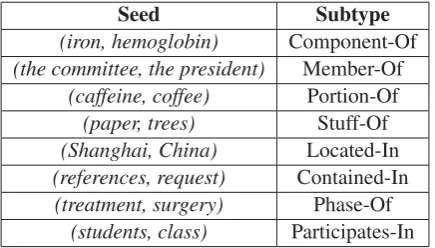
In total, 35 instances are manually selected as the seed set for our problem. Table 2 lists examples of the seeds.
We experimentally set the number of instances and patterns that the system keeps in each iteration.
3http://reverb.cs.washington.edu
Seed Subtype
(iron, hemoglobin) Component-Of
(the committee, the president) Member-Of
(caffeine, coffee) Portion-Of
(paper, trees) Stuff-Of
(Shanghai, China) Located-In
(references, request) Contained-In
(treatment, surgery) Phase-Of
(students, class) Participates-In
Table 2: Sample seeds used for part-whole relation
The parameters for the Espresso bootstrapping algo-rithm are as follows:
• In the 1st iteration: keep top-10 patterns and top-100 instances.
• In next iterations: keep 5 patterns and top-20 instances.
We perform experiments with the random selec-tion of seeds (ESP system), to compare the effect of the careful seed selection step in the Espresso bootstrapping algorithm. In contrast to the careful seed selection step, we do not separate subtypes of part-whole relation. Each seed set contains 35 in-stances selected randomly such that those inin-stances always convey part-whole relation. Part-whole rela-tion is single-type in those experiments. The results of theESPsystem is the average precision when we conduct experiments with two different seed sets of part-whole relation. Each seed set contains 35 in-stances selected randomly.
The results are reported in Table 3. We evalu-ated the results after 30 iterations since the precision was nearly constant. At this point, 680 instances were extracted by both systems. The ESP system achieved a precision of 74.3%, while the precision of instances harvested by theESP*system is 83.3%. We extracted new instances keeping them in differ-ent subtypes to be non-overlapping, this can be con-sider as a kind of multi-task learning. The results show that multi-task learning and seed selection are effective ways to get high precision.
ESP W2V 680 493 54 78.5%a
680 563 45
ESP* 680 549 35 83.3%
ESP* W2V 680 554 47 84.9%
a The result of this system is the average precision when we perform two
experi-ments with two random seed sets of part-whole relation.
Table 3: System performance for part-whole relation extraction task
5.4 Our Proposed System (Espresso + Word2vec)
In this experiment, we present the result of our pro-posed system for integrating word embedding off-sets into the Espresso system. We use the careful seed set in the previous experiment to perform our system for part-whole relation extraction task. The parameters for our proposed system are as follows:
• In the 1st iteration: keep top-10 patterns and
top-100 instances (the same as in previous ex-periment).
• In next iterations: keep top-5 patterns; for in-stances, keep top-100 by instance reliability, then keep top-20 (out of 100) by similarity score (similar to the previous experiment).
One problem of Word2vec model is that it tends to select very similar instances to given instances, for example,(team, seven players),(team, six players),
(team, three players), etc. Therefore, we keep only one of them that has the highest instance reliability in each iteration.
We denote the system in this experiment by
ESP* W2V. Then, we evaluated the results after 30 iterations. At this point, 680 instances were ex-tracted. The ESP* W2V system achieved a preci-sion of 84.9%. It outperformedESP*system, which is reported 83.3% precision.
We also conduct another experiment for integrat-ing word embeddintegrat-ing approach into the Espresso sys-tem, without careful seed selection step. That is, we use random seed sets (the same for ESP system) in a new system, which is denoted byESP W2V. The
results of theESP W2V system is the average pre-cision when we conduct experiments with two dif-ferent seed sets. From Table 3, we can see that the precision is increased from 74.3% (ESP system) to 83.3% (ESP* system) by using careful selection of seeds, and improved from 78.5% (ESP W2V sys-tem) to 84.9% (ESP* W2V system) by integrating word embedding approach into the Espresso system. All above results showed that our proposed system (Espresso + Word2vec) can keep high-precision over iterations, and outperformed the orig-inal Espresso system for part-whole relation extrac-tion.
6
Conclusion and Future Work
References
Eugene Agichtein and Luis Gravano. 2000. Snowball: Extracting relations from large plain-text collections. InProceedings of the fifth ACM conference on Digital libraries, pages 85–94. ACM.
Sergey Brin. 1999. Extracting patterns and relations from the world wide web. InThe World Wide Web and Databases, pages 172–183. Springer.
Razvan C Bunescu and Raymond J Mooney. 2005. A shortest path dependency kernel for relation extrac-tion. InProceedings of the conference on Human Lan-guage Technology and Empirical Methods in Natural Language Processing, pages 724–731. Association for Computational Linguistics.
Roger Chaffin, Douglas J Herrmann, and Morton Win-ston. 1988. An empirical taxonomy of part-whole relations: Effects of part-whole relation type on rela-tion identificarela-tion.Language and Cognitive processes, 3(1):17–48.
James R Curran, Tara Murphy, and Bernhard Scholz. 2007. Minimising semantic drift with mutual exclu-sion bootstrapping. InProceedings of the 10th Con-ference of the Pacific Association for Computational Linguistics, volume 6.
Anthony Fader, Stephen Soderland, and Oren Etzioni. 2011. Identifying relations for open information ex-traction. InProceedings of the Conference on Empiri-cal Methods in Natural Language Processing, pages 1535–1545. Association for Computational Linguis-tics.
Roxana Girju, Adriana Badulescu, and Dan Moldovan. 2006. Automatic discovery of part-whole relations. Computational Linguistics, 32(1):83–135.
Zhou GuoDong, Su Jian, Zhang Jie, and Zhang Min. 2005. Exploring various knowledge in relation extrac-tion. InProceedings of the 43rd annual meeting on association for computational linguistics, pages 427– 434. Association for Computational Linguistics. Marti A Hearst. 1992. Automatic acquisition of
hy-ponyms from large text corpora. InProceedings of the 14th conference on Computational linguistics-Volume 2, pages 539–545. Association for Computational Lin-guistics.
Ashwin Ittoo and Gosse Bouma. 2013. Minimally-supervised extraction of domain-specific part–whole relations using wikipedia as knowledge-base. Data & Knowledge Engineering, 85:57–79.
Nanda Kambhatla. 2004. Combining lexical, syntactic, and semantic features with maximum entropy mod-els for extracting relations. In Proceedings of the ACL 2004 on Interactive poster and demonstration sessions, page 22. Association for Computational Lin-guistics.
C Maria Keet and Alessandro Artale. 2008. Represent-ing and reasonRepresent-ing over a taxonomy of part–whole re-lations.Applied Ontology, 3(1):91–110.
Tomas Mikolov, Ilya Sutskever, Kai Chen, Greg S Cor-rado, and Jeff Dean. 2013. Distributed representations of words and phrases and their compositionality. In Advances in Neural Information Processing Systems, pages 3111–3119.
Patrick Pantel and Marco Pennacchiotti. 2006. Espresso: Leveraging generic patterns for automatically harvest-ing semantic relations. InProceedings of the 21st In-ternational Conference on Computational Linguistics and the 44th annual meeting of the Association for Computational Linguistics, pages 113–120. Associa-tion for ComputaAssocia-tional Linguistics.
Patrick Pantel and Deepak Ravichandran. 2004. Auto-matically labeling semantic classes. InHLT-NAACL, volume 4, pages 321–328.
Alan Rector, Chris Welty, Natasha Noy, and Evan Wal-lace. 2005. Simple part-whole relations in owl on-tologies.
Alexander Yates, Michael Cafarella, Michele Banko, Oren Etzioni, Matthew Broadhead, and Stephen Soderland. 2007. Textrunner: open information ex-traction on the web. InProceedings of Human Lan-guage Technologies: The Annual Conference of the North American Chapter of the Association for Com-putational Linguistics: Demonstrations, pages 25–26. Association for Computational Linguistics.
Dmitry Zelenko, Chinatsu Aone, and Anthony Richardella. 2003. Kernel methods for relation extraction. The Journal of Machine Learning Research, 3:1083–1106.
Shubin Zhao and Ralph Grishman. 2005. Extracting re-lations with integrated information using kernel meth-ods. InProceedings of the 43rd Annual Meeting on As-sociation for Computational Linguistics, pages 419– 426. Association for Computational Linguistics.