Consistent and Flexible Integration of Morphological Annotation
in the Arabic Treebank
Seth Kulick, Ann Bies, Mohamed Maamouri
Linguistic Data ConsortiumUniversity of Pennsylvania 3600 Market Street, Suite 810 Philadelphia, PA 19104 USA
E-mail: {skulick,bies,maamouri}@ldc.upenn.edu
Abstract
Complications arise for standoff annotation when the annotation is not on the source text itself, but on a more abstract representation. This is particularly the case in a language such as Arabic with morphological and orthographic challenges, and we discuss various aspects of these issues in the context of the Arabic Treebank. The Standard Arabic Morphological Analyzer (SAMA) is closely integrated into the annotation workflow, as the basis for the abstraction between the explicit source text and the more abstract token representation. However, this integration with SAMA gives rise to various problems for the annotation workflow and for maintaining the link between the Treebank and SAMA. In this paper we discuss how we have overcome these problems with consistent and more precise categorization of all of the tokens for their relationship with SAMA. We also discuss how we have improved the creation of several distinct alternative forms of the tokens used in the syntactic trees. As a result, the Treebank provides a resource relating the different forms of the same underlying token with varying degrees of vocalization, in terms of how they relate (1) to each other, (2) to the syntactic structure, and (3) to the morphological analyzer.
1.
Introduction
The Arabic language presents several challenges for both annotation and natural language processing. This is in part due to its morphological characteristics, in which multiple units of meaning are combined together in a single whitespace-delimited token from the source text, which we call here a “source token.” For example, a source token such as “ktbh”1 آ might be analyzed as two parts, in which the “ktb” is a noun meaning “books” and “h” is a possessive pronoun. There are many reasons why it is important to be able to refer to these individual components separately, such as using them as leaves in a tree structure for syntactic annotation, or for word alignment with another language, such as English, in which the noun and possessive pronoun (in this case) would already be separate tokens.
Another reason why Arabic is a particular challenge is the orthographic convention of leaving out short vowels and other distinguishing marks in written text. This causes a great increase in ambiguity for resolving the analysis of each source token, as has long been noted for natural language processing. However, perhaps less noted has been the fact that this also raises many issues for annotation projects that analyze Arabic text from the source tokens to a full analysis including morphological analysis and syntactic structure. The tree structure is built not upon the source tokens, but rather ona more abstract representation, not explicitly present in the original text.
1
Throughout this paper we use the Buckwalter transliteration http://www.qamus.org/transliteration.htm
This more abstract representation includes the morphological analysis and the separation of the source tokens into multiple parts, if necessary. These multiple levels of representation must all be related to each other throughout the annotation and in the end product, allowing corrections at one level to flow back to previous levels.
These issues apply to treebanks more generally. For any treebank in which the annotation is not on the explicit source text, but on some more abstract, articulated representation, similar issues will arise in some form. Even for a morphologically simple language such as English, this problem arose with the Penn Treebank, with the segmentation of “won’t” into “wo” and “n’t” (Bies et. al., 1995). The tree annotation continued as if the former was really “will”, although the lexical item was not explicitly “normalized” to “will”. In that case such needed abstractions from the data were limited enough so that the entire problem of carefully defining what the object of annotation was, and how it related to the source data, could be side-stepped. In other languages, however, this is not possible, when such abstractions are more pervasive.
INPUT_STRING: ً
IS_TRANS: jndyAF
INDEX: P1W2 OFFSETS: 4-11 TOKENS: P1W2-P1W2 STATUS: 1
LEMMA: [junodiy~_1] UNSPLITVOC: (junodiy~AF)
POS: NOUN+CASE_INDEF_ACC
VOC: junodiy~+AF
GLOSS: soldier + [acc.indef.]
has status #1, indicating that the given solution (POS,VOC,GLOSS,LEMMA,UNSPLITVOC) exactly matches one of the SAMA solutions for the input word jndyAF.
Status #2. LIMITED SOLUTION: The given solution is not a possible SAMA solution for the input string, and so has been entered manually as a separate step in the annotation pipeline. The entered solution is of a very limited format, in which there has been no attempt to add the vocalization information in a typical SAMA solution.
For example, this solution:
INPUT_STRING: لا
IS_TRANS: sntrAl
INDEX: P4W42 OFFSETS: 229-236 TOKENS: P4W49-P4W49 STATUS: 2
LEMMA: [TBupdate] UNSPLITVOC: None
POS: FOREIGN VOC: sntrAl GLOSS: nogloss
is a status #2 solution, since the given fields of the solution are not a SAMA solution – the VOC is the same as the INPUT_STRING field, with no additional information entered.
The intent is that status #2 will be reserved for those words that are Arabic but are not expected to have a solution in SAMA, such as TYPO, FOREIGN, etc. This also includes DIALECT words, which are by intent not included in SAMA, which is focused on Modern Standard Arabic. Following is one such example:
INPUT_STRING: م
IS_TRANS: btqwm
INDEX: P15W7 OFFSETS: 36-42
TOKENS: P15W8-P15W8 STATUS: 2
LEMMA: None UNSPLITVOC: None POS: DIALECT VOC: btqwm GLOSS: nogloss
Status #3. PENDING SAMA SOLUTION: This is similar to status #2 in that the given solution is not a SAMA solution for the input string, and so has been entered in an alternate way. However, in this case the solution does have vocalization and other characteristics of a SAMA solution, and so is considered a “pending” SAMA solution. The intent is that these solutions will be subject to further review and eventual inclusion in SAMA.
For example, this solution:
INPUT_STRING:
IS_TRANS: bAnh
INDEX: P6W15 OFFSETS: 68-73
TOKENS: P6W18-P6W20 STATUS: 3
LEMMA: [bi>an~a_1] UNSPLITVOC: (bi>an~ahu)
POS: PREP+SUB_CONJ+PRON_3MS
VOC: bi+>an~a+hu
GLOSS: by/with+that+it/he
has status #3 because the given solution is not actually a solution included in SAMA 3.1, although it has the complete form of such a solution. (This particular instance appears to an example of the well-known “missing hamza” problem discussed in Buckwalter (2004).)
Status #4. EXCLUDED FROM CHECK WITH SAMA: The source token is a case of punctuation or some other token that by intent is not included in SAMA and therefore excluded from this analysis.
INPUT_STRING: 650
IS_TRANS: 650
INDEX: P1W1 OFFSETS: 0-4
TOKENS: P1W1-P1W1 STATUS: 4
LEMMA: [DEFAULT] UNSPLITVOC: (650)
POS: NOUN_NUM
VOC: 650 GLOSS: nogloss
has status #4 because digit numbers are not checked for inclusion in SAMA.
In the ATB3-v3.2 release there are 339,710 source tokens, which are categorized with the following statuses:
Status #1 INCLUDED IN SAMA 287,282
Status #2 LIMITED SOLUTION 939
Status #3 PENDING SAMA SOLUTION 4323
Status #4 EXCLUDED FROM CHECK
WITH SAMA
47,156
TOTAL 339,710
Table 1: Categorization of SAMA status of source tokens in ATB3-v3.2.
4. New Algorithm for Creation of INPUT
STRING and UNVOCALIZED Tokens
We now return to the issue discussed in Section 2, regarding the creation of the INPUT STRING and UNVOCALIZED tokens at the end of the annotation process.
4.1 INPUT STRING
The INPUT_STRING value for the tree token is a substring of the INPUT_STRING for the source token such that it corresponds in a mostly natural way to the VOCALIZED field for that tree token. For example, in Section 2 the source token with INPUT_STRING “ktbh” yielded two tree tokens with INPUT_STRING values “ktb” and “h”, corresponding to the VOCALIZED values “kutubi” and “hi”.
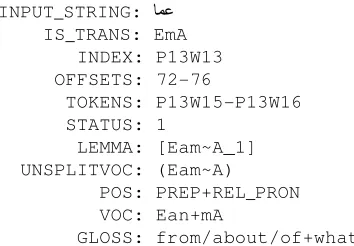
To take a somewhat less obvious example, the source token “EmA” can receive the following analysis:
INPUT_STRING:
IS_TRANS: EmA
INDEX: P13W13 OFFSETS: 72-76
TOKENS: P13W15-P13W16 STATUS: 1
LEMMA: [Eam~A_1] UNSPLITVOC: (Eam~A)
POS: PREP+REL_PRON
VOC: Ean+mA
GLOSS: from/about/of+what
In this case the vocalized solution is Ean+mA, and based on the part-of-speech tags results in two tree tokens, for Ean/PREP and mA/REL_PRON:
INPUT_STRING: ع
IS_TRANS: E
COMMENT: [Separated] INDEX: P13W15 OFFSETS: 72,73 UNVOCALIZED: En VOCALIZED: Ean- POS: PREP
GLOSS: from/about/of
INPUT_STRING:
IS_TRANS: mA
COMMENT: [] INDEX: P13W16 OFFSETS: 73,76 UNVOCALIZED: mA VOCALIZED: -mA
POS: REL_PRON
GLOSS: what
This is an example where the “normalization” introduced in SAMA inserts the “n” of “Ean” that is dropped when it appears in the source token text “EmA”. However, the creation of the INPUT_STRING values for the two tree tokens is a partition of the source token text, so “EmA” must be split over the two tree tokens, and here the “mA” in the source token INPUT_STRING belongs with the second tree token, and only the “E” remains for the first tree token.
The algorithm used in earlier data releases to create the INPUT_STRING tokens for the tree tokens sometimes created inappropriate INPUT_STRING tokens. For example, here it would have created the two INPUT_STRING values “Em” and “A”.
both in terms of how they relate to each other and how they relate to the syntactic structure.
6.
Acknowledgements
This work was supported in part by the Defense Advanced Research Projects Agency, GALE Program Grant No. HR0011-06-1-0003. The content of this paper does not necessarily reflect the position or the policy of the Government, and no official endorsement should be inferred.
We would also like to thank David Graff and Fatma Kaddeche for valuable discussions, and the Arabic Treebank annotators for their many contributions.
7.
References
Ann Bies, Mark Ferguson, Karen Katz and Robert MacIntyre (Eds.). (1995). Bracketing Guidelines for Treebank II Style. Penn Treebank Project, University of Pennsylvania, CIS Technical Report MS-CIS-95-06.
Daniel Bikel. (2004). On the Parameter Space of Lexicalized Statistical Parsing Models. Dissertation, Department of Computer and Information Sciences, University of Pennsylvania. 2004.
Tim Buckwalter. (2004). Issues in Arabic orthography and morphology analysis. In Proceedings of the Workshop on Computational Approaches to Arabic Script-based Languages (ACL Semitic Workshop 2004).
Seth Kulick, Ryan Gabbard and Mitchell Marcus. (2006). Parsing the Arabic Treebank: Analysis and Improvements. In Proceedings of the 5th International Conference on Treebanks and Linguistic (TLT 2006 ).
Mohamed Maamouri, Ann Bies and Seth Kulick. (2009). Upgrading and enhancing the Penn Arabic Treebank: A GALE challenge. In Joseph Olive (Ed.), In progress for publication (book describing work in GALE program).
Mohamed Maamouri, Ann Bies, Seth Kulick, Wajdi Zaghouani, David Graff and Michael Ciul. (2010). From Speech to Trees: Applying Treebank Annotation to Arabic Broadcast News. In Proceedings of the Seventh International Conference on Language Resources and Evaluation (LREC 2010).