Computational Linguistics and Chinese Language Processing
Vol. 19, No. 1, March 2014, pp. 33-54 33 The Association for Computational Linguistics and Chinese Language Processing
Linking Databases using Matched Arabic Names
Tarek El-Shishtawy
Abstract
In this paper, a new hybrid algorithm that combines both token-based and character-based approaches is presented. The basic Levenshtein approach also has been extended to the token-based distance metric. The distance metric is enhanced to set the proper granularity level behavior of the algorithm. It smoothly maps a threshold of misspelling differences at the character level and the importance of token level errors in terms of token position and frequency.
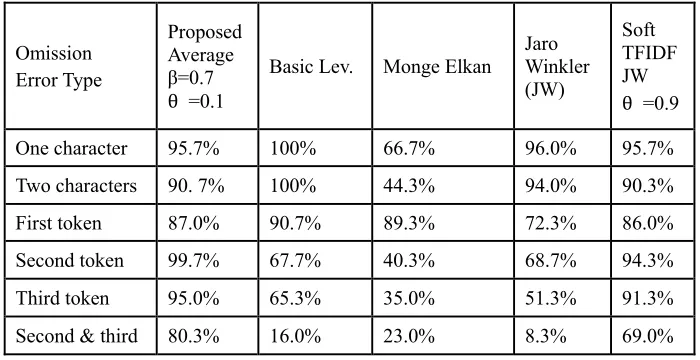
Using a large Arabic dataset, the experimental results show that the proposed algorithm successfully overcomes many types of errors, such as typographical errors, omission or insertion of middle name components, omission of non-significant popular name, and different writing style character variations. When compared with other classical algorithms, using the same dataset, the proposed algorithm was found to increase the minimum success level of the best tested lower limit algorithm (Soft TFIDF) from 69% to about 80%, while achieving an upper accuracy level of 99.67%.
Keywords: Name Matching, Record Linkage, Data Integration, Arabic NLP, Information Retrieval.
1.
Introduction
Information about individuals can be found in a variety of resources, such as population survey databases, national identifier databases, medical records, news articles, tax information, and educational databases. In all of these heterogeneous sources, name matching is a fundamental task for data integration that joins one or more tables to extract information referring to the same person.
Matching personal names has been used in a wide range of applications, such as record linkage or integration, database hardening, removing or cleaning up duplicated records, and searching the Web. Unfortunately, the name may not be known exactly, may be misspelled, or may have spelling variations. Therefore, in these applications, the general word matching
Prof. Ass. of Computer Engineering, Faculty of Computers and Information, Benha University
34 Tarek El-Shishtawy
techniques are insufficient, and optimized techniques have been developed to cope with matching multiple variations of the same personal name.
There are efficient and well-established algorithms that deal with spelling errors, variants for strings, and name matching at a character level. For relatively short names that contain similar yet orthographically distinct tokens, character-based measures are preferable because they can estimate the difference between the strings with higher resolution (Bilenko et al., 2003a; Bilenko & Mooney, 2003). In languages where names have very close typographic structure, such as Arabic, character level similarity is not enough to produce high precision matching.
Unfortunately, spelling errors are not the only source of name mismatching. People may report their names inconsistently by removing or inserting additional name tokens, adding initial titles, or writing different punctuation marks and whitespaces. In all of these cases, bag-of-words methods are better suited to the matching problem, since they are more flexible at word level. In addition, token-based approaches are not able to capture the degree of similarity between individual tokens with minor variations in characters (Bilenko et al., 2003b).
Experimental results show that hybrid techniques, which take word frequency as well as character-based word similarities into account, increase matching. A first attempt in this direction was introduced by Cohen et al. (Cohen et al., 2003), in the form of a measure called Soft-TFIDF, which extends the Jaro-Winkler method to combine both the frequency weight of words in a cosine similarity measure and a CLOSE measure at the character level. The soft TFIDF algorithm works as follows: for each token Ai in the first name, find a word Bj in the
second one that maximizes the similarity function. Moreau et al. (Moreau et al., 2008) showed that this may lead to double matching of words and proposed a generic model to enhance the soft TFIDF. Camacho et al. (Camacho et al., 2008) used a cost function that basically depends on matching all pairs of tokens and summing all edit distances at character level. The distance metric was modified by a frequency measure of the tokens. They also used a permutation factor – Monge-Elkan concept (Monge & Elkan, 1996) – to allow a non-ordered sequence of word tokens to be matched.
Linking Databases using Matched Arabic Names 35
restricted sequence of writing names. To improve the matching efficiency, most hybrid techniques include weights for token frequency but do not give the same attention to the relative position where the mismatch occurs.
The proposed hybrid algorithm is an extension to the Levenshtein algorithm, with computing 'edit distances' at token level instead of character level in the basic algorithm. The sequential nature of the algorithm keeps the ordering importance of name tokens. The two names to be matched are considered as two bags of tokens, and the algorithm computes the cost of transforming one bag into the other. While the basic Levenshtein algorithm assigns a unity cost to all edit operations, the current algorithm assigns weights that reflect the importance of each edit operation. When matching a pair of tokens, the importance of the edit operation is determined by the relative position of the tokens in names, their frequency measure, and their character level partial similarity.
The remaining parts of this paper are organized as follows. In Section 2, we present some basic techniques for name matching. After that, Section 3 briefly discusses the characteristics of the Arabic naming system considered in our work. The proposed algorithm is described in Section 4. The results of experimental comparisons are discussed in Section 5. Finally, conclusions are discussed in Section 6.
2.
Matching Algorithms for Names
Name matching is the process of determining whether two name strings are instances of the same name. Multiple methods have been developed for matching names, which reflects the large number of errors or transformations that may occur in real-life data (Elmagarmid et al., 2007). The basic goal of all techniques is to match names (or strings) that are not necessarily required to be identical. Instead of an exact match, a normalized similarity measure usually is calculated to have a value between 1.0 (when the two names are identical) and 0.0 (when the two names are totally different). There are several well-known methods for estimating similarity between strings, which can be roughly separated into two groups: character-based techniques and token-based techniques.
The Levenshtein algorithm and its variants are character-based matching techniques based on edit distance metrics, and the Levenshtein edit distance is defined originally for matching two strings of arbitrary lengths. It counts the minimum differences between strings in terms of the number of insertions, deletions, or substitutions required to transform one string into the other. A score of zero represents a perfect match.
36 Tarek El-Shishtawy
allow different weights at character level. The weights for replacing characters can depend on keyboard layout or phonetic similarities (Snae, 2007). In other research (Bilenko et al., 2003b), a distance function is produced by a distance function learner and the weights are learned from a training data set to have a combined record-level similarity metric for all fields.
The affine gap distance metric (Waterman et al., 1975) offers a smaller cost for gap mismatch; hence, it is more suitable for matching names that are truncated or shortened. Smith and Waterman (1981) described an extension of edit distance and affine gap distance to find the optimal local alignment at the character level. Regions of gaps and mismatches are assigned lower costs. Jaro (1989) introduced a string comparison metric that is dependent on both the number of common characters and the number of non-matching transpositions in the two strings.
Token-based approaches are motivated by the fact that most of the differences between similar named entities often arise because of abbreviations or whole word insertions and deletions. Hence, token models should produce a more sensitive similarity estimate than character-based approaches. Also, experimental results show that including token frequency as a parameter in matching algorithms leads to a significant improvement in matching accuracy. Jaccard-vector space cosine similarity is an example of difference measures that operate on tokens, treating a string as a “bag of words”. In these approaches, the two string names to be compared are divided into sets of words (or tokens) before a similarity metric is considered over these sets.
The Jaccard similarity between the word sets A and B is defined as the size of the intersection divided by the size of the union of the sample sets: J (A,B) = |A ⋂ B| / |A ⋃ B|. The algorithm has been extended to compare bi-grams (paired characters of two string), tri-grams, or n-grams. Strings can be "padded" (Keskustalo et al., 2003) by adding special characters at the beginning and end of strings, Padded n-grams will result in a larger similarity measure for strings that have the same beginning and end but errors in the middle.
TFIDF, or cosine similarity, is another measure that is widely used in the information retrieval community. The basic TFIDF makes uses of the frequency of terms in the entire collections of documents and the inverse frequency of a specific term in a document. The TFIDF weighting method is often used in the Vector Space Model together with Cosine Similarity to determine the similarity between two documents. Similarity between database strings, or between a database string and a query string, is computed via the cosine similarity (inner product) of the corresponding weight vectors, essentially taking the weights of the common tokens into account. The TFIDF similarity of two word sets A and B can be defined as:
w A B
TFIDF(A, B) V(w, A).V(w, B)
Linking Databases using Matched Arabic Names 37
where V is a weight vector that measures the normalized TFIDF of word w. Like Jaccard, the TFIDF scheme depends on common terms, but the terms are weighted; these weights are larger for words w that are rare in the collection of strings from which A and B are drawn. The basic TFIDF does not account for misspelling mistakes in words. Cohen et al. (2003) proposed a soft TFIDF with a heuristic that accounts for certain kinds of typographical errors.
Soft TFIDF is one approach that combines both string-based and token-based distances. In this approach, similarity is affected not only by the tokens w that appear in the sets A and B, but also for those “similar” tokens in A that appear in B.
w close(θ,A,B)
softTFIDF(A, B) V(w,A).V(w, B)D(w, B)
(2)
Here, D is the character-based distance of the word w, such that it is greater than a threshold θ. The new set close allows one to integrate a token-based distance and the statistics of a particular corpus in the similarity evaluation of a particular word.
Both TFIDF and Soft TFIDF are insensitive to the location of words, thus allowing natural word moves and swaps (e.g., “John Smith” is equivalent to “Smith, John”). Although this is useful in many naming systems, it does not fit the Arabic naming system, which is characterized by restricted component order. Camacho et al. (2008) proposed a similar metric that combines both the frequency of words and the edit-based distances of each word pair of the two names. Also, strings may be phonetically similar even if they are not similar at the character or token level. Soundex (Holmes & McCabe, 2002), Phonex (Gadd, 1990), and Phonix (Gadd, 1990) are examples of phonetic-based techniques that convert the name into a sequence of codes that represent how the name is spoken. Phonetic representation of the names is used either for exact or approximate match.
When considering contextual information stored with names (such as address, mail, and other details) to increase the likelihood of a match, the problem is called data or record linkage (Xiao et al., 2011). Many techniques have been proposed for record linkage, where not only are pairs of name strings matched, but also many other matching features (Monge & Elkan, 1996). Winkler (2002) demonstrated how machine-learning methods could be applied in record linkage situations where training data are available. Name is time-independent information; therefore, even in feature-based approaches, having an effective name matching is crucial (Winkler, 2006). This work considers only name matching without taking any contextual information into account.
3.
Characteristics of Arabic Name Variations
38 Tarek El-Shishtawy
3.1 Very Close Typographic Structure
Spelling errors normally occur during data entry. This may be due to typographical errors, cognitive errors, or phonetic errors. Whatever the reason for the error, the source and target names are considered strings differing at the character level. According to Jurafsky and Martin (Jurafsky et al., 2002), this type of error can be categorized as insertion, deletion or omission, substitution, or transposition.
There are efficient and well-established algorithms that deal with spelling errors variants for a string. When data is represented by relatively short strings that contain similar yet orthographically distinct tokens, character-based measures are preferable since they can estimate the difference between the strings with higher resolution.
The reason that misspelling errors are particularly difficult in Arabic names is the close typographical structure of names. For example, inserting the character "و" to the name "دمحم," yields a correct name "دومحم". Also, substituting the character "أ" with "م" in "محمد," gives a correct name "دمحأ". If the Levenshtein algorithm is used for matching two names with a length of 20 characters of each name, a single edit distance will show 95% matching similarity of the two names, while they are two different persons. The problem is how to know if the name is written incorrectly or refers to another person (e.g., his brother), especially when searching family databases.
3.2 Omission of Name Components
While it is common to have one first, one or more middle, and a surname name for writing a personal name, several variations exist in real free form names. The same problem exists in many other languages, and it has been reported by Borgman and Siegfried (Borgman & Siegfried, 1999) that there are no legal regulations of what constitutes a name. The source of the ambiguity, in many cases, is people themselves as they report their names differently depending upon the organization they are contacting. Examining different Arabic databases shows that name omission is a serious problem that should be handled efficiently in any Arabic name matching algorithm. Name omission is related to both position and frequency as follows.
3.2.1 Name Order
Persons tend to write their names in a restricted correct order. They may omit one or more tokens, while still keeping the correct order.
Linking Databases using Matched Arabic Names 39
nature of the proposed algorithm assigns one edit distance to 'omission' and 'two edit distances' to transposition.
3.2.2 Position of Omitted Name
Persons tend to omit one or more middle names, while fewer name omissions typically occur at the beginning or at the end of names.
The analysis shows that a person is keen on writing his first and surname carefully. This raises the position importance of the name variations. For example, one wants “Hamed Mohamed Fawzy Ibrahim” to match with “Hamed Mohamed Ibrahim” but not with “Mohamed Fawzy Ibrahim”. To realize the position relation, the proposed algorithm gives less importance to name omission – or insertion – occurring in the middle of the name, and more importance to first and last names.
3.2.3 Frequency of Omitted Name
Persons tend to omit non-significant components of their names, i.e., omission is likely to occur with common names.
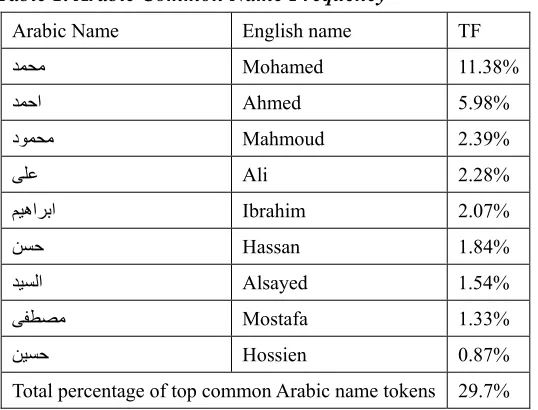
Results of analyzing a sample of 7140 Egyptian full names show that nearly 30% of all name components lie within a set of only 9 common names, as shown in Table (1). In the proposed algorithm, less importance is given to a common name omission or insertion. For example, one wants “Hamed Mohamed Fawzy Ibrahim” to prefer the match with “Hamed Fawzy Ibrahim” over “Hamed Mohamed Ibrahim,” because 'Mohamed' is not as indicative a name as ' Fawzy'.
Table 1. Arabic Common Name Frequency
Arabic Name English name TF
دمحم Mohamed 11.38%
دمحا Ahmed 5.98%
دومحم Mahmoud 2.39%
ىلع Ali 2.28%
ميھاربا Ibrahim 2.07%
نسح Hassan 1.84%
ديسلا Alsayed 1.54%
ىفطصم Mostafa 1.33%
نيسح Hossien 0.87%
40 Tarek El-Shishtawy
Common names have another impact when searching the Web for famous persons. When searching for the former president of Egypt, many people do not know that his first name is 'Mohamed,' and search the web only for 'Hossny Mubark". The search engine should be smart enough to return also matches with his full name as top hits, because 'Mohamed' is a common name and is expected to be omitted. This is different from returning 'Gamal Hossny Mubark' – his son – since 'Gamal' is not a common name.
The previous discussion shows that the frequency distributions of name values can be used to improve the quality of name matching. They can be calculated either from the data set containing the names to be matched or from a more complete population-based database, like a telephone directory or an electoral roll.
3.3 Writing Styles Character Variations
One important component of the proposed work is name standardization. Standardization eliminates writing style character variations; hence, it makes the data comparable and more usable. To produce a uniform representation, the algorithm runs SQL script to replace various spellings of words with a single spelling. For instance, different prefixes, spacing, punctuations, and character variations are replaced with a single standardized spelling.
A name standardization (or character variation elimination) module is common module in name matching algorithms (PAtman & Thompson, 2003). In the current work, the standardization concept is optimized for Arabic names. For instance, the module trims certain prefixes such as (د. أ.د. م. رو تكد, د/ ، دي سلا/), replaces multiple blanks with a single blank, replaces the characters (أ،إ،آ with ا), and replaces the ending character (ي) with (ى). There are some cases where the Arabic name component is composed of two tokens. For example, a prefix name component (د بع) and a postfix name component (نيد لا) cannot be standalone names. There is no standard style for writing composite names, as it is not always necessary to have a distance space between them. To standardize composite names, either leading or trailing spaces are removed, whenever a pre/post tokens are detected. Name style standardization is an inexpensive step, but it improves the overall performance for name matching.
4.
The Proposed Algorithm
Linking Databases using Matched Arabic Names 43
k,l
P is the position weight for a matching token k with a token j. In general, the proposed position cost is flexible and can have different values at each token position. In our implementation, persons are keen to write their first and last names. For this reason, more importance is given when matching first and last names. Position weight is assigned a complete unity edit cost when matching either the two first or the two last tokens in both strings.
In our implementation, for two tokens(a , b )k l , where 1 ≤ l ≤ L and 1 ≤ k ≤ K, the position cost rule is given by:
k,l
1, (k=1 and l=1) P or(k=K and l=L)
β Otherwise
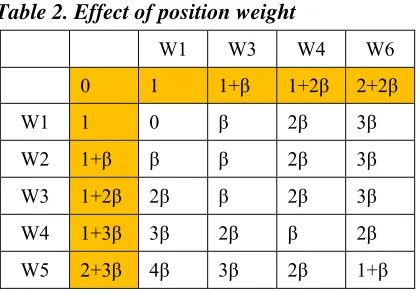
(9) The position rule is used to initialize the zero rows and columns, as shown in Table 1. Note that this initialization is different from Smith and Waterman (1981), which assigns zeroes to all zero rows and columns. Table (2) illustrates an example of computing H(l,k), defined in Equation (4), when considering only position weights to match two strings a [L]= (W1, W2, W3, W4, W5) and name b[K]= (W1, W3, W4, W6).
Table 2. Effect of position weight
W1 W3 W4 W6
0 1 1+β 1+2β 2+2β
W1 1 0 β 2β 3β
W2 1+β β β 2β 3β
W3 1+2β 2β β 2β 3β
W4 1+3β 3β 2β β 2β
W5 2+3β 4β 3β 2β 1+β
As given in Equation (9), the position weight has either a value of 1 or β. In Table (2), and according to Equation (9), the step increase of position weight (in zero rows and columns) is β, except for the first and last cells, which have a value of one. The remaining cells are computed based on Equation (4) while considering only position weight. For example, the entry at a cell (W2, W3) is the minimum of its up, left, and left-up cells plus β, which gives H(W2,W3)=β. Another example, H(W3.W3) is β, since the two words are matched and the IF-part of Equation (4) is applied.
44 Tarek El-Shishtawy
position importance of the token.
4.3 Frequent Name Mismatch Cost
Motivated by the assumption that 'persons tend to omit their common names,' we allow the cost of edit distances for a common name to have a different cost than a rare name. This concept is called a term frequency weight 0 ≤ F ≤ 1, For two tokens (a , b )k l , where 1 ≤ l ≤ L
and 1 ≤ k ≤ K, the term frequency is given by:
k l k,l TF(a )TF(b )2
F 1 α
MTF
(10)
where TF(a )k is the Term Frequency of token ak,TF(b )l is the Term Frequency of token
l
b , MTF is the maximum term frequency of names, and α is a frequency weighting factor. To allow the algorithm to have a maximum frequency effect, α is set to 1. In this case, the common name frequency cost and the overall cost of the edit operation are nearly 0.
5.
Experimental Results
5.1 sets
We used two types of datasets: the base set and test sets. The base dataset contains a sample of 7140 names extracted from MIS of Egyptian university staff members. To make the base dataset usable, all names were standardized to eliminate writing style character variations, as explained in Section 3.3. The extracted sample contains two fields: 1) a Base name IDentifier B_ID, and the Base Name (BName).
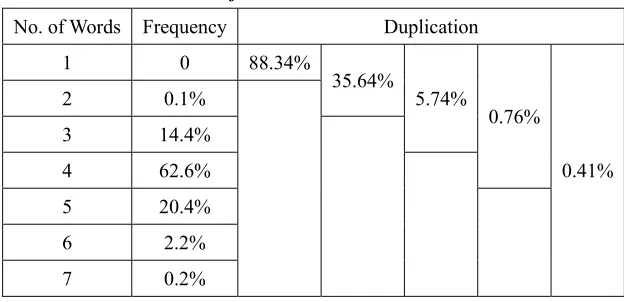
The Arabic names dataset characteristics are shown in Table (3) and can be downloaded from http://www.scribd.com/doc/143493637/Arabic-Name-Dataset. The frequency distribution of the number of tokens in the sample indicates that 97.4% of the Arabic names were written in 3 to 5 tokens. The preliminary analysis of the sample shows that the sample contains 30 duplicated names (a percentage of 0.41%). Also, as shown in Table (3), the duplication of names is only 0.76% (actually 0.35% when subtracting full name duplications) when the Arabic name is written in four tokens.
46 Tarek El-Shishtawy
Set Ref Record = B_ID (j); } } End loop j
If Ref record = Ref_B_ID (i) { /* success */ Increment True Match Count by 1 ; }
} End loop i
Success percentage = True Match Count / 300; End;
In summary, we used artificially generated files, with each carrying one type of error. Although the generated data sets do not approximate the types of errors that occur in real data, they are very useful in 1) analyzing the effect of different parameters on each type of error and 2) determining the upper and lower success limits of each algorithm.
5.3 Results
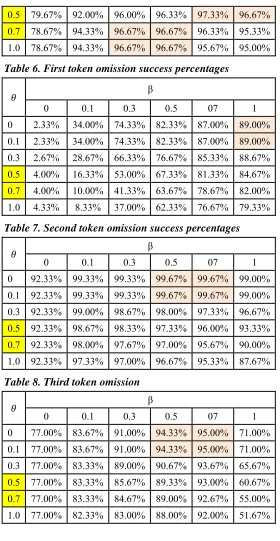
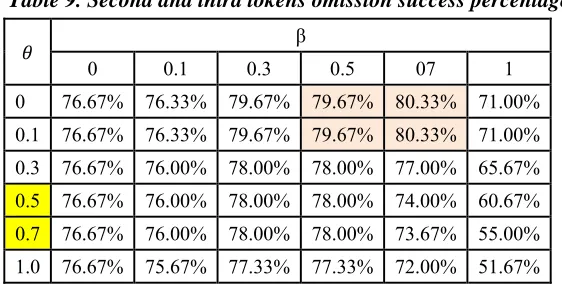
We ran our experiments on data sets, with each carrying only one type of error. Results of the proposed algorithm are summarized in Tables 4 to 9. Each cell entry is the percentage of success, which is calculated as the number of true matches of the test set names divided by the total number of names in the set. To illustrate the role of the position weight and individual token match threshold in evaluating a name matching, the experiment was repeated for different values of β and θ.
Table 4. One character omission success percentages β
0 0.1 0.3 0.5 07 1
0 50.33% 70.33% 91.00% 93.67% 94.67% 94.00% 0.1 50.33% 70.33% 91.00% 93.67% 95.67% 94.00% 0.3 82.33% 91.00% 95.33% 95.33% 97.67% 95.33% 0.5 87.67% 97.00% 97.33% 99.00% 99.00% 99.33% 0.7 88.00% 97.33% 98.67% 98.67% 98.00% 98.33% 1.0 87.33% 97.00% 98.67% 98.67% 98.00% 98.00%
Table 5. Two characters omission success percentages β
Linking Databases using Matched Arabic Names 47
0.5 79.67% 92.00% 96.00% 96.33% 97.33% 96.67% 0.7 78.67% 94.33% 96.67% 96.67% 96.33% 95.33% 1.0 78.67% 94.33% 96.67% 96.67% 95.67% 95.00%
Table 6. First token omission success percentages
β
0 0.1 0.3 0.5 07 1
0 2.33% 34.00% 74.33% 82.33% 87.00% 89.00%
0.1 2.33% 34.00% 74.33% 82.33% 87.00% 89.00%
0.3 2.67% 28.67% 66.33% 76.67% 85.33% 88.67%
0.5 4.00% 16.33% 53.00% 67.33% 81.33% 84.67%
0.7 4.00% 10.00% 41.33% 63.67% 78.67% 82.00%
1.0 4.33% 8.33% 37.00% 62.33% 76.67% 79.33%
Table 7. Second token omission success percentages
β
0 0.1 0.3 0.5 07 1
0 92.33% 99.33% 99.33% 99.67% 99.67% 99.00% 0.1 92.33% 99.33% 99.33% 99.67% 99.67% 99.00% 0.3 92.33% 99.00% 98.67% 98.00% 97.33% 96.67% 0.5 92.33% 98.67% 98.33% 97.33% 96.00% 93.33% 0.7 92.33% 98.00% 97.67% 97.00% 95.67% 90.00% 1.0 92.33% 97.33% 97.00% 96.67% 95.33% 87.67%
Table 8. Third token omission
β
0 0.1 0.3 0.5 07 1 0 77.00% 83.67% 91.00% 94.33% 95.00% 71.00% 0.1 77.00% 83.67% 91.00% 94.33% 95.00% 71.00% 0.3 77.00% 83.33% 89.00% 90.67% 93.67% 65.67% 0.5 77.00% 83.33% 85.67% 89.33% 93.00% 60.67% 0.7 77.00% 83.33% 84.67% 89.00% 92.67% 55.00% 1.0 77.00% 82.33% 83.00% 88.00% 92.00% 51.67%
48 Tarek El-Shishtawy
Table 9. Second and third tokens omission success percentages
β
0 0.1 0.3 0.5 07 1 0 76.67% 76.33% 79.67% 79.67% 80.33% 71.00% 0.1 76.67% 76.33% 79.67% 79.67% 80.33% 71.00% 0.3 76.67% 76.00% 78.00% 78.00% 77.00% 65.67% 0.5 76.67% 76.00% 78.00% 78.00% 74.00% 60.67% 0.7 76.67% 76.00% 78.00% 78.00% 73.67% 55.00% 1.0 76.67% 75.67% 77.33% 77.33% 72.00% 51.67%
In general, the results show that the algorithm succeeds in overcoming single character and second token omissions with nearly 100% accuracy when properly setting the parameter values. Names with two character omission are matched successfully with 97.33% accuracy. Next is the third token omission with a success percentage of 95.00%. Table (6) shows that the first token omission is a serious error, and the algorithm succeeds only with 89% accuracy in matching correct names. The worst accuracy of 79.67% is achieved when a person omits both his/her second and third names.
5.3.1 Effect of Threshold and Position Weights
The results show that there is a conflicting need for the value of θ required for obtaining optimum results for all types of errors. Character omission errors require a moderate value (θ = 0.5), while overcoming token omission requires lower values of θ ranging from 0 to 0.1. It is clear that, for lower thresholds, the similarity of token cost at character level (the third term of the minimum relation of Equation 3), always dominates, and the system behavior is mainly a character level operation. On the other hand, setting the threshold θ = 1, a unity edit cost is assumed and the algorithm neglects all character variations at the token level.
50 Tarek El-Shishtawy
5.3.3 Practical Implementation of the Algorithm
The proposed algorithm was built as a tool for integrating cluttered and heterogeneous databases in universities as a part of activities of the Egyptian Universities Portals Project EUP. The project was funded by Ministry of Higher Education MOHE in Egypt. The official data of staff members are stored in SQL server databases – across universities – and include many fields, such as primary key fields, staff national ID, staff name, and address. Also, there exist many simple databases (in many cases only Excel sheets), that hold other activities within each university, such as Training File Records. Training records include staff name, course title, completion date, and other attributes. For each new course, new records are added to the file describing attendance with repeated staff member names. Therefore, the only available field for integrating both databases to get all courses for a staff member is matching the names in both databases.
The proposed algorithm was adopted to copy primary key fields from staff MIS table as foreign key fields in training database tables when names in both tables are matched. In Benha University, the staff table holds data of nearly 3500 staff members, while the number of records in the training database was 2200. When trying to link both databases using exact name matching, only 14% of names stored in the training database were identified. In implementing the proposed algorithm, the success in linking both tables reached 98.5% without any manual intervention. It is important to note here that the success factor greatly exceeds the minimum success level described previously through testing experiments. This is because the implemented heavy distortion scenarios were the worst cases that any matching algorithm should overcome. For example, real names to be matched cannot all have two missed tokens. Nevertheless, this high linking success level cannot be generalized since it is strongly dependent on the nature of errors existing in the names to be matched. Therefore, we highlight the importance of setting referenced criterion based on error types when comparing the success percentage of matching algorithms.
6.
Conclusions
In this work, the basic character-based Levenshtein approach has been extended to a token-based distance metric. The algorithm is enhanced to combine the minor misspelling differences at the character level and both position and frequency parameters at the token level.
Linking Databases using Matched Arabic Names 51
algorithm considers all token pairs to be matched with a similarity score; hence, the operation of the algorithm approaches character level algorithms. Sets that are characterized by more spelling errors need higher thresholds, while those that are characterized with token omissions need lower thresholds. Nevertheless, our presented hybrid name matching algorithm is able to work efficiently under different types of errors. Due to flexibility in changing the algorithm parameters, it can be optimized according to dataset characteristics to obtain better results.
Comparing the performance of different name matching algorithms is still a problematic issue. It was agreed that even metrics that demonstrate high performance for some data sets can perform poorly on others (Bilenko & Mooney, 2003). In a real environment, one cannot expect the matched set characterization. Therefore, in this work, we follow another comparison methodology by setting upper and lower limits of success of tested algorithms based on a variety of error schemes they may face in real sets. Clearly, highly spanned success algorithms are better and will have robust performance for different datasets. Also, since we intend to automate the whole matching process, we defined a 'success' of a tested algorithm as its ability to produce the correct matched name as a top scoring name. Using this methodology with a large Arabic dataset, the average performance of the proposed algorithm was compared with other classical algorithms. It was found that it raises the minimum success level from 69% – of best tested Soft TFIDF algorithm – to about 80%, (for second and third token omission), while achieving an upper accuracy limit of 99.67%. The best accuracy is lower than the basic Levenshtein algorithm, which achieves 100% upper accuracy levels for single and two character omission. Nevertheless, basic Levenshtein achieves only 16% as a lower accuracy level.
The concepts used in this algorithm are general and can be applied to name matching in many other languages in which the naming system is characterized by writing names in a restricted correct order, omission of one or more middle names, omission of non-significant components of names, and rare use of abbreviations for tokens. The only modification required to apply the proposed algorithm to other languages is the replacement of the Arabic name frequency table with the specific language one.
52 Tarek El-Shishtawy
References
Bilenko, M., Mooney, R., Cohen, W., Ravikumar, P., & Fienberg, S. (2003). Adaptive name matching in information integration. Intelligent Systems, IEEE, 18(5), 16-23.
Bilenko, M., & Mooney, R. (2003). Adaptive duplicate detection using learnable string similarity measures. In Proceedings of the ninth ACM SIGKDD international conference on Knowledge discovery and data mining (2003), 39-48.
Borgman, C. L., & Siegfried, S. L. (1999). Getty's Synoname™ and its cousins: A survey of applications of personal namematching algorithms. Journal of the American Society for Information Science, 43(7), 459-476
Camacho, D., Huerta, R., & Elkan, C. (2008). An Evolutionary Hybrid Distance for Duplicate String Matching. http://arantxa.ii.uam.es/~dcamacho/ StringDistance/ hybrid-distance.pdf .
Cohen, W., Ravikumar, P., & Fienberg, S. (2003). A comparison of string distance metrics for name-matching tasks. In Proceedings of the IJCAI-2003 Workshop on Information Integration on the Web (IIWeb-03), 73-78.
Elmagarmid, A., Ipeirotis, P., & Verykios, V. (2007). Duplicate record detection: A survey. IEEE Transactions on Knowledge and Data Engineering, 19(1), 1-16.
Gadd, T. N. (1990). PHONIX: The algorithm. Program: electronic library and information systems, 24(4), 363-366.
Hall, P., & Dowling, G. (1980). Approximate string matching. ACM Computing Surveys (CSUR), 12(4), 381-402.
Holmes, D., & McCabe, M. (2002). Improving precision and recall for soundex retrieval. In Information Technology: Proceedings. International Conference on Coding and Computing 2002, 22-26.
Jaro, M. (1989). Advances in record-linkage methodology as applied to matching the 1985 census of Tampa, Florida. Journal of the American Statistical Association, 84(406), 414-420.
Jurafsky, D., Martin, J., & Kehler, A. (2002). Speech and language processing: an introduction to natural language processing, computational linguistics and speech recognition (Vol. 2). Prentice Hall.
Keskustalo, H., Pirkola, A., Visala, K., Leppänen, E., & Järvelin, K. (2003). Non-adjacent digrams improve matching of cross-lingual spelling variants. In String Processing and Information Retrieval, Lecture Notes in Computer Science Volume 2857, 252-265. Springer Berlin/Heidelberg.
Monge, A., & Elkan, C. (1996). The field matching problem: Algorithms and applications. In Proceedings of the second international Conference on Knowledge Discovery and Data Mining, 267-270.
Linking Databases using Matched Arabic Names 53
Patman, F., & Thompson, P. (2003). Names: A new frontier in text mining. Intelligence and Security Informatics, Lecture Notes in Computer Science Volume 2665, 960-960. Smith, T., & Waterman, M. (1981). ªIdentification of Common Molecular Subsequences. º J.
Molecular Biology, 147, 195-197.
Snae, C. (2007). A comparison and analysis of name matching algorithms. International Journal of Applied Science, Engineering and Technology, 4(1), 252-257.
Waterman, M., Smith, T., & Beyer, W. (1976). Some biological sequence metrics. Advances in Mathematics, 20(3), 367-387.
Winkler, W. (2002). Methods for record linkage and Bayesian networks. Technical report, Statistical Research Division, (2002). US Census Bureau, Washington, DC.
Winkler, W. (2006). Overview of record linkage and current research directions. In Bureau of the Census. (2006).
Xiao, C., Wang, W., Lin, X., Yu, J., & Wang, G. (2011). Efficient similarity joins for near-duplicate detection. ACM Transactions on Database Systems (TODS), 36(3), 15.