CSEIT1724166 | Received : 10 August 2017 | Accepted : 25 August 2017 | July-August-2017 [(2)4: 746-750]
International Journal of Scientific Research in Computer Science, Engineering and Information Technology © 2017 IJSRCSEIT | Volume 2 | Issue 4 | ISSN : 2456-3307
746
Enhanced Genetic Algorithm Inspired Cuckoo Search (GACS)
Algorithm for Combinatorial Optimization Travelling Salesman
Problem
R. Pavithra, K. Mythili
1
M. Phil Research Scholar, Hindusthan College of Arts and Science, Coimbatore, Tamil Nadu, India
2
Head & Associate Professor, Department of IT/CT, Hindusthan College of Arts and Science, Coimbatore, Tamil Nadu, India
ABSTRACT
MLT finds potentially useful patterns in the data. Optimisation problems, either single-objective or multi-objective, are generally difficult to solve. The most famous example is probably the traveling salesman problem (TSP) in which a salesperson intends to visit a number of cities exactly once, and returning to its starting point, while minimizing the total distance traveled or the overall cost of the trip. TSP is one of the most widely studied problems in combinatorial optimization. It belongs to the class of NP-hard optimization problems, whose the computational complexity increases exponentially with the number of cities. It is often used for testing optimization algorithms. This paper proposed genetic algorithm based cuckoo search technique for TSP. Result significantly improves the performance of the TSP. The algorithm is implemented using MATLAB. Results seems to be promising when compared with the existing methods for the problem.
Keywords : MLT, TSP, Genetic Algorithm, Cuckoo search, NP Hard problem
I.
INTRODUCTION
Researchers proposed many methods for TSP using MLT. Many of them are said to be NP-hard and cannot be solved efficient by any known algorithms in an acceptable amount of time. In fact, many seemingly simple problems are very difficult to solve because the number of combinations increases exponentially with the size of the problem of interest, search for every combination is extremely computationally expansive and unrealistic.
This paper proposed genetic algorithm based cuckoo search technique for TSP. Result significantly improves the performance of the TSP. The algorithm is implemented using MATLAB. Results seems to be promising when compared with the existing methods for the problem.
II.
Literature Review
Machine learning deals with the erection and study of systems that learns from data. Rohit Chaturvedi et al,(2014) proposed a competent method which improves ACO in terms of iteration count and ability to find better solutions for TSP so that it can be used in different areas like industrial and educational, for solving NP problems more efficiently. This paper proposes a modified ant colony optimization (MACO) algorithm which uses the peculiarity of Elitist Ant System (EAS) and Ant Colony System (ACS).
Using EAS property, the convergence speed is optimized by additional pheromone deposition on the arcs of the best tour and pseudorandom proportional rule and local pheromone update of ACS tunes the degree of exploration and prevents the algorithm from stagnation. The experiments done on benchmark datasets from TSPLIB manifest clearly that MACO has an upper hand in terms of performance on conventional ACO, ACO-GA and ACO-PSO. This paper proffer how an improved ant colony algorithm can solve travelling salesman problem competently and thus help in taking up other NP complex problems without any hitch.
Ms. Rinky Dwivedi et. al (2014) focused the efficiency of machine learning algorithm, ACO has been improved for solving Travelling Salesman Problem (TSP) in finding optimal path by varying its parameters (α and β explained later) using Fuzzy inference system. TSP is a NP hard combinatorial optimization problem which means no algorithm is known to solve it in polynomial time. Ant colony optimization algorithm is first applied and then studied for the parameters that highly affect its performance. Fuzzy logic is applied over it and performance in terms of the optimal distance is being improved. It can be extended to similar problems. The FACO (fuzzy controller with ACO) algorithm is tested many times on Travelling Salesman Problem with varying sizes and input sets, and the results are compared with those of the basic ACO algorithm.
Oloruntoyin Sefiu Taiwo et.al.(2013) investigated the application of Genetic Algorithm capable of solving the traveling salesman problem (TSP). Genetic Algorithm are able to generate successively shorter feasible tours by using information accumulated in the form of a pheromone trail deposited on the edges of the TSP graph. Computer Simulations demonstrate that the
Genetic Algorithm is capable of generating good solutions to both symmetric and asymmetric instances of the TSP.
Marco Dorigo and Luca Maria Gambardella introduced(1997) ant colony system (ACS), a distributed algorithm that is applied to the traveling salesman problem (TSP). In ACS, a set of cooperating agents called ants cooperate to find good solutions to TSPs. Ants cooperate using an indirect form of communication mediated by pheromone they deposit on the edges of the TSP graph while building solutions. From the review of the existing literature it is clear that every work tries to substantiate a small success in terms of the performance. This paper proposed genetic algorithm based cuckoo search technique for TSP. Result significantly improves the performance of the TSP. The algorithm is implemented using MATLAB. Results seems to be promising when compared with the existing methods for the problem.
III.
Technical perspectives of working
methodology
The genetic algorithm is a method for solving both constrained and unconstrained optimization problems that is based on natural selection, the process that drives biological evolution. The genetic algorithm repeatedly modifies a population of individual solutions. At each step, the genetic algorithm selects individuals at random from the current population to be parents and uses them to produce the children for the next generation. Over successive generations, the population "evolves" toward an optimal solution.
This paper proposes hybrid genetic algorithm implied cuckoo search. Hybrid algorithms with Good heuristics for combinatorial problems usually emphasize combining information from good parents (crossover). This research used genetic algorithm with support to cuckoo search algorithm that is inspired by the reproduction strategy of cuckoos. Because of this method is a simple, efficient and optimal random search path, and effectively applied to practical optimization problems.
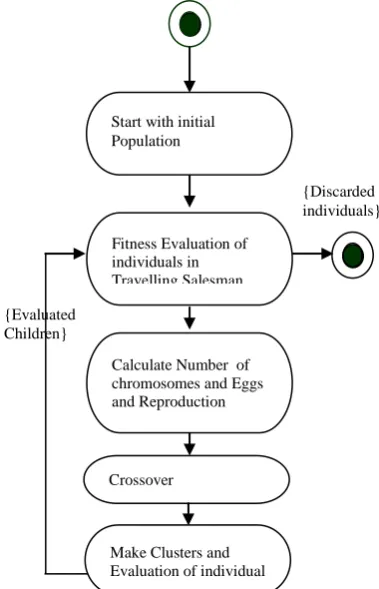
Figure 2. Genetic Algorithm based Cuckoo Search (GACS)
An initial population can be obtained as follows. Step 1. cities cluster into groups with based on -means clustering.
Step 2. GA is used to obtain the local optimal path of each group and a global optimal path of groups. Step 3. According to the global optimal path, one edge of each local optimal path disconnects to rewire the front and back groups.
Step 4. Repeating Step 3, an initial population can be generated.
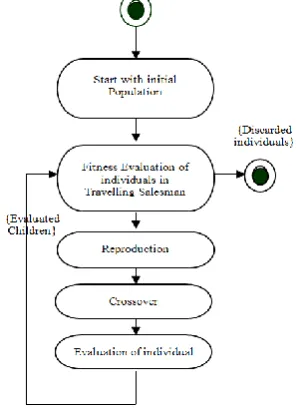
The first step of GA is to generate an initial population in which a set of possible solutions is contained. The quality of this population plays an important role in solving a problem by GACS. As can be seen from Figure 1, in which a TSP of N cities is considered.
Proposed GA based Cuckoo Search (GACS) algorithm:
Input:
1) Training Data - Tdata 2) Total Population -
3) Number of individuals - NI[ ]
4) Maximum Generations of the population - MGP[ ]
Output:
Travelling salesman problem cities mapped with solutions ranked .
Algorithm:
Step 1: Start with a randomly generated population with Mutation, =0.01 and Crossover, =0.99
Generate initial population of n host nests xi(i = 1, . . . , n)
while (t <MaxGeneration) or (stop criterion) do
Step 2: Assess the fitness value of each individual in the population . (1) Where SR –individual, rr -relevant class and ar - all class, (2) The fitness may range from 0 to 1
Step 3: Cuckoo Search, calculate Objective function f (x), x = (x1, . . . , xd) T
Get a cuckoo randomly by Levy flights and Evaluate its quality/fitness Fi
Choose a nest among n (say, j) randomly if (Fi > Fj) then
replace j by the new solution; end if
Step 3: Select individuals to reproduce based on their fitness given. Compute the average fitness of all value
(3) Step 4: Apply crossover with probability
=0.99 Step 5: Apply mutation with probability =0.01
A fraction (pa) of worse nests are abandoned and new ones are built; Keep the best solutions (or nests with quality solutions); Rank the solutions and find the current best
end while
Postprocess results and visualization
Step 6: Replace the population by the new generation of individuals after the evaluation
Step 7: Go to step 2
{Discarded individuals}
{Evaluated Children}
Make Clusters and Evaluation of individual Crossover
Start with initial Population
Fitness Evaluation of individuals in Travelling Salesman
Cuckoo search is based on three basic rules:
[1] Each cuckoo lays one egg at a time, and dumps it in a randomly chosen nest.
[2] The best nests with high quality of eggs will carry over to the next generations.
[3] The number of available host nests is fixed, and a host can discover an alien egg with a probability pa ∈
[0,1]. In this case, the host bird can either throw the egg away or abandon the nest so as to build a completely new nest in a new location.
For this work, the simplest approach has been chosen where each nest has only a single egg. Based the basic steps of the Cuckoo Search: When generating new solutions x (t+1) for, say, a cuckoo i,a Levy flight is performed
x (t+1) i =x (t) i + α*Levy(λ),[1]
Where α>0 is the step size which should be related to the rules of the problem of interests. In most cases, use α =1. The above equation is basically the stochastic equation for random walk. The random walk via Levy flight is more efficient in exploring the search space as its step length is much longer in the long run.
IV.
Experimental Results
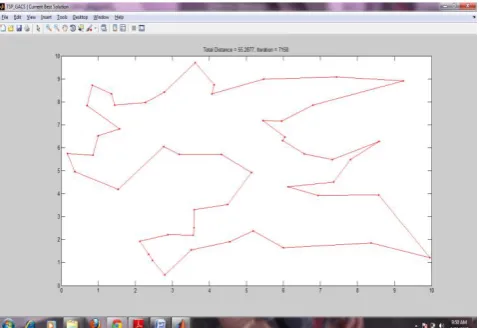
GACS is implemented using MATLAB under 32 bit Vista operating system. Experiments are conducted on a laptop with Intel(R) CoreTM 2 Duo 2.00 GHz CPU, and 3 GB of RAM. The values of parameters of the proposed algorithm are selected based on some preliminary trials. The selected parameters in both algorithms basic and improved DCS are those values that gave the best results concerning both the solution quality and the computational time needed to reach this solution.
Figure 3. Proposed GACS for N cities with population 200
V.
Findings and Discussion
The development environment that is used was MATLAB to process the stated original cuckoo algorithm and the proposed algorithm using the same fitness function for each individual/ chromosome. The initial number of population size is set to be only 50 individuals/chromosomes. Each member represents a cuckoo instance which can produce solution contains from 2 to 4 eggs as max. Conceptually, cuckoos will not do more than 100 iterations to find out the best habitat.
Global goal is minimization of the cost of the problem at earlier iteration. The cost of the problem is a performance metric represents the benefits to use the solution with lowest cost. In opposite of cost there is an urgent another metric which is the iteration obtains the optimal solution. Finally the optimal solution space, level or interval which is encloses the optimal solution block.
VI.
Conclusion
TSP is a classic NP hard problem which may seek many optimizations. In this research, it is extended and improved the cuckoo search (CS) via Levy flights by reconstructing the population and introducing a new cuckoo category which is more intelligent and combined with the genetic algorithm. Improved CS with GA named as GACS is adapted to solve the traveling salesman problem (TSP). This adaptation is based on the study of interpretation of the terminology used in GA and CS and in its inspiration source. GACS (improved GA and CS adapted to TSP) has been implemented and its performance has been tested on benchmark TSP instances.
VII.
REFERENCES
[1]. Ms. Rinky Dwivedi, Japleen Kaur, Divya Dawra, Devanshi Rish1 and Manusmriti Nandal,
“IMPLEMENTING AND ANALYSING
FUZZY CONTROLLER WITH ACO ON TRAVELLING SALESMAN PROBLEM” Elsevier, 2014..
[2]. Oloruntoyin Sefiu Taiwo, Olukehinde Olutosin Mayowa & Kolapo Bukola Ruka, “APPLICATION OF GENETIC ALGORITHM TO SOLVE TRAVELLING SALESMAN PROBLEM” International Journal of Advance Research, Volume 1, Issue 4, April 2013.
[3]. Musa PEKER, Baha SEN, P_nar Yildiz KUMRU, “AN EFFICIENT SOLVING OF THE TRAVELING SALESMAN PROBLEM: THE
ANT COLONY SYSTEM HAVING
PARAMETERS OPTIMIZED BY THE TAGUCHI METHOD” Turkish Journal of Electrical Engineering & Computer Sciences, 2013.
[4]. Marco Dorigo and Luca Maria Gambardella, “ANT COLONY SYSTEM: A COOPERATIVE
LEARNING APPROACH TO THE
TRAVELING SALESMAN PROBLEM “ IEEE Transactions on Evolutionary Computation, Vol.1, No.1, 1997.
[5]. F.S.Gharehchopogh, I.Maleki, S.R.Khaze, “A
NEW APPROACH IN DYNAMIC
TRAVELING SALESMAN SOLUTION: A HYBRID OF ANT COLONY OPTIMIZATION
AND DESCENDING GRADIENTS”,
International Journal of Managing Public Sector Information and Communication Technologies (IJMPICT), Vol. 3, No. 2, pp. 1-9, December 2012.
[6]. A. Toofani, “SOLVING ROUTING PROBLEM
USING PARTICLE SWARM
OPTIMIZATION”, International Journal of Computer Applications, Vol. 52, No.18, pp. 16-18, August 2012.
[7]. M. H.Mehta, “HYBRID GENETIC ALGORITHM WITH PSO EFFECT FOR
COMBINATORIAL OPTIMIZATION
PROBLEMS”, International Journal of Advanced Computer Research, Vol. 2, No. 4, pp. 300-305, December 2012.
[8]. I. Maleki, S. R.Khaze, F. S.Gharehchopogh, “A
NEW SOLUTION FOR DYNAMIC
TRAVELLING SALESMAN PROBLEM WITH HYBRID ANT COLONY OPTIMIZATION ALGORITHM AND CHAOS THEORY”, International Journal of Advanced Research in Computer Science (IJARCS), Vol. 3, No. 6, pp. 39-44, Nov-Dec 2012
[9]. F.S. Gharehchopogh, I. Maleki, M. Farahmandian, "NEW APPROACH FOR
SOLVING DYNAMIC TRAVELING
SALESMAN PROBLEM WITH HYBRID
GENETIC ALGORITHMS AND ANT
COLONY OPTIMIZATION", International Journal of Computer Applications (IJCA), Vol .53, No.1, pp. 39-44, September 2012.
[10]. Harun Rasit Er and Prof. Dr. Nadia Erdogan, ”PARALLEL GENETIC ALGORITHM TO
SOLVE TRAVELLING SALESMAN
PROBLEM ON MAPREDUCE FRAMEWORK
USING HADOOP CLUSTER”, The
International Journal of Soft Computing and Software Engineering [JSCSE], Vol. 3, No. 3, March 2013.
[11]. Hashim Ali, Muhammad Haris, Fazl Hadi, Ahmadullah, Salman, Yasir Shah, “SOLVING
TRAVELING SALESMAN PROBLEM
THROUGH OPTIMIZATION TECHNIQUES USING GENETIC ALGORITHM AND ANT COLONY OPTIMIZATION” Journal of Applied Environmental and Biological Sciences, 2016.
Appendix – A
Sample Screens : TSP -> No of cities: 3