CSEIT172493 | Received : 26 August 2017 | Accepted : 05 Sep 2017 | September-October-2017 [(2)4: 19-26]
International Journal of Scientific Research in Computer Science, Engineering and Information Technology © 2017 IJSRCSEIT | Volume 2 | Issue 5 | ISSN : 2456-3307
19
Optimized connected Median filter using Particle Swarm
Optimization
M. Rajalakshmi, Dr. P. Subashini
Department of Computer Science, Avinashilingam Institute for Women, Coimbatore, India
ABSTRACT
In the image processing Median filter were used to remove the impulse noise. It preserves the edges for the next level operations such as segmentation and object recognition. The present paper deals with the preprocessing of chili x-ray images. The researcher has already preprocessed the chili x-ray images by adopting the Average filter, Median filter, Wiener filter, Gamma intensity correction, CLAHE, 4-connected Median filter and weighted 4-connected median filter. The result of the above stated preprocess methods to contain noise in the pixels, hence it is considered as unsuitable for next level operations. To remove such noise from the image, this paper contributes a precise and well-organized algorithm. The proposed noise removal algorithm replaces the noisy pixels by using „4-connected median value‟ and replaces the remaining pixels by using „weighted 4-connected median value‟ in the selected window. The replacement of middle pixel value in 4-connected median filter is done through particle swarm optimization algorithm. Peak Signal to Noise Ratio used as the fitness function in the particle swarm optimization algorithm. The performance measures were taken for all the noise removal algorithm. Among the various results obtained, the proposed algorithm works better than others.
Keywords - chili x-ray image, impulse noise, particle swarm optimization, weighted and 4-connected median filter, Optimized connected Median filter, Particle Swarm Optimization, Peak Signal to Noise Ratio.
I.
INTRODUCTION
Salt and pepper noise is a kind of impulse noise. It generally found on all types of images. It looks like a black and white pixel on the images in a random manner. Black pixels appear in the bright regions and white pixels appear in the dark regions of the noisy image. Formerly linear filters were considered as the most accepted filters for removal of noise in the images. It became fame by virtue of its working methodology. Linear filter preserves the edges of the image and removes the noise without any loss of primary contents of the image. Among the various linear filters median filter is the most important filter. However median filter seems to be very difficult to remove the salt and pepper noise without distortion of image [2].
Amera Abdul et.al [1] presented an algorithm in their research work to de noise an image by adopting
Particle Swarm Optimization. It retains the details of an image despite of increase in the density of noise. The author has adopted Peak Signal to Noise Ratio for evaluating the performance. They have obtained better results in their work by getting 5dB more than the conventional method of de noising.
Mean Square Error. Fuzzy filter along with PSO attained the excellent quality of image without noise.
J. K. Mandal et. Al. [6] proposed a novel approach in their study for de noising the images. They have detected and filtered the noise pixels from all the neighbor directional weighted pixels by applying minimum variance. They have also employed Particle Swarm Optimization to found out the filtering operators for the sake of obtaining better performance. They adopted Peak Signal to Noise Ratio for fitness evaluation function and performance metric. Final results of their work exposed that the contents of image edges were excellently preserved for the too noisy images.
Mohamed Mansoor Roomi et.al [12] proposed a particle swarm optimization based on noise filter. It removes noise in the lena, hand x-ray image and SAR image. In their research work the filter weights were optimized by particle swarm optimization. It replaces the noisy pixel through acquiring the nearby pixel based upon its edge direction values of minimum mean square error. This filter obtains 4 dB greater than the other existing filters. Similarly many researchers have applied PSO for removal of noise in order to attain best quality of images.
The present study deals with the analysis of chili x-ray images taken exclusively for this purpose.The chili x-ray image gets noisy due to lack of temperature, light and humidity of the chili. To remove such noise, the chili x-ray images were preprocessed by adopting the existing algorithms such as Average filter, Median filter, Wiener filter, Gamma intensity correction[10] and CLAHE. Among them median filter produces better result than the other filters. However the Peak Signal-to-Noise Ratio (PSNR) value obtained was significantly low. In order to overcome such drawbacks in the median filter, it was slightly modified and renamed it as 4-connected median filter. It took 4 neighbors of a middle pixel instead of selecting 3x3 windows. The similar process of 4-connected median filter was repeated along with the addition of weights known as weighted 4-connected median filter. The possible weights are [1,1,1,1,1],[3,2,2,1,1],[2,2,1,1,1] and [3,1,1,1,1]. Among the four weights, fourth weight viz. [3,1,1,1,1] produced better results. The final result of the preprocessing does not differentiate the chili‟s seed and toxin affected area from the other pixels of the image due to the content of noise. PSO was adopted to
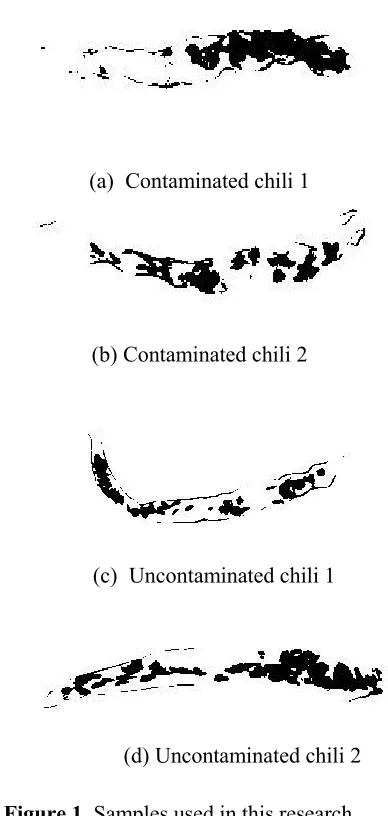
remove the noise in most of the review of literature [7]. Hence an attempt of PSO was made in the present study to remove the noise in the chili x-ray image. Few chili x-ray images used in this paper are shown in following figure 1.
(a) Contaminated chili 1
(b) Contaminated chili 2
(c) Uncontaminated chili 1
(d) Uncontaminated chili 2
Figure 1. Samples used in this research
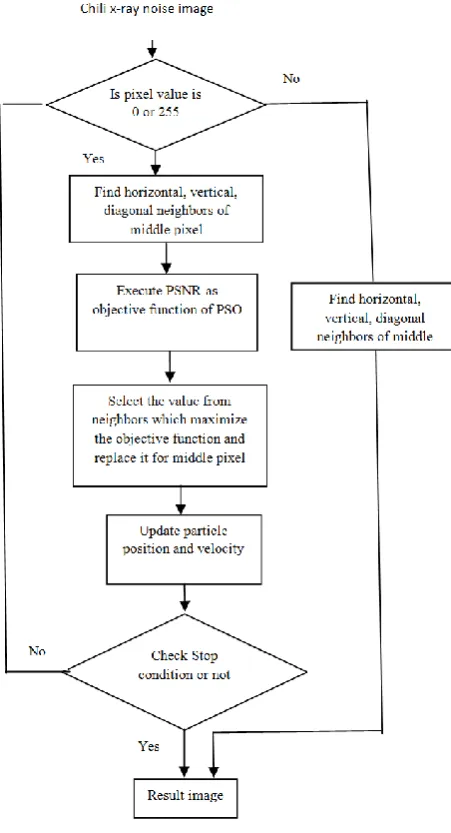
The flow of the proposed work is shown in figure 2.
Figure 2. Flow of the proposed work
II.
METHODOLOGY
The proposed work “Optimized connected Median Filter using Particle Swarm Optimization algorithm” initiates its first process by identifying the impulse noise from the noisy image [9]. The algorithm verifies the value of the image pixel whether it lies in between 0 (minimum gray level) to 255 (maximum gray level) then weighted 4-connected median filter has to be implemented. If the value of image pixel has the exact minimum gray level (0) or maximum gray level (255) then the algorithm identifies it has a noisy pixel [4] and employ 4-connected median filter algorithm along with particle swarm optimization algorithm to process the noisy pixel.
A. Algorithm
Step 1 : Select the processing window size of 3×3. Let the
processing pixel given as Xij.
Step 2 : If processing pixel value lies in between 0 to 255 i.e. 0 < Xij < 255, then Weighted 4- connected median filter with weight [3, 1, 1, 1, and 1] are to be employed.
Step 3 : If the processing pixel value are either 0 or 255 then 4-connected median filter with particle swarm optimization algorithm are to be employed.
Step 4 : Repeat steps 1 to 3 until all the pixels in the image are to be processed.
B. Weighted 4-connected median filter
Weighted 4-connected median filter works by taking horizontal, vertical neighbors of pixel x i.e., N4(x) and
diagonal neighbors of pixel x i.e., ND(x) all are added
to pre-established weights[2].
The Filtering Process works as Follows
Duplicate the pixel inputs to the number of times corresponding to its weight W Sort the pixel inputs in the selected window Select the middle value as a median from the
set of sorted pixel values
For the filtering purpose, the filter window size 5 has to be selected and the predefined weights [3, 1, 1, 1, 1] are to be employed in this research. The greater value of two i.e., the weighted median of N4(x) and weighted
median of ND(x), has to be replaced in the middle pixel
value of x.
Pixel x = max { (1)
By applying the equation (1), the new pixel value was calculated. This same procedure was repeated for every pixel in the chili x-ray image.
C. Particle Swarm Optimization
from the primary group of the individuals [11]. The individuals of this primary group are again reconstructed on some kind of procedure so that they are motivated to select a better solution area.
In PSO system, each individual in a group was referred as “particle” and the ith particle was represented as Xi =
(x1, x2, x3, · · ·, xi). The best position of a particle was identified by the calculation of fitness value using the fitness function. In the proposed algorithm Peak Signal-to-Noise Ratio was calculated as a fitness function. The best place of each and every particle was noted as pbest and the point of the best particle among all the values in the group for that iteration was recorded as gbest. The velocity for particle „i‟ was represented as Vi = (V1, V2, V3, · · · , Vi). From the above information, the velocity and place of every particle is updated according to the following equation 2 and 3. are uniform random numbers in between the range 0 and 1.
D. Implementation of PSO based 4-connected median filter
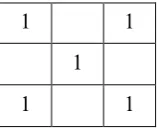
following coordinates (u-1, v-1), (u-1, v+1), (u+1, v-1), (u+1, v+1) and it is illustrated in fig 4.
1 1
1
1 1
Figure 4. 4-diagonal neighbors of pixel x i.e., ND (x)
4-connected median filter works as follows:
The greater among the three value viz. the median of N4(x), median of ND(x) and original pixel value of x,
has to be replaced in the middle pixel value of x.
Middle pixel x= max {
}(4)
By applying the equation (4), the new pixel value was calculated. The same procedure was repeated for every pixel in the chili x-ray image.
(ii) Implementation of PSO Algorithm Algorithm:
Step 1: Select the processing window size of 3×3. Let the processing pixel as Xij. Initialize the input samples as given below.
Step 2: Find the diagonal neighbors of pixel x i.e., ND(x).
Step 3: Find the horizontal, vertical neighbors of pixel x i.e.,
N4(x).
Step 4: Define Peak Signal to Noise Ratio as objective function in particle swarm optimization algorithm[13].
Step 5: Among the three values such as the median of N4(x), median of ND(x), and original value of
that point x, which one maximizes the objective function i.e., PSNR in particle swarm optimization has taken to replace the pixel value of that point x.
Implementation:
From the three values such as the median of N4(x),
ND(x) and original pixel value of that point x which one
maximizes the objective function in particle swarm optimization has taken to replace the pixel value of that point x.
Pixel x = {
}
(6)
By using the equation (6), selection of new pixel value for each pixel x are done through the implementation of particle swarm optimization with 4-connected median filter. The filtering process was carried out repeatedly for every pixel value in the chili x-ray image. Finally the resultant filtered image was evaluated by the defined performance measures.
III.
RESULTS AND DISCUSSIONS
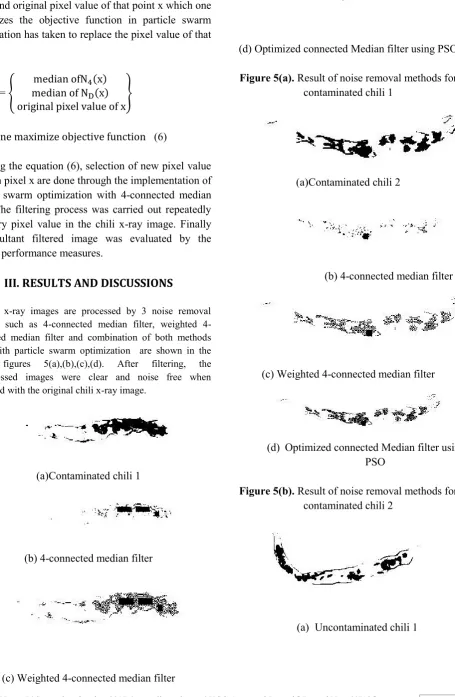
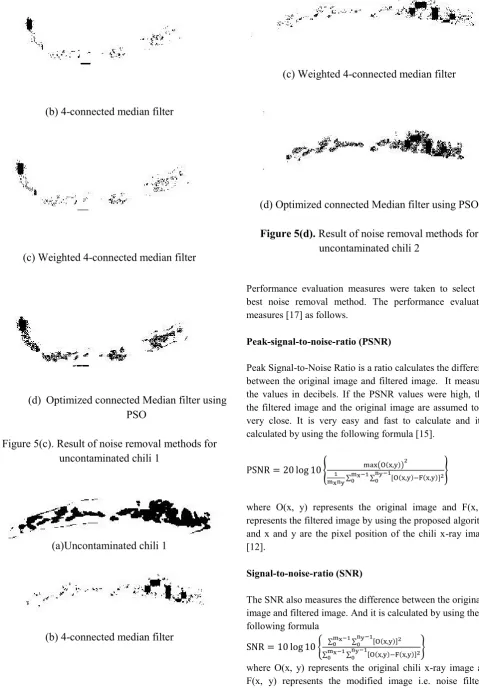
50 chili x-ray images are processed by 3 noise removal methods such as connected median filter, weighted 4-connected median filter and combination of both methods along with particle swarm optimization are shown in the below figures 5(a),(b),(c),(d). After filtering, the preprocessed images were clear and noise free when compared with the original chili x-ray image.
(a)Contaminated chili 1
(b) 4-connected median filter
(c) Weighted 4-connected median filter
(d) Optimized connected Median filter using PSO
Figure 5(a). Result of noise removal methods for contaminated chili 1
(a)Contaminated chili 2
(b) 4-connected median filter
(c) Weighted 4-connected median filter
(d) Optimized connected Median filter using PSO
Figure 5(b). Result of noise removal methods for contaminated chili 2
(b) 4-connected median filter
(c) Weighted 4-connected median filter
(d) Optimized connected Median filter using PSO
Figure 5(c). Result of noise removal methods for uncontaminated chili 1
(a)Uncontaminated chili 1
(b) 4-connected median filter
(c) Weighted 4-connected median filter
(d) Optimized connected Median filter using PSO
Figure 5(d). Result of noise removal methods for uncontaminated chili 2
Performance evaluation measures were taken to select the best noise removal method. The performance evaluation measures [17] as follows.
Peak-signal-to-noise-ratio (PSNR)
Peak Signal-to-Noise Ratio is a ratio calculates the difference between the original image and filtered image. It measures the values in decibels. If the PSNR values were high, then the filtered image and the original image are assumed to be very close. It is very easy and fast to calculate and it is calculated by using the following formula [15].
{ ( )
∑ ∑
} (7)
where O(x, y) represents the original image and F(x, y) represents the filtered image by using the proposed algorithm and x and y are the pixel position of the chili x-ray image. [12].
Signal-to-noise-ratio (SNR)
The SNR also measures the difference between the original image and filtered image. And it is calculated by using the following formula
{ ∑ ∑
∑ ∑ } (8)
image and x and y are the pixel position of the mx× ny
image[15].
Root Mean Squared Error (RMSE)
Mean Squared Error was calculated through the average square of difference between the noisy chili image and noise removed image [14]. The Mean-Squared-Error (MSE) is the simplest one to calculate, and the most widely used for
original image and modified image are equal [ ].
Mean Absolute Error (MAE)
Mean Absolute Error measures the absolute closeness between two nxx ny digital images [14]. It is a linear score
which is calculated by using the following formula as:
∑ ∑
Table1. Comparison Of Quality Assessment Parameters
Method/Measure Contami filtering methods such as 4-connected Median filter, Weighted 4-connected Median filter along with proposed Optimized connected Median using Particle Swarm Optimization. To determine the result on the above comparison some performance measures were calculated, by Peak signal to noise ratio (PSNR), Signal to noise ratio (SNR), Root Mean Squared Error (RMSE) and Mean Absolute Error (MAE). These performance measures are calculated by above equations starting from 6 to 9. The calculations are done between the original chili x-ray image and the result of filtered image. From the above, Optimized connected Median using Particle Swarm Optimization provides good results than the existing proposed methods. The MAE error value obtained was lower than the 4-connected median filter and the weighted 4-4-connected median filter. From the table 2, it infers that the PSNR value obtained was greater than all the other values and it is proved that fitness function has attained the optimization. The earlier studies proved that greater value of PSNR gives very good image quality and suitable for the next level processing. From the above analysis it is concluded that the Optimized connected Median using Particle Swarm Optimization is considered as a best method to remove the noise in the chili pepper x-ray images.
IV.
CONCLUSION
V.
REFERENCES
[1]. Amera Abdul,Wohid Funjan AL.Tayee, “Denoising An Image Based On Particle Swarm Optimization (PSO) Algorithm”, Journal of Babylon University/Pure and Applied Sciences/ No.(5)/ Vol.(21): 2013,pp.1511-1518.
[2]. Anuradha, Mr.Sanjay Yadav, “ Review On:-Face Recognition algorithm based on Surf Feature Extraction, Median Filter with Particle Swarm Optimization Algorithm”,International Journal of Research Development and Innovation (IJRDI), Volume 1, Issue 2, March 2015, pp. 72-76.
[3]. Baladhandapani Arunadevi, and Subramaniam N. Deepa, ”Brain Tumor Tissue Categorization In 3d Magnetic Resonance Images Using Improved PSO for Extreme Learning Machine”, Progress In Electromagnetics Research B, Vol. 49, 2013,pp. 31-54.
[4]. Bharathi P. T, Dr. P. Subashini, ”Decision Based Median Filter using Particle Swarm Optimization for Impulsive Noise”, International Journal of Emerging Technologies in Computational and Applied Sciences (IJETCAS), 4(1), March-May 2013, pp.109-115. [5]. Christo Ananth, Vivek.T, Selvakumar.S., Sakthi
Kannan.S., Sankara Narayanan.D, “ Impulse Noise Removal using Improved Particle Swarm Optimization”, International Journal of Advanced Research in Electronics and Communication Engineering (IJARECE) Volume 3, Issue 4, April 2014, pp. 366-370.
[6]. J. K. Mandal, Somnath Mukhopadhyay, “Image Filtering using all Neighbor Directional Weighted Pixels: Optimization using Particle Swarm Optimization”, Signal & Image Processing : An International Journal (SIPIJ) Vol.2, No.4, December 2011.
[7]. Jansi S., Subashini P., “Particle Swarm Optimization Based Total Variation Filter for Image Denoising”, Journal Of Theoretical And Applied Information Technology, Vol. 57 No.2, 20th November 2013.pp. 169-173.
[8]. Rafael C. Gonzalez, Richard E. Woods, “Digital Image Processing”, pp.40-42,191-195.
[9]. Rutuja N. Kulkarni, P.C. Bhaskar, “Decision Based Median Filter algorithm using Resource Optimized FPGA to Extract Impulse Noise”, International Journal of Reconfigurable and Embedded Systems (IJRES), Vol. 3, No. 1, March 2014, pp. 1-10.
[10]. Sachin K. Ingale and Ashish B. Jirapure, ”A Survey of Image Processing Technique For Contrast Improvement of An Image“, International Conference on Electronics and Communication Engineering, April 28th-29th, 2012,pp.109-114.
[11]. Sarah B. Aziz and Maytham A. Shahed,”Impulsive and Poisson Noises Removal Using Takagi Neuro-Fuzzy Network”, Scientific Journal of King Faisal University (Basic and Applied Sciences),Vol.11 No.1, 2010, pp.117-141.
[12]. S. Mohamed Mansoor Roomi, P.L. Muthu Karuppi, P. Rajesh and B. Guru Revathi,” A Particle Swarm Optimization Based Edge Preserving Impulse Noise Filter”, Journal of Computer Science 6 (9), 2010, pp. 1014-1020.
[13]. Somnath Mukhopadhyay, J. K. Mandal,” Algorithms for Denoising Medical and Digital Images”, Elsevier, January 25, 2014, pp.1-11.
[14]. Sumathi Poobal,G.Ravindran,”The Performance of Fractal Image Compression on Different Imaging Modalities Using Objective Quality Measures”, International journal of Engineering science and technology (IJEST), Vol 3. No.1 Jan 2011, pp.525-530.
[15]. Suresh Kumar, Papendra Kumar, Manoj Gupta, Ashok Kumar Nagawat,”Performance Comparison of Median and Wiener Filter in Image De-noising”,International Journal of Computer Applications (0975 – 8887) Volume 12– No.4, November 2010,pp. 27-31.
[16]. V.Mythili, Dr. R. Manavalan, “ Optimizing Structuring Element Using Eagle Optimization for Image Denoising: Performance Analysis”, IJASCSE, Volume 2, Special Issue 2, 2013, pp.24-30.