Evolving Cryptographic Approach for Enhancing Security of Resource
Constrained Mobile Device Outsourced Data in Cloud Computing
K. Kaviya 1, K. K. Shanthini 1, Dr. M. Sujithra2
1MSc. Software Systems, Coimbatore Institute of Technology, Coimbatore, Tamil Nadu, India 2Assistant Professor, Coimbatore Institute of Technology, Coimbatore, Tamil Nadu, India
ABSTRACT
Mobile cloud computing in the increasing popularity among users of mobile device enables to store their data in cloud. Security is the major concern when the sensitive information is stored and transferred across the internet. It is essential to make sure that the data is secured and protected. In this paper, we discussed the problem of privacy of data with reducing the resources usage. Moreover, mobile cloud computing has limitations in resources such as power energy, processor, Memory and storage. Cryptography ensures the confidentiality, authentication, availability, and integrity of the data. This is done through cryptographic algorithms such as Data Encryption Standard (DES), Blowfish and Advanced Encryption Standard (AES). The experimental results evaluated and compared the performance of the encryption algorithms. The performance metrics used are encryption and decryption time, CPU and Memory utilization. Evaluation results showed a significant improvement in reducing the resources, amongst all the techniques, choosing a suitable encryption algorithm based on different parameters that are best fit to the future user requirements is considered.
Keywords : Mobile Cloud Computing, Blowfish, AES, Security, Privacy, Mobile Device.
I. INTRODUCTION
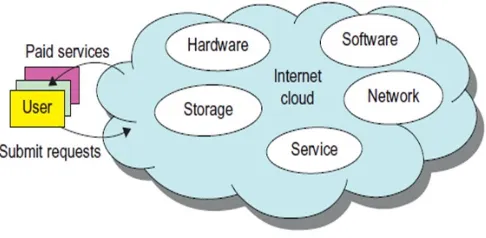
Mobile cloud computing uses cloud computing to carry out the resource intensive tasks over the internet to provide higher scope of functionality with minimal pressure on mobile resources. Cloud computing is a modern era computing technique that has a greater future and bringing a lot of benefit to the information technology. The major advantage of using cloud is that it offers the cloud services to people by Pay-as-You-Go manner. Cloud computing applies a virtualized platform with elastic resources on demand by provisioning hardware, software, and data sets dynamically.
Figure 1.1 Cloud Environments
allocate hardware resources to users in an efficient, quick, and smooth way. The supervisor software layer contains the system software to manage the cloud hardware resources. The system software permits application software to run and utilize underlying resources in an efficient way.In the context of mobile cloud security, cloud providers should ensure reliability and availability by integrating security technologies MCC satisfies limitations of resource constrained devices by allocating cloud services for the purpose of application executions and data storage. So, whenever we talk about the security in MCC, it is necessary to consider the security and privacy issues.
To secure the mobile cloud environment, several issues need to be considered regarding the data security, data integrity, data confidentiality, authentication, authorization, network security, data violation issues etc. A secure framework is essential to protect sensitive data of mobile users with minimal performance degradation. The proposed scheme uses data encryption to protect sensitive data leakage. When user’s data is transmitted to and stored on cloud, it creates many possibilities of unauthorized access of data either during transmission or from storage devices. There are many cryptographic algorithms to deal with security, but the selection must be taken by considering security as well as performance improvement, especially in the case of resource constrained devices.
II. SECURITY ISSUES
Data Storage: Cloud storage providers manage the data in multiple copies across many independent locations
Confidentiality: Confidentiality can be defined as the sensitive data not being disclosed to unauthorized process, devices and person. A cloud service provider knows where the user’s public or private data is located and who
can/cannot access the data. The principle of confidentiality specifies that only the sender and the intended recipient should be able to access the contents of a message.
Integrity: The integrity mechanism ensures that the contents of the message remain the same when it reaches the intended recipient as sent by the sender. It is defined as the rightness of data stored in the cloud. The alterations between two updates of a record violate the data integrity.
Security: In the traditional file systems data was stored within boundaries, but cloud data is stored outside the boundaries of an organization, say, and third-party storage using strong encryption techniques.
Authentication: Authentication mechanisms help to establish proof of identities. This process ensures that the origin of the message is correctly identified.
Non- repudiation: Non-repudiation does not allow the sender of a message to refute the claim of not sending the message.
Access Control: Access Control specifies and controls who can access the process.
Availability: The principle of availability states that resources should be available to authorized parties all the times.
III. CRYPTOGRAPHY
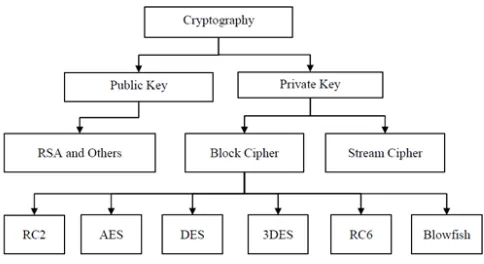
come up as a solution to this security issue. Cryptography is classified into symmetric cryptography, asymmetric cryptography and hashing.
Types of Cryptography
Secret Key Cryptography: When the same key is used for both encryption and decryption, DES, Triple DES, AES, Blow Fish RC5 etc., may be the examples of such encryption, then that mechanism is known as secret key cryptography.
Public Key Cryptography: When two different keys are used, that is one key for encryption and another key for decryption, RSA, Elliptic Curve etc., may be the examples of such encryption, then that mechanism is known as public key cryptography.
Hash Algorithms where the input data (message) is recreated from the hash value (message digest/digest) examples include: MD5, SHA, MD2, MD4, MD6.SHA-256, SHA-512, SHA-1, Whirlpool etc.
Figure 3.1 Types of cryptographic algorithms
IV.PROPOSED METHODOLOGY
Data Encryption Standard (DES)
DES utilized the one secret key for encryption and decryption process and key length is 56 bits and performs the encryption of message using the 64 bits
block size. It includes 64 bits key that contains 56 bits are directly utilized by the algorithm as key bits and are randomly generated. The DES algorithm processes the 64 bits input with an initial permutation, 16 rounds of the key and the final permutation. The DES was initially considered as a strong algorithm, but today the large amount of data and short key length of DES limits its use.
Advanced Encryption Standard (AES)
The algorithm explains about by AES is a secret-key algorithm which means of the same key is used for both encrypting and decrypting the data. This is one reason why it has a comparably small number of rounds. AES encryption is fast and flexible. It can be implemented on various platforms especially in small devices. All the operations in this algorithm involve complete bytes for effective implementation. Three different key lengths such as 128, 192 and 256 block size are supported by AES.
Table 4.1 Comparison of Symmetric Algorithms
Blowfish
Blowfish is fast, license free, unpatented, freely available and alternative for existing encryption
Algorith ms/Metr ics
DES AES BLOWFIS
H
Structure Feistel
Substitution-Permutation Feistel
Key
Length 56 bits 32-448 128,192 or 256
Rounds 16 10, 12, 14 16
Block
Size 64 bits 128 bits/192 0r 256 64 bits
Through put
< AES < Blowfish High
Security Adequat
e Excellent Excellent
algorithms. It uses the key length range up to 32-448- and 64-bits block. Blowfish algorithm employed 16 rounds for the encryption process. Each round contains a key dependent permutation and key- and data dependent substitution. Data Encryption involves the iteration of a simple function of 16 times. Each round contains a key dependent permutation and data dependent substitution. Sub key Generation involves converts the key up to 448 bits long to 4168 bits. Blowfish is very suitable algorithm for the platform of smart phones because of its high security level and high speed.
V. PERFORMANCE EVALUATION METRICS
CPU Time Calculation
CPU Time = I * CPI * T, where I = number of instructions in program, CPI = average cycles per instruction and T = clock cycle time.
CPU Time = I * CPI / R, where R = 1/T the clock rate, T or R are usually published as performance measures for a processor, I requires special profiling software and CPI depends on many factors (including memory).
Performance Calculation
Seconds/Program = (Instructions/Program) x (Clocks/Instruction) x (Seconds/Clock)
Memory Consumption Calculation
Total Memory - (Free + Buffers + Cached) = current total memory usage
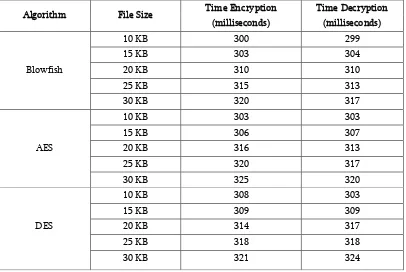
Table 5.1. Experimental Results: Time Comparison
Algorithm File Size Time Encryption Time Decryption
(milliseconds) (milliseconds)
Blowfish
10 KB 300 299
15 KB 303 304
20 KB 310 310
25 KB 315 313
30 KB 320 317
AES
10 KB 303 303
15 KB 306 307
20 KB 316 313
25 KB 320 317
30 KB 325 320
DES
10 KB 308 303
15 KB 309 309
20 KB 314 317
25 KB 318 318
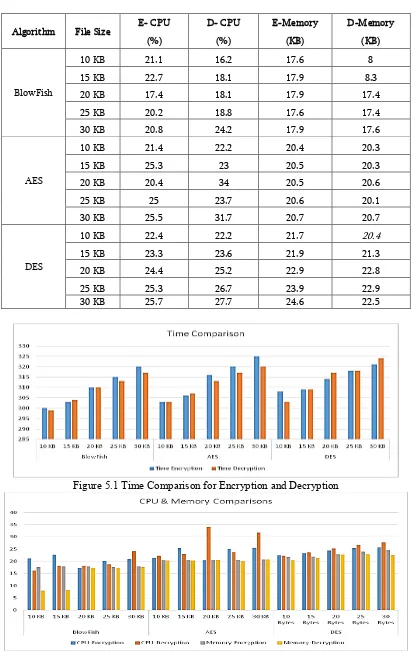
Table 2. Experimental Results: CPU and Memory Consumption
Algorithm File Size E- CPU D- CPU E-Memory D-Memory
(%) (%) (KB) (KB)
BlowFish
10 KB 21.1 16.2 17.6 8
15 KB 22.7 18.1 17.9 8.3
20 KB 17.4 18.1 17.9 17.4
25 KB 20.2 18.8 17.6 17.4
30 KB 20.8 24.2 17.9 17.6
AES
10 KB 21.4 22.2 20.4 20.3
15 KB 25.3 23 20.5 20.3
20 KB 20.4 34 20.5 20.6
25 KB 25 23.7 20.6 20.1
30 KB 25.5 31.7 20.7 20.7
DES
10 KB 22.4 22.2 21.7 20.4
15 KB 23.3 23.6 21.9 21.3
20 KB 24.4 25.2 22.9 22.8
25 KB 25.3 26.7 23.9 22.9
30 KB 25.7 27.7 24.6 22.5
Figure 5.1 Time Comparison for Encryption and Decryption
VI.CONCLUSION
The demonstration of results and discussion about these algorithms are mainly focused on evaluation parameter like encryption and decryption time, memory and CPU utilization which has more impact on the security, confidentiality, integrity, and reliability for secure communication. Security as earlier discussed is the main challenge faced while time and minimum energy consumption.
VII. REFERENCES
[1]. Gurpreet Kaur and Manish Mahajan (2013), Analyzing Data Security for Cloud Computing Using Cryptography Algorithms‖, International Journal of Engineering Research and Application, Vol.-3,782-786.
[2]. Sujithra, M., G. Padmavathi, and Sathya Narayanan. Mobile Device Data Security: A Cryptographic Approach by Outsourcing Mobile Data to Cloud. In: Procedia Computer Science 47; 2015.p. 480-485.
[3]. Paresh D.Sharma, Prof. Hitesh Gupta(February 2014) An Implementation for Conserving Privacy based on Encryption Process to Secured Cloud Computing Environment‖ IJESRT Sharma, 3(2).
[4]. D. S. A. Elminaam, H. M. A. Kader, and M. M. Hadhoud, "Evaluating the performance of symmetric encryption algorithms," International Journal of Computer Theory and Engineering, vol. 10, no. 3, pp. 343-351, 2009. [5]. M. Sujithra, and G. Padmavathi, "Ensuring
Security on mobile device data with two phase
RSA algorithms over cloud storage", Journal of Theoretical and Applied Information Technology, Vol.80. No.2 ISSN: 1992-8645, October 2015.
[6]. HealeyM(2010) Why IT needs to push data sharing efforts. Information Week. Source: http://www.informationweek.com/services/inte gration/why-it-needs-to-push-data-sharing-effort/225700544. Accessed on Oct 2012 [7]. D. Elminaam, H. M. A. Kader, and M. M.
Hadhoud, "Performance evaluation of symmetric encryption algorithms," International Journal of Computer Science and Network Security, vol. 8, no. 12, pp. 280-286, 2008.
[8]. Shanthni KK., Kaviya K and Sujithra M.2018, A Survey on Cloud Computing: Data Security Challenges and Their DefensiveMechanisms. Int J Recent Sci Res. 9(5), pp. 26497-26500. DOI:
http://dx.doi.org/10.24327/ijrsr.2018.0905.2070 [9]. D. Salama, A. Minaam, H. M. Abdual-kader,
and M. M. Hadhoud, "Evaluating the effects of symmetric cryptography algorithms on power consumption for different data types," International Journal of Network Security, vol. 11, no. 2, pp. 78-87, 2010.
[10]. L Krithikashree ; S. Manisha ; M Sujithra," Audit Cloud: Ensuring Data Integrity for Mobile Devices in Cloud Storage",Published in: 2018 9th International conference on Computing, Communication and Networking Technologies (ICCCNT), IEEE , DOI: 10.1109/ICCCNT.2018.8493963
Cite this article as :
K. Kaviya, K. K. Shanthini, Dr. M. Sujithra, "Evolving Cryptographic Approach for Enhancing Security of Resource Constrained Mobile Device Outsourced Data in Cloud Computing", International Journal of Scientific Research in Computer Science, Engineering and Information Technology (IJSRCSEIT), ISSN : 2456-3307, Volume 5 Issue 1, pp. 101-106, January-February 2019. Available at doi :