International Journal of Scientific Research in Computer Science, Engineering and Information Technology © 2018 IJSRCSEIT | Volume 3 | Issue1 | ISSN : 2456-3307
A Novel Quality of Service (QoS) routing algorithm for
Software Defined Network (SDN) using Particle Swarm
Optimization (PSO)
Raghavendra Kulkarni*1, Dr.Kalpana Sharma2
*1Research Scholar, Department of Computer Science, Bhagwant University, Ajmer, Rajasthan, India 2Assistant Professor, Department of Computer Science, Bhagwant University, Ajmer, Rajasthan, India
ABSTRACT
Due to the use of various technologies like mobile, cloud, big data. The network traffic has increased this has resulted in the reexamination of the working of traditional network architectures as these are built as static architectures and cannot handle the rapid growing traffic on the internet. A dynamic architecture which can be programmed according to the traffic behavior was the need. Software Defined Networking (SDN) was emerged to address the growing needs of the dynamic traffic which has been in the moonlight since 2010. SDN increase and makes the network as flexible to program according to the programmers needs by keeping the traffic in line. It gives the user flexibility of adjusting the network resources by separating the control plane and data plane. By using SDN networks can be managed dynamically. The capacity of a network to offer good services to the selected network traffic over various technologies is termed as Quality of Service (QoS). To transfer high-bandwidth video and multimedia information continuously QoS is of particular objective.
Keywords: Delay Constrained Least Cost (DCLC), Particle Swarm Optimization (PSO), Software Defined Network (SDN), Quality of Service (QoS), Throughput, Latency.
I.
INTRODUCTION
Quality of Service (QoS) is an attempt to adjust the allocation of the network resources to the requirements of services administrating in the network [25][18][16]. The objective is to offer each service with the needed network resources given the possibly inadequate overall available resources [19]. However, these services have diverse QoS requirements such as throughput, latency, jitter, error-rate and redundancy [7]. It is difficult to develop a model that addresses all requirements and there are two methods tries to solve these drawbacks in the Internet [1]. IntServ is the first method to offer end-to-end QoS connections per flow. Nevertheless, the computational effort for verifying these end-to-end relations is vast which lead to the scalability of
this method is inadequate [3]. Another method is called as Diffserv which is designed for scalability but it provide low granularity in flow control [2]. Moreover, the Diffserv is highly restricted which leads to difficulties in its management [4].
metric [31]. DCLC routing algorithms and similar routing algorithms that reinforce QoS networking are called as QoS routing algorithms. Besides, the improvement of the Open Flow protocol with QoS-related characteristics [8][24]. This leads to higher cost and effort due to the lack of standardization.
SDN is an innovative networking standard which splits the control plane from the data plane. SDN enable the network management and administrators to program and control their networks dynamically [21][27]. In SDN, the data plane includes switches, handle network traffic based on the forwarding rules installed by the control plane or the controller. The logically centralized controller is a global evaluation of the network and gathers network statistics [32]. Due to the controller is a global knowledge about network which is adaptively installs suitable forwarding rules over the data plane components concerning the network status. This method creates SDN as a suitable candidate for controlling multicast communications. Also, the capabilities of SDN to support network providers to guarantee QoS for their customers. Therefore, a wide range of research which are considering the application of SDN for QoS networking [33].
Google recently announced that it is using Software Defined Network (SDN) to interconnect its data centers due to the ease, efficiency and flexibility in performing traffic engineering functions. It expects the SDN architecture to result in better network capacity utilization 20-30% and improved delay and loss performance [36].
A set of QoS parameters [15] includes:
• Throughput - a part of the channel bandwidth available to the particular connection;
• End-to-end delay - time is needed to deliver a packet from one source host to a destination host; • Jitter - a deviation of the end-to-end delay from its mean value;
• Error Rates - the share of packets lost or damaged during a transmission through connection.
Traffic engineering (TE) is an important network application, which studies measurement and management of network traffic, and designs reasonable routing mechanisms to guide network traffic to improve utilization of network resources, and better meet requirements of the network quality of service (QoS)[17].
II.
AIM AND OBJECTIVES OF STUDY
1.1 Aim
The major aim of the research is to develop a novel Quality of Service (QoS) routing algorithm for Software Defined Networking (SDN) using Particle swarm Optimization (PSO).
1.2 Objectives
To achieve the abovementioned aim, the research
has following objectives:
1.To explore the various conventional techniques and its challenges in QoS routing algorithm in Software Defined Networks (SDN).
2.To provide the greater QoS performance using Particle Swarm Optimization (PSO) based Delay Constraint Least Cost (DCLC) routing algorithm.
III.
LITERATURE REVIEW
[5] proposed a genetic-inspired based multicast routing with QoS constraints which includes bandwidth and end-to-end delay. In this, GA is used to attain efficient determination of a minimum-cost multicast tree which provides various services with fast convergence speed and high reliability.
[9] proposed GA based multimedia multicast routing to detect the low-cost multicasting tree with delay and bandwidth constraints.
[10] proposed hybrid scatter search and path relinking optimization for the Delay-Constrained Least-Cost (DCLC) multicast routing problem.
A multicast framework called Cast flow proposed which manages multicast groups and performs multicast routing in SDN [12]. Also, the cost of each link in Cast flow is described as the distance between the source and destinations. Cast flow estimates Minimum Spanning Tree (MST) using Prim algorithm to route network traffic. However, Cast flow does not have any procedure to
offerQoS for end hosts applications.
A fault tolerant IP multicasting approach over SDN is proposed [11]. In this, the approach is developed which estimates two different multicast trees between source and destinations. Once a switch in primary multicast tree fails, the controller adapts the forwarding rules of network to the alternative multicast tree.
A new approach called Multiflowis presented for multimedia multicasting [13]. The objective of Multiflow is to control multicast group, and drop end-to-end delay between the source and destinations. In Multiflow, the edge of each link in the network is allocated using the distance between two nodes. Multiflow uses Dijkstra algorithm to estimate shortest path tree. Due to Multiflow only chooses care about delay, it does not guarantee packet loss reduction, and it might be cause high packet loss ratio.
A network-layer single-source multicast framework called Lcastis presented [22]. This is an inter-domain multicast model that utilizes Locator/ID Separation Protocol (LISP) overlay router to create the network scalable.
[19] proposed an approach to offer real-time QoS performance through network elements. In this, end-to-end real-time QoS path planning is implemented with a greedy algorithm and a Mixed Integer Program (MIP). The greedy algorithm defines the performance of a real-time QoS reservation concept with a fixed flow to queue allocation. The MIP gives the possible gain which is achieved with SDN-based approach. Various communication networks provide strict delay guarantees to the carried flows. So, the fast optimal QoS routing algorithm like Delay Constrained Least Cost (DCLC) routing algorithm is required routing flows in such networks with strict delay demands .The objective of using DCLC routing is to estimate a minimum cost end-to-end delay between the source and destination. DCLC is one of the linear programming problems which used to minimize the cost of multicast tree while guaranteeing the end-to-end delay constraint between the source and destinations. However, the end-to-end QoS performance is reduced due to NP-completeness of DCLC problem.
20] proposed Avalanche by means of an SDN-based model to permit multicasting in service switches for data centers. Avalanche utilizes a multicast routing known as Avalanche Routing Algorithm to reduce the size of routing tree for each multicast group in data center. This algorithm is appropriate for Fat Tree topologies and effectively improves the bandwidth utilization. Though, avalanche is used to multicast communication in the special network topologies such as tree [23].
An SDN-based testbed proposed for service assurance in IPTV networks [26]. In this, Dijkstra algorithm is implemented to estimate multicast tree between IPTV server and customers. Besides, a new architecture is developed for Open Flow switches to support IPTV service. In their proposed approach, the cost of links is determined based on the quality of received video.
The main objective of the proposed methodology is to provide greater QoS performance using Particle swarm Optimization (PSO) based Delay Constraint Least Cost (DCLC) routing algorithm. QoS providing for multimedia application is an important problem for network providers. In general, packet loss and end-to-end delay are two significant QoS parameters in multimedia applications which adversely disturb the quality of received data packets at end users. Hence, it is essential to decrease these parameters for providing QoS. In this, the link cost considered as the utilization of the connection where the estimation of the minimum multicast tree with low congested connections is required. Also, end-to-end delay of
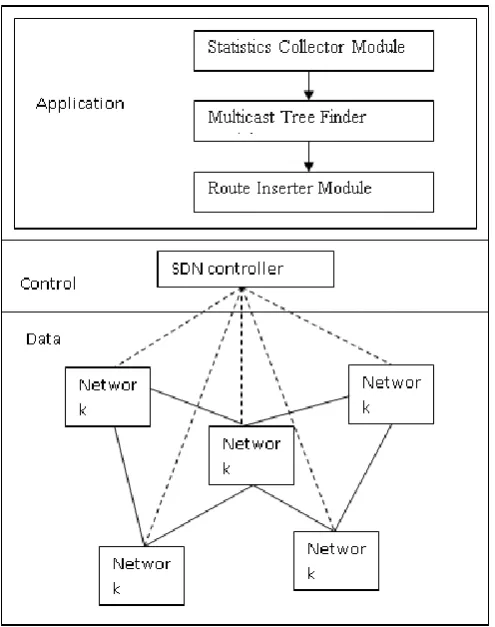
the each packet should not exceed certain limit since the exceeded packets affect the quality of received multimedia packets. To guarantee this constraint, particle swarm optimization based DCLC routing problem in SDN. Fig.1 shows that the proposed QoS routing algorithm framework with SDN network.
The following end-to-end Quality of Service (QoS) evaluation parameters are to be estimated for proving the superiority of the proposed research work.
1.Throughput 2.End-to-End delay 3.Packet loss ratio
Authors Year Methods/Approaches QoS Constraints Observations/Results
Oh 2006 Genetic Inspired Based Multicast
Routing
Bandwidth and End-to-End Delay Minimum cost multicast tree
Wang 2009 Chaotic neural networks(NCNN) Delay constrained multicast
routing tree
More optimal than HNN.
Younes 2011 GA based multimedia multicast
routing
Delay and bandwidth constraints Low -cost multicasting Tree
Xu&Qu 2012 Hybrid scatter search and path
relinking optimization
Delay Constrained Least cost(DCLC)
Multicast routing problem.
Marcondes 2012 Cast Flow Minimum Spanning Tree(MST)
using Prim algorithm
Route Network Traffic.
Kotani 2012 Fault tolerant IP multicasting
approach over SDN
Estimation of two multicast trees between source and destination
Forwarding rules of network to the alternative multicast tree.
Bondan 2013 Multiflow for multimedia
multicasting
Drop End to end delay Not Gurantee packet loss
reduction
Coras 2014 Lcastis Inter domain multicast model Network Scalable
Guck & Keller 2014 Greedy Algorithm & Mixed
Integer Program
End to end real time Qos path planning
Performance and possible gains.
Iyer 2014 Avalanche Multicasting in service switches Improves bandwidth
utilization.
Thorpe 2015 Service assurance in IPTV
networks
Server and customers Cost of links is determined
based on the quality of received video.
Derrick D’ souza 2016 Tests on traditional and SDN Low latency Running QoS application on
standard x86 hardware.
SiamackLayeghy 2017 SCOR(Software Defined Constained Optimal Routing)
Constraints and utility function .complexity is hidden
Figure 1. Proposed novel Quality of Service (QoS) routing algorithm with SDN.
From the Figure 1, the proposed QoS routing algorithm is implemented in application layer over the SDN control plane. This, algorithm includes three modules such as statistics collector module, multicast tree finder module and router inserter module. The statistics collector module collects the statistics of network links which includes the delay and utilization of links and stores it in two individual matrices. Initially, this module generates a packet and inserts the timestamp in the header of the packet. Then, this module estimate the delay of the link by subtracting the timestamp value from the header which are performed for each link in the network. Finally, this module collects the statistics of the linked ports in both sides to collect the utilization of the each link. Then, the highest attained value for the both sides of the link is considered as utilization of the link. Multicast tree finder module is responsible for calculating minimum cost multicast tree by modelling the multicast routing as a DCLC problem. Then, it executes Particle swarm optimization problem (PSO)
to solve the problem. The output of PSO algorithm is the minimum cost multicast tree.
At last, the router inserter module is executed to inject the result of multicast tree finder module by means of forwarding rules entries into the relevant switches.
V.CONCLUSION
In the proposed technique, a novel Quality of Service (QoS) routing algorithm for Software Defined Networking (SDN) using Particle swarm Optimization (PSO).The procedure supports QoS providing since the SDN controller estimates effective multicast tree based on network status with delay constraint. In addition, the cost of each link is measured as a function of its utilization, hence it estimates minimum congested multicast tree that reduces the packet loss. The following end-to-end Quality of Service (QoS) evaluation parameters are to be estimated for proving the superiority of the proposed research work.
1. Throughput 2. End-to-End delay 3. Packet loss ratio.
V.
REFERENCES
[1]. Schmitt, J., & Wolf, L. (1997). Quality of Service-An Overview. April1997. citeseerx. ist. psu. edu/viewdoc/downl oad.
[2]. Blake, S., Black, D., Carlson, M., Davies, E., Wang, Z., & Weiss, W. (1998). An architecture for differentiated services(No. RFC 2475). [3]. Braden, R., Clark, D., & Shenker, S. (2000).
Integrated services in the internet architecture: an overview (No. RFC 1633).
[4]. Welzl, M., & Muhlhauser, M. (2003). Scalability and quality of service: a trade-off?. IEEE Communications Magazine, 41(6), 32-36. [5]. Oh, S., Ahn, C., & Ramakrishna, R. S. (2006,
optimization algorithm with bandwidth and end-to-end delay constraints. In International Conference on Neural Information Processing (pp. 807-816). Springer, Berlin, Heidelberg [6]. Wang, L., Liu, W., & Shi, H. (2009).
Delay-constrained multicast routing using the noisy chaotic neural networks. IEEE Transactions on Computers, 58(1), 82-89.
[7]. Fiedler, M., Hossfeld, T., & Tran-Gia, P. (2010). A generic quantitative relationship between quality of experience and quality of service. IEEE Network, 24(2).
[8]. Kim, W., Sharma, P., Lee, J., Banerjee, S., Tourrilhes, J., Lee, S. J., & Yalagandula, P. (2010). Automated and Scalable QoS Control for Network Convergence. INM/WREN, 10(1), 1-1.
[9]. Younes, A. (2011). Multicast routing with bandwidth and delay constraints based on genetic algorithms. Egyptian Informatics Journal, 12(2), 107-114.
[10]. Xu, Y., & Qu, R. (2012). A hybrid scatter search meta-heuristic for delay-constrained multicast routing problems. Applied Intelligence, 36(1), 229-241.
[11]. Kotani, D., Suzuki, K., & Shimonishi, H. (2012, July). A design and implementation of OpenFlow controller handling IP multicast with fast tree switching. In Applications and the Internet (SAINT), 2012 IEEE/IPSJ 12th International Symposium on (pp. 60-67). IEEE. [12]. Marcondes, C. A., Santos, T. P., Godoy, A. P.,
Viel, C. C., & Teixeira, C. A. (2012, July). CastFlow: Clean-slate multicast approach using in-advance path processing in programmable networks. In Computers and Communications (ISCC), 2012 IEEE Symposium on (pp. 000094-000101). IEEE.
[13]. Bondan, L., Müller, L. F., & Kist, M. (2013). Multiflow: Multicast clean-slate with anticipated route calculation on OpenFlow programmable networks. Journal of Applied Computing Research, 2(2), 68-74.
[14]. Gungor, V. C., Sahin, D., Kocak, T., Ergut, S., Buccella, C., Cecati, C., & Hancke, G. P. (2013). A survey on smart grid potential applications and communication requirements. IEEE Transactions on Industrial Informatics, 9(1), 28-42. May). Realizing the quality of service (QoS) in software-defined networking (SDN) based cloud infrastructure. In Information and Communication Technology (ICoICT), 2014 2nd International Conference on (pp. 505-510). IEEE.
[17]. Zhaogang Shu, Jiafu Wan, Jiaxiang Lin, Shiyong Wang,Di Li, Seungmin Rho, and Changcai Yang, "Traffic Engineering in Software-Defined Networking: Measurement and Management", Special Section On Green Communications And Networking For 5g Wireless,June 21, 2016.
[18]. Akella, A. V., &Xiong, K. (2014, August). Quality of service (QoS)-guaranteed network resource allocation via software defined networking (SDN). In Dependable, Autonomic and Secure Computing (DASC), 2014 IEEE 12th International Conference on (pp. 7-13). IEEE
[19]. Guck, J. W., & Kellerer, W. (2014, October). Achieving end-to-end real-time quality of service with software defined networking. In Cloud Networking (CloudNet), 2014 IEEE 3rd International Conference on (pp. 70-76). IEEE. [20]. Iyer, A., Kumar, P., & Mann, V. (2014,
January). Avalanche: Data center multicast using software defined networking. In Communication Systems and Networks (COMSNETS), 2014 Sixth International Conference on (pp. 1-8). IEEE.
concept to implementation. IEEE Communications Surveys & Tutorials, 16(4), 2181-2206.
[22]. Coras, F., Domingo-Pascual, J., Maino, F., Farinacci, D., & Cabellos-Aparicio, A. (2014). Lcast: Software-defined inter-domain multicast. Computer networks, 59, 153-170. [23]. Ananta, M. T., Jiang, J. R., & Muslim, M. A.
(2014). Multicasting with the Extended Dijkstra’s Shortest Path Algorithm for Software Defined Networking.
[24]. Owens II, H., & Durresi, A. (2015). Video over software-defined networking (vsdn). Computer Networks, 92, 341-356.
[25]. Tassi, A., Khirallah, C., Vukobratović, D., Chiti, F., Thompson, J. S., &Fantacci, R. (2015). Resource allocation strategies for network-coded video broadcasting services over lte-advanced. IEEE Transactions on Vehicular Technology, 64(5), 2186-2192.
[26]. Thorpe, C., Olariu, C., Hava, A., & McDonagh, P. (2015, May). Experience of developing an openflow SDN prototype for managing IPTV networks. In Integrated Network Management (IM), 2015 IFIP/IEEE International Symposium on (pp. 966-971). IEEE.
[27]. Kreutz, D., Ramos, F. M., Verissimo, P. E., Rothenberg, C. E., Azodolmolky, S., & Uhlig, S. (2015). Software-defined networking: A comprehensive survey. Proceedings of the IEEE, 103(1), 14-76.
[28]. Zhaogang Shu, Jiafu Wan, Jiaxiang Lin, Shiyong Wang,Di Li, Seungmin Rho, and Changcai Yang, "Traffic Engineering in Software-Defined Networking: Measurement and Management", Special Section On Green Communications And Networking For 5g Wireless, June 21, 2016.
[29]. Wollschlaeger, M., Sauter, T., & Jasperneite, J. (2017). The future of industrial communication: Automation networks in the era of the internet of things and industry 4.0. IEEE Industrial Electronics Magazine, 11(1), 17-27.
[30]. Carabelli, B. W., Blind, R., Dürr, F., & Rothermel, K. (2017). State-dependent Priority Scheduling for Networked Control Systems. arXiv preprint arXiv:1703.08311.
[31]. Guck, J. W., Van Bemten, A., Reisslein, M., & Kellerer, W. (2017). Unicast QoS Routing Algorithms for SDN: A Comprehensive Survey and Performance Evaluation. IEEE Communications Surveys & Tutorials.
[32]. Mohammadi, R., Javidan, R., Keshtgari, M., & Akbari, R. (2017). A novel multicast traffic engineering technique in SDN using TLBO algorithm. Telecommunication Systems, 1-10. [33]. Guck, J. W., Van Bemten, A., & Kellerer, W.
(2017). DetServ: Network Models for Real-Time QoS Provisioning in SDN-based Industrial Environments. IEEE Transactions on Network and Service Management.
[34]. Bhakti Jadhav, Zia Saquib, Sanjay Pawar (2017). Issues and Parameters For Improving QoS And Performance in SDN. International Journal of Advances in Electronics and Computer Science, ISSN: 2393-2835 Volume-4, Issue-7, Jul-2017.
[35]. Derrick D’souza, Dr. Levi Perigo,Rob Hagens (2016). Improving QoS in a Software Defined Networks. Capstone Research Paper. Interdisciplinary Telecom Program. University of Colarado Boulder.
[36]. Sugam Agarwal 1 Murali Kodialam T. V. Lakshman,"Traffic Engineering in Software Defined Networks", 2013 Proceedings IEEE INFOCOM.