CSEIT118365 | Received : 01 July 2018 | Accepted : 08 July 2018 | July-August-2018 [ 3 (6) : 17-24 ]
© 2018 IJSRCSEIT | Volume 3 | Issue 6 | ISSN : 2456-3307
17
Simulations and Result analysis of VANET Based Self
Adaptive Prioritized Traffic Signal Control
Shaikh Sharique Ahmad*, Prof. Hiralal Solunke
Department of Computer Science Engineering, G.H. Raisoni Institute of Engineering and Managements, Jalgaon (M.S), India
ABSTRACT
Increase in the number of vehicle causes traffic congestion at intersections of roads. It suffers the people time and Emergency Vehicle (EV) such as, ambulance, fire brigade etc, are stuck or delay to destination causes heavy losses. To avoid this, Our Traffic control system should be intelligent and adaptive in Management of signal allocation, EV has to be varies with priority order to create desirable circumstances. Here, I propose to use Vehicular Ad Hoc Networks (VANET) to collect, schedule and aggregate speed and location information of individual vehicles to optimize signal control at traffic intersections. In my proposed work, the Priority Scheduling Algorithm (PS) used to provide the efficient prioritize Traffic Control System. The Priority Scheduling Algorithm schedules the higher priority vehicles (that are Emergency Vehicles). Simulation and Experimental analysis done on proposed work. Different parameters are considered for analyzing the system and results are effectively improved than existing system. The experimental results are presented in this paper.
Keywords: VANET, Priority, Time, Emergency Vehicles
I. INTRODUCTION
The term VANET is acronym for vehicular ad-hoc networks was originally adopted to reflect the ad-hoc nature of highly dynamic networks. First, consider the opportunities. If the vehicles can directly interact altogether and with infrastructure, a new paradigm for vehicle safety applications can be created. Second, further challenges are created by high vehicle speed and highly dynamic operating environments. Third, new requirements include new expectations for high packet delivery rates and low packet latency. Further, customer acceptance and governmental oversight bring very high expectations of privacy and security. Driving means constantly changing location. A very important category is driver assistance and car safety. Another category is
Volume 3, Issue 6, July-August-2018 | http:// ijsrcseit.com
18
To control traffic signals there are so many technologies were proposed. In the management of traffic the Emergency Vehicles is highly considerable fact to avoid time delays in the services of EV. Recently increasing the number of cars on city roads has There are many problems created , such as traffic density, people get killed in accidents, emissions, fuel consumption, etc. Emergency vehicle such as ambulances, fire trucks, and police vans are special vehicle designated to respond to emergency immediately. Thus, reaching their destination as fast as possible is their primary concern. Due to traffic congestion, response time of emergency vehicles is increases. Emergency vehicles should be able to respond to emergency calls for an incident with minimum delay. Where time delays in the services of EV causes human lives risks as well as financial losses. Therefore, need a Traffic Management System that responsible for managing traffic with emergency vehicle Consideration, on the roads, efficiently. That can be possible by applying the priority preferences to vehicles. So we motive and avoid this problem by prioritizing emergency vehicles at the traffic signal intersection, Where EV having higher priority than other vehicles. Exists work manages and controls the traffic using the VANET technology, and focuses only on job scheduling, where jobs are the Platoon (the Platoons are the group of one or more vehicles that are to be cross through the intersections) [1]. But the priority considerations for Emergency Vehicles are not considered in this System. This makes the more chances of time delays in the services of EV. Hence in exists work only applicable to reduce conflicts at intersections but not to overcome the time delays of EV. This work focuses on the particular problem of traffic management for emergency services, for which a delay of few minutes in the services of EV may cause human lives risks as well as financial losses. In our proposed scenarios the idea to solve the problem with traffic emergency control, by designing Emergency Vehicle Priority Preference at Intelligent Road Traffic Signal Control System in VANET where the emergency
vehicles will be consider first based on calculated arrival time at the intersections. Every Emergency Vehicle is always deals with high priority than other vehicles. The Priority Scheduling Algorithm schedules the higher priority vehicles and provides the circumstances in such a way that, the EV will scheduled to high priority vehicles and cross over intersection without any conflict at intersection.
II. RELATED WORK
The entire project implements Dynamic Traffic Signal other than Static. The reason for this decision is to adapt the signal control to dynamic traffic flow. The number of vehicles present at the intersection varies from time to time because of which Static Traffic Control may prove to be unreliable. Moreover it has also been observed that Periodic Signal Control is unable to perform up to its potential in case of very busy intersections.
1. Objectives
To scale back the delays in Emergency vehicles waiting time at intersections.
To scale back the message ratio in vehicle to vehicle communication.
To Improve the capability of Traffic controlling system in such a by adding priority scheduling algorithm to the system.
Propose a novel, highly efficient and fully distributed approach for what we believe that will be the next generation of traffic signs.
2. Vehicular Ad hoc Network (VANET)
Volume 3, Issue 6, July-August-2018 | http:// ijsrcseit.com
19
vehicles can be formed and information can be relayed among cars. There is vehicle-to-vehicle and vehicle-to-roadside communications architectures will co-exist in VANETs to provide road safety, navigation, and other roadside services.
III. PROPOSED WORK
This work focuses on the particular problem of traffic management for emergency services, for which a delay of few minutes may cause human lives risks as well as financial losses. This has instigated an idea and scenarios to solve the traffic emergency control problem, by designing Emergency Vehicle Priority Preference at Intelligent Road Traffic Signal Control System Using Vehicular Ad-hoc Network (VANET) where the emergency vehicles will be consider first based on calculated arrival time at the intersections. Every Emergency Vehicle is always deals with high prior than other vehicles. The Priority Scheduling Algorithm schedules the higher priority vehicles and provides the circumstances in such a way that, the EV will scheduled to high priority vehicles and cross over intersection without any conflict at intersection. And the reduction in conflicts will achieve by Scheduling of Platoons. This approach increases road capacity, traffic flow, prevents traffic congestions, accident and thus increases society economic growth.
1. Steps of proposed system plan
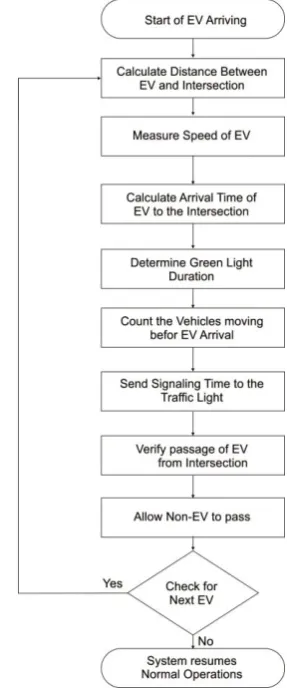
In order to achieve optimal traffic light control to provide clearance for any emergency vehicle and to shorten its travel time, we propose a distance-based emergency vehicle dispatching algorithm. We assumed only one emergency vehicle per direction. The proposed algorithm is represented in Figure 3.1. The EVs in the flowchart represent the emergency vehicles. The proposed algorithm has mainly seven steps:
Figure 3.1 Work Flow of Proposed System Based on the data, algorithm will be working step by step.
i. Step 1
Start the Emergency Vehicle (EV) from source.
ii. Step 2
Application Unit (AU- equipped with OBU at vehicle) provides electronic information to the Road Side Unit (RSU), in the form of Vehicle Id, Its GPS location, Speed etc.
iii. Step 3
Detect the presence of EV, and its priority preference.
iv. Step 4
Calculate the Estimated Arrival Time (ETA) of EV to the intersection.
v. Step 5
Traffic Signal Controller Estimate the available traffic. ie. Estimated Traffic Value (ETV).
Volume 3, Issue 6, July-August-2018 | http:// ijsrcseit.com
20
Priority Scheduler schedules the traffic by using estimated traffic value and information provided by AU.
Optimize the possible traffic signs as follows: i)Allow the other non-EV’s to cross
intersection until EV reaches the intersection. Required time t1
ii)Make hold on non-EV’s to wait until EV pass the Intersection. Required time t2
iii)Allow non-EV’s to pass on their requested direction. Required time t3
2. The Architecture of Traffic Management System (TMS)
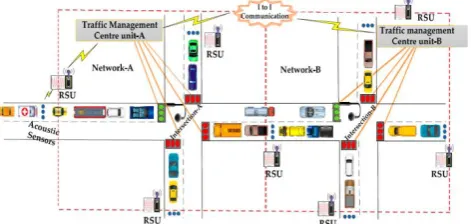
WSNs and VANETs for smart cities [3] are becoming a reality with increased options for area coverage and connectivity stemming from machine-to-machine communication [4] and the Internet-of-Things [5]. An Urban Traffic Management System (UTMS), depicted in Figure 2, refers to a system that integrates sensing technologies, data processing techniques, wireless communications and advanced technologies to reduce traffic congestion, travel time, fuel consumption and provide priority-based signaling. On obtaining the data of emergency vehicles from sensors, the Traffic Management Centre (TMC) follows the distance-based emergency vehicle dispatching (DBEVD) algorithm and provides signals to the emergency vehicle immediately.
Figure 3.2 Architecture of Traffic Management System (TMS).
3. Dynamic Traffic Scheduling
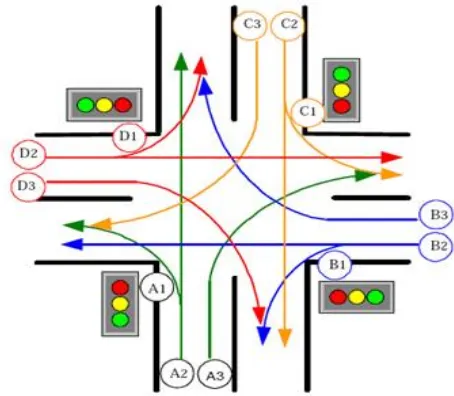
The controlling of traffic scheduling that can changed dynamically the priority and easy to implement is written to facilitate the efficient traffic control at certain junction. This also can be extended to multiple junction control. It is based on an automatic intelligent selection of traffic sequence in a multilane traffic flow. The multilane traffic flow is shown in Fig. 4.4. The A1, A2 and A3 represent vehicle moving from A direction which A1 is moving to the west, A2 is moving forward and A3 is moving to the east. The orientation is similarly applied to the vehicle moving from B, C and D direction. Figure 4.4 shows an example of how the algorithm works. Assuming A, B, C and D are traffic column in which A from south can go forward, east or west, with timing slot that is dynamically determine according to the number of vehicle for each route. The same sequence is then shifted to B, C then D.
Mathematical Calculations: This algorithm can change the sequence dynamically depending on the real time situation at the specific junction with respect to situations that currently exist in other junctions of the surrounding area. If, for example the accepted waiting time at each junction is 90 sec, the period for Green and Yellow states may probably be 30 sec at each junction. In reality, the state of traffic condition and congestion change with time.
Volume 3, Issue 6, July-August-2018 | http:// ijsrcseit.com
21
Green state at B represents as BG while Yellow state at B represents as BY and it is applicable to other parameter e.g., CG, DG, CY and DY. The waiting time for example can be computed for a state A as:
Await=BG+CG+DG+AY+BY+CY+DY
Await=BG+CG+DG+4(3s)
Await=BG+CG+DG+12s
Where,
Await≠ Bwait≠ Cwait≠ Dwait
The decision makes use of the accumulated data saved in the centralized traffic management database. The system can learn from the accumulated decisions and can be produce an overall scenario of the traffic flow by identifying avariety of situation:
1. Identify the junction with a longest queue 2. Identify the busiest route
3. Identify the routine traffic pattern at particular time and day
4. Determine the most efficient sequence
Fig 3.3 Architecture of Multilane Traffic Flow
The traffic scheduling algorithm is defined as follow:
If A1, A2, A3: G
then B1: G until A1, A2, A3: Y
If only A3 not detected at B(z, y, x), then A3: Y then compare queue at C(x, y, z) and B(x, y, z) {
if C(x, y, z) > B(x, y, z)
then C1, C2:G until A1and A2: Y else C1, B1: G until A1 and A2: Y }
then B1, B2, B3 start G
If only A2 not detected at C(z, y, x), then A2: Y {
then D1, C1: G until A1and A2: Y }
then B1, B2, B3 start G
If A1 not detected at D(z, y, x) AND
If A2 not detected at C(z, y, x), then A1, A2: Y {
then D1, C3: G until A3: Y }
then B1, B2, B3 start G
If A2 not detected at C(z, y, x) AND
If A3 not detected at B(z, y, x) then A2, A3: Y then compare queue at C(x, y, z), B(x, y, z) and D(x, y, z)
{
if B(x, y, z) > C(x, y, z) and D(x, y, z) then B3, B1:G until A1:Y
if C(x, y, z) > D(x, y, z) and B(x, y, z) then C1, C2:G until A1:Y
if D(x, y, z) > B(x, y, z) and C(x, y, z) then D1, D2, D3:G until A1:Y }
then B1,B2,B3 start G
If A1, A2, A3 not detected at A(x, y, z) then B1, B2, B3 start G
Where,
A1,A2,A3= vehicles R,G,Y= signal colors A,B,C,D= directions x,y,z= RFID readers
Volume 3, Issue 6, July-August-2018 | http:// ijsrcseit.com
22
IV. SIMULATION AND EXPERIMENTAL RESULTS
1. VANET Simulation in Network Simulator 2 We choose the popular network simulator Java In Simulation Time for Scalable Wireless Ad hoc Networks (NS2) as the simulator primarily to implement methods because it is widespread use in the academic community and the comprehensive manuals and tutorials that are freely available. It is possible to simulate a mobile multi-hop ad hoc wireless network in NS2 using simulated 802.11 MAC layer
2. Real Traffic Generator (SUMO)
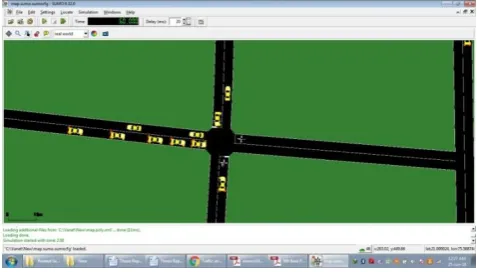
To design and implementation of VANET in urban environment, we downloaded the Jalgaon city Ajanta Chawk Area OSM file from OpenStreetMap [6] and created a real time road traffic scenario using SUMO 0.22 simulator with a real traffic as shown in below Figure 4.1. The mobility of traffic data is generated in SUMO trace exporter that will be exported to NS2 simulator which is used as vehicular network simulator for analyzing the VANET performance.
Figure 4.1 Traffic at Ajanta Intersection
3. SUMO AND NS2 INTEGRATION FOR VANET SIMULATION
While EV arrives at intersection, and if it is detected, the priority is assigned to EV, the system makes the changes in the scheduling sequence of traffic light controller.
Figure 4.2 Traffic Simulation of Proposed System
Figure 4.3 Green Light allocated For EV
Figure 4.2 shows the phenomenon of EV arriving. For that some consideration is there. Left side Road, Upper side Road, Right side Road and Bottom side Road are A, B, C and D respectively. An EV (Node 70, Red Color) arriving at intersection (look at D Lane), it pass the message to RSU by using OBU (inbuilt with vehicle). System detects it, identifies it as EV and assigns the priority to EV. System proceeds further to make changes in traffic light sequence. In Figure 4.3, it shown that the green light allocation is for the B Lane. And normal traffic light sequence allows next to C according to Indian rule. But the system is capable to make change in the traffic light scheduling sequence. How it changes the sequence and allow the Green Light next to the D and Red Light to all Lane (i.e. A, B and C). It allows the EV to pass intersection first. After passing the EV from Intersection the system resumes to the normal scheduling sequence.
4. Performance Evaluation And Results
Volume 3, Issue 6, July-August-2018 | http:// ijsrcseit.com
23
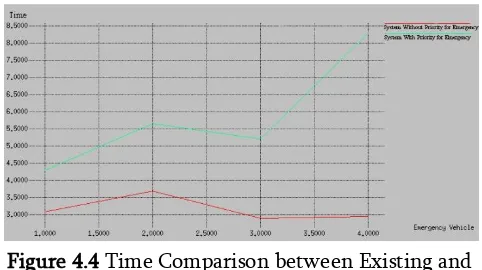
and Time comparison between time required by EV’s. In both cases, Emergency Vehicles Time duration is different.
Figure 4.4 Time Comparison between Existing and Proposed System
In Normal Traffic Controller System Delay in Services of EV is observed, which is considered in Priority Intersection Control. Result is improved in Priority Intersection Control by considering time duration of EV. It seems to be compare the Time delay in EV for both type of System, the second one is proposed system. Time required for each EV is different. Duration of time for each EV is considered from the time T1, when it is detected by the Priority
Intersection Control System to the time T2, when it
crosses the Intersection.
Time required by EV to cross the intersection is
Time required by all EV’s to cross the intersection is
∑
V. CONCLUSION
Proposed System will help us to prioritize emergency vehicle at the traffic signal intersection. We have given an extension to the existing system keeping in mind the sole objective of minimizing the average waiting time at intersection for an EV. We also include a scenario involving different cases in management of emergency vehicles. The
Experimental results are effectively improved and enhanced. For simulation of VANET, the Network Simulator 2 is best. It makes possible to implement all Protocols to make our Simulation better.
REFERENCES
[1] ”Adaptive Traffic Signal Control With Vehicular Ad hoc Networks” by Kartik Pandit, Dipak Ghosal, Member, IEEE, H. Michael Zhang, and Chen-Nee Chuah, Senior Member, IEEE, IEEE TRANSACTIONS ON VEHICULAR TECHNOLOGY, VOL. 62, NO. 4, MAY 2013.
[2] Morteza Mohammadi Zanjireh; Hadi Larijani (May 2015). A Survey on Centralised and Distributed Clustering Routing Algorithms for WSNs,IEEE 81st Vehicular Technology Conference. Glasgow, Machine-to-Machine: Possible Applications in Industrial Networks. In Proceedings of the IEEE International Conference on Industrial Technology (ICIT), Cape Town, South Africa, 25–28 February 2013; pp. 1321–1326. [5] Kruger, P.C.; Hancke, G.P. Benchmarking
Internet of things devices. In Proceedings of the IEEE International Conference on Industrial Informatics, Porto Alegre, Brazil, 27–30 July 2014; pp. 611–616.
[6] OpenStreetMap,
https://www.openstreetmap.org/
Volume 3, Issue 6, July-August-2018 | http:// ijsrcseit.com
24
[8] "A Comparative study of MANET and VANET Environment". Journal of Computing. 2 (7). July 2010. Retrieved 28 October 2013.