© 2018 IJSRCSEIT | Volume 3 | Issue 6 | ISSN : 2456-3307
Determining Metadata Schema for Small Medium Enterprises
(SMEs)
Sarwati Rahayu*, Ratna Mutu Manikam
Faculty of Computer Science, Universitas Mercu Buana, Jakarta Barat, Indonesia [email protected]
ABSTRACT
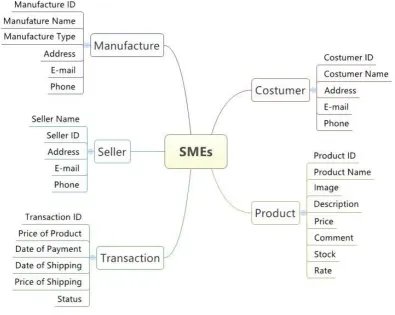
Content management system (CMS) is a technology that can be used to support business activity of Small Medium Enterprises (SMEs). Related works regarding metadata analysis have been done by Yang and Chan (2000), Khazraee (2011), Rasaiah et al. (2015) through different methods. This research will use the approach of domain analysis, system centric analysis and user-centric analysis to complete research entitled metadata for small medium enterprises (SMEs) using user centric analysis. As the result, we found recommendation of metadata element set for SMEs that consists of five main sections, including manufacture, product, seller, costumer and transaction.
Keywords : Metadata Schema, Smes, Business Activities
I.
INTRODUCTIONContent management system (CMS) is a technology that can be used to support business activity of Small Medium Enterprises (SMEs) [1]. Features available in CMS can generally be used to create, archive, search, disseminate information in a flexible and integrated manner [2]. However, to design and build a CMS, we need to identify the metadata corresponding to the CMS domain at first. In the context of content management system (CMS), metadata is used to describe an object of data to be managed in CMS [3].
Some researchers attempted to build metadata that match the domain of the system to be built [4], [5]. For example, a study conducted by Yang and Chan (2000) about metadata analysis on Chinese Medicine domain using two analytical approaches: system centric analysis and user-centric analysis [6]. Research conducted in 2011 by Khazraee (2011) explained metadata analysis using a domain analysis approach that exist in the field of cultural heritage
[7]. The recent research conducted by Rasaiah et al. (2015) performed analysis to build metadata in the field of spectroscopy [8].
Based on the above background, this research will use the approach of domain analysis, system centric analysis and user-centric analysis to complete research entitled metadata for small medium enterprises (SMEs) using user centric analysis.
II.
RELATED WORKSresearch conducted by Rasaiah et al. (2015) performed analysis to build metadata in the spectroscopy field [8].
III.
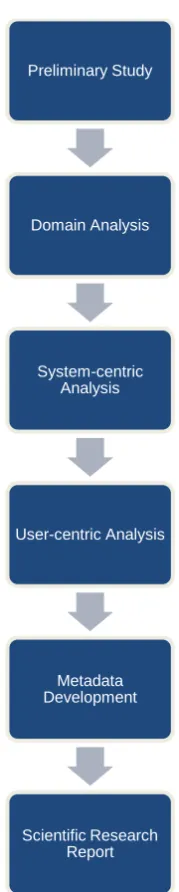
RESEARCH METHODOLOGYThis research used metadata analysis approach to obtain the result of research as seen in Figure 1.
Figure 1. Research phase
First, in the preliminary study, we searched and reviewed scientific papers that relevant to the object of research. Second, we conducted domain analysis by investigating the subject or object involved in a metadata domain [9]. Third, we conducted system-centric analysis by observing the information architecture of a system that has a relationship with the metadata domain [10]. The user-centric analysis stage is performed to determine the required metadata elements of the system user side [11]. We conducted interview with ten SMEs regarding their business activities and their data record. The last phase is metadata development and scientific publication writing.
IV.
RESULTS AND DISCUSSIONIn this section will deliver about metadata element set and its description based system-user side.
A. Domain Analysis
In this section, we defined the purpose of metadata development, actor and business activities that are involved. We have found metadata development is to document data related to the product plan until product sold in SMEs. We defined actors of this business activities are costumer, seller and manufacture.
B. System-centric analysis
Based literature review, there are metadata that have been used in system to support vocational training of small and medium enterprises (SMEs) in rural areas. This metadata proposed by Tzikopoulos et al. 2007 [12], as shown in Figure 2.
Preliminary Study
Domain Analysis
System-centric Analysis
User-centric Analysis
Metadata Development
F
ig
ure
2
.
Me
tad
ata
p
ro
p
o
sed
b
y
T
zik
o
p
o
u
lo
s
et
al.
2
0
0
C. User Centric Analysis
Based result of interview with SMEs in Indonesia, we identified that factory or manufacture, small medium enterprises and costumers are involved to promote and sell product activities. Actor of small medium enterprise (SMEs) needed to record data regarding their activities to track their sales, including
manufacture, seller, transaction, costumer and product.
D. Finalization
Based three phases before, we identified data record consisted of description element that related to small medium enterprise activities. The finalization of metadata schema can be seen in Figure 3 below.
Figure 3. Metadata element for small medium enterprise (SMEs) business activities record
E. Metadata Element Description
This section will elaborate the description of metadata elements that are displayed in Table 1 below.
TABLEI
METADATA ELEMENT DESCRIPTION
Main
Element Sub Element Description
Main
Element Sub Element Description
Manufacture
Address Location of
product seller
Transaction ID Record ID for transaction
Element Sub Element Description
Date of
Status Transaction
status
Costumer
Costumer ID Record ID for costumer
Costumer Name Name of costumer
Address Location of
costumer
Product Name Product name
Image Detail image
of product
Description Product
description
Price Product price
Main
Element Sub Element Description
Rate Product rate
by costumer
V.
CONCLUSIONBased on our research, the conclusion that can be derived as follows:
1. Related works about metadata analysis that are used for completing this reasearch, including Yang and Chan (2000) Khazraee (2011) Rasaiah et al. (2015) through different methods.
2. This research used three approaches, including domain analysis, system centric analysis and user-centric analysis to complete research. 3. Recommendation of metadata element set for
SMEs that consisted of five main sections, including manufacture, product, seller, costumer and transaction.
VI.
ACKNOWLEDGMENTThis research was funded by Universitas Mercu Buana through internal research scheme (named Penelitian Internal) in 2017 - 2018.
VII.
REFERENCES1. N Ani, “Peningkatan Daya Saing dan Pangsa Pasar
UKM (Usaha Kecil Menengah) Melalui Strategi Penerapan E-Commerce,” J. FIFO, vol. 4, no. 6, 2014.
2. L Burzagli, M. Billi, F. Gabbanini, P. Graziani, and
E. Palchetti, “The use of current content management systems for accessibility,” in ICCHP, 2004, pp. 331-338.
3. K M. Clair, “Metadata Best Practices in Web
Content Management Systems,” J. Libr. Metadata,
4. H Noprisson, D. I. Sensuse, Y. G. Sucahyo, and
Lukman, “Metadata Development for
Ethnophytomedicine Resources Using Metadata Analysis Approach,” in The 2016 8th International Conference on Information Technology and Electrical Engineering (ICITEE 2016), 2016.
5. D I. Sensuse, H. Noprisson, Y. G. Sucahyo, and L.
Lukman, “Metadata Schema for Traditional Knowledge,” Int. J. Adv. Sci. Eng. Inf. Technol., vol. 7, no. 6, 2017.
6. C C. Yang and W. W. Chan, “Metadata Design for
Chinese Medicine Digital Library Using XML,” in Proceedings of the 33rd Hawaii International Conference on System Sciences, 2000.
7. E Khazraee, “Domain Specific Considerations of
Metadata for Cultural Heritage,” in International Conference on Dublin Core and Metadata Applications, 2011, pp. 189-191.
8. B A. Rasaiah, C. Bellman, S. D. Jones, T. J. Malthus,
and C. Roelfsema, “Towards an interoperable field spectroscopy metadata standard with extended support for marine specific applications,” Remote Sens., vol. 7, no. 11, pp. 15668-15701, 2015.
9. B Hjørland and J. Hartel, “Afterword: Ontological,
epistemological and sociological dimensions of domains,” Knowl. Organ., vol. 30, no. 3-4, pp. 239-245, 2003.
10. X. Mu, J. Jordan, W. Jeong, and J. Plessis, “Towards
a Combined Approach to Metadata in Corporate Knowledge Management: A Case Study of GE Healthcare,” J. Inf. Knowl. Manag., vol. 8, no. 3, pp. 189-200, 2009.
11. J. Greenberg and T. Severiens, “DCMI-Tools:
Ontologies for Digital Application Description,” in Openness in Digital Publishing: Awareness, Discovery and Access - Proceedings of the 11th International Conference on Electronic Publishing, 2007, pp. 437-444.
12. A. Tzikopoulos, N. Manouselis, C. Yialouris, and A.