© 2018 IJSRCSEIT | Volume 3 | Issue 5 | ISSN : 2456-3307
Concept of Geometric Programming for Designing an Optimal
Routing Method in Wireless Network
Neha Kumari1, Abhishek Kumar2, Arun Prasad Burnwal3
1Department of Mathematics, Jharkhand Rai University, Ranchi, India 2Department of ECE, BIT Mesra, Ranchi, Jharkhand, India 3Department of Mathematics, GGSESTC, Bokaro, Jharkhand, India
ABSTRACT
In current scenarios, the applications of wireless network increases rapidly due to dynamic feature. Each node of this network associated with an infrastructure that helps to connect one node to another node with wirelessly within a specific range. But nodes of this network consist of limited capacity of batteries which is insufficient during any operation. So, in this paper, a routing technique is design for wireless network using geometric programming that used some strategies of game theory that help to derive an optimal route between source and destination nodes.
Keywords : Wireless Network, Geometric Programming, Game Theory, Fuzzy Logic, Routing.
I. INTRODUCTION
In last few decades, the applications of wireless network increases rapidly due to dynamic nature. It has several variation in the term of wireless ad-hoc network, wireless sensor network, vehicular ad-hoc network, hybrid ad-hoc network [1-4]. It helps in several areas such as disaster management, entertainment, business, marketing, education system, e-commerce, etc. [5-6]. The most important feature of this network is the presence of dynamic topology which will lead to the movement of the nodes. Each node of the network is consists of limited capacity of battery which is insufficient during any mission or operation, because frequently changes the place of node, energy capacity is exhaust and route or transaction is fails. In this paper, an optimal routing technique is proposed with the help of some artificial intelligence techniques. Artificial
full of uncertainty and imprecise related information where characteristic of hard computing is fails and characteristic of soft computing is pass. [15-18]. The combination of these three artificial intelligence techniques produce a solution where we can easily find the optimal routing technique in the wireless network.
II. RELATED WORKS
Energy efficient routing is the main challenges of the ad-hoc network. There have been lot of works are done on energy efficient routing such as Wei et al. [19] proposed a new optimized priority based energy efficient routing algorithm PDSR. The main aims of this algorithm to add priority to the existing routing algorithm according to the residual energy proportion of the nodes. Lower residual energy means lower priority and the nodes with lower priority are less likely to forward packets to other nodes. It can also improve the performance of routing discovery, routing maintenance and route cache. But it has a limitation that hop count and distance are not considered for improvement and route maintenance. Su et al. [20] proposed the fuzzy logic modified AODV routing (FMAR) protocol for multicast routing in mobile ad-hoc networks. The main aim of this protocol is dynamically evaluate the active routes based on fuzzy logic weighted multi-criteria. It also helps to managing the limited bandwidths of wireless links. But it has some drawback that the proposed protocol does not considered all possible routes as evaluation of route lifetime by fuzzy logic multi-criteria, so it cannot be determine which routes are highly useful. Therefore, routes cannot repair and maintain partially or completely before they crashed. Matthew J. Miller and Nitin H. Vaidya [21] proposed a link layer protocol to provide k levels of power save and a routing protocol to use this link layer effectively. In this protocol the authors first to generalize the concept for ad-hoc networks by proposing the use of k levels of power save, each of which presents a
each route and determines the best and worst routing in wireless sensor network. But it has some limitation that the proposed method does not considered hop count and data packet as parameters of energy efficient routing. Because energy efficient routing not considering only energy and distance, it also cover hop count and transmitter packet. Das et al. [30] proposed a method (IECR) for energy efficient routing in wireless sensor network. The main aims of this method to generate some values for each and every route based on fuzzy inference engine. This values determine the different nature of the routes. Therefore, this value helps to determine which route is best and which route is worst for routing in term of energy efficiency. But it has some limitation that the proposed method does not considered hop count and data packet as parameters of fuzzy inference engine. Because energy efficient routing cannot determines by using two parameters such as energy and distance.
However, none of the technique derived an optimal routing by combing strategies of the nodes in non-linear formulation. So, proposed method pave the gap of the earlier method. Several preliminaries are used in the proposed method such as game theory, geometric programming, and fuzzy logic. Game theory is used to model the conflicting strategy of the network with the help of player, strategy, and utility function where nodes are play the role of players, network conflicting situations are play the role of strategies, and used techniques for selecting optimal route are play the role of utility functions. Geometric programming is a non-linear programming which works in posynomial environment instead of polynomial environment. It helps to estimates non-linear parameters of the network efficiently.
III. PROPOSED ROUTING METHOD
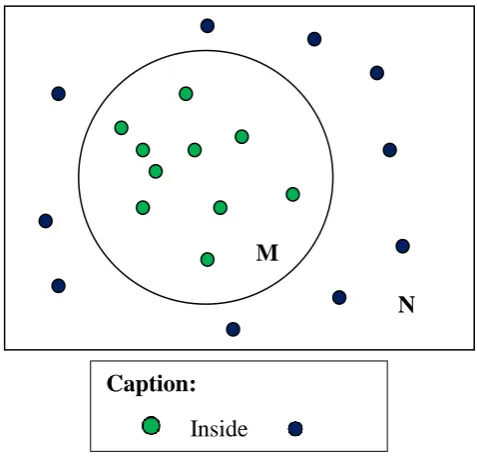
The proposed network model consider as a graph G(N,E) where N is a set of nodes and E is a set of edges. Each node of this network associated within
range shown in Fig. 1. In this figure M is indicates one radio range that consist of some nodes and N indicates out of radio range that also consist of some nodes. Moreover, the nodes in M can communicate one to another and able to send/receive data packet, but the nodes in N cannot communicate one to another and not able to send/receive data packet.
Fig. 1: Zone of the network model.
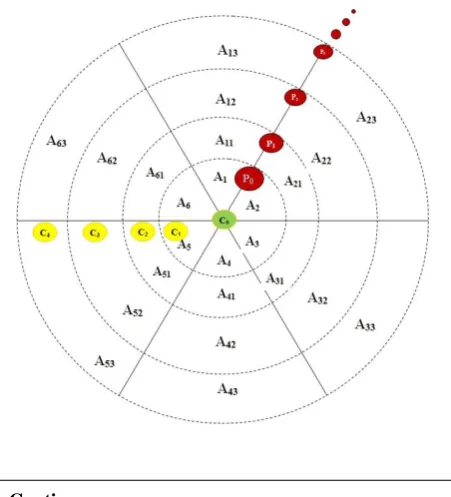
The framework of the proposed method divided by clustered mechanism. Each cluster is divided into two basic zones Zone 1 (i.e. M) and Zone 2 (i.e. N) because there is no any node that control and manage to all nodes of the proposed framework. The distribution of different nodes within network is bounded different clustered areas C1, C2, C3, C4 shown in Fig. 2. Each and every clustered distributed in Zone 1 of proposed system model are encloses by cluster such as areas A1, A2, A3, A4, A5, A6 enclosed by cluster C1, the next areas A11, A21, A31, A41, A51, A61 enclosed by cluster C2, the next areas A12, A22, A32, A42, A52, A62 enclosed by cluster C3, the next areas A13, A23, A33, A43, A53, A63 enclosed by cluster C4 and so on, where „C0‟ encloses no wireless node, it contains the center node which is fixed. The wireless network is not connected with any wired and it is not fixed, position of the node is changes based on the requirement of the users. So, here crisp logic is not
M
N
Caption:
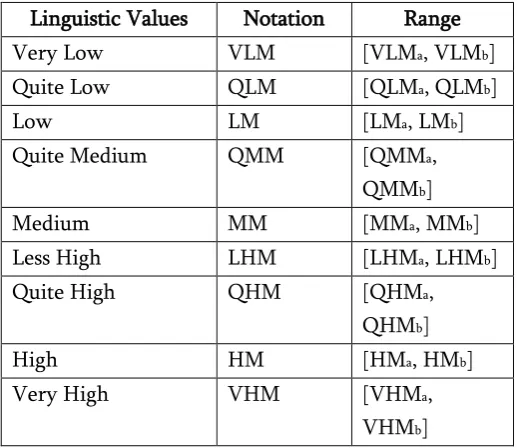
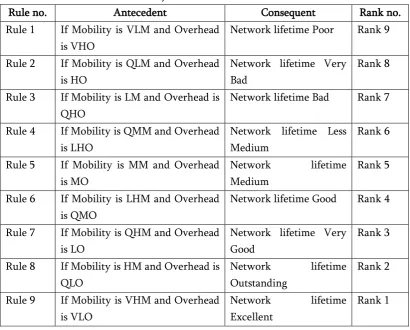
employed, instead of crisp logic the parameters of the network are used fuzzy logic, because fuzzy logic deals with partial true and partial false which range between 0 and 1. Hence, membership functions of some network parameters such as energy, distance, mobility, and overhead are shown in Table 1 to Table 4. These network parameters are known as input parameter. Each membership function of input parameter is divided into nine linguistic variables as Very Low, Quite Low, Low, Quite Medium, Medium, Less High, Quite High, High, Very High. In this proposal, output variable is consider as network lifetime that depends on two types natures as Nature 1 and Nature 2. The input parameters energy and distance are considered in Nature 1 and another two input parameters mobility and overhead are considered in Nature 2. The output parameter network lifetime is also divided into nine linguistic variables such as Poor, Very Bad, Bad, Less Medium, Medium, Good, Very Good, Outstanding, and Excellent. The details of both natures predicted as fuzzy rules that shown in Table 5 and Table 6. In the proposed method, nodes of the network work as players and different conflicting situations are work as strategies. The function which is derive the optimal routing is known as utility function. Eq. 1 indicates the set of players, Eq. 2. Indicates set of strategies, Eq. 3 indicates set of utility functions. The combination of game theory strategy and non-linear formulation of geometric programming helps to
implement the proposed method. Table 7 shows different considered strategies of the players. The network having one or more objective depends on the situation, so, the proposed equations shows in Eqs. 4 and 5. The actual optimal route is derives by the help of higher rank of nature 1 and nature 2 conditions that defined in Tables 5 and 6.
Fig 2: Clustering framework model.
Table 1: Membership function of energy.
Linguistic Values Notation Range
Very Low VLE [VLEa, VLEb]
Quite Low QLE [QLEa, QLEb]
Low LE [LEa, LEb]
Quite Medium QME [QMEa, QMEb]
Medium ME [MEa, MEb]
Less High LHE [LHEa, LHEb]
Quite High QHE [QHEa, QHEb]
High HE [HEa, HEb]
Very High VHE [VHEa, VHEb]
Caption:
Table 2: Membership function of distance.
Linguistic Values Notation Range
Very Low VLD [VLDa, VLDb]
Quite Low QLD [QLDa, QLDb]
Low LD [LDa, LDb]
Quite Medium QMD [QMDa,
QMDb]
Medium MD [MDa, MDb]
Less High LHD [LHDa, LHDb]
Quite High QHD [QHDa, QHDb]
High HD [HDa, HDb]
Very High VHD [VHDa, VHDb]
Table 3: Membership function of mobility.
Linguistic Values Notation Range
Very Low VLM [VLMa, VLMb]
Quite Low QLM [QLMa, QLMb]
Low LM [LMa, LMb]
Quite Medium QMM [QMMa,
QMMb]
Medium MM [MMa, MMb]
Less High LHM [LHMa, LHMb]
Quite High QHM [QHMa,
QHMb]
High HM [HMa, HMb]
Very High VHM [VHMa,
VHMb]
Table 4: Membership function of overhead.
Linguistic Values Notation Range
Very Low VLO [VLOa, VLOb]
Quite Low QLO [QLOa, QLOb]
Low LO [LOa, LOb]
Quite Medium QMO [QMOa,
QMOb]
Medium MO [MOa, MOb]
Less High LHO [LHOa, LHOb]
Quite High QHO [QHOa, QHOb]
High HO [HOa, HOb]
Table 5: Fuzzy rules for nature 1.
Rule no. Antecedent Consequent Rank no.
Rule 1 If Energy is VLE and Distance is VHD
Network lifetime Poor Rank 9
Rule 2 If Energy is QLE and Distance is HD
Network lifetime Very Bad
Rank 8
Rule 3 If Energy is LE and Distance is QHD
Network lifetime Bad Rank 7
Rule 4 If Energy is QME and Distance is LHD
Network lifetime Less Medium
Network lifetime Good Rank 4
Rule 7 If Energy is QHE and Distance is LD
Network lifetime Very Good
Table 6: Fuzzy rules for nature 2.
Rule no. Antecedent Consequent Rank no.
Rule 1 If Mobility is VLM and Overhead is VHO
Network lifetime Poor Rank 9
Rule 2 If Mobility is QLM and Overhead is HO
Network lifetime Very Bad
Rank 8
Rule 3 If Mobility is LM and Overhead is QHO
Network lifetime Bad Rank 7
Rule 4 If Mobility is QMM and Overhead is LHO
Network lifetime Less Medium
Rule 6 If Mobility is LHM and Overhead is QMO
Network lifetime Good Rank 4
Rule 7 If Mobility is QHM and Overhead is LO
Network lifetime Very Good
Rule 9 If Mobility is VHM and Overhead is VLO
Network lifetime Excellent
Table 7: Strategy description of the nodes.
Strategy Description
Wait This strategy indicates the node still waiting for acknowledgement.
Sleep It is energy saving mode when node is not working. Running It is working mode when node either send or receive
the data packets.
Dead It is energy less mode when battery capacity is fully exhaust.
N={n1, n2, n3, . . . 1} (1)
S={s1, s2, s3, . . . 2} (2)
U={u1, u2, u3, . . . 3} (3)
Optimize f(x)=(f1(x), f2(x), . . .fk(x))T
subject to gj(x)≤bj, where j=1, 2, 3, . . ., n (4) X=(x1, x2, x3, . . .,xn)0
flow(ni, nj)0, ni↔nj E (5)
Hence, final optimal route is considered by combining two situations: (i) when energy is very high and distance is very low, (ii) when mobility is very high and overhead is very low. Due to dynamic nature and high confliction condition second choice also considered as (iii) when energy is high and distance is quite low, (iv) when mobility is high and overhead is quite low.
IV.PERFORMANCE EVALUATION
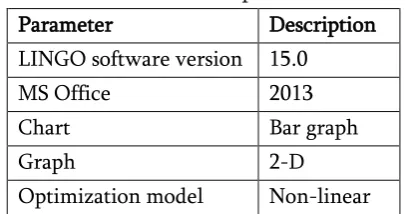
The performance of the proposed method is compared with linear model. The proposed model is simulated in LINGO optimization software which is licensed based optimization software. The simulation parameters are shown in Table 8. The version of LINGO software is 15.0, the graph is drawn in MS Excel 2013, and type of graph is chosen is bar chart.
The optimization level of the proposed model is non-linear.
Table 8: Simulation parameters.
Parameter Description
LINGO software version 15.0
MS Office 2013
Chart Bar graph
Graph 2-D
Optimization model Non-linear
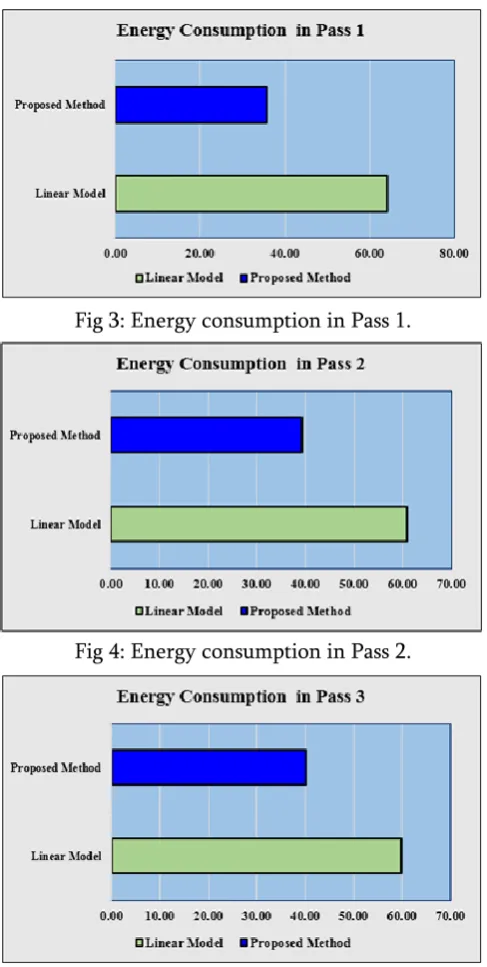
residual energy. This parameter effects all other parameters including network lifetime. In this paper, energy consumption is evaluated based on fusion of game theory strategy and non-linear geometric programming formulation.
Fig 3: Energy consumption in Pass 1.
Fig 4: Energy consumption in Pass 2.
Fig 5: Energy consumption in Pass 3.
Fig 6: Energy consumption in Pass 4.
Energy consumption is the amount of energy consumed during a process. It covered energy consumed during transmit data packet as well as send data packet. The proposed model is evaluated in four iterations shown in Figs. 3 to 6 by modelling two ways such as linear method, and proposed method. We observe that energy consumption is significantly reduced in each iteration of the proposed method.
V.
CONCLUSION
In this paper, an optimal routing technique is design for wireless network with the help of three methods such as game theory strategy, geometric programming and fuzzy logic. Strategy of the game theory is used to model all conflicting strategies of the network, geometric programming is used to model all non-linear parameters of the network, fuzzy logic is used to make imprecise goals of the network. The combination of these methods helps to derive an optimal routing which enhance the network lifetime by reducing less energy of the nodes.
VI.
REFERENCES
[1] S. K. Das and S. Tripathi, “Intelligent energy-aware efficient routing for MANET,” Wireless Networks, 2016, pp. 1-21, DOI 10.1007/s11276-016-1388-7.
routing protocol for ad-hoc network,” Peer-to-Peer Networking and Applications, 2016, vol. 10, no. 3, pp. 670-687, DOI 10.1007/s12083-016-0532-6.
[3] A. K. Yadav, S. K. Das and S. Tripathi, “EFMMRP: Design of efficient fuzzy based multi-constraint multicast routing protocol for wireless ad-hoc network,” Computer Networks,
2017, vol. 118, pp. 15-23,
https://doi.org/10.1016/j.comnet.2017.03.001.
[4] Boukerche, Azzedine, et al. "Vehicular ad hoc networks: A new challenge for localization-based systems." Computer communications 31.12 (2008): 2838-2849.
[5] S. K. Das, A. Kumar, B. Das, and A. Burnwal, “Ethics of reducing power consumption in wireless sensor networks using soft computing techniques,” International Journal of Advanced Computer Research, 2013, vol. 3, no. 1, pp. 301-304.
[6] S. K. Das, S. Tripathi, and A. Burnwal, “Intelligent energy competency multipath routing in wanet,” in Information Systems Design and Intelligent Applications, Springer, 2015, pp. 535-543, DOI: 10.1007/978-81-322-2250-7_53.
[7] S. K. Das and S. Tripathi, “Energy efficient routing formation technique for hybrid ad hoc network using fusion of artificial intelligence techniques,” International Journal of Communication Systems, 2017, pp. 1-16, DOI: 10.1002/dac.3340.
[8] A. Burnwal, A. Kumar, and S. K. Das, “Survey on application of artificial intelligence techniques,” International Journal of Engineering Research & Management, 2014, vol. 1, no. 5, pp. 215-219.
[9] S. K. Das and S. Tripathi, “Adaptive and intelligent energy efficient routing for transparent heterogeneous ad-hoc network by fusion of game theory and linear programming,” Applied Intelligence, 2017, pp. 1-21, https://doi.org/10.1007/s10489-017-1061-6.
[10]A. Burnwal, A. Kumar, and S. K. Das, “Assessment of Mathematical Modeling in Different Areas,” International Journal of Advanced Technology & Engineering Research, 2013, vol. 3, no. 3, pp. 23-26.
[11]S. K. Das and S. Tripathi, “Energy efficient routing formation algorithm for hybrid ad-hoc network: A geometric programming approach,” Peer-to-Peer Networking and Applications, 2018, pp. 1-27, https://doi.org/10.1007/s12083-018-0643-3.
[12]S. K. Das, S. Tripathi, and A. Burnwal, “Fuzzy based energy efficient multicast routing for ad-hoc network,” in Computer, Communication, Control and Information Technology (C3IT), 2015 Third International Conference on, IEEE, 2015, pp. 1-5, DOI: 10.1109/C3IT.2015.7060126.
[13]S. K. Das, S. Tripathi, and A. Burnwal, “Design of fuzzy based intelligent energy efficient routing protocol for WANET,” in Computer, Communication, Control and Information Technology (C3IT), 2015 Third International Conference on, IEEE, 2015, pp. 1-4, DOI: 10.1109/C3IT.2015.7060201.
[14]A. Burnwal, A. Kumar, and S. K. Das, “Assessment of fuzzy set theory in different paradigm,” International Journal of Advanced Technology & Engineering Research, 2013, vol. 3, no. 3, pp. 16-22.
[15]S. K. Das and S. Tripathi, “Energy efficient routing protocol for manet based on vague set measurement technique,” Procedia Computer Science, 2015, vol. 58, pp. 348-355, doi:10.1016/j.procs.2015.08.030.
[16]S. K. Das and S. Tripathi, “Energy Efficient Routing Protocol for MANET Using Vague Set,” in Proceedings of Fifth International Conference on Soft Computing for Problem Solving, Springer, 2016, pp. 235-245, DOI: 10.1007/978-981-10-0448-3_19.
Computer Science & Information Technology (CS & IT), 2013, vol. 3, pp. 59-68, DOI : 10.5121/csit.2013.3206.
[18]S. K. Das, S. Tripathi, and A. Burnwal, “Some relevance fields of soft computing methodology,” International Journal of Research in Computer Applications and Robotics, 2014, vol. 2, pp. 1-6.
[19] Xiaohai Wei, Guoliang Chen, Yingyu Wan and Fred Mtenzi, "Optimized priority based energy efficient routing algorithm for mobile ad hoc networks." Ad Hoc Networks 2.3 (2004): 231-239.
[20] Bey-Ling Su, Ming-Shi Wang and Yueh-Ming Huang, "Fuzzy logic weighted multi-criteria of dynamic route lifetime for reliable multicast routing in ad hoc networks." Expert Systems with Applications 35.1 (2008): 476-484.
[21] Matthew J. Miller and Nitin H. Vaidya "Ad hoc routing for multilevel power save protocols." Ad Hoc Networks 6.2 (2008): 210-225.
[22] R. Zheng, R. Kravets, On-demand power management for ad hoc networks, in: IEEE Infocom 2003, April 2003.
[23] C. Sengul, R. Kravets, TITAN: On-demand topology management in ad hoc networks, ACM Mobile Computing and Communications Review (MC2R) 9 (1) (2005) 77–82.
[24] B. Chen, K. Jamieson, H. Balakrishnan, R. Morris, Span: An energy-efficient coordination algorithm for topology maintenance in ad hoc wireless networks, in: ACM Mobi-Com 2001, July 2001.
[25] Y. Xu, J. Heidemann, D. Estrin, Geography-informed energy conservation for ad hoc routing, in: ACM MobiCom 2001, July 2001.
[26] Zhihao Guo , Shahdi Malakooti, Shaya Sheikh, Camelia Al-Najjar and Behnam Malakooti, "Multi-objective OLSR for proactive routing in MANET with delay, energy, and link lifetime predictions." Applied Mathematical Modelling 35.3 (2011): 1413-1426.
[27] Samira Kalantari, Mohsen Amiri besheli, Zeinab Sam Daliri, Shahaboddin Shamshirband and Liang Shing Ng, "Routing in wireless sensor network based on soft computing technique." Scientific Research and Essays 6.21 (2011): 432-4441.
[28] R.Vadivel and V. Murali Bhaskaran, "Energy efficient with secured reliable routing protocol (EESRRP) for mobile ad-hoc networks." Procedia Technology 4 (2012): 703-707.
[29] S. K. Das, A. Kumar, B. Das, and A. Burnwal, “Ethics of E-Commerce in Information and Communications Technologies,” International Journal of Advanced Computer Research, 2013, vol. 3, no. 1, pp. 122-124, doi=10.1.1.300.9397.