Multi-Document Summarization with GIST
EXTER
Sanda M. Harabagiu , Steven J. Maiorano
Language Computer Corporation Dallas TX 75206 USA [email protected]
University of Sheffield Sheffield S1 4DP UK
Abstract
This paper presents the architecture and the multidocument summarization techniques implemented in the GISTEXTERsystem. The paper presents an algorithm for producing incremental multi-document summaries if extraction templates of good quality are available. An empirical method of generating ad-hoc templates that can be populated with information extracted from texts by automatically acquired extraction patterns is also presented. The results of GISTEXTERin the DUC-2001 evaluations account for the advantages of using the techniques presented in this paper.
1.
Introduction
One of the major problems faced when searching in-formation from vast on-line sources stems from the fact that the same topic is covered in multiple documents, each adding a new perspective. Current indexing and retrieval methods do not aim at bringing forward the different per-spectives, but rather at exploiting the redundancy of in-formation in documents of similar content. A user may be potentially helped to see at a glance both similarities and differences in the information content when provided with Multi-Document Summarization (MSD) techniques. MDS can be viewed as either as (1) an extension of single-document summarization of a collection of single-documents cov-ering the same topic; or (2) an application of Information Extraction (IE) since it uses information extracted from the documents to generate a summary that takes into account several different perspectives of the extracted information.
Single-documents summaries are produced with the goal of presenting the most important content in a con-densed way. Two possible techniques can be used to create summaries: (1) sentence extraction, followed by sentence compression; or (2) identification of the relevant informa-tion followed by generainforma-tion of a textual summary from the facts that need to be included. In (Mani and Maybury 1999) a representative set of papers focusing on the first tech-nique are collected whereas (Radev and McKeown 1998) and (Lin and Hovy 2000) report on implementations of the second technique. Multi-document summaries produced by extending the first technique present the problem of order-ing the sentences extracted from different documents in or-der to obtain a coherent summary. This problem was ad-dressed in (Barzilay et al.2001) and a strategy of combin-ing cohesive indicators along with chronological ordercombin-ing was reported. The extension of single-document summa-rization techniques based on topic identification for dealing with multiple documents involves the notion of topic
repre-sentation.
Topics can be represented as a set of inter-related con-cepts, implemented as a frame having slots and fillers.
TEXT:
officials in florida have ended the search for a 23−year−old man, bringing the death toll to 40 from last week’s tonadoes. funerals are being held across central florida this weekend. four of the victims were buried yesterday, a husband, wife, their daughter and her fiancee. other families spent the day trying to secure belongings from the first heavy rain since the tornadoes. estimates of the damage now exceeds $100 million.
TEMPLATE
Doc_NR: CNN19980301.1000.0329
Event: <Natural_Disaster−CNN19980301.1000.0329−1> Comment: Prototypical
<Natural_Disaster−CNN19980301.1000.0329−1> := Amount Damage: $100 million
Disaster: last week’s TORNADOES Number Dead: 40
/ four of the victims Location: Florida
/ central Florida Date: last week
/ a husband, wife, their daughter and her fiancee
(a)
(b)
(c)
TOPIC SIGNATURE: victim, damage, estimate, flood, tornado, dead, week
Figure 1: (a) Template representation of the “natural disas-ters” topic; (b) Text containing information about the topic; (c) Topic signature for “natural disasters”.
In the Information Extraction technology, such frames are called templates and are populated with information related to the salient facts reported in documents and extracted by the IE systems. For example, if the topic is “natural
disas-ters”, Figure 1 illustrates a template populated with
infor-mation extracted from the text illustrated in Figure 1(b). An alternative representation of a topic was proposed in (Lin and Hovy 2000), with the goal of modeling the minimum amount of knowledge required to effectively identify con-cepts related to a topic. This representation, called topic
signature, associates a target concept (i.e. the topic) with
a vector of related terms (i.e. the signature). Each from the signature has an associated weight . (Lin and
ob-Input article
Single−Document Summary
Input article set + Topic
No Yes
Multiple−Document Summary
Text Preprocessing Sentence Extraction
Sentence Compression
Decomposition Single− Document
Summary Reduction
Determine topical relations
WordNet Known Topic ?
GISTexter
human−written abstracts Corpus of
Generate ad−hoc template
Acquire extraction rules
Multi−Document Summarizer Single−Document Summarizer
Representation Template
of Topic
Extracted Templates
Template−combination Operators and sentence extraction
System Information Extraction
CICERO
Named−Entity Recognizer
Phrasal Parser
Entity Coreference
Domain−Event Recognizer
Merging of Event Information
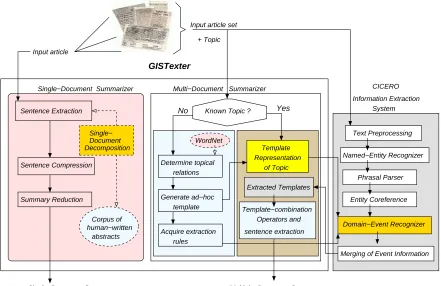
Figure 2: Architecture of GISTEXTER
tained with the method reported in (Lin and Hovy 2000).
When topic signatures are known, they can be used to improve the quality of sentence extraction. Moreover, un-like templates, topic signatures can be extracted automati-cally by using statistical methods. However, this topic rep-resentation does not address the issue of possible similari-ties and differences between the salient facts. Our experi-ments show that such knowledge is paramount to produc-ing coherent multi-document summaries. A way of deriv-ing possible relations between salient facts is by relyderiv-ing on templates extracted from the texts. This idea was imple-mented in SUMMONSfor the terrorism domain and the re-sults reported in (Radev and McKeown 1998) indicate that it generates informative and coherent multi-document sum-maries that cover different perspectives of each topic. The drawback of this method is that it requires (1) a manually generated template; (2) an IE system that extracts informa-tion for the specific topic and its template representainforma-tion; and (3) empirical methods for finding all possible relations between extracted templates.
In this paper we present a third alternative, that com-bines the advantages of both topic representations. When-ever we have a template representation for a given topic and we have trained an IE system to work for that do-main, we extract salient information and populate tem-plates, enabling the generation of multi-document sum-maries informing about all the relations between salient facts. When new topics are presented, we generate an ad-hoc template which combines statistical information with topical relations mined from the WordNet lexical database. To populate the ad-hoc templates we acquire extraction
rules and derive possible relations between the salient facts that were extracted. To be able to evaluate this summa-rization technique we could either use the human assesses results from DUC-2001 or compared our method to multi-document summarization techniques that rely on sentences extraction and compression. In the latter case we could use the single-document summarization module implemented in GISTEXTERand apply to its output (1) topic signature information and (2) sentence ordering techniques. In this paper we preferred to present only the results originating the the DUC-2001 evaluations.
The rest of the paper is organized as follows. Sec-tion 2 presents the architecture of GISTEXTER, our single-document and multi-document summarization sys-tem. Section 3 details the IE-based multi-document sum-marization whereas Section 4 presents the technique for de-riving ad-hoc templates. Section 5 reports and discusses the experimental results and Section 6 summarizes the conclu-sions.
2.
The architecture of GIST
EXTERGISTEXTER is a summarization system implemented for the evaluations of the Document Understanding Con-ferences (DUCs)1. The architecture of the system is shown in Figure 2. Input to the system is either a single document or a collection of documents sharing the same topic. When a summary of a single document is sought, GISTEXTER first extracts the key sentences, similarly to most single-document summarizers. The sentence extraction function
1
is learned, using the technique of single-document
decom-position. This technique analyzes the features of
human-written abstracts of single documents. In the second stage, to further filter out un-necessary information, the extracted sentences are compressed. In the final stage a summary
reduction is performed, to trim the whole summary to the
length of 100 words. Figure 3 illustrates a single-document summary produced by GISTEXTER.
yesterday to begin a massive rebuilding effort after Hurricane Andrew had flattened whole districts, killing two people and injuring dozens more. The government estimated it would cost Dollars 20bn − Dollars 30bn to tidy and rebuild in Florida.
Louisiana state officials said they had no overall count of storm − related injuries but initial estimates reckoned fewer than 100.
SQUADS of workers fanned out across storm − battered Louisiana
Most of the storm ’s fury was spent against sparsely populated farming communities and swampland in the state, sparing it the widespread destruction caused in Florida, where 15 people died.
Figure 3: Single-document summary produced by GIS-TEXTER.
When multi-document summaries need to be created, the processing takes additionally into account the topic of the document set. Sometimes the topic is well-known and may be already implemented in Information Extraction (IE) systems. In this case an IE system identifies all the informa-tion that needs to be used in the multi-document summary. Other times the topic is completely new, and the summary is generated by modeling the topic in an ad-hoc manner.
GISTEXTER produces multi-document summaries by relying on the output of the CICEROIE system2. CIC ERO, as reported in (Surdeanu and Harabagiu 2002) produces un-surpassed quality of extraction because it combines the role of linguistic extraction patterns with coreference knowl-edge. For multi-document summarization, this means that the templates generated by CICEROare easily mapped into text snippets from the texts, in which pronouns and other anaphoric expressions are resolved. These text snippets can be used to generate coherent, informative multi-document summaries.
To extract information from a set of documents, CI-CEROneeds to have a template representation of the topic. The template slots are filled whenever textual information relevant for the topic is identified. To recognize each topic-relevant event and entity, CICERO first pre-processes the text, by tokenizing the article and recognizing the part-of-speech and attributes of each word against a rich dictionary structure. Next, all names from the article are categorized by a named entity recognizer which taggs Red Cross as an
Organization and Florida as a Location. A phrasal parser
brackets all noun and verb phrases, to enable the recog-nition of linguistic patterns that relate to the topic. Since anaphoric expressions are often used, before matching the text against linguistic patterns, coreference resolution takes place.
Linguistic patterns are matched to identify the topic-relevant information. For example, for the topic of “natural disasters”, the rule Casualty-expression tofrom $
Num-ber frombecause-of Disaster-word is matched against
2
CICERO is an ARDA-sponsored on-going project that stud-ies the effects of incorporating world knowledge into IE systems. CICEROis being developed at Language Computer Corporation.
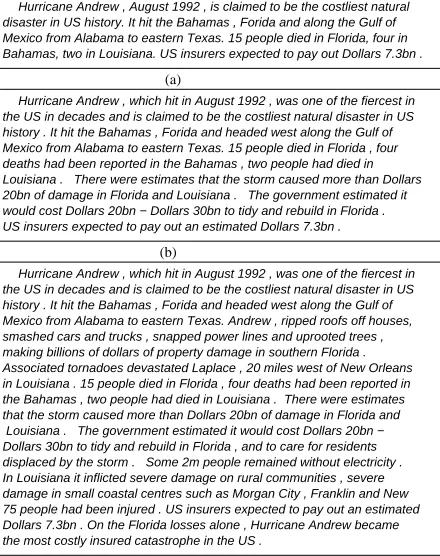
the snippet “the death toll to 40 from last week’s tornado” in the text from Figure 1(b). Other extraction patterns are matched against the text and populate the rest of the tem-plate illustrated in Figure 1(a). CICEROextracts all the tem-plates from the article collection and keeps mappings from the template slots the the text snippets containing informa-tion that fills the slots. These text snippets are indicators of the summary content.Figure 4 illustrates the 50-word long, the 100-word long and the 200-word long multi-document summaries generated by GISTEXTER for a collection of articles dealing with “natural disasters”.
(c) (b) (a)
history . It hit the Bahamas , Forida and headed west along the Gulf of the US in decades and is claimed to be the costliest natural disaster in US
Hurricane Andrew , which hit in August 1992 , was one of the fiercest in Hurricane Andrew , which hit in August 1992 , was one of the fiercest in history . It hit the Bahamas , Forida and headed west along the Gulf of the US in decades and is claimed to be the costliest natural disaster in US
deaths had been reported in the Bahamas , two people had died in Louisiana . There were estimates that the storm caused more than Dollars 20bn of damage in Florida and Louisiana . The government estimated it would cost Dollars 20bn − Dollars 30bn to tidy and rebuild in Florida . US insurers expected to pay out an estimated Dollars 7.3bn . Mexico from Alabama to eastern Texas. 15 people died in Florida , four
Mexico from Alabama to eastern Texas. Andrew , ripped roofs off houses, smashed cars and trucks , snapped power lines and uprooted trees , making billions of dollars of property damage in southern Florida . Associated tornadoes devastated Laplace , 20 miles west of New Orleans in Louisiana . 15 people died in Florida , four deaths had been reported in the Bahamas , two people had died in Louisiana . There were estimates that the storm caused more than Dollars 20bn of damage in Florida and Louisiana . The government estimated it would cost Dollars 20bn − Dollars 30bn to tidy and rebuild in Florida , and to care for residents displaced by the storm . Some 2m people remained without electricity . In Louisiana it inflicted severe damage on rural communities , severe damage in small coastal centres such as Morgan City , Franklin and New 75 people had been injured . US insurers expected to pay out an estimated Dollars 7.3bn . On the Florida losses alone , Hurricane Andrew became the most costly insured catastrophe in the US .
Hurricane Andrew , August 1992 , is claimed to be the costliest natural disaster in US history. It hit the Bahamas , Forida and along the Gulf of Bahamas, two in Louisiana. US insurers expected to pay out Dollars 7.3bn . Mexico from Alabama to eastern Texas. 15 people died in Florida, four in
Figure 4: Multiple-document summary produced by GIS-TEXTER: (a) 50-word summary; (b) 100-word summary; (c) 200-word summary.
Whenever the topic of the collection of documents has not been previously encoded in the CICEROIE system and no template representation of the topic exists, we need to perform some additional processing to gist the missing in-formation. Thus we need to generate in an ad-hoc man-ner: (1) the template and (2) the extraction rules that en-able CICERO to identify the relevant information. To this end, we have developed a methodology for generating an ad-hoc template based on the topical relations that can be identified from WordNet (Miller 1995). When the template is known, several possible methods of acquiring extraction rules can be applied, e.g. the methods reported in (Yangar-ber and et al.2000) (Riloff and Jones 1999) or (Harabagiu and Maioarano 2000). For GISTEXTER, we applied the techniques reported in (Harabagiu and Maioarano 2000).
domi-4.1. Extracting Topical Relations from WordNet
WordNet is both a thesaurus and a dictionary. It is a thesaurus because each word is encoded along with its syn-onyms in a synsyn-onyms set called synset, representing a
lex-ical concept. WordNet is a dictionary because each synset
is defined by a gloss. Moreover, WordNet is a knowl-edge base because it is organized in 24 noun hierarchies and 512 verb hierarchies. Additionally WordNet encodes three meronym relations (e.g. HAS-PART, HAS-STUFF and HAS-MEMBER) between nouns and two causality rela-tions (e.g. ENTAILMENTand CAUSE-TO) between verbs. However, there are no direct relations between the concepts used in any of the template representation of the topics en-coded in the CICERO IE system. Nevertheless we noticed that chains of lexico-semantic relations can be mined from WordNet to account for the connection between any pair of template concepts of known topics. To illustrate how such chains of relations can be mined, we first consider two of the relations already encoded in WordNet and then show how additional relations can be uncovered as lexico-semantic chains between two concepts pertaining to the same topic. We call these lexico-semantic chains topical
relations.
The sources of topical relations
In WordNet, a synset is defined in three ways. First it is defined by the common meaning of the words forming the synset. This definition relies on psycholinguistic principles, based on the human ability to disambiguate a word if sev-eral synonyms are presented. Second, the synset is defined by the attributes it inherits from its super-concepts. Third, a glossed definition is provided to each synonym. A GLOSS relation connects a synonym to its definition. We believe that glosses are good sources for topical relations, since they bring forward concepts related to the defined synset. We consider four different ways of using the glosses as sources for topical relations:
1. We extend the GLOSSrelation to connect the defined synset not only to a textual definition but to each con-tent word from the gloss, and thus to the synset it represents. For example, the gloss of synset bovine
spongiform encephalitis, BSE, mad cow disease is (
fatal disease of cattle that affects the central nervous system; causes staggering and agitation). A GLOSS relation exists between the defined synset and fatal,
disease, cattle, affect, central nervous system, stagger-ing and agitation.
2. Each concept from a gloss has its own definition, and thus by combining the GLOSS relations, we connect the defined synset to the defining concepts of each concept from its own gloss.
3. The hypernym of a synset has also a gloss, thus a synset can be connected to the concepts from the gloss of its hypernym. Similarly to the IS-A relations, other WordNet lexico-semantic relations can be followed to reach a new synset and have access to the concepts used in its gloss. Such relations may include HAS-MEMBER, HAS-PART or ENTAILS and CAUSE-TO.
Lexical relations based on morphological derivations, if available may be used too3. Morphological relations include the NOMINALIZATIONrelations, known to be useful in IE.
4. A synset can be used itself to define other concepts, therefore connections exist between each concept and all concepts it helps define.
Figure 8 illustrates the four possible sources of topical relations based on two of the WordNet relations, namely GLOSSand IS-A.
Synset 2 Synset 1
Synset 3
Synset n
Synset 1
Synset n
Synset n
Synset 2
Synset 3 Synset 4
Synset 1 Synset 2
Synset 3 Synset 4
Synset 2 Synset 3
Synset n
Synset 1
Case 1
Gloss Gloss
Gloss
Gloss Gloss
Gloss
Case 2
Gloss Gloss
Gloss
Case 3 Case 4
IsA
Gloss
Gloss Gloss
Figure 8: Four sources of topical relations.
Topical relations as Paths between WordNet Synsets Two principles guide the uncovering of topical relations. First we believe that redundant connections rule out con-nection discovered by accident. Therefore, if at least two different paths of WordNet relations can be established be-tween any two synsets, they are likely to be part of the rep-resentation of the same topic. Second, the shorter the paths, the stronger their validity. Consequently, we rule out paths of length larger than 4. This entails the fact that each topic may be represented by at least five synsets.
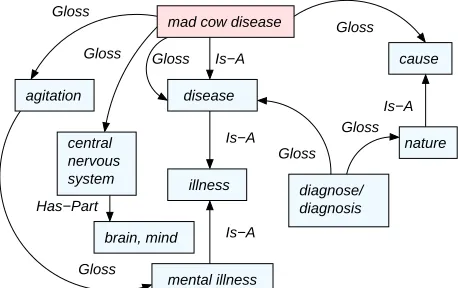
Figure 9 shows the topical relations produced by the paths originating at the WordNet synset mad cow disease
and traversing concepts like mental illness , agitation
or brain, mind . It is to be noted that each concept may be
reached by at least two different paths of relations.
illness
cause
diagnose/ diagnosis
nature mad cow disease
disease Is−A
Is−A
Gloss
Is−A
Gloss Gloss central
nervous system agitation
brain, mind
mental illness Gloss
Gloss Gloss
Is−A
Gloss Has−Part
Figure 9: Topical relations for the “mad cow disease” topic.
3
4.2. Ad-hoc Templates
A template representation of a topic can be viewed as a list of semantic roles, each role being a slot that is filled by information extracted from text. The topical relations mined from WordNet have the advantage that they bring forward semantically-connected concepts deemed relevant to the topic. However these concepts cannot be mapped di-rectly into a list of slots. First, WordNet was not devised with the IE application in mind - it is a general resource of English lexico-semantic knowledge. Because of this, some concepts relevant to a given topic may not be encoded in WordNet. Second, several WordNet concepts traversed by topical relations may be categorized under the same seman-tic role. Third, some semanseman-tic roles may be encoded in WordNet at a very abstract level, and thus they may never be reached by topical relations. Fourth, some of the seman-tic roles derived from topical relations may never be filled, since there is no corresponding information in the texts. To address all these issues, we have developed a corpus-based technique for creating ad-hoc lists of semantic roles for the template representation of the collection topic. Our algo-rithm for ad-hoc template generation was inspired by the empirical approach for conceptual case frame acquisition presented in (Riloff and Schmelzenbach 1998).
Algorithm Ad-hoc Template Generation
Step 1: Extract all sentences in which one of the concepts
traversed by topical relations is present. The concepts from the topical relations are used as a seed lexical items used for the identification of the template slots.
Step 2: Identify all Subject-Verb-Object (SVO)
+Preposi-tional attachments syntatic structures in which one of the topical concepts is used. For this purpose, we used the phrasal parser implemented in CICERO as well as all the syntactic variants of the SVO syntactic structures used to implement extraction patterns.
Step 3: Apply the IE coreference resolution module and
consider all the syntactic SVO structures involving all core-ferring expression of any of the nouns used in the syntactic structures discovered at Step 2.
Step 4: Combine the extraction dictionaries with WordNet
to classify each noun from the structures identified at Step 2 and Step 3.
Step 5: Generate the semantic profile of the topic. For this
reason we compute three values for each semantic class de-rived at Step 4: (1) SFreq: the number of syntactic struc-tures identified in the collection; (2) CFreq: the number of times elements from the same semantic class were identi-fied; and (3) PRel the probability that the semantic class identifies a relevant slot of the template. Similarly to the method reported in (Riloff and Schmelzenbach 1998), PRel = CFreq/SFreq. To select the template slots the following formula is used:
( CFreq F1) or ((SFreq F2) and ( PRel P))
The first test selects roles that because of the semantic cat-egories that are identified with high frequency, under the assumption that this reflect a real association with the topic elaboration in the collection. The second text promotes slots that come from a high percentage of the syntactic structures recognized as containing information relevant to
the topic even though their frequency might be low. The values of F1, F2 and P vary from one topic to another - we derive them from the requirement that a template should not contain more than 5 slots.
5.
Evaluation
We participated with GISTEXTER in the DUC-2001 multi-document summarization involving 30 document sets. For each test data set the multi-document sum-mary generated by our system was compared with a gold-standard summary created by humans. For each data set, the author of the gold-standard summary assessed the de-gree of matching between the model summary and the sum-maries generated by the systems evaluated in DUC-2001. Three qualitative measures were used to compare the sys-tems as a whole. These measures are grammaticality,
cohe-sion and organization. Each of these measures were scored
on a scale between 0 and 4.
To compute the quantitative measures of overlap be-tween the system-generated summaries and the gold-standard summary, the human-created summary was seg-mented by hand by assessors into model units (MUs), which are informational units that should express one self-contained fact in the ideal case. MUs are sometimes sen-tence clauses, sometimes entire clauses. In contrast, the summaries generated by the summarization systems were automatically segmented into peer units (PUs) - which are always sentences. Subsequently, the assessor located the PU(s) that covered the content of each MU, if any, and as-signed an estimate of the degree of matching, between 1 and 4.
From the assessor judgments, an extensive analysis was reported in (McKeown et al.2001). In this paper we re-port only on the results of GISTEXTER. For evaluating the content, we consider only the Precision and Recall mea-sures. Precision is calculated as the number of PUs match-ing some MU divided by the number of PUs in the peer summary, considering all summaries automatically gener-ated for the same collection. Our system scored a preci-sion of 50.76%. As reported in (McKeown et al.2001), this estimate of the precision is conservative, since the num-ber of PUs that are considered correct can be increased by considering information about the PUs not assigned to MUs. However, this information is not available, since the data on PUs not assigned to MUs is qualitative in nature (e.g. “some”, “most”) rather than a count. In (McKeown et al.2001) it is proposed to use a more accurate measure by using weights reflecting the degree of matching between PUs and MUs. Unfortunately, this data was not available after the evaluation. However an accurate analysis of the recall was possible. The recall is defined as the number of MUs matched on or above a threshold divided by the
to-tal number of MUs in the gold-standard summary. A very strict recall measure is granted when
whereas a le-nient recall measure considers even MUs with “little” con-tent covered for .
We present here also a method proposed in (McKeown et al.2001) for combining the four recall measures corre-sponding to the four possible values of. Instead of treating
Recall Ranking between all systems
1 35.53 3
2 28.82 3
3 15.03 1
4 7.42 1
Average 88.41 1
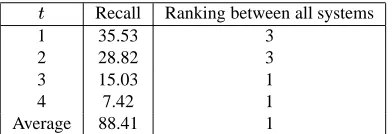
Table 1: Recall of summary content obtained by GISTEX-TERin DUC-2001
to consider it a ratio, i.e. assume that a value of matching of 2 is twice as good as a matching of 1 and half as good as a matching of 4. Under this assumption, the degree of matching over MUs can be averaged and the recall is con-sidered as an average of the degree of matching. Table 1 shows the values of the recall obtained by GISTEXTER de-pending on the threshold as well as the average recall. The
Table also shows that for recall GISTEXTERwas scored as the best system among all 12 participating multi-document summarization systems.
To evaluate the style of the summary, the assessments were based on the grammaticality, organization and
co-herence/cohesion of the output of GISTEXTER. Table 2 shows the scores obtained by our system as well as the rel-ative ranking between the automated multi-document sum-marization systems that participated in DUC-2001.
Criterion Value Ranking between all systems
Grammaticality 3.5086 8
Cohesion 2.3362 1
Organization 2.6121 1
Table 2: The evaluation of the summary style for GISTEX-TERin DUC-2001
6.
Conclusions
In this paper we have shown that multi-document sum-marization of good quality can be obtained if extraction templates populated by a high performance IE systems are available. We have presented an IE-based multi-document summarization procedure that incrementally adds informa-tion to create summaries of variable size. The decision of using incremental additions of sentences from multiple documents based on their mapping from the template slots produced very good results for coherence and organization in the DUC-2001 evaluations.
Additionally, in this paper we have presented a method for creating ad-hoc templates for new topics that made pos-sible the good recall results we obtained with GISTEXTER in DUC-2001. The scores on the style of the summary showed that the grammaticality of the summaries produced by our system were not very good. We are currently work-ing on a generation module that would realize the structure of the populated templates.
7.
References
R. Barzilay, N. Elhedad and K. McKeown. Sentence ordering in multidocument summarization. In Proceedings of Conference
on Human Language Technology (HLT-2001), 2001.
G. DeJong. An overview of the FRUMP system. In Stategies for
natural language processing, W. Lehnert and M. Ringle Eds.,
pages 149-176, Lawrence Erlbaum Associates, 1982.
M. Elhadad. Using argumentation to control lexical choice: A unification-based implementation. PhD Thesis, Computer Sci-ence Department, Columbia University, 1993.
S. Harabagiu and S. Maiorano. Acquisition of Linguistic Patterns for Knowledge-Based Information Extraction. In Proceedings
of Second International Conference on Language Resources and Evaluation (LREC-2000), Athens, Greece, 2000.
D. Appelt, J. Hobbs, J. Bear, D. Israel, M. Kameyama, M. Stickel and M. Tyson. FASTUS: A Cascaded Finite-State Transducer for Extracting Information from Natural-Language Text. In
Fi-nite State Language Processing, edited by Emmanuel Roche
and Yves Schabes, MIT Press, 1997.
C.Y. Lin and E. Hovy. The Automated Acquisition of Topic Sig-natures for Text Summarization. In Proceedings of the 18th
International Conference on Computational Linguistics (COL-ING 2000), Saarbrcken, Germany, July 31- August 4, 2000.
I. Mani and M. Maybury, eds. Advances in Automatic Text Sum-marization. MIT Press, 1999.
K. McKeown, R. Barzilay, D. Evans, V. Hatzivassiloglou, M.Y. Kan, B. Schiffman and S. Teufel. Columbia Multi-Document Summarization: Approach and Evaluation. In Workshop Notes
for the DUC-2001 Summarization, pages 43–64, September
2001.
George A. Miller. WordNet: a lexical database for English. In
Communications of the ACM, Vol.38, No.11:39–41, 1995.
Fernando Pereira and Rebecca Wright. Finite-state approximation of phrase-structure grammars. In Finite State Language
Pro-cessing, edited by Emmanuel Roche and Yves Schabes, MIT
Press, 149–179, 1997.
D. Radev and K. McKeown. Generating natural language sum-maries from multiple on-line sources. Computational
Linguis-tics, 24(3):469-500, September 1998.
E. Riloff and M. Schmelzenbach. An Empirical Approach to Con-ceptual Case Frame Acquisition. In Proceedings of the
Six-teenth Workshop on Very Large Corpora, 1998.
E. Riloff and R. Jones. Learning Dictionaries for Information Ex-traction by Multi-Level Bootstrapping. In Proceedings of the
Sixteenth National Conference on Artificial Intelligence (AAAI-99), pp. 474-479, 1999.
M. Surdeanu and S. Harabagiu. Infrastructure for Open-Domain Information Extraction. In Proceedings of Conference on
Hu-man Language Technology (HLT-2002), 2002.
R. Yangarber, R. Grishman, P. Tapanainen and S. Huttunen Au-tomatic Acquisition of Domain Knowledge for Information Extraction. In Proceedings of the 18th International
Confer-ence on Computational Linguistics (COLING-2000),