Acquisition of Qualia Elements from Corpora - Evaluation of a Symbolic
Learning Method
Pierrette Bouillon , Vincent Claveau
, C´ecile Fabre
, Pascale S´ebillot
TIM/ISSCO - ETI, University of Geneva 40 Bvd du Pont-d’Arve, CH-1205 Geneva, Switzerland
IRISA
Campus de Beaulieu, 35000 Rennes, France
vincent.claveau, pascale.sebillot @irisa.fr
ERSS, University of Toulouse II
5, all´ees A. Machado, 31058 Toulouse cedex, France [email protected]
Abstract
This paper presents and evaluates a system extracting from a corpus noun-verb pairs whose components are related by a special kind of link: the qualia roles as defined in the Generative Lexicon. This system is based on a symbolic learning method that automatically learns, from noun-verb pairs that are or are not related by a qualia link, rules characterizing positive examples from negative ones in terms of their surrounding part-of-speech or semantic contexts. The qualia noun-verb pair extraction is thus performed by applying the learnt rules on a part-of-speech or semantically tagged text. Stress is put on the quality of the learning when compared with traditional statistical or syntactical-based approaches. The linguistic relevance of the rules is also evaluated through a comparison with manually acquired qualia patterns.
1.
Introduction
In the Generative Lexicon (GL) framework (Puste-jovsky, 1995), the qualia structure gives access to relation-al information that prove to be crucirelation-al both for linguistic analysis and for NLP applications. In particular, the quali-a roles express, in terms of predicquali-ative formulquali-ae, the bquali-asic features of the semantics of nouns (telic, agentive, consti-tutive, formal). In this model, the noun is linked not on-ly to other nouns via traditional lexical relations (such as meronymy and hyperonymy) but also to verbs. For exam-ple, the noun book is linked in the telic role to the predicate read and in the agentive role to the predicate write; here-after, a noun(N)-verb(V) pair in which V expresses one of the qualia roles of N (like book-read or book-write) is called a qualia pair. Previous works (Fabre and S´ebillot, 1999, for example) have demonstrated that these N-V rela-tions provide lexical resources that are very useful for in-formation retrieval applications. Different studies (Grefen-stette, 1997; Pustejovsky et al., 1997, for example) also prove that N-V pairs can feed indexes that help a user to select the most interesting occurrences of a given noun in a text. Moreover, a short survey (Vandenbroucke, 2000) at the documentation center of the Banque Bruxelles Lambert (Brussels) shows that verbs that express a qualia relation seem to be more relevant than others for that task. Indeed, in this study, no N-V pairs that are not qualia related were considered as interesting by the documentalists.
Given the lack of lexical resources containing those qualia pairs and the fact that verbs in those pairs may vary considerably from one domain to another (especially in technical domains), methods for corpus-based acquisition of these N-V relations are needed. To simplify matters,
t-wo options are usually taken into consideration to acquire N-V links: on one side, statistical approaches extract pairs that are related in a statistically significant way (see (Daille, 1994) for an overview). The problem is that this type of method is not accurate enough to extract precise relation-s (N-V pairrelation-s linked by a qualia relation verrelation-surelation-s other pairrelation-s in our case). Another possibility is to use a linguistic ap-proach and to extract the N-V pairs by spotting a set of syntactic structures related to qualia roles (as proposed by Pustejovsky et al. (1993)). In this last case, the advantage is that such patterns can be very precise but a major problem is to define and adapt them to new texts and corpora. In our work, we want to go one step further than the linguistic ap-proach as we have no a priori concerning the structures that are likely to convey qualia roles in a given corpus. Thus, we develop and apply a symbolic learning method which auto-matically produces general rules that explain what, in terms of surrounding context (part-of-speech and semantic tags) in a text, characterizes examples of relevant N-V pairs (i.e., qualia pairs) from irrelevant (i.e., non-qualia) ones. The rules produced this way are then applied to a corpus to ex-hibit qualia N-V pairs. Therefore, with this system, we aim at combining the precision of linguistic rules (or patterns) in extraction tasks and the flexibility of an automated method.
linguistic rules generally proposed by linguists?
2.
Learning method description
Our aim is to extract a special kind of semantic relations from a corpus, that is, verbs playing a specific role in the se-mantic representation of common nouns, as defined in the qualia structure in GL formalism. Trying to infer lexical se-mantic information from corpora is not new: a lot of work has already been conducted on this subject, especially in the statistical learning domain (see (Habert et al., 1997) or (Pichon and S´ebillot, 1997) for surveys of this field). Be-side these works, symbolic learning has also led to several studies on the automatic acquisition of semantic lexical el-ements from corpora (Wermter et al., 1996) during the last years. It is in this last framework that we have chosen to place our project to automatically acquire qualia N-V pairs. This section is devoted to the presentation of the corpus (and its taggings) used for our experiments and to the de-scription of the symbolic learning method which is the core of our qualia-pair extraction system.2.1. Corpus and its taggings
Our corpus has first undergone a part-of-speech (POS) tagging (see section 2.1.2.) which aims at providing each word of the text with an unambiguous categorial tag (sin-gular common noun, infinitive verb, etc.). Secondly, in or-der to have some possibilities to learn what distinguishes qualia pairs from non-qualia ones that appear in exactly the same categorial patterns, semantic tags, that is, tags unam-biguously describing the semantic class of each word, have been added (see section 2.1.3.).
2.1.1. The MATRA-CCR corpus
The French corpus used in our experiments is a 700 KBytes handbook of helicopter maintenance, provid-ed byMATRA-CCRA´erospatiale, which contains more than 104,000 word occurrences. This technical corpus has some special characteristics that are especially well suited for our task: it is coherent, that is, its vocabulary and syntac-tic structures are homogeneous; it contains many concrete terms that are frequently used in sentences together with verbs indicating their telic or agentive roles.
2.1.2. Part-Of-Speech tagging
This corpus has been POS-tagged with the help of anno-tation tools developed in theMULTEXTproject (Armstrong, 1996); sentences and words are first segmented with MT -SEG; words are analyzed and lemmatized withMMORPH (Petitpierre and Russell, 1998; Bouillon et al., 1998), and finally disambiguated by theTATOOtool, a hidden Markov model tagger (Armstrong et al., 1995). Each word there-fore only receives one POS tag which indicates its morpho-syntactic category (and its gender, number, etc.) with a high precision: less than 2% of errors have been detected when compared to a manually tagged 4,000-word test-sample of the corpus.
2.1.3. Semantic tagging
The semantic tagging is performed on the already POS-taggedMATRA-CCRcorpus; we therefore benefit from the disambiguation of polyfunctional words (that is, words that
have different syntactic categories, asr`eglein French which can be the indicative of the verbto regulateand the com-mon nounrule) (Wilks and Stevenson, 1996).
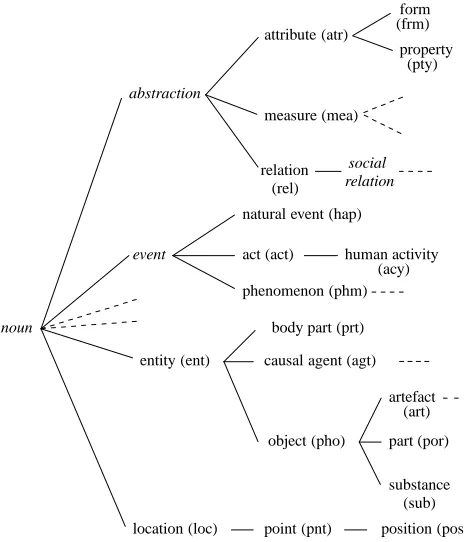
To carry out this tagging, the first step is to build a se-mantic classification which is used as tagset for the seman-tic tagging. A lexicon containing every word (the lexicon entries) of theMATRA-CCRcorpus is created; it associates with each word all its possible semantic tags. The most rel-evant tagset for each category must be chosen. For exam-ple, some WordNet’s (Fellbaum, 1998) most generic class-es have been used to classify nouns; irrelevant classclass-es (for our corpus) have been withdrawn and, for large classes, a more precise granularity has been chosen. This has led to 33 classes, hierarchically organized as shown in Figure 1 (WordNet classes not used for tagging are in italics and semantic tags are bracketed). Similar tagsets are built for
entity (ent) causal agent (agt)
object (pho) body part (prt)
artefact
part (por)
substance measure (mea)
location (loc) point (pnt) position (pos) noun
relation attribute (atr)
abstraction
social
phenomenon (phm)
event human activity
natural event (hap)
act (act)
(rel) relation (frm)
(pty) property
(sub) form
(acy)
(art)
Figure 1: Part of the semantic class hierarchy used for noun tagging
verbs, prepositions, adjectives and other word categories. A more detailed presentation can be found in Bouillon et al. (2001).
2.2. Description and settings of the learning method
All those POS and semantic tags in theMATRA-CCR corpus are the contextual key information used by the qualia-pair extraction system that we have developed. This system is built upon an inductive symbolic learning method called inductive logic programming (ILP). The choice of this method is explained in section 2.2.1.; the needed ex-amples and their representations are described in section 2.2.2.; and important settings of the method ensuring the linguistic relevance of the produced rules are given in sec-tion 2.2.3..
2.2.1. Learning with ILP
Our selection of a learning method is guided by the fac-t fac-thafac-t fac-this mefac-thod musfac-t nofac-t only provide a predicfac-tor (fac-this N-V pair is qualia, this one is not), like most of statisti-cal methods, but also infer general rules able to explain the examples, that is, bring linguistically interpretable el-ements about the predicted qualia relations. This essential explanatory characteristic has motivated our choice of the ILP framework (Muggleton and De-Raedt, 1994) in which programs that are inferred from a set of facts (positive and negative examples of the concept to be learnt) and a back-ground knowledge, are logic programs, that is, sets of Horn clauses. Indeed, ILP relational nature can provide a power-ful expressiveness for the still unknown linguistic patterns expressing qualia relations. Moreover, errors inherent in the automatic POS and semantic tagging process previous-ly described make the choice of an error-tolerant learning method essential. The easy handling of data noise in ILP guarantees this robustness.
Most ILP systems provide a way to deal more or less with the form of the generated rules but only some of them enable a total control of this form. Moreover, the particular hierarchical structure of our POS and semantic information makes it essential to use a relational background knowledge processing capable ILP system. For these reasons, we have thus chosen ALEPH1, an ILP implementation that has al-ready been proven well suited to deal with a large amount of data in multiple domains (mutagenesis, drug structure. . . ) and permits complete and precise customization of all the settings of the learning task.
2.2.2. Example construction
As explained above, ILP algorithms generate rules ex-plaining what characterize positive examples of the concept to be learnt from negative ones. In our case, we want to dis-criminate qualia N-V pairs from non-qualia ones according to their POS and semantic context. Therefore, our first task consists in building the sets of positive and negative exam-ples, that is, in describing in terms of POS and semantic information the sentences where qualia N-V pairs and non-qualia ones occur. Here is our methodology for their con-struction.
Given a subset of N-V pairs of our corpus, every occurrence in the text of each pair of this subset is manually annotated as relevant or irrelevant according
1http://web.comlab.ox.ac.uk/oucl/research/areas/machlearn/
aleph/aleph toc.html
to Pustejovsky’s qualia structure principles. The con-sidered occurrence is then added to the positive exam-ple set if it is annotated as relevant, to the negative one otherwise, and the contextual information of this occur-rence is added to the background knowledge. The pos-itive and negative examples therefore contain clauses of the form is qualia(noun identifier,verb identifier). where noun identifier and verb identifier are the unique identifier of the considered N-V pair occurrence. In the background knowledge, the contextual information is stored in the form of the following clauses:
tags(w 1,POS-tag,semantic-tag). tags(w 2,POS-tag,semantic-tag). pred(w 2,w 1).
tags(w 3,POS-tag,semantic-tag). pred(w 3,w 2).
tags(w 4,POS-tag,semantic-tag). pred(w 4,w 3).
tags(w 5,POS-tag,semantic-tag). pred(w 5,w 4).
distances(w 4,w 2,distance in words,distance in verbs).
where the studied N-V pair w4 w2 occurs in the sentence “w1 w2 w3 w4 w5”,pred(x,y)indicates that wordyoccurs just before wordxin the sentence, predicatetags/3gives the POS and semantic tags of a word, anddistances/4 spec-ifies the number of words and the number of verbs between N and V in the sentence. During this step, some word cat-egories (determiners, some adjectives) which are not con-sidered as relevant to bring up information about context of qualia or non-qualia pairs are not taken into account.
3,099 positive examples and 3,176 negative ones are au-tomatically produced this way from the MATRA-CCR cor-pus. ALEPH’s background knowledge is also provided with other information describing the hierarchical relationships among POS and semantic tags. Those relationships encode, for example, the fact that a tagtc verb plindicates a conju-gated verb at the plural (conjugated plural), that can be con-sidered as a conjugated verb (conjugated) or simply a verb (verb).
2.2.3. Hypothesis language
Most ILP systems allow to indicate the form of rules one wants to obtain. Without restricting the expressiveness of the learning process, this important setting, called hy-pothesis language bias, permits to save computation time and to obtain only well-formed rules with respect to the aimed task, that is, linguistically interpretable rules in our case. For us, a well-formed hypothesis identifying a quali-a N-V pquali-air is defined quali-as quali-a clquali-ause thquali-at gives (semquali-antic and/or POS) information about words (N, V or words oc-curring in their context) and/or information about respec-tive positions of N and V in the sentence. For exam-pleis qualia(A,B) :- artefact(A), pred(B,C), suc(A,C), auxil-iary(C).—which means that a N-V pair (here A-B) is qualia if N is an artefact, V is preceded by an auxiliary verb and N is followed by the same verb—is a well-formed hypoth-esis. We have therefore to indicate inALEPH’s settings that the predicatesartefact/1, pred/2, suc/2, auxiliary/1. . . can be used to construct a hypothesis.
mean-s that the hypothemean-simean-s is qualia(A,B) :- pred(B,C), partici-ple(C), past participle(C). is not considered as legal since there are two POS information about the word represent-ed by C. Such a redundant information on one word is indeed superfluous and useless since all our POS and se-mantic information is hierarchically organized (see fig-ure 1): one of the literals is thus more specific than the others and describes the word in a precise enough way. In our example, there is no need to say that C
is a participle (participle(C)) if it is known to be a past participle (past participle(C)). Conversely, the hypotheses
is qualia(A,B) :- pred(B,C), participle(C), action verb(C).
or is qualia(A,B) :- pred(B,C), past participle(C), phys-ical action verb(C). or even is qualia(A,B) :- pred(B,C), suc(A,C).are well-formed with respect to our task.
Several other predicates, in particular those dealing with the distances between N and V and their relative positions, are used in the hypothesis language. More than 100 differ-ent predicates can thus occur in a hypothesis.
3.
Results and validation
In spite of the accurate settings of our learning system, several steps of evaluation are necessary to ensure that the rules that are learnt will provide good results for our task of qualia-pair extraction.
We first present a theoretical evaluation step of our learning process and its parameter setting. A second kind of evaluation is described in section 3.2., which aims at e-valuating empirically the performances of a qualia-pair ex-traction system built upon the learnt rules. Finally, in order to highlight specificities, advantages and drawbacks of our extraction system, we compare our results with well-known basic co-occurrence extraction techniques.
3.1. Noise rate setting and learning
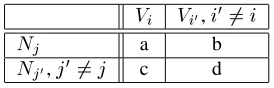
Before using the generated rules to extract qualia pairs from our corpus, we must ensure that these rules have been correctly learnt, that is, our ILP parameters have been cor-rectly set. One of the most important of these parameters is noise, that is, the number of negative examples allowed to be covered by the learnt rules. Indeed, as explained in section 2., handling noisy data is essential for our learn-ing process as for any corpus-based NLP works. There-fore, different values for the noise parameter are tested and their effects are evaluated. The results of the successive ex-periments (recall and precision rate of the rules, learning time) are compared using a single performance measure, the Pearson coefficient:
!
#"!"
where A =actual, Pr =predicated, P =positive, N = nega-tive, T =true, F =false; a value close to 1 indicates a good learning.
In order to precisely estimate these different character-istics of the learning stage, we perform a 10-fold cross-validation (Kohavi, 1995). We split up therefore the initial set of 3,099 positive examples and 3,176 negative ones into ten subsets. Each subset is alternatively used as testing set while the nine others are used to train the ILP algorithm.
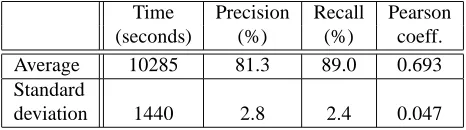
The computing time2, precision, recall and Pearson coef-ficient averages and standard deviations obtained through these ten learning experiments for the best noise rate (i.e., maximizing the Pearson coefficient) are summarized into table 1.
Time Precision Recall Pearson
(seconds) (%) (%) coeff.
Average 10285 81.3 89.0 0.693
Standard
deviation 1440 2.8 2.4 0.047
Table 1: Cross-validation results
A final learning experiment is then conducted with the entire set of examples as training set. A total of nine rules is obtained (see section 4.2. for a detailed presentation of these rules).
3.2. Empirical validation
Beside the theoretical validation described above which only aims at evaluating the learning step performances, we want to know how a system built upon those learnt rules performs in our qualia-pair extraction task. We therefore construct a real-condition test set and compare our ILP-based system results with experts’ ones on this set.
3.2.1. Empirical test set construction
The test corpus on which the qualia-pair extraction test is performed is a subset of about 32,000 words of the MATRA-CCRcorpus. Despite this relative small size, exam-ining every N-V pair in this subset to see if it is a qualia or non-qualia pair is impossible. We have therefore focused our attention on seven domain relevant nouns: vis, ´ecrou, porte, voyant, prise, capot, bouchon (screw, nut, door, in-dicator signal, plug, cowl, cap). None of these common nouns has been used either as part of a positive or negative N-V pair examples during the learning process.
A Perl program retrieves all N-V pair occurrences in-cluding one of the seven studied common nouns and any verb occurring in the same sentence. Then, four GL ex-perts manually tag each pair as relevant or not relevan-t. Divergences are discussed until complete agreement is reached. Finally, 286 different pairs containing one of the seven nouns are found, 66 of which are qualia pairs.
3.2.2. Empirical validation results
The learnt rules produced by our ILP learning method are applied to the sub-corpus. That is, each N-V pair containing one of the seven test nouns and any verb co-occurring with it within a sentence is tested to see whether it is accepted by one of the learnt rules.
We can decide to consider a N-V pair as relevant if$ occurrences of this pair are detected in the test corpus by the learnt rules, that is, if the context of the$ occurrences correspond to the general patterns defined by the rules. Of course, if$ is high, the precision rate is higher than if$ is
2Experiments were conducted on a 966MHz PC running
recall precision F-measure Pearson
(%) (%) coeff.
*,+.- 36.4 70.6 0.48 0.414
=?>A@B!#CD! 42.4 82.4 0.56 0.517
JLK 51.5 40 0.45 0.261
JLKDQ 36.4 92.3 0.522 0.52
JS 36.4 70.6 0.48 0.414
W
1
37.9 78.1 0.51 0.464
-NMPOd-`!edf 42.4 80 0.554 0.505
p JS 100 25.3 0.385 0.17
t+.-Nf 53 41.2 0.464 0.279
w
1
51.5 47.9 0.496 0.338
Table 4: Statistical method results
and the statistical-based method results can be easily ex-plained by the differences of knowledge used by these t-wo kinds of techniques. Indeed, while statistical model-s only umodel-se word lemma occurrencemodel-s, our inductive learn-ing process makes the most of categorial and semantic tags but also needs (positive and negatives) examples which is a way to implicitly add linguistic knowledge to the extraction system. Nevertheless, this comparison remains interesting from a pragmatic point of view, more particularly in the balance between the choice of a supervised or unsupervised method and the resulting performances.
3.3.2. Syntactic linkedness
We have also compared our qualia extraction system with an entirely manual approach: a syntactic annotation of the studied text. Each N-V pair occurring within a sen-tence of the corpus is tagged as syntactically linked (that is, the noun is subject or object of the verb) or not. The under-lying idea of this method is to say that a frequent syntactic link between a noun and a verb in a text may indicate a se-mantic link between this noun and this verb, for example a qualia link.
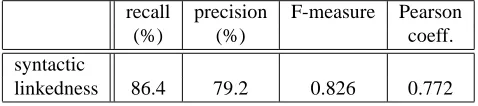
Therefore, a N-V pair is considered qualia if more than a certain number of its occurrences are detected syntactical-ly linked. This threshold, as for the ILP-based and statisti-cal methods, is chosen to maximize the Pearson coefficient; the value found is 1. Table 5 gives the performances of such a system for our test set.
recall precision F-measure Pearson
(%) (%) coeff.
syntactic
linkedness 86.4 79.2 0.826 0.772
Table 5: Syntactic linkedness method results
These results indicate a slightly lower recall rate but a better precision rate than our ILP-based method. This would tend to show that a qualia link is more than a ba-sic syntactic link, but also that our ILP-based method could improve its results, especially its precision rate, by consid-ering syntactic information. However, automatic syntactic annotation remains too noisy to be used without human
su-pervision, and a manual annotation cannot be foreseen for a huge amount of texts. Here again, one should choose be-tween high quality results and automatic or quasi-automatic extraction methods, accordingly with one’s goals.
A comparison between the N-V pairs retrieved by this approach and our inductive learning approach is made in section 4.1..
4.
Linguistic evaluation of the results
This section is devoted to a linguistically orientated dis-cussion of the different results presented above. More pre-cisely, we first examine the causes of undetected or mis-detected qualia N-V pairs during the empirical test of our extraction system. Secondly, we focus our attention on the rules learnt by the ILP learning method, examine the pat-terns they describe and compare them with observations made manually on the same corpus.4.1. Retrieved N-V pairs
The results of the ILP-based extraction from the test set are quite promising. On one side, our system detect-s modetect-st of the qualia N-V coupledetect-s. The five non-detected pairs appear in very rare constructions in our test sub-corpus, like prise-relier (plug-connect) in la citerne est re-li´ee `a l’appareil par des prises (the tank is connected to the machine by plugs) where a prepositional phrase (PP) `a l’appareil (to the machine) is inserted between the ver-b and the par-PP (ver-by-PP). These are clearly too rare to ver-be taken into consideration by the learning method. On the other side, only 8 pairs from the 36 non-qualia pairs de-tected qualia are not linked syntactically. That means that the ILP algorithm can already reliably distinguish between syntactically and not syntactically linked pairs.
If we compare these results with those obtained by the different statistical methods, the conclusion is obvious: the main problem for statistical methods is silence (good quali-a pquali-airs thquali-at quali-are not retrieved) while the mquali-ain problem for the ILP algorithm is precision (non-qualia pairs that are retrieved). But here we should carefully distinguish be-tween two types of errors made by the ILP method. The first ones are caused by constructions that are ambiguous and where N and V can be or cannot be syntactically relat-ed, as enlever-prises (remove-plugs) in enlever les shunts sur les prises (remove the shunts from the plugs). These couples cannot be disambiguated by superficial contextual clues (that is, word tags) and thus show the limitation of learning only from POS and semantic information. How-ever they are very rare in our corpus (8 pairs). On the contrary, all remaining errors seem more related to the pa-rameter settings of the learning method. For example, tak-ing into consideration the number of nouns between the V and the N could avoid a lot of wrong pairs like poser-capot (put-up-cover) in poser les obturateurs capots (put up cov-er stopcocks) or assurcov-er-voyant (make sure-warning light) in s’assurer de l’allumage du voyant (make sure that the warning light is switched on).
4.2. Linguistic validation of the learnt rules
For a linguist, the issue is not only to find good exam-ples of qualia relations but also to identify in texts the lin-guistic patterns that are used to express them. Consequent-ly, the question is: what do the learnt clauses tell us about the linguistic structures that are likely to convey qualia re-lations between a noun and a verb? We know from previ-ous research (Morin, 1999) made on other types of seman-tic relations, that a given relation can be instantiated in a large variety of structures, and that this set of structures may greatly vary from one corpus to another. Such research gen-erally focuses on hyperonymy (is-a) and meronymy (part-of) relations, which provide the basic structure of ontolo-gies. Our aim is thus similar, with the additional difficulty that some of the relations we focus on (such as telic or agen-tive ones) have never been studied extensively on corpora, and are more difficult to identify than more conventional semantic relations.
We are thus faced with a set of nine clauses that we now try to interpret in terms of linguistic rules:
(1) is qualia(A,B) :- precedes(B,A), near verb(A,B), infini-tive(B), action verb(B).
(2) is qualia(A,B) :- contiguous(A,B).
(3) is qualia(A,B) :- precedes(B,A), near word(A,B), near verb(A,B), suc(B,C), preposition(C).
(4) is qualia(A,B) :- near word(A,B), pred(A,C), void(C).
(5) is qualia(A,B) :- precedes(B,A), suc(B,C), colon(C), pred(A,D), punctuation(D), singular common noun(A).
(6) is qualia(A,B) :- near word(A,B), suc(B,C), suc(C,D), action verb(D).
(7) is qualia(A,B) :- precedes(A,B), near word(A,B), pred(A,C), punctuation(C).
(8) is qualia(A,B) :- near verb(A,B), pred(B,C), pred(C,D), pred(D,E), preposition(E), pred(A,F), void(F).
(9) is qualia(A,B) :- precedes(A,B), near verb(A,B), pred(A,C), subordinating conjunction(C).
Predicates must be read as follows : precedes(X,Y)means that X occurs somewhere in a sentence before Y.pred(X,Y)
means that Y occurs immediately before X and converse-ly suc(Y,X) means that X occurs immediately after Y. n-ear word(X,Y)means that X and Y are separated by at least one word and at most 2 words, andnear verb(X,Y)that there is no verb between X and Y.
What is first striking is the fact that, at this level of gen-eralization, few linguistic features are retained. The clauses seem to provide very general indications and tell us very lit-tle about types of verbs (action verb is the only information we get), nouns (common noun) or prepositions that are like-ly to fit into such structures. But the clauses contain other information, related to several aspects of linguistic descrip-tions, like:
- proximity: this is a major criterion. Most clauses in-dicate that the noun and the verb must be either contiguous (clause 2) or separated by at most one element (clauses 3, 4, 6, 7) and that no verb must appear between N and V (clauses 1, 3, 8, 9).
- position: clauses 4 and 7 indicate that the one of the two elements is found at the beginning of a sentence or right
after a punctuation mark, whereas the relative position of N and V (precede/2) is given in clauses 1, 3, 5, 7, 9.
- punctuation: punctuation marks, and more specifically colons, are mentioned in clauses 5 and 7.
- morpho-syntactic categorization: the first clause de-tects a very important structure in the text, corresponding to action verbs in the infinitive form.
These features bring to light linguistic patterns that are very specific to the corpus—a text falling within the instruc-tional genre. We find in this text many examples in which a verb at the infinitive form occurs at the beginning of a proposition and is followed by a noun phrase. Such lists of instructions are very typical of the corpus:
–d´ebrancher la prise(disconnect the plug)
–enclencher le disjoncteur(engage the circuit breaker) –d´eposer les obturateurs(remove the obturators) To further evaluate these findings, we have compared what is obtained by the automatic learning process to lin-guistic observations made manually on the same corpus (Galy, 2000). Galy has listed a set of canonical verbal struc-tures that convey telic information:
– infinitive verb + det + noun (visser le bouchon) (to tight-en the cap)
– verb + det + noun (ferment le circuit ) (close the circuit) – noun + past participle (bouchon maintenu) (held cap) – noun + be + past participle (circuits sont raccord ´es) (circuits are connected)
– noun + verb (un bouchon obture) (a cap blocks up) – be + past participle + par + det + noun (sont obtur ´ees
par les bouchons) (are blocked up by caps)
The two types of results show some overlap: both ex-periments demonstrate the significance of infinitive struc-tures and bring to light patterns in which verb and noun are very close to each other. Yet the results are quite differ-ent since the learning method proposes a generalization of the structures discovered by Galy. In particular, the opposi-tion between passive and active construcopposi-tions is merged in clause 2 by the indication of mere contiguity (V can occur before or after N). Conversely, some clues have not been observed by manual analysis because they are related to levels of linguistic information that are usually neglected by linguistic observation (punctuation marks and position in the sentence).
Consequently, when we look at the results of the learn-ing process from a llearn-inguistic point of view, it appears that the clauses give very general surface clues about the struc-tures that are favored in the corpus for the expression of qualia relations. Yet, these clues are sufficient to give ac-cess to some corpus-specific patterns, which is a very inter-esting result.
5.
Conclusion and future work
co-occurrence extraction approaches on a test set:
– statistical models, entirely automatic, do not perform well enough to be used without enhancements or a posteri-ori human supervision;
– a manual syntactic annotation of the N-V pairs, gives high quality results but is too costly to be used on a big amount of texts.
In this respect, our symbolic learning approach is a good compromise, combining good results and a modest human intervention. Moreover, the rules generated by ILP provide interesting linguistic patterns to describe the qualia relation from a theoretical point of view.
As regards the symbolic learning approach, one nex-t snex-tep of nex-this work is nex-to repeanex-t nex-the experimennex-t on new cor-pora and other languages in order to help to identify specif-ic structures carrying qualia relations. Another future work is to apply similar methods to extract other kinds of co-occurrences and more generally to any information extrac-tion task.
Concerning the qualia N-V pairs, future studies will be undertaken to use them to reformulate or extend indexes in a real information retrieval system such as a textual search engine.
6.
References
Susan Armstrong, Pierrette Bouillon, and Gilbert Robert. 1995. Tagger Overview. Technical report, ISSCO. Susan Armstrong. 1996. Multext: Multilingual Text Tools
and Corpora. In H. Feldweg and W. Hinrichs, editors, Lexikon und Text. T¨ubingen: Niemeyer.
Pierrette Bouillon, Sabine Lehmann, Sandra Manzi, and Dominique Petitpierre. 1998. D´eveloppement de lex-iques `a grande ´echelle. In Proceedings of colloque de Tunis 1997 “La m´emoire des mots”, Tunis, Tunisie. Pierrette Bouillon, Robert H. Baud, Gilbert Robert, and
Patrick Ruch. 2000. Indexing by Statistical Tagging. In Proceedings of Journ´ees d’Analyse statistique des Don-n´ees Textuelles, JADT2000, Lausanne, Switzerland. Pierrette Bouillon, Vincent Claveau, C´ecile Fabre, and
Pas-cale S´ebillot. 2001. Using Part-of-Speech and Seman-tic Tagging for the Corpus-Based Learning of Qualia Structure Elements. In Proceedings of First Internation-al Workshop on Generative Approaches to the Lexicon, GL’2001, Gen`eve, Suisse.
Kenneth W. Church and William A. Gale. 1991. Concor-dances for parallel text. In Proceedings of the Seventh Annual Conference of the UW Centre for the New OED and Text Research.
B´eatrice Daille. 1994. Approche mixte pour l’extraction de terminologie : statistique lexicale et filtres linguistiques. Ph.D. thesis, Universit´e Paris 7.
Ted E. Dunning. 1993. Accurate methods for the statistics of surprise and coincidence. Computational Linguistics, 19(1):61–74.
C´ecile Fabre and Pascale S´ebillot. 1999. Semantic Inter-pretation of Binominal Sequences and Information Re-trieval. In Proceedings of International ICSC Congress on Computational Intelligence: Methods and Applica-tions,CIMA’99, Symposium on Advances in Intelligent Data Analysis AIDA’99, Rochester, N.Y., USA.
Christiane Fellbaum, editor. 1998. WordNet: An Electronic Lexical Database. MIT Press, Cambridge, MA.
Edith Galy. 2000. Rep´erer en corpus les associations s´emantiques privil´egi´ees entre le nom et le verbe : le cas de la fonction d´enot´ee par le nom. Master’s thesis, Universit´e de Toulouse - Le Mirail.
Gregory Grefenstette. 1997. SQLET: Short Query Lin-guistic Expansion Techniques, Palliating One-Word Queries by Providing Intermediate Structure to Text. In McGill-University, editor, Proceedings of Recherche d’Informations Assist´ee par Ordinateur, RIAO’97, Mon-tr´eal, Qu´ebec, Canada.
Benoˆıt Habert, Adeline Nazarenko, and Andr´e Salem. 1997. Les linguistiques de corpus. Armand Collin/Mas-son, Paris.
Ron Kohavi. 1995. A Study of Cross-Validation and Boot-strap for Accuracy Estimation and Model Selection. In Proceedings of the 14th International Joint Conference on Artificial Intelligence, IJCAI 95, Montr´eal, Qu´ebec, Canada.
Emmanuel Morin. 1999. Extraction de liens s´emantiques entre termes `a partir de corpus de textes techniques. Ph.D. thesis, Universit´e de Nantes.
Stephen Muggleton and Luc De-Raedt. 1994. Inductive Logic Programming: Theory and Methods. Journal of Logic Programming, 19-20:629–679.
Dominique Petitpierre and Graham Russell. 1998. M-morph - the Multext Morphology Program. Technical report, ISSCO.
Ronan Pichon and Pascale S´ebillot. 1997. Acquisition au-tomatique d’informations lexicales `a partir de corpus : un bilan. Research report 3321, INRIA, Rennes. James Pustejovsky, Peter Anick, and Sabine Bergler.
1993. Lexical Semantic Techniques for Corpus Analy-sis. Computational Linguistics, 19(2):331–358.
James Pustejovsky, Branimir Boguraev, Marc Verhagen, Paul Buitelaar, and Michael Johnston. 1997. Semantic indexing and typed hyperlinking. In Proceedings of the American Association for Artifical Intelligence Confer-ence, Spring Symposium, NLP for WWW, 120-128. Stan-ford University, CA.
James Pustejovsky. 1995. The Generative Lexicon. Cam-bridge:MIT Press.
Laurence Vandenbroucke. 2000. Indexation automatique par couples nom-verbes pertinents, M´emoire de DES en information et documentation. Master’s thesis, Univer-sit´e Libre de Bruxelles.
Stefan Wermter, Ellen Riloff, and Gabriele Scheler, edi-tors. 1996. Connectionist, Statistical and Symbolic Ap-proaches to Learning for Natural Language Processing. Lecture Notes in Computer Science, Vol. 1040, Springer Verlag.