A Web-based Text Corpora Development System
Dan Bohus¸, Marian Boldea
“Politehnica” University of Timis¸oara Vasile Pˆarvan 2, 1900 Timis¸oara, Romania
fbd1206, [email protected] Abstract
One of the most important starting points for any NLP endeavor is the construction of text corpora of appropriate size and quality. This paper presents a web-based text corpora development system which focuses both on the size and the quality of these corpora. The quantitative problem is solved by using the Internet as a practically limitless source of texts. To ensure a certain quality, we enrich the text with relevant information, to be fit for further use, by treating in an integrated manner the problems of morpho-syntactic annotation, lexical ambiguity resolution, and diacritic characters restoration. Although at this moment it is targeted at texts in Romanian, the system can be adapted to other languages, provided that some appropriate auxiliary resources are available.
1.
System Overview
This paper presents a web-based text corpora develop-ment system which focuses on both their size and quality, built by adapting several existing tools to the necessities of the intended task and the peculiarities of the Romanian lan-guage, and by creating a couple of new ones.
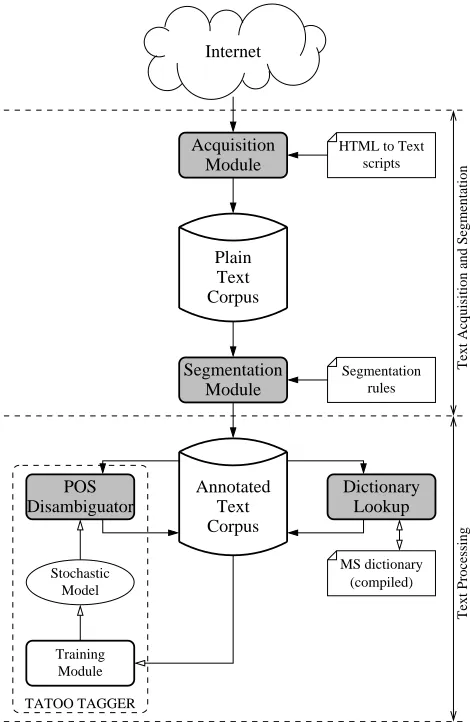
The structure of the system is illustrated in Figure 1. It is composed of four main modules, each of them acting se-quentially and performing some basic operation on the in-put text: acquisition, segmentation, dictionary lookup, and part-of-speech disambiguation. For an easier control, the modules are encapsulated by a graphical user interface built as a Tcl/Tk wrapper.
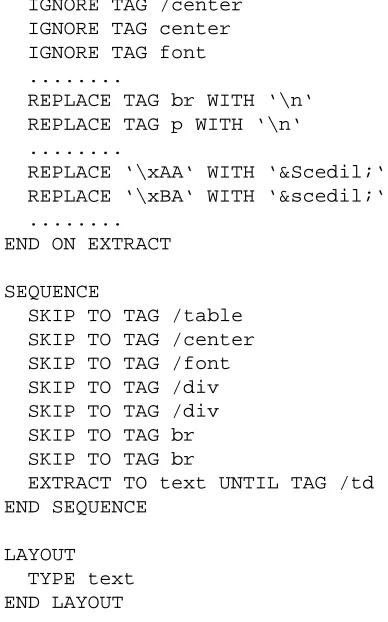
Since we use the Internet as a source of raw texts, the acquisition module performs text acquisition from both HTML and plain text files. A dedicated scripting language was developed to solve the problem of extracting the useful text from HTML files.
Next, the segmentation module translates the text into a stream of tokens, thus forming the Annotated Text Cor-pus. This module was built using the flex lexical analyzers generator (FSF-GNU, 2000a) , and support for dynamically extending the set of segmentation rules is included via the wrapper interface.
After segmentation, the dictionary lookup module iden-tifies the dictionary words from which every word token could have been obtained, each of them with its corre-sponding lemma and morpho-syntactic description. A fi-nite state automata software package (Daciuk, 1998) was used to compile the large scale morpho-syntactic dictionary (MSD) as a transducer, reducing the lookup time.
Furthermore, we use a probabilistic part-of-speech tag-ger to disambiguate between the different variants obtained for some word tokens from the dictionary lookup. For this purpose we adapted the ISSCO TATOO tagger (Robert, 1998) to the Romanian language.
The files in both the Plain Text Corpus and the An-notated Text Corpus are saved in SGML format, with ap-propriate annotations for each identified token. Attributes regarding each file (e.g. collection date, source, manual intervention flags) are also saved for corpus management purposes.
Plain Text Corpus
HTML to Text scripts
Segmentation Module
Segmentation rules
Stochastic Model
Training Module
Acquisition Module
Lookup Dictionary
Corpus Annotated
Text
TATOO TAGGER
Text Acquisition and Segmentation
Text Processing
MS dictionary (compiled)
POS Disambiguator
Internet
Figure 1: System overview
ated them, together with their corresponding lemmas and CTAGs.
Based on this information, the set of possible tags for eachWORDtoken is constructed and passed to TATOO for disambiguation: its output is then processed, and the most likely tags string, together with the associated words, are annotated as correct to the corresponding tokens.
In most cases, the disambiguation is complete and uniquely identifies the dictionary word that generated a
WORD token, thus solving the diacritics restoration prob-lem. For a small number of cases (see the Experiments sec-tion), the disambiguation is not complete, partly due to the reduced tagset we use: although the tagger decided upon a CTAG as being the most likely one, there are more dictio-nary words corresponding to that CTAG. Lexical ambigu-ity resolution is not complete for these words (they are still morpho-syntactically ambiguous), but the CTAG identifi-cation can be in some cases enough to solve the diacritics restoration problem. The remaining unsolved tokens are corrected by manual intervention, which can be easily per-formed from the Corpora Development Workbench.
4.
The Corpora Development Workbench
The described modules are all accessible within a sin-gle Corpora Development Workbench, which is a graph-ical user interface created using Tcl/Tk. The main ratio-nale behind it was to make the system accesible even to non-specialists, and to offer an efficient way of performing manual interventions and corrections in text corpora.
To create a friendly interface we used the Tix 4.1 widget library over the extended Tcl (TclX) scripting language, in conjunction with various shell scripts. The main window provides easy access to all modules and processing steps: text acquisition, segmentation, dictionary lookup, and POS tagging/disambiguation.
The Workbench allows parallel work on multiple cor-pora. For each corpus, a separate configuration is kept, in-dicating the various resources used throughout the different processing stages: the set of H2T scripts, the segmenta-tion rules, the dicsegmenta-tionary used for lookup, and the stochastic model used for tagging.
The acquisition is launched by specifying a few param-eters, such as source, type of text (plain text or HTML-formatted), H2T script to use, and target location. The task of writing HTML-to-text scripts is highly simplified by the H2T scripts editor – a framed window that allows a simul-taneous view of an HTML file, an acquisition script, and the result of applying the script on the HTML file.
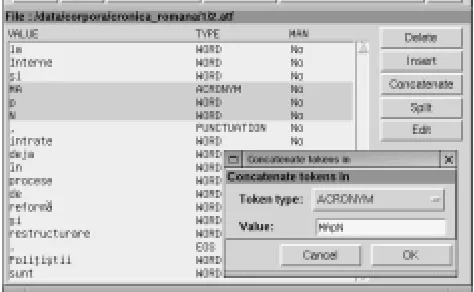
The Workbench includes support for refining and ex-tending the existent segmentation rules. The manual seg-mentation window, illustrated in Figure 3, provides an easy way for performing manual corrections. Once the user has selected a location to browse, the tokens in the file are dis-played as a list, with their corresponding type and manual intervention flag. By scrolling the contents of the file, the user can easily spot possible mistakes of the segmenter, and options such as inserting, removing, splitting, concatenat-ing, and directly editing a token, are available.
The dictionary lookup process is also controlled from the Workbench, dictionary management can be performed
Figure 3: Manual segmentation window
directly from the interface, and commands for automati-cally creating lists with the unknown words from the ATF files and adding them to the dictionary are included.
One of the primary goals in designing this integrated graphical interface was to provide an efficient way of per-forming manual interventions and corrections in the text corpora, which otherwise can be a time-consuming, error-prone operation.
Two issues had to be solved here: first, the user must be able to easily spot and manually tag the words that are still ambiguous after the automatic process; and secondly, the user must be able to correct possible mistakes of the tagger. To accommodate both these problems, we used an approach similar to the Penn Treebank standard of ”slash encoding”, together with highlighting certain categories of tokens.
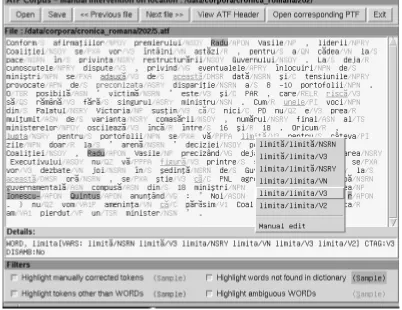
Figure 4 illustrates the manual intervention window. Depending on the task at hand, the user can activate various highlighting filters to spot the intended token categories. When moving the mouse cursor over the text, the token un-der the cursor is raised, and its attributes are displayed in the Details area. A right-click on a token opens a context-menu, from which the user can change the currently as-signed CTAG and dictionary word to another variant found in the look-up process, or to a manually specified word / CTAG.
This way, the words that are still ambiguous after the tagging process can be easily spotted and disambiguated, and the same applies to the words for which diacritics restoration did not succeed: by using different colors for text and tags, even with slash encoding, the text stays read-able, and the user can spot not only the words that are still ambiguous, but also the possible mistakes of the automatic diacritics restoration process.
“Cronica Romˆan˜a” “Dimineat¸a” “22” TOTAL
HTML files 3,350 3,234 794 7,378
Total size of HTML files (kB) 40,338 38,843 8,688 87,869
ACQUISITION time (hh:mm:ss) 18:15 21:50 9:27 49:32
Number of H2T scripts used 2 1 1 4
Empty PTF files after first extraction 602 0 3 605 PTF files successfully extracted 3,350 3,234 791 7375
PTF corpus size (kB) 8,580 18,414 8,189 35,185
SEGMENTATION time (hh:mm:ss) 8:13 5:39 1:42 15:34
Total number of tokens 1,262,213 3,179,274 1,492,513 5,934,000 Total number ofWORDtokens 1,055,540 2,651,233 1,247,196 4,953,969
WORDtokens percentage 83.6 % 83.4 % 83.6 % 83.5 %
LOOKUP time (hh:mm:ss) 14:17 16:40 6:30 37:27
Unknown words 61,225 128,837 82,209 272,271
Unknown words percentage 5.8 % 4.9 % 6.6 % 5.5 %
Words with one dictionary form 441,946 1,123,510 510,366 2,075,822 Words with one dictionary form (%) 41.9 % 42.4 % 40.9 % 41.9 % Words with multiple dictionary forms 552,369 1,398,886 654,621 2,605,876 Words with multiple dictionary forms (%) 52.3 % 52.7 % 52.5 % 52.6 % TAGGING time (hh:mm:ss) 38:37:19 41:58:37 19:40:25 100:16:21 ATF corpus size (kB) 220,555 555,767 256,523 1,023,846 Remaining ambiguous words 47,357 117,868 53,926 219,151 Remaining ambiguous words (%) 4.5 % 4.4 % 4.3 % 4.4 %
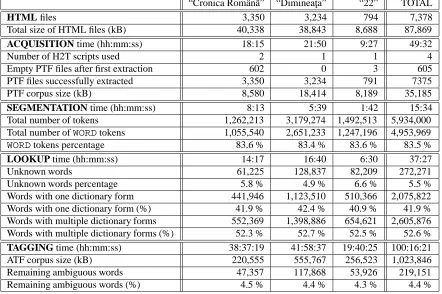
Table 1: Sample corpora development statistics
5.
Experiments
In this section we will detail some of our work in col-lecting and developing text corpora from web-sites. The ex-periments were performed on a Pentium II 333 MHz com-puter with 64 MB of RAM, running Red Hat Linux 5.2.
Three web-sites were selected for these experi-ments (Table 1): the first two, “Cronica Romˆan˜a” (domino.kappa.ro/e-media/cronica.nsf) and “Dimineat¸a” (domino.kappa.ro/e-media/dimineata.nsf), are daily Romanian newspaper-sites, while the other, “22” (www.dntb.ro/22/), is a weekly magazine-site, with slightly longer articles on various subjects, and all post archives with articles from past issues.
The first step was downloading the targeted archives: after quickly studying the structure of each site, shell scripts were written to download HTML files using wget (FSF-GNU, 2000b). As Table 1 shows, this operation resulted in 7,378 files, with a total size of about 87 Mbytes.
The next step was writing H2T acquisition scripts for these archives. For “Dimineat¸a” and “22” a single one was enough to extract the useful text from the HTML files: the number of extraction errors for “22” (Table 1) was very small compared to the total number of files, so we merely discarded the resulting empty PTF files. By contrast, for “Cronica Romˆan˜a” the acquisition resulted in 602 empty PTF files, and a second H2T script was written to cope with structural differences between the corresponding HTML files and the ones succesfully processed with the first. Text acquisition using this second H2T script resulted in no fur-ther errors.
Next, text segmentation and dictionary lookup were
per-formed, and the results on the three PTF corpora are pre-sented in the 3rd and 4th sections of Table 1.
The fourth and final operation was part-of-speech tag-ging. As the statistics illustrate, only about 4.4% of the
WORDtokens are still ambiguous after the tagging process, and this relatively small number of words are to be disam-biguated manually.
The time measurements show that text acquisition, seg-mentation and dictionary lookup have a tens of minutes or-der of magnitude, significantly faster than part-of-speech tagging, which took tens of hours for the given size of the processed corpora: leaving aside the manual work still nec-essary to verify and correct these corpora, in less than a week we obtained a quantity of texts large enough to e.g. start building language models for large vocabulary contin-uous speech recognition.
An anomaly can be noticed: while the number ofWORD
tokens in the “Dimineat¸a” PTF corpus is about twice and a half that in “Cronica Romˆan˜a”, the tagging times are quite close. This can be explained by the fact that new ambi-guity classes were encountered and added to the model while tagging the first corpus, thus increasing the tagging time: the number of ambiguity classes was initially 92 (the ones corresponding to CTAGs after training with Orwell’s “1984”), and rose to 511 after tagging “Cronica Romˆan˜a”. By contrast, only 13 new ambiguity classes were encoun-tered when tagging “Dimineat¸a”.
Figure 4: Manual intervention window (tagging/diacritics restoration)
6.
Conclusion
In this paper we have presented our work so far on cre-ating a web-based text corpora development system by in-tegrating several existing tools with a couple of new ones, together with the first experiments on using it.
The manual verification and correction of the resulting corpora, necessary for a detailed performance evaluation, is still under way, but a preliminary statistic analysis of sys-tem’s behavior demonstrates its efficiency as a means to quickly collect and process significantly large text corpora. Although the system is targeted at Romanian, it can be adapted to other languages, given a couple of appropriate resources: a large-scale morpho-syntactic dictionary, and a pre-tagged text corpus.
Besides improvements of various modules, future work will concentrate on thorough performance evaluations.
7.
References
Armstrong, S., G. Robert, and P. Bouillon, 1996. Building a Language Model for POS Tagging (unpublished). Daciuk, J., 1998. Incremental Construction of Finite-State
Automata and Transducers, and their Use in Natural Language Processing. Ph.D. Thesis, Technical
Univer-sity of Gda´nsk, Poland.
FSF-GNU, 2000a. http://www.gnu.org/software/flex/. FSF-GNU, 2000b. http://www.gnu.org/software/wget/. Mohri, M., 1996. On Some Applications of Finite-State
Automata Theory to Natural Language Processing.
Nat-ural Language Engineering, (2):1–20.
Robert, G., 1998. TATOO: ISSCO TAgger TOOl. http://issco-www.unige.ch/staff/robert/tatoo/.
Scheytt, P., P. Geutner, and A. Waibel, 1998. Serbo-Croatian LVCSR on the Dictation and Broadcast News Domain. In Proceedings ICASSP’98.
Tufis¸, D., 1999. Tiered Tagging and Combined Language Models Classifiers. In F. Jelinek and E. N¨oth (eds.), Text,
Speech and Dialogue, volume 1692 of Lecture Notes in Artificial Intelligence. Springer.
Tufis¸, D. and A. Chit¸u, 1999. Automatic Diacritics Inser-tion in Romanian Texts. In Proceedings InternaInser-tional
Conference on Computational Lexicography - COM-PLEX’99. Pecs, Hungary.
Tufis¸, D., N. Ide, and T. Erjavec, 1998. Standardized Specifications, Development and Assessment of Large Morpho-Lexical Resources for Six Central and East-ern European Languages. In Proceedings First LREC. Granada, Spain.