Ordering adverbs by their scaling effect on adjective intensity
Josef Ruppenhofer∗, Jasper Brandes∗, Petra Steiner∗, Michael Wiegand†
∗Hildesheim University
Hildesheim, Germany
{ruppenho|brandesj|steinerp}@uni-hildesheim.de
†Saarland University
Saarbr¨ucken, Germany
Abstract
In recent years, theoretical and computa-tional linguistics has paid much attention to linguistic items that form scales. In NLP, much research has focused on order-ing adjectives by intensity (tiny<small). Here, we address the task of automatically ordering English adverbs by their intensi-fying or diminishing effect on adjectives
(e.g.extremelysmall<verysmall).
We experiment with 4 different methods: 1) using the association strength be-tween adverbs and adjectives; 2)
exploit-ing scalar patterns (such asnot only X but
Y); 3) using the metadata of product
re-views; 4) clustering. The method that per-forms best is based on the use of metadata and ranks adverbs by their scaling factor relative to unmodified adjectives.
1 Introduction
Being able to recognize the intensity associ-ated with scalar expressions is a basic capability needed for tackling any NLP task that can be re-duced to textual entailment. For instance, as il-lustrated by de Marneffe et al. (2010), when
inter-preting dialogue (A:Was it good? B:It was ok /
great / excellent.), a yes/no question involving a gradable predicate may require understanding the entailment relations between that predicate and another contained in the answer. Another applica-tion is within sentiment analysis, where assessing
the strength of subjective expressions (e.g. good
< great < excellent) is one of the central tasks besides subjectivity detection and polarity classi-fication (Rill et al., 2012b; Sheinman et al., 2013; de Melo and Bansal, 2013; Ruppenhofer et al.,
2014,inter alia). It is also well known that
sub-jective adsub-jectives are frequently modified by
ad-verbs that increase (veryexpensive) or decrease
(fairlyexpensive) their intensity. As Benamara et al. (2007) have shown, it is useful to take such adverbial intensification into account when pre-dicting document-level sentiment scores. How-ever, Benamara et al. (2007) used human-assigned scores to model adverbs’ effect on adjectives.
As far as we know, there is no well-established automatic method that can determine for degree adverbs what their effect will be on the intensity of various adjectives. In this paper, we explore sev-eral methods on English data that might be used towards that purpose, evaluating them against a new gold standard data set that we collected. All new resources that were created in the context of our investigation will be made publicly available.
The remainder of this paper is structured as fol-lows. We present our data in §2. We describe the construction of our gold standard in §3 and the methods we use in §4. This is followed by the presentation of our experiments and results in §5. We discuss related work in §6 and conclude in §7.
2 Data
For our experiments we use two large corpora (Ta-ble 1). The first is a large set of Amazon reviews, which consist of numerical star ratings and textual assessments. Since both express the writers’ eval-uation, they are strongly correlated. Accordingly, we project the numerical star ratings onto the ad-jectives and adverbs in the texts as intensity scores
(cf. §4.2). Second, we also use the ukWaC
web-corpus, which is even larger than the review cor-pus, as general language data on which we
com-pute association measures (cf. §4.1) and which we
mine for linguistic patterns (cf.§4.3,§4.4).
Corpora Tokens Reference
Amazon reviews ∼1.06 B Jindal and Liu (2008)
ukWaC ∼2.25 B Baroni et al. (2009)
Figure 1: Dendrogram for the 14 adverbs from the survey. Indices show Paradis’ (1997) classes.
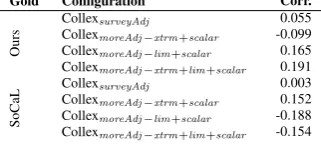
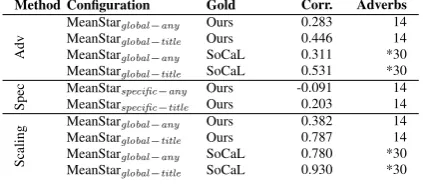
observed. Somewhat surprisingly, the methods that are more directly grounded in linguistic the-ory performed worse (collostructional analysis) or proved unusable (Horn patterns). One possible reasons for the inferior Collex and clustering re-sults may be that the relation between adverbs and adjectives is asymmetric to begin with, and easier to exploit in one direction than the other. Another is that the 5-way classification of adverbs and the assumptions about their common interaction with three types of adjectives cannot readily be ex-tended beyond the set of well-known and highly
grammaticized degree adverbs such asvery, quite,
absolutely to the much larger set of less
gram-maticized cases such as mind-bogglinglyor
blis-teringly. The metadata approach, notably makes no assumptions about adverb or adjective classes.
6 Related work
Benamara et al. (2007) show the usefulness of tak-ing adverbial intensification of adjectives into ac-count when predicting document-level sentiment scores for news articles and blog posts. They di-vide adverbs into 5 classes based on the work of Quirk et al. (1985) and Bolinger (1972). The vari-ous scoring functions they explore for the adverb-adjective combinations are sensitive both to an verb’s class and to its score. The score of an ad-verb could lie between 0 and 1, with 0 meaning that the adverb has no impact on an adjective and 1 signifying that the adverb pushes the score of the combination to the minimum or maximum of the [-1,+1] scale. However, Benamara et al. (2007) lack an automatic way of scoring adverbs and rely on scores gathered from annotators.
Rill et al. (2012a) present a method for gather-ing opinion-beargather-ing words and phrases, includgather-ing adjective-phrases, from Amazon review data and assigning polarity scores on a continuous range between -1 and +1 to the entries based on the star ratings associated with the reviews. In subsequent work, Rill et al. (2012b) mention ways to infer the scores of unobserved adverb-adjective combina-tions based on observed combinacombina-tions involving other, similar adjectives. However, the authors do not implement and evaluate these ideas.
Finally, a great deal of research on intensity has focused on acquiring prior polarity scores for individual words, and specifically adjectives. Various methods have been explored, including phrasal patterns (Sheinman et al., 2013; de Melo and Bansal, 2013); the use of star ratings (Rill et al., 2012b); extracting knowledge from lexical re-sources Gatti and Guerini (2012); and collostruc-tional analysis (Ruppenhofer et al., 2014).
7 Conclusion
Maite Taboada, Julian Brooke, Milan Tofiloski, Kim-berly Voll, and Manfred Stede. 2011. Lexicon-Based Methods for Sentiment Analysis. Computa-tional Linguistics, 37(2):267–307.
Mike Thelwall, Kevan Buckley, Georgios Paltoglou, and Di Cai. 2010. Sentiment Strength Detec-tion in Short Informal Text. Journal of the Amer-ican Society for Information Science and Technol-ogy, 61(12):2544–2558.
Joe H Ward. 1963. Hierarchical grouping to optimize an objective function. Journal of the American sta-tistical association, 58(301):236–244.
Theresa Wilson, Janyce Wiebe, and Paul Hoffmann. 2005. Recognizing Contextual Polarity in Phrase-level Sentiment Analysis. In Proceedings of the Conference on Human Language Technology and Empirical Methods in Natural Language
Process-ing (HLT/EMNLP), pages 347–354, Vancouver, BC,