Capturing Anomalies in the Choice of Content Words
in Compositional Distributional Semantic Space
Ekaterina Kochmar Computer Laboratory University of Cambridge
Ted Briscoe Computer Laboratory University of Cambridge
Abstract
In this work, we present a new task for testing compositional distributional se-mantic models. Recently, there has been a spate of research into how distributional representations of individual words can be combined to represent the meaning of phrases. Vecchiet al.(2011) have shown that some compositional models, includ-ing the additive and multiplicative mod-els of Mitchell and Lapata (2008; 2010) and the linear map-based model of Baroni and Zamparelli (2010), can be applied to detect semantically anomalous adjective– noun combinations. We extend their ex-periments and apply these models to the combinations extracted from texts written by learners of English.
Our work contributes to the field of com-positional distributional semantics by in-troducing a new test paradigm for seman-tic models and shows how these models can be used for error detection in language learners’ content word combinations.
1 Introduction
Vector-based (distributional) models are widely used for representing the meaning of single words. They rely on the assumption that word meaning can be learned from the linguistic environment and can be approximated by a word’sdistribution
across contexts. Words are represented as vectors in a high-dimensional space, with vector dimen-sions encoding word co-occurrence with contex-tual elements – other words within a local win-dow, words linked by specific dependencies to the target word, and so forth. Distributional models provide a clear basis for interpreting word mean-ing, as well as a simple means for measuring se-mantic similarity. These properties have been ex-ploited in many NLP tasks, including automatic
thesaurus extraction (Grefenstette, 1994), word sense induction (Sch¨utze, 1998) and disambigua-tion (McCarthy et al., 2004), collocadisambigua-tion extrac-tion (Schone and Jurafsky, 2001) and others.
In contrast to single words, the distribution of phrases cannot be used as a reliable approxima-tion of their meaning, as phrase vectors are much sparser. Irrespective of the size of the corpus con-sidered, some content word combinations will re-main unattested as a consequence of their Zipf-like distributions. For example, Vecchi et al. (2011) have shown that both semantically acceptable and semantically deviant word combinations will be absent from large English corpora. A promising alternative is to usecompositional models which combine distributional vectors for the component words in some way, for example, using a di-rect vector combination function (Kintsch, 2001; Mitchell and Lapata, 2008; Erk and Pad´o, 2008; Thater et al., 2010) or linear transformations on vectors (Baroni and Zamparelli, 2010).
In spite of the spate of recent work in this area, the question of how to combine word representa-tions is far from answered. Compositional mod-els can be assessed by their ability both to provide a solid theoretical basis for meaning composition and to represent composite meaning for relevant practical tasks. Promising results have been shown with such models on similarity detection and para-phrase ranking (Mitchell and Lapata, 2008; Erk and Pad´o, 2008; Thater et al., 2010), adjective– noun vector prediction (Baroni and Zamparelli, 2010) and semantic anomaly detection (Vecchi et al., 2011). Of these tasks, the latter appears to be particularly challenging since it addresses the abil-ity of compositional models to account for linguis-tic productivity.
No corpus can effectively sample all possi-ble content word combinations. On the other hand, some corpus-attested word combinations may appear semantically deviant when considered
out of context (for example, when they are used metaphorically). Vecchiet al.(2011) have focused on unattested adjective–noun (AN) combinations and noted that if a combination does not occur in a corpus, it may be due to various reasons including data sparsity as well as nonsensicality. The task of distinguishing between the two cases is challeng-ing. Vecchiet al.use the following examples:
(1) a.blue rose
b.residential steak
Whereas both may well be unattested in a cor-pus, the concept ofblue roseis perfectly conceiv-able while that ofresidential steakis nonsensical and only interpretable in specifically-constructed discourse contexts. Vecchiet al. argue that there should be a detectable difference between the model-generated representations for the semanti-cally deviant combinations and those for the ac-ceptable ones, and assess compositional models by their ability to capture this difference. Vecchi
et al. have created a set of corpus-unattested AN combinations, annotated them as semantically ac-ceptable or deviant, and applied theadditive (add)
andmultiplicative (mult) models of Mitchell and Lapata (2008) and adjective-specific linear maps (alm)of Baroni and Zamparelli (2010).
Given that promising results have been obtained in their experiments, we propose that a useful ex-tension of this task is to test the compositional models on errors in content word combinations ex-tracted from texts written by learners of English. This task provides a natural setting for testing se-mantic models on genuine examples and is a po-tential practical application for such models.
Language learners’ errors are diverse, but many of them can naturally be explained in terms of non-productive, semantically anomalous combination of content words (Leacock et al., 2010). Learn-ers may lack robust intuitions about words’ selec-tional preferences and subtle differences in mean-ing, so they may confuse near-synonyms, overuse words with broad meaning, and otherwise choose words inappropriately. Consider the following ex-amples extracted from our data:
(2) a.∗big importancevsgreat importance
b.∗economical crisisvseconomic crisis
c.∗deep regardsvskind regards
d.best momentvsbest time
These examples illustrate that learner errors can often be explained by confusions stemming from
similar meaning (2a) or form (2b). When a word combination appears to be nonsensical as in 2c, the words chosen might still be related to the ap-propriate ones in the learner’s mental lexicon. We recognise that although error detection in learn-ers’ content word combinations is a natural exten-sion to semantic anomaly detection, it also poses additional difficulties that semantic models might not be able to deal with. For example, some erro-neous word combinations may not be completely devoid of compositional meaning, while violating language conventions. However, semantic models might still be able to capture some of these con-ventions. Another challenge is that some expres-sions cannot be unambiguously classified as either correct or incorrect, as their interpretation depends on the context of use: best moment(2d) is appro-priate when used to denote a short period of time, but it is often incorrectly used by learners instead ofbest time.
To make our work comparable with previous work on semantic anomaly, we investigate AN combinations extracted from texts written by non-native speakers of English, and apply theadd,mult
and alm models of semantic composition. The main contributions of this work are to show that error detection in content word combinations pro-vides a natural testbed and useful application for the compositional distributional models, and that the results obtained on this task provide a more natural estimate of the models’ performance than ones based on artificially constructed examples. If the compositional distributional models can distin-guish between correct and incorrect content word combinations, these models can then be used for writing or pedagogical assistance. To the best of our knowledge, this is the first attempt to handle learner errors in the choice of content words using compositional distributional semantics.
Plan of the paper. We overview related work on error detection and discuss the three models of semantic composition in Section 2. Section 3 presents the data and experimental setup. We dis-cuss the results of our experiments in Section 4 and conclude in Section 5.
2 Related Work
2.1 Error Detection in Content Words
2012). Such errors are more frequent, but they are also more systematic which makes them easier to detect. Function words constitute a closed class, so the set of possible corrections is also limited. By comparison, errors in content word combina-tions pose a bigger challenge. Since content words primarily express meaning rather than encode syn-tax, detection and correction of such errors depend on a system’s ability, in the limit, to recognise the communicative intent of the writer. Moreover, the set of possible corrections is much larger than for function words.
Previous work has either focused on correc-tion alone assuming that errors are already de-tected (Liu et al., 2009; Dahlmeier and Ng, 2011), or has reformulated the task as writing improve-ment (Shei and Pain, 2000; Wible et al., 2003; Chang et al., 2008; Futagi et al., 2008; Park et al., 2008; Yi et al., 2008). In the former case error de-tection, which is a difficult task in itself, is not ad-dressed, while in the latter case it is integrated into that of suggesting alternatives according to some metric (for example, frequency or mutual informa-tion). In some cases, a database of typical errors in word combinations is collected from learner texts and suggestions are only made for these error-prone combinations. Otherwise suggestions will be made for many acceptable phrases.
In this work, we treat error detection in the choice of content words as an independent task and assess the ability of compositional distribu-tional models to discriminate incorrect from cor-rect AN combinations – a frequent source of error in learner texts.
2.2 Composition by Component-wise Operations
In the additive and multiplicative compositional models of Mitchell and Lapata (2008; 2010), the components of the composite vector are obtained by component-wise operations applied to the word vectors. If cis a word combination vector anda andbare word vectors, thenc’si-th component is the sum of thei-th components ofaandbfor the
addmodel:
ci =ai+bi (1)
and the product of the corresponding compo-nents for themultmodel:
ci =aibi (2)
An advantage of using these models is that they provide a clear and simple interpretation of vector composition, requiring no training or tuning. They have also been shown to be promising models of composition in a number of NLP tasks, including semantic anomaly detection (Vecchi et al., 2011). However, the principal weakness of these models is that they use commutative operations, and there-fore fail to represent the difference in the gram-matical function of the component words, their or-der, and “headedness”. For example, these mod-els would produce the same composite vectors for
component vectorandvector component.
In addition, the add model does not take “in-compatibility” of constituent vectors along indi-vidual dimensions into account. If one vector has a high value in its i-th dimension while another vector has0, the composed vector will receive the high value from the first input vector, even though, intuitively, this dimension should get0 or near-0
value. This problem does not arise with themult
model. On the other hand, themultmodel is heav-ily biased towards dimensions with high values in both input vectors (Baroni et al., 2012).
2.3 Distributional Functions and Linear Maps
The adjective-specific linear maps of Baroni and Zamparelli (2010) take the grammatical functions of the words within a combination into account. Focusing on AN combinations, they try to model the fact that adjectives modify nouns and the re-sulting combination is nominal. They note that the meaning of nouns can be represented with their distributional vectors, but the meaning of attribu-tive adjecattribu-tives cannot be fully captured by their distribution alone: for example,newinnew friend
is not the same asnewinnew shoes. The meaning of the adjective new is defined through its appli-cation to the denotations of the nouns. Therefore, Baroni and Zamparelli (2010) suggest treating ad-jectives as distributional functions that map be-tween semantic vectors representing nouns to ones representing AN combinations.
Within this approach, adjectives are represented with weight matrices. The composition is defined by matrix-by-vector multiplication as follows:
f(noun) =def F×a=b (3)
noun vectorato the output AN vectorb. Theij-th cell of the matrix contains the weight determining how much the component corresponding to thej -th context element in -the noun vector contributes to the value assigned to thei-th context element in the AN vector (Baroni et al., 2012). These weights are estimated separately for each adjective from all corpus-observed noun–AN vector pairs using (multivariate) partial least squares regression.
3 Experimental Setup
3.1 Test Data
We have extracted a set of AN combinations from the publicly available CLC-FCE dataset (Yan-nakoudakis et al., 2011), a subset of the Cam-bridge Learner Corpus (CLC),1 which is a large corpus of texts produced by English language learners sitting Cambridge Assessment’s examina-tions.2
These texts have been manually error-coded (Nicholls, 2003). Using the error an-notation, we have divided extracted ANs into two subsets – correctly used ANs and those that are annotated with error codes due to inappropriate choice of an adjective or/and noun.3 For the ANs that are used correctly in some contexts and incorrectly in others we use the most frequent annotation from the data.
Our test set contains 4681 correct and 530 in-correct combinations. In contrast to Vecchi et al. (2011), who have used a limited set of con-stituent adjectives and nouns and an approxi-mately equal number of semantically acceptable and deviant combinations, our test set is more skewed towards correct combinations and consists of a wider range of constituent words. It also in-cludes ANs occurring in the BNC4 – 3294 of the correct test ANs and 256 of the incorrect ones are corpus-attested. The set of corpus-attested ANs annotated as incorrect in our data includes low-frequency combinations from the BNC, as well as combinations whose error-annotation depends on context. We believe that this test set reflects prac-tical applications of semantic anomaly detection more closely.5
1
http://www.cup.cam.ac.uk/gb/elt/catalogue/subject/custom/ item3646603/Cambridge-International-Corpus-Cambridge-Learner-Corpus/
2http://www.cambridgeenglish.org 3
The corresponding error codes areRJandRN.
4
http://www.natcorp.ox.ac.uk/
5The examples extracted for our experiments are publicly
3.2 Semantic Space Construction
In constructing thesemantic spacewe follow the procedure outlined in Vecchi et al. (2011). We populate the semantic space with a large number of distributional vectors for the target elements
– constituent nouns and adjectives from the test ANs, and the most frequent nouns and adjectives from a corpus of English as well as AN combina-tions of these words. To estimate the frequency rankings, we use a concatenation of two well-formed English corpora – the 100M word BNC and the Web-derived 2B word ukWaC corpus.6
The semantic space is represented by a matrix encoding word co-occurrences, with the rows resenting the target elements and the columns rep-resenting a set of 10K context words consisting of 6,590 nouns, 1,550 adjectives and 1,860 verbs most frequent in the combined corpus. The ij -th cell of -the original matrix contains a sentence-internal co-occurrence count of the i-th target element with the j-th context word. The raw sentence-internal co-occurrence counts from the original matrix have been transformed into Local Mutual Information scores (Baroni and Zampar-elli, 2010; Evert, 2005).
An interesting research question is how much data are needed to obtain reliable word co-occurrence counts. We estimate the word co-occurrence statistics using the BNC only, and leave it for future research to explore the impact of estimating them from larger corpora, for example, the ukWaC or the concatenated corpus mentioned above. We lemmatise, tag and parse the data with the RASP system (Briscoe et al., 2006; Andersen et al., 2008), and extract all statistics at the lemma level.
The target elements are selected as follows: we first select the 4K adjectives and 8K nouns which are most frequent in the concatenated corpus. In each case, we exclude the top 50 most frequent words since those may have too general meanings. Next, we extract the constituent adjectives and nouns from our test data and populate the semantic space with the words not yet contained in it. As a result, our semantic space contains 8,364 nouns.
Since we aim at investigating AN behaviour in a highly-populated semantic space, we add more AN combinations to that. We select 218 very fre-quent adjectives (occurring more than 100K but
available at http://www.cl.cam.ac.uk/˜ek358/.
less than 740K times) and merge them with the adjectives from the test ANs. We generate all possible AN combinations by crossing this com-bined set of adjectives and the set of 8,364 nouns. This results in a set of ANs of which 1,6M com-binations are corpus-attested. From these we ran-domly choose 62,205 ANs that occur more than 100 times in the corpus. As a result, we popu-late our semantic space with ANs with the num-ber of unique corpus-attested combinations per ad-jective ranging from 1 to 1,226 and being 84.52 on average. Since we apply our approach to real data, we cannot avoid having a different number of training examples for different adjectives. It is worth exploring how many training examples are needed for a single adjective, since some highly frequent adjectives may have more training exam-ples in the data, while some adjectives may require more training examples than others due to poly-semy or lack of strong selectional preferences.
Finally, we check our test set against the com-bined corpus and add 1,131 test ANs which are corpus-attested but not yet contained in the seman-tic space. Our final semanseman-tic space consists of 8,364 nouns, 4,353 adjectives and 63,336 corpus-attested ANs.
We perform all operations on vectors in the full semantic space, using a 76,053×10K matrix. We leave it for future research to perform dimension-ality reduction (for example, using Singular Value Decomposition) and to compare the results with the ones reported here.
3.3 Composition Methods
For theaddandmultmodels, the AN vectors are obtained by component-wise addition and mul-tiplication without normalisation. For the alm
model, the weight coefficients are estimated with multivariate partial least squares regression using the R pls package (Mevik and Wehrens, 2007), using the leave-one-out training regime. This model is computationally expensive since a sep-arate weight matrix must be learned for each ad-jective and since we use the non-reduced semantic space. Therefore, for the experiments presented here we limit the number of test adjectives to 38. The selected adjectives are, on the one hand, fre-quently misused by language learners, and, on the other, have a manageable number of training ex-amples. The reduced set of test ANs consists of 347 combinations.
The number of latent variables used by the train-ing algorithm depends on the number of avail-able noun–AN training pairs. We have gradually changed this number from 3 to 20 depending on the adjective and the number of available train-ing pairs with the aim of keeptrain-ing the independent-variable-to-training-item ratio stable. However, we have not optimised this number and leave it for future research.
3.4 Measures of Semantic Anomaly
Once the composite vectors are obtained, the next question is how to distinguish between the vectors for correct and anomalous combinations. Vecchi
et al. (2011) propose three simple measures for distinguishing between the two sets of vectors:
1. Vector Length (VLen): they hypothesise that vectors for anomalous ANs are shorter than those for acceptable ones. Since the distributional vectors encode word occur-rence, words that do not “match” semanti-cally should have their co-occurrence counts distributed differently along the dimensions, and their composition is expected to have many near-0 values.
2. Cosine with the Noun Vector (CosN): they hypothesise that in nonsensical ANs the meaning of the input nouns is degraded and their model-generated vectors are situated further away from the original noun vectors. For example, since abig dogis still adogand an*extensive dogis less clearly so, in the se-mantic space the vector forbig dogwould be closer to that ofdogthan the vector for *ex-tensive dogtodog. Semantically deviant ANs are expected to have lower cosine between their vectors and the original noun vectors.
3. Density of the AN Neighbourhood (Dens): it is hypothesised that deviant ANs will have fewer close neighbours and be more “iso-lated” in the semantic space. This is mea-sured by the average cosine with the top 10 nearest neighbours, which is assumed to be lower for anomalous ANs.
We hypothesise that some cues alternative to the ones already proposed may also be effective:
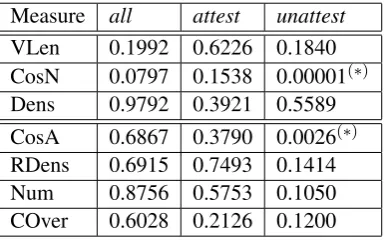
Measure all attest unattest
VLen 0.1992 0.6226 0.1840 CosN 0.0797 0.1538 0.00001(∗) Dens 0.9792 0.3921 0.5589
CosA 0.6867 0.3790 0.0026(∗) RDens 0.6915 0.7493 0.1414 Num 0.8756 0.5753 0.1050 COver 0.6028 0.2126 0.1200
Table 1:pvalues for theaddmodel
output combination equally, we also measure the distance to the original adjective vector.
2. Ranked Density (RDens): we define close proximity to the model-generated AN tor as the neighbourhood populated with tors for which the cosine to the AN vec-tor is higher than 0.8. Since the num-ber of close neighbours is different for dif-ferent ANs, we measure ranked density as
PN
i=1rankidistancei, whereN is the
num-ber of neighbours.
3. Number of Neighbours within Close Prox-imity (Num): the number of close neigh-bours itself can be used as a measure.
4. Component Overlap (COver): we assume that AN combinations, unless they are id-iomatic, are similar to the constituent words or combinations with the same constituents. The models can be assessed by their abil-ity to place the AN vector in the neighbour-hood populated by similar words and combi-nations. We measure this as the proportion of nearest neighbours containing same con-stituent words as in the tested ANs.
4 Results
We use the measures described above and com-pute the difference between the mean values for the correct and incorrect model-generated ANs. We apply the unpaired t-test, assuming a two-tailed distribution, to assess the statistical signif-icance of the difference between these values. In Tables 1 to 3 we reportpvalues estimating statis-tical significance at the 0.05 level, and statisstatis-tical significance is marked with an asterisk (∗).
We assume that there might be a difference be-tween the corpus-attested and corpus-unattested
Measure all attest unattest
VLen 0.0033(∗) 0.1549 0.0004(∗) CosN 0.0017(∗) 0.0182(∗) 0.0083(∗) Dens 0.3531 0.6656 0.2703
CosA 0.00002(∗) 0.0144(∗) 0.3352 RDens 0.0002(∗) 0.0300(∗) 0.0001(∗) Num 0.0001(∗) 0.0091(∗) 0.0001(∗) COver 0.0041(∗) 0.0096(∗) 0.7317
Table 2:pvalues for themultmodel
test ANs, with each of the subgroups being more homogeneous than the entire test set. Our corpus-unattested examples are more similar to the ANs considered by Vecchiet al.(2011). We report the results on the full set of test ANs, as well as on each of the two subgroups separately.
Our goals are to:
• comparatively evaluate performance of the three composition models;
• assess the appropriateness of the proposed metrics;
• investigate models’ performance on the corpus-attested and corpus-unattested combi-nations.
4.1 Comparative Performance of the Models
Of the three composition models, the multmodel (Table 2) shows the best results overall.
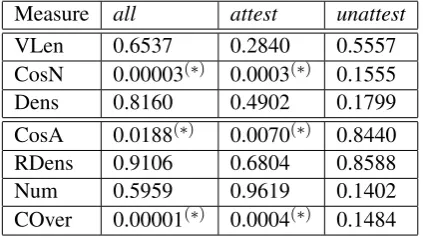
Thealmmodel (Table 3) shows statistically sig-nificant difference between the model-generated vectors for the correct and incorrect combina-tions with the cosines and component overlap, but it does not detect the difference on the corpus-unattested subset with any of the metrics.
Theaddmodel (Table 1) shows statistically sig-nificant differences only with the cosine measures on the corpus-unattested subset. The poor perfor-mance of this model may be due to its weaknesses outlined in Section 2.2. Also, Baroni and Zampar-elli (2010) note that normalisation may help im-proving its performance.
4.2 Appropriateness of the Metrics
Measure all attest unattest
VLen 0.6537 0.2840 0.5557 CosN 0.00003(∗) 0.0003(∗) 0.1555 Dens 0.8160 0.4902 0.1799
CosA 0.0188(∗) 0.0070(∗) 0.8440 RDens 0.9106 0.6804 0.8588 Num 0.5959 0.9619 0.1402 COver 0.00001(∗) 0.0004(∗) 0.1484
Table 3:pvalues for thealmmodel
AN bad intention ∗bad information
add bad, information,
badcompany, otherinformation,
badimage realinformation
mult uncomplicated, uncomplicated,
improbable, improbable,
suggestive humane
alm intention, people,
mainintention, blind people,
realintention like-minded
Table 4: Top3neighbours for each model
many of the combinations tested in our experi-ments are not genuinely anomalous, the fact that they are situated in densely populated semantic neighbourhoods is not surprising. Measures based on close proximity neighbourhood – RDens and Num – show statistical difference when applied to themult-generated vectors only.
With COver, the alm model, followed by the
mult model, produce sensible results. Table 4 shows the top 3 nearest neighbours found by the models for the correct AN bad intention and the incorrect∗bad information. The latter is annotated as incorrect since its meaning is quite vague and a possible correction is inaccurate information. Note that only the alm model is able to discrim-inate between the correct and the incorrect word combinations suggesting sensible nearest neigh-bours forbad intentionand less sensible ones for
*bad information.
4.3 Attested vs Unattested Combinations
Our results show that the models perform differ-ently on the two subsets and somewhat better on corpus-attested ANs. However, the results also confirm that appropriate models and metrics can be found to distinguish between correct and incor-rect ANs in both subsets.
5 Conclusion
In this paper we have introduced a new task on which compositional distributional semantic mod-els can be tested. Our results support the hypoth-esis that semantic models can be applied to detect errors in the choice of content words by English language learners. The original contribution of our paper is to show how compositional and distribu-tional semantics can be linked to error detection to provide a solution to a practical task.
Our results suggest that with the metrics con-sidered it is easier to detect the difference between the model-generated vectors for the correct and incorrect word combinations with the multiplica-tivemodel. On the other hand, qualitative analysis suggests that theadjective-specific linear mapsof Baroni and Zamparelli (2010) are superior, since they place the model-generated vectors in seman-tically sensible neighbourhoods.
We plan to investigate further whether the use of a bigger corpus for collecting word co-occurrence statistics provides more reliable counts, and whether dimensionality reduction and/or normal-isation of the models improves the results. We also plan to apply thealmmodel to a larger num-ber of examples. Some other models such as the ones by Erk and Pad´o (2008) and Thater et al.(2010) which take selectional preferences and context into account may yield better results on this task, and we plan to test this experimentally in the future. Finally, since these models can dis-criminate between correct and anomalous combi-nations, the next step is to incorporate them into an error detection classifier.
Acknowledgments
We are grateful to Cambridge ESOL, a divi-sion of Cambridge Assessment, and Cambridge University Press for supporting this research and for granting us access to the CLC for research purposes. We would like to thank Helen Yan-nakoudakis, Øistein Andersen and the anonymous reviewers for their valuable comments.
References
Andersen Ø., Nioche J., Briscoe T. and Carroll J. 2008.
Baroni M., Bernardi R. and Zamparelli R. 2012.
Frege in Space: A Program for Compo-sitional Distributional Semantics. http: //clic.cimec.unitn.it/composes/ materials/frege-in-space.pdf
Baroni M. and Zamparelli R. 2010. Nouns are vectors, adjectives are matrices: Representing adjective– noun constructions in semantic space. In Proceed-ings of the EMNLP-2010, pp. 1183–1193.
Briscoe E., Carroll J., and Watson R. 2006. The Sec-ond Release of the RASP System. In Proceedings of the COLING/ACL-2006 Interactive Presentation Sessions, pp. 59–68.
Chang Y.C., Chang J.S., Chen H.J., and Liou H.C. 2012. An automatic collocation writing assistant for Taiwanese EFL learners: A case of corpus-based NLP technology. Computer Assisted Lan-guage Learning, 21(3):283–299.
Dahlmeier D. and Ng H.T. 2011. Correcting Se-mantic Collocation Errors with L1-induced Para-phrases. In Proceedings of the EMNLP-2011, pp. 107–117.
Dale R., Anisimoff I., and Narroway G. 2012. HOO 2012: A Report on the Preposition and Determiner Error Correction Shared Task. In Proceedings of the 7th Workshop on Innovative Use of NLP for Build-ing Educational Applications, pp. 54–62.
Erk K. and Pad´o S. 2008. A Structured Vector Space Model for Word Meaning in Context. In Proceedings of the EMNLP-2008, pp. 897–906.
Evert S. 2005. The Statistics of Word Cooccurrences. Dissertation, Stuttgart University.
Futagi Y., Deane P., Chodorow M., and Tetreault J. 2009. A computational approach to detecting col-location errors in the writing of non-native speakers of English. Computer Assisted Language Learning, 21(4):353–367.
Grefenstette G. 1994. Explorations in Automatic The-saurus Discovery. Kluwer Academic Publishers.
Kintsch W. 2001. Predication. Cognitive Science, 25:173–202.
Leacock C., Chodorow M., Gamon M. and Tetreault J. 2010. Automated Grammatical Error Detection for Language Learners. Morgan and Claypool Publish-ers.
Liu A. L.-E., Wible D., and Tsao N.-L. 2009. Auto-mated suggestions for miscollocations. In Proceed-ings of the 4th Workshop on Innovative Use of NLP for Building Educational Applications, pp. 47–50.
McCarthy D., Koeling R., Weeds J. and Carroll J. 2004.Finding predominant word senses in untagged text. In Proceedings of the 42nd Annual Meeting on Association for Computational Linguistics, pp. 280– 287.
Mevik B. and Wehrens R. 2007. The pls package: Principal component and partial least squares re-gression in R. Journal of Statistical Software, 18(2).
Mitchell J. and Lapata M. 2008. Vector-based models of semantic composition. In Proceedings of ACL, pp. 236–244.
Mitchell J. and Lapata M. 2010. Composition in dis-tributional models of semantics. Cognitive Science, 34:1388–1429.
Nicholls D. 2003. The Cambridge Learner Cor-pus: Error coding and analysis for lexicography and ELT. In Proceedings of the Corpus Linguistics con-ference, pp. 572–581.
Park T., Lank E., Poupart P., and Terry M. 2008. Is the sky pure today? AwkChecker: an assistive tool for detecting and correcting collocation errors. In Proceedings of the 21st annual ACM symposium on User interface software and technology, pp. 121– 130.
Schone P. and Jurafsky D. 2001. Is Knowledge-Free Induction of Multiword Unit Dictionary Headwords a Solved Problem?. Pittsburg, PA, pp. 100–108.
Sch¨utze H. 1998. Automatic word sense discrimina-tion. Computational Linguistics, 24(1):97–123.
Shei C.C. and Pain H. 2000. An ESL Writer’s Collo-cation Aid. Computer Assisted Language Learning, 13(2):167–182.
Thater S., F¨urstenau, H., and Pinkal M. 2010. Contex-tualizing Semantic Representations Using Syntacti-cally Enriched Vector Models. In Proceedings of the 48th Annual Meeting of the Association for Compu-tational Linguistics, pp. 948–957.
Vecchi E., Baroni M. and Zamparelli R. 2011. (Lin-ear) maps of the impossible: Capturing semantic anomalies in distributional space. In Proceedings of the DISCO Workshop at ACL-2011, pp. 1–9.
Wible H., Kwo C.-H., Tsao N.-L., Liu A., and Lin H.-L. 2003. Bootstrapping in a language-learning en-vironment. Journal of Computer Assisted Learning, 19(4):90–102.
Yannakoudakis H., Briscoe T. and Medlock B. 2011.
A New Dataset and Method for Automatically Grad-ing ESOL Texts. In Proceedings of the 49th Annual Meeting of the Association for Computational Lin-guistics: Human Language Technologies, 1:180– 189.