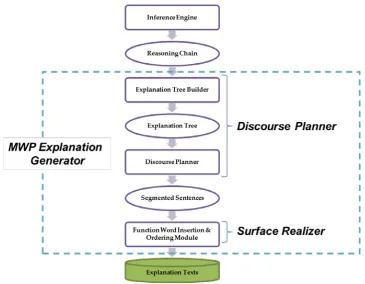
(resulted from Discourse Planner) and generates the explanation texts according to the
selected template (based on the operator encountered).
Figure 2. Block Diagram of the proposed MWP Explanation Generator
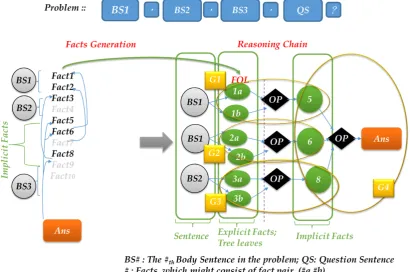
Following example demonstrates how the framework works. And Figure 3(a) reveals more
details for each part illustrated in Figure 2.
[Sample-1] 阿志買一臺冰箱和一臺電視機,付 2疊一萬元鈔票、6 張千元鈔票和13 張
百元鈔票,阿志共付了幾元?
(A-Zhi bought a refrigerator and a TV, paid 2 piles of ten-thousand-dollar bill,
six thousand-dollar bill and 13 hundred-dollar bill. How many dollars did
A-Zhi totally pay?)
Facts Generation in Figure 3(a) shows how the body text is transformed into
meaningful logic facts to perform inference. In math problems, the facts are mostly related to
quantities. The generated facts are either the quantities explicitly appearing in the sentence
text or the implicit quantities deduced by the IE. Those generated facts are linked together
within the reasoning chain constructed by the IE as shown in Figure 3(b). Within this
framework, the discourse planner is responsible for selecting the associated content for each
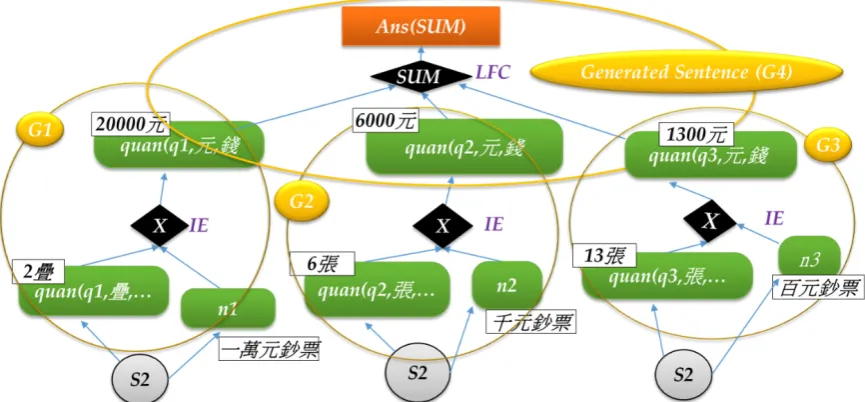
sentence to be generated. Figure 3(c) shows how the contents in the Explanation Tree are
used as fillers to fill in the template slots for generating the explanation sentences.
A typical reasoning chain, represented with an Explanation Tree structure, is shown at
interleaved within the Explanation Tree, and serve as the input to OP Oriented Algorithm in
Discourse Planner.
(a) Facts Generation (b) Reasoning Chain
(c) Function Word Insertion & Ordering Module, serving as the Surface Realizer. It
shows how surface realization is done with non-slot fillers (circled by ellipses) and
slot-fillers (the diamond shape is for operators, and the rectangle one is for quantities).
Figure 3. (a) Facts Generated from the Body Text. (b) The associated Reasoning Chain,
Proceedings of the Ninth International Workshop on Natural Language Generation,
(1998 Aug).
[11] E. Reiter, R. Robertson, L. Osman, Types of knowledge required to personalise
smoking cessation letters, In Proceedings of the Joint European Conference on
Artificial Intelligence in Medicine and Medical Decision Making. Springer-Verlag, (1999).
[12] D. Jurafsky, J.H. Martin, Speech and Language Processing, Chapter 20, Prentice Hall,