A Named Entity Recognition Method using Rules Acquired from
Unlabeled Data
Tomoya Iwakura Fujitsu Laboratories Ltd.
1-1, Kamikodanaka 4-chome, Nakahara-ku, Kawasaki 211-8588, Japan [email protected]
Abstract
We propose a Named Entity (NE) recogni-tion method using rules acquired from un-labeled data. Rules are acquired from au-tomatically labeled data with an NE rec-ognizer. These rules are used to identify NEs, the beginning of NEs, or the end of NEs. The application results of rules are used as features for machine learning based NE recognizers. In addition, we use word information acquired from un-labeled data as in a previous work. The word information includes the candidate NE classes of each word, the candidate NE classes of co-occurring words of each word, and so on. We evaluate our method with IREX data set for Japanese NE recog-nition and unlabeled data consisting of more than one billion words. The exper-imental results show that our method us-ing rules and word information achieves the best accuracy on the GENERAL and ARREST tasks of IREX.
1 Introduction
Named Entity (NE) recognition aims to recognize proper nouns and numerical expressions in text, such as names of people, locations, organizations, dates, times, and so on. NE recognition is one of the basic technologies used in text processing such as Information Extraction and Question Answer-ing.
To implement NE recognizers, semi-supervised-based methods have recently been widely applied. These methods use several differ-ent types of information obtained from unlabeled data, such as word clusters (Freitag, 2004; Miller et al., 2004), the clusters of multi-word nouns (Kazama and Torisawa, 2008), phrase clusters (Lin and Wu, 2009), hyponymy relations extracted
from WikiPedia (Kazama and Torisawa, 2008), NE-related word information (Iwakura, 2010), and the outputs of classifiers or parsers created from unlabeled data (Ando and Zhang, 2005). These previous works have shown that features acquired from large sets of unlabeled data can contribute to improved accuracy. From the results of these previous works, we see that several types of features augmented with unlabeled data contribute to improved accuracy. Therefore, if we can incorporate new features augmented with unlabeled data, we expect more improved accuracy.
We propose a Named Entity recognition method using rules acquired from unlabeled data. Our method uses rules identifying not only whole NEs, but also the beginning of NEs or the end of NEs. Rules are acquired from automatically la-beled data with an NE recognizer. The appli-cation results of rules are used as features for machine-learning based NE recognitions. Com-pared with previous works using rules identifying NEs acquired from manually labeled data (Isozaki, 2001), or lists of NEs acquired from unlabeled data (Talukdar et al., 2006), our method uses new features such as identification results of the be-ginning of NEs and the end of NEs. In addi-tion, we use word information (Iwakura, 2010). The word information includes the candidate NE classes of each word, the candidate NE classes of co-occurring words of each word, and so on. The word information is also acquired from automati-cally labeled data with an NE recognizer.
We report experimental results with the IREX Japanese NE recognition data set (IREX, 1999). The experimental results show that our method using rules and word information achieves the best accuracy on the GENERAL and ARREST tasks. The experimental results also show that our method contributes to fast improvement of accu-racy compared with only using manually labeled
Table 1: Basic character types Hiragana (Japanese syllabary characters), Katakana, Kanji (Chinese letter), Capital alphabet,
Lower alphabet, number and Others
training data.
2 Japanese Named Entity Recognition
This section describes our NE recognition method that combines both word-based and character-based NE recognitions.
2.1 Chunk Representation
Each NE consists of one or more words. To recog-nize NEs, we have to identify word chunks with their NE classes. We use Start/End (SE) rep-resentation (Uchimoto et al., 2000) because an SE representation-based NE recognizer shows the best performance among previous works (Sasano and Kurohashi, 2008). SE representation uses five tags which are S, B, I, E and O, for representing chunks. S means that the current word is a chunk consisting of only one word. B means the start of a chunk consisting of more than one word. E means the end of a chunk consisting of more than one word. I means the inside of a chunk consisting of more than two words. O means the outside of any chunk. We use the IREX Japanese NE recognition task for our evaluation. The task is to recognize the eight NE classes. The SE based NE label set for IREX task has (8×4) + 1 = 33 labels such as B-PERSON, S-PERSON, and so on.
2.2 Word-based NE Recognition
We classify each word into one of the NE labels defined by the SE representation for recognizing NEs. Japanese has no word boundary marker. To segment words from Japanese texts, we use MeCab 0.98 with ipadic-2.7.0.1
Our NE recognizer uses features extracted from the current word, the preceding two words and the two succeeding words (5-word window). The ba-sic features are the word surfaces, the last charac-ters, the base-forms, the readings, the POS tags, and the character types of words within 5-word window size. The base-forms, the readings, and the POS tags are given by MeCab. Base-forms are representative expressions for conjugational words. If the base-form of each word is not equiv-alent to the word surface, we use the base-form
1http://mecab.sourceforge.net/
as a feature. If a word consists of only one char-acter, the character type is expressed by using the corresponding character types listed in Table 1. If a word consists of more than one character, the character type is expressed by a combination of the basic character types listed in Table 1, such as Kanji-Hiragana. MeCab uses the set of POS tags having at most four levels of subcategories. We use all the levels of POS tags as POS tag features. We use outputs of rules to a current word and word information within 5-word window size as features. The rules and the word information are acquired from automatically labeled data with an NE recognizer. We describe rules in section 3. We use the following NE-related labels of words from unlabeled data as word information as in (Iwakura, 2010).
Candidate NE labels: We use NE labels as-signed to each word more than or equal to 50 times as candidate NE labels of words.
Candidate co-occurring NE labels: We use NE labels assigned to co-occurring words of each word more than or equal to 50 times as candidate co-occurring NE labels of the word.
Frequency information of candidate NE la-bels and candidate co-occurring NE lala-bels: These are the frequencies of the NE candidate la-bels of each word on the automatically labeled data. We categorize the frequencies of these NE-related labels by the frequency of each word n;
50 ≤ n ≤ 100, 100 < n ≤ 500, 500 < n ≤
1000, 1000 < n ≤ 5000, 5000 < n ≤ 10000,
10000< n ≤50000,50000< n ≤100000, and
100000< n.
Ranking of candidate NE labels: This infor-mation is the ranking of candidate NE class labels for each word. Each ranking is decided according to the label frequencies.
For example, we obtain the following statistics from automatically labeled data with an NE rec-ognizer forTanaka: S-PERSON was assigned to
Tanaka10,000 times, B-PERSON was assigned to
Tanaka1,000 times, and I-PERSON was assigned to words appearing next to Tanaka 1,000 times. The following NE-related labels are acquired for
Tanaka: Candidate NE labels are S-PERSON and B-ORGANIZATION. Frequency information of candidate NE labels are 5000 < n ≤ 10000
B-ORGANIZATION. Candidate co-occurring NE labels at the next word position is I-PERSON. Fre-quency information of candidate co-occurring NE labels at the next word position is 500 < n ≤
1000for I-PERSON.
2.3 Character-based NE Recognition
Japanese NEs sometimes include partial words that form the beginning, the end of NE chunks or whole NEs.2 To recognize Japanese NEs in-cluding partial words, we use a character-unit-chunking-based NE recognition algorithm (Asa-hara and Matsumoto, 2003; Nakano and Hirai, 2004) following word-based NE recognition as in (Iwakura, 2010).
Our character-based NE recognizer uses fea-tures extracted from the current character, the pre-ceding two characters and the two succeeding characters (5-character window). The features ex-tracted from each character within the window size are the followings; the character itself, the character type of the character listed in Table 1, and the NE labels of two preceding recognition re-sults in the direction from the end to the beginning. In addition, we use words including characters within the window size. The features of the words are the character types, the POS tags, and the NE labels assigned by a word-based NE recognizer.
As for words including characters, we extract features as follows. LetW(ci)be the word includ-ing thei-th character ci and P(ci) be the identi-fier that indicates the position whereciappears in W(ci). We combine W(ci) and P(ci) to create a feature. P(ci) is one of the followings: B for a character that is the beginning of a word, I for a character that is in the inside of a word, E for a character that is the end of a word, and S for a character that is a word.3
We use the POS tags of words including charac-ters within 5-character window. LetP OS(W(ci))
be the POS tag of the wordW(ci)including the i-th characterci. We express these features with the position identifierP(ci)likeP(ci)-P OS(W(ci)). In addition, we use the character types of words
2For example, Japanese word ”houbei” (visit U.S.) does
not match with LOCATION ”bei (U.S)”.
3If “Gaimusyouha”, is segmented as “Gaimusyou (the
Ministry of Foreign Affairs) / ha (particle)”, then words including characters are follows; W(Gai) = Gaimusyou,
W(mu) = Gaimusyou, W(syou) = Gaimusyou, and
W(ha)=ha. The identifiers that indicate positions where characters appear are follows; P(Gai) =B, P(mu) = I,
P(syou) = E, andP(ha)=S.
including characters. To utilize outputs of a word-based NE recognizer, we use NE labels of words assigned by a word-unit NE recognizer. Each character is classified into one of the 33 NE labels provided by the SE representation.
2.4 Machine Learning Algorithm
We use a boosting-based learner that learns rules consisting of a feature, or rules represented by combinations of features consisting of more than one feature (Iwakura and Okamoto, 2008). The boosting algorithm achieves fast training speed by training a weak-learner that learns several rules from a small portion of candidate rules. Candidate rules are generated from a subset of features called bucket. The parameters for the boosting algorithm are as follows. We used the number of rules to be learned asR=100,000, the bucketing size for split-ting features into subsets as|B|=1,000, the num-ber of rules learned at each boosting iteration asν =10, the number of candidate rules used to gener-ate new combinations of features at each rule size asω=10, and the maximum number of features in rules asζ=2.
The boosting algorithm operates on binary clas-sification problems. To extend the boosting to multi-class, we used the one-vs-the-rest method. To identify proper tag sequences, we use the Viterbi search. To apply the Viterbi search, we convert the confidence value of each classifier into the range of 0 to 1 with sigmoid function defined ass(X) = 1/(1 +exp(−βX)), whereX is the output of a classifier to an input. We usedβ=1 in this experiment. Then we select a tag sequence which maximizes the sum of those log values.
to be examined by specifying part of features as atomic. We specify features based on word infor-mation and rules acquired from unlabeled data as the atomic features.
3 Rules Acquired from Unlabeled Data
This section describes rules and a method to ac-quire rules.
3.1 Rule Types
Previous works such as Isozaki (Isozaki, 2001), Talukdar et al., (Talukdar et al., 2006), use rules or lists of NEs for only identifying NEs. In addition to rules identifying NEs, we propose to use rules for identifying the beginning of NEs or the end of NEs to capture context information. To acquire rules, an automatically labeled data with an NE recognizer is used. The following types of rules are acquired.
Word N-gram rules for identifying NEs ( NE-W-rules, for short): These are word N-grams cor-responding to candidate NEs.
Word trigram rules for identifying the begin-ning of NEs (NEB-W-rules): Each rule for iden-tifying the beginning of NEs is represented as a word trigram consisting of the two words preced-ing the beginnpreced-ing of an NE and the beginnpreced-ing of the NE.
Word trigram rules for identifying the end of NEs (NEE-W-rules): Each rule for identifying the end of NEs is represented as a word trigram consisting of the two words succeeding the end of an NE and the end of the NE.
In addition to word N-gram rules, we acquire Word/POS N-gram rules for achieving higher rule coverage. Word/POS N-gram rules are ac-quired from N-gram rules by replacing some words in N-gram rules with POS tags. We call
NE-W-rules,NEB-W-rulesandNEE-W-rules con-verted to Word/POS N-gram rulesNE-WP-rules,
NEB-WP-rules and NEE-WP-rules, respectively. Word/POS N-gram rules also identify NEs the be-ginning of NEs and the end of NEs
To acquire Word/POS rules, we replace words having one of the following POS tags with their POS tags as rule constituents: proper noun words, unknown words, and number words. This is be-cause words having these POS tags are usually low frequency words.
3.2 Acquiring Rules
This section describes the method to acquire the rules used in this paper. The rule acquisition con-sists of three main steps: First, we create auto-matically labeled data. Second, seed rules are ac-quired. Finally the outputs of rules are decided.
The first step prepares an automatically labeled data with an NE recognizer. The NE recognizer recognizes NEs from unlabeled data and generates the automatically labeled data by annotating char-acters recognized as NEs with the NE labels.
The second step acquires seed rules from the tomatically labeled data. The following is an au-tomatically labeled sentence.
[ Tanaka/$PN mission/$N party/$N ]ORGwent/ $V to/$P [U.K/$PN]LOC...” ,
where $PN (Proper Noun), $N, $V, and $P follow-ing/are POS tags, and words between “[ and ]” were identified as NEs. ORG and LOC after “]” indicate NE types.
The following seed rules are acquired from the above sentence by following the procedures de-scribed in previous sections:
NE-W-rules:{Tanaka mission party→ORG}, NEB-W-rules:{went to U.K→LW=B-LOC}, NEE-W-rules:{party went to→FW=E-ORG}, NE-WP-rules:{$PN mission party→ORG}, NEB-WP-rules:{went to$PN→LW=B-LOC}, NEE-WP-rules: {$PN mission party → LW=B-ORG},
where FW, LW, B-LOC, and E-ORG indicate the first words of word sequences that a rule is applied to, the last words of word sequences that a rule is applied to, the beginning word of a LOCATION NE, and the end word of an ORGANIZATION NE, respectively. The left of each → is therule conditionto apply a rule, and the right of each→
is the seed output of a rule. If the output of a rule is only an NE type, this means the rule identifies an NE. Rules with outputs including=indicate rules for identifying the beginning of NEs or the end of NEs. The left of=indicates the positions of words where the beginning of NEs or the end of NEs ex-ist in the identified word sequences by rules. For example, LW=B-LOC means that LW is B-LOC.
more than or equal to 50 times.4 For example, if LW=B-LOC are obtained 10,000 times, and LW=B-ORG are obtained 1,000 times, as the outputs for {went to $PN}, the followings are acquired as final outputs:
LW=B-LOC RANK1, LW=B-ORG RANK2, LW=B-LOC FREQ-5000 < n ≤ 10000, and LW=B-ORG FREQ-500< n≤1000.
The LOC RANK1 and the LW=B-ORG RANK2 are the ranking of the outputs of rules. LW=B-LOC is 1st ranked output, and LW=B-ORG is 2nd ranked output. Each ranking is decided by the frequency of each output of each rule condition. The most frequent output of each rule is ranked as first.
LW=B-LOC FREQ-5000 < n ≤ 10000 and LW=B-ORG FREQ-500 < n ≤ 1000 are fre-quency information. To express the frefre-quency of each rule output as binary features, we categorize the frequency of each rule output by the frequency of each rule output n; 50 ≤ n ≤ 100, 100 < n ≤ 500, 500 < n ≤ 1000,1000 < n ≤ 5000,
5000 < n ≤ 10000, 10000 < n ≤ 50000,
50000< n≤100000, and100000< n.
3.3 Rule Application
We define the rule application by following the method for using phrase clusters in NER (Lin and Wu, 2009). The application of rules is allowed to overlap with or be nested in one another. If a rule is applied at positionsbtoe, we add the fea-tures combined with the outputs of the rule and matching positions to each word; outputs with
B-(beginning) tob-th word, outputs withE-(end) to b-th word, outputs withI-(inside) withinb+ 1-th to e−1-th words, outputs with P- (previous) to b−1-th word, and outputs withF-(following) to e+ 1-th word.
If a rule having the condition{went to$PN}is applied to{.... Ken/$PN went/$V to/$P Japan/ $PN for/$P ...}, the followings are captured as rule application results: b-th word is went, the word between b-th and e-th is to, e-th word is Japan,b−1-th is Ken, ande+ 1-th is for.
If the output of the rule is LW=B-LOC, the following features are added: B-LW=B-LOC for
4We conducted experiments using word information and
rules obtained from training data with different frequency threshold parameters. The parameters are 1, 3, 5, 10, 20, 30, 40, and 50. We select 50 as the threshold because the pa-rameter shows the best result among the results obtained with these parameters on a pilot study.
went, I-LW=B-LOC for to, E-LW=B-LOC for Japan, P-LW=B-LOC for Ken, and F-LW=B-LOC for for.
3.4 Repeatedly Acquisition
We also apply a method to acquire word informa-tion (Iwakura, 2010) to the rule acquisiinforma-tion repeat-edly. This is because the previous work reported that better accuracy was obtained by repeating the acquisition of NE-related labels of words. The col-lection method is as follows.
(1)Create an NE recognizer from training data. (2) Acquire word information and rules from unlabeled data with the current NE recognizer.
(3) Create a new NE recognizer with the train-ing data, word information and rules acquired at step (2). This NE recognizer is used for acquiring new word information and rules at the next itera-tion.
(4) Go back to step (2) if the termination cri-terion is not satisfied. The process (2) to (4) is repeated 4 times in this experiment.
4 Experiments
4.1 Experimental settings
The following data prepared for IREX (IREX, 1999) were used in our experiment. We used the CRL data for the training. CRL data has 18,677 NEs on 1,174 stories from Mainichi Newspaper. In addition, to investigate the effectiveness of un-labeled data and un-labeled data, we prepared another labeled 7,000 news stories including 143,598 NEs from Mainichi Shinbun between 2007 and 2008 according to IREX definition. We have, in total, 8,174 news stories including 162,859 NEs that are about 8 times of CRL data. To create the addi-tional labeled 7,000 news stories, about 509 hours were required. The average time for creating a labeled news story is 260 seconds, which means only 14 labeled news stories are created in an hour. For evaluation, we used formal-run data of IREX: GENERAL task including 1,581 NEs, and ARREST task including 389 NEs.
We compared performance of NE recognizers by using the F-measure (FM) defined as follows with Recall (RE) and Precision (PR);
FM = 2×RE×PR/( RE + PR ), where,
Table 2: Experimental Results: Each AV. indicates a micro average F-measure obtained with each NE recognizer. B., +W, +R, and +WR indicate the base line recognizer, using word information, us-ing rules, and usus-ing word information and rules. Base indicates the base line NE recognizer not us-ing word information and rules.
B. + W + R +WR
GENERAL 85.35 88.04 85.93 88.43 ARREST 85.64 89.35 87.39 91.33 AV. 85.40 88.56 86.22 89.00
and NUM is the number of NEs correctly identi-fied by an NE recognizer.
The news stories from the Mainichi Shinbun be-tween 1991 and 2008 and Japanese WikiPedia en-tries of July 13, 2009, were used as unlabeled data for acquiring word information and rules. The to-tal number of words segmented by MeCab from these unlabeled data was 1,161,758,003, more than one billion words.5
4.2 Evaluation of Our Proposed Method We evaluated the effectiveness of the combination of word information and rules. Table 2 shows ex-perimental results obtained with an NE recognizer without any word information and rules (NER-BASE, for short), an NE recognizer using word information (NER-W for short), an NE recognizer using rules (NER-R, for short), and an NE recog-nizer using word information and rules (NER-WR, for short), which is based on our proposed method We used word information and rules obtained with the NER-BASE, which was created from CRL data without word information and rules. We see that we obtain better accuracy by using word information and rules acquired from unla-beled data.
The NER-WR shows the best average F-measure (FM). The average FM of the NER-WR is 3.6 points higher than that of the NER-BASE. The average FM of the NER-WR is 0.44 points higher than that of NER-W, and 2.78 points higher than that of the NER-R. These results show that com-bination of word information and rules contributes to improved accuracy. We also evaluated the
effec-5We used WikiPedia in addition to news stories because
Suzuki and Isozaki (Suzuki and Isozaki, 2008) reported that the use of more unlabeled data in their learning algorithm can really lead to further improvements. We treated a successive numbers and alphabets as a word in this experiment.
Table 3: Experimental Results obtained with NE recognizers using word information and rules: G., A., and AV. indicate GENERAL, ARREST, and a micro average obtained with each NE recognizer at each iteration, respectively.
1 2 3 4 5
G. 85.35 88.43 88.22 88.20 88.31 A. 85.64 91.33 91.52 91.49 92.19 AV. 85.40 89.00 88.88 88.85 89.08
tiveness of the combination of rules for identifying NEs, and rules for identifying beginning of NEs or end of NEs. The micro average FM values for an NE recognizer using rules for identifying NEs, an NE recognizer using rules for identifying begin-ning of NEs or end of NEs, and the NE recognizer using the both types of rules are 85.77, 84.19 and 86.22. This result shows using the two types of rules are effective.
Then we evaluate the effectiveness of the acqui-sition method described in section 3.4. Table 3 shows the accuracy obtained with each NE rec-ognizer at each iteration. The results at iteration 1 is the results obtained with the base line NE recognizer not using word information and rules. We obtained the best average accuracy at iteration 5. The results obtained with the NE recognizer at iteration 5 shows 4.76 points higher average F-measure than that of the NE recognizer at iteration 1, and 0.37 points higher average F-measure than that of the NE recognizer at iteration 2.
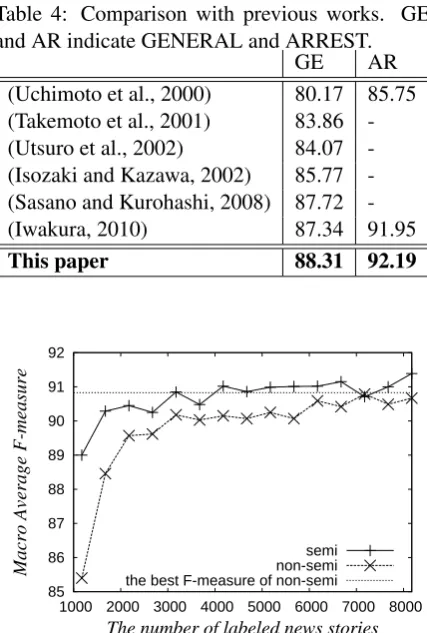
Table 4 shows the results of the previous works using IREX Japanese NE recognition tasks. All the results were obtained with CRL data as man-ually labeled training data. Our results are F-measure values obtained with the NE recognizer at iteration 5 on Table 3.
perfor-Table 4: Comparison with previous works. GE and AR indicate GENERAL and ARREST.
GE AR
(Uchimoto et al., 2000) 80.17 85.75 (Takemoto et al., 2001) 83.86 -(Utsuro et al., 2002) 84.07 -(Isozaki and Kazawa, 2002) 85.77 -(Sasano and Kurohashi, 2008) 87.72 -(Iwakura, 2010) 87.34 91.95
This paper 88.31 92.19
85 86 87 88 89 90 91 92
1000 2000 3000 4000 5000 6000 7000 8000
Macro Average F-measure
The number of labeled news stories semi non-semi the best F-measure of non-semi
Figure 1: Experimental results obtained with dif-ferent size of training data. Each point indicates the micro average F-measure of an NE recognizer.
mance than the other methods.
4.3 Evaluating Effectiveness of Our Method
This section describes the performances of NE recognizers trained with larger training data than CRL-data. Figure 1 shows the performance of each NE recognizer trained with different size of labeled training data. The leftmost points are the performance of the NE recognizers trained with CRL data (1,174 news stories). The other points are the performances of NE recognizers trained with training data larger than CRL data. The size of the additional training data is increased by 500 news stories.
We examined NE recognizers using our pro-posed method (semi), and NE recognizers not us-ing our method (non-semi). In the following, semi-NER indicates NE recognizers using unla-beled data based on our method, and non-semi-NER indicates NE recognizers not using unla-beled data. Figure 1 shows that the semi-NER trained with CRL data shows competitive
perfor-mance of the non-semi-NER trained with about 1.5 time larger training data consisting of CRL data and additional labeled 500 news stories. To create manually labeled 500 news stories, about 36 hours are required.6 To achieve the compet-itive performance of the non-semi-NER trained with CRL data and the labeled 7,000 news sto-ries, semi-NER requires only 2,000 news stories in addition to CRL data. This result shows that our proposed method significantly reduces the num-ber of labeled data to achieve a competitive per-formance obtained with only using labeled data. Figure 1 also shows that our method contributes to improved accuracy when using the large labeled training data consisting of CRL data and 7,000 news stories. The accuracy is 90.47 for GEN-ERAL, and 94.30 for ARREST. In contrast, when without word information and rules acquired from unlabeled data, the accuracy is 89.43 for GEN-ERAL, and 93.44 for ARREST.
5 Related Work
To augment features, methods for using informa-tion obtained with clustering algorithms were pro-posed. These methods used word clusters (Fre-itag, 2004; Miller et al., 2004), the clusters of multi-word nouns (Kazama and Torisawa, 2008), or phrase clusters (Lin and Wu, 2009). In con-trast, to collect rules, we use an automatically tagged data with an NE recognizer. Therefore, we expect to obtain more target-task-oriented in-formation with our method than that of previous works. Although there are differences between our method and the previous works, our method and previous works are complementary .
To use rules in machine-learning-based NE recognitions, Isozaki proposed a Japanese NE recognition method based on a simple rule gener-ator and decision tree learning. The method gen-erates rules from supervised training data (Isozaki, 2001). Talukdar et al., proposed a method to use lists of NEs acquired from unlabeled data for NE recognition (Talukdar et al., 2006). Starting with a few NE seed examples, the method extends lists of NEs. These methods use rules or lists of NEs for identifying only NEs. Compared with these methods, our method uses rules for identifying the beginning of NEs and the end of NEs in addition
6We estimate the hours by using the average labeling time
to rules identifying whole NEs. Therefore, our methods can use new features not used in previ-ous works.
6 Conclusion
This paper proposed an NE recognition method using rules acquired from unlabeled data. Our method acquires rules for identifying NEs, the be-ginning of NEs, and the end of NEs from an auto-matically labeled data with an NE recognizer. In addition, we use word information including the candidate NE classes, and so on. We evaluated our method with IREX data set for Japanese NE recognition and unlabeled data consisting of more than one billion words. The experimental results showed that our method using rules and word in-formation achieved the best accuracy on the GEN-ERAL and ARREST tasks.
References
Rie Ando and Tong Zhang. 2005. A high-performance semi-supervised learning method for text chunking. InProc. of ACL 2005, pages 1–9.
Masayuki Asahara and Yuji Matsumoto. 2003. Japanese named entity extraction with redundant morphological analysis. In Proc. of HLT-NAACL 2003, pages 8–15.
Dayne Freitag. 2004. Trained named entity recog-nition using distributional clusters. In Proc. of
EMNLP 2004, pages 262–269.
Satoru Ikehara, Masahiro Miyazaki, Satoshi Shirai, Akio Yokoo, Hiromi Nakaiwa, Kentaro Ogura, Yoshifumi Ooyama, and Yoshihiki Hayashi. 1999.
Goi-Taikei -A Japanese Lexicon CDROM. Iwanami
Shoten.
Committee IREX. 1999.Proc. of the IREX workshop.
Hideki Isozaki and Hideto Kazawa. 2002. Speeding up named entity recognition based on Support Vector Machines (in Japanese). InIPSJ SIG notes NL-149-1, pages 1–8.
Hideki Isozaki. 2001. Japanese named entity recogni-tion based on a simple rule generator and decision tree learning. InProc. of ACL 2001, pages 314–321.
Tomoya Iwakura and Seishi Okamoto. 2008. A fast boosting-based learner for feature-rich tagging and chunking. InProc. of CoNLL 2008, pages 17–24.
Tomoya Iwakura. 2009. Fast boosting-based part-of-speech tagging and text chunking with efficient rule representation for sequential labeling. InProc. of
RANLP 2009.
Tomoya Iwakura. 2010. A named entity extraction us-ing word information repeatedly collected from un-labeled data. InProc. of CICLing 2010, pages 212– 223.
Jun’ichi Kazama and Kentaro Torisawa. 2008. Induc-ing gazetteers for named entity recognition by large-scale clustering of dependency relations. InProc. of
ACL-08: HLT, pages 407–415.
Dekang Lin and Xiaoyun Wu. 2009. Phrase cluster-ing for discriminative learncluster-ing. In Proc. of
ACL-IJCNLP 2009, pages 1030–1038.
Scott Miller, Jethran Guinness, and Alex Zamanian. 2004. Name tagging with word clusters and dis-criminative training. InProc. of HLT-NAACL 2004, pages 337–342.
Keigo Nakano and Yuzo Hirai. 2004. Japanese named entity extraction with bunsetsu features (in Japanese). InIPSJ Journal, 45(3), pages 934–941.
Ryohei Sasano and Sadao Kurohashi. 2008. Japanese named entity recognition using structural natural language processing. In Proc. of IJCNLP 2008, pages 607–612.
Jun Suzuki and Hideki Isozaki. 2008. Semi-supervised sequential labeling and segmentation using giga-word scale unlabeled data. In Proc. of ACL-08: HLT, pages 665–673.
Yoshikazu Takemoto, Toshikazu Fukushima, and Hi-roshi Yamada. 2001. A Japanese named entity ex-traction system based on building a large-scale and high quality dictionary and pattern-matching rules (in Japanese). 42(6):1580–1591.
Partha Pratim Talukdar, Thorsten Brants, Mark Liber-man, and Fernando Pereira. 2006. A context pat-tern induction method for named entity extraction.
InProc. of CoNLL 2006, pages 141–148.
Kiyotaka Uchimoto, Qing Ma, Masaki Murata, Hiromi Ozaku, Masao Utiyama, and Hitoshi Isahara. 2000. Named entity extraction based on a maximum en-tropy model and transformati on rules. In Proc. of
the ACL 2000, pages 326–335.
Takehito Utsuro, Manabu Sassano, and Kiyotaka Uchi-moto. 2002. Combining outputs of multiple Japanese named entity chunkers by stacking. In