28 Chien-Tsung Huang et al.
reasoning (instead of looking for a wide coverage parser and acquiring considerable amount of domain knowledge). We thus also choose it as the goal of the first year for studying the MR problem, and propose a tag-based statistical approach (Lin et al., 2015) to find out the answer.
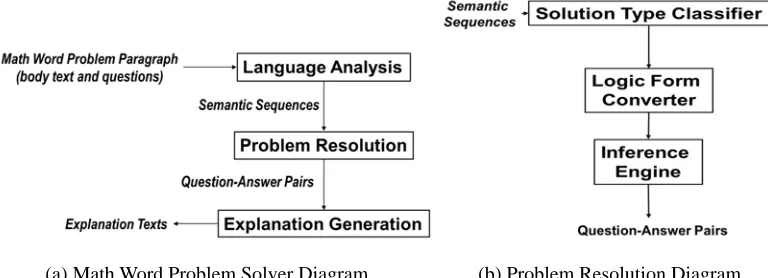
The architecture of this proposed approach is shown in Figure 1. First, every sentence in the MWP, including both body text and the question text, is analyzed by the Language Analysis module, which transforms each sentence into its corresponding semantic representation tree. The sequence of semantic representation trees is then sent to the Problem Resolution module, which adopts logic inference approach, to obtain the answer of each question in the MWP. Finally, the Explanation Generation module will explain how the answer is found (in natural language text) according to the given reasoning chain (Russell & Norvig, 2009) (which includes all related logic statements and inference steps to reach the answer).
(a) Math Word Problem Solver Diagram (b) Problem Resolution Diagram Figure 1. The block diagram of the proposed Math Word Problem Solver.
As depicted in Figure 1(b), the Problem Resolution module in the proposed system consists of three components: Solution Type Classifier (TC), Logic Form Converter (LFC) and Inference Engine (IE). The TC is responsible to assign a math operation type for every question of the MWP. In order to perform logic inference, the LFC first extracts the related facts from the given semantic representation tree and then represents them in First Order Logic (FOL) predicates/functions form (Russell & Norvig, 2009). In addition, it is also responsible for transforming every question into an FOL-like utility function according to the assigned solution type. Finally, according to inference rules, the IE derives new facts from the old ones provided by the LFC. Besides, it is also responsible for providing utilities to perform math operations on related facts.
Explanation Generation for a Math Word Problem Solver 29
Generator (EG) module, which is responsible to explaining the associated reasoning steps in fluent natural language from the given reasoning chain (Russell & Norvig, 2009). In other words, explanation generation is the process of constructing natural language outputs from a non-linguistic input, and is a task of Natural Language Generation (NLG).
Various applications of NLG (such as weather report) have been proposed before (Halliday, 1985; Goldberg et al., 1994; Paris & Vander Linden, 1996; Milosavljevic, 1997; Paris et al., 1998; Coch, 1998; Reiter et al., 1999). However, to the best of our knowledge, none of them discusses how to generate the explanation for WMP, which possesses some special characteristics (e.g., math operation oriented description) that are not shared with other tasks.
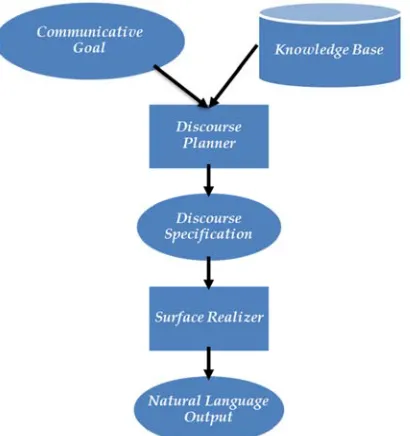
A typical architecture for NLG is shown at Figure 2, which is re-drawn from Jurafsky and Martin (Jurafsky & Martin, 2000). Under this architecture, Communicative Goal, which specifies the purpose for communication, and Knowledge Base, which specifies the content to be generated, are fed as the inputs to Discourse Planner. The Discourse Planner will then output a hierarchy form to the Surface Realizer, which further solves the issues of selecting lexicons, functional words, lexicon order in the sentence, syntactic form, subject-verb agreement (mainly required for English), tense (mainly required for English), and so on for the texts to be generated.
Figure 2. A typical architecture for NLG systems (Jurafsky & Martin, 2000)
Explanation Generation for a Math Word Problem Solver 31
Figure 3. Block Diagram of the proposed MWP Explanation Generator
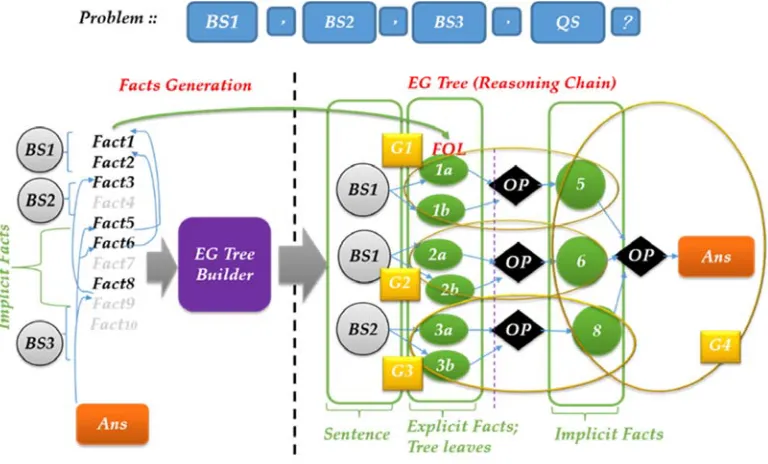
Following example demonstrates how the framework works. And Figure 4 (a) reveals more details for each part illustrated in Figure 3.
[Sample-1] 阿志買一臺冰箱和一臺電視機,付2疊一萬元鈔票、6張千元鈔票和13張百元
鈔票,阿志共付了幾元?
(A-Zhi bought a refrigerator and a TV. He paid 2 stacks of ten-thousand-dollar bill, six thousand-dollar bills and 13 hundred-dollar bills. How many dollars did A-Zhi pay in total?)
32 Chien-Tsung Huang et al.
Figure 4(a). Facts Generation Figure 4(b). Reasoning Chain (represented as an and EG Tree Builder Explanation Tree for illustration)
34 Chien-Tsung Huang et al.
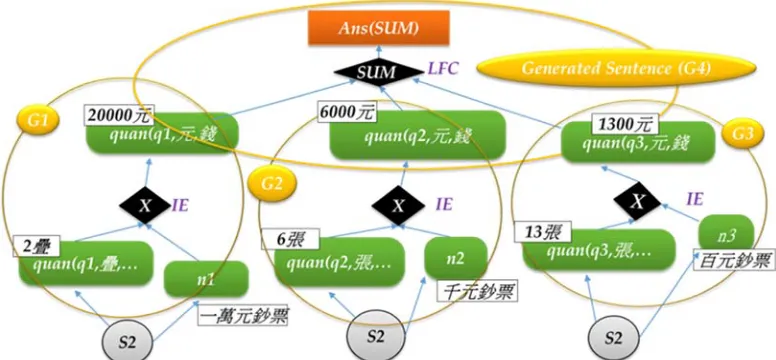
Figure 5. Explanation Tree for Discourse Planning, where S2 means that those facts are from the 2nd body sentence.
2.1 Explanation Tree Builder
The original reasoning chain resulted from the IE is actually a stream of chunks (as shown in Figure 4(a)), in which the causal chain is implicitly embedded. Therefore, it is not suitable for explaining inference steps. The Explanation Tree Builder is thus adopted to build up the Explanation Tree, which centers on the math operations involved in the inference process, to explicitly express the causal chain implied.
The Explanation Tree Builder first receives various facts, as a stream of chunks, from the IE. It then creates the nodes of the Explanation Tree according to the content of those chunks. After the Explanation Tree is created, it serves as the corresponding reasoning chain for the following process since then.
With the root node serving as the Answer, which is a Quan_node, the Explanation Tree is interleaved with Quan_node layers and OP_node layers, as shown in Figure 4(b). Each OP_node has one Quan_node as its parent node, and has at least one Quan_node as it’s child node. On the other hand, each Quan_node (except the root node) serves as the input to an OP_node. With the Explanation Tree, the work of discourse planning can be simply done via traversing those OP_nodes, which will be described in the following section.
2.2 Sentence Segmenter (Discourse Planner)
Explanation Generation for a Math Word Problem Solver 37
Take the last explanation sentence of the above sample 1 as an example,
所以,共付了 20000 + 6000 + 1300 = 27300元
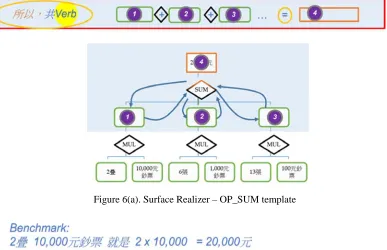
Since its associated operator is “SUM”, the template of “SUM” is first fetched and there are four slots to be filled. The arrow then directs the flow to ① for “20,000” to be printed out and then SUM for the “+”. Next on, the flow is directed to the middle child node, ②, and “6,000” is therefore outputted as the subsequent component in this sentence, and then it directs back to SUM again to print “+”. Finally, the flow directs to the most right-hand-side node, ③, then goes back to SUM; the “1,300” is then popped out accordingly. We don’t print out the “+” for the SUM this time since we know there’s no more child node below the SUM node that hasn’t been traversed. After all the child nodes are traversed and their contents are copied into the associated slots, the parent node, ④, is traversed and the text “=27,300元” is printed out to complete the explanation sentence.
Figure 6(a). Surface Realizer – OP_SUM template
Figure 6(b). Benchmark for the output of Surface Realizer
Explanation Generation for a Math Word Problem Solver 39
(1) Each operator generates a sentence.
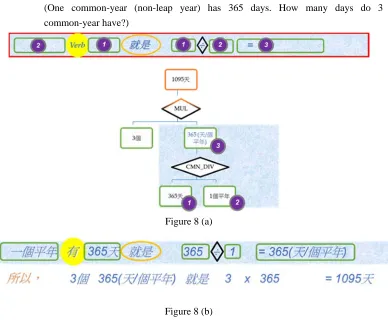
(2) Each sentence is generated from the operator and the quantities connected to it. (3) The operators and the quantities are inserted into the slots specified in the template. (4) The instantiated template serves as the corresponding explanation sentence string. Apart from the OP_SUM, this section introduces a few other templates associated with OP_MUL, OP_COMMON_DIVISION, and OP_UNIT_TRANS as follows. OP_MUL is related to Sample-1 mentioned above (Figure 7). OP_COMMON_DIV is associated with Sample-2 (Figure 8). Also, Figure 9 shows the template associated with “OP_UNIT_TRANS” adopted in Sample-3.
Figure 7(a)
Figure 7(b)
Figure 7. The template for OP_MUL (“MUL” in Figure 7 (a)) and the explanation sentences for Sample-1.
40 Chien-Tsung Huang et al.
[Sample-2] 1個平年有365天,3個平年共有幾天?
(One common-year (non-leap year) has 365 days. How many days do 3 common-year have?)
Figure 8 (a)
Figure 8 (b)
Explanation Generation for a Math Word Problem Solver 41
[Sample-3] 一艘輪船20分鐘可以行駛25公里,2.5小時可以行駛多少公里?
(A ship can travel 25 km in 20 minutes. How many kilometers can it travel for 2.5 hours?)
Figure 9 (a)
Figure 9 (b)
Figure 9. The template for OP_UNIT_TRANS (“U_TRAN” in Figure 9 (a)), which performs unit conversions, and the explanation sentences for Sample-3.
4.
Current Status
Currently, 11 types of operators are supported. They are shown at Figure 10. After having manually checked 37 MWP problems with their associated operations specified in Figure 10,
Operation Utilities
44 Chien-Tsung Huang et al.
Russell, S. J. & Norvig, P. (2009). Artificial Intelligence : A Modern Approach(3rd Edition), Prentice Hall.
Strassel, S., Adams, D., Goldberg, H., Herr, J., Keesing, R., Oblinger, D., Simpson, H., Schrag, R., & Wright, J. (2010). The DARPA Machine Reading Program - Encouraging Linguistic and Reasoning Research with a Series of Reading Tasks. LREC 2010.
Wahlster, W., André, E., Finkler, W., Profitlich, H.-J., & Rist, T. (1993). Plan based Integration of Natural Language and Graphics Generation. Artificial Intelligence, 63(1993) 387-428.