Finding the Appropriate Generalization Level for
Binary Ontological Relations Extracted from the Genia Corpus
P. Cimiano , M. Hartung , E. Ratsch
Institute AIFB, University of Karlsruhe, [email protected], [email protected]
Bioinformatics, University of W¨urzburg, [email protected]
Abstract
Recent work has aimed at discovering ontological relations from text corpora. Most approaches are based on the assumption that verbs typically indicate semantic relations between concepts. However, the problem of finding the appropriate generalization level for the verb’s arguments with respect to a given taxonomy has not received much attention in the ontology learning community. In this paper, we address the issue of determining the appropriate level of abstraction for binary relations extracted from a corpus with respect to a given concept hierarchy. For this purpose, we reuse techniques from the subcategorization and selectional restrictions acquisition communities. The contribution of our work lies in the systematic analysis of three different measures. We conduct our experiments on the Genia corpus and the Genia ontology and evaluate the different measures by comparing the results of our approach with a gold standard provided by one of the authors, a biologist.
1.
Introduction
A lot of effort has been devoted to discovering ontologi-cal relations from text corpora in recent years (M¨adche and Staab, 2000; Yamaguchi, 2001; Kavalec and Sv´atek, 2005; Ciaramita et al., 2005; Schutz and Buitelaar, 2005). Re-lations together with ontological restrictions on their argu-ments are needed for many applications, especially in the field of natural language processing. Ontological restric-tions can, for example, be used as a basis to capture the selectional restrictions and preferences of verbs for disam-biguation purposes. Relations as well as inference rules de-fined on their basis have important applications in question answering (Lin and Pantel, 2001). Further, relations auto-matically derived from a corpus can assist a domain expert in ontology engineering.
Most approaches to learning ontological relations from text are based on the assumption that verbs typically indicate semantic relations between concepts, e.g. (Kavalec and Sv´atek, 2005; Ciaramita et al., 2005; Schutz and Buitelaar, 2005). However, the problem of finding the appropriate generalization level for the verb’s arguments with respect to a given taxonomy has not received much attention in the knowledge acquisition community. In fact, the only works we are aware of along these lines are the ones in (Faure and Nedellec, 1998; M¨adche and Staab, 2000; Ciaramita et al., 2005). A very related problem is the acquisition of se-lectional restrictions (compare (Ribas, 1995; Resnik, 1997; Clark and Weir, 2002)). In this paper we address the is-sue of determining the appropriate level of abstraction for binary relations extracted form a corpus with respect to a given concept hierarchy. For this purpose, as in (Ciaramita et al., 2005), we reuse techniques from the subcategoriza-tion and selecsubcategoriza-tional restricsubcategoriza-tions acquisisubcategoriza-tion communities. We conduct our experiments on the Genia corpus and the
Genia ontology1. The contribution of our work lies in the
systematic analysis of three different measures. We evalu-ate the different measures by comparing the results of our
1http://www-tsujii.is.s.u-tokyo.ac.jp/
˜genia/topics/Corpus/
approach with a gold standard provided by the third author, a biologist.
2.
Approach
In our approach, verb frames are extracted using Steven Abney’s chunker CASS (Abney, 1996). From CASS’s out-put, we extract tuples NP-V-NP and NP-V-P-NP. We con-struct binary relations from these tuples, using the lemma-tized verb
(with the preposition if applicable) as
cor-responding relation label and the head of the NP phrases as concepts for the domain and range of the relation. In partic-ular, we only consider nouns as concepts which also appear in the Genia ontology. Our aim is then to find the most general and appropriate concept for the domain and range of the relation on the basis of the different examples found in the corpus. For illustration purposes, let us consider the input sentences marked with (a) and the CASS output in (b):
(1) a. This bipartite motif consists of an N-terminal POU-specific domain.
b. consist(subj:bipartite motif, of: N-terminal POU-specific domain )
(2) a. Infection leads to severe acute disease in macaques. b. lead(subj:infection, to:disease, in: macaque)
(3) a. Lipoarabinomannan releases IL-6 in a dose-response manner.
b. release(subj:Lipoarabinomannan, obj:IL-6, in:dose-response manner)
'
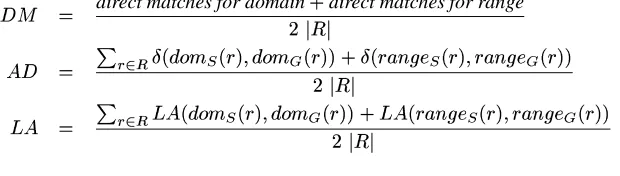
direct matches for domain? direct matches for range
9
3
;
>
11 87 + , 11 69+-.@?
>
- B ? 7 ,.- B ? 9 +-.
9
3
:<;
:<; 11 67 +-, 11 9 F ? : ; +> B ? 7 +-,F- B ? 9 F
9
3
Figure 2: Evaluation Measures
Table 3: Results for the different measures
DM AD LA
opt. avg. pess. opt. avg. pess. Conditional 33.53% 1.21 1.76 2.22 70.40% 60.57% 53.24% PMI 13.53% 3.28 3.76 4.19 48.65% 43.06% 38.62%
26.79% 2.63 3.44 4.15 56.71% 46.19% 38.48%
a priori evaluations are the ones of M¨adche et al., Schutz
and Buitelaar as well as ours. Examples for a posteriori evaluations are the ones of Ciaramita et al., Yamaguchi, but also Schutz and Buitelaar. With respect to the directly com-parable approach of M¨adche and Staab, our approach gets much higher results in terms of precision or direct matches, i.e. 33.53% compared to 11%. The best a priori preci-sion of Schutz and Buitelaar (11.9%) is comparable to the one obtained by M¨adche et al. However, the focus of the latter approach was not on learning the right level of gener-alization. Finally, we would also like to draw the attention to the ASIUM system (Faure and Nedellec, 1998) which addresses the question from a clustering perspective, cap-turing and generalizing selectional restrictions with respect to hierarchically organized word clusters.
5.
Conclusion and Further Work
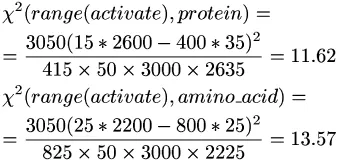
The contribution of our paper is a systematic analysis of dif-ferent probabilistic and statistical measures for the purpose of finding the appropriate generalization level for ontologi-cal relations extracted from a corpus with respect to a given taxonomy. Our conclusion is that the conditional probabil-ity performs better than other measures such as PMI or a
-test. We have so far conducted experiments on the Ge-nia corpus and ontology. In general, we have also observed that it seems quite difficult to find the appropriate general-ization due to the fact that the Genia ontology is very small and lacks a reasonable hierarchical structure. Therefore, it remains an open question if our results would transfer to on-tologies with a richer structure. The main drawback of our approach is that it is currently restricted to binary relations. Furthermore, the domain and range of a relation can actu-ally not be regarded as independent from each other. How-ever, according to our current observations, an approach to generalizing domain and range dependently could be seri-ously affected by data sparseness in the Genia corpus. Con-cerning the approximation of the conditional probabilities, some more elaborate linguistic analysis or even smooth-ing techniques should be explored. Finally, other structures
than verb frames could be considered for deriving relations.
Acknowledgments We acknowledge support from the
SmartWeb project2, funded by the German Ministry of
Re-search and Education.
6.
References
S. Abney. 1996. Partial parsing via finite-state cascades. In Proceedings of the ESSLLI ’96 Robust Parsing
Work-shop, pages 8–15.
M. Ciaramita, A. Gangemi, E. Ratsch, J. Saric, and I. Ro-jas. 2005. Unsupervised learning of semantic relations between concepts of a molecular biology ontology. In
Proceedings of IJCAI’05, pages 659–664.
S. Clark and D.J. Weir. 2002. Class-based probability esti-mation using a semantic hierarchy. Computational
Lin-guistics, 28(2):187–206.
D. Faure and C. Nedellec. 1998. A corpus-based concep-tual clustering method for verb frames and ontology. In
Proceedings of the LREC Workshop on Adapting lexical and corpus resources to sublanguages and applications,
pages 5–12.
U. Hahn and K. Schnattinger. 1998. Towards text knowl-edge engineering. In Proceedings of AAAI’98/IAAI’98, pages 524–531.
M. Kavalec and V. Sv´atek. 2005. A study on automated re-lation labelling in ontology learning. In Ontology
Learn-ing from Text: Methods, Evaluation and Applications,
number 123 in Frontiers in Artificial Intelligence and Ap-plications, pages 44–58. IOS Press.
H. Li and N. Abe. 1998. Generalizing case frames using a thesaurus and the MDL principle. Computational
Lin-guistics, 24(2):217–244.
D. Lin and P. Pantel. 2001. Discovery of inference rules for question answering. Natural Language Engineering, 7(4):343–360.
A. M¨adche and S. Staab. 2000. Discovering conceptual
lations from text. In Proceedings of ECAI, pages 321– 325.
C. Manning and H. Sch¨utze. 1999. Foundations of
Statisti-cal Language Processing. MIT Press.
D. McCarthy. 1997. Word sense disambiguation for ac-quisition of selectional preferences. In Automatic
Infor-mation Extraction and Building of Lexical Semantic Re-sources for NLP Applications, pages 52–60. Association
for Computational Linguistics.
T. Ohta, Y. Tateisi, and J. Kim. 2002. The GENIA cor-pus: an annotated research abstract corpus in molecular biology domain. In Proceedings of the 10th Internationl
Conference on Human Language Technology (HLT).
P. Resnik. 1997. Selectional preference and sense disam-biguation. In Proceedings of the ACL SIGLEX Workshop
on Tagging Text with Lexical Semantics: Why, What, and How?
F. Ribas. 1995. On learning more appropriate selectional restrictions. In Proceedings of the 7th Conference of the
European chapter of the Association for Computational Linguistics (EACL), pages 112–118.
A. Schutz and P. Buitelaar. 2005. Relext: A tool for rela-tion extracrela-tion from text in ontology extension. In
Pro-ceedings of the International Semantic Web Conference,
pages 593–606.
H. Sch¨utze. 1993. Word space. In Advances in Neural
In-formation Processing Systems 5, pages 895–902.
T. Yamaguchi. 2001. Acquring conceptual relationships from domain-specific texts. In Proceedings of the IJCAI