Czech MWE Database
Karel Pala, Luk´aˇs Svoboda, Pavel ˇSmerk
Faculty of Informatics Masaryk University Brno
{pala,xsvobod4,smerk}@fi.muni.cz
Abstract
In this paper we deal with a recently developed large Czech MWE database containing at the moment 160 000 MWEs (treated as lexical units). It was compiled from various resources such as encyclopedias and dictionaries, public databases of proper names and toponyms, collocations obtained from Czech WordNet, lists of botanical and zoological terms and others. We describe the structure of the database and give basic types of MWEs according to domains they belong to. We compare the built MWEs database with the corpus data from Czech National Corpus (approx. 100 mil. tokens) and present results of this comparison in the paper. These MWEs have not been obtained from the corpus since their frequencies in it are rather low. To obtain a more complete list of MWEs we propose and use a technique exploiting the Word Sketch Engine, which allows us to work with statistical parameters such as frequency of MWEs and their components as well as with the salience for the whole MWEs. We also discuss exploitation of the database for working out a more adequate tagging and lemmatization. The final goal is to be able to recognize MWEs in corpus text and lemmatize them as complete lexical units, i. e. to make tagging and lemmatization more adequate.
1.
Introduction
Effective collocation searching is one of basic processes in almost all computational text processing. For many appli-cations we need a module that is able to recognize MWEs (collocations) in a raw text and process them appropriately, i.e. as correctly as possible for the purpose of lemmatiza-tion, tagging or parsing.
One possibility how to handle (recognize) MWEs is to use statistical techniques. We use them when it makes sense but for some tasks like semantic categorization they offer rather approximate solutions. The second way is to com-pile a large MWE database (partly automatically) and then classify its items semantically. In our view, a reliable se-mantic classification of the MWEs can hardly be achieved with statistical techniques only. In this sense we prefer here rather rule-based techniques.
In this paper we present large MWE database recently built for Czech that at the moment contains more than 160 000 items. It was compiled from various resources such as en-cyclopedia headwords categorized by their meaning, pub-lic databases of the toponyms, collocations obtained from Czech WordNet (Pala and Smrˇz, 2004), lists of abbrevia-tions, names of institutions and others. Thus we have built a database of MWEs first and now we use it for recognizing MWEs appearing in an input (corpus) text.
Another possibility is to try to build a MWE database us-ing Word Sketch Engine (Kilgarriff et al., 2004) and exploit statistical parameters such as MI- or T-score, salience and others. The obtained results have to be cleaned and cor-rected manually but we are looking for the rules that would make the task easier.
2.
Motivation
One good reason for having MWE database and recogniz-ing MWEs in texts is to achieve more adequate taggrecogniz-ing and lemmatizing. According to our experience it is rather diffi-cult to judge the quality of tagging the corpus texts if we do not know how correctly the MWEs are tagged (if they are
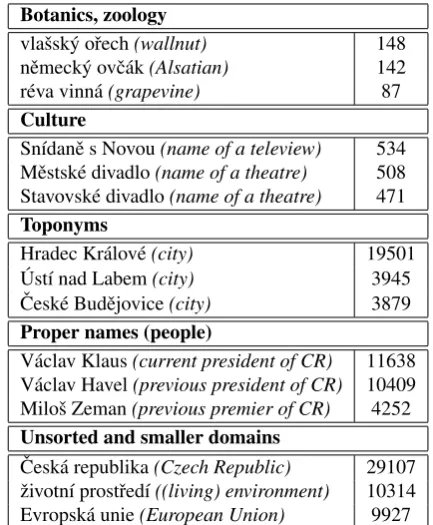
tagged at all). If we are told that a tagger’s precision is 96 % and nothing is said (typically) about handling the MWEs in corpus text this ’good’ result is rather disputable. Many examples from Czech grammatically tagged cor-pus SYN2000 ( ˇCerm´ak et al., 2000) can be adduced that demonstrate how problematic is the existing tagging in some relevant aspects. Many (if not all) collocations con-taining proper names likeV´aclav Havelare tagged as two independent items in the corpus SYN2000 though it is one whole representing a proper name. The frequency of this collocation in SYN2000 is 6565 (from 100 mil. positions). The same case of this sort is proper nameV´aclav Klauswith frequency 7206 in SYN2000. It is lemmatized as two units with two distinct grammatical tags. ToponymNov´e Mˇesto na Moravˇe (New Town at Moravia)displays frequency 65 but it is lemmatized as four lexical units with four tags, re-spectively. Such tagging and lemmatizing offers a distorted picture of the language (we will say more about this below) and the authors of the taggers used are usually silent about this state. In this case it would be useful to speak about a ’conventional’ way of tagging which does not reflect struc-ture of the language adequately.
The second good reason are many NLP applications in which, however, the results of the above mentioned tagging are used without any further explanation. In fact, the Czech MWE database was originally built for a NLP application representing the QA system UIO (Svoboda, 2004) but obvi-ously many other NLP applications require more adequate MWEs recognition as well.
3.
Description of the Czech MWE database
Figure 1: Word Sketch of English noun ‘school’
texts do not yield any useful information about syntactic, semantic or pragmatic behaviour of those word forms in language. For instance, occurrences of the word forms
lesy (forests),ˇcern´ymi (black)orMoravˇe (Moravia)in the toponyms Kostelec nad ˇCern´ymi lesy (Kostelec on Black Forests)orNov´e Mˇesto na Moravˇe (New Town at Moravia)
are not relevant with regard to the most of the queries con-taining wordsˇcern´y (black)orMorava (Moravia).
From this point of view it is then useful to mark each token to indicate whether it is or is not a part of a MWE so a user can query only positions in corpus that are not parts of a MWE (or specify that the searched position can be a part of a MWE, as a default we may assume that user is not interested in such contexts).
Similarly, if a corpus user wants to search for an evidence related to syntactic relations the occurrences of the un-marked MWEs are problematic since they violate sentence structure and consequently user’s expectations. In some cases MWEs are not formed according to the actual syntac-tic rules but they are ’inherited’ from the past (toponyms) or they can be completely agramatical (e.g. names of movies or books).
In such cases it is not enough to mark positions that are parts of a MWE but it is also necessary for a corpus man-ager to be able to represent the whole MWE as one posi-tion with a morphological tag capturing properties of the head of the phrase which represents MWE in the sentence. Of course, the possibility of querying particular positions in a MWE has to be retained, thus consequently, at the same time the corpus manager has to allow for representing the same corpus as having more levels where the particular levels differ in number of tokens (positions). The corpus manager Manatee/Bonito developed at NLP Centre FI MU (Rychl´y, 2000) allows for this.
Exactly the same, i.e. treating whole MWEs as one token (position) with an appropriate grammatical tag is very use-ful for morphological disambiguation ( ˇSmerk, 2007) and partial parsing ( ˇZ´aˇckov´a, 2002) algorithms because not rec-ognized MWEs complicate or even disrupt a sentence struc-ture.
Since we have the large Czech MWE database we can solve all the above mentioned tasks in the following way: from the possible MWEs corresponding to a certain sequence of the word forms in the input text we always choose the longest one. Obviously, it is possible to construct artificial counterexamples for which this approach will not give the correct results but we have not observed such cases in the real texts so far. Also overlapping of MWEs is theoretically possible but we have not found convincing enough evidence that would confirm it.
6.
Conclusions
We describe a recently prepared Czech database containing more than 160 000 MWEs (treated as lexical units). Ac-cording to our results the obtained MWEs cover approx. 3.25 % of the CNC (100 M) which appears to be a new re-sult for Czech.
legomena. This can be also observed when Word Sketch Engine is exploited – there are many contexts (bigrams) whose frequencies are low though they can be considered as very good candidates of MWEs. The development goes in this direction – there are already corpora containing more than one billion tokens (cf. OEC, itWAC, deWAC, see e.g. http://www.lexmasterclass.com/), and a compilation of a Czech corpus with similar size is presently going on as well. The issues discussed in the paper also lead to the conclusion that it is inevitable to work out a more adequate tagging, lemmatization and parsing. As we argue in the pa-per this cannot be done without MWEs or, more concretely, without the database containing them.
7.
Acknowledgements
This work has been partly supported by the Academy of Sciences of Czech Republic under the project 1ET200610406, by the Ministry of Education of CR within the Center of Computational Linguistics LC536, and in the National Research Programme II project 2C06009.
8.
References
Adam Kilgarriff, Pavel Rychl´y, Pavel Smrˇz, and David Tugwell. 2004. The Sketch Engine. Proceedings of Eu-ralex, pages 105–116.
Karel Pala and Pavel Smrˇz. 2004. Building Czech Word-net. Romanian Journal of Information Science and Tech-nology.
Pavel Rychl´y. 2000. Corpus Managers and Their Effec-tive Implementation. Ph.D. thesis, Masaryk University, Brno, Czech Republic.
Ivan A. Sag, Timothy Baldwin, Francis Bond, Anne Copes-take, and Dan Flickinger. 2002. Multiword Expressions: A Pain in the Neck for NLP. proceedings of the Third International Conference on Intelligent Text Processing and Computational Linguistics.
Radek Sedl´aˇcek and Pavel Smrˇz. 2001. A New Czech Morphological Analyser ajka. Proceedings of the 4th In-ternational Conference Text, Speech and Dialogue. Luk´aˇs Svoboda. 2004. Processing of Natural Language
Multiword Expressions. Proceedings of Znalosti. Frantiˇsek ˇCerm´ak et al. 1994. Slovn´ık ˇcesk´e frazeologie a
idiomatiky. Academia, Prague, Czech Republic. Frantiˇsek ˇCerm´ak et al. 2000. The Czech National Corpus
— SYN2000. The Institute of the Czech National Corpus, Charles University, Prague, Czech Republic.
Pavel ˇSmerk. 2007. Towards morphological disambigua-tion of Czech. Ph.D. thesis proposals, Masaryk Univer-sity, Brno, Czech Republic (in Czech).